
Proverbs 15:16

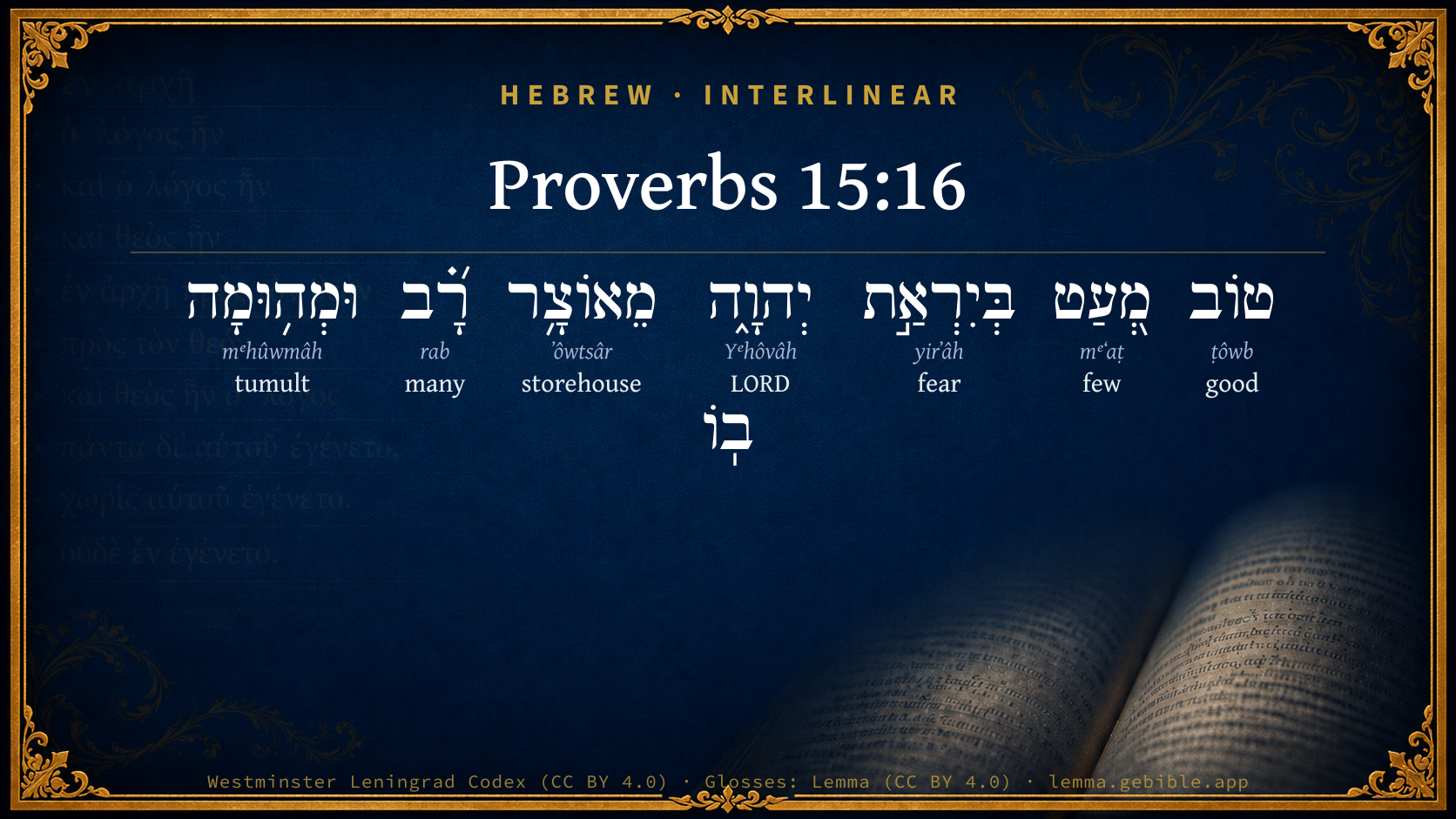
Hebrew (Westminster Leningrad Codex) Proverbs 15:16 appears in the Hebrew Old Testament. The text above is from the Westminster Leningrad Codex. Each word links to its Strong’s number, a concise gloss, and parsing drawn from the Open Scriptures Hebrew Bible morphology. Click any word for its full Brown-Driver-Briggs (BDB) entry.
Download image
Cite this verse

Proverbs 15:16 (World English Bible). Public Domain. Lemma interlinear Bible study tool, https://lemma.gebible.app/v/proverbs/15/16.

Show BibTeX & RIS
BibTeX
RIS
English Translation
Better is little, with the fear of Yahweh, Than great treasure with trouble.
World English Bible · Public Domain
Download a study sheet

One document with this verse’s original text, its word-by-word gloss line, the meaning frame, cross-references with their text, attributed commentary, and full source and license credits — printable, and it pastes into notes with its structure intact.

This verse Autodidact and up

Study sheet (.html) Plain text (.txt)

A passage Seminary Student

Up to 50 verses in one chapter. A passage sheet keeps up to 6 commentary sources and 12 cross-references per verse, in the order this page ranks them, and says so on the sheet whenever that leaves anything out. Ask for a single verse and you get the Autodidact verse sheet above.

Everything on this page stays free to read, with no account — the sheet is a download of what is already on screen, not access to it.

Want to remove ads? Support Godless Engineer
Compare translations 3

The same verse in 3 English versions, stacked beneath the original-language interlinear above. Click any original word for its lexicon entry.

Each is an independent rendering of the whole verse — the interlinear is not word-aligned to these translations.

Highlighted words mark where these versions differ — a whole-verse word diff, not a word-by-word alignment.

  • World English Bible Public Domain
    Better is little, with the fear of Yahweh, Than great treasure with trouble.
  • King James Version Public Domain
    Better is little with the fear of the LORD than great treasure and trouble therewith.
  • unfoldingWord Literal Text CC BY-SA 4.0
    Better a little with the fear of Yahweh than much treasure and anxiety with it.

unfoldingWord Literal Text — © unfoldingWord, licensed CC BY-SA 4.0. Word-aligned USFM3 via Door43 (git.door43.org/unfoldingWord/en_ult).

Versions to compare (up to 4)

3 of 4 selected

Show all 18 translations

Every available English version of this verse, each an independent rendering of the whole verse.

  • World English Bible Public Domain
    Better is little, with the fear of Yahweh, Than great treasure with trouble.
  • Berean Standard Bible Public Domain
    Better a little with the fear of the LORD than great treasure with turmoil.
  • Majority Standard Bible Public Domain
    Better a little with the fear of the LORD than great treasure with turmoil.
  • King James Version Public Domain
    Better is little with the fear of the LORD than great treasure and trouble therewith.
  • American Standard Version (1901) Public Domain
    Better is little, with the fear of Jehovah, Than great treasure and trouble therewith.
  • Revised Version (1885) Public Domain
    Better is little with the fear of the LORD, than great treasure and trouble therewith.
  • Geneva Bible (1599) Public Domain
    Better is a litle with the feare of the Lord, then great treasure, and trouble therewith.
  • Douay-Rheims (1899) Public Domain
    Better is a little with the fear of the Lord, than great treasures without content,
  • Young's Literal Translation Public Domain
    Better `is' a little with the fear of Jehovah, Than much treasure, and tumult with it.
  • Literal Standard Version CC BY-SA 4.0
    Better [is] a little with the fear of YHWH, || Than much treasure, and tumult with it.
  • Unlocked Literal Bible CC BY-SA 4.0
    Better is little with the fear of Yahweh than great treasure with confusion.
  • unfoldingWord Literal Text CC BY-SA 4.0
    Better a little with the fear of Yahweh than much treasure and anxiety with it.
  • Darby Bible Public Domain
    Better is little with the fear of Jehovah than great store and disquietude therewith.
  • World Messianic Bible Public Domain
    Better is little, with the fear of the LORD, than great treasure with trouble.
  • Webster's Bible Public Domain
    Better is little with the fear of the LORD, than great treasure and trouble with it.
  • Free Bible Version CC BY-SA 4.0
    It's better to respect the Lord and only have a little than to have plenty of money and the trouble that comes with it.
  • Bible in Basic English Public Domain
    Better is a little with the fear of the Lord, than great wealth together with trouble.
  • JPS Tanakh (1917) Public Domain
    Better is little with the fear of the LORD, than great treasure and turmoil therewith.

Literal Standard Version (2020), Covenant Press — licensed CC BY-SA 4.0. Text via the HelloAO Bible API (eBible.org). Unlocked Literal Bible (unfoldingWord) — licensed CC BY-SA 4.0. Text via the HelloAO Bible API (eBible.org). unfoldingWord Literal Text — © unfoldingWord, licensed CC BY-SA 4.0. Word-aligned USFM3 via Door43 (git.door43.org/unfoldingWord/en_ult). Free Bible Version, Dr. Jonathan Gallagher — licensed CC BY-SA 4.0. Text via the HelloAO Bible API (eBible.org).

Word by word

More ways to search: Search by grammar → Find every occurrence → Compare this word →

Practice this passage: Drill this verse → Learn its vocabulary →

About this verse

These counts appear in no published source. They are computed here, from the morphology-tagged text and Lemma’s own curated glosses. What Lemma adds →

8
words
7
distinct lemmas
Wisdom
section

Notable vocabulary

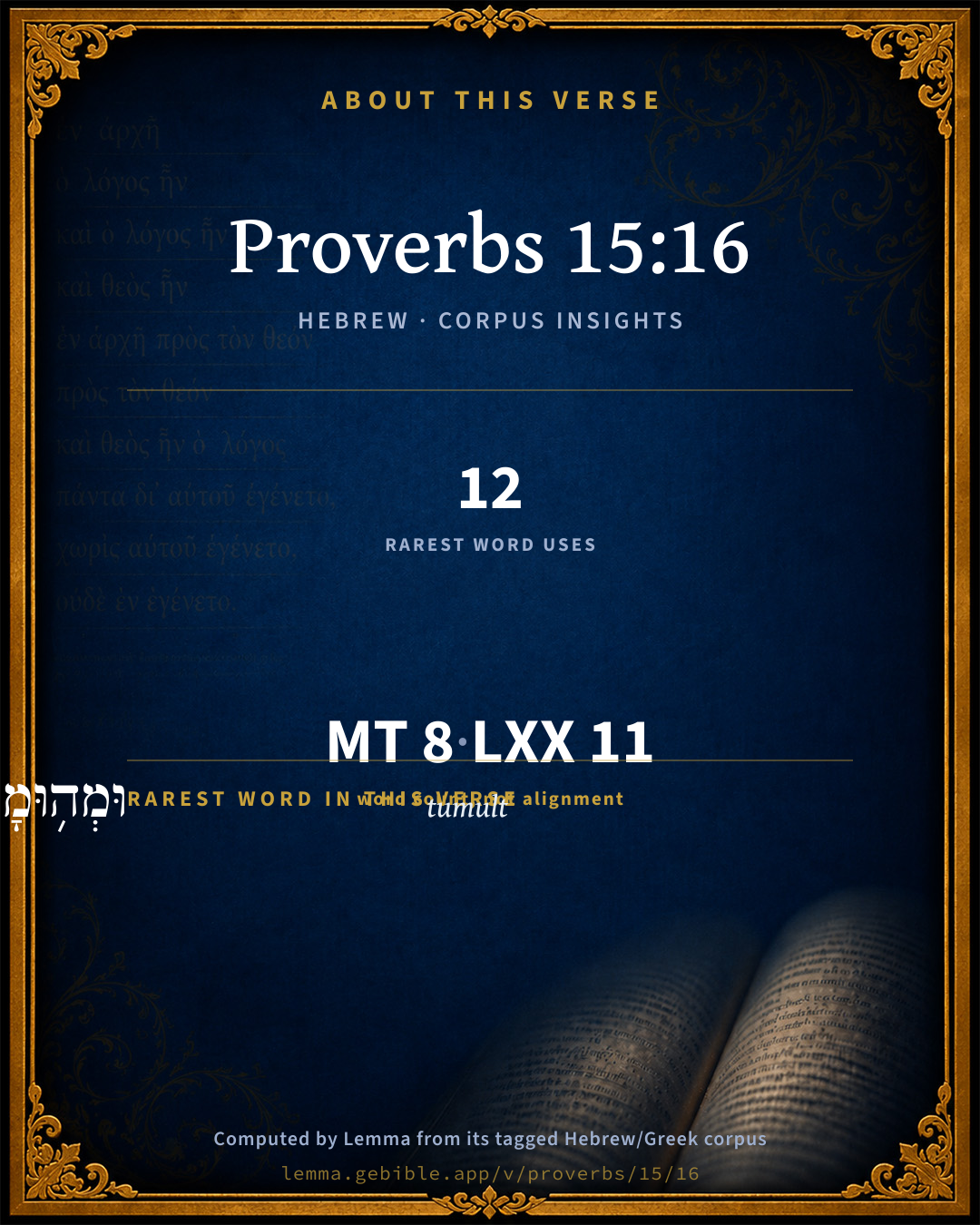
The rarest word here is וּמְה֥וּמָה tumult H4103 — appearing just 12 times in the whole Hebrew Bible.

Shared distinctive vocabulary

וּמְה֥וּמָה tumult H4103 occurs in 12 verses of the Hebrew Bible. Also found in:

Grammatical profile

  • 5 nouns
  • 2 adjectives
  • 1 preposition

Hebrew & Septuagint length

In English translation the verse runs 13 words from the Hebrew and 20 from the Septuagint (LXX English) — the Septuagint runs noticeably longer here. See the side-by-side →

A rough comparison of the two English renderings, which tokenize alike — not a word-level alignment.

Word counts can differ between the Hebrew and the Greek without any difference in meaning — e.g. the Hebrew direct-object marker אֵת has no separate Greek word, and Greek often adds the article ὁ.

In the original languages it is 8 Hebrew tokens and 11 Greek tokens — but the two are counted differently (Hebrew bundles its prefixes and suffixes into one token; the Greek is in lemma form), so that isn’t a like-for-like length.

Cross-references

8

Topical passages linked to Proverbs 15:16 in the Treasury of Scripture Knowledge — connected by theme and wording, ordered by reader-vote popularity; previews shown in the World English Bible.

  • Proverbs 16:8 Better is a little with righteousness, Than great revenues with injustice.
  • Psalms 37:16 Better is a little that the righteous has, Than the abundance of many wicked.
  • Ecclesiastes 5:10–12 He who loves silver shall not be satisfied with silver; nor he who loves abundance, with increase: this also is vanity.
  • 1 Timothy 6:6 But godliness with contentment is great gain.
  • Proverbs 28:6 Better is the poor who walks in his integrity, Than he who is perverse in his ways, and he is rich.
  • Proverbs 10:22 Yahweh's blessing brings wealth, And he adds no trouble to it.
  • Ecclesiastes 2:18–23 I hated all my labor in which I labored under the sun, seeing that I must leave it to the man who comes after me.
  • Ecclesiastes 2:10–11 Whatever my eyes desired, I didn't keep from them. I didn't withhold my heart from any joy, for my heart rejoiced because of all my labor, and this was my portion from all my labor.

Cross-references courtesy of OpenBible.info (CC BY 4.0).

Hebrew and Greek witnesses Masoretic Hebrew ↔ Greek Septuagint

The same verse in the two great witnesses to the Old Testament, shown verse-for-verse.

Here the Septuagint runs noticeably longer than the Hebrew — LXX2012 (modern English Septuagint) 20 words vs World English Bible 13. A rough length comparison of the two English translations, not a word-level alignment — read both below.

These are two independent witnesses, not word-aligned to each other, and the Septuagint is shown in lemma (dictionary) form.

Hebrew Proverbs 15:16 Masoretic · Westminster Leningrad Codex

טוֹב מְ֭עַט בְּיִרְאַ֣ת יְהוָ֑ה מֵאוֹצָ֥ר רָ֝֗ב וּמְה֥וּמָה בֽוֹ

Better is little, with the fear of Yahweh, Than great treasure with trouble.

World English Bible · Public Domain

Greek LXX Proverbs 15:16 Septuagint · lemma form

κρείσσων μικρός μερίς μετά φόβος κύριος ἤ θησαυρός μέγας μετά ἀφοβία

Better is a small portion with the fear of the Lord, than great treasures without the fear of the Lord.

LXX2012 (modern English Septuagint) · Public Domain

On this verse, John Gill's Exposition discusses the Septuagint’s reading. Read the note in Commentary ↓

Hebrew: Westminster Leningrad Codex (CC BY 4.0). Greek: Septuagint (public domain); English from LXX2012 (modern English Septuagint) (Public Domain). How the Septuagint differs from the Hebrew →

Commentary

Notes on Proverbs 15:16 from classic Christian and Jewish commentators (each source and its license shown beneath its notes). The classic Christian expositions comment on the surrounding passage and are grouped to its opening verse, so a note may address several verses; the Jewish commentaries on the Tanakh (Rashi and others) are per-verse, so they appear only where the commentator wrote on this verse.

Lemma curates 59 commentaries, every one of them public domain or Creative Commons licensed, each selected and text-cleaned for this edition rather than reprinted as found. About our sources →

Trapp's Complete Commentary

John Trapp

Pro 15:16 Better [is] little with the fear of the LORD than great treasure and trouble therewith.

Ver. 16. Better is a little with the fear of the Lord.] This is one special consideration that keeps up the good heart in continual comfort. Contented godliness is great riches; Misera est magni custodia census. {a} Great treasures bring great troubles. It is not the great cage that makes the bird sing. It is not the great estate that brings alway the inward joy, the cordial contentment. The little lark with a wing sees further than the ox with a bigger eye but without a wing. Birds use not to sing when they are on the ground, but when got into the air, or upon the top of trees. If saints be sad, it is because they are too busy here below, and, Martha-like, troubled about many things, with neglect of that one thing necessary. They that will be rich pierce themselves through with many sorrows. If the bramble bear rule, fire will rise out of it that will consume the cedars; the lean kine will soon eat up the fat, and it shall not be seen by them. It is hard to handle these thorns hard and not to prick one’s fingers. Riches, though well got, are but as manna, those that gathered less had no want, and those that gathered more, it was but a trouble and annoyance to them.

{a} Juvenal.

John Trapp, A Commentary or Exposition upon All the Books of the Old and New Testament (1647–1656) — public domain. Text from a community e-Sword module.

Joseph Benson's Commentary

Pro 15:16-17. Better is a little with the fear of the Lord — Which gives a man tranquillity and comfort in what he hath; than great treasure and trouble therewith — Tumultuous lusts and passions, vexatious cares and fears, horrors of conscience, and expectations of God’s wrath and indignation. Better is a dinner of herbs where love is — True friendship and kindness between those that eat together; than a stalled ox and hatred therewith — Than the most sumptuous entertainment by him that hates us, or among those that quarrel and contend. “Stalled oxen, or oxen fatted in a stall, were looked upon as the highest entertainment in those ancient times. It is remarkable that Homer never sets any other repast than this before his heroes.”

Joseph Benson's Commentary on the Old and New Testaments (1811–1818) — public domain. Text from a community e-Sword module.

The Preacher's Complete Homiletical Commentary

Joseph S. Exell (gen. ed.)

MAIN HOMILETICS OF Pro_15:16

A TREASURE WITHOUT TROUBLE

The fear of the Lord is better than worldly treasure—I. Because the fear of the Lord tends to peace of mind. In any piece of complicated machinery the condition of the internal works is a much more important matter than the ornamenting of the exterior. It is of much more consequence that all within a timepiece should move in harmony than that it should have a golden face or be set with jewels. It is of more importance to a man that all his internal bodily organs should be in perfect health than that he should be possessed of much external beauty. A strong frame, and pure blood, and health of body will minister much more effectually to his comfort than the most comely countenance. And the state of a man’s inner life has infinitely more to do with his real happiness than his external circumstances. He who has the fear of the Lord has the foundation-stone of peace within, and he who has that does not need an abundance of that which can only minister to the outer man. A little material wealth will content him who has the rich inheritance of a peaceful and contented spirit. Peace with God and love to man are included in the fear of the Lord, and neither the one nor the other of these good and perfect gifts can be bought with the treasure of this world. The first is the very salt of life without which all else is insipid and insufficient to satisfy the cravings of the human soul, and where the first is there will the second, which is also a great sweetener of poverty—(see Pro_15:17), be found also. II. Because of the trouble that is inseparable from worldly wealth. The treasure of this world has a certain value—it can do much for a man, both intellectually and materially. It can be so used by him as to bring blessings upon himself and others; but it is never unaccompanied by drawbacks.

1. There is trouble in getting it. The bare sufficiency to sustain life may be got without much strain or anxiety; but if a man sets out to make a fortune, he must be content to have many cares and anxieties—many weary days and sleepless nights—before he obtains his object. Those that will be rich cannot avoid much real trouble in carrying out their determination.

2. There is trouble after it is gotten. When men have accumulated great treasure they are not freed from trouble in connection with it. There is the care of retaining it, the desire, and almost the necessity, of increasing it. The more a man has the more he generally desires, and the more he seems to need. New demands are the outcome of a new position, and he who has amassed great treasure rarely contents himself with what he has, but strains every nerve to make the much, more.

3. There is great trouble attendant on its loss. Even if a rich man possesses the higher wealth—the fear of the Lord—he is more to be pitied if he loses his worldly wealth than a poor man is. The fall is so much greater, as the height from which he has fallen so far exceeds that from which a poor man can fall the hope of climbing it again is so much fainter, and he is in a more helpless and hopeless condition than his brother, who had but little to lose. But if he is destitute of the real treasure of human existence, then he has trouble without any compensation. He may say with Micah, “Ye have taken away my gods and what have I left?”

OUTLINES AND SUGGESTIVE COMMENTS

The preposition gives choice of meanings. It may be, by “the fear of Jehovah,” in which case it would mean the “little” earned by piety: or it may be “in the fear of Jehovah;” in which case it would mean the little held and got possession of in a devout state; or it may be “along with,” as the word often means. All the ideas are correct. We choose as our English version, and, of course, for both parts of the sentence; for the expression “therewith,” has the same familiar preposition, and the same chance of either of the alternative meanings. “Better” is a Christian’s shieling, than an impenitent man’s palace (chap. Pro_14:11). And that, not on account of heaven alone, but for the intrinsic joys of piety (see next verse).—Miller.

Judas is bursar, and he shuts himself into his pouch; the more he hath, the more he covets. The apostles, that wanted money, are not so having: Judas hath the bag, and yet he must have more, or he will filch it. So impossible is it that these outward things should satisfy the heart of man. Soli habent omnia qui habent habentem omnia—They alone possess all things that possess the possessor of all things. The nature of true content is to fill all the chinks of our desires, as the wax doth the seal. None can do this but God, for (as it is well observed) the world is round, man’s heart three cornered: a globe can never fill a triangle, but one part will still be empty; only the blessed Trinity can fill these three corners of a man’s heart.… The bag never comes alone, but brings with it cares, saith Christ (Mat_13:22); snares, saith Paul (1Ti_6:9) … It is none of God’s least favours, that wealth comes not trolling in upon us; for many of us, if our estate were better to the world, would be worse to God. The poor labourer hath not time to luxuriate: he trusts to God to bless his endeavours, and so rests content; but the bag commonly makes a man a prodigal man, or a prodigious man; for a covetous man is a monster.… It is no argument of God’s favour to be His purse-bearer; no more than it was a sign that Christ loved Judas above the other apostles because he made him His steward: He gave the rest grace, and him the bag; which sped best? The outward things are the scatterings of His mercies, like the gleaning after the vintage: the full crop goes to His children.—T. Adams.

Here also we trace the harmony of wisdom, i.e., of the Divine Word, speaking through many different channels, and in different tones. The proverb has its completion in the teaching which bids us “seek first the Kingdom of God and His righteousness” (Mat_6:33), and finds echoes in the maxims of the wise among other nations who have uttered like thoughts.—Plumptre.

It is not the great cage that makes the bird sing. It is not the great estate that brings always the inward joy—the cordial contentment. The little lark with a wing sees farther than the ox with a bigger eye, but without a wing. Birds use not to sing when they are on the ground, but when got into the air, or on tops of trees. If saints be sad, it is because they are too busy here below.… If the bramble bear rule, fire will arise out of it that will consume the cedars; the lean kine will soon eat up the fat, and it shall not be seen by them. It is hard to handle these thorns hard and not to prick one’s fingers. Riches, though well got, are but as manna; those that gathered less had no want, and those that gathered more, it was but a trouble and annoyance to them.—Trapp.

The Preacher's Complete Homiletical Commentary (gen. ed. Joseph S. Exell; Funk & Wagnalls, c. 1892) — public domain (pre-1929). A full-Bible homiletical/sermon-outline anthology covering 65 of 66 books (2 John is absent from the source module). Text from a community e-Sword module.

Tyndale Open Study Notes

Tyndale Open Resources

15:16 A healthy fear for the Lord counteracts inner turmoil and brings inner peace. • Better to have little: See also 16:8.

Tyndale Open Study Notes — © Tyndale Open Resources, licensed CC BY-SA 4.0. Text via the HelloAO Bible API.

Matthew Henry's Commentary

Solomon had said in the foregoing verse that he who has not a large estate, or a great income, but a cheerful spirit, has a continual feast; Christian contentment, and joy in God, make the life easy and pleasant; now here he tells us what is necessary to that cheerfulness of spirit which will furnish a man with a continual feast, though he has but little in the world - holiness and love.

I. Holiness. A little, if we manage it and enjoy it in the fear of the Lord, if we keep a good conscience and go on in the way of duty, and serve God faithfully with the little we have, will be more comfortable, and turn to a better account, than great treasure and trouble therewith. Observe here, 1. It is often the lot of those that fear God to have but a little of this world. The poor receive the gospel, and poor they still are, Jam 2:5. 2. Those that have great treasure have often great trouble therewith; it is so far from making them easy that it increases their care and hurry. The abundance of the rich will not suffer them to sleep. 3. If great treasure bring trouble with it, it is for want of the fear of God. If those that have great estates would do their duty with them, and then trust God with them, their treasure would not have so much trouble attending it. 4. It is therefore far better, and more desirable, to have but a little of the world and to have it with a good conscience, to keep up communion with God, and enjoy him in it, and live by faith, than to have the greatest plenty and live without God in the world.

II. Love. Next to the fear of God, peace with all men is necessary to the comfort of this life. 1. If brethren dwell together in unity, if they are friendly, and hearty, and pleasant, both in their daily meals and in more solemn entertainments, that will make a dinner of herbs a feast sufficient; though the fare be coarse, and the estate so small that they can afford no better, yet love will sweeten it and they may be as merry over it as if they had all dainties. 2. If there be mutual enmity and strife, though there be a whole ox for dinner, a fat ox, there can be no comfort in it; the leaven of malice, of hating and being hated, is enough to sour it all. Some refer it to him that makes the entertainment; better have a slender dinner and be heartily welcome than a table richly spread with a grudging evil eye.

Cum torvo vultu mihi conula nulla placebit,

Cum placido vultu conula ulla placet.

The most sumptuous entertainment, presented with

a sullen brow, would offend me; while the plainest

repast, presented kindly would delight me.

Matthew Henry's Commentary on the Whole Bible (1708–1710) — public domain (CC PDM 1.0). Text via the HelloAO Bible API.

Jamieson, Fausset & Brown

Robert Jamieson, A. R. Fausset & David Brown

trouble--agitation, implying the anxieties and perplexities attending wealth held by worldlings (Pro 16:18; Ti1 6:6).

Jamieson, Fausset & Brown — Commentary Critical and Explanatory on the Whole Bible (1871) — public domain (CC PDM 1.0). Text via the HelloAO Bible API.

Adam Clarke's Commentary

Verse 16. Better is little with the fear of the Lord] Because where the fear of God is, there are moderation and contentment of spirit.

Adam Clarke's Commentary on the Bible (1810–1826) — public domain. Text from a community e-Sword/MySword module.

Ellicott's Commentary for English Readers

(16) Trouble.—The “disquiet” (Psa_39:6) which attends the pursuit and care of riches, in contrast to the “peace which they have who love God’s law. (Psa_119:165.)

A Bible Commentary for English Readers, edited by Charles John Ellicott (1878–1897) — public domain. Text from a community e-Sword module.

John Gill's Exposition

Better is little with the fear of the Lord than great treasure and trouble therewith. Not that a "little" is better than "much" of that which is good, as the things of this world are in themselves; poverty is not better than riches, simply considered; but as these are attended with different circumstances: if a man has but little of worldly substance, yet if he has "the fear of God" in his heart, and before his eyes; that fear which has God for its author and for its object, and which is itself a treasure; and may be here put for all grace, for the riches of grace saints are partakers of; such a man's little is better than another man's abundance without the fear of the Lord, as the Septuagint and Arabic versions render it: for such a man, though he has but little, which is the common portion of good men, yet he does not lack; be has enough, and is content; what he has he has with a blessing, and he enjoys it, and God in it, and has communion with him; and has also other bread to eat, the world knows nothing of: and particularly having the fear of God, the eve of God is upon him with pleasure; his heart is towards him, and sympathizes with him in all his troubles; his hand communicates unto him both temporal and spiritual meat, which is given to them that fear the Lord; his angels encamp about him, his power protects him; his secrets are with him, and inconceivable and inexpressible goodness is laid up for him: wherefore he is better off with his little, having the fear of God, than another with his great abundance and affluence, being destitute of it: and besides, having a great deal of "trouble" along with his treasure; trouble in amassing and getting it together; trouble in keeping it from being lost, or taken away by thieves and, robbers, for fear of which he cannot sleep; trouble through an insatiable desire of having more; he has no rest nor peace because he has not so much as he would have, or others have. Besides, he has what he has with curse; God sends upon him cursing, vexation, and rebuke, in all he sets his hand to, Deu 28:2; where the same word is used as here: and he has it also with the cry of the poor; so some render the word, "a noise" or "tumult" (g); and interpret it of the cries and tears of those that are oppressed and injured; so Jarchi and Gersom; or, "with terror" (h), as some render it; with the terrors of a guilty conscience, with the fear of hell and everlasting damnation. Better have a little with a good conscience, than ever so much attended with such circumstances; it is not any man's little, but the good man's little, that is preferable to the wicked man's much; see Psa 37:16.

(g) "tumultus", Tigurine version, Montanus, Vatablus; "strepitus", Mercerus. (h) "Terror", Aben Ezra.

John Gill's Exposition of the Whole Bible (1746–1763) — public domain (CC PDM 1.0). Text via the HelloAO Bible API.

Albert Barnes' Notes on the Bible

This proverb has its completion in the teaching of Mat 6:33.

Albert Barnes' Notes on the Bible (1834–1885) — public domain. Text from a community e-Sword/MySword module.

Haydock's Catholic Bible Commentary

Content. Septuagint, "fear." Hebrew, "with trouble," which is preferable, 1 Timothy vi. 6.

George Leo Haydock (1774–1849), Haydock's Catholic Family Bible and Commentary, 1859 edition — public domain. Excludes Psalms (Douay-Rheims chapter numbering differs from Protestant) and Deuterocanonical books (Catholic canon only).

Matthew Poole's English Annotations

The fear of the Lord, which gives a man tranquillity and comfort in what he hath.

Trouble; tumultuous lusts and passions, vexatious cares and fears, horrors of conscience, and expectation of God’s curse and judgment, which riches gotten without God’s fear do commonly produce.

Matthew Poole's English Annotations on the Holy Bible (1683–1685) — public domain. Text from a community e-Sword/MySword module.

Whedon's Commentary on the Bible

Daniel D. Whedon

16. Trouble — Torment, confusion. It refers to that anxiety, vexation, and solicitude which usually accompany the possession of riches. Piety with little is better than wealth with trouble. Psa_39:6; Mat_6:33.

Daniel D. Whedon (gen. ed.), Commentary on the Old and New Testaments (1874–1909) — public domain. Text from a community e-Sword module.

The Pulpit Commentary

Better is little with the fear of the Lord. The good man"s little store, which bears upon it the blessing of the Lord, is better than great treasure and trouble therewith, i.e. with the treasure. (Pro_16:8 Psa_37:16) The trouble intended is the care and labour and anxiety attending the pursuit and preservation of wealth. "Much coin, much care". (comp. Ecc_6:4) It was good advice of the old moralist, "Sis pauper honeste potius quam dives male; Namque hoc fert crimen, illud misericordiam." Vulgate, thesauri magni et insatiabiles, "treasures which satisfy not;" Septuagint, "Great treasures without fear (of the Lord)." Christ"s maxim is, "Seek ye first the kingdom of God, and his righteousness; and all these things shall be added unto you". (Mat_6:33)

Vers. 16, 17. The better things.

Earthly good is comparative. Many things regarded by themselves appear to be eminently attractive; but if they exclude more desirable things they must be rejected. We need not make the worst of this world in order to make the best of the higher world. Taking earth at its brightest, it is still outshone by the glories of heaven. But earth is not always at its brightest; and we must make our comparison with the actual facts of life, not with ideal possibilities.

I GODLY POVERTY IS BETTER THAN TROUBLED WEALTH.

1. Wealth is disappointing. It might be shown that wealth at its best cannot satisfy the soul; for

(1) it is only external, and

(2) it is but a means of obtaining other ends.

But plain experience shows that the advantages of wealth are very commonly neutralized by trouble.

(1) For wealth will not prevent trouble. Rich men suffer from disease, disappointment, discontent, the unkindness of friends, etc. The child of affluence may die.

(2) Wealth may bring trouble. It has its own anxieties. Antonio, who has ships at sea, is distressed at the storms that do not trouble the poor man. Many interests lead to conflicting claims, and the cares of riches are often as great as those of poverty.

(3) Wealth cannot compensate for trouble. The small vexations of life may be smoothed away by money, and of course certain specific troubles such as hunger, cold, nakedness may be quite prevented. But the greater troubles remain. Gold will not heal a broken heart.

2. Godliness is satisfying. It may be found with wealth. Then it will correct the evils and supply the detects. But it may be seen with poverty, and in this case it will prove itself the true riches which will give what money can never supply. Indeed, in presence of this real good the question as to whether even great earthly treasure is to be added need not be raised. It is lost in the infinitely greater possession. The ocean will not be concerned to know whether the trickling sreamlet that flows into its abundant waters be full or failing. Further, it is to be noted that God satisfies the soul directly, while at best riches can only pretend to do so indirectly. Riches seek to buy happiness. Inward religion directly confers blessedness. To have God is to be at rest.

II LOVE WITH PRIVATIONS IS BETTER THAN HATRED WITH SUPERFLUITY.

1. Hatred neutralizes superfluity. What is the use of the ox in the stall if hatred makes a hell of the home? How often is it seen that the comforts of affluence only mock the wretchedness of their master, because the more essential joys of affection have been shattered! A household of discord must be one of misery. Family feuds cannot but bring unhappiness to all concerned in them. Hatred in the house leads to wretchedness in proportion to the blessedness that love would have conferred. We are more touched by our relations with persons than by our relations with things. Therefore, if those closer relations are marred, no prosperity of external affairs can bring peace.

2. Love can neutralize privations. The dinner of herbs may not be hurtful in itself. Daniel and his companions throve on it. (Dan_1:15) If it is not attractive and appetizing, other considerations may withdraw our attention from it and fill the heart with joy. Love is more than meat. Nay, even bitter herbs may be not unpalatable when seasoned with affection, while an alderman"s feast will be insipid to a guest who is preoccupied with vexatious thoughts.

Vers. 16, 17. Alternatives.

I POVERTY WITH PIETY, OR RICHES WITH DISCONTENT. Which shall we choose? Naturally all, or nearly all, will prefer to take riches with its risks rather than poverty with its certain privations. Our Bible is precious because it reminds us that there is another side in this matter. Riches are too dearly gained at the expense of peace of conscience; poverty is blessed if it brings us nearer to God.

II SCANTY FARE WITH RICH SPIRITUAL SEASONING, OR RICH FARE WITH A POOR HEART. Which? For ourselves and our personal comfort? For others and the hospitality we should like to dispense to them? For ourselves, high thinking with tow living; for others, slight fare with large welcome will make a true feast. J.

The Pulpit Commentary (1880–1919), ed. H.D.M. Spence-Jones & Joseph S. Exell — public domain. Text from a community e-Sword module.

John Wesley's Explanatory Notes

Trouble - Tumultuous lusts and passions, vexatious cares, and horrors of conscience.

John Wesley, Explanatory Notes Upon the Whole Bible (1754–1765) — public domain. Text via the GEBible commentary corpus.

Bridges on Proverbs

Charles Bridges

Here are the sources of the merry heart — the fear of the LORD, and love to man. And here also is the continual feast, so satisfying, that the saint’s little is better than the worldling’s all.†1 It is his Father’s gift;†2 the fruit of his Savior’s love;†3 enjoyed by special promise,†4 and sweetened with the "great gain of godly contentment."†5 If it be only little, it is not from lack of his Father’s care and love; but because his wisdom knows what he really needs,†6 and that all beyond would be a temptation and snare. Truly "a man’s life consisteth not in the abundance of the things which he possesseth."†7 ’Riches and poverty are more in the heart than in the hand. He is wealthy, that is contented. He is poor, that wanteth more.’†8 The universe will not fill a worldly,†9 while a little will suffice for an heavenly,†10 heart. "The children of light" content themselves willingly with the small pittances, which their Father allows them during the time of their minority; knowing that their main portion is reserved for them in safe keeping unto the "full age." (1Pe 1:4 .) They are well satisfied on their way home to live rather more scantily by the way; like Joseph’s brethren, who were provided with food for their journey; but their full sacks were unopened, till they reached their home. (Gen 42:25 .) Here their God compensates for everything. But what would compensate for him?

On the other hand, there must be trouble with great treasure, without the fear of the LORD. (Ecc 4:6 ; Ecc 5:12 .) And far more destitute is its possessor in his unsubstantial happiness, than the man of God, who is "eating his bread in the sweat of his brow." ’Jacob’s ladder, which conveys to heaven, may have its foot in the smoking cottage.’†11 And as to this world’s comforts — the dinner of herbs, the homely meal of love, is better than the stalled ox, preparing for a sumptuous, but unbrotherly, feast.†12 Love sweetens the meanest food. Hatred embitters the richest feast.†13 How did the presence and converse of the Lord of angels dignify the humble fare!†14 How much more refreshing were the social meals of the Pentecostal Christians, than the well-furnished tables of their enemies!†15 When the Lord’s ordinance of marriage is marred by man’s selfishness; when wealth, rank, or adventitious accomplishments govern the choice of life’s companion, rather than the fear of the LORD; what wonder if the stalled ox, and hatred therewith, be the order of the house? Mutual disappointment is too often the source of criminal indulgence abroad; always the bane of peace and unity at home.

Few, alas! practically believe this divine testimony. Parents! do you seek the solid happiness of your children? Then lead them to expect little from the world; everything from God.

Footnotes:

†1 Pro 16:8. Psa 37:16 .

†2 Mat 6:11.

†3 2Pe 1:3 .

†4 Psa 34:10; Psa 37:3, Psa 37:19 . Isa 33:15-16 .

†5 1Ti 6:6 . Php 4:11-12 .

†6 Mat 6:32.

†7 Luk 12:15.

†8 Bishop Hall.

†9 Ecc 1:8.

†10 Gen 28:29.

†11 Bishop Reynolds’ Sermon on 1Ti 6:17-19 .

†12 Pro 17:1; Pro 21:19 ; Pro 23:6 .

†13 1Sa 20:24-34 . 2Sa 13:23-29 .

†14 Joh 21:9-12.

†15 Act 2:46. Compare Psa 133:1-3 .

Charles Bridges, An Exposition of the Book of Proverbs (1846) — public domain. Text from a community e-Sword module.

Scofield Reference Notes

C. I. Scofield

fear

Also; Pro 14:26, (See Scofield "Psa 19:9").

The Scofield Reference Bible (1917 edition), notes by C. I. Scofield — public domain. Text from a community e-Sword module.

Kretzmann's Popular Commentary

Paul E. Kretzmann

v. 16. Better is little with the fear of the Lord, the proper contentment with the blessings of the Lord, small as they may be outwardly, than great treasure and trouble therewith, for the possession of riches brings cares and worries, which often are very unpleasant, 1Ti 6:6.

Paul E. Kretzmann, Popular Commentary of the Bible (1921–1924) — public domain. Text from a community e-Sword module.

Rashi

Rabbi Shlomo Yitzchaki (Rashi)

Better a little with the fear of the Lord, than a great treasury and turmoil with it The voice of people shouting that the treasury was made from robbery and violence, as in (Amos 3:9): “And see great confusions within it and people being oppressed in its midst.”

Rashi on the Tanakh — English translations: “The Judaica Press complete Tanach with Rashi, translated by A. J. Rosenberg” (CC BY 4.0); “Pentateuch with Rashi's commentary by M. Rosenbaum and A.M. Silbermann, 1929-1934” (public domain); “The Metsudah Tanach series, Lakewood, N.J” (CC BY 4.0); and “The Book of Joshua, Metsudah Publications, 1997” (CC BY 4.0). Text via Sefaria.

Lesson kit

Teaching starters — assembled from the data on this page, not authored interpretation. Every prompt links to the verse data it draws on. Edit before teaching.

Proverbs, in the Wisdom, opens this verse with 8 words (7 distinct Hebrew lemmas). Its most distinctive word is mᵉhûwmâh (“tumult”). The Greek Septuagint runs longer here. A historical commentator’s framing appears above. Read the whole chapter for the surrounding context.

Discussion questions

  1. What does “tumult” (mᵉhûwmâh) contribute to the verse as a whole?
  2. Deuteronomy 7:23 shares the word «tumult» with this verse. How do the two illuminate each other?
  3. Compared with the Hebrew, the Septuagint runs longer here. What questions does that raise?
  4. These translations render this verse differently. What is at stake in choosing one wording over another?
  5. Reading how Trapp's Complete Commentary and Joseph Benson's Commentary read this verse, where do the two commentators agree and where do they part?

Things to notice

Reading settings

Reading text

Shown beneath each verse's original-language words.

Old Testament
Old Testament edition

Read the OT as the Masoretic Hebrew (MT) or the Greek Septuagint (LXX).

English shown for the Greek Septuagint (in the Hebrew ↔ Greek comparison).

Comparing translations? Open the Compare panel on any verse page to stack up to four side by side.