
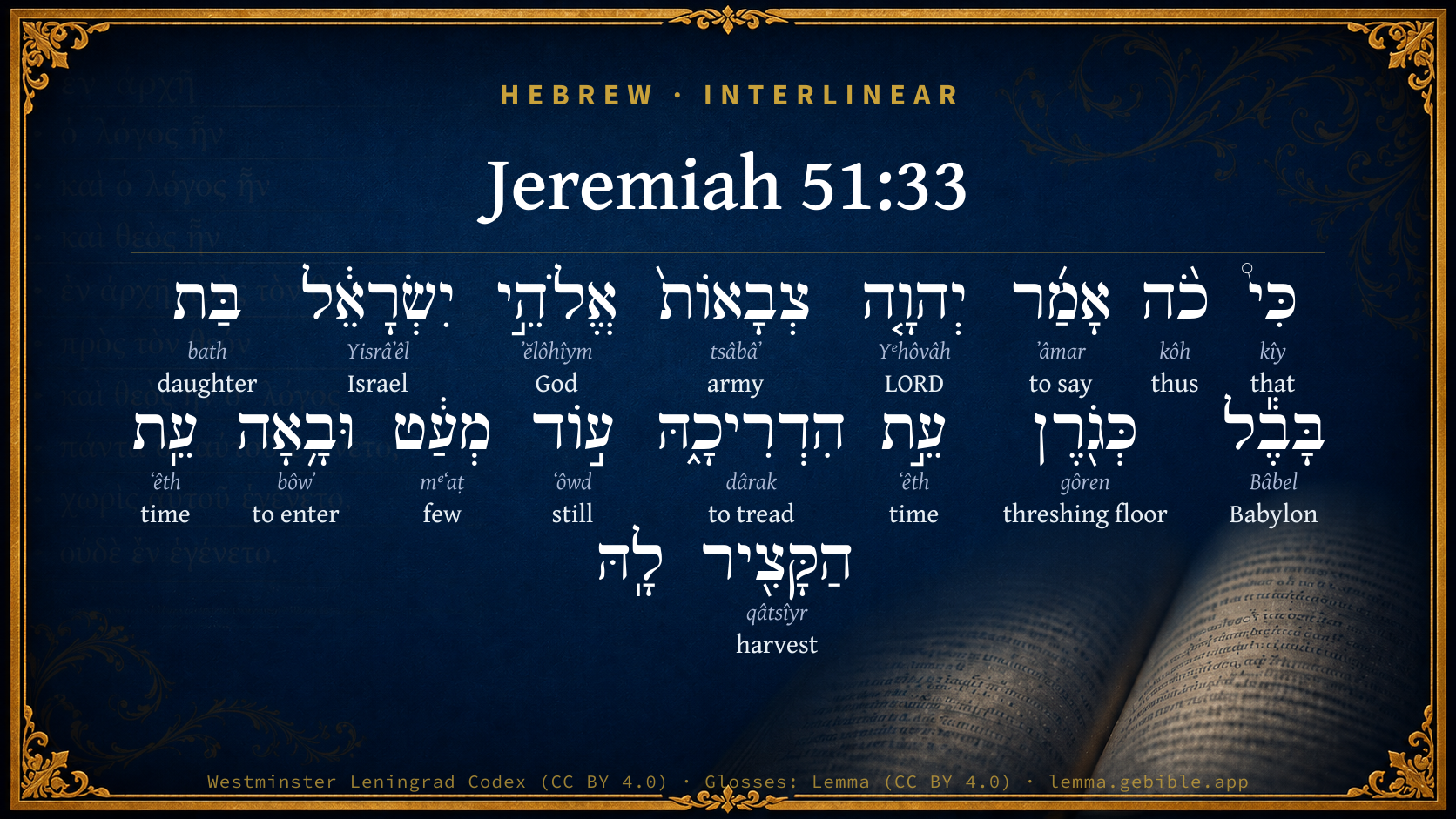
Jeremiah 51:33

Hebrew (Westminster Leningrad Codex) Jeremiah 51:33 appears in the Hebrew Old Testament. The text above is from the Westminster Leningrad Codex. Each word links to its Strong’s number, a concise gloss, and parsing drawn from the Open Scriptures Hebrew Bible morphology. Click any word for its full Brown-Driver-Briggs (BDB) entry.
Download image
Cite this verse

Jeremiah 51:33 (World English Bible). Public Domain. Lemma interlinear Bible study tool, https://lemma.gebible.app/v/jeremiah/51/33.

Show BibTeX & RIS
BibTeX
RIS
English Translation
For thus says Yahweh of hosts, the God of Israel: The daughter of Babylon is like a threshing floor at the time when it is trodden; yet a little while, and the time of harvest shall come for her.
World English Bible · Public Domain
Download a study sheet

One document with this verse’s original text, its word-by-word gloss line, the meaning frame, cross-references with their text, attributed commentary, and full source and license credits — printable, and it pastes into notes with its structure intact.

This verse Autodidact and up

Study sheet (.html) Plain text (.txt)

A passage Seminary Student

Up to 50 verses in one chapter. A passage sheet keeps up to 6 commentary sources and 12 cross-references per verse, in the order this page ranks them, and says so on the sheet whenever that leaves anything out. Ask for a single verse and you get the Autodidact verse sheet above.

Everything on this page stays free to read, with no account — the sheet is a download of what is already on screen, not access to it.

Want to remove ads? Support Godless Engineer
Compare translations 3

The same verse in 3 English versions, stacked beneath the original-language interlinear above. Click any original word for its lexicon entry.

Each is an independent rendering of the whole verse — the interlinear is not word-aligned to these translations.

Highlighted words mark where these versions differ — a whole-verse word diff, not a word-by-word alignment.

  • World English Bible Public Domain
    For thus says Yahweh of hosts, the God of Israel: The daughter of Babylon is like a threshing floor at the time when it is trodden; yet a little while, and the time of harvest shall come for her.
  • King James Version Public Domain
    For thus saith the LORD of hosts, the God of Israel; The daughter of Babylon is like a threshingfloor, it is time to thresh her: yet a little while, and the time of her harvest shall come.
  • unfoldingWord Literal Text CC BY-SA 4.0
    For Yahweh of hosts, God of Israel, says this: The daughter of Babylon is like a threshing floor. It is time to trample her down. In a little while the time of harvest will come to her.

unfoldingWord Literal Text — © unfoldingWord, licensed CC BY-SA 4.0. Word-aligned USFM3 via Door43 (git.door43.org/unfoldingWord/en_ult).

Versions to compare (up to 4)

3 of 4 selected

Show all 18 translations

Every available English version of this verse, each an independent rendering of the whole verse.

  • World English Bible Public Domain
    For thus says Yahweh of hosts, the God of Israel: The daughter of Babylon is like a threshing floor at the time when it is trodden; yet a little while, and the time of harvest shall come for her.
  • Berean Standard Bible Public Domain
    For this is what the LORD of Hosts, the God of Israel, says: “The Daughter of Babylon is like a threshing floor at the time it is trampled. In just a little while her harvest time will come.”
  • Majority Standard Bible Public Domain
    For this is what the LORD of Hosts, the God of Israel, says: “The Daughter of Babylon is like a threshing floor at the time it is trampled. In just a little while her harvest time will come.”
  • King James Version Public Domain
    For thus saith the LORD of hosts, the God of Israel; The daughter of Babylon is like a threshingfloor, it is time to thresh her: yet a little while, and the time of her harvest shall come.
  • American Standard Version (1901) Public Domain
    For thus saith Jehovah of hosts, the God of Israel: The daughter of Babylon is like a threshing-floor at the time when it is trodden; yet a little while, and the time of harvest shall come for her.
  • Revised Version (1885) Public Domain
    For thus saith the LORD of hosts, the God of Israel: The daughter of Babylon is like a threshing-floor at the time when it is trodden; yet a little while, and the time of harvest shall come for her.
  • Geneva Bible (1599) Public Domain
    For thus sayth the Lord of hosts the God of Israel, the daughter of Babel is like a threshing floore: the time of her threshing is come: yet a litle while, and the time of her haruest shall come.
  • Douay-Rheims (1899) Public Domain
    For thus saith the Lord of hosts the God of Israel: The daughter of Babylon is like a thrashingfloor, this is the time of her thrashing: yet a little while, and the time of her harvest shall come.
  • Young's Literal Translation Public Domain
    For thus said Jehovah of Hosts, God of Israel, The daughter of Babylon `is' as a threshing-floor, The time of her threshing -- yet a little, And come hath the time of her harvest.
  • Literal Standard Version CC BY-SA 4.0
    For thus said YHWH of Hosts, God of Israel: The daughter of Babylon [is] as a threshing-floor, || The time of her threshing—yet a little [while], || And the time of her harvest has come.
  • Unlocked Literal Bible CC BY-SA 4.0
    For Yahweh of hosts, God of Israel, says this: The daughter of Babylon is like a threshing floor. It is time to trample her down. In a little while the time of harvest will come to her.
  • unfoldingWord Literal Text CC BY-SA 4.0
    For Yahweh of hosts, God of Israel, says this: The daughter of Babylon is like a threshing floor. It is time to trample her down. In a little while the time of harvest will come to her.
  • Darby Bible Public Domain
    For thus saith Jehovah of hosts, the God of Israel: The daughter of Babylon is like a threshing-floor, at the time of its being trodden; yet a little while, and the time of harvest shall come for her.
  • World Messianic Bible Public Domain
    For the LORD of Hosts, the God of Israel says: “The daughter of Babylon is like a threshing floor at the time when it is trodden. Yet a little while, and the time of harvest comes for her.”
  • Webster's Bible Public Domain
    For thus saith the LORD of hosts, the God of Israel; The daughter of Babylon is like a threshing-floor, it is time to thresh her: yet a little while, and the time of her harvest shall come.
  • Free Bible Version CC BY-SA 4.0
    This is what the Lord Almighty, the God of Israel, says: The people of Babylon are like a threshing floor when the grain is trampled out. Her time of harvest will come very soon.
  • Bible in Basic English Public Domain
    For these are the words of the Lord of armies, the God of Israel: The daughter of Babylon is like a grain-floor when it is stamped down; before long, the time of her grain-cutting will come.
  • JPS Tanakh (1917) Public Domain
    For thus saith the LORD of hosts, the God of Israel: The daughter of Babylon is like a threshing-floor at the time when it is trodden; yet a little while, and the time of harvest shall come for her.

Literal Standard Version (2020), Covenant Press — licensed CC BY-SA 4.0. Text via the HelloAO Bible API (eBible.org). Unlocked Literal Bible (unfoldingWord) — licensed CC BY-SA 4.0. Text via the HelloAO Bible API (eBible.org). unfoldingWord Literal Text — © unfoldingWord, licensed CC BY-SA 4.0. Word-aligned USFM3 via Door43 (git.door43.org/unfoldingWord/en_ult). Free Bible Version, Dr. Jonathan Gallagher — licensed CC BY-SA 4.0. Text via the HelloAO Bible API (eBible.org).

Word by word

More ways to search: Search by grammar → Find every occurrence → Compare this word →

Practice this passage: Drill this verse → Learn its vocabulary →

כְּגֹ֖רֶן
gôren
H1637
“like/as · threshing floor”
Preposition + Noun, Common, Both, Singular, Absolute
Part of Speech
Preposition + Noun
Type
Common
Gender
Both
Number
Singular
State
Absolute
Full BDB Definition

Origin: from an unused root meaning to smooth

TWOT: 383a

threshing-floor - (TWOT) barn, barn floor, corn floor, void place
  1. כִּי֩ kîy H3588 “that” Conjunction
  2. כֹ֨ה kôh H3541 “thus” Adverb
  3. אָמַ֜ר ʼâmar H559 “to say” Verb, Qal, Perfect, 3rd Person, Masculine, Singular
  4. יְהוָ֤ה Yᵉhôvâh H3068 “LORD” Noun, Proper
  5. צְבָאוֹת֙ tsâbâʼ H6635 “armies” Noun, Common, Both, Plural, Absolute
  6. אֱלֹהֵ֣י ʼĕlôhîym H430 “God(s) of” Noun, Common, Masculine, Plural, Construct
  7. יִשְׂרָאֵ֔ל Yisrâʼêl H3478 “Israel” Noun, Proper
  8. בַּת bath H1323 “daughter of” Noun, Common, Feminine, Singular, Construct
  9. בָּבֶ֕ל Bâbel H894 “Babylon” Noun, Proper
  10. עֵ֣ת ʻêth H6256 “time” Noun, Common, Both, Singular, Absolute
  11. הִדְרִיכָ֑הּ dârak H1869 “to tread · her” Verb, Hiphil, Perfect, 3rd Person, Masculine, Singular + Suffix, Personal, 3rd Person, Feminine, Singular
  12. ע֣וֹד ʻôwd H5750 “still” Adverb
  13. מְעַ֔ט mᵉʻaṭ H4592 “few” Noun, Common, Masculine, Singular, Absolute
  14. וּבָ֥אָה bôwʼ H935 “and · to enter” Conjunction + Verb, Qal, Sequential Perfect, 3rd Person, Feminine, Singular
  15. עֵֽת ʻêth H6256 “time of” Noun, Common, Both, Singular, Construct
  16. הַקָּצִ֖יר qâtsîyr H7105 “the · harvest” Particle, Definite Article + Noun, Common, Masculine, Singular, Absolute

About this verse

These counts appear in no published source. They are computed here, from the morphology-tagged text and Lemma’s own curated glosses. What Lemma adds →

18
words
16
distinct lemmas
Prophets
section

Shared distinctive vocabulary

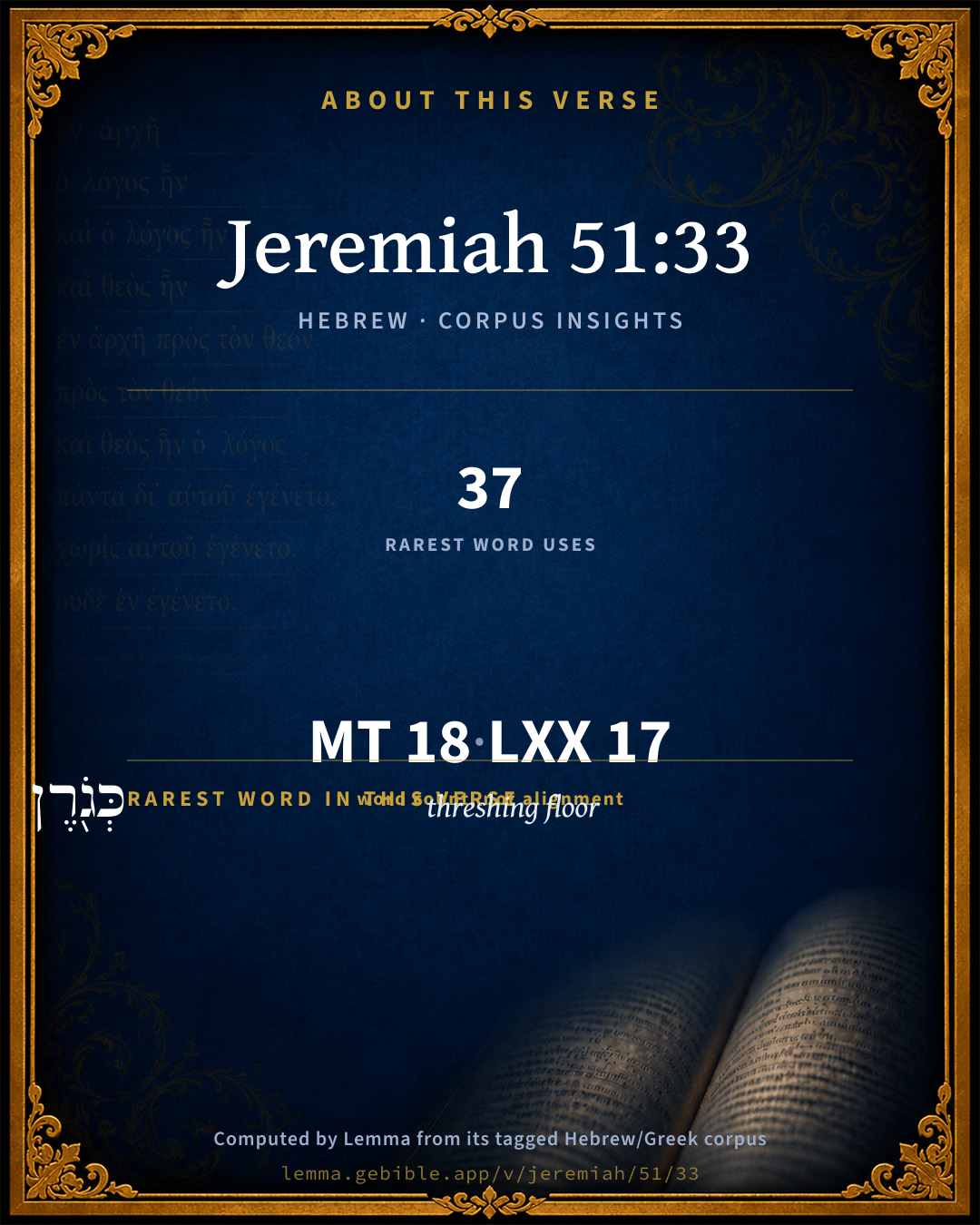
כְּגֹ֖רֶן threshing floor H1637 occurs in 37 verses of the Hebrew Bible. Also found in:

Grammatical profile

  • 3 verbs
  • 11 nouns
  • 1 preposition
  • 1 conjunction
  • 2 adverbs

Verb forms

  • אָמַ֜ר Qal · Perfect
  • הִדְרִיכָ֑הּ Hiphil · Perfect
  • וּבָ֥אָה Qal · Sequential Perfect

Repetition

A word recurs within this verse — often emphatic in Hebrew:

  • עֵ֣ת time H6256 ×2

Hebrew & Septuagint length

In the original languages it is 18 Hebrew tokens and 17 Greek tokens — but the two are counted differently (Hebrew bundles its prefixes and suffixes into one token; the Greek is in lemma form), so that isn’t a like-for-like length.

Cross-references

12

Topical passages linked to Jeremiah 51:33 in the Treasury of Scripture Knowledge — connected by theme and wording, ordered by reader-vote popularity; previews shown in the World English Bible.

  • Isaiah 21:10 You my threshing, and the grain of my floor! that which I have heard from Yahweh of hosts, the God of Israel, have I declared to you.
  • Hosea 6:11 "Also, Judah, there is a harvest appointed for you, When I restore the fortunes of my people.
  • Joel 3:13 Put in the sickle; For the harvest is ripe. Come, tread, for the winepress is full, The vats overflow, for their wickedness is great."
  • Isaiah 41:15–16 Behold, I have made you [to be] a new sharp threshing instrument having teeth; you shall thresh the mountains, and beat them small, and shall make the hills as chaff.
  • Micah 4:13 Arise and thresh, daughter of Zion; For I will make your horn iron, And I will make your hoofs brass; And you will beat in pieces many peoples: And I will devote their gain to Yahweh, And their substance to the Lord of the whole earth.
  • Revelation 14:15–20 Another angel came out from the temple, crying with a loud voice to him who sat on the cloud, "Send forth your sickle, and reap; for the hour to reap has come; for the harvest of the earth is ripe!"
  • Isaiah 17:5–11 It shall be as when the harvester gathers the standing grain, and his arm reaps the ears; yes, it shall be as when one gleans ears in the valley of Rephaim.
  • Isaiah 18:5 For before the harvest, when the blossom is over, and the flower becomes a ripening grape, he will cut off the sprigs with pruning-hooks, and the spreading branches will he take away [and] cut down.
  • Amos 1:3 Thus says Yahweh: "For three transgressions of Damascus, yes, for four, I will not turn away its punishment; Because they have threshed Gilead with threshing instruments of iron;
  • Habakkuk 3:12 You marched through the land in wrath. You threshed the nations in anger.
  • Matthew 13:30 Let both grow together until the harvest, and in the harvest time I will tell the reapers, "First, gather up the darnel, and bind them in bundles to burn them; but gather the wheat into my barn."'"
  • Matthew 13:39 The enemy who sowed them is the devil. The harvest is the end of the age, and the reapers are angels.

Cross-references courtesy of OpenBible.info (CC BY 4.0).

Hebrew and Greek witnesses Masoretic Hebrew ↔ Greek Septuagint

The same verse in the two great witnesses to the Old Testament, shown verse-for-verse.

These are two independent witnesses, not word-aligned to each other, and the Septuagint is shown in lemma (dictionary) form.

Hebrew Jeremiah 51:33 Masoretic · Westminster Leningrad Codex

כִּי֩ כֹ֨ה אָמַ֜ר יְהוָ֤ה צְבָאוֹת֙ אֱלֹהֵ֣י יִשְׂרָאֵ֔ל בַּת בָּבֶ֕ל כְּגֹ֖רֶן עֵ֣ת הִדְרִיכָ֑הּ ע֣וֹד מְעַ֔ט וּבָ֥אָה עֵֽת הַקָּצִ֖יר לָֽהּ

For thus says Yahweh of hosts, the God of Israel: The daughter of Babylon is like a threshing floor at the time when it is trodden; yet a little while, and the time of harvest shall come for her.

World English Bible · Public Domain

Greek LXX Structure differs

In the Septuagint, Jeremiah is about an eighth shorter than the Hebrew and arranges its material differently — the Oracles Against the Nations (Hebrew chapters 46–51) appear in the middle of the Greek book, after 25:13. Because the chapter and verse boundaries do not line up, a verse-for-verse comparison with the Hebrew is not shown.

A verse-for-verse comparison isn’t shown here because the chapters and verses don’t line up. Switch to the LXX edition with the MT / LXX toggle above to read the Greek directly.

Hebrew: Westminster Leningrad Codex (CC BY 4.0). Greek: Septuagint (public domain); English from a public-domain English Septuagint. How the Septuagint differs from the Hebrew →

Targum (Aramaic paraphrase)

1

The Targum is the ancient Jewish Aramaic paraphrase of the Hebrew Scriptures — an interpretive translation, not the Hebrew text itself. Onkelos (literal) and Pseudo-Jonathan (expansive) render the Torah, and Jonathan the Prophets. Coverage is partial: where no permissively-licensed English translation exists for a verse, only the Aramaic is shown. This is verse-level text, not a word-by-word alignment to the Hebrew.

  1. Targum Jonathan Prophets (Joshua–Malachi)
    אֲרֵי כִּדְנַן אֲמַר יְיָ צְבָאוֹת אֱלָהָא דְיִשְׂרָאֵל כְּנִשְׁתָּא דְבָבֶל דַמְיָא לְאִדְרָא דִמְטָא עִדַן אִדְרִיכוּתֵיהּ עוֹד (צִיבְחַר) כִּזְעֵיר וְיֵיתוּן בָּזוֹזִין עֲלָהּ:

    (no public-domain English translation for this verse)

    Targum Jonathan — Aramaic: “Mikraot Gedolot” (public domain). English: “Sefaria Community Translation” (CC0 1.0 (public-domain dedication)); “London "Chaldee Paraphrase," 1871” (public domain). Text via Sefaria.

Commentary

Notes on Jeremiah 51:33 from classic Christian and Jewish commentators (each source and its license shown beneath its notes). The classic Christian expositions comment on the surrounding passage and are grouped to its opening verse, so a note may address several verses; the Jewish commentaries on the Tanakh (Rashi and others) are per-verse, so they appear only where the commentator wrote on this verse.

Lemma curates 59 commentaries, every one of them public domain or Creative Commons licensed, each selected and text-cleaned for this edition rather than reprinted as found. About our sources →

Trapp's Complete Commentary

John Trapp

Jer 51:33 For thus saith the LORD of hosts, the God of Israel; The daughter of Babylon [is] like a threshingfloor, [it is] time to thresh her: yet a little while, and the time of her harvest shall come.

Ver. 33. The daughter of Babylon.] Proud of her wealth and strength, as young maids many are of their beauty.

And the time of her harvest shall come.] When God shall put in his sickle, and cut her down, being ripe and ready. See Rev 14:16 Gen 15:16.

John Trapp, A Commentary or Exposition upon All the Books of the Old and New Testament (1647–1656) — public domain. Text from a community e-Sword module.

Joseph Benson's Commentary

Jer 51:33. The daughter of Babylon is like a thrashing-floor — God’s people have been sorely bruised and trodden under foot by the Babylonians, as corn in a thrashing-floor: see note on Isa 21:10. It is time to thrash her — It is time for her to feel the miseries she has made others suffer. The word thrash often signifies to subdue by force and power. Yet a little while and the time of her harvest shall come — There shall be a clear riddance made of her inhabitants and their treasures, as the harvest clears the fields, and leaves them empty and bare. By her harvest may be meant the slaughter and spoiling of her inhabitants; and by the thrashing, or treading, which follows the harvest, the destruction of the city itself.

Joseph Benson's Commentary on the Old and New Testaments (1811–1818) — public domain. Text from a community e-Sword module.

Tyndale Open Study Notes

Tyndale Open Resources

51:33 The wealth of the city was likened to wheat on a threshing floor; the looting of Babylon was like a harvest.

Tyndale Open Study Notes — © Tyndale Open Resources, licensed CC BY-SA 4.0. Text via the HelloAO Bible API.

Geneva Bible (1599)

Geneva Bible translators

When she shall be cut up and threshed.

Geneva Bible (1599) marginal notes — public domain. Text via Bolls.life.

Jamieson, Fausset & Brown

Robert Jamieson, A. R. Fausset & David Brown

like a threshing-floor, it is time to thresh her--rather, "like a threshing-floor at the time of threshing," or "at the time when it is trodden." The treading, or threshing, here put before the harvest, out of the natural order, because the prominent thought is the treading down or destruction of Babylon. In the East the treading out of the corn took place only at harvest-time. Babylon is like a threshing-floor not trodden for a long time; but the time of harvest, when her citizens shall be trodden under foot, shall come [CALVIN]. "Like a threshing-floor full of corn, so is Babylon now full of riches, but the time of harvest shall come, when all her prosperity shall be cut off" [LUDOVICUS DE DIEU]. GROTIUS distinguishes the "harvest" from the "threshing"; the former is the slaying of her citizens, the latter the pillaging and destruction of the city (compare Joe 3:13; Rev 14:15, Rev 14:18).

Jamieson, Fausset & Brown — Commentary Critical and Explanatory on the Whole Bible (1871) — public domain (CC PDM 1.0). Text via the HelloAO Bible API.

Adam Clarke's Commentary

Verse 33. The daughter of Babylon is like a threshing floor] The threshing wheel is gone over her; she is trodden under foot.

Adam Clarke's Commentary on the Bible (1810–1826) — public domain. Text from a community e-Sword/MySword module.

John Calvin's Commentaries

BY this similitude the Prophet confirms what he had before said, even that God would be the avenger of his Church, and would justly punish the Babylonians, but at the suitable time, which is usually called in Scripture the time of visitation, He then compares Babylon to a threshing-floor, not indeed in the sense which interpreters have imagined, but because the threshing-floor only serves for the time of harvest, and is afterwards closed up and not used. Babylon, then, had been for a long time like a threshing-floor, because there had been no treading there, that is, no noise or shouting. But God declares that the time of harvest would come, when the threshing-floor would be used. Oxen did then tread the corn; for the corn was not beaten out with flails, as with us and in most places in France, though the inhabitants of Provence still use the treading. In Judea they tread out the corn on floors, and oxen were used for the purpose. Now, the reason for the similitude seems evident; for the time would come when God would smite Babylon, as oxen after harvest tread out with their feet the corn on the threshing-floor, which for the rest of the year is not wanted, but remains closed up and quiet. Hence I have said that what we have before seen as to the time of visitation is confirmed; for it was strange at the first view to promise deliverance to the Jews, while yet Babylon was increasing more and more and extending the limits of its monarchy. (Isaiah 28:24-26.) God shows in that passage that it was no matter of wonder if he did not daily exercise his judgments in an equal degree; and he bids us to consider how husbandmen act, for they do not sow at the same time wheat and barley and other kinds of grain; nor do they always plough, or always reap, but wait for seasonable times. “Since, then, husbandmen are endowed with so much care and foresight as I have taught them, why may not I also have my times rightly distributed, so that there may be now the harvest, and then the treading or threshing? and should I not at one time sow wheat, and at another cumin?” for the Prophet adds these several sorts. The same is the mode of reasoning in this place, though the Prophet speaks more briefly.

He then says that Babylon would be like a threshing-foor, and how? because it had been as a place closed up and wholly quiet; for God had spared the Chaldeans, and, as we shall hereafter see, they had been so inebriated with pleasures that they feared no danger.

And then immediately he explains himself, — it is time to tread or thresh her. Then Babylon became like a threshing-fioor, for she had not been trodden or threshed for a long time, as the threshing-floor is not used for nine or ten months through the whole year. But he adds, yet a little while, and come will her harvest

We learn from this and other passages that treading or threshing was in use among the Jews and other eastern nations only during harvest. In other places, corn is often kept in the ears for five and six years. Some thresh the corn after six, or eight, or nine months, as it suits their convenience. But there are many countries where the corn is immediately threshed; it is not stored up, but is immediately conveyed to the threshing-floor, and there it is trodden by oxen or threshed with flails. As then it was usual immediately to tread the corn, hence God declares that the time of harvest would come when Babylon would be trodden, as the threshing-floor is trodden after harvest.

We must observe that a little while is not to be understood according to the notions of men; for though God suspends his judgments, he yet never delays beyond the time; on the contrary, he performs his work with all due celerity The Prophet Haggai says,

“Yet a little while, and I will shake the heaven and the earth.” (Haggai 2:7)

But this was not fulfilled till many years after. But we must remember what is in Habakkuk, —

“If the vision delays, wait for it, for it will come and will not be slow.” (Habakkuk 2:5)

He says that prophecies delay, that is, according to the judgment of men, who make too much haste, and are even carried away headlong by their own desires. But God performs his work with sufficient celerity, provided we allow him to arrange the times according to his own will, as it is just and right for us to do. Whenever, then, the ungodly enjoy ease and securely indulge themselves, let this fact come to our own minds, that the threshing-floor is not always trodden, but that the time of harvest will come whenever it pleases God. This is the use we ought to make of what is here said. It follows, —

John Calvin's Commentaries (1540-1563) — public domain. Text from the Calvin Translation Society English edition (1840s-50s) via the Christian Classics Ethereal Library (ccel.org). Calvin's coverage is partial (roughly two-thirds of the Bible); uncommented books and verses are honest gaps, never fabricated. The 19th-century editor's footnotes and remarks are omitted so the notes are faithfully Calvin's own voice.

Ellicott's Commentary for English Readers

(33) The daughter of Babylon . . .—More literally, The daughter of Babylon is like a threshing-floor, in the time when it is trodden (i.e., when it is being prepared for the actual process), yet a little while, and the time of harvest shall come to her. The imagery is so familiar that it hardly needs an illustration (see Psa_1:4; Isa_21:10; Isa_28:27-28; Mic_4:13). The time of “her harvest” of the Authorised version is ambiguous. What is meant is that the heaped-up treasures of Babylon are but as the harvest which shall be reaped by her conquerors, and the city itself as the threshing-floor on which men shall trample on the plunder.

A Bible Commentary for English Readers, edited by Charles John Ellicott (1878–1897) — public domain. Text from a community e-Sword module.

The Cambridge Bible for Schools and Colleges

gen. ed. J. J. S. Perowne

33. at the time when it is trodden] i.e. made smooth and hard in preparation for the corn which is to be threshed upon it.

The Cambridge Bible for Schools and Colleges (gen. ed. J. J. S. Perowne; Cambridge University Press, 1878–1918) — public domain. Text from a community e-Sword module.

John Gill's Exposition

The violence done to me, and to my flesh, be upon Babylon,.... That is, let the injuries done to Zion and her children, be avenged on Babylon; the hurt done to their persons and families, and the spoiling of their goods, and destruction of their cities, houses, and substance:

shall the inhabitant of Zion say; by way of imprecation:

and my blood upon the inhabitants of Chaldea, shall Jerusalem say; let the guilt of it be charged upon them, and punishment for it be inflicted on them. The Targum is,

"the sin of the innocent blood which is shed in me;''

let that be imputed to them, and vengeance come upon them for it.

John Gill's Exposition of the Whole Bible (1746–1763) — public domain (CC PDM 1.0). Text via the HelloAO Bible API.

Albert Barnes' Notes on the Bible

Translate, “The daughter of Babylon is as a threshing-floor at the time when it is trampled,” i. e., trodden hard in readiness for the threshing: “yet a little while and the harvest-time” shall come to her, i. e., overtake her. In the East, the grain when reaped is carried at once to the threshing-floor, a level spot carefully prepared beforehand, usually about 50 feet in diameter, and trampled hard. The grain after it has been beaten out by a sledge drawn over it by oxen is separated from the chaff and stored up in granaries.

Albert Barnes' Notes on the Bible (1834–1885) — public domain. Text from a community e-Sword/MySword module.

Haydock's Catholic Bible Commentary

Threshing, performed by oxen treading, and by rollers, &c., Judges viii. 16., and 2 Kings xii. 31. --- Little; about fifty-six years.

George Leo Haydock (1774–1849), Haydock's Catholic Family Bible and Commentary, 1859 edition — public domain. Excludes Psalms (Douay-Rheims chapter numbering differs from Protestant) and Deuterocanonical books (Catholic canon only).

Matthew Poole's English Annotations

Babylon had been a threshing instrument by which, and a threshing-floor in which, God had threshed many other nations; God now intended to make it as a

threshing-floor wherein he would thresh the Chaldeans.

It is time to thresh her: some think because of the next words, that the words were better translated it is time to tread her, (so the word properly signifies,) as men use to prepare their threshing-floors against the time of harvest, for the time of this harvest was near;

her harvest signifieth the harvest which the justice of God would have from the ruin of the Chaldeans.

Matthew Poole's English Annotations on the Holy Bible (1683–1685) — public domain. Text from a community e-Sword/MySword module.

Whedon's Commentary on the Bible

Daniel D. Whedon

33. A threshingfloor — Trodden hard and ready for the time of harvest, which is also the time of threshing.

Daniel D. Whedon (gen. ed.), Commentary on the Old and New Testaments (1874–1909) — public domain. Text from a community e-Sword module.

The Pulpit Commentary

It is time to thresh her; rather, at the time when it is trodden (i.e. made level by treading or trampling); comp. Isa_21:10 Mic_4:13.

Harvests of horror and threshings of wrath.

The Bible continually makes use of the similitude of the harvest and its labours, but it is only by its qualifying words that we can know what kind of harvest is meant. Here we have the frequent metaphor, but it tells of no joy, of sorrow only. Similar language has been used of Israel as is here used of Babylon. (cf. Isa_21:10 Isa_41:15) Israel"s sins had been the seed of that harvest, and it was a terrible one. All the sorrows of the invasion and destruction of their beloved land and city, their holy city, Jerusalem, and all those which were associated with and sprang out of their bitter exile in Babylon, were but parts of that harvest and strokes of "the bruising flails of God"s corrections." But here it is Babylon that is spoken of (cf. Isa 21 for a yet earlier prediction of Babylon"s fall). She had sown the seed; the cup of her iniquity was full ere the harvests and threshings told of here came upon her. "Dissolute and luxurious in their habits, the Babylonians hid under their soft luxurious exterior a fierceness, an insatiable lust for blood, such as marked many Eastern tribes such, for instance, as we ourselves have found in "the mild Hindoo." The Hebrew prophets describe them as "a bitter and hasty," a "terrible and dreadful" people, "fiercer than the evening wolves," a people who "made the earth tremble and did shake kingdoms. They conquered well nigh all the kingdoms of the then known world; they pillaged every country they conquered, and often went far to depopulate the countries they pillaged. In Judaea, for instance, the land became a mere haunt of wild beasts after the Babylonians had subdued it, and from Jerusalem they pillaged even the sacred vessels of the temple. Hence to Isaiah they appeared as "the spoiler spoiling, and the destroyer destroying." And besides all this, there seems to have been an inherent and ineradicable wickedness in the nation itself, or it could hardly have been selected, as it is, as the type of all that is abominable and hateful in the sight of God. For many a generation and century she had been spared. From the beginning to the end of the Bible we read of her. In her decayed greatness there was a little Christian Church there, of which St. Peter tells. (1Pe_5:1-9) But up to the time of the Exile, and during far the grater portion of it, Babylon seemed only to advance in splendour, in wealth, and power. But at length the time of her harvest an awful time, indeed came, and in the sorrows connected with her capture and overthrow, and in the hard and hated rule of her Persian lords, there was the "threshing" of which both Isaiah and Jeremiah tell The contemplation of it filled the Prophet Isaiah with an unspeakable horror: "My loins are filled with pain: pangs have taken hold on me". (Isa_21:3, Isa_21:4) Jew as he was, he could not behold the dread vision of what was to come on Babylon without deep anguish. She "must have filled in his thoughts much the place which Rome held in the mind of a cultivated Spaniard or Carthnginian of the early Christian centuries. To him the Medes and Persians, plunging down from their unknown, mysterious mountain fastnesses upon the wealthy Babylonian plain, must have seemed much as the Goths and Vandals morned to the more civilized races of Europe, when they came pouring down the Alps, to carry sword and fire through the storied plains of Italy. The whole Christian world shuddered when Rome fell; and as her fall to the modern so was the fall of Babylon to the ancient world." Harvest and threshing: these images of the barn commonly suggest that which is peaceful and joyous; but here they tell of the reverse of that of horror and woe unspeakable. Learn, therefore

I SINS ARE SEEDS WHICH MAY HAVE A LATE, BUT SHALL SURELY HAVE A LARGE AND TERRIBLE HARVEST.

II RELUCTANT AS GOD MAY BE TO AFFLICT THE CHILDREN OF MEN, HE WILL NOT SPARE A SINGLE STROKE SO LONG AS THEY CLING TO THE EVILS WHICH DEGRADE AND DESTROY THEM.

III THE JUDGMENTS AND PUNISHMENTS OF GOD ARE NOT VINDICTIVE AND FINAL, BUT THE "THRESHINGS OF THE CORN OF HIS FLOOR". (Isa_21:10) The separation, that is, of the evil from the good, the worthless from that which is precious and shall be preserved forevermore. C.

The Pulpit Commentary (1880–1919), ed. H.D.M. Spence-Jones & Joseph S. Exell — public domain. Text from a community e-Sword module.

John Wesley's Explanatory Notes

Threshing floor - Babylon had been a threshing instrument, by which, and a threshing-floor in which God had threshed many other nations; God now intended to make it as a threshing-floor wherein he would thresh the Chaldeans. Tread her - So they used to prepare their threshing-floors against the time of harvest. The time - The harvest which the justice of God would have from the ruin of the Chaldeans.

John Wesley, Explanatory Notes Upon the Whole Bible (1754–1765) — public domain. Text via the GEBible commentary corpus.

unfoldingWord translationNotes

Door43 World Missions Community

Yahweh of hosts ... says this

Jeremiah often uses these words to introduce an important message from Yahweh. See how you translated this in Jeremiah 6:6.

The daughter of Babylon

"Daughter of Babylon" here is another name for the people who live in Babylon. (See: Metonymy)

is like a threshing floor

People thresh grain by trampling it on a threshing floor, and Yahweh speaks of people punishing the daughter of Babylon as if they were threshing grain. (See: Simile)

It is time to trample her down

Yahweh punishing the daughter of Babylon is spoken of as if he were trampling and threshing grain on a threshing floor. AT: "It is time to punish her" (See: Metaphor)

the time of harvest will come to her

The harvest is a metaphor for the result of the actions that the people did before. Babylon will experience the result of its people's sins. AT: "God will punish her for her sins" (See: Metaphor)

translationWords

Yahweh of hosts

God

Israel

Babylon

thresh

harvest

unfoldingWord translationNotes — © Distant Shores Media and the Door43 World Missions Community, licensed CC BY-SA 4.0. Source: git.door43.org/Door43/en_tn.

Rashi

Rabbi Shlomo Yitzchaki (Rashi)

is like a granary at the time it is threshed Behold, now it is full, like a granary at the time they have threshed its grain, when it is full of wheat.

A little more time and she shall he emptied and shall resemble a granary at the time of the beginning of the harvest, when it is empty.

Rashi on the Tanakh — English translations: “The Judaica Press complete Tanach with Rashi, translated by A. J. Rosenberg” (CC BY 4.0); “Pentateuch with Rashi's commentary by M. Rosenbaum and A.M. Silbermann, 1929-1934” (public domain); “The Metsudah Tanach series, Lakewood, N.J” (CC BY 4.0); and “The Book of Joshua, Metsudah Publications, 1997” (CC BY 4.0). Text via Sefaria.

Lesson kit

Teaching starters — assembled from the data on this page, not authored interpretation. Every prompt links to the verse data it draws on. Edit before teaching.

Jeremiah, in the Prophets, opens this verse with 18 words (16 distinct Hebrew lemmas). Its most distinctive word is gôren (“threshing floor”). A historical commentator’s framing appears above. Read the whole chapter for the surrounding context.

Discussion questions

  1. How does “threshing floor” (gôren) shape what this verse is saying?
  2. How does Genesis 50:10, which shares the word «threshing floor», read alongside this verse?
  3. What does the repetition of “time” (2× in this one verse) do in this verse?
  4. These translations render this verse differently; the difference is in the English rendering, not the original. What questions does that raise?
  5. «אָמַ֜ר» is a Qal Perfect verb. How does that grammatical form shape the action described?
  6. Compare how Trapp's Complete Commentary and Joseph Benson's Commentary read this verse. Where do they agree or differ?

Things to notice

Reading settings

Reading text

Shown beneath each verse's original-language words.

Old Testament
Old Testament edition

Read the OT as the Masoretic Hebrew (MT) or the Greek Septuagint (LXX).

English shown for the Greek Septuagint (in the Hebrew ↔ Greek comparison).

Comparing translations? Open the Compare panel on any verse page to stack up to four side by side.