
Job 10:20

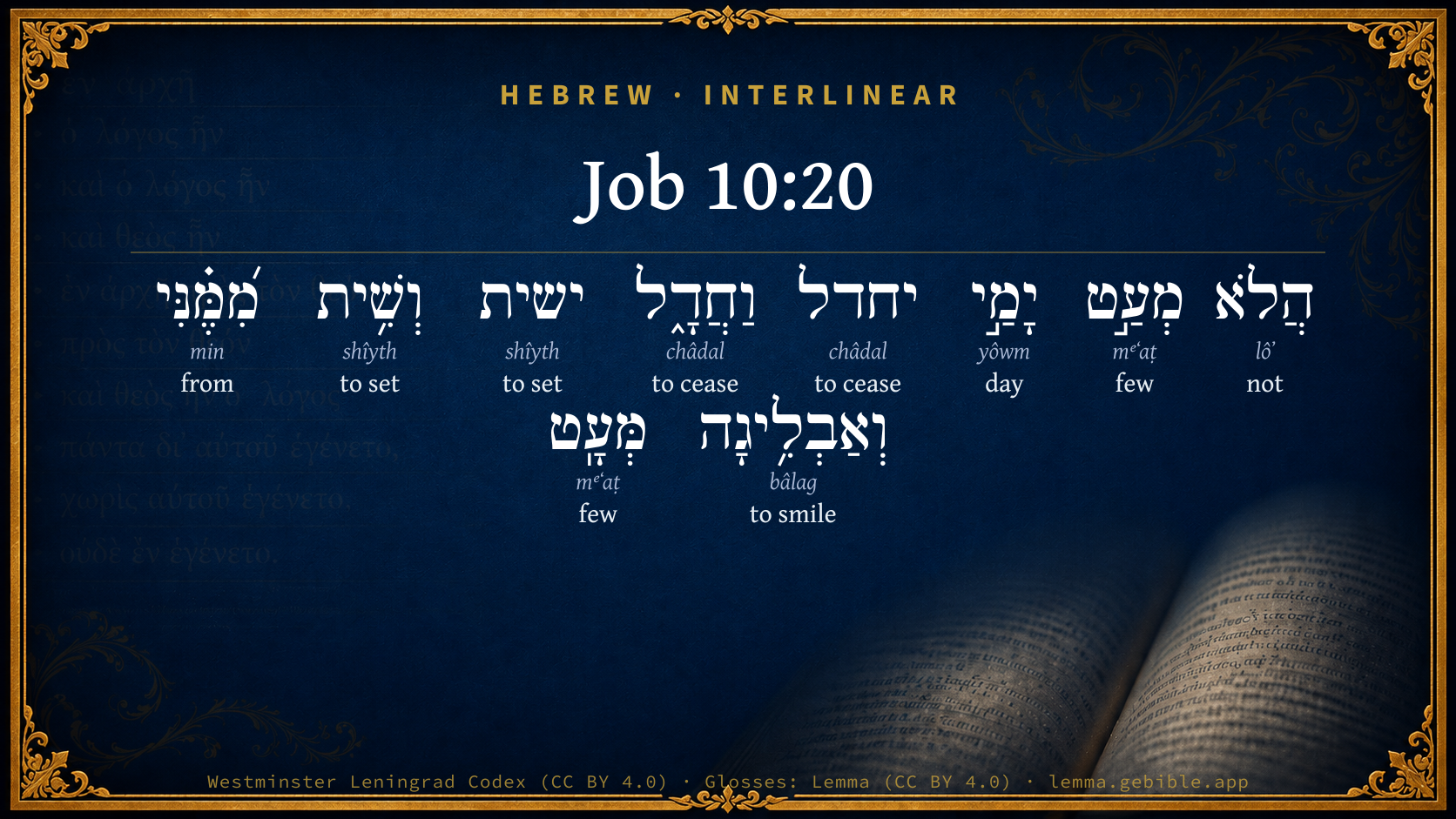
Hebrew (Westminster Leningrad Codex) Job 10:20 appears in the Hebrew Old Testament. The text above is from the Westminster Leningrad Codex. Each word links to its Strong’s number, a concise gloss, and parsing drawn from the Open Scriptures Hebrew Bible morphology. Click any word for its full Brown-Driver-Briggs (BDB) entry.
Download image
Cite this verse

Job 10:20 (World English Bible). Public Domain. Lemma interlinear Bible study tool, https://lemma.gebible.app/v/job/10/20.

Show BibTeX & RIS
BibTeX
RIS
English Translation
Aren't my days few? Cease then, Leave me alone, that I may find a little comfort,
World English Bible · Public Domain
Download a study sheet

One document with this verse’s original text, its word-by-word gloss line, the meaning frame, cross-references with their text, attributed commentary, and full source and license credits — printable, and it pastes into notes with its structure intact.

This verse Autodidact and up

Study sheet (.html) Plain text (.txt)

A passage Seminary Student

Up to 50 verses in one chapter. A passage sheet keeps up to 6 commentary sources and 12 cross-references per verse, in the order this page ranks them, and says so on the sheet whenever that leaves anything out. Ask for a single verse and you get the Autodidact verse sheet above.

Everything on this page stays free to read, with no account — the sheet is a download of what is already on screen, not access to it.

Want to remove ads? Support Godless Engineer
Compare translations 3

The same verse in 3 English versions, stacked beneath the original-language interlinear above. Click any original word for its lexicon entry.

Each is an independent rendering of the whole verse — the interlinear is not word-aligned to these translations.

Highlighted words mark where these versions differ — a whole-verse word diff, not a word-by-word alignment.

  • World English Bible Public Domain
    Aren't my days few? Cease then, Leave me alone, that I may find a little comfort,
  • King James Version Public Domain
    Are not my days few? cease then, and let me alone, that I may take comfort a little,
  • unfoldingWord Literal Text CC BY-SA 4.0
    my days not few? So cease and put from me, and let me smile a little.

unfoldingWord Literal Text — © unfoldingWord, licensed CC BY-SA 4.0. Word-aligned USFM3 via Door43 (git.door43.org/unfoldingWord/en_ult).

Versions to compare (up to 4)

3 of 4 selected

Show all 18 translations

Every available English version of this verse, each an independent rendering of the whole verse.

  • World English Bible Public Domain
    Aren't my days few? Cease then, Leave me alone, that I may find a little comfort,
  • Berean Standard Bible Public Domain
    Are my days not few? Withdraw from me, that I may have a little comfort,
  • Majority Standard Bible Public Domain
    Are my days not few? Withdraw from me, that I may have a little comfort,
  • King James Version Public Domain
    Are not my days few? cease then, and let me alone, that I may take comfort a little,
  • American Standard Version (1901) Public Domain
    Are not my days few? cease then, And let me alone, that I may take comfort a little,
  • Revised Version (1885) Public Domain
    Are not my days few? cease then, and let me alone, that I may take comfort a little,
  • Geneva Bible (1599) Public Domain
    Are not my dayes fewe? let him cease, and leaue off from me, that I may take a litle comfort,
  • Douay-Rheims (1899) Public Domain
    Shall not the fewness of my days be ended shortly? suffer me, therefore, that I may lament my sorrow a little:
  • Young's Literal Translation Public Domain
    Are not my days few? Cease then, and put from me, And I brighten up a little,
  • Literal Standard Version CC BY-SA 4.0
    Are my days not few? Cease then, and put from me, || And I brighten up a little,
  • Unlocked Literal Bible CC BY-SA 4.0
    Are not my days only a few? Stop then, let me alone, so that I may have a little rest
  • unfoldingWord Literal Text CC BY-SA 4.0
    my days not few? So cease and put from me, and let me smile a little.
  • Darby Bible Public Domain
    Are not my days few? cease then and let me alone, that I may revive a little,
  • World Messianic Bible Public Domain
    Aren’t my days few? Stop! Leave me alone, that I may find a little comfort,
  • Webster's Bible Public Domain
    Are not my days few? cease then, and let me alone, that I may take comfort a little,
  • Free Bible Version CC BY-SA 4.0
    I only have a few days left, so why don't you leave me alone so I can have a little peace
  • Bible in Basic English Public Domain
    Are not the days of my life small in number? Let your eyes be turned away from me, so that I may have a little pleasure,
  • JPS Tanakh (1917) Public Domain
    Are not my days few? Cease then, and let me alone, that I may take comfort a little,

Literal Standard Version (2020), Covenant Press — licensed CC BY-SA 4.0. Text via the HelloAO Bible API (eBible.org). Unlocked Literal Bible (unfoldingWord) — licensed CC BY-SA 4.0. Text via the HelloAO Bible API (eBible.org). unfoldingWord Literal Text — © unfoldingWord, licensed CC BY-SA 4.0. Word-aligned USFM3 via Door43 (git.door43.org/unfoldingWord/en_ult). Free Bible Version, Dr. Jonathan Gallagher — licensed CC BY-SA 4.0. Text via the HelloAO Bible API (eBible.org).

Word by word

More ways to search: Search by grammar → Find every occurrence → Compare this word →

Practice this passage: Drill this verse → Learn its vocabulary →

וְאַבְלִ֥יגָה
bâlag
H1082
“and · to smile”
Conjunction + Verb, Hiphil, Cohortative, 1st Person, Common, Singular
Part of Speech
Conjunction + Verb
Stem
Hiphil
Form
Cohortative
Person
1st Person
Gender
Common
Number
Singular
Full BDB Definition

Origin: a primitive root

TWOT: 245

to gleam, smile - (Hiphil) only - to show a smile, look pleasant - to cause to burst
  1. הֲלֹא lôʼ H3808 “not” Particle, Interrogative + Particle, Negative
  2. מְעַ֣ט mᵉʻaṭ H4592 “few” Noun, Common, Masculine, Singular, Absolute
  3. יָמַ֣י yôwm H3117 “days · my” Noun, Common, Masculine, Plural, Construct + Suffix, Personal, 1st Person, Common, Singular
  4. יחדל châdal H2308 “to cease” Verb, Qal, Jussive, 3rd Person, Masculine, Singular
  5. וַחֲדָ֑ל châdal H2308 “and · cease” Conjunction + Verb, Qal, Imperative, 2nd Person, Masculine, Singular
  6. ישית shîyth H7896 “to set” Verb, Qal, Jussive, 3rd Person, Masculine, Singular
  7. וְשִׁ֥ית shîyth H7896 “and · set” Conjunction + Verb, Qal, Imperative, 2nd Person, Masculine, Singular
  8. מִ֝מֶּ֗נִּי min H4480 “from · me” Preposition + Suffix, Personal, 1st Person, Common, Singular
  9. מְּעָֽט mᵉʻaṭ H4592 “few” Adverb

About this verse

These counts appear in no published source. They are computed here, from the morphology-tagged text and Lemma’s own curated glosses. What Lemma adds →

10
words
7
distinct lemmas
Wisdom
section

Notable vocabulary

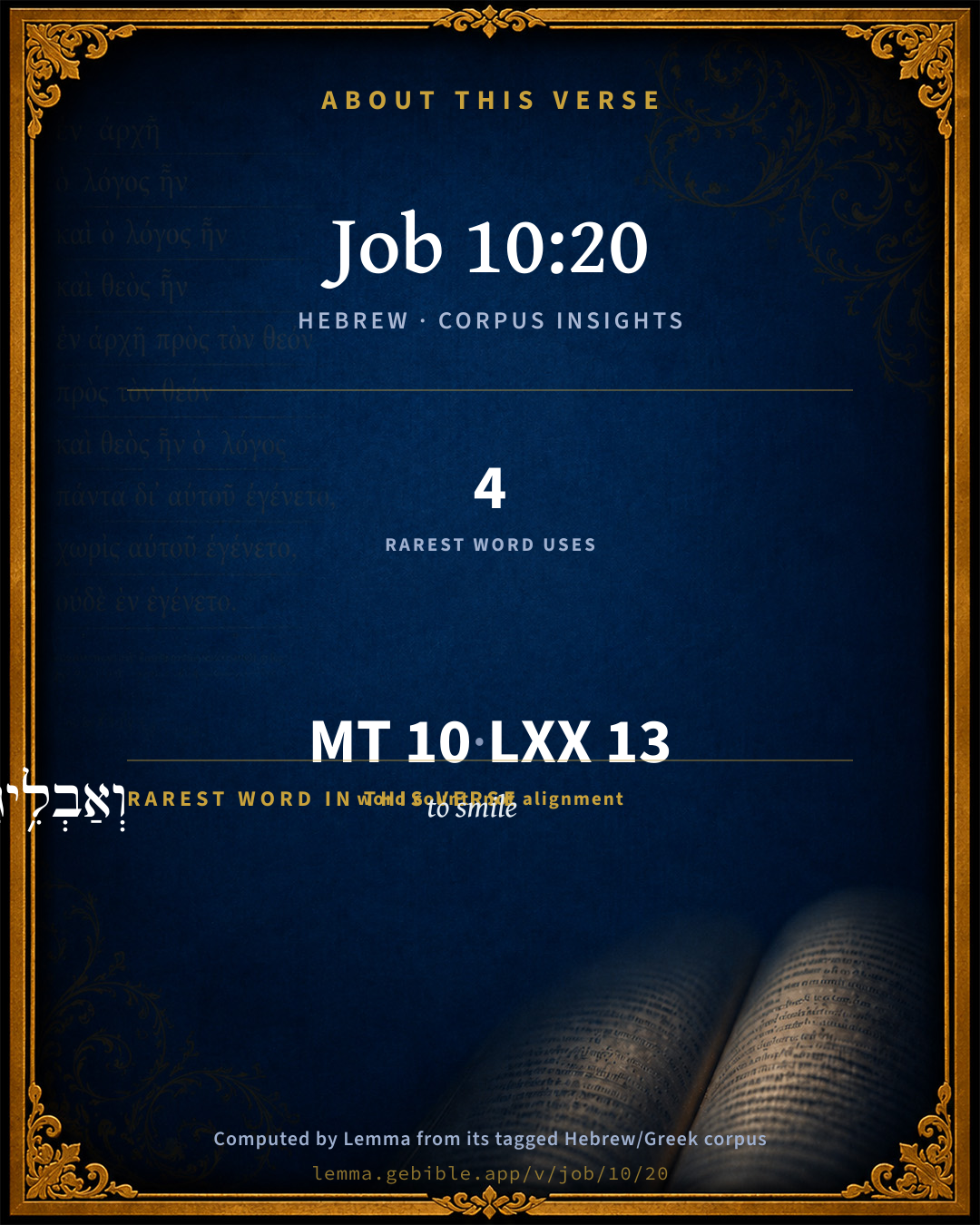
The rarest word here is וְאַבְלִ֥יגָה to smile H1082 — appearing just 4 times in the whole Hebrew Bible.

Shared distinctive vocabulary

וְאַבְלִ֥יגָה to smile H1082 occurs in 4 verses of the Hebrew Bible. Also found in:

Grammatical profile

  • 5 verbs
  • 2 nouns
  • 1 preposition
  • 1 adverb
  • 1 particle

Verb forms

  • יחדל Qal · Jussive
  • וַחֲדָ֑ל Qal · Imperative
  • ישית Qal · Jussive
  • וְשִׁ֥ית Qal · Imperative
  • וְאַבְלִ֥יגָה Hiphil · Cohortative

Repetition

Words recur within this verse — often emphatic in Hebrew:

  • מְעַ֣ט few H4592 ×2
  • יחדל to cease H2308 ×2
  • ישית to set H7896 ×2

Hebrew & Septuagint length

In English translation the verse runs 16 words from the Hebrew and 14 from the Septuagint (LXX English) — closely comparable.

A rough comparison of the two English renderings, which tokenize alike — not a word-level alignment.

Word counts can differ between the Hebrew and the Greek without any difference in meaning — e.g. the Hebrew direct-object marker אֵת has no separate Greek word, and Greek often adds the article ὁ.

In the original languages it is 10 Hebrew tokens and 13 Greek tokens — but the two are counted differently (Hebrew bundles its prefixes and suffixes into one token; the Greek is in lemma form), so that isn’t a like-for-like length.

Cross-references

9

Topical passages linked to Job 10:20 in the Treasury of Scripture Knowledge — connected by theme and wording, ordered by reader-vote popularity; previews shown in the World English Bible.

  • Job 14:1 "Man, who is born of a woman, Is of few days, and full of trouble.
  • Psalms 39:13 Oh spare me, that I may recover strength, Before I go away, and be no more."
  • Job 7:6–7 My days are swifter than a weaver's shuttle, And are spent without hope.
  • Job 7:16–21 I loathe my life. I don't want to live forever. Leave me alone; for my days are but a breath.
  • Job 8:9 (For we are but of yesterday, and know nothing, Because our days on earth are a shadow.)
  • Job 9:25–26 "Now my days are swifter than a runner. They flee away, they see no good,
  • Job 13:21 Withdraw your hand far from me; And don't let your terror make me afraid.
  • Psalms 39:5 Behold, you have made my days handbreadths. My lifetime is as nothing before you. Surely every man stands as a breath." Selah.
  • Psalms 103:15–16 As for man, his days are like grass. As a flower of the field, so he flourishes.

Cross-references courtesy of OpenBible.info (CC BY 4.0).

Hebrew and Greek witnesses Masoretic Hebrew ↔ Greek Septuagint

The same verse in the two great witnesses to the Old Testament, shown verse-for-verse.

These are two independent witnesses, not word-aligned to each other, and the Septuagint is shown in lemma (dictionary) form.

Hebrew Job 10:20 Masoretic · Westminster Leningrad Codex

הֲלֹא מְעַ֣ט יָמַ֣י יחדל וַחֲדָ֑ל ישית וְשִׁ֥ית מִ֝מֶּ֗נִּי וְאַבְלִ֥יגָה מְּעָֽט

Aren't my days few? Cease then, Leave me alone, that I may find a little comfort,

World English Bible · Public Domain

Greek LXX Job 10:20 Septuagint · lemma form

ἦ οὐ ὀλίγος εἰμί ὁ χρόνος ὁ βίος ἐγώ ἐάω ἐγώ ἀναπαύω μικρός

Is not the time of my life short? suffer me to rest a little,

LXX2012 (modern English Septuagint) · Public Domain

Hebrew: Westminster Leningrad Codex (CC BY 4.0). Greek: Septuagint (public domain); English from LXX2012 (modern English Septuagint) (Public Domain). How the Septuagint differs from the Hebrew →

Commentary

Notes on Job 10:20 from classic Christian and Jewish commentators (each source and its license shown beneath its notes). The classic Christian expositions comment on the surrounding passage and are grouped to its opening verse, so a note may address several verses; the Jewish commentaries on the Tanakh (Rashi and others) are per-verse, so they appear only where the commentator wrote on this verse.

Lemma curates 59 commentaries, every one of them public domain or Creative Commons licensed, each selected and text-cleaned for this edition rather than reprinted as found. About our sources →

Trapp's Complete Commentary

John Trapp

Job 10:20 [Are] not my days few? cease [then, and] let me alone, that I may take comfort a little,

Ver. 20. Are not my days few?] And oh that they might not be also evil! since I shall not much trouble the world, oh that I might not find much trouble in the world! What man is he that would fain see good days? saith David, Psa 34:12. What man is he that would not? saith Austin in answer to him. Job and David join in one and the same suit for a truce from trouble, since their time here was so very short, Psa 39:13; Psa 89:47.

Cease then, and let me alone] After he had vented his passions he falls again to his prayers. Ye have done all this wickedness (saith Samuel to the people who had been over importunate for a king), yet turn not aside from following the Lord, &c., 1Sa 12:20. Whilst prayer stands still, the whole trade of godliness stands still. Saints, though they have sinned, yet must not restrain prayer, but go home to God again with shame in their faces and tears in their eyes, and he will speak peace; only they must be sensible that their Father hath spit in their faces, &c.

That I may take comfort a little] A modest request. The poor man speaks supplications, begs a farthing. They who are lowly make low demands. Oh that I were but a door keeper! Oh that Ishmael might live in thy sight! &c.

John Trapp, A Commentary or Exposition upon All the Books of the Old and New Testament (1647–1656) — public domain. Text from a community e-Sword module.

Joseph Benson's Commentary

Job 10:20-22. Are not my days few? Cease then, &c. — My life is short, and of itself hastens to an end; there is no need that thou shouldest grudge me some ease for so small a moment. Let me alone — Or lay aside, or remove thy hand or anger from me. That I may take comfort a little — Hebrews אבליגה, abligah, et recreabo me, I shall refresh, or strengthen myself: shall have some respite, some remission of my grief and pain, some consolation. Those that are not duly thankful for constant ease should think how welcome one hour’s ease would be if they were in constant pain. Before I go to the place whence I shall not return — Shall not come back into this world and life. At death we must bid a final farewell to this world: the body must then be laid where it will lie long; and the soul appointed to that state where it must be for ever. That had need to be well done which is to be done but once, and done for eternity. Even to the land of darkness, and the shadow of death — That is, a dark and dismal shade. Holy souls at death remove to a land of light, where there is no death; but their bodies they leave to a land of darkness, and the shadow of death. Of darkness, as darkness itself, &c. — He heaps up expressions here to show that he has as dreadful apprehensions of death and the grave as other men naturally have, so that it was only the extreme misery he was in that made him wish for it. Without any order — No order is observed in bringing people to the grave, not the eldest are brought first, not the richest, not the poorest, and yet every one in his own order, the order appointed by the God of life. All lie there on the same level, and there is no distinction between the prince and the peasant; but the servant is there free from his master: and in the grave there is perpetual night, and no succession of day. And where the light is as darkness — Where there is no difference between light and darkness; where the day is as dark as the night; where there is nothing but perpetual and uninterrupted darkness. In the grave there is no knowledge, no comfort, no joy, no praising God, no working out our salvation, for the night is come wherein no man can work. Let us consider this, and therefore walk and work while we have the light with us.

Joseph Benson's Commentary on the Old and New Testaments (1811–1818) — public domain. Text from a community e-Sword module.

Tyndale Open Study Notes

Tyndale Open Resources

10:20-22 Earlier, Job had painted a fairly pleasant picture of Sheol (3:13-19); now he describes it as a land of darkness and utter gloom (see also 7:9-10; 14:7-22).

Tyndale Open Study Notes — © Tyndale Open Resources, licensed CC BY-SA 4.0. Text via the HelloAO Bible API.

Geneva Bible (1599)

Geneva Bible translators

He wisheth that God would leave off his affliction, considering his great misery and the brevity of his life.

Geneva Bible (1599) marginal notes — public domain. Text via Bolls.life.

Jamieson, Fausset & Brown

Robert Jamieson, A. R. Fausset & David Brown

But, since I was destined from my birth to these ills, at least give me a little breathing time during the few days left me (Job 9:34; Job 13:21; Psa 39:13).

Jamieson, Fausset & Brown — Commentary Critical and Explanatory on the Whole Bible (1871) — public domain (CC PDM 1.0). Text via the HelloAO Bible API.

Adam Clarke's Commentary

Verse 20. Are not my days few?] My life cannot be long; let me have a little respite before I die.

Adam Clarke's Commentary on the Bible (1810–1826) — public domain. Text from a community e-Sword/MySword module.

Ellicott's Commentary for English Readers

(20) Cease then, and let me alone.—According to another reading, “Let him cease, and let me alone.” In reading this reply of Job’s, one cannot but feel that it moves upon the very verge of blasphemy, and is only redeemed therefrom by its pervading reverence and deep undertone of faith. Job never gives up his faith in God, though, like Jacob, he wrestles with Him in the dark, and the issue shows that God is not displeased with such an unburdening of the soul that keeps close to the straight line of truth, which is, after all, one of the many manifestations of God.

A Bible Commentary for English Readers, edited by Charles John Ellicott (1878–1897) — public domain. Text from a community e-Sword module.

The Cambridge Bible for Schools and Colleges

gen. ed. J. J. S. Perowne

20–22. He begs for a little easing of his pain ere he departs to the land of darkness.

are not my days few] The same argument as ch. Job_7:16.

cease then, and let me alone] Another reading is, let him cease then, &c. In the last case the speaker turns away from God and speaks of Him. In the rest of the chapter, however, Job everywhere addresses God.

take comfort] The same word as ch. Job_9:27, brighten up.

The Cambridge Bible for Schools and Colleges (gen. ed. J. J. S. Perowne; Cambridge University Press, 1878–1918) — public domain. Text from a community e-Sword module.

John Gill's Exposition

Before I go whence I shall not return,.... Before he went out of the world, the way of all flesh, to the grave, his long home, from whence there is no return to this world, and to the business and affairs of it; to a man's house, his family and his friends, to converse with them as before, there will be no return until the resurrection, which Job does not here deny, as some have thought; it was a doctrine he well understood, and strongly asserts in Job 19:26; but this must be understood in the same sense as in Job 7:9,

even to the land of darkness, and the shadow of death; which describes not the state of the damned, as some Popish interpreters, carry it; for Job had no thought nor fear of such a state; but the grave, which is called "a land", or country, it being large and spacious, and full of inhabitants; a land of "darkness", a very dark one, where the body separated from the soul is deprived of all light; where the sun, moon, and stars, are never seen; nor is there the least crevice that light can enter in at, or be seen by those that dwell in those shades, which are "the shadow of death" itself; deadly shades, thick and gross ones, the darkest shades, where death itself is, or dead men are, destitute of light and life; where no pleasure, comfort, and conversation, can be had; and therefore a land in itself most undesirable.

John Gill's Exposition of the Whole Bible (1746–1763) — public domain (CC PDM 1.0). Text via the HelloAO Bible API.

Albert Barnes' Notes on the Bible

Are not my days few? - My life is short, and hastens to a close. Let not then my afflictions be continued to the last moment of life, but let thine hand be removed, that I may enjoy some rest before I go hence, to return no more. This is an address to God, and the meaning is, that as life was necessarily so short, he asked to be permitted to enjoy some comfort before he should go to the land of darkness and of death; compare the note at Job 7:21. A somewhat similar expression occurs in Psa 39:13 :

O spare me, that I may recover strength,

Before I go hence, and be no more.

Albert Barnes' Notes on the Bible (1834–1885) — public domain. Text from a community e-Sword/MySword module.

Haydock's Catholic Bible Commentary

Lament. Hebrew, "take comfort," (Haydock) or breath. (Calmet) --- Repentance is always necessary, but more particularly at the hour of death. (Worthington)

George Leo Haydock (1774–1849), Haydock's Catholic Family Bible and Commentary, 1859 edition — public domain. Excludes Psalms (Douay-Rheims chapter numbering differs from Protestant) and Deuterocanonical books (Catholic canon only).

Matthew Poole's English Annotations

My life is short, and of itself hastens apace to an end; there is no need that thou shouldst push it forward, or grudge me some ease for so small a moment.

Let me alone; or, lay aside, or remove, thy hand or anger from me.

Matthew Poole's English Annotations on the Holy Bible (1683–1685) — public domain. Text from a community e-Sword/MySword module.

Whedon's Commentary on the Bible

Daniel D. Whedon

20. Take comfort — Same as Job_9:27. Cease — Let him cease. “Job at the end of his complaint, not venturing to speak to God, but of him, in the third person.” — Schlottmann.

Daniel D. Whedon (gen. ed.), Commentary on the Old and New Testaments (1874–1909) — public domain. Text from a community e-Sword module.

The Pulpit Commentary

Are not my days few? Cease then, and let me alone, that I may take comfort a little. Job here returns from vague longings and idle aspirations to actual realities the facts of the case and asks, "Is not the time that I now have to live short? Must not my disease make an end of me in a very brief space? If so, then may I not make a request? My petition is that God will "cease" from me, grant me a respite, "let me alone" for a short time, remove his heavy hand, and allow me to "take comfort a little," recover my strength, and obtain a breathing-space, before my actual end, before the time comes for my descent to Sheol," which is then (vers. 21, 22) described. The parallel with Psa_39:13 is striking.

The Pulpit Commentary (1880–1919), ed. H.D.M. Spence-Jones & Joseph S. Exell — public domain. Text from a community e-Sword module.

John Wesley's Explanatory Notes

Cease - My life is short, and of itself hastens to an end, there is no need that thou shouldest grudge me some ease for so small a moment.

John Wesley, Explanatory Notes Upon the Whole Bible (1754–1765) — public domain. Text via the GEBible commentary corpus.

unfoldingWord translationNotes

Door43 World Missions Community

Are not my days only a few?

Here "my days" represent the length of Job's life. This question expects a positive answer, to emphasize that Job only expects to live a few more days. It can be translated as a statement. AT: "I only have a few days left to live." or "My life will soon end." (See: Rhetorical Question)

the land

Here the place where the spirits of dead people go is spoken of as if it was a land. AT: "the place" (See: Metaphor)

of darkness and of the shadow of death

The phrase "shadow of death" intensifies the idea of "darkness." Both phrases describe where the spirits of dead people go. (See: Doublet)

the shadow of death

See how you translated this in Job 3:5.

as dark as midnight

The darkness of the place where the spirits of dead people go is compared to the darkness of midnight. (See: Simile)

without any order

This negative phrase can be expressed in positive form. AT: "full of confusion" or "where all is confused" (See: Litotes)

where the light is like midnight

The light of the place where the spirits of dead people go is compared to midnight. AT: "where there is no light" (See: Simile)

translationWords

rest

darkness

shadow

die

light

unfoldingWord translationNotes — © Distant Shores Media and the Door43 World Missions Community, licensed CC BY-SA 4.0. Source: git.door43.org/Door43/en_tn.

Rashi

Rabbi Shlomo Yitzchaki (Rashi)

withdraw from me Withdraw Yourself from me and from upon me, like (Isa. 65:5), “Keep to yourself” Remain by yourself and distance yourself from me.

Rashi on the Tanakh — English translations: “The Judaica Press complete Tanach with Rashi, translated by A. J. Rosenberg” (CC BY 4.0); “Pentateuch with Rashi's commentary by M. Rosenbaum and A.M. Silbermann, 1929-1934” (public domain); “The Metsudah Tanach series, Lakewood, N.J” (CC BY 4.0); and “The Book of Joshua, Metsudah Publications, 1997” (CC BY 4.0). Text via Sefaria.

Lesson kit

Teaching starters — assembled from the data on this page, not authored interpretation. Every prompt links to the verse data it draws on. Edit before teaching.

Job, in the Wisdom, opens this verse with 10 words (7 distinct Hebrew lemmas). Its most distinctive word is bâlag (“to smile”). A historical commentator’s framing appears above. Read the whole chapter for the surrounding context.

Discussion questions

  1. What does “to smile” (bâlag) contribute to the verse as a whole?
  2. Job 9:27 shares the word «to smile» with this verse. How do the two illuminate each other?
  3. “few” occurs 2× in this one verse. What is the effect of the repetition?
  4. The translations on this page render this verse differently — a whole-verse word diff, not a word-by-word alignment. What might account for the different wordings?
  5. The verb «יחדל» is Qal Jussive. How does its form color the action?
  6. Reading how Trapp's Complete Commentary and Joseph Benson's Commentary read this verse, where do the two commentators agree and where do they part?

Things to notice

Reading settings

Reading text

Shown beneath each verse's original-language words.

Old Testament
Old Testament edition

Read the OT as the Masoretic Hebrew (MT) or the Greek Septuagint (LXX).

English shown for the Greek Septuagint (in the Hebrew ↔ Greek comparison).

Comparing translations? Open the Compare panel on any verse page to stack up to four side by side.