
Ezekiel 5:3

Hebrew (Westminster Leningrad Codex) Ezekiel 5:3 appears in the Hebrew Old Testament. The text above is from the Westminster Leningrad Codex. Each word links to its Strong’s number, a concise gloss, and parsing drawn from the Open Scriptures Hebrew Bible morphology. Click any word for its full Brown-Driver-Briggs (BDB) entry.
Download image
Cite this verse

Ezekiel 5:3 (World English Bible). Public Domain. Lemma interlinear Bible study tool, https://lemma.gebible.app/v/ezekiel/5/3.

Show BibTeX & RIS
BibTeX
RIS
English Translation
You shall take of it a few in number, and bind them in your skirts.
World English Bible · Public Domain
Download a study sheet

One document with this verse’s original text, its word-by-word gloss line, the meaning frame, cross-references with their text, attributed commentary, and full source and license credits — printable, and it pastes into notes with its structure intact.

This verse Autodidact and up

Study sheet (.html) Plain text (.txt)

A passage Seminary Student

Up to 50 verses in one chapter. A passage sheet keeps up to 6 commentary sources and 12 cross-references per verse, in the order this page ranks them, and says so on the sheet whenever that leaves anything out. Ask for a single verse and you get the Autodidact verse sheet above.

Everything on this page stays free to read, with no account — the sheet is a download of what is already on screen, not access to it.

Want to remove ads? Support Godless Engineer
Compare translations 3

The same verse in 3 English versions, stacked beneath the original-language interlinear above. Click any original word for its lexicon entry.

Each is an independent rendering of the whole verse — the interlinear is not word-aligned to these translations.

Highlighted words mark where these versions differ — a whole-verse word diff, not a word-by-word alignment.

  • World English Bible Public Domain
    You shall take of it a few in number, and bind them in your skirts.
  • King James Version Public Domain
    Thou shalt also take thereof a few in number, and bind them in thy skirts.
  • unfoldingWord Literal Text CC BY-SA 4.0
    But take a small number of hairs from them and tie them into the folds of your robe.

unfoldingWord Literal Text — © unfoldingWord, licensed CC BY-SA 4.0. Word-aligned USFM3 via Door43 (git.door43.org/unfoldingWord/en_ult).

Versions to compare (up to 4)

3 of 4 selected

Show all 18 translations

Every available English version of this verse, each an independent rendering of the whole verse.

  • World English Bible Public Domain
    You shall take of it a few in number, and bind them in your skirts.
  • Berean Standard Bible Public Domain
    But you are to take a few strands of hair and secure them in the folds of your garment.
  • Majority Standard Bible Public Domain
    But you are to take a few strands of hair and secure them in the folds of your garment.
  • King James Version Public Domain
    Thou shalt also take thereof a few in number, and bind them in thy skirts.
  • American Standard Version (1901) Public Domain
    And thou shalt take thereof a few in number, and bind them in thy skirts.
  • Revised Version (1885) Public Domain
    And thou shalt take thereof a few in number, and bind them in thy skirts.
  • Geneva Bible (1599) Public Domain
    Thou shalt also take thereof a fewe in nomber, and binde them in thy lappe.
  • Douay-Rheims (1899) Public Domain
    And thou shalt take thereof a small number: and shalt bind them in the skirt of thy cloak.
  • Young's Literal Translation Public Domain
    And thou hast taken thence a few in number -- and hast bound them in thy skirts;
  • Literal Standard Version CC BY-SA 4.0
    And you have taken there a few in number—and have bound them in your skirts;
  • Unlocked Literal Bible CC BY-SA 4.0
    But take a small number of hairs from them and tie them into the folds of your robe.
  • unfoldingWord Literal Text CC BY-SA 4.0
    But take a small number of hairs from them and tie them into the folds of your robe.
  • Darby Bible Public Domain
    And thou shalt take thereof a few in number, and bind them in thy skirts;
  • World Messianic Bible Public Domain
    You shall take a small number of these and bind them in the folds of your robe.
  • Webster's Bible Public Domain
    Thou shalt also take of them a few in number, and bind them in thy skirts.
  • Free Bible Version CC BY-SA 4.0
    Take just a few hairs and tuck them into the hem of your clothes.
  • Bible in Basic English Public Domain
    And take from them a small number of hairs, folding them in your skirts.
  • JPS Tanakh (1917) Public Domain
    Thou shalt also take thereof a few by number, and bind them in thy skirts.

Literal Standard Version (2020), Covenant Press — licensed CC BY-SA 4.0. Text via the HelloAO Bible API (eBible.org). Unlocked Literal Bible (unfoldingWord) — licensed CC BY-SA 4.0. Text via the HelloAO Bible API (eBible.org). unfoldingWord Literal Text — © unfoldingWord, licensed CC BY-SA 4.0. Word-aligned USFM3 via Door43 (git.door43.org/unfoldingWord/en_ult). Free Bible Version, Dr. Jonathan Gallagher — licensed CC BY-SA 4.0. Text via the HelloAO Bible API (eBible.org).

Word by word

More ways to search: Search by grammar → Find every occurrence → Compare this word →

Practice this passage: Drill this verse → Learn its vocabulary →

וְצַרְתָּ֥
tsûwr
H6696
“and · to besiege”
Conjunction + Verb, Qal, Sequential Perfect, 2nd Person, Masculine, Singular
Part of Speech
Conjunction + Verb
Stem
Qal
Form
Sequential Perfect
Person
2nd Person
Gender
Masculine
Number
Singular
Full BDB Definition

Origin: a primitive root

TWOT: 1898 , 1899 , 1900

to bind, besiege, confine, cramp - (Qal) - to confine, secure - to shut in, beseige - to shut up, enclose - (Qal) to show hostility to, be an adversary, treat as foe - (Qal) to form, fashion, delineate
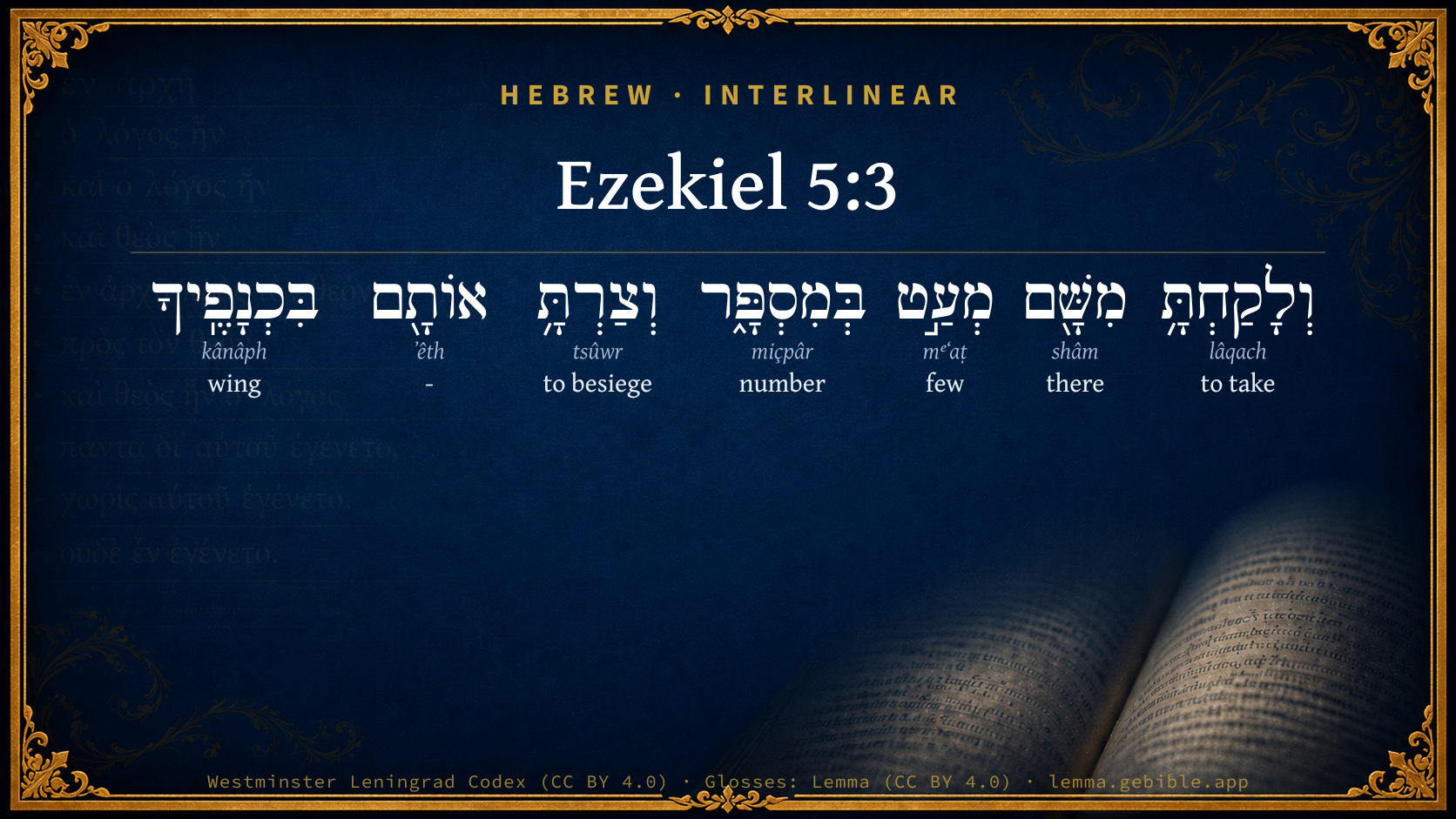
  1. וְלָקַחְתָּ֥ lâqach H3947 “and · to take” Conjunction + Verb, Qal, Sequential Perfect, 2nd Person, Masculine, Singular
  2. מִשָּׁ֖ם shâm H8033 “from · there” Preposition + Adverb
  3. מְעַ֣ט mᵉʻaṭ H4592 “few” Noun, Common, Masculine, Singular, Absolute
  4. בְּמִסְפָּ֑ר miçpâr H4557 “in/at · number” Preposition + Noun, Common, Masculine, Singular, Absolute
  5. אוֹתָ֖ם ʼêth H853 “- · them” Particle, Direct Object + Suffix, Personal, 3rd Person, Masculine, Plural
  6. בִּכְנָפֶֽיךָ kânâph H3671 “in/at · wings · your” Preposition + Noun, Common, Feminine, Dual, Construct + Suffix, Personal, 2nd Person, Masculine, Singular

About this verse

These counts appear in no published source. They are computed here, from the morphology-tagged text and Lemma’s own curated glosses. What Lemma adds →

7
words
7
distinct lemmas
Prophets
section

Shared distinctive vocabulary

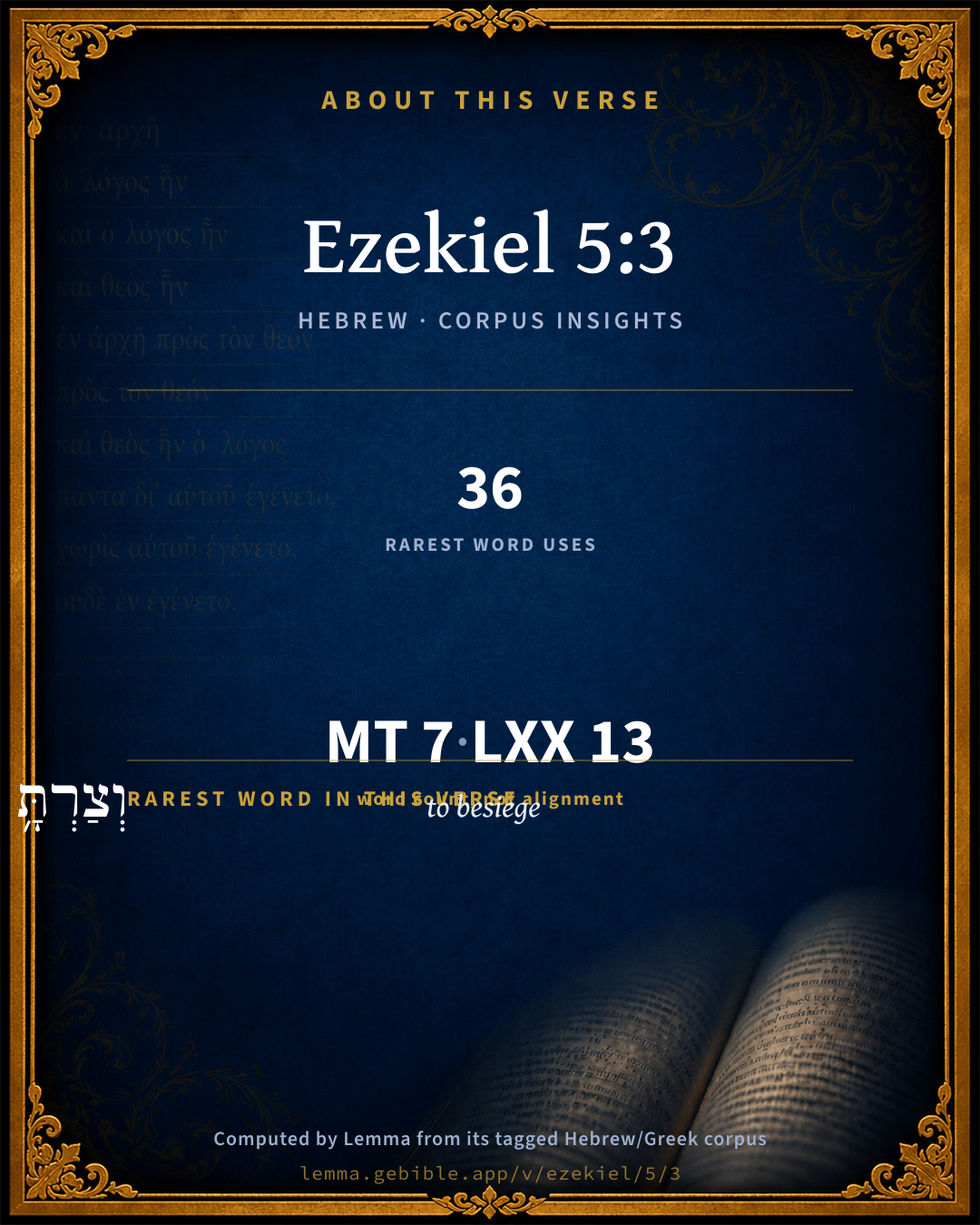
וְצַרְתָּ֥ to besiege H6696 occurs in 36 verses of the Hebrew Bible. Also found in:

Grammatical profile

  • 2 verbs
  • 3 nouns
  • 1 adverb
  • 1 particle

Verb forms

  • וְלָקַחְתָּ֥ Qal · Sequential Perfect
  • וְצַרְתָּ֥ Qal · Sequential Perfect

Hebrew & Septuagint length

In English translation the verse runs 15 words from the Hebrew and 19 from the Septuagint (LXX English) — closely comparable.

A rough comparison of the two English renderings, which tokenize alike — not a word-level alignment.

Word counts can differ between the Hebrew and the Greek without any difference in meaning — e.g. the Hebrew direct-object marker אֵת has no separate Greek word, and Greek often adds the article ὁ.

In the original languages it is 7 Hebrew tokens and 13 Greek tokens — but the two are counted differently (Hebrew bundles its prefixes and suffixes into one token; the Greek is in lemma form), so that isn’t a like-for-like length.

Cross-references

7

Topical passages linked to Ezekiel 5:3 in the Treasury of Scripture Knowledge — connected by theme and wording, ordered by reader-vote popularity; previews shown in the World English Bible.

  • Jeremiah 40:6 Then went Jeremiah to Gedaliah the son of Ahikam to Mizpah, and lived with him among the people who were left in the land.
  • Jeremiah 52:16 But Nebuzaradan the captain of the guard left of the poorest of the land to be vineyard keepers and farmers.
  • Jeremiah 39:10 But Nebuzaradan the captain of the guard left of the poor of the people, who had nothing, in the land of Judah, and gave them vineyards and fields at the same time.
  • 2 Kings 25:12 But the captain of the guard left of the poorest of the land to work the vineyards and fields.
  • Matthew 7:14 How narrow is the gate, and restricted is the way that leads to life! Few are those who find it.
  • Luke 13:23–24 One said to him, "Lord, are they few who are saved?" He said to them,
  • 1 Peter 4:18 "If it is hard for the righteous to be saved, what will happen to the ungodly and the sinner?"

Cross-references courtesy of OpenBible.info (CC BY 4.0).

Hebrew and Greek witnesses Masoretic Hebrew ↔ Greek Septuagint

The same verse in the two great witnesses to the Old Testament, shown verse-for-verse.

These are two independent witnesses, not word-aligned to each other, and the Septuagint is shown in lemma (dictionary) form.

Hebrew Ezekiel 5:3 Masoretic · Westminster Leningrad Codex

וְלָקַחְתָּ֥ מִשָּׁ֖ם מְעַ֣ט בְּמִסְפָּ֑ר וְצַרְתָּ֥ אוֹתָ֖ם בִּכְנָפֶֽיךָ

You shall take of it a few in number, and bind them in your skirts.

World English Bible · Public Domain

Greek LXX Ezekiel 5:3 Septuagint · lemma form

καί λαμβάνω ἐκεῖθεν ὀλίγος ἐν ἀριθμός καί συν περιλαμβάνω αὐτός ὁ ἀναβολή σύ

And you shall take thence a few in number, and shall wrap them in the fold of your garment.

LXX2012 (modern English Septuagint) · Public Domain

Hebrew: Westminster Leningrad Codex (CC BY 4.0). Greek: Septuagint (public domain); English from LXX2012 (modern English Septuagint) (Public Domain). How the Septuagint differs from the Hebrew →

Targum (Aramaic paraphrase)

1

The Targum is the ancient Jewish Aramaic paraphrase of the Hebrew Scriptures — an interpretive translation, not the Hebrew text itself. Onkelos (literal) and Pseudo-Jonathan (expansive) render the Torah, and Jonathan the Prophets. Coverage is partial: where no permissively-licensed English translation exists for a verse, only the Aramaic is shown. This is verse-level text, not a word-by-word alignment to the Hebrew.

  1. Targum Jonathan Prophets (Joshua–Malachi)
    וְתִסֵב מִתַּמָן זְעֵיר בְּמִנְיַן וּתְצוּר יַתְהוֹן בִכְנָפָךְ:

    (no public-domain English translation for this verse)

    Targum Jonathan — Aramaic: “Mikraot Gedolot” (public domain). English: “Sefaria Community Translation” (CC0 1.0 (public-domain dedication)); “London "Chaldee Paraphrase," 1871” (public domain). Text via Sefaria.

Commentary

Notes on Ezekiel 5:3 from classic Christian and Jewish commentators (each source and its license shown beneath its notes). The classic Christian expositions comment on the surrounding passage and are grouped to its opening verse, so a note may address several verses; the Jewish commentaries on the Tanakh (Rashi and others) are per-verse, so they appear only where the commentator wrote on this verse.

Lemma curates 59 commentaries, every one of them public domain or Creative Commons licensed, each selected and text-cleaned for this edition rather than reprinted as found. About our sources →

Trapp's Complete Commentary

John Trapp

Eze 5:3 Thou shalt also take thereof a few in number, and bind them in thy skirts.

Ver. 3. Thou shalt also take thereof a few in number.] A remnant is still reserved, "that the Lord God may dwell among men." {Psa 68:18} See Jer 44:28 2Ki 25:12 Isa 1:9; Isa 6:10.

John Trapp, A Commentary or Exposition upon All the Books of the Old and New Testament (1647–1656) — public domain. Text from a community e-Sword module.

Tyndale Open Study Notes

Tyndale Open Resources

5:3-4 Ezekiel was to tie just a bit of the hair in his robe to show that a remnant would be safe, but even some of them would die in the fire of exile. Few would survive the multiple catastrophes about to befall God’s people.

Tyndale Open Study Notes — © Tyndale Open Resources, licensed CC BY-SA 4.0. Text via the HelloAO Bible API.

Geneva Bible (1599)

Geneva Bible translators

Meaning, that a very few should be left, which the Lord should preserve among all these storms, but not without troubles and trial.

Geneva Bible (1599) marginal notes — public domain. Text via Bolls.life.

Adam Clarke's Commentary

Verse 3. See Clarke on Eze 5:1.

Adam Clarke's Commentary on the Bible (1810–1826) — public domain. Text from a community e-Sword/MySword module.

John Calvin's Commentaries

It is now added: Thou shalt take then a small number, and bind them, (that is, that number, but the number is changed,) viz., those hairs of which the number is small in the skirts of thy clothing It either takes away the confidence which might spring up from a temporary escape, or else it signifies that very few should be safe in the midst of the destruction of the whole people, which came to pass wonderfully. If that is received, the correction is added, that God would give some hope of favor because the people was consumed, yet so that the covenant of God might remain. Hence it was necessary that some relics should be preserved, and they had been reduced like Sodom, unless God had kept for himself a small seed. (Isaiah 1:9; Romans 9:29.) Therefore in this sense the Prophet is ordered to bind and to hide in the skirts of his garment, some part of the hair. Moreover, that part is understood only in the third order, because those who had escaped thought that they had obtained safety by flight, especially when they collected themselves in troops. Afterwards it follows, thou shalt then take from these, and throw it into the midst of the fire, and burn it in the fire Out of these few hairs God wishes another part to be burnt and consumed; by which words he signifies, even where only a small portion remains, yet it must be consumed in like manner, or at least that many out of these few will be rejected. And indeed those who seemed to have happily escaped and to have survived safely, were soon after cut off by various slaughters, or pined away by degrees as if they had perished by a slow contagion. But since it pleased him to remember his promise, we gather that a few of the people survived through God’s wonderful mercy: for because he was mindful of his covenant, he wished some part to be preserved, and therefore that correction was interposed, that the Prophet should bind under his skirts a small number. Yet from that remnant, God again snatched away another part, and cast it into the fire. If the filth of the remainder was such, that it was necessary to purge it, and cast part of it into the fire, what must be thought of the whole people, that is, of the dregs themselves? For the portion which the Prophet bound in his skirts was clearly the flower of the people: if there was any integrity, it ought to be seen there.

John Calvin's Commentaries (1540-1563) — public domain. Text from the Calvin Translation Society English edition (1840s-50s) via the Christian Classics Ethereal Library (ccel.org). Calvin's coverage is partial (roughly two-thirds of the Bible); uncommented books and verses are honest gaps, never fabricated. The 19th-century editor's footnotes and remarks are omitted so the notes are faithfully Calvin's own voice.

Ellicott's Commentary for English Readers

(3) A few in number, and bind them in thy skirts.—A small remnant of the people was still left in the land after the great captivity (2Ki_25:22); but even of these some were to perish by violence (“cast them into the midst of the fire”) in the disorders which arose, and from this “shall a fire come forth into all the house of Israel.” (See Jeremiah 40, 41) The ultimate result was the expatriation of all that remained in Judæa, and the entire emptying of the land of the chosen people.

At this point the use of symbolism ceases for a while, and the prophet now, for the first time, begins to utter his prophecies in plain language. Accordingly, he changes his style from prose to the more ordinary form of prophetic utterance in parallelisms, which constitute the distinctive feature of Hebrew poetry, and this continues until another vision begins with Ezekiel 8.

A Bible Commentary for English Readers, edited by Charles John Ellicott (1878–1897) — public domain. Text from a community e-Sword module.

The Cambridge Bible for Schools and Colleges

gen. ed. J. J. S. Perowne

3. few in number] Or, “by number,”—accurately numbering them. (Isa_40:26.) Of those dispersed a few shall meantime be preserved.

The Cambridge Bible for Schools and Colleges (gen. ed. J. J. S. Perowne; Cambridge University Press, 1878–1918) — public domain. Text from a community e-Sword module.

John Gill's Exposition

Thou shall also take thereof a few in number,.... These are they that were left in the land of Judea by Nebuzaradan, for vinedressers and husbandmen, and such as returned out of Egypt into the land of Judah, Jer 44:28;

and bind them in thy skirts; in the pockets of them; signifying both the very small number of them, and their preservation. Jarchi and Kimchi interpret these of those that were carried captive to Babylon, and lived there, and were preserved, and returned again.

John Gill's Exposition of the Whole Bible (1746–1763) — public domain (CC PDM 1.0). Text via the HelloAO Bible API.

Albert Barnes' Notes on the Bible

Of the third part a few are yet to be taken and kept in the fold of the garment (representing those still to remain in their native land), and yet even of those few some are to be cast into the fire. Such was the fate of those left behind after the destruction of Jerusalem Jer. 40; 41. The whole prophecy is one of denunciation.

Eze 5:4

Thereof - Or, from thence, out of the midst of the fire. Omit “For.”

Albert Barnes' Notes on the Bible (1834–1885) — public domain. Text from a community e-Sword/MySword module.

Matthew Poole's English Annotations

Thereof, i.e. of the last third which were to be dispersed.

A few, or small quantity.

In number; or, by number, as

them in thy skirts; as men tie up in a handkerchief, or in the skirt of their garment, what they would not lose. So some few shall be kept, God will not cut off the whole house of Israel, but reserves a remnant.

Matthew Poole's English Annotations on the Holy Bible (1683–1685) — public domain. Text from a community e-Sword/MySword module.

Whedon's Commentary on the Bible

Daniel D. Whedon

3, 4. To take a few hairs “by number,” and preserve them thus carefully only emphasizes the fate of the mass; but even of this remnant (Isa_10:20-22; Isa_11:11; Eze_6:8-9), flying into exile, whom Jehovah in the person of the prophet would gladly bind to his person, some will be lost. For thereof [literally, from thence] shall a fire come forth — The punishment which falls upon the rebellious exiles whom Jehovah has tried to save will be felt by the whole nation.

Daniel D. Whedon (gen. ed.), Commentary on the Old and New Testaments (1874–1909) — public domain. Text from a community e-Sword module.

The Pulpit Commentary

Vers. 3, 4. Thou shalt also take, etc. The words may point

(1) either to those in Jerusalem who had escaped the famine and the sword, and were left in the land (2Ki_25:22; Jer_40:6 Jer_40:6) or

(2) to those who should go into exile, and yet even there suffer from the "fire" of God"s chastening judgments. They were, if saved at all, to be saved "so as by fire", (1Co_3:15) to be as "brands plucked from the burning". (Amo_4:11; Zec_3:2) Isaiah"s thought of the "remnant" (Isa_10:20-22 Isa_11:11-16) seems hardly to come in here. The whole utterance is one of denunciation. The act of "binding in the skirts" implies only a limited protection. Omit "for," and for "thereof" read "therefrom," s.c. from the fire (Revised Version).

The Pulpit Commentary (1880–1919), ed. H.D.M. Spence-Jones & Joseph S. Exell — public domain. Text from a community e-Sword module.

John Wesley's Explanatory Notes

Take - Of the last third. Bind - As men tied up in the skirt of their garment what they would not lose: to signify the small remnant.

John Wesley, Explanatory Notes Upon the Whole Bible (1754–1765) — public domain. Text via the GEBible commentary corpus.

unfoldingWord translationNotes

Door43 World Missions Community

General Information:

Yahweh continues to speak to Ezekiel.

But take ... Then take

Ezekiel was to do this when he shaved his hair and beard (Ezekiel 5:1) and before he burned the hair (Ezekiel 5:2). You may need to place these verses before those verses. "But when you shave off your hair and beard, and before you burn them, take ... After you have scattered the hair to the wind, then take" (See: Order of Events and Verse Bridges)

a small number of hairs from them

"a few hairs from the piles"

tie them

The word "them" refers to the hairs. Possible meanings are 1) the hairs were long enough so Ezekiel could tie them or 2) Ezekiel was to sew the hairs or otherwise attach them 3) Ezekiel was to place the hairs loosely in a fold of the garment.

the folds of your robe

Possible meanings are 1) "the cloth on your arms" ("your sleeves") or 2) "the end of the cloth on your robe" ("your hem") or 3) the fold in the garment where it is tucked into the belt.

from there a fire will go out to all the house of Israel

"from there a fire will spread out and burn up all the people of Israel." Yahweh speaks of how he will punish Israel as if he were going to set fire to a house and of the people of Israel as if they were the family that lives in that house but were at that time outside the house. (See: Metaphor)

the house of Israel

The word "house" is a metonym for the family that lives in the house, in this case the Israelites, the descendants of Jacob over many years. See how you translated this in Ezekiel 3:1. AT: "the Israelites" or "the Israelite people group" (See: Metonymy)

translationWords

fire

house

Israel

unfoldingWord translationNotes — © Distant Shores Media and the Door43 World Missions Community, licensed CC BY-SA 4.0. Source: git.door43.org/Door43/en_tn.

Rashi

Rabbi Shlomo Yitzchaki (Rashi)

and you shall bind them in your skirts These are the few people who will be exiled to Babylon and will live. An addendum to Rashi reads: and you shall bind them From here is an allusion [to the fact] that whoever cuts his hair should not cast it away, but should hide it, for any act written in these verses has implications of evil.

Rashi on the Tanakh — English translations: “The Judaica Press complete Tanach with Rashi, translated by A. J. Rosenberg” (CC BY 4.0); “Pentateuch with Rashi's commentary by M. Rosenbaum and A.M. Silbermann, 1929-1934” (public domain); “The Metsudah Tanach series, Lakewood, N.J” (CC BY 4.0); and “The Book of Joshua, Metsudah Publications, 1997” (CC BY 4.0). Text via Sefaria.

Lesson kit

Teaching starters — assembled from the data on this page, not authored interpretation. Every prompt links to the verse data it draws on. Edit before teaching.

Ezekiel, in the Prophets, opens this verse with 7 words (7 distinct Hebrew lemmas). Its most distinctive word is tsûwr (“to besiege”). A historical commentator’s framing appears above. Read the whole chapter for the surrounding context.

Discussion questions

  1. How does “to besiege” (tsûwr) shape what this verse is saying?
  2. How does Exodus 23:22, which shares the word «to besiege», read alongside this verse?
  3. These translations render this verse differently. What is at stake in choosing one wording over another?
  4. «וְלָקַחְתָּ֥» is a Qal Sequential Perfect verb. How does that grammatical form shape the action described?
  5. Compare how Trapp's Complete Commentary and Tyndale Open Study Notes read this verse. Where do they agree or differ?

Things to notice

Reading settings

Reading text

Shown beneath each verse's original-language words.

Old Testament
Old Testament edition

Read the OT as the Masoretic Hebrew (MT) or the Greek Septuagint (LXX).

English shown for the Greek Septuagint (in the Hebrew ↔ Greek comparison).

Comparing translations? Open the Compare panel on any verse page to stack up to four side by side.