
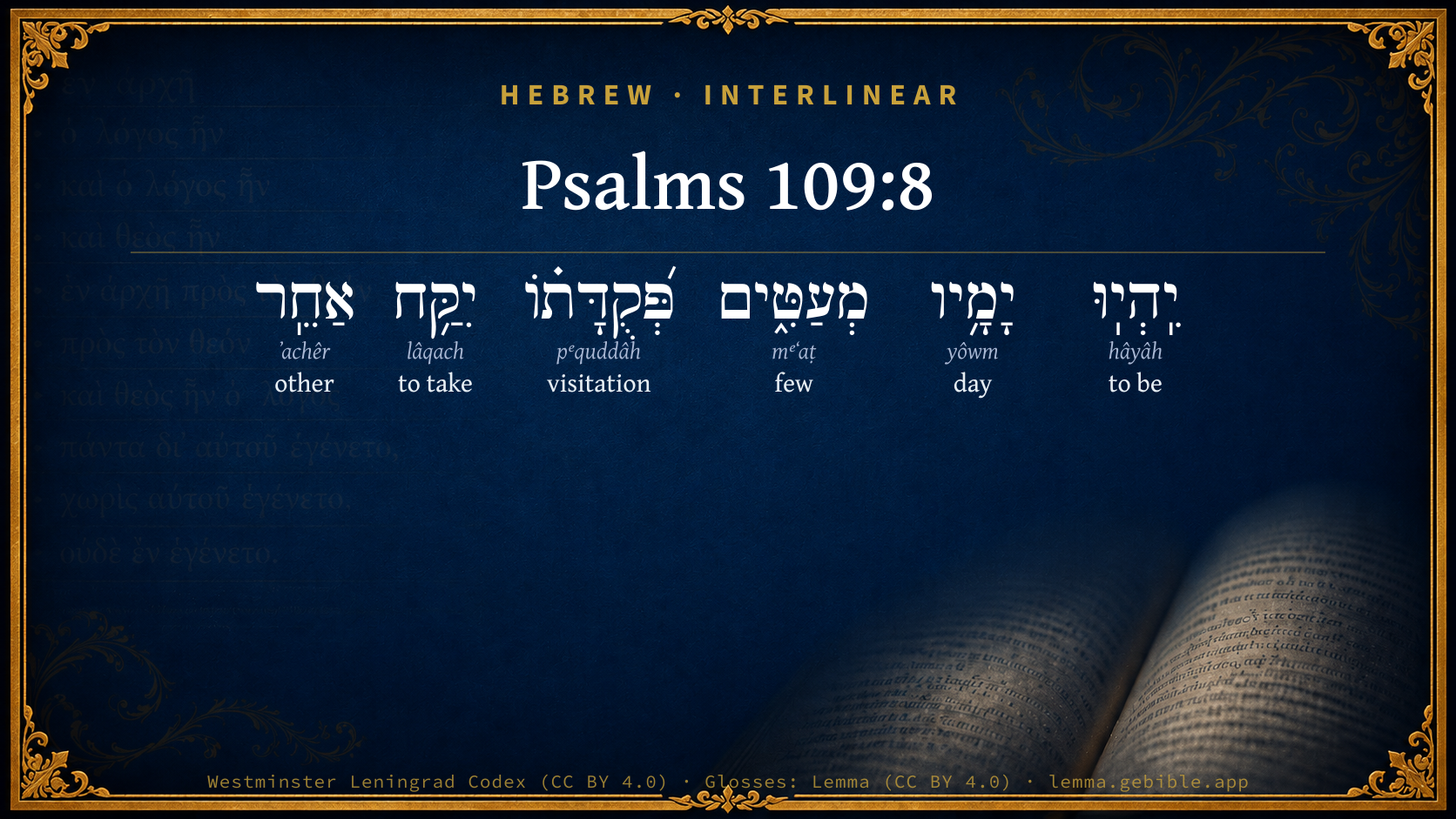
Psalms 109:8

Hebrew (Westminster Leningrad Codex) Psalms 109:8 appears in the Hebrew Old Testament. The text above is from the Westminster Leningrad Codex. Each word links to its Strong’s number, a concise gloss, and parsing drawn from the Open Scriptures Hebrew Bible morphology. Click any word for its full Brown-Driver-Briggs (BDB) entry.
Download image
Cite this verse

Psalms 109:8 (World English Bible). Public Domain. Lemma interlinear Bible study tool, https://lemma.gebible.app/v/psalms/109/8.

Show BibTeX & RIS
BibTeX
RIS
English Translation
Let his days be few. Let another take his office.
World English Bible · Public Domain
Download a study sheet

One document with this verse’s original text, its word-by-word gloss line, the meaning frame, cross-references with their text, attributed commentary, and full source and license credits — printable, and it pastes into notes with its structure intact.

This verse Autodidact and up

Study sheet (.html) Plain text (.txt)

A passage Seminary Student

Up to 50 verses in one chapter. A passage sheet keeps up to 6 commentary sources and 12 cross-references per verse, in the order this page ranks them, and says so on the sheet whenever that leaves anything out. Ask for a single verse and you get the Autodidact verse sheet above.

Everything on this page stays free to read, with no account — the sheet is a download of what is already on screen, not access to it.

Want to remove ads? Support Godless Engineer
Compare translations 3

The same verse in 3 English versions, stacked beneath the original-language interlinear above. Click any original word for its lexicon entry.

Each is an independent rendering of the whole verse — the interlinear is not word-aligned to these translations.

Highlighted words mark where these versions differ — a whole-verse word diff, not a word-by-word alignment.

  • World English Bible Public Domain
    Let his days be few. Let another take his office.
  • King James Version Public Domain
    Let his days be few; and let another take his office.
  • unfoldingWord Literal Text CC BY-SA 4.0
    May his days be few; may another take his position.

unfoldingWord Literal Text — © unfoldingWord, licensed CC BY-SA 4.0. Word-aligned USFM3 via Door43 (git.door43.org/unfoldingWord/en_ult).

Versions to compare (up to 4)

3 of 4 selected

Show all 18 translations

Every available English version of this verse, each an independent rendering of the whole verse.

  • World English Bible Public Domain
    Let his days be few. Let another take his office.
  • Berean Standard Bible Public Domain
    May his days be few; may another take his position.
  • Majority Standard Bible Public Domain
    May his days be few; may another take his position.
  • King James Version Public Domain
    Let his days be few; and let another take his office.
  • American Standard Version (1901) Public Domain
    Let his days be few; `And' let another take his office.
  • Revised Version (1885) Public Domain
    Let his days be few; and let another take his office.
  • Geneva Bible (1599) Public Domain
    Let his daies be fewe, and let another take his charge.
  • Douay-Rheims (1899) Public Domain
    May his days be few: and his bishopric let another take.
  • Young's Literal Translation Public Domain
    His days are few, his oversight another taketh,
  • Literal Standard Version CC BY-SA 4.0
    His days are few, another takes his oversight,
  • Unlocked Literal Bible CC BY-SA 4.0
    May his days be few; may another take his office.
  • unfoldingWord Literal Text CC BY-SA 4.0
    May his days be few; may another take his position.
  • Darby Bible Public Domain
    Let his days be few, let another take his office;
  • World Messianic Bible Public Domain
    Let his days be few. Let another take his office.
  • Webster's Bible Public Domain
    Let his days be few; and let another take his office.
  • Free Bible Version CC BY-SA 4.0
    May his life be short; let someone else take over his position.
  • Bible in Basic English Public Domain
    Let his life be short; let another take his position of authority.
  • JPS Tanakh (1917) Public Domain
    Let his days be few; let another take his charge.

Literal Standard Version (2020), Covenant Press — licensed CC BY-SA 4.0. Text via the HelloAO Bible API (eBible.org). Unlocked Literal Bible (unfoldingWord) — licensed CC BY-SA 4.0. Text via the HelloAO Bible API (eBible.org). unfoldingWord Literal Text — © unfoldingWord, licensed CC BY-SA 4.0. Word-aligned USFM3 via Door43 (git.door43.org/unfoldingWord/en_ult). Free Bible Version, Dr. Jonathan Gallagher — licensed CC BY-SA 4.0. Text via the HelloAO Bible API (eBible.org).

Word by word

More ways to search: Search by grammar → Find every occurrence → Compare this word →

Practice this passage: Drill this verse → Learn its vocabulary →

About this verse

These counts appear in no published source. They are computed here, from the morphology-tagged text and Lemma’s own curated glosses. What Lemma adds →

6
words
6
distinct lemmas
Wisdom
section

Shared distinctive vocabulary

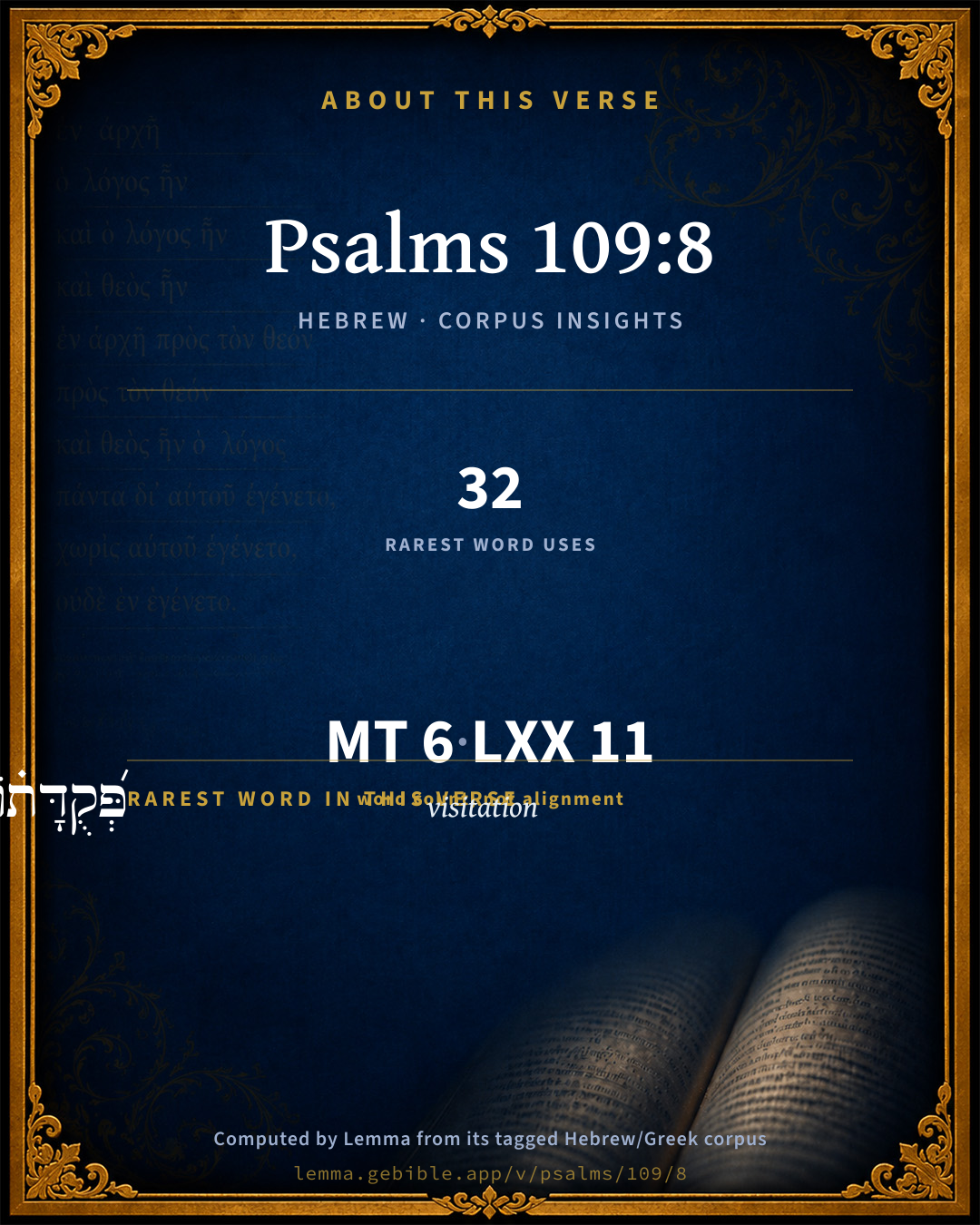
פְּ֝קֻדָּת֗וֹ visitation H6486 occurs in 31 verses of the Hebrew Bible. Also found in:

Grammatical profile

  • 2 verbs
  • 2 nouns
  • 2 adjectives

Verb forms

  • יִֽהְיֽוּ Qal · Imperfect
  • יִקַּ֥ח Qal · Imperfect

Hebrew & Septuagint length

In English translation the verse runs 10 words from the Hebrew and 13 from the Septuagint (LXX English) — closely comparable.

A rough comparison of the two English renderings, which tokenize alike — not a word-level alignment.

Word counts can differ between the Hebrew and the Greek without any difference in meaning — e.g. the Hebrew direct-object marker אֵת has no separate Greek word, and Greek often adds the article ὁ.

In the original languages it is 6 Hebrew tokens and 11 Greek tokens — but the two are counted differently (Hebrew bundles its prefixes and suffixes into one token; the Greek is in lemma form), so that isn’t a like-for-like length.

Cross-references

3

Topical passages linked to Psalms 109:8 in the Treasury of Scripture Knowledge — connected by theme and wording, ordered by reader-vote popularity; previews shown in the World English Bible.

  • Psalms 55:23 But you, God, will bring them down into the pit of destruction. Bloodthirsty and deceitful men shall not live out half their days, But I will trust in you.
  • Acts 1:16–26 "Brothers, it was necessary that this Scripture should be fulfilled, which the Holy Spirit spoke before by the mouth of David concerning Judas, who was guide to those who took Jesus.
  • Matthew 27:5 He threw down the pieces of silver in the sanctuary, and departed. He went away and hanged himself.

Cross-references courtesy of OpenBible.info (CC BY 4.0).

Hebrew and Greek witnesses Masoretic Hebrew ↔ Greek Septuagint

The same verse in the two great witnesses to the Old Testament, shown verse-for-verse.

You’re reading Greek Psalm 108 (Hebrew Psalm 109). The Septuagint counts the superscription, so verse numbers can differ from the Hebrew — chapter-level alignment, not verse-by-verse. Numbering follows Rahlfs.

These are two independent witnesses, not word-aligned to each other, and the Septuagint is shown in lemma (dictionary) form.

Hebrew Psalms 109:8 Masoretic · Westminster Leningrad Codex

יִֽהְיֽוּ יָמָ֥יו מְעַטִּ֑ים פְּ֝קֻדָּת֗וֹ יִקַּ֥ח אַחֵֽר

Let his days be few. Let another take his office.

World English Bible · Public Domain

Greek LXX Greek Psalm 108:8 Septuagint · lemma form

γίγνομαι ὁ ἡμέρα αὐτός ὀλίγος καί ὁ ἐπισκοπή αὐτός λαμβάνω ἕτερος

Let his days be few: and let another take his office of overseer.

LXX2012 (modern English Septuagint) · Public Domain

On this verse, J. A. Alexander on Psalms discusses the Septuagint’s reading. Read the note in Commentary ↓

Hebrew: Westminster Leningrad Codex (CC BY 4.0). Greek: Septuagint (public domain); English from LXX2012 (modern English Septuagint) (Public Domain). How the Septuagint differs from the Hebrew →

Commentary

Notes on Psalms 109:8 from classic Christian and Jewish commentators (each source and its license shown beneath its notes). The classic Christian expositions comment on the surrounding passage and are grouped to its opening verse, so a note may address several verses; the Jewish commentaries on the Tanakh (Rashi and others) are per-verse, so they appear only where the commentator wrote on this verse.

Lemma curates 59 commentaries, every one of them public domain or Creative Commons licensed, each selected and text-cleaned for this edition rather than reprinted as found. About our sources →

Trapp's Complete Commentary

John Trapp

Psa 109:8 Let his days be few; [and] let another take his office.

Ver. 8. Let his days be few] Let his execution be hastened, as Haman’s was. Ahithophel and Judas were their own deathsmen. Doeg, doubtless, came to an ill end; and so did other persecutors. See the Book of Martyrs.

And let another take his office] Praefecturam. Officers are ofttimes the Church’s chief enemies; Popish bishops especially, as here in Queen Mary’s days. Judas was guide to those that took Jesus, Act 1:16; Act 1:20.

John Trapp, A Commentary or Exposition upon All the Books of the Old and New Testament (1647–1656) — public domain. Text from a community e-Sword module.

The Biblical Illustrator

Joseph S. Exell

Psa_109:8

Let his days be few; and let another take his office.

The outcasts place filled

(for St. Matthias Day):--The words in themselves sound simple enough; they might seem to speak of no more than all human beings must undergo, by the necessity of their mortal nature. All our days are few: they are but as grass, they are gone almost before we can count them. All our places, stations, and offices, whatever they may be, must soon pass away from us, and another take them in our place. But this, the common lot of all, is here turned into a fearful and peculiar curse, for those who slight high privileges, and betray sacred trusts. The instance of Judas is a very plain one, for showing forth the dealings of Gods providence in this respect. His short life as an apostle would have been a blessing, had he been such as St. James, the first of the twelve who came to his great reward: he would have departed, and been with Christ so much the sooner. But as it was, what judgment could be more fearful? Thus his days were signally cut short; and as to another taking his office, St. Peter reminded the disciples that the Scriptures concerning him were of course to be fulfilled, especially two which he specified: Let his habitation be desolate, and let no man dwell therein; and, His bishopric let another take. Now, it is a serious thought for us all, If Judas Iscariot, who, favoured as he was, had never received the Holy Ghost; if the Jewish people, whose highest privileges were but a shadow of what we receive in Baptism,--if they had their days cut off by so dreadful a sentence, and their place in Gods world given over to others: what are Christians, what are Christian pastors to expect, should they prove, after all, unclean and unworthy? The nearer Christ has called us to Himself, the more dangerous surely are the first beginnings and whispers of sin; and the nearer we have ventured to approach, the greater advantage have we given to Satan, except we tried in earnest to purify our hearts and desires. No doubt, St. Matthias himself may have had trembling thoughts like these, wherewith to keep himself lowly and humble, when he was called to so great an honour, so high a place in the Church. What must have been the new apostles thoughts, when he was thus put in mind of Judass place! How earnestly must he have prayed in his secret heart, that such place, or a worse, might never be his own! I say a worse; for must it not be worse for those who, besides Judass other privileges, have also that which is above all, union with Christ by His Holy Spirit, and yet fall away as Judas did? That privilege Matthias received within a few days, when the Holy Ghost came down upon the assembled apostles, and he never forfeited its; he went on glorifying God as an apostle, until he was permitted to glorify Him as a martyr. Or how can a sinner ever be thankful enough that it is not yet over with him; that he has still time, he knows not how much, to humble and punish himself heartily for his great imperfection and unworthiness; to watch and break himself of all beginnings of sin; to subdue the flesh to the Spirit; in all things; to acquaint himself with God in all the ways of His Church; to fear always; and to be more faithful and true in every part of his calling towards God and man? (Plain Sermons by contributors to the Tracts for the Times.)

The Apostleship of St. Matthias

There is a fearful light, as it were, around the Apostleship of Matthias. We cannot think of him without recalling his memory who went before. Surely, we imagine, he must have gone about the work of an apostle With a fear and trembling which even Peter never knew.

1. It is remarkable that the sin of Judas was amongst those particulars of the life and sorrows of the Saviour of the world which were not obscurely predicted in the Old Testament. He was placed upon his trial; a certain position given him, a position of vast privileges. These Scriptures were amongst the means vouchsafed to enable him to maintain his station in the spiritual world, and finish the work given him to do. Now, the state of Judas thus viewed is a very correct type of our own. Consider for a moment the Christian Church itself. It stands indeed to the Jewish race, as Matthias to Iscariot. The Israelites were the first called to be Gods special servants; to them was the commission given to keep alive the remembrance of His name, to make His praise to be glorious. They betrayed the trust; they adhered not to His worship; they gave His honour to another; they stoned His prophets; they rejected His Son! And then went forth the decree, Let their days be few, and let another take their office. There is a voice from the past to the present, from the old Israel to the new, which bids us not be high minded, but fear, as those who fill a traitors place. And when we extend our thoughts from the Christian Church to the whole human race, we find the same to hold good. There is much to confirm the idea, that the creation of man had its origin in the fall of Satan and his angels. Before us is now placed the choice which ages ago was given to Satan and his legions--the choice whether in sincerity and truth we will be the servants of the Son of God. We are on our trial now, as they were before the pillars of the earth were set up; but with this advantage, that like Judas, who sinned after their manner, we have warnings against the consequences of rebellion. He with the example of their sin and punishment, fell into the same sin, viz. the disowning the Only Begotten. We, with his example also, are called to stand where they stood, and exhibit the obedience which they withheld.

2. But there are deducible from the foregoing remarks, certain truths touching our relation to God.

(1) For example, we learn in a most striking manner from what has been advanced, the sureness with which Gods will is accomplished, sooner or later. God has no need of our services; He requires not our obedience; our very sins help on His designs. If we are obedient, He will work through us; if disobedient, He equally bends us to His purpose; or it may be, blots us out of the book of the living, and calls others into existence to do that which we refused; and all without the least pause in the majestic march of His providence. If we resist, it costs Him nothing to say, Let another take His office.

(2) Again, we cannot but press upon you the wonderful uniformity of the test to which God has subjected all His creatures; the test is simply, loyalty to the Only Begotten Son. There are but two kingdoms, the kingdom of light and the kingdom of darkness; but two monarchs, the Lord Jesus, upon the right hand of the Father, and the outcast archangel, in the fiery abyss. And all choice between good and evil, right and wrong, is a choice between these. (Bishop Wood ford.)

The Biblical Illustrator, edited by Joseph S. Exell (c. 1880s–1900s) — public domain. Text from a community e-Sword module.

Joseph Benson's Commentary

Psa 109:8. Let his days be few — The days of his life. Let him die an untimely death. So did Ahithophel, and so did Judas; both hanging themselves. And let another take his office — Made void by his death. This is the clause which St. Peter has cited and applied to Judas, in his discourse to the disciples, at the election of Matthias into Judas’s place. He cites, at the same time, a clause from Psa 69:25; Let their habitation be desolate, and let no man dwell therein. This latter sentence, though in the plural number in the Hebrew, yet is applied by St. Peter in the singular number to Judas. The passage in this Psalm is singular, “yet applicable,” says Dr. Horne, “not to Judas only, but to the whole nation of the Jews; whose days, after they had crucified the Lord of glory, were few; who were dispossessed of the place and office which they held as the church of God, and to which, with all its honours and privileges, the Gentile Christian Church succeeded in their stead, when the Aaronical priesthood was abolished, and that of the true Melchisedek established for ever.”

Joseph Benson's Commentary on the Old and New Testaments (1811–1818) — public domain. Text from a community e-Sword module.

J. A. Alexander on Psalms

Joseph Addison Alexander

8. (Psa 109:8) Let his days be few—his office let another take. The word translated office is a collateral derivative of the verb at the beginning of Psa 109:6, and means commission, charge. This expression makes it still more probable that a real individual is referred to, as the possession of a charge or office could not be common to the whole class of malignant enemies. The Septuagint version is oversight or supervision, corresponding exactly to the meaning of the Hebrew verb in Psa 109:6. This translation is retained in Acts i. 20, where the verse before us is expressly quoted by Peter as "written in the book of Psalms," and applied to the case of Judas Iscariot.

Joseph Addison Alexander, The Psalms Translated and Explained (1850) — public domain. Text from a community e-Sword module.

Tyndale Open Study Notes

Tyndale Open Resources

109:8-11 Family members of those guilty of capital crimes often died with the perpetrator (Num 16:1-33; Josh 7:1-25) or had their property confiscated (1 Kgs 21:13-16).

109:8 The wicked person apparently held a position of leadership. Peter referred to this psalm in regard to Judas Iscariot (Acts 1:20-26).

Tyndale Open Study Notes — © Tyndale Open Resources, licensed CC BY-SA 4.0. Text via the HelloAO Bible API.

Geneva Bible (1599)

Geneva Bible translators

This was chiefly accomplished in Judas, Acts 1:20.

Geneva Bible (1599) marginal notes — public domain. Text via Bolls.life.

Adam Clarke's Commentary

Verse 8. Let another take his office.] The original is פקדתו pekuddatho, which the margin translates charge, and which literally means superintendence, oversight, inspection from actual visitations. The translation in our common Version is too technical. His bishopric, following the Septuagint, επισκοπην, and Vulgate, episcopatum, and has given cause to some light people to be witty, who have said, "The first bishop we read of was bishop Judas." But it would be easy to convict this witticism of blasphemy, as the word is used in many parts of the sacred writings, from Genesis downward, to signify offices and officers, appointed either by God immediately, or in the course of his providence, for the accomplishment of the most important purposes. It is applied to the patriarch Joseph, Ge 39:4, ויפקדהו vaiyaphkidehu, he made him bishop, alias overseer; therefore it might be as wisely said, and much more correctly, "The first bishop we read of was bishop Joseph;" and many such bishops there were of God's making long before Judas was born. After all, Judas was no traitor when he was appointed to what is called his bishopric, office, or charge in the apostolate. Such witticisms as these amount to no argument, and serve no cause that is worthy of defence.

Our common Version, however, was not the first to use the word: it stands in the Anglo-Saxon [A.S.], "and his episcopacy let take other." The old Psalter is nearly the same; I shall give the whole verse: Fa be made his days, and his bysshopryk another take. "For Mathai was sett in stede of Judas; and his days was fa that hynged himself."

Adam Clarke's Commentary on the Bible (1810–1826) — public domain. Text from a community e-Sword/MySword module.

John Calvin's Commentaries

8 Let his days be few Although this world is the scene of much toil and trouble, yet we know that these are pledges and proofs of God’s loving-kindness, inasmuch as he frequently, and as a token of his love, promises to prolong the lives of men; not that it is absolutely necessary for us to remain long here, but that we may have an opportunity of sharing of God’s fatherly love which he bears towards us, by which we may be led to cherish the hope of immortality. Now, in opposition to this, the brevity of human life is here introduced as a mark of God’s disapprobation; for when he cuts off the wicked after a violent manner, he thus testifies that they did not deserve to breathe the breath of life. And the same sentiment is inculcated when, denuding them of their honor and dignity, he hurls them from the place of power and authority. The same thing may also happen to the children of God, for temporal evils are common to the good and to the bad; at the same time, these are never so mingled and blended together, but that one may perceive occasionally the judgments of God in a very manifest and marked manner. Peter, quoting this verse, Acts 1:20, says it behoved to be fulfilled in Judas, because it is written here, “let another take his bishopric.” And this, he does on the assumed principle of interpretation that David here spoke in the person of Christ. To this it cannot be objected, that the Hebrew term פקודה, pekudah, signifies generally superintendence, because Peter very properly applies it to the apostleship of Judas. In expounding this passage, sometimes in reference to a wife, or to the soul, (which is a precious jewel in man,) or to wealth and property, there is good reason to believe that, in doing so, the Jewish interpreters are actuated by pure malice. What purpose can it serve to pervert the sense of a word, the meaning of which is so pointed and plain, unless that, under the influence of a malignant spirit, they endeavor so to obscure the passage, as to make it appear not to be properly quoted by Peter? From these words we learn, that there is no cause why the ungodly should be proud while their reputation is high in this world, seeing they cannot after all escape from that doom which the Holy Spirit here declares awaits them. Here too we are furnished with very valuable matter of comfort and patience, when we hear that, however elevated may be their rank and reputation now, their downfall is approaching, and that they will soon be stript of all their pomp and power. In the two succeeding verses the malediction is extended both to the wife and children; and the desire, that she may be left a widow and they become fatherless, depends upon the brevity of that life to which the prophet formerly adverted. Mention is likewise made of beggary, and the want of all the necessaries of life, which is a proof of the magnitude of their guilt; for assuredly the Holy Spirit would not denounce against them a punishment so grievous and heavy for a trivial offense. In delivering up his property as booty to the extortioners, David must be understood as alluding to the poverty which was to overtake his children; for he is not speaking of a poor and mean person who at his death can leave nothing to his family, but of one who, regardless of right or wrong, has amassed wealth to enrich his children, but from whom God takes away the goods which he had unrighteously taken from others.

John Calvin's Commentaries (1540-1563) — public domain. Text from the Calvin Translation Society English edition (1840s-50s) via the Christian Classics Ethereal Library (ccel.org). Calvin's coverage is partial (roughly two-thirds of the Bible); uncommented books and verses are honest gaps, never fabricated. The 19th-century editor's footnotes and remarks are omitted so the notes are faithfully Calvin's own voice.

Ellicott's Commentary for English Readers

(8) Office.—See Note, Psa_109:6. Evidently some post of power and influence.

A Bible Commentary for English Readers, edited by Charles John Ellicott (1878–1897) — public domain. Text from a community e-Sword module.

The Cambridge Bible for Schools and Colleges

gen. ed. J. J. S. Perowne

8. Let his life come prematurely to an end (Psa_37:35-36; Psa_55:23), and let another man succeed him in his post of authority: or perhaps, let his life be short and withal dishonoured by degradation from his office. Cp. Isa_22:19 ff. The rendering let another take his store is less probable.

The second clause is quoted together with Psa_69:25 in Act_1:20. Judas was the antitype of the man who requited love with treachery, and the words of Scripture are appealed to as a solemn sanction for filling up his office by the election of another Apostle.

The Cambridge Bible for Schools and Colleges (gen. ed. J. J. S. Perowne; Cambridge University Press, 1878–1918) — public domain. Text from a community e-Sword module.

John Gill's Exposition

Let his days be few,.... The days of men in common are but few at most: length of days, either beyond or according to the usual term of life, is reckoned a blessing; and to be cut off in the midst of a man's days a curse; when this is by the immediate hand of God, as a visible token of his displeasure; or by the hand of the civil magistrate, for some capital offence; or by a man's own hands, which was the case of Judas; whose days were but few, in comparison of the other apostles, who outlived him many years; especially the Apostle John, who lived sixty years after, at least. The Syriac version renders it, "let their days be few"; and so it reads the whole context in the plural number, both in the verses preceding and following; and the whole may be interpreted of the Jews, as it is by Theodoret, as well as of Judas; since they were concerned in the same sin, and are equally charged as the betrayers and murderers of Christ, Act 7:52, and their days as a nation and church after the death of Christ were very few; within forty years, or thereabout, their city and temple were destroyed.

And let another take his office; or bishopric, as the Septuagint version and the Apostle Peter call it; who cites this passage, and applies it to Judas, in Act 1:20. His office was the office of an apostle, an high and honourable one, the chief office in the church: it was a charge, as the word signifies; a charge of souls, an oversight of the flock; which is to be taken not by constraint, but willingly; not for filthy lucre's sake, but of a ready mind. Judas took it for filthy lucre's sake, and it was taken away from him, and given to another; to Matthias, on whom the lot fell, and who was numbered with the apostles in his room, Act 1:21. This is true also of the priests, Scribes, and Pharisees, who were divested of their offices in a very little time; three shepherds were cut off in one month, Zac 11:8. There being a change of the priesthood, law, and ordinances, there was a change of offices and officers; new ordinances were appointed by Christ, and new officers created, on whom gifts were bestowed suitable to their work.

John Gill's Exposition of the Whole Bible (1746–1763) — public domain (CC PDM 1.0). Text via the HelloAO Bible API.

Albert Barnes' Notes on the Bible

Let his days be few - Let him be soon cut off; let his life be shortened. It cannot be wrong for an officer of justice to aim at this; to desire it; to pray for it. How strange it would be for a magistrate to pray “that a murderer or a traitor should be long lived!”

And let another take his office - So every man acts, and practically prays, who seeks to remove a bad and corrupt man from office. As such an office must be filled by someone, all the efforts which he puts forth to remove a wicked man tend to bring it about that “another should take his office;” and for this it is “right” to labor and pray. The act does not of itself imply malignity or bad feeling, but is consistent with the purest benevolence, the kindest feelings, the strictest integrity, the sternest patriotism, and the highest form of piety. The word rendered office here is in the margin “charge.” It properly denotes a “mustering, an enumeration;” then, care, watch, oversight, charge, as in an army, or in a civil office. In Act 1:20, this passage is applied to Judas, and the word - the same word as in the Septuagint here - is rendered in the text “bishopric,” in the margin, “office.” See the notes at that passage. It had no original reference to Judas, but the language was exactly adapted to him, and to the circumstances of the case, as it is used by the apostle in that passage.

Albert Barnes' Notes on the Bible (1834–1885) — public domain. Text from a community e-Sword/MySword module.

Matthew Poole's English Annotations

Let his days be few; the days of his life. Let him die an untimely death.

His office, made void by his death. He also implies that his enemy was a man of power and reputation.

Matthew Poole's English Annotations on the Holy Bible (1683–1685) — public domain. Text from a community e-Sword/MySword module.

The Treasury of David

Charles H. Spurgeon

Ver. 8. Let his days be few. Who would desire a persecuting tyrant to live long? As well might we wish length of days to a mad dog. If he will do nothing but mischief the shortening of his life will be the lengthening of the world's tranquillity. "Bloody and deceitful men shall not live out half their days", this is bare justice to them, and great mercy to the poor and needy.

And let another take his office. Perhaps a better man may come, at any rate it is time a change were tried. So used were the Jews to look upon these verses as the doom of traitors, of cruel and deceitful mind, that Peter saw at once in the speedy death of Judas a fulfilment of this sentence, and a reason for the appointment of a successor who should take his place of oversight. A bad man does not make an office bad: another may use with benefit that which he perverted to ill uses.

Ver. 8. Let his days be few. By "his days", he meant the days of his apostleship, which were few; since before the passion of our Lord, they were ended by his crime and death. And as if it were asked, What then shall become of that most sacred number twelve, within which our Lord willed, not without a meaning, to limit his twelve first apostles? he at once addeth, and let another take his office. As much as to say, let both himself be punished according to his desert, and let his number be filled up. And if any one desire to know how this was done, let him read the Acts of the Apostles. Augustine.

Ver. 8. Let another take his office. So every man acts, and practically prays, who seeks to remove a bad and corrupt man from office. As such an office must be filled by some one, all the efforts which he puts forth to remove a wicked man tend to bring it about that "another should take his office", and for this it is right to labour and pray. The act does not of itself imply malignity or bad feeling, but is consistent with the purest benevolence, the kindest feelings, the strictest integrity, the sternest patriotism, and the highest form of piety. Albert Barnes.

Ver. 8. Let his days be few. Sin the great shortener of human life. After the flood the whole race lived a shorter time; passion and avaricious care shorten life, and some sins have a peculiar power to do this, lust, drunkenness, & c.

Psalms 109:9*

Charles H. Spurgeon's The Treasury of David (1869–1885) — public domain. Psalms only. Text from a community e-Sword/MySword module.

Whedon's Commentary on the Bible

Daniel D. Whedon

8. Let his days be few—His days shall be few. A prediction and a warning founded on the justice of God, by which “bloody and deceitful men shall not live out half their days.” Psa_55:23. The verbs in this last passage quoted, and in the text, are in the same conjugation and tense, and should be rendered alike, in the declarative future, not the imperative. The full meaning is: “As he intended to have shortened my days, so let his days be few.”—Hengstenberg.

Let another take his office—Quoted verbatim from the Septuagint, and applied to Judas Iscariot, Act_1:20. The word “office” means, a superior office, that of oversight; Greek, επισκοπη, episcope, English version, (Act_1:20,) bishopric. See Num_1:50; Neh_12:44; Jer_1:10. Doeg, David’s enemy, held the office of overseer of Saul’s herdsmen, an important position, (1Sa_21:7,) and it would seem, also, that of a prime minister of his court. 1Sa_22:9. High in office and base in character, he was a fit type of the arch traitor who “by transgression fell.” Act_1:25

Daniel D. Whedon (gen. ed.), Commentary on the Old and New Testaments (1874–1909) — public domain. Text from a community e-Sword module.

The Pulpit Commentary

Let his days be few. There were Divine promises that "bloodthirsty and deceitful men" should not "live out half their days," which might naturally be regarded as justifying this wish. (see Psa_55:23 Pro_10:27 Ecc_7:17) And let another take his office. Th , LXX Applied by St. Peter to Judas. (Act_1:20)

The Pulpit Commentary (1880–1919), ed. H.D.M. Spence-Jones & Joseph S. Exell — public domain. Text from a community e-Sword module.

unfoldingWord translationNotes

Door43 World Missions Community

May his days be few

The phrase "his days" refers to the length of his life. AT: "May he not live a long time" (See: Idiom)

his office

"his position of authority"

handouts

food or money given to beggars

their ruined home

"their destroyed homes"

translationWords

day

beg

ruin

unfoldingWord translationNotes — © Distant Shores Media and the Door43 World Missions Community, licensed CC BY-SA 4.0. Source: git.door43.org/Door43/en_tn.

Rashi

Rabbi Shlomo Yitzchaki (Rashi)

his office of dignity Heb. פקדתו, his greatness, provostie or pruvote in Old French, like (Esther 2: 3): “And let the king appoint officers (פקידים).”

Rashi on the Tanakh — English translations: “The Judaica Press complete Tanach with Rashi, translated by A. J. Rosenberg” (CC BY 4.0); “Pentateuch with Rashi's commentary by M. Rosenbaum and A.M. Silbermann, 1929-1934” (public domain); “The Metsudah Tanach series, Lakewood, N.J” (CC BY 4.0); and “The Book of Joshua, Metsudah Publications, 1997” (CC BY 4.0). Text via Sefaria.

Lesson kit

Teaching starters — assembled from the data on this page, not authored interpretation. Every prompt links to the verse data it draws on. Edit before teaching.

Psalms, in the Wisdom, opens this verse with 6 words (6 distinct Hebrew lemmas). Its most distinctive word is pᵉquddâh (“visitation”). A historical commentator’s framing appears above. Read the whole chapter for the surrounding context.

Discussion questions

  1. The word pᵉquddâh carries the sense “visitation.” How does it shape the verse?
  2. Numbers 3:32 shares the word «visitation» with this verse. How do the two illuminate each other?
  3. These translations render this verse differently; the difference is in the English rendering, not the original. What questions does that raise?
  4. The verb «יִֽהְיֽוּ» is Qal Imperfect. How does its form color the action?
  5. Reading how Trapp's Complete Commentary and The Biblical Illustrator read this verse, where do the two commentators agree and where do they part?

Things to notice

Reading settings

Reading text

Shown beneath each verse's original-language words.

Old Testament
Old Testament edition

Read the OT as the Masoretic Hebrew (MT) or the Greek Septuagint (LXX).

English shown for the Greek Septuagint (in the Hebrew ↔ Greek comparison).

Comparing translations? Open the Compare panel on any verse page to stack up to four side by side.