
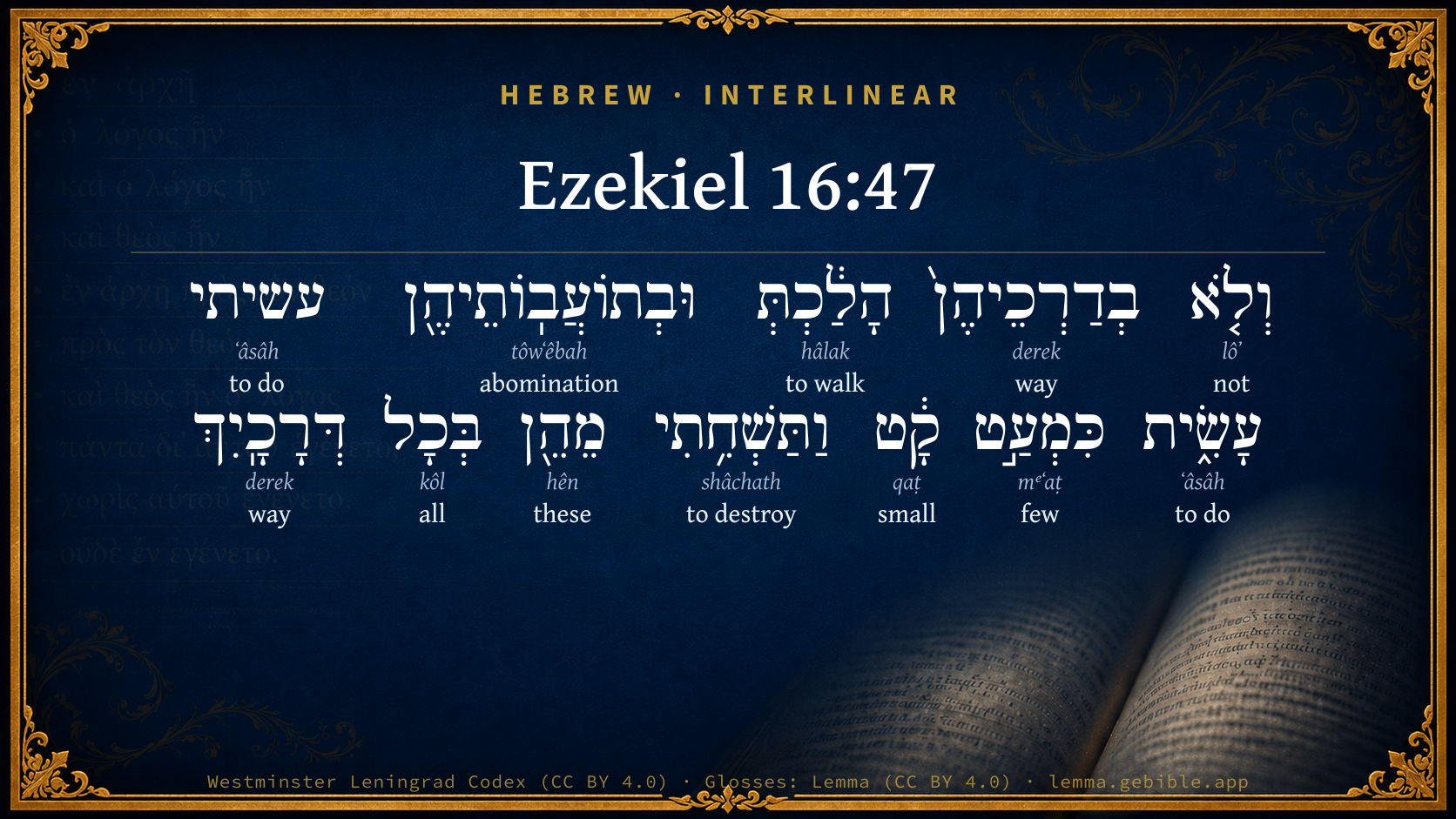
Ezekiel 16:47

Hebrew (Westminster Leningrad Codex) Ezekiel 16:47 appears in the Hebrew Old Testament. The text above is from the Westminster Leningrad Codex. Each word links to its Strong’s number, a concise gloss, and parsing drawn from the Open Scriptures Hebrew Bible morphology. Click any word for its full Brown-Driver-Briggs (BDB) entry.
Download image
Cite this verse

Ezekiel 16:47 (World English Bible). Public Domain. Lemma interlinear Bible study tool, https://lemma.gebible.app/v/ezekiel/16/47.

Show BibTeX & RIS
BibTeX
RIS
English Translation
Yet have you not walked in their ways, nor done after their abominations; but, as [if that were] a very little [thing], you were more corrupt than they in all your ways.
World English Bible · Public Domain
Highlights
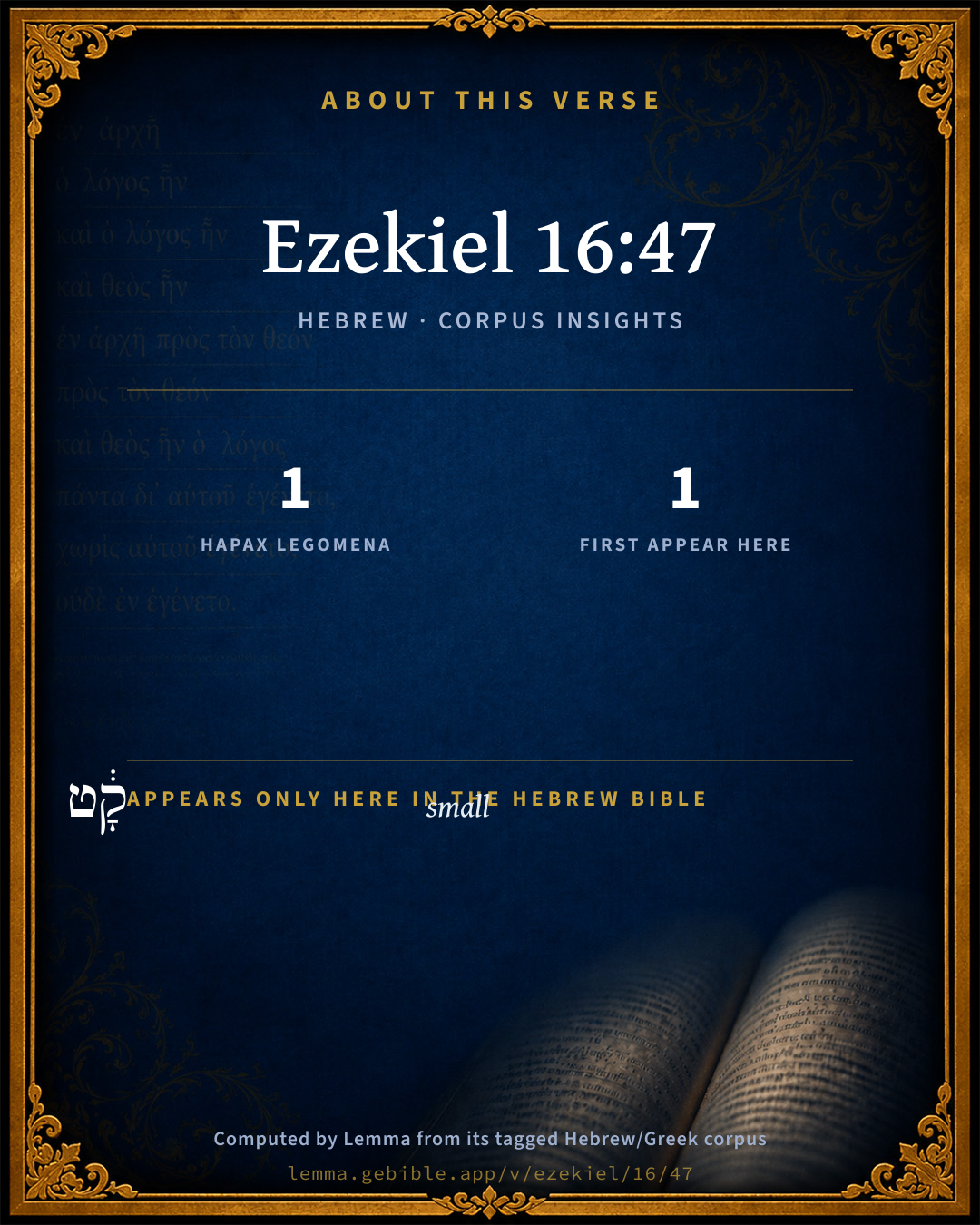
  • 1 hapax legomenon — only here in the Hebrew Bible
  • 1 first appearance in the Hebrew Bible
Full analysis ↓
Download a study sheet

One document with this verse’s original text, its word-by-word gloss line, the meaning frame, cross-references with their text, attributed commentary, and full source and license credits — printable, and it pastes into notes with its structure intact.

This verse Autodidact and up

Study sheet (.html) Plain text (.txt)

A passage Seminary Student

Up to 50 verses in one chapter. A passage sheet keeps up to 6 commentary sources and 12 cross-references per verse, in the order this page ranks them, and says so on the sheet whenever that leaves anything out. Ask for a single verse and you get the Autodidact verse sheet above.

Everything on this page stays free to read, with no account — the sheet is a download of what is already on screen, not access to it.

Want to remove ads? Support Godless Engineer
Compare translations 3

The same verse in 3 English versions, stacked beneath the original-language interlinear above. Click any original word for its lexicon entry.

Each is an independent rendering of the whole verse — the interlinear is not word-aligned to these translations.

Highlighted words mark where these versions differ — a whole-verse word diff, not a word-by-word alignment.

  • World English Bible Public Domain
    Yet have you not walked in their ways, nor done after their abominations; but, as [if that were] a very little [thing], you were more corrupt than they in all your ways.
  • King James Version Public Domain
    Yet hast thou not walked after their ways, nor done after their abominations: but, as if that were a very little thing, thou wast corrupted more than they in all thy ways.
  • unfoldingWord Literal Text CC BY-SA 4.0
    You not only walked in their ways and copied their behavior and practices, but in all your ways you have been worse than they were.

unfoldingWord Literal Text — © unfoldingWord, licensed CC BY-SA 4.0. Word-aligned USFM3 via Door43 (git.door43.org/unfoldingWord/en_ult).

Versions to compare (up to 4)

3 of 4 selected

Show all 18 translations

Every available English version of this verse, each an independent rendering of the whole verse.

  • World English Bible Public Domain
    Yet have you not walked in their ways, nor done after their abominations; but, as [if that were] a very little [thing], you were more corrupt than they in all your ways.
  • Berean Standard Bible Public Domain
    And you not only walked in their ways and practiced their abominations, but soon you were more depraved than they were.
  • Majority Standard Bible Public Domain
    And you not only walked in their ways and practiced their abominations, but soon you were more depraved than they were.
  • King James Version Public Domain
    Yet hast thou not walked after their ways, nor done after their abominations: but, as if that were a very little thing, thou wast corrupted more than they in all thy ways.
  • American Standard Version (1901) Public Domain
    Yet hast thou not walked in their ways, nor done after their abominations; but, as `if that were' a very little `thing', thou wast more corrupt than they in all thy ways.
  • Revised Version (1885) Public Domain
    Yet hast thou not walked in their ways, nor done after their abominations; but, as if that were a very little thing, thou wast more corrupt than they in all thy ways.
  • Geneva Bible (1599) Public Domain
    Yet hast thou not walked after their wayes, nor done after their abominations: but as it had bene a very little thing, thou wast corrupted more then they in all thy wayes.
  • Douay-Rheims (1899) Public Domain
    But neither hast thou walked in their ways, nor hast thou done a little less than they according to their wickednesses: thou hast done almost more wicked things than they in all thy ways
  • Young's Literal Translation Public Domain
    And -- in their ways thou hast not walked, And according to their abominations done, As a little thing it hath been loathed, And thou dost more corruptly than they in all thy ways.
  • Literal Standard Version CC BY-SA 4.0
    And you have not walked in their ways, || And done according to their abominations, || It has been loathed as a little thing, || Indeed, you do more corruptly than they in all your ways.
  • Unlocked Literal Bible CC BY-SA 4.0
    You not only walked in their ways and copied their behavior and practices, but in all your ways you have been worse than they were.
  • unfoldingWord Literal Text CC BY-SA 4.0
    You not only walked in their ways and copied their behavior and practices, but in all your ways you have been worse than they were.
  • Darby Bible Public Domain
    And thou hast not walked in their ways, nor done according to their abominations; but as though that were a very little, thou hast been more corrupt than they in all thy ways.
  • World Messianic Bible Public Domain
    Yet you have not walked in their ways, nor done their abominations; but soon you were more corrupt than they in all your ways.
  • Webster's Bible Public Domain
    Yet hast thou not walked after their ways, nor done after their abominations: but as if that were a very little thing, thou wast corrupted more than they in all thy ways.
  • Free Bible Version CC BY-SA 4.0
    You didn't just follow their ways and do the same disgusting things they did, you very quickly became even worse than them.
  • Bible in Basic English Public Domain
    Still you have not gone in their ways or done the disgusting things which they have done; but, as if that was only a little thing, you have gone deeper in evil than they in all your ways.
  • JPS Tanakh (1917) Public Domain
    Yet hast thou not walked in their ways, nor done after their abominations; but in a very little while thou didst deal more corruptly than they in all thy ways.

Literal Standard Version (2020), Covenant Press — licensed CC BY-SA 4.0. Text via the HelloAO Bible API (eBible.org). Unlocked Literal Bible (unfoldingWord) — licensed CC BY-SA 4.0. Text via the HelloAO Bible API (eBible.org). unfoldingWord Literal Text — © unfoldingWord, licensed CC BY-SA 4.0. Word-aligned USFM3 via Door43 (git.door43.org/unfoldingWord/en_ult). Free Bible Version, Dr. Jonathan Gallagher — licensed CC BY-SA 4.0. Text via the HelloAO Bible API (eBible.org).

Word by word

More ways to search: Search by grammar → Find every occurrence → Compare this word →

Practice this passage: Drill this verse → Learn its vocabulary →

קָ֔ט
qaṭ
H6985
“small”
Adjective, Adjective, Masculine, Singular, Absolute
Part of Speech
Adjective
Type
Adjective
Gender
Masculine
Number
Singular
State
Absolute
Full BDB Definition

Origin: from H6990 in the sense of abbreviation

TWOT: 2006 . 1

a small thing, little, merely (adverb) - meaning dubious
  1. וְלֹ֤א lôʼ H3808 “and · not” Conjunction + Particle, Negative
  2. בְדַרְכֵיהֶן֙ derek H1870 “in/at · ways · their” Preposition + Noun, Common, Both, Plural, Construct + Suffix, Personal, 3rd Person, Feminine, Plural
  3. הָלַ֔כְתְּ hâlak H1980 “to walk” Verb, Qal, Perfect, 2nd Person, Feminine, Singular
  4. וּבְתוֹעֲבֽוֹתֵיהֶ֖ן tôwʻêbah H8441 “and · in/at · abominations · their” Conjunction + Preposition + Noun, Common, Feminine, Plural, Construct + Suffix, Personal, 3rd Person, Feminine, Plural
  5. עשיתי ʻâsâh H6213 “to do” Verb, Qal, Perfect, 2nd Person, Feminine, Singular
  6. עָשִׂ֑ית ʻâsâh H6213 “to do” Verb, Qal, Perfect, 2nd Person, Feminine, Singular
  7. כִּמְעַ֣ט mᵉʻaṭ H4592 “like/as · few” Preposition + Noun, Common, Masculine, Singular, Absolute
  8. וַתַּשְׁחִ֥תִי shâchath H7843 “and · to destroy” Conjunction + Verb, Hiphil, Sequential Imperfect, 2nd Person, Feminine, Singular
  9. מֵהֵ֖ן hên H2004 “from · them” Preposition + Suffix, Personal, 3rd Person, Feminine, Plural
  10. בְּכָל kôl H3605 “in/at · all of” Preposition + Noun, Common, Masculine, Singular, Construct
  11. דְּרָכָֽיִךְ derek H1870 “ways · your” Noun, Common, Both, Plural, Construct + Suffix, Personal, 2nd Person, Feminine, Singular

About this verse

These counts appear in no published source. They are computed here, from the morphology-tagged text and Lemma’s own curated glosses. What Lemma adds →

12
words
10
distinct lemmas
Prophets
section

Notable vocabulary

1 hapax legomenon — a word that appears only here in the entire Hebrew Bible:

First appearance in Scripture

This word makes its first canonical appearance in the Hebrew Bible here:

Shared distinctive vocabulary

מֵהֵ֖ן these H2004 occurs in 14 verses of the Hebrew Bible. Also found in:

Grammatical profile

  • 4 verbs
  • 5 nouns
  • 1 adjective
  • 1 preposition
  • 1 particle

Verb forms

  • הָלַ֔כְתְּ Qal · Perfect
  • עשיתי Qal · Perfect
  • עָשִׂ֑ית Qal · Perfect
  • וַתַּשְׁחִ֥תִי Hiphil · Sequential Imperfect

Repetition

Words recur within this verse — often emphatic in Hebrew:

  • בְדַרְכֵיהֶן֙ way H1870 ×2
  • עשיתי to do H6213 ×2

Hebrew & Septuagint length

In English translation the verse runs 32 words from the Hebrew and 29 from the Septuagint (LXX English) — closely comparable.

A rough comparison of the two English renderings, which tokenize alike — not a word-level alignment.

Word counts can differ between the Hebrew and the Greek without any difference in meaning — e.g. the Hebrew direct-object marker אֵת has no separate Greek word, and Greek often adds the article ὁ.

Cross-references

9

Topical passages linked to Ezekiel 16:47 in the Treasury of Scripture Knowledge — connected by theme and wording, ordered by reader-vote popularity; previews shown in the World English Bible.

  • 2 Kings 21:9 But they didn't listen: and Manasseh seduced them to do that which is evil more than did the nations whom Yahweh destroyed before the children of Israel.
  • Ezekiel 5:6–7 She has rebelled against my ordinances in doing wickedness more than the nations, and against my statutes more than the countries that are round about her; for they have rejected my ordinances, and as for my statutes, they have not walked in them.
  • Ezekiel 16:48 As I live, says the Lord Yahweh, Sodom your sister has not done, she nor her daughters, as you have done, you and your daughters.
  • Ezekiel 16:51 Neither has Samaria committed half of your sins; but you have multiplied your abominations more than they, and have justified your sisters by all your abominations which you have done.
  • 1 Kings 16:31 It happened, as if it had been a light thing for him to walk in the sins of Jeroboam the son of Nebat, that he took as wife Jezebel the daughter of Ethbaal king of the Sidonians, and went and served Baal, and worshiped him.
  • 2 Kings 21:16 Moreover Manasseh shed innocent blood very much, until he had filled Jerusalem from one end to another; besides his sin with which he made Judah to sin, in doing that which was evil in the sight of Yahweh.
  • Ezekiel 8:17 Then he said to me, Have you seen [this], son of man? Is it a light thing to the house of Judah that they commit the abominations which they commit here? for they have filled the land with violence, and have turned again to provoke me to anger: and, behold, they put the branch to their nose.
  • John 15:21–22 But all these things will they do to you for my name's sake, because they don't know him who sent me.
  • 1 Corinthians 5:1 It is actually reported that there is sexual immorality among you, and such sexual immorality as is not even named among the Gentiles, that one has his father's wife.

Cross-references courtesy of OpenBible.info (CC BY 4.0).

Hebrew and Greek witnesses Masoretic Hebrew ↔ Greek Septuagint

The same verse in the two great witnesses to the Old Testament, shown verse-for-verse.

These are two independent witnesses, not word-aligned to each other, and the Septuagint is shown in lemma (dictionary) form.

Hebrew Ezekiel 16:47 Masoretic · Westminster Leningrad Codex

וְלֹ֤א בְדַרְכֵיהֶן֙ הָלַ֔כְתְּ וּבְתוֹעֲבֽוֹתֵיהֶ֖ן עשיתי עָשִׂ֑ית כִּמְעַ֣ט קָ֔ט וַתַּשְׁחִ֥תִי מֵהֵ֖ן בְּכָל דְּרָכָֽיִךְ

Yet have you not walked in their ways, nor done after their abominations; but, as [if that were] a very little [thing], you were more corrupt than they in all your ways.

World English Bible · Public Domain

Greek LXX Ezekiel 16:47 Septuagint · lemma form

καί οὐδέ ὡς ἐν ὁ ὁδός αὐτός πορεύομαι οὐδέ κατά ὁ ἀνομία αὐτός ποιέω παρά μικρός καί ὑπερκεῖμαι αὐτός ἐν πᾶς ὁ ὁδός σύ

Yet notwithstanding you have not walked in their ways, neither have you done according to their iniquities within a little, but you have exceeded them in all your ways.

LXX2012 (modern English Septuagint) · Public Domain

On this verse, Haydock's Catholic Bible Commentary discusses the Septuagint’s reading. Read the note in Commentary ↓

Hebrew: Westminster Leningrad Codex (CC BY 4.0). Greek: Septuagint (public domain); English from LXX2012 (modern English Septuagint) (Public Domain). How the Septuagint differs from the Hebrew →

Targum (Aramaic paraphrase)

1

The Targum is the ancient Jewish Aramaic paraphrase of the Hebrew Scriptures — an interpretive translation, not the Hebrew text itself. Onkelos (literal) and Pseudo-Jonathan (expansive) render the Torah, and Jonathan the Prophets. Coverage is partial: where no permissively-licensed English translation exists for a verse, only the Aramaic is shown. This is verse-level text, not a word-by-word alignment to the Hebrew.

  1. Targum Jonathan Prophets (Joshua–Malachi)
    וְאִלוּ בְּאוֹרְחָתְהוֹן הֲלֵיכְתְּ וּכְתוֹעֲבָתְהוֹן עֲבַדְתְּ חֲסוֹךְ הֲוָה חוֹבִיךְ אֱלָהֵין דְאַסְגֵית לְחַבָּלָא מִנְהוֹן בְּכָל אוֹרְחָתָיִךְ:

    (no public-domain English translation for this verse)

    Targum Jonathan — Aramaic: “Mikraot Gedolot” (public domain). English: “Sefaria Community Translation” (CC0 1.0 (public-domain dedication)); “London "Chaldee Paraphrase," 1871” (public domain). Text via Sefaria.

Commentary

Notes on Ezekiel 16:47 from classic Christian and Jewish commentators (each source and its license shown beneath its notes). The classic Christian expositions comment on the surrounding passage and are grouped to its opening verse, so a note may address several verses; the Jewish commentaries on the Tanakh (Rashi and others) are per-verse, so they appear only where the commentator wrote on this verse.

Lemma curates 59 commentaries, every one of them public domain or Creative Commons licensed, each selected and text-cleaned for this edition rather than reprinted as found. About our sources →

Trapp's Complete Commentary

John Trapp

Eze 16:47 Yet hast thou not walked after their ways, nor done after their abominations: but, as [if that were] a very little [thing], thou wast corrupted more than they in all thy ways.

Ver. 47. Yet hast thou not walked after their ways.] But hast out sinned them. Nolunt solita peccare, Do not make a habit of sinning, saith Seneca of some, They will not sin in an ordinary way. Et pudet non esse impudentes, saith Augustine of others; i.e., they are ashamed not to be past shame.

But as if that were a very little thing.] Paululum pauxillumque; A peccadillo.

John Trapp, A Commentary or Exposition upon All the Books of the Old and New Testament (1647–1656) — public domain. Text from a community e-Sword module.

Geneva Bible (1599)

Geneva Bible translators

But done far worse.

Geneva Bible (1599) marginal notes — public domain. Text via Bolls.life.

Jamieson, Fausset & Brown

Robert Jamieson, A. R. Fausset & David Brown

their abominations--Milcom and Chemosh, the "abominations of Ammon and Moab" (Kg1 11:5, Kg1 11:7).

corrupted more than they--So it is expressly recorded of Manasseh (Kg2 21:9).

Jamieson, Fausset & Brown — Commentary Critical and Explanatory on the Whole Bible (1871) — public domain (CC PDM 1.0). Text via the HelloAO Bible API.

John Calvin's Commentaries

Now the Prophet, not content with the simile which he had used, says that the Jews were far worse than either their mothers or sisters. Yet he is not inconsistent, for God wished by degrees to drag the wicked to trial. If at the very first word he had said that they were worse than the Sodomites, they would have been less attentive to this accusation. But when he proposed a thing incredible, namely, that they were the daughters of the nations of Canaan, and the sisters of Samaria and Sodom, and afterwards proceeded further, and pronounced that they surpassed both their mother and sisters, this, as I have said, would stir up their minds more vehemently. This difference then contains no inconsistency, but rather tends to magnify their crimes. You, says he, have not walked according to their ways. He does not here exempt the Jews from participating in sins as if they were faultless through not imitating the Hittites, or Sodomites, or Israelites: but the word walking ought to be restricted to the sense of equality, as if he said, you are not equal. But it is a kind of correction when God says that the Jews were not equal to the Hittites or Sodomites, meaning that their impiety was more detestable, since they rushed forward to all kinds of wickedness with greater license. We now understand the Prophet’s meaning when he says that; the Jews had not walked in the ways of either Sodom or Samaria or the nations of Canaan, since they had gone before them, and even with greater ardor of pursuit; for if they had simply imitated the three people of whom mention has been made, they had walked in their ways. But when they were so hurried on in their intemperance as to run before them, they did not walk in their ways only through leaving them behind. And this comparison will sufficiently explain the Prophet’s mind, that the Jews did not follow either the Sodomites, Israelites, or Canaanites, but through their base and headlong violence left them far behind. And he says, as if it were only a small matter, that is, as if it were of little moment to thee to be like thy mother and sisters. But you have been corrupt, says he, before them. He now explains the case more clearly, since they had not walked in their ways through precipitating themselves with greater license, as we have already said. It follows —

John Calvin's Commentaries (1540-1563) — public domain. Text from the Calvin Translation Society English edition (1840s-50s) via the Christian Classics Ethereal Library (ccel.org). Calvin's coverage is partial (roughly two-thirds of the Bible); uncommented books and verses are honest gaps, never fabricated. The 19th-century editor's footnotes and remarks are omitted so the notes are faithfully Calvin's own voice.

Ellicott's Commentary for English Readers

(47) As if that were a very little thing.—Better, thou hast not walked after their ways, nor done after their abominations a little only, but hast done more corruptly than they, &c. This excess of wickedness is constantly charged upon the Jews (see Eze_5:6-7). Sodom had indeed sinned grievously in its day, but more than 1,000 years had since passed, in which resistance to Divine admonitions had led on to a still more grievous depth of wickedness; and Samaria had been carried into captivity more than a century before the time of the prophet, and during this period the people, with now and then a few short intervals of reformation, had been tending steadily downwards. This same thought is dwelt upon in the four following verses, in which the sin of Sodom is described, while that of Samaria is passed over as being sufficiently well known.

A Bible Commentary for English Readers, edited by Charles John Ellicott (1878–1897) — public domain. Text from a community e-Sword module.

The Cambridge Bible for Schools and Colleges

gen. ed. J. J. S. Perowne

47. as if that were a very little thing] Or temporally: but a little while, and then, i.e. speedily thou wast corrupted; though there seems no reference to any actual period of righteousness, such as the times of David. (The strange word ḳâṭ is utterly unknown; any connexion with Ar. ḳaṭ only, or with an Assyr. word “a little,” Fried. Del. p. xvi. is little probable. If the word be anything but an echo of preceding sounds it may be a fragment of the word “little,” cf. Isa_16:14; Isa_29:17.) Cf. ch. Eze_5:6-7.

47–51. The depravity of Jerusalem exceeded that of either of her sisters: Sodom (Eze_16:48-50), Samaria (Eze_16:51).

The Cambridge Bible for Schools and Colleges (gen. ed. J. J. S. Perowne; Cambridge University Press, 1878–1918) — public domain. Text from a community e-Sword module.

John Gill's Exposition

As I live, saith the Lord God,.... This is an oath, which the Lord God swore; who, because he could swear by no greater, he swore by himself, by his life; and this he did to confirm what he had and was about to say, that the sins of Judah were greater than those of Samaria and Sodom; which might not be easily believed, but it was as true as he was the living God:

Sodom thy sister hath, or done, she nor her daughters, as thou hast done, thou and thy daughters; that is, the inhabitants of Sodom, and of the villages adjacent, as the Targum, had not committed such gross iniquities as the inhabitants of Jerusalem, and of the towns and villages about it, and of other cities of Judah.

John Gill's Exposition of the Whole Bible (1746–1763) — public domain (CC PDM 1.0). Text via the HelloAO Bible API.

Haydock's Catholic Bible Commentary

Ways, but hast done even worse. --- Almost. He seems to diminish their crimes, (Calmet) as if it could hardly be believed that Jerusalem should be more abandoned. Hebrew and Septuagint, "that would be but little: yea, thou hast done more," &c. (Haydock)

George Leo Haydock (1774–1849), Haydock's Catholic Family Bible and Commentary, 1859 edition — public domain. Excludes Psalms (Douay-Rheims chapter numbering differs from Protestant) and Deuterocanonical books (Catholic canon only).

Matthew Poole's English Annotations

Yet, Heb. And.

Walked; lived and behaved thyself as they did, for they, all things considered, were less sinners than thou.

Nor done, & c.; the same in other words; their doings were abominable, but thine have been worse.

Thou, O Jerusalem! wast corrupted more than they; art deeper dyed in sin. These deep sins were more universal, if not as to the actors, for number, yet as to extent of the wickednesses those actors committed.

Matthew Poole's English Annotations on the Holy Bible (1683–1685) — public domain. Text from a community e-Sword/MySword module.

Whedon's Commentary on the Bible

Daniel D. Whedon

47. Yet hast thou not walked after their ways — Every Hebrew would say Amen to this statement, but would grind his teeth when he found that the contrast drawn was in favor of these despised cities and nations. (Compare Mat_10:15; Mat_11:24.)

Daniel D. Whedon (gen. ed.), Commentary on the Old and New Testaments (1874–1909) — public domain. Text from a community e-Sword module.

The Pulpit Commentary

The words in italics indicate, as usual, a difficulty. A better construction gives, Thou hast not done after a small measure only. So the Vulgate, Neque secundum scelera earum fecisti pauxillum minus. The LXX connects the words with the clause that follows: "Thou wast all but (para mikron) corrupted more than they."

The Pulpit Commentary (1880–1919), ed. H.D.M. Spence-Jones & Joseph S. Exell — public domain. Text from a community e-Sword module.

John Wesley's Explanatory Notes

Not walked after their ways - For they, all things considered, were less sinners than thou. Nor done - Their doings were abominable, but thine have been worse.

John Wesley, Explanatory Notes Upon the Whole Bible (1754–1765) — public domain. Text via the GEBible commentary corpus.

unfoldingWord translationNotes

Door43 World Missions Community

General Information:

Yahweh continues to speak about Jerusalem as if the city were his unfaithful wife. The city represents the people who live there. (See: Metaphor and Metonymy)

You not only walked in their ways

The way a person lives is spoken of as if the person were walking on a path. AT: "You not only acted like them" (See: Metaphor)

copied their behavior and practices

Here the words "behavior" and "practices" mean basically the same thing. AT: "copied the things that they did" (See: Doublet)

As I live

"As surely as I am alive." Yahweh uses this expression to show that what he says next is certainly true. This is a way of making a solemn promise. See how you translated this in Ezekiel 5:11. AT: "I solemnly swear" (See: Idiom)

translationWords

walk

Lord Yahweh

declare

Sodom

evil

unfoldingWord translationNotes — © Distant Shores Media and the Door43 World Missions Community, licensed CC BY-SA 4.0. Source: git.door43.org/Door43/en_tn.

Rashi

Rabbi Shlomo Yitzchaki (Rashi)

If only you had gone in their ways Heb. וְלֹא, if only you had gone in their ways and not committed abominations more than they. Likewise (II Kings 5:17): “Now if only (וָלֹֹא) your servant to be given.” Likewise (I Sam. 20:14): “And please, if (וְלֹא) I am still alive,” concerning Jonathan, et plut a in French, would that..., if only!

so very little Would your abominations have been before Me, had you not committed abominations more than they, but you dealt more corruptly than they. This is also Jonathan’s rendering. Others interpret וְלא בָּדֳרְכֵהֶן הָלֳכְתְּ as its apparent meaning, “and you did not go in their ways,” [and thus follows the reason:] So very little were their abominations in your eyes that you dealt more corruptly than they, pochet in Old French, a little.

Rashi on the Tanakh — English translations: “The Judaica Press complete Tanach with Rashi, translated by A. J. Rosenberg” (CC BY 4.0); “Pentateuch with Rashi's commentary by M. Rosenbaum and A.M. Silbermann, 1929-1934” (public domain); “The Metsudah Tanach series, Lakewood, N.J” (CC BY 4.0); and “The Book of Joshua, Metsudah Publications, 1997” (CC BY 4.0). Text via Sefaria.

Lesson kit

Teaching starters — assembled from the data on this page, not authored interpretation. Every prompt links to the verse data it draws on. Edit before teaching.

Ezekiel, in the Prophets, opens this verse with 12 words (10 distinct Hebrew lemmas). Its most distinctive word is qaṭ (“small”). A historical commentator’s framing appears above. Read the whole chapter for the surrounding context.

Discussion questions

  1. What does “small” (qaṭ) contribute to the verse as a whole?
  2. 1 word here appears nowhere else in the Hebrew Bible. Why might the author reach for such rare wording?
  3. This is the first place “small” appears in Scripture (first appears here). What does its debut here establish?
  4. How does Genesis 19:29, which shares the word «these», read alongside this verse?
  5. What does the repetition of “way” (2× in this one verse) do in this verse?
  6. The translations on this page render this verse differently — a whole-verse word diff, not a word-by-word alignment. What might account for the different wordings?
  7. «הָלַ֔כְתְּ» is a Qal Perfect verb. How does that grammatical form shape the action described?
  8. Compare how Trapp's Complete Commentary and Geneva Bible (1599) read this verse. Where do they agree or differ?

Things to notice

  • 1 word in this verse appears nowhere else in the Hebrew Bible.
  • 1 word makes its first canonical appearance in Scripture here.
  • These translations choose different wording for 17 words in this verse.
  • “way” occurs 2× in this single verse.
  • 10 distinct Hebrew lemmas span 12 words in this verse.

Reading settings

Reading text

Shown beneath each verse's original-language words.

Old Testament
Old Testament edition

Read the OT as the Masoretic Hebrew (MT) or the Greek Septuagint (LXX).

English shown for the Greek Septuagint (in the Hebrew ↔ Greek comparison).

Comparing translations? Open the Compare panel on any verse page to stack up to four side by side.