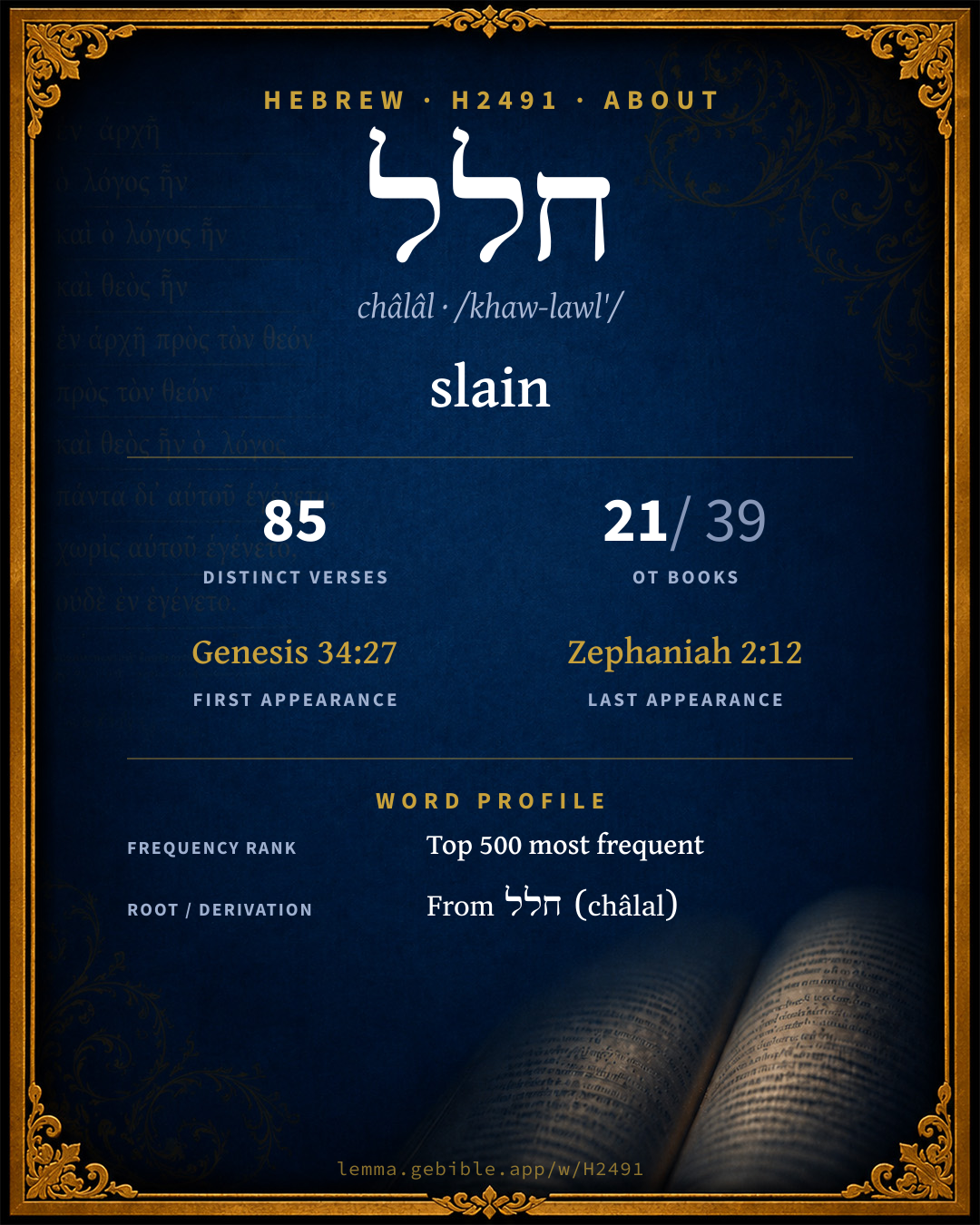
חָלָל
slain
also: fatally wounded, pierced fuller range ↓
Full lexicon entry — Brown-Driver-Briggs (BDB)
From Brown-Driver-Briggs (BDB)
Where this word appears
See every Absolute-state word in the Hebrew Bible →
Grammar key — what these labels mean
Part of speech
- Adjective
- A word that describes or qualifies a noun.
State
- Absolute
- The independent form of a noun, not bound to a following word.
- Construct
- A noun bound to a following noun in a possessive / “of” relationship (the construct chain).
Gender
- Masculine
- Grammatically masculine.
- Feminine
- Grammatically feminine.
Number
- Plural
- More than one (in Hebrew, generally three or more).
- Singular
- One.
32 distinct verses where H2491 appears in the Construct state, across 10 books. Filtered view — show all forms. Click any verse to open its interlinear word-by-word view. Verse text shown in the World English Bible for context — . Each verse’s Hebrew form is shown with its reference; the English is not keyword-highlighted, since the data carries no word-level English alignment. Use “Compare translations” on any verse to read it across multiple English versions. This concordance covers the Hebrew Bible; Septuagint (Greek Old Testament) occurrences are not indexed here.
Numbers 2 verses
- Numbers 19:16 בַּֽ/חֲלַל prep + Adjective Adjective ms cs Whoever in the open field touches one who is slain with a sword, or a dead body, or a bone of a man, or a grave, shall be unclean seven days.
- Numbers 31:8 חַלְלֵי/הֶ֗ם adj Adjective mp cs + sfx pers 3mp They killed the kings of Midian with the rest of their slain: Evi, and Rekem, and Zur, and Hur, and Reba, the five kings of Midian: Balaam also the son of Beor they killed with the sword.
Joshua 1 verse
Judges 1 verse
1 Samuel 1 verse
Psalms 1 verse
Isaiah 3 verses
- Isaiah 22:2 חֲלָלַ֨יִ/ךְ֙ חַלְלֵי adj Adjective mp cs + sfx pers 2fs adj Adjective mp cs You that are full of shouting, a tumultuous city, a joyous town; your slain are not slain with the sword, neither are they dead in battle.
- Isaiah 34:3 וְ/חַלְלֵי/הֶ֣ם conj + Adjective Adjective mp cs + sfx pers 3mp Their slain also shall be cast out, and the stench of their dead bodies shall come up; and the mountains shall be melted with their blood.
- Isaiah 66:16 חַֽלְלֵ֥י adj Adjective mp cs For by fire will Yahweh execute judgment, and by his sword, on all flesh; and the slain of Yahweh shall be many.
Jeremiah 5 verses
- Jeremiah 9:1 חַֽלְלֵ֥י adj Adjective mp cs Oh that my head were waters, and my eyes a spring of tears, that I might weep day and night for the slain of the daughter of my people!
- Jeremiah 14:18 חַלְלֵי adj Adjective mp cs If I go forth into the field, then, behold, the slain with the sword! and if I enter into the city, then, behold, those who are sick with famine! for both the prophet and the priest go about in the land, and have no knowledge.
- Jeremiah 25:33 חַֽלְלֵ֤י adj Adjective mp cs The slain of Yahweh shall be at that day from one end of the earth even to the other end of the earth: they shall not be lamented, neither gathered, nor buried; they shall be dung on the surface of the ground.
- Jeremiah 51:47 חֲלָלֶ֖י/הָ adj Adjective mp cs + sfx pers 3fs Therefore, behold, the days come, that I will execute judgment on the engraved images of Babylon; and her whole land shall be confounded; and all her slain shall fall in the midst of her.
- Jeremiah 51:49 חַֽלְלֵ֣י חַֽלְלֵ֥י adj Adjective mp cs adj Adjective mp cs As Babylon has caused the slain of Israel to fall, so at Babylon shall fall the slain of all the land.
Lamentations 1 verse
Ezekiel 16 verses
- Ezekiel 6:4 חַלְלֵי/כֶ֔ם adj Adjective mp cs + sfx pers 2mp Your altars shall become desolate, and your sun-images shall be broken; and I will cast down your slain men before your idols.
- Ezekiel 6:13 חַלְלֵי/הֶ֗ם adj Adjective mp cs + sfx pers 3mp You shall know that I am Yahweh, when their slain men shall be among their idols round about their altars, on every high hill, on all the tops of the mountains, and under every green tree, and under every thick oak, the places where they offered sweet savor to all their idols.
- Ezekiel 11:6 חַלְלֵי/כֶ֖ם חָלָֽל adj Adjective mp cs + sfx pers 2mp adj Adjective ms You have multiplied your slain in this city, and you have filled the streets of it with the slain.
- Ezekiel 11:7 חַלְלֵי/כֶם֙ adj Adjective mp cs + sfx pers 2mp Therefore thus says the Lord Yahweh: Your slain whom you have laid in the midst of it, they are the flesh, and this [city] is the caldron; but you shall be brought forth out of the midst of it.
- Ezekiel 21:29 חַֽלְלֵ֣י adj Adjective mp cs while they see for you false visions, while they divine lies to you, to lay you on the necks of the wicked who are deadly wounded, whose day is come in the time of the iniquity of the end.
- Ezekiel 31:17 חַלְלֵי adj Adjective mp cs They also went down into Sheol with him to those who are slain by the sword; yes, those who were his arm, [that] lived under his shadow in the midst of the nations.
- Ezekiel 31:18 חַלְלֵי adj Adjective mp cs To whom are you thus like in glory and in greatness among the trees of Eden? yet shall you be brought down with the trees of Eden to the lower parts of the earth: you shall lie in the midst of the uncircumcised, with those who are slain by the sword. This is Pharaoh and all his multitude, says the Lord Yahweh.
- Ezekiel 32:20 חַלְלֵי adj Adjective mp cs They shall fall in the midst of those who are slain by the sword: she is delivered to the sword; draw her away and all her multitudes.
- Ezekiel 32:21 חַלְלֵי adj Adjective mp cs The strong among the mighty shall speak to him out of the midst of Sheol with those who help him: they are gone down, they lie still, even the uncircumcised, slain by the sword.
- Ezekiel 32:25 חֲ֠לָלִים חַלְלֵי חֲלָלִ֖ים adj Adjective mp adj Adjective mp cs adj Adjective mp They have set her a bed in the midst of the slain with all her multitude; her graves are round about her; all of them uncircumcised, slain by the sword; for their terror was caused in the land of the living, and they have borne their shame with those who go down to the pit: he is put in the midst of those who are slain.
- Ezekiel 32:28 חַלְלֵי adj Adjective mp cs But you shall be broken in the midst of the uncircumcised, and shall lie with those who are slain by the sword.
- Ezekiel 32:29 חַלְלֵי adj Adjective mp cs There is Edom, her kings and all her princes, who in their might are laid with those who are slain by the sword: they shall lie with the uncircumcised, and with those who go down to the pit.
- Ezekiel 32:30 חֲלָלִ֗ים חַלְלֵי adj Adjective mp adj Adjective mp cs There are the princes of the north, all of them, and all the Sidonians, who are gone down with the slain; in the terror which they caused by their might they are put to shame; and they lie uncircumcised with those who are slain by the sword, and bear their shame with those who go down to the pit.
- Ezekiel 32:31 חַלְלֵי adj Adjective mp cs Pharaoh shall see them, and shall be comforted over all his multitude, even Pharaoh and all his army, slain by the sword, says the Lord Yahweh.
- Ezekiel 32:32 חַלְלֵי adj Adjective mp cs For I have put his terror in the land of the living; and he shall be laid in the midst of the uncircumcised, with those who are slain by the sword, even Pharaoh and all his multitude, says the Lord Yahweh.
- Ezekiel 35:8 חֲלָלָ֑י/ו חַלְלֵי adj Adjective mp cs + sfx pers 3ms adj Adjective mp cs I will fill its mountains with its slain: in your hills and in your valleys and in all your watercourses shall they fall who are slain with the sword.
Zephaniah 1 verse
About this entry
At a glance — auto-summarized from this page’s data, not written by a person. Every figure links to its source below. This summary describes the numbers; it doesn’t interpret them.
At its core, חלל (châlâl) means “slain.” Scripture first uses it in Genesis 34:27. It turns up in 85 verses across 21 books, a moderately common footprint. The word gravitates to Ezekiel (34%), then Jeremiah and Numbers. Not a single-sense word: its full sense range also takes in “fatally wounded” and “pierced”. Dig into 85-verse concordance and the renderings breakdown below.
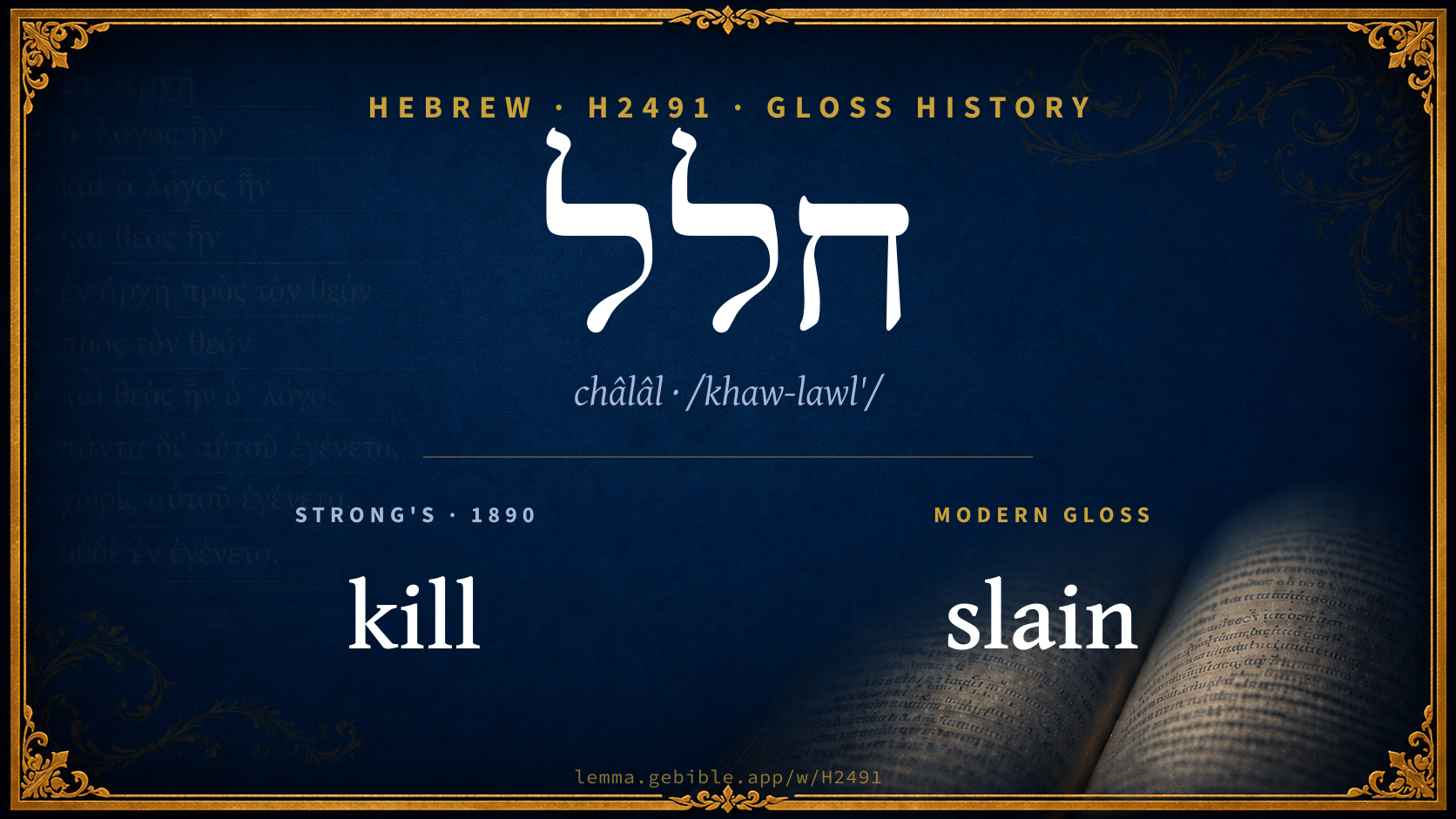
Gloss history
Strong's 1890 vs modern scholarship
About this word
Strong's H2491 catalogs a Hebrew word from the Hebrew Old Testament.
These counts are not copied from any lexicon or concordance. They are computed here, from the morphology-tagged Hebrew Old Testament. What Lemma adds →
- 85
- distinct verses
- The word appears in 85 distinct verses.
- 21 / 39
- OT books
- The word appears in 21 of 39 Old Testament books.
- #440
- by frequency
- Top 500 most frequent Hebrew words (rank 440 of 8,640 Hebrew words by occurrence).
View all 85 occurrences in the concordance →
By section of the Old Testament
By traditional corpus
Conventional, traditional groupings — biblical authorship is debated, so this is a traditional corpus grouping, not an authorship claim. Each share is this word’s portion of its verses in that division of the Hebrew canon. Each figure is a share of the word’s 85 distinct verses.
- Prophets (Nevi'im) 57 verses · 67%
- Writings (Ketuvim) 15 verses · 18%
- Torah (Pentateuch) 13 verses · 15%
How translations render this word
Counts come from each version’s own published word-to-Strong’s tagging or interlinear alignment — an approximate guide to how each version renders this word, not a word-level alignment the data otherwise carries. Because each total is that version’s own tagged count, the per-version totals vary from one another and need not match the appearance or distinct-verse counts above. These counts may also differ from a printed concordance because Lemma counts each distinctly tagged rendering and does not collapse phrase taggings into a single head-word total. This is a fixed set of word-tagged versions (KJV, ASV, BSB, ULT) and does not change with the reading translation you choose elsewhere. Each version’s license is shown beside its name below (and on Sources).
BDB lists this Strong’s number as 2 distinct words (homographs). Each count above pools all of them and is not split by sense — see the Senses section below. A low-frequency rendering may belong to a different one of those words, not the primary meaning.
- King James Version†: Slain 38×, Wounded 8×, Are slain 6×
- American Standard Version†: Slain 35×, Are slain 10×, Wounded 8×
- Berean Standard Bible†: Slain 45×, Dead 6×, Wounded 5×
- unfoldingWord Literal Text†: Slain 28×, Were killed 8×, Pierced 4×
King James Version Public Domain
Renders H2491 across 94† tagged occurrences — most commonly:
Plus 20 renderings that appear only once — usually multi-word phrases or single function words the recovered tagging swept in, not distinct renderings.
American Standard Version Public Domain
Renders H2491 across 93† tagged occurrences — most commonly:
Plus 26 renderings that appear only once — usually multi-word phrases or single function words the recovered tagging swept in, not distinct renderings.
Berean Standard Bible Public Domain
Renders H2491 across 93† tagged occurrences — most commonly:
Plus 19 renderings that appear only once — usually multi-word phrases or single function words the recovered tagging swept in, not distinct renderings. Not rendered by a distinct English word in 1 further occurrence.
unfoldingWord Literal Text CC BY-SA 4.0
Renders H2491 across 93† tagged occurrences — most commonly:
Plus 31 renderings that appear only once — usually multi-word phrases or single function words the recovered tagging swept in, not distinct renderings.
Senses in the full BDB
What do BDB’s symbols mean?
BDB uses these scholarly abbreviations:
| Symbol | Meaning |
|---|---|
| 𝔊 | the Septuagint (the ancient Greek translation, LXX) |
| 𝔙 | the Vulgate (the Latin translation) |
| 𝔖 | the Syriac version (the Peshitta) |
| 𝔗 | the Targum (the Aramaic translation) |
| ψ | the Psalms |
| √ | root (the underlying root or stem) |
| ‖ | parallel passage (a synonymous or contrasted parallel) |
| † | the dagger: every passage where the word occurs is cited |
The 2 senses and sub-senses the full Brown-Driver-Briggs lexicon distinguishes for this word, in lexicon order (not ranked by frequency), with BDB’s own verbatim wording and sub-sense lettering. Shown in Hebrew script with BDB’s own scholarly abbreviations. The condensed entry is in the Lexicon Entry tab. See also the Forms in the corpus table below.
חלל I pierced, ח׳ abs. Dt. 21
- 1. pierced, fatally wounded ψ 69:27 Je 51:52 Ez 26:15; 30:24 La 2:12 Jb 24:12. e.g. Psalms 69:27
- 2. slain Nu 19:18; 31:8, 19 (P), etc.; sg. coll. 2 S 23:8, 18 = 1 Ch 11:11, 20 Ez 6:7; 30:11, etc., but usually pl. Gn 34:27 1 S 17:52 (RV wounded) Je 51:49, etc.; †חַלְלֵי חֶרֶב Is 22:2 Je 14:18 Ez 31:17, 18; 32:20, 21, 25, 28, 29, 30, 31, 32 Zp 2:12 La 4:9; חַלְלֵי רעב La 4:9; חַלְלֵי יהוה Is 66:16 Je 25:33. e.g. Numbers 19:18
חלל II ofaned
Senses from the full Brown-Driver-Briggs lexicon (Brown, Driver, Briggs; Oxford 1906 — public domain), digitized via Sefaria, supplemented by the OpenScriptures HebrewLexicon (CC BY 4.0). Full attribution on Sources.
Word origin
I. n.m. pierced, ח׳ abs. Dt. 21:1 + 25 times; cstr. חֲלַל Nu 19:16; pl. חֲלָלִים Nu 23:24 + 28 times; cstr. חַלְלֵי Is 22:2 + 21 times; sf. חֲלָלֶיךָ ψ 69:27, etc. + 11 times sfs.;—
II. adj. profaned;—חָלָל רָשָׁע (read cstr. חֲלַל SS) profaned, dishonoured wicked one Ez 21:30 (so AV Thes MV SS Co Or; but RV Hä deadly wounded, Ew Sm fallen, slain); pl. cstr. חַלְלֵי רְשָׁעִים Ez 21:34; fs. חֲלָלָה of woman sexually dishonoured Lv 21:7; 14 (H; ‖ זָנָה).
— Brown-Driver-Briggs (Oxford 1906, public domain), digitized via Sefaria, supplemented by the OpenScriptures HebrewLexicon (CC BY 4.0). See Sources.
Derived from חלל (châlal) (H2490) — to profane.
Jastrow Dictionary
A second Hebrew/Aramaic lexicon for comparison, covering Aramaic and post-biblical (Talmudic, Targumic, Midrashic) usage that the biblical-Hebrew BDB does not. Matched by lemma rather than by Strong’s number, so a lemma may carry more than one Jastrow headword (shown separately below), and the entries cover usage well beyond the Bible.
חָלַל
- H. Dict.10 s. vv. חלל I, II)
- 1. (v. חוּל) to roll, turn. Ber. 32ᵃ (ref. to ייחל, Ex. XXXII, 11) שחַל עליהם מדת הדין למדת הרחמים Ms. M. (v. חָלָה) he (Moses) turned justice into mercy in their behalf; Yalk. Ex. 392 הֵחֵל (Hif.).—[Tanḥ. Yithro 1 מת חולל, read וחָלָל.] e.g. Exodus 32:11
- 2. to bore, hollow, pierce, v. חָלִיל, חָלָל I. I.
- 3. to surround; to place outside a circle, v. חוֹל III, חִילּוֹנִי.
- (v. חָלָל I) to be cut all around, be severed. Naz. 54ᵃ (ref. to Num. XIX, 18) בחלל זה אבר הנ׳ מן החי וכ׳ ‘on something severed’, that means a limb which has been cut off a living body, and on which there was not flesh enough to have made healing possible; במת זה אבר הנ׳ וכ׳ ‘on something dead’, that means a limb severed from a corpse; ib. 53ᵇ e.g. Numbers 19:18
- to become חוּלִּין, to cease to be sacred. Shebi. I, 8 עד שיֵחוֹלּוּ until the fruits become available for private use; Y. ib. 33ᶜ top מהו עד שיח׳ עד שיפדו או עד שיעשו חולין וכ׳ what does ad sheyeḥôllu mean? Until they are redeemed (in the fourth year), or until they become ḥullin of themselves (in the fifth year)?
- 1. [ [to set in motion,] to begin. Sifré Num. 134 (ref. to Deut. III, 24) אתה הֲחִילּוֹתָ וכ׳ thou hast begun to open the door &c. Dem. VII, 4 ומֵיחֵל ושותה Y. ed. (v. Rabb. D. S. a. l. note) and he may at once commence drinking (Maim.; v. infra). e.g. Deuteronomy 3:24
- 2. to make חוּלִּין; to break a vow; to profane. Ber. l. c. (ref. to Num. XXX, 3) הוא אינו מֵיחֵל אבל אחרים מְחַלִּין לו he himself cannot break a vow, but others may break it for him (absolve him; Ḥag. 10ᵃ … מיחל … מוֹחֲלִין; Ex. R. s. 43 מוחל אבל … חכם מוֹחֵל, corr. acc.). Dem. l. c. ומיחל ושותה and thus he redeems, and he may drink (R. S.); Tosef. ib. VIII, 7 ומ׳ ושותה מיד.—Kidd. 77ᵃ (ref. to Lev. XXI, 15) מֵיחֵל he produces profanation (begets degraded priests), v. חָלָל II.—3) to turn, change. Yalk. Ex. 392, v. supra. e.g. Numbers 30:3
- 1. to break a vow, to profane, to desecrate; to degrade. Deut. R. s. 2 (play on החלת, Deut. III, 24) חִלַּלְתָּ וכ׳ hast thou not broken the oath? (Sifré Num. 134 הֲחִלּוֹתָ, v. supra). Ab. III, 11 המְחַלֵּל את הקדשים who treats profanely sacred things (causes them to be carried out and burnt). Ab. Zar. 28ᵃ מְחַלְּלִין עליה וכ׳ you may desecrate the Sabbath for the sake of curing it; a. fr.—Esp. to cause the loss of the priestly status. Macc. 2ᵃ המְחַלֵּל אינו מִתְחַלֵּל he (the priest marrying a divorced woman) who causes the loss of priestly status (to his issue) does not lose the priestly status himself; הבא לחַלֵּל ולא חִילֵּל he who intended to cause the loss of priestly status (by false testimony) and did not succeed. e.g. Deuteronomy 3:24
- 2. (v. Deut. XIV, 24, sq.) to redeem, to make available for private use. Maas. Sh. I, 2; a. fr. e.g. Deuteronomy 14:24
- 1. to be removed from the priestly status, become a חָלָל. Kidd. 77ᵃ (ref. to Lev. XXI, 15 ‘he shall not degrade’) לא יְחוּלָּל זה וכ׳ no degradation shall be caused—which can only refer to a person who had a status and now becomes degraded (i.e. his wife). e.g. Leviticus 21:15
- 2. to be redeemed, to become secular again. Part. מְחוּלָּל, f. מְחוּלֶּלֶת. Dem. V, 1, a. fr. ומח׳ על המעות and it is redeemed by setting aside its value. Maas. Sh. II, 10 מה … סלע זו ח׳ עליו (not על זו, v. Rabb. D. S. a. l.) this Sela (which has been set apart as an equivalent for second tithes) shall be redeemed against the wine which the clean (sons of mine) may drink in Jerusalem, i.e. I buy with this Sela only that portion of the wine which the clean may drink. Ib. הרי מעות האלו מְחוּלָּלִים וכ׳ that money (dedicated for purchasing equivalents in Jerusalem) shall be redeemed against thy fruits; a. v. fr.
- 3. to be loosely joined, to be a movable link. Sabb. 52ᵇ במְחוּלָּלִין referring to movable links, (v. חוּלְיָא I). Y. Pes. I, 27ᶜ top במְחוּלָּלוֹת when the vessels can be rolled about, opp. אפוצות close together (v. חִלְחֵל).
- 1. [ [to be perforated,] (of bowels) to be loose. Esth. R. to I, 8 שיִתְחַלְּלוּ מעיו.
- 2. to be profaned, desecrated, degraded. Ab. I, 11. Macc. 2ᵃ, v. supra. Yeb. 79ᵃ ואל יתְחַלֵּל וכ׳ rather than that the name of the Lord be profaned in public; a. fr.
חֲלַל I
- 1. to perforate, v. חָלֵיל.
- 2. to degrade, profane. Part. pass. חָלִיל, f. חֲלִילָא. Targ. O. Lev. XXI, 14.
- 3. (denom. of חוּלָּא) to be profaned. Targ. Ez. XXII, 26 וְחַלַת.
- 1. to desecrate, profane, degrade. Targ. Prov. XXX, 9; a. e.—Part. pass. מְחַלַּל, f. מְחַלְלָא, מְחַלָּא. Targ. O. Lev. XXI, 7 (ed. Berl. מַחְלָא, Regia מְחָלָא).—Y. Kil. IX, 32ᵇ top, a. e. דילמא דחַלְּלִינָן וכ׳ did we perhaps desecrate the Sabbath?—Ber. 6ᵃ מְחַלְּלֵי Ms. (ed. מחליין); a. e.
- 2. to redeem. B. Mets. 44ᵇ טבעא אפירא לא מְחַלְּלִינָן we dare not redeem coins with goods.
- same, to desecrate. Targ. O. Lev. XIX, 8. Targ. Am. II, 7 לאָחָלָא (ed. Lag. לאפסא); a. fr.—Part. pass. f. מַחְלָא, v. supra.
- , אִתְּחַל to be profaned. Targ. Ez. XXXVI, 23 (not אַתְּחַל). Ib. VII, 24; a. fr.—Snh. 51ᵃ היכא דמִיתַּחֲלָא השתא if she degraded herself now; מית׳ וקיימא she was degraded before this.
חֲלַל II
- (cmp. חלחל), (mostly) Pa. חַלֵּיל (v. preced.) [to turn in a hollow space,] to wash, rinse. Targ. II Chr. IV, 6. Targ. Lev. I, 9; a. fr.—Ḥull. 113ᵃ דחַלְּלֵי בי טבחא when they washed the meat in the slaughter house.
- same. Targ. Ruth III, 3.—Ḥull. 95ᵇ top מַחְלִיל רישא וכ׳ (or מְחַלֵּיל) Ar. (ed. מחוור) he was washing an animal’s head in the river, v. חֲוַר
חָלָל I
- cut all around, beheaded, in gen. slain. Sot. 45ᵇ (ref. to Deut. XXI, 1) ח׳ ולא חנוק slain but not strangled, ח׳ ולא מפרפר וכ׳ slain but not rolling in dying agony. Ib. IX, 4 ממקום שנעשה ח׳ מצוארו from the place where he has been cut, that means, (the measurement starts) from his throat, v. חָלָל III. Y. Naz. VII, 56ᶜ (ref. to Num. XIX, 18) בח׳ כל שהוא ח׳ beḥalal means whoever is slain, בח׳ זה אבר וכ׳ beḥalal means a severed limb … without sufficient flesh, v. חָלַל, Nif.—Ḥull. 3ᵃ, a. e. (ref. to Num. XIX, 16) חרב הרי הוא כח׳ a sword (with which a person has been killed) has the same levitical status as a slain body. Koh. R. to VIII, 10; Yalk. Ps. 808, a. e. (play on מתחולל Job XV, 20) מת וח׳ (the wicked man even in his life-time) is dead and beheaded; Tanḥ. Yithro 1 מת חולל (corr. acc.); ib. ed. Bub.; a. fr.—Pl. חֲלָלִים. Sot. 45ᵃ; a. e. e.g. Deuteronomy 21:1
חָלָל II
- [put outside,] ḥalal, one unfit for priesthood on account of his father’s illegitimate connection (Lev. XXI, 7; 14, sq.). Kidd. IV, 6. Snh. 51ᵃ; a. fr.—Pl. חֲלָלִים, חֲלָלִין. Kidd. 77ᵃ, v. מִקְוֵה; a. e.—Fem. חֲלָלָה the female issue of a priest’s illegitimate connection, or a priest’s wife illegitimately married to him. Ib. ח׳ מוזכרת, v. זָכַר; a. fr.—Pl. חֲלָלוֹת. Ib., v. מִקְוֵה; a. e. e.g. Leviticus 21:7
חָלָל III
- (חָלַל)
- 1. cavity, empty space, hollow; throat; inside. Ukts. II, 8 ממעך את חֲלָלָהּ you squeeze its cavity (compress it); Y. Yoma VIII, 44ᵈ bot. (v. Löw, Pfl. p. 123). Ab. Zar. 28ᵃ מכה של ח׳ an internal sore (as in the mouth, throat &c.). Y. ib. II, 40ᵈ top; Y. Sabb. XIV, 14ᵈ top כל שהוא מן הח׳ ולפנים וכ׳ whatever is in the throat and farther inside may be cured on the Sabbath, opp. to מן השפה; cmp. Sot. 45ᵇ quot. s. v. חָלָל I. Ḥull. III, 1 if the heart is perforated לבית חֲלָלוֹ up to its chamber. Ber. 19ᵇ ח׳ טפח a hollow space of one hand-breadth. Ḥull. 44ᵇ. Pes. 54ᵃ חֲלָלָהּ the formation of its interior; a. fr.—Pl. חֲלָלִים. Ber. 60ᵇ, v. חָלוּל.
- 2. (cmp. חַלְחוֹלִית) intricacy, devices. Sabb. 11ᵃ חֲלָלָהּ של רשות the devices of political government.
A Dictionary of the Targumim, the Talmud Babli and Yerushalmi, and the Midrashic Literature (Marcus Jastrow; London, Luzac, 1903) — Public Domain. Digitized via Sefaria. Digitized via Sefaria. Full attribution on Sources.
Forms in the corpus
The 48 distinct written forms H2491 takes in the Hebrew Bible, most frequent first — each parse links to that state’s occurrences in the concordance. Hebrew forms include their vowel points and cantillation, so a single lemma takes many written forms.
Same root — word family
Other BDB entries built from the same root as H2491, grouped by Strong’s listed origin. These share a root / origin per the lexicon — not necessarily a shared meaning. Each links to that word’s own entry.
Derives from
Shares the same root
- חל chôl H2455 profane
- חלה challâh H2471 cake
- חליל châlîyl H2485 flute
- מחלה mᵉchillâh H4247 hole
- תחלה tᵉchillâh H8462 beginning
Proper names from this root
People and places named from this root — a name, not an additional meaning of the word.
Compare all same-root words → Showing 4 of 8 — not the complete family. 1 of the same-root words is a proper name (a person or place). They share a root, not necessarily a meaning.
Septuagint verse parallels
This word appears in 79 verses that also exist in the Greek Old Testament (Septuagint), out of the 85 Hebrew verses it occurs in. You can read those verses in Greek by switching the Old Testament edition to the Septuagint.
Read these verses in the Septuagint
- Genesis 34:27
- Leviticus 21:7
- Numbers 19:16
- Deuteronomy 21:1
- Joshua 11:6
- Judges 9:40
- 1 Samuel 31:1
- 2 Samuel 1:19
- 1 Kings 11:15
- 1 Chronicles 5:22
- 2 Chronicles 13:17
- Job 24:12
This is a verse-level parallel only — the same verses exist in both the Hebrew and Greek Old Testaments. No word-level Hebrew↔Greek correspondence is claimed: the data carries no such alignment, so no Greek word is shown as this Hebrew word’s translation. Coverage is not total — the Septuagint omits the deuterocanon and renumbers the Psalms, so some Hebrew verses have no direct Greek parallel.