
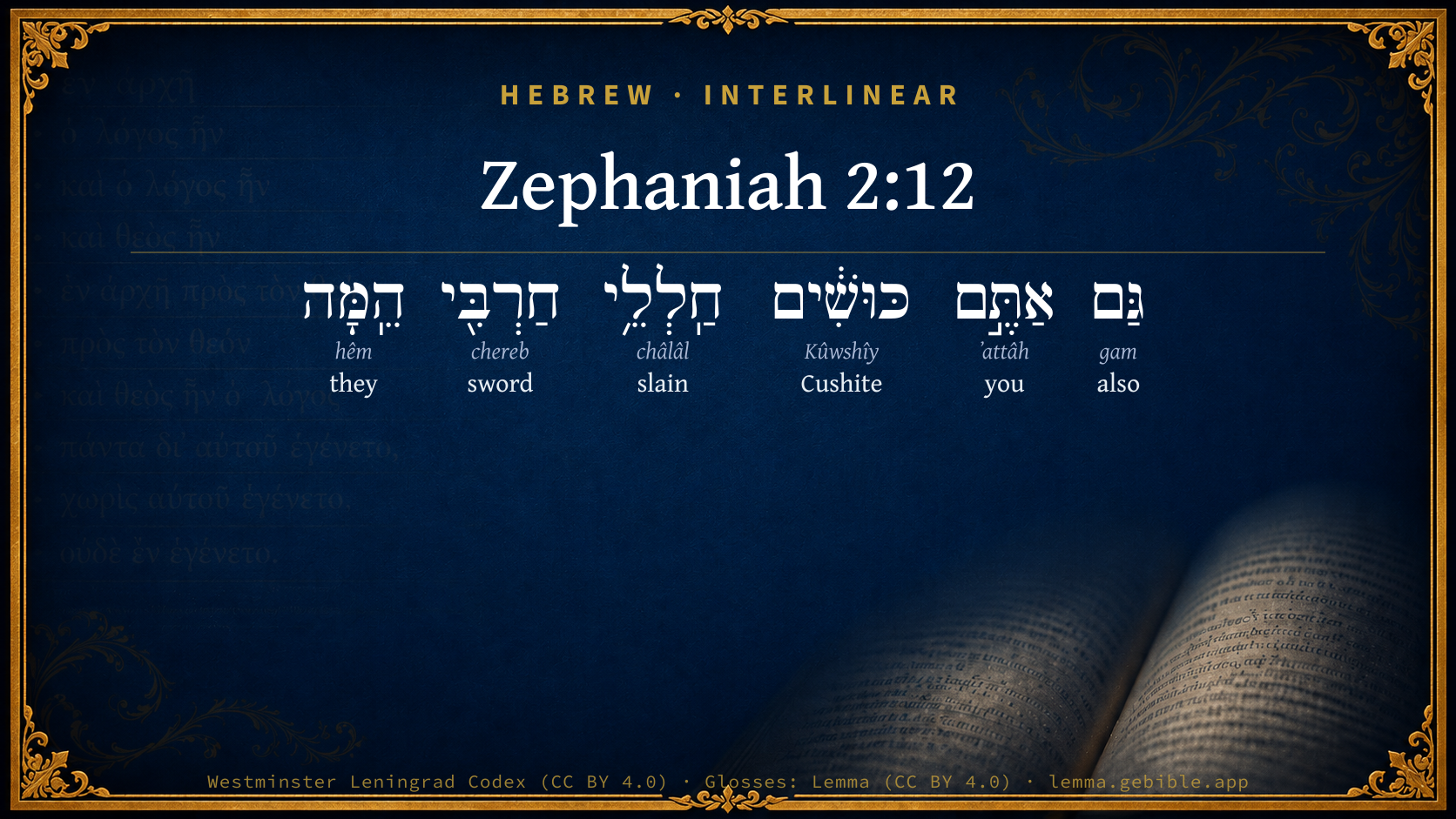
Zephaniah 2:12

Hebrew (Westminster Leningrad Codex) Zephaniah 2:12 appears in the Hebrew Old Testament. The text above is from the Westminster Leningrad Codex. Each word links to its Strong’s number, a concise gloss, and parsing drawn from the Open Scriptures Hebrew Bible morphology. Click any word for its full Brown-Driver-Briggs (BDB) entry.
Download image
Cite this verse

Zephaniah 2:12 (World English Bible). Public Domain. Lemma interlinear Bible study tool, https://lemma.gebible.app/v/zephaniah/2/12.

Show BibTeX & RIS
BibTeX
RIS
English Translation
You Cushites also, you will be killed by my sword.
World English Bible · Public Domain
Download a study sheet

One document with this verse’s original text, its word-by-word gloss line, the meaning frame, cross-references with their text, attributed commentary, and full source and license credits — printable, and it pastes into notes with its structure intact.

This verse Autodidact and up

Study sheet (.html) Plain text (.txt)

A passage Seminary Student

Up to 50 verses in one chapter. A passage sheet keeps up to 6 commentary sources and 12 cross-references per verse, in the order this page ranks them, and says so on the sheet whenever that leaves anything out. Ask for a single verse and you get the Autodidact verse sheet above.

Everything on this page stays free to read, with no account — the sheet is a download of what is already on screen, not access to it.

Want to remove ads? Support Godless Engineer
Compare translations 3

The same verse in 3 English versions, stacked beneath the original-language interlinear above. Click any original word for its lexicon entry.

Each is an independent rendering of the whole verse — the interlinear is not word-aligned to these translations.

Highlighted words mark where these versions differ — a whole-verse word diff, not a word-by-word alignment.

  • World English Bible Public Domain
    You Cushites also, you will be killed by my sword.
  • King James Version Public Domain
    Ye Ethiopians also, ye shall be slain by my sword.
  • unfoldingWord Literal Text CC BY-SA 4.0
    “Also you, Cushites, they pierced by my sword.”

unfoldingWord Literal Text — © unfoldingWord, licensed CC BY-SA 4.0. Word-aligned USFM3 via Door43 (git.door43.org/unfoldingWord/en_ult).

Versions to compare (up to 4)

3 of 4 selected

Show all 18 translations

Every available English version of this verse, each an independent rendering of the whole verse.

  • World English Bible Public Domain
    You Cushites also, you will be killed by my sword.
  • Berean Standard Bible Public Domain
    “You too, O Cushites, will be slain by My sword.”
  • Majority Standard Bible Public Domain
    “You too, O Cushites, will be slain by My sword.”
  • King James Version Public Domain
    Ye Ethiopians also, ye shall be slain by my sword.
  • American Standard Version (1901) Public Domain
    Ye Ethiopians also, ye shall be slain by my sword.
  • Revised Version (1885) Public Domain
    Ye Ethiopians also, ye shall be slain by my sword.
  • Geneva Bible (1599) Public Domain
    Ye Morians also shalbe slaine by my sword with them.
  • Douay-Rheims (1899) Public Domain
    You Ethiopians, also shall be slain with my sword.
  • Young's Literal Translation Public Domain
    Also ye, O Cushim, pierced of My sword `are' they.
  • Literal Standard Version CC BY-SA 4.0
    “Also you, O Cushim, they [are] pierced of My sword.”
  • Unlocked Literal Bible CC BY-SA 4.0
    You Cushites also will be pierced by my sword,
  • unfoldingWord Literal Text CC BY-SA 4.0
    “Also you, Cushites, they pierced by my sword.”
  • Darby Bible Public Domain
    Ye Ethiopians also, ye shall be the slain of my sword.
  • World Messianic Bible Public Domain
    You Cushites also, you will be killed by my sword.
  • Webster's Bible Public Domain
    Ye Cushites also, ye shall be slain by my sword.
  • Free Bible Version CC BY-SA 4.0
    You Ethiopians will be killed by the sword.
  • Bible in Basic English Public Domain
    And you Ethiopians will be put to death by my sword.
  • JPS Tanakh (1917) Public Domain
    Ye Ethiopians also, ye shall be slain by My sword.

Literal Standard Version (2020), Covenant Press — licensed CC BY-SA 4.0. Text via the HelloAO Bible API (eBible.org). Unlocked Literal Bible (unfoldingWord) — licensed CC BY-SA 4.0. Text via the HelloAO Bible API (eBible.org). unfoldingWord Literal Text — © unfoldingWord, licensed CC BY-SA 4.0. Word-aligned USFM3 via Door43 (git.door43.org/unfoldingWord/en_ult). Free Bible Version, Dr. Jonathan Gallagher — licensed CC BY-SA 4.0. Text via the HelloAO Bible API (eBible.org).

Word by word

More ways to search: Search by grammar → Find every occurrence → Compare this word →

Practice this passage: Drill this verse → Learn its vocabulary →

About this verse

These counts appear in no published source. They are computed here, from the morphology-tagged text and Lemma’s own curated glosses. What Lemma adds →

6
words
6
distinct lemmas
Prophets
section

Notable vocabulary

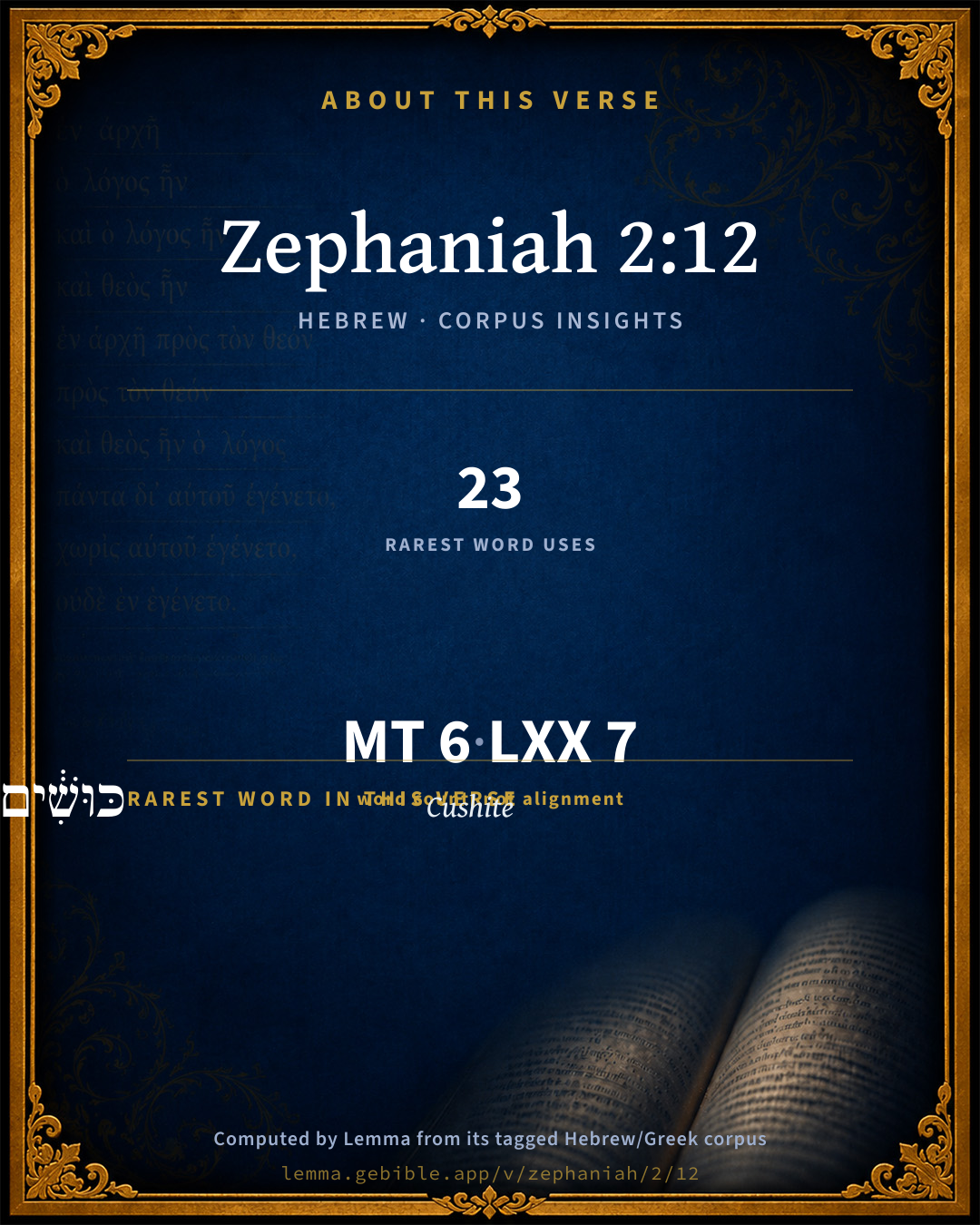
The rarest word here is כּוּשִׁ֔ים Cushite H3569 — appearing just 23 times in the whole Hebrew Bible.

Shared distinctive vocabulary

כּוּשִׁ֔ים Cushite H3569 occurs in 19 verses of the Hebrew Bible. Also found in:

Grammatical profile

  • 2 nouns
  • 1 adjective
  • 2 pronouns
  • 1 particle

Hebrew & Septuagint length

In English translation the verse runs 10 words from the Hebrew and 9 from the Septuagint (LXX English) — closely comparable.

A rough comparison of the two English renderings, which tokenize alike — not a word-level alignment.

Word counts can differ between the Hebrew and the Greek without any difference in meaning — e.g. the Hebrew direct-object marker אֵת has no separate Greek word, and Greek often adds the article ὁ.

In the original languages it is 6 Hebrew tokens and 7 Greek tokens — but the two are counted differently (Hebrew bundles its prefixes and suffixes into one token; the Greek is in lemma form), so that isn’t a like-for-like length.

Cross-references

10

Topical passages linked to Zephaniah 2:12 in the Treasury of Scripture Knowledge — connected by theme and wording, ordered by reader-vote popularity; previews shown in the World English Bible.

  • Ezekiel 30:4–9 A sword shall come on Egypt, and anguish shall be in Ethiopia, when the slain shall fall in Egypt; and they shall take away her multitude, and her foundations shall be broken down.
  • Isaiah 13:5 They come from a far country, from the uttermost part of heaven, even Yahweh, and the weapons of his indignation, to destroy the whole land.
  • Isaiah 18:1–7 Ah, the land of the rustling of wings, which is beyond the rivers of Ethiopia;
  • Isaiah 20:4–5 so shall the king of Assyria lead away the captives of Egypt, and the exiles of Ethiopia, young and old, naked and barefoot, and with buttocks uncovered, to the shame of Egypt.
  • Isaiah 43:3 For I am Yahweh your God, the Holy One of Israel, your Savior; I have given Egypt as your ransom, Ethiopia and Seba in your place.
  • Jeremiah 46:9–10 Go up, you horses; and rage, you chariots; and let the mighty men go forth: Cush and Put, who handle the shield; and the Ludim, who handle and bend the bow.
  • Jeremiah 51:20–23 You are my battle-axe and weapons of war: and with you will I break in pieces the nations; and with you will I destroy kingdoms;
  • Psalms 17:13 Arise, Yahweh, Confront him, cast him down. Deliver my soul from the wicked by your sword;
  • Isaiah 10:5 Ho Assyrian, the rod of my anger, the staff in whose hand is my indignation!
  • Jeremiah 47:6–7 You sword of Yahweh, how long will it be before you be quiet? put up yourself into your scabbard; rest, and be still.

Cross-references courtesy of OpenBible.info (CC BY 4.0).

Hebrew and Greek witnesses Masoretic Hebrew ↔ Greek Septuagint

The same verse in the two great witnesses to the Old Testament, shown verse-for-verse.

These are two independent witnesses, not word-aligned to each other, and the Septuagint is shown in lemma (dictionary) form.

Hebrew Zephaniah 2:12 Masoretic · Westminster Leningrad Codex

גַּם אַתֶּ֣ם כּוּשִׁ֔ים חַֽלְלֵ֥י חַרְבִּ֖י הֵֽמָּה

You Cushites also, you will be killed by my sword.

World English Bible · Public Domain

Greek LXX Zephaniah 2:12 Septuagint · lemma form

καί σύ αἰθίοψ τραυματίας ῥομφαία ἐγώ εἰμί

You⌃ Ethiopians also are the slain of my sword.

LXX2012 (modern English Septuagint) · Public Domain

Hebrew: Westminster Leningrad Codex (CC BY 4.0). Greek: Septuagint (public domain); English from LXX2012 (modern English Septuagint) (Public Domain). How the Septuagint differs from the Hebrew →

Targum (Aramaic paraphrase)

1

The Targum is the ancient Jewish Aramaic paraphrase of the Hebrew Scriptures — an interpretive translation, not the Hebrew text itself. Onkelos (literal) and Pseudo-Jonathan (expansive) render the Torah, and Jonathan the Prophets. Coverage is partial: where no permissively-licensed English translation exists for a verse, only the Aramaic is shown. This is verse-level text, not a word-by-word alignment to the Hebrew.

  1. Targum Jonathan Prophets (Joshua–Malachi)
    אַף אַתּוּן כּוּשָׁאֵי קְטִילֵי חַרְבִּי תְּהוֹן:

    (no public-domain English translation for this verse)

    Targum Jonathan — Aramaic: “Mikraot Gedolot” (public domain). English: “Sefaria Community Translation” (CC0 1.0 (public-domain dedication)); “London "Chaldee Paraphrase," 1871” (public domain). Text via Sefaria.

Commentary

Notes on Zephaniah 2:12 from classic Christian and Jewish commentators (each source and its license shown beneath its notes). The classic Christian expositions comment on the surrounding passage and are grouped to its opening verse, so a note may address several verses; the Jewish commentaries on the Tanakh (Rashi and others) are per-verse, so they appear only where the commentator wrote on this verse.

Lemma curates 59 commentaries, every one of them public domain or Creative Commons licensed, each selected and text-cleaned for this edition rather than reprinted as found. About our sources →

Matthew Henry's Commentary

The cup is going round, when Nebuchadnezzar is going on conquering and to conquer; and not only Israel's near neighbours, but those that lay more remote, must be reckoned with for the wrongs they have done to God's people; the Ethiopians and the Assyrians are here taken to task. 1. The Ethiopians, or Arabians, that had sometimes been a terror to Israel (as in Asa's time, Ch2 14:9), must now be reckoned with: They shall be slain by my sword, Zep 2:12. Nebuchadnezzar was God's sword, the instrument in his hand with which these and other enemies were subdued and punished, Psa 17:14. 2. The Assyrians, and Nineveh the head city of their monarchy, are next set to the bar, to receive their doom: He that is God's sword will stretch out his hand against the north, and destroy Assyria, and make himself master of it. Assyria had been the rod of God's anger against Israel, and now Babylon is the rod of God's anger against Assyria, Isa 10:5. He will make Nineveh a desolation, as was lately and largely foretold by the prophet Nahum. Observe, (1.) How flourishing Nineveh's state had formerly been (Zep 2:15): This is the rejoicing city that dwelt carelessly. Nineveh was so strong that she feared no evil, and therefore dwelt carelessly and set danger at defiance; she was so rich that she thought herself sure of all good, and therefore was a rejoicing city, full of mirth and gaiety; and she had such a dominion that she admitted no rival, but said in her heart, "I am, and there is none besides me that can compare with me, no city in the world that can pretend to be equal with me." God can with his judgments frighten the most secure, humble the most haughty, and mar the mirth of those that most laugh now. (2.) How complete Nineveh's ruin shall now be; it shall be made a desolation, Zep 2:13. Such a heap of ruins shall this once pompous city be that it shall be, [1.] A receptacle for beasts, such a wilderness that flocks shall lie down in it; nay, such a waste, desolate, frightful place, that wild beasts, shall take up their abode there; the melancholy birds, as the cormorant and bittern, shall make their nests in what remains of the houses, as they sometimes do in old ruinous buildings that are uninhabited and unfrequented. The lintels, or chapiters of the pillars, the windows and thresholds, and all the fine cedar-work curiously engraven, shall lie exposed; and on them these rueful ominous birds shall perch, and their voice shall sing. How are the songs of mirth turned into hideous horrid noises! What little reason have men to be proud of stately buildings, and rich furniture, when they know not what all the pomp of them may come to at last! [2.] A derision to travellers. Those that had come from far, to gratify their curiosity with the sight of Nineveh's splendour, shall now look on her with as much contempt as ever they looked upon her with admiration (Zep 2:15): Every one that passes by shall hiss at her, and wag his hand, making light of her desolations, nay, and making sport with them - "There is an end of proud Nineveh." They shall not weep, and wring their hands (the adversities of those are unpitied and unlamented who were insolent and haughty in their prosperity), but they shall hiss and wag their hands, forgetting that perhaps their own ruin is not far off.

Matthew Henry's Commentary on the Whole Bible (1708–1710) — public domain (CC PDM 1.0). Text via the HelloAO Bible API.

Trapp's Complete Commentary

John Trapp

Zep 2:12 Ye Ethiopians also, ye [shall be] slain by my sword.

Ver. 12. Ye Ethiopians also, ye shall be slain by my sword] Which is long enough to reach you, though far remote. The poets feign that Jupiter was wont to be feasted by the Ethiopians; but that shall not save them from God’s sore and great strong sword. Nebuchadnezzar, to whom God had given Ethiopia, and Egypt, and Saba as a ransom for his people, Isa 43:3. See Pro 11:8. {See Trapp on "Pro 11:8"} The Ethiopians and Egyptians were subdued together, Jer 46:2 Isa 18:1-2. It is now inhabited by the Abyssinians (a kind of mongrel Christians), and called Prester John’s country; where they say they have this custom, among others: In their great solemnities they have a cup of gold borne before them, filled within, and besmeared without with dirt, yet so as the gold appeareth; and next to this cup is carried a crucifix. Hereby they would show that man should be pure as gold; but being within and without defiled by sin, he is restored by Christ crucified, so as that the gold of God’s graces appeareth in him here in part, and shall do hereafter in all perfection.

John Trapp, A Commentary or Exposition upon All the Books of the Old and New Testament (1647–1656) — public domain. Text from a community e-Sword module.

Joseph Benson's Commentary

Zep 2:12. Ye Ethiopians also shall be slain — Here a denunciation of divine wrath is uttered against the Ethiopians, as, Zep 2:8, against the Moabites and Ammonites. It is said that they should be slain by God’s sword; because Nebuchadnezzar, who was to subdue them, was raised up by the divine providence, in order to execute its purposes; and to cut off those whose wickedness called for the infliction of divine vengeance. This denunciation against the Ethiopians was fulfilled by Nebuchadnezzar, by whom they were overthrown, when they came to assist the king of Egypt against him.

Joseph Benson's Commentary on the Old and New Testaments (1811–1818) — public domain. Text from a community e-Sword module.

The Preacher's Complete Homiletical Commentary

Joseph S. Exell (gen. ed.)

CRITICAL NOTES.]

Zep_2:12.] Fulfilled when Nebuchadnezzar conquered Egypt, with which Ethiopia was closely allied (Jer_46:2; Jer_46:9; Eze_30:5-9).

THE DOOM OF ETHIOPIA.—Zep_2:12

“Zephaniah has to complete his circuit. He has travelled East and West, and now completes his round by denouncing judgment on the nations of the North and South. At the South he merely aims a blow in passing; but it is curious to note how far it reaches. He travels to the utmost limit of his knowledge, and hurls his curt ringing anathema at Cush or Ethiopia, the southernmost kingdom known to the Hebrews.” Notice—

I. That the enemies of the Church, though numerous and far distant, will be found out and punished. Philistia, Moab, and Ammon escape not. The sword passes Edom, a constant enemy, immediately south to Judah. Egypt insolent and more southern still, is not mentioned. But far away the judgment sweeps to remote Ethiopia. “Ye Ethiopians also.”

II. That in the punishment of these enemies the hand of God must be recognized. “Slain by my sword.” All nations and individuals are God’s instruments, and under his control. The most powerful and profane are under the rule and wielded by the hand of God. None can annoy and act without his permission. All things are as easily managed as a sword in the hand. Hence learn (a) to submit to God in the persecution by wicked men; and (b) to discern his power and use of them. “Deliver my soul from the wicked, which is thy sword.”

The Preacher's Complete Homiletical Commentary (gen. ed. Joseph S. Exell; Funk & Wagnalls, c. 1892) — public domain (pre-1929). A full-Bible homiletical/sermon-outline anthology covering 65 of 66 books (2 John is absent from the source module). Text from a community e-Sword module.

Keil & Delitzsch

C. F. Keil & F. Delitzsch

After this statement of the aim of the judgments of God, Zephaniah mentions two other powerful heathen nations as examples, to prove that the whole of the heathen world will succumb to the judgment. Zep 2:12. "Ye Cushites also, slain of my sword are they. Zep 2:13. And let him stretch out his hand toward the south, and destroy Asshur; and make Nineveh a barren waste, a dry place, like the desert. Zep 2:14. And herds lie down in the midst of it, all kinds of beasts in crowds: pelicans also and hedgehogs will lodge on their knobs; the voice of the singer in the window; heaps upon the threshold: for their cedar-work hath He made bare. Zep 2:15. This the city, the exulting one, the safely dwelling one, which said in her heart, I, and no more: how has she become a desolation, a lair of beasts! Every one that passeth by it will hiss, swing his hand." As a representative of the heathen dwelling in the south, Zephaniah does not mention Edom, which bordered upon Judah, or the neighbouring land of Egypt, but the remote Ethiopia, the furthest kingdom or people in the south that was known to the Hebrews. The Ethiopians will be slain of the sword of Jehovah. המּה does not take the place of the copula between the subject and predicate, any more than הוּא in Isa 37:16 and Ezr 5:11 (to which Hitzig appeals in support of this usage: see Delitzsch, on the other hand, in his Comm. on Isaiah, l.c.), but is a predicate. The prophecy passes suddenly from the form of address (in the second person) adopted in the opening clause, to a statement concerning the Cushites (in the third person). For similar instances of sudden transition, see Zep 3:18; Zac 3:8; Eze 28:22.

(Note: Calvin correctly says: "The prophet commences by driving them, in the second person, to the tribunal of God, and then adds in the third person, 'They will be,' etc.")

חללי חרבּי is a reminiscence from Isa 66:16 : slain by Jehovah with the sword. Zephaniah says nothing further concerning this distant nation, which had not come into any hostile collision with Judah in his day; and only mentions it to exemplify the thought that all the heathen will come under the judgment. The fulfilment commenced with the judgment upon Egypt through the Chaldaeans, as is evident from Eze 30:4, Eze 30:9, as compared with Josephus, Ant. x. 11, and continues till the conversion of that people to the Lord, the commencement of which is recorded in Act 8:27-38. The prophet dwells longer upon the heathen power of the north, the Assyrian kingdom with its capital Nineveh, because Assyria was then the imperial power, which was seeking to destroy the kingdom of God in Judah. This explains the fact that the prophet expresses the announcement of the destruction of this power in the form of a wish, as the use of the contracted forms yēt and yâsēm clearly shows. For it is evident that Ewald is wrong in supposing that ויט stands for ויּט, or should be so pointed, inasmuch as the historical tense, "there He stretched out His hand," would be perfectly out of place. נטה יד (to stretch out a hand), as in Zep 1:4. ‛al tsâphōn, over (or against) the north. The reference is to Assyria with the capital Nineveh. It is true that this kingdom was not to the north, but to the north-east, of Judah; but inasmuch as the Assyrian armies invaded Palestine from the north, it is regarded by the prophets as situated in the north. On Nineveh itself, see at Jon 1:2 (p. 263); and on the destruction of this city and the fall of the Assyrian empire, at Nah 3:19 (p. 379). Lishmâmâh is strengthened by the apposition tsiyyâh kammidbâr.

Nineveh is not only to become a steppe, in which herds feed (Isa 27:10), but a dry, desolate waste, where only desert animals will make their home. Tsiyyâh, the dry, arid land - the barren, sandy desert (cf. Isa 35:1). בּתוכהּ, in the midst of the city which has become a desert, there lie flocks, not of sheep and goats (צאן, Zep 2:6; cf. Isa 13:20), but כּל־חיתו־גוי , literally of all the animals of the (or a) nation. The meaning can only be, "all kinds of animals in crowds or in a mass." גּוי is used here for the mass of animals, just as it is in Joe 1:6 for the multitude of locusts, and as עם is in Prov. 30:35-36 for the ant-people; and the genitive is to be taken as in apposition. Every other explanation is exposed to much greater objections and difficulties. For the form חיתו, see at Gen 1:24. Pelicans and hedgehogs will make their homes in the remains of the ruined buildings (see at Isa 34:11, on which passage Zephaniah rests his description). בּכפתּריה, upon the knobs of the pillars left standing when the palaces were destroyed (kaphtōr; see at Amo 9:1). The reference to the pelican, a marsh bird, is not opposed to the tsiyyâh of Zep 2:13, since Nineveh stood by the side of streams, the waters of which formed marshes after the destruction of the city. קול ישׁורר cannot be rendered "a voice sings," for shōrēr, to sing, is not used for tuning or resounding; but yeshōrēr is to be taken relatively, and as subordinate to קול, the voice of him that sings will be heard in the window. Jerome gives it correctly: vox canentis in fenestra. There is no necessity to think of the cry of the owl or hawk in particular, but simply of birds generally, which make their singing heard in the windows of the ruins. The sketching of the picture of the destruction passes from the general appearance of the city to the separate ruins, coming down from the lofty knobs of the pillars to the windows, and from these to the thresholds of the ruins of the houses. Upon the thresholds there is chōrebh, devastation (= rubbish), and no longer a living being. This is perfectly appropriate, so that there is no necessity to give the word an arbitrary interpretation, or to alter the text, so as to get the meaning a raven or a crow. The description closes with the explanatory sentence: "for He has laid bare the cedar-work," i.e., has so destroyed the palaces and state buildings, that the costly panelling of the walls is exposed. 'Arzâh is a collective, from 'erez, the cedar-work, and there is no ground for any such alteration of the text as Ewald and Hitzig suggest, in order to obtain the trivial meaning "hews or hacks in pieces," or the cold expression, "He destroys, lays bare." In Zep 2:15 the picture is rounded off. "This is the city," i.e., this is what happens to the exulting city. עלּיזה, exulting, applied to the joyful tumult caused by the men - a favourite word with Isaiah (cf. Isa 22:2; Isa 23:7; Isa 24:8; Isa 32:13). The following predicates from היּושׁבת to עוד are borrowed from the description of Babel in Isa 47:8, and express the security and self-deification of the mighty imperial city. The Yod in 'aphsı̄ is not paragogical, but a pronoun in the first person; at the same time, 'ephes is not a preposition, "beside me," since in that case the negation "not one" could not be omitted, but "the non-existence," so that אפסי = איני, I am absolutely no further (see at Isa 47:8). But how has this self-deifying pride been put to shame! איך, an expression of amazement at the tragical turn in her fate. The city filled with the joyful exulting of human beings has become the lair of wild beasts, and every one that passes by expresses his malicious delight in its ruin. Shâraq, to hiss, a common manifestation of scorn (cf. Mic 6:16; Jer 19:8). היניע יד, to swing the hand, embodying the thought, "Away with her, she has richly deserved her fate."

Keil & Delitzsch — Biblical Commentary on the Old Testament (1861–1891) — public domain (CC PDM 1.0). Text via the HelloAO Bible API. (Old Testament only.)

Tyndale Open Study Notes

Tyndale Open Resources

2:12 Ethiopians: Hebrew Cushites. While the Hebrew term can refer to any nation or people along the southern edge of the known world of that time, here it refers specifically to the Ethiopian dynasty that ruled Egypt.

Tyndale Open Study Notes — © Tyndale Open Resources, licensed CC BY-SA 4.0. Text via the HelloAO Bible API.

Jamieson, Fausset & Brown

Robert Jamieson, A. R. Fausset & David Brown

Fulfilled when Nebuchadnezzar (God's sword, Isa 10:5) conquered Egypt, with which Ethiopia was closely connected as its ally (Jer 46:2-9; Eze 30:5-9).

Ye--literally, "They." The third person expresses estrangement; while doomed before God's tribunal in the second person, they are spoken of in the third as aliens from God.

Jamieson, Fausset & Brown — Commentary Critical and Explanatory on the Whole Bible (1871) — public domain (CC PDM 1.0). Text via the HelloAO Bible API.

Adam Clarke's Commentary

Verse 12. Ye Ethiopians also] Nebuchadnezzar subdued these. See Jer 46:2; Jer 46:9; Eze 30:4; Eze 30:10. See also on Am 9:1-7.

Adam Clarke's Commentary on the Bible (1810–1826) — public domain. Text from a community e-Sword/MySword module.

John Calvin's Commentaries

The Prophet extends farther the threatened vengeance, and says, that God would also render to the Ethiopians the reward which they deserved; for they had also harassed the chosen people. But if God punished that nation, how could Ammon and Moab hope to escape? For how could God spare so great a cruelty, since he would visit with punishment the remotest nations? For the hatred of the Moabites and of the Ammonites, as we have said, was less excusable, because they were related to the children of Abraham. They ought, on this account, to have mitigated their fierceness: besides, vicinity ought to have rendered them more humane. But as they exceeded other nations in cruelty, a heavier punishment awaited them. Now this comparison was intended for this end—that the Jews might know that God would be inexorable towards the Moabites, by whom they had been so unjustly harassed, since even the Ethiopians would be punished, who yet were more excusable on account of their distance.

As to the words, some regard the demonstrative pronoun המה, eme, they, as referring to the Babylonians, and others, to the Moabites. I prefer to understand it of the Moabites, if we read, like them, or with them, as these interpreters consider it: for they regard the particle את, at, with, or כ, caph, like, to be understood, Ye Ethiopians shall be slain by my sword like them, or with them. It would in this case doubtless apply to the Moabites. But it seems to me that the sentence is irregular, even ye Ethiopians, and then, they shall be slain by any sword. The Prophet begins the verse in the second person, summoning the Ethiopians to appear before God’s tribunal; he afterwards adds in the third person, they shall be slain by my sword.

God calls whatever evils were impending over the Ethiopians his sword; for though they were destroyed by the Chaldeans yet it was done under the guidance of God himself. The Chaldeans made war under his authority, as the Assyrians did, who had been previously employed by him to execute his vengeance. It follows—

John Calvin's Commentaries (1540-1563) — public domain. Text from the Calvin Translation Society English edition (1840s-50s) via the Christian Classics Ethereal Library (ccel.org). Calvin's coverage is partial (roughly two-thirds of the Bible); uncommented books and verses are honest gaps, never fabricated. The 19th-century editor's footnotes and remarks are omitted so the notes are faithfully Calvin's own voice.

Ellicott's Commentary for English Readers

(12) Ethiopia is to suffer by the sword in the execution of God’s purpose of magnifying His people. The conjunction of Ethiopia and Assyria is probably suggested by the earlier passage in Nah_3:8. et seq. In addition to its earlier vicissitudes at the hands of Assyrian invaders, Ethiopia perhaps suffered as an ally of Egypt after the battle of Carchemish. It was probably invaded by Nebuchadnezzar; see on Eze_30:4. With the Median ascendancy came a fresh series of calamities. Cambyses, the successor of Cyrus, reduced the country to a condition of vassalage, B.C. 525; and in the time of Xerxes the Ethiopians had to furnish a contingent against the Greeks.

A Bible Commentary for English Readers, edited by Charles John Ellicott (1878–1897) — public domain. Text from a community e-Sword module.

The Cambridge Bible for Schools and Colleges

gen. ed. J. J. S. Perowne

12. Threat against Ethiopia

Ethiopia or Cush was the country lying south of Egypt. Stretching from Syene (Assouan) southward, it corresponded to Nubia and the modern Soudan. Its capital is supposed to have lain near the 4th Cataract, on the great western bend of the Nile, about midway between Abu Hamed and Old Donkola.

ye shall be slain] lit. are the slain of my sword, Isa_66:16. Comp. Jer_25:33. The words are a prediction.

The Cambridge Bible for Schools and Colleges (gen. ed. J. J. S. Perowne; Cambridge University Press, 1878–1918) — public domain. Text from a community e-Sword module.

John Gill's Exposition

Ye Ethiopians also Or, "as for ye Ethiopians also" {h}; not the Ethiopians in Africa beyond Egypt, at a distance from the land of Israel, and the countries before mentioned; but the inhabitants of Arabia Chusea, or Ethiopia, which lay near to Moab and Ammon; these should not escape, but suffer with their neighbours, who sometimes distressed the people of the Jews, and made war with them, being nigh them; see ( 2 Chronicles 14:9 ) ( 21:16 ) : ye [shall be] slain by my sword; or, "the slain of my sword are they" F9; R. Japhet thinks here is a defect of the note of similitude "as", which should be supplied thus, "ye" are, or shall be, "the slain of my sword", as they; as the Moabites and Ammonites; that is, these Ethiopians should be slain as well as they by the sword of Nebuchadnezzar; which is called the sword of God, because he was an instrument in the hand of God for punishing the nations of the earth. This was fulfilled very probably when Egypt was subdued by Nebuchadnezzar, with whom Ethiopia was confederate, as well as near unto it, ( Jeremiah 46:1 Jeremiah 46:2 ) . The destruction of these by the Assyrians is predicted, ( Isaiah 20:4 ) . FOOTNOTES: F8 (Myvwk Mta Mg) "etiam ad vos Aethiopes quod attinet", Piscator. F9 (hmh ybrx yllx) "interfecti gladio meo ipsi", Montanus.

John Gill's Exposition of the Whole Bible (1746–1763) — public domain (CC PDM 1.0). Text via the HelloAO Bible API.

Albert Barnes' Notes on the Bible

Ye Ethiopians also, ye shall be slain by My sword - Literally, “Ye Ethiopians also, the slain of My sword are they.” Having summoned them to His throne, God speaks of them, not to them anymore; perhaps in compassion, as elsewhere in indignation . The Ethiopians were not in any direct antagonism to God and His people, but allied only to their old oppressor, Egypt. They may have been in Pharaoh Necho’s army, in resisting which, as a subject of Assyria, Josiah was slain: they are mentioned Jer 46:9 in that army which Nebuchadnezzar smote at Carchemish in the 4th year of Jehoiakim. The prophecy of Ezekiel implies rather, that Ethiopia should be involved in the calamities of Egypt, than that it should be itself invaded. “Great terror shall be in Ethiopia, ‘when the slain shall fall in Egypt’ Eze 30:4.” “Ethiopia and Lybia and Lydia etc. and all the men of the land that is in league, shall fall ‘with these,’ by the sword” Eze 30:5. “They also that ‘uphold Egypt’ shall fall” Eze 30:6.

Syene, the frontier-fortress over against Ethiopia, is especially mentioned as the boundary also of the destruction. “Messengers” God says, “shall go forth from Me to make the careless Ethiopians afraid” Eze 30:9, while the storm was bursting in its full desolating force upon Egypt. All the other cities, whose destruction is foretold, are cities of lower or upper Egypt .

But such a blow as that foretold by Jeremiah and Ezekiel must have fallen heavily upon the allies of Egypt. We have no details, for the Egyptians would not, and did not tell of the calamities and disgraces of their country. No one does. Josephus, however, briefly but distinctly says , that after Nebuchadnezzar had in the 23rd year of his reign, the 5th after the destruction of Jerusalem, “reduced into subjection Moab and Ammon, he invaded Egypt, with a view to subdue it,” “killed its then king, and having set up another, captured for the second time the Jews in it and carried them to Babylon.” The memory of the devastation by Nebuchadnezzar lived on apparently in Egypt, and is a recognized fact among the Muslim historians, who had no interest in the fulfillment of Jewish prophecy, of which it does not appear that they even knew.

Bokht-nasar (Nebuchadnezzar), they say , “made war on the son of Nechas (Necho), slew him and ruined the city of Memphis” and many other cities of Egypt: he carried the inhabitants captive, without leaving one, so that Egypt remained waste forty years without one inhabitant.” Another says , The refuge which the king of Egypt granted to the Jews who fled from Nebuchadnezzar brought this war upon it: for he took them under his protection and would not give them up to their enemy. Nebuchadnezzar, in revenge, marched against the king of Egypt and destroyed the country.” “One may be certain,” says a good authority , “that the conquest of Egypt by Nebuchadnezzar was a tradition generally spread in Egypt and questioned by no one.”

Ethiopia was then involved, as an ally, and as far as its contingent was concerned, in the war, in which Nebuchadnezzar desolated Egypt for those 40 years. But, although this fulfilled the prophecy of Ezekiel, Isaiah, some sixty years before Zephaniah, prophesied a direct conquest of Ethiopia. I “have given,” God says, “Egypt as thy ransom, Ethiopia and Seba for thee” Isa 43:3. It lay in God’s purpose, that Cyrus should restore His own people, and that his ambition should find its vent and compensation in the lands beyond. It may be that, contrary to all known human policy, Cyrus restored the Jews to their own land, willing to bind them to himself, and to make them a frontier territory toward Egypt, not subject only but loyal to himself. This is quite consistent with the reason which he assigns; “The Lord God of heaven hath given me all the kingdoms of the earth; and He hath charged me to build Him an house at Jerusalem which is in Judah” Ezr 1:2-3; and with the statement of Josephus, that he was moved thereto by “reading the prophecy which Isaiah left, 210 years before.”

It is, alas! nothing new to Christians to have mixed motives for their actions: the exception is to have a single motive, “for the glory of God.” The advantage to himself would doubtless flash at once on the founder of a great empire, though it did not suggest the restoration of the Jews. Egypt and Assyria had always, on either side, wished to possess themselves of Palestine, which lay between them. Anyhow, one Persian monarch did restore the Jews; his successor possessed himself of “Egypt, and part, at least, of Ethiopia.” Cyrus wished, it is related , “to war in person against Babylon, the Bactrians, the Sacae, and Egypt.” He perished, as is known, before he had completed the third of his purposed conquests. Cambyses, although after the conquest of Egypt he planned ill his two more distant expeditions, reduced “the Ethiopians bordering upon Egypt” ( “lower Ethiopia and Nubia”), and these “brought gifts” permanently to the Persian Sovereign. Even in the time of Xerxes, the Ethiopians had to furnish their contingent of troops against the Greeks. Herodotus describes their dress and weapons, as they were reviewed at Doriscus . Cambyses, then, did not lose his hold over Ethiopia and Egypt, when forced by the rebellion of Pseudo-Smerdis to quit Egypt.

Albert Barnes' Notes on the Bible (1834–1885) — public domain. Text from a community e-Sword/MySword module.

Haydock's Catholic Bible Commentary

Ethiopians. Hebrew Cushim, denotes also the Arabs, &c., who fell a prey to the Chaldeans. (Calmet)

George Leo Haydock (1774–1849), Haydock's Catholic Family Bible and Commentary, 1859 edition — public domain. Excludes Psalms (Douay-Rheims chapter numbering differs from Protestant) and Deuterocanonical books (Catholic canon only).

Matthew Poole's English Annotations

The prophet doth not speak of the African Ethiopians, south of Egypt, but of the Arabian Ethiopians, much nearer to Canaan, whose country was called Cusaea, with the addition Ethiopia Cusaea. See Hab 3:7.

Ye shall be slain, punished by war, and your people cut off,

by my sword; Nebuchadnezzar and his Chaldeans, called here God’s sword, for God employed and prospered them.

Matthew Poole's English Annotations on the Holy Bible (1683–1685) — public domain. Text from a community e-Sword/MySword module.

Whedon's Commentary on the Bible

Daniel D. Whedon

12. The doom of Ethiopia.

Ethiopians — Or, Cushites. The inhabitants of the vast and undefined territory immediately south of Egypt. The country — Hebrews Kush — is mentioned frequently in connection with Egypt (Nah_3:9; Isa_20:3-5). During the flourishing period of Egyptian history, Ethiopia was subject to the kings of Egypt, but toward the close of the eighth century B.C. an Ethiopian dynasty usurped the throne of the latter, which it was able to hold for only a brief period. At the time of Zephaniah, the Ethiopian rulers had been expelled again; nevertheless, some have supposed that in this passage Ethiopia stands for Egypt. It is undoubtedly true that a threat against the near and powerful Egypt would make a deeper impression upon the people of Judah than a threat against the distant Ethiopia, and, as a matter of fact, the Scythians never went farther than the northern borders of Egypt; yet there seems insufficient warrant for identifying the two. It is preferable to retain Ethiopia and take it as a representative of the remote south, just as the islands of the nations represent the west and Assyria the east or northeast; the dreaded enemy comes from the north.

Ye shall be slain — Hebrew, “they shall be slain”; the ancient versions read the second person, which is to be preferred. The terrible invader will make a terrible end of the Ethiopians.

Daniel D. Whedon (gen. ed.), Commentary on the Old and New Testaments (1874–1909) — public domain. Text from a community e-Sword module.

The Pulpit Commentary

Vers. 12-15. The judgment shall fall upon the Ethiopians and Assyrians, representing the south and north.

Ethiopians; Cushites. These are named as the most remote inhabitants of the south with which the Israelites were acquainted. (Eze_38:5) Ye shall be slain by my sword; the slain of my sword are they, the second person being dropped, as one cannot address the dead (Orelli). The Lord"s sword is the instrument which he uses to effect his purpose of punishment. (comp. Isa_27:1 Isa_34:5 Isa_66:16) The Ethiopians are reckoned among the forces of Egypt. (2Ch_12:3 Nah_3:9, etc.) The prediction had a fulfilment when the Assyrians conquered Egypt, and again under Nebuchadnezzar. It shall have a more sublime accomplishment when the sword of the Spirit shall reduce the utmost south to the dominion of Christ. (see Isa_45:14 Psa_68:31) The commencement of this conversion is seen in the chamberlain of Queen Candace. (Act_8:27, etc.)

The doom of Ethiopia.

We have here simply a passing allusion, yet we do well to pause and reflect upon it. Every word of God is "profitable," and even words which at first glance seem unimportant are found on reflection to be suggestive of holy teaching. We are reminded here

I THAT THE DIVINE JUDGMENTS BEACH EVEN TO REMOTE PLACES. Ethiopia was in the south, and at the extreme south. Now, Judah had other and nearer foes in that direction. There was Edom and there was Egypt; but the prophet, in his announcement. of coming Divine judgments, carried his thoughts beyond these, and fixed his mind upon those dwelling at the remotest point. "Ye Ethiopians also," etc. (ver. 12). Remoteness will not screen wrong doers.

II THAT IT IS PERILOUS TO STAND IN ASSOCIATION WITH THOSE WHO ENGAGE IN EVIL DOING. These Ethiopians or Cushites had no direct conflict with Judah, but they were in alliance with Egypt; and through this alliance they would have to suffer in the time of coming retribution. Egypt was specially singled out for judgment because of her oppression, and Ethiopia, as one of her allies, her "helpers," would fall under the retributive chastisements of God. (Eze_30:4, Eze_30:5) They who ally themselves with transgressors make themselves participators in their crimes, and must expect to be partakers of their plagues.

III THAT THE EVIL PASSIONS OF MEN ARE MADE TO FULFIL THE DIVINE BEHESTS. War is a terrible evil. In no way are the evil passions of men more surely let loose than in such conflicts; yet by these military conflicts God"s purposes have at times been accomplished. Nebuchadnezzar and his forces, invading Egypt and destroying the Egyptians and their allies the Ethiopians, were instruments God employed to work his will. God through his holy prophet declared, "Ye Ethiopians also, ye shall be slain by my sword" (ver. 12).

The Pulpit Commentary (1880–1919), ed. H.D.M. Spence-Jones & Joseph S. Exell — public domain. Text from a community e-Sword module.

John Wesley's Explanatory Notes

By my sword - The Chaldeans are called God's sword; because God employed them.

John Wesley, Explanatory Notes Upon the Whole Bible (1754–1765) — public domain. Text via the GEBible commentary corpus.

unfoldingWord translationNotes

Door43 World Missions Community

General Information:

In Zep 2:4-15, Yahweh announces his judgment on the nations that surround Judah.

You Cushites also will be pierced by my sword

Here "pieced by my sword" is a metonym for being killed in battle. AT: "I will kill you people of Cush in battle" (See: Metonymy and Active or Passive)

God's hand

Here "hand" refers to power. AT: "God's power" (See: Metonymy)

an abandoned devastation

The abstract noun "devastation" can be stated as an action. AT: "ruined and deserted" (See: Abstract Nouns)

as dry as the desert

This means it will be so dry that nothing will grow there. (See: Simile)

every animal of the nations

"every kind of animal"

the screech owl

This term is uncertain. Some versions translate it as "hedgehog."

in the top of her columns

When buildings were destroyed and fell down, the columns used for decoration and support would often remain standing.

A call will sing out from the windows

"A call will be heard from the windows"

beams

Beams are long and thick pieces of wood that are used to keep a building stable.

translationWords

Cush

sword

hand

Assyria

Nineveh

devastate

desert

column

cedar

unfoldingWord translationNotes — © Distant Shores Media and the Door43 World Missions Community, licensed CC BY-SA 4.0. Source: git.door43.org/Door43/en_tn.

Rashi

Rabbi Shlomo Yitzchaki (Rashi)

You, too, Cushites When Israel was exiled there to the other side of the rivets of Cush.

Rashi on the Tanakh — English translations: “The Judaica Press complete Tanach with Rashi, translated by A. J. Rosenberg” (CC BY 4.0); “Pentateuch with Rashi's commentary by M. Rosenbaum and A.M. Silbermann, 1929-1934” (public domain); “The Metsudah Tanach series, Lakewood, N.J” (CC BY 4.0); and “The Book of Joshua, Metsudah Publications, 1997” (CC BY 4.0). Text via Sefaria.

Lesson kit

Teaching starters — assembled from the data on this page, not authored interpretation. Every prompt links to the verse data it draws on. Edit before teaching.

Zephaniah, in the Prophets, opens this verse with 6 words (6 distinct Hebrew lemmas). Its most distinctive word is Kûwshîy (“Cushite”). A historical commentator’s framing appears above. Read the whole chapter for the surrounding context.

Discussion questions

  1. What does “Cushite” (Kûwshîy) contribute to the verse as a whole?
  2. How does 2 Samuel 18:21, which shares the word «Cushite», read alongside this verse?
  3. These translations render this verse differently. What is at stake in choosing one wording over another?
  4. Compare how Matthew Henry's Commentary and Trapp's Complete Commentary read this verse. Where do they agree or differ?

Things to notice

Reading settings

Reading text

Shown beneath each verse's original-language words.

Old Testament
Old Testament edition

Read the OT as the Masoretic Hebrew (MT) or the Greek Septuagint (LXX).

English shown for the Greek Septuagint (in the Hebrew ↔ Greek comparison).

Comparing translations? Open the Compare panel on any verse page to stack up to four side by side.