
Jeremiah 51:49

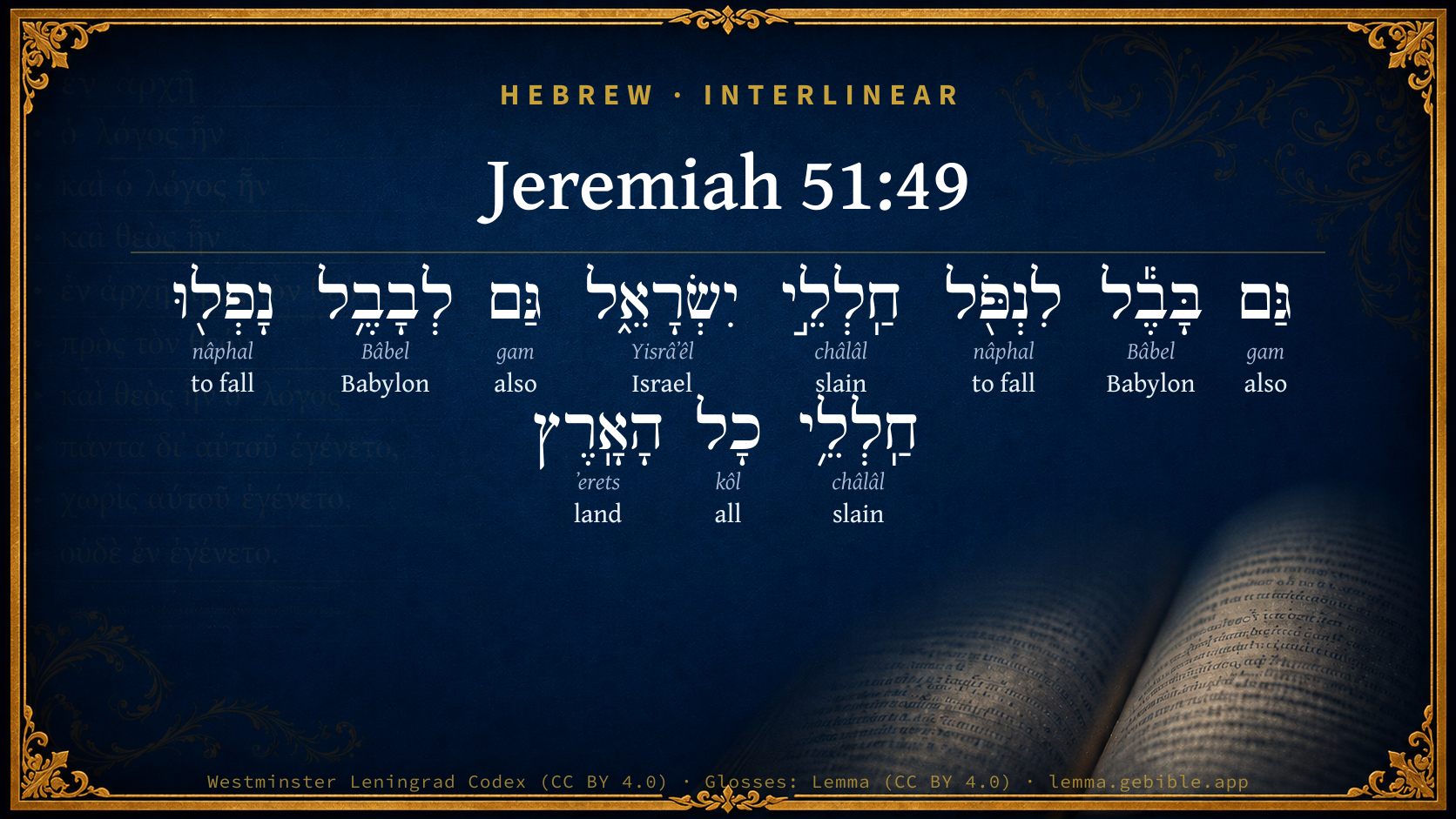
Hebrew (Westminster Leningrad Codex) Jeremiah 51:49 appears in the Hebrew Old Testament. The text above is from the Westminster Leningrad Codex. Each word links to its Strong’s number, a concise gloss, and parsing drawn from the Open Scriptures Hebrew Bible morphology. Click any word for its full Brown-Driver-Briggs (BDB) entry.
Download image
Cite this verse

Jeremiah 51:49 (World English Bible). Public Domain. Lemma interlinear Bible study tool, https://lemma.gebible.app/v/jeremiah/51/49.

Show BibTeX & RIS
BibTeX
RIS
English Translation
As Babylon has caused the slain of Israel to fall, so at Babylon shall fall the slain of all the land.
World English Bible · Public Domain
Download a study sheet

One document with this verse’s original text, its word-by-word gloss line, the meaning frame, cross-references with their text, attributed commentary, and full source and license credits — printable, and it pastes into notes with its structure intact.

This verse Autodidact and up

Study sheet (.html) Plain text (.txt)

A passage Seminary Student

Up to 50 verses in one chapter. A passage sheet keeps up to 6 commentary sources and 12 cross-references per verse, in the order this page ranks them, and says so on the sheet whenever that leaves anything out. Ask for a single verse and you get the Autodidact verse sheet above.

Everything on this page stays free to read, with no account — the sheet is a download of what is already on screen, not access to it.

Want to remove ads? Support Godless Engineer
Compare translations 3

The same verse in 3 English versions, stacked beneath the original-language interlinear above. Click any original word for its lexicon entry.

Each is an independent rendering of the whole verse — the interlinear is not word-aligned to these translations.

Highlighted words mark where these versions differ — a whole-verse word diff, not a word-by-word alignment.

  • World English Bible Public Domain
    As Babylon has caused the slain of Israel to fall, so at Babylon shall fall the slain of all the land.
  • King James Version Public Domain
    As Babylon hath caused the slain of Israel to fall, so at Babylon shall fall the slain of all the earth.
  • unfoldingWord Literal Text CC BY-SA 4.0
    As Babylon has made the killed of Israel fall, so the killed of all her land will fall in Babylon.

unfoldingWord Literal Text — © unfoldingWord, licensed CC BY-SA 4.0. Word-aligned USFM3 via Door43 (git.door43.org/unfoldingWord/en_ult).

Versions to compare (up to 4)

3 of 4 selected

Show all 18 translations

Every available English version of this verse, each an independent rendering of the whole verse.

  • World English Bible Public Domain
    As Babylon has caused the slain of Israel to fall, so at Babylon shall fall the slain of all the land.
  • Berean Standard Bible Public Domain
    “Babylon must fall on account of the slain of Israel, just as the slain of all the earth have fallen because of Babylon.
  • Majority Standard Bible Public Domain
    “Babylon must fall on account of the slain of Israel, just as the slain of all the earth have fallen because of Babylon.
  • King James Version Public Domain
    As Babylon hath caused the slain of Israel to fall, so at Babylon shall fall the slain of all the earth.
  • American Standard Version (1901) Public Domain
    As Babylon hath caused the slain of Israel to fall, so at Babylon shall fall the slain of all the land.
  • Revised Version (1885) Public Domain
    As Babylon hath caused the slain of Israel to fall, so at Babylon shall fall the slain of all the land.
  • Geneva Bible (1599) Public Domain
    As Babel caused the slaine of Israel to fal, so by Babel the slaine of all the earth did fall.
  • Douay-Rheims (1899) Public Domain
    And as Babylon caused that there should fall slain in Israel: so of Babylon there shall fall slain in all the earth.
  • Young's Literal Translation Public Domain
    Even Babylon `is' to fall, ye pierced of Israel, Even they of Babylon have fallen, Ye pierced of all the earth.
  • Literal Standard Version CC BY-SA 4.0
    “As Babylon [has caused the] pierced of Israel to fall, || So they of Babylon have fallen, || You pierced of all the earth.
  • Unlocked Literal Bible CC BY-SA 4.0
    As Babylon has made the killed of Israel fall, so the killed of all her land will fall in Babylon.
  • unfoldingWord Literal Text CC BY-SA 4.0
    As Babylon has made the killed of Israel fall, so the killed of all her land will fall in Babylon.
  • Darby Bible Public Domain
    As Babylon caused the slain of Israel to fall, so at Babylon shall fall the slain of all the earth.
  • World Messianic Bible Public Domain
    “As Babylon has caused the slain of Israel to fall, so the slain of all the land will fall at Babylon.
  • Webster's Bible Public Domain
    As Babylon hath caused the slain of Israel to fall, so at Babylon shall fall the slain of all the earth.
  • Free Bible Version CC BY-SA 4.0
    Babylon has to fall because of the Israelites and people of other nations she killed.
  • Bible in Basic English Public Domain
    As Babylon had the dead of Israel put to the sword, so in Babylon the dead of all the land will be stretched out.
  • JPS Tanakh (1917) Public Domain
    As Babylon hath caused the slain of Israel to fall, so at Babylon shall fall the slain of all the land.

Literal Standard Version (2020), Covenant Press — licensed CC BY-SA 4.0. Text via the HelloAO Bible API (eBible.org). Unlocked Literal Bible (unfoldingWord) — licensed CC BY-SA 4.0. Text via the HelloAO Bible API (eBible.org). unfoldingWord Literal Text — © unfoldingWord, licensed CC BY-SA 4.0. Word-aligned USFM3 via Door43 (git.door43.org/unfoldingWord/en_ult). Free Bible Version, Dr. Jonathan Gallagher — licensed CC BY-SA 4.0. Text via the HelloAO Bible API (eBible.org).

Word by word

More ways to search: Search by grammar → Find every occurrence → Compare this word →

Practice this passage: Drill this verse → Learn its vocabulary →

About this verse

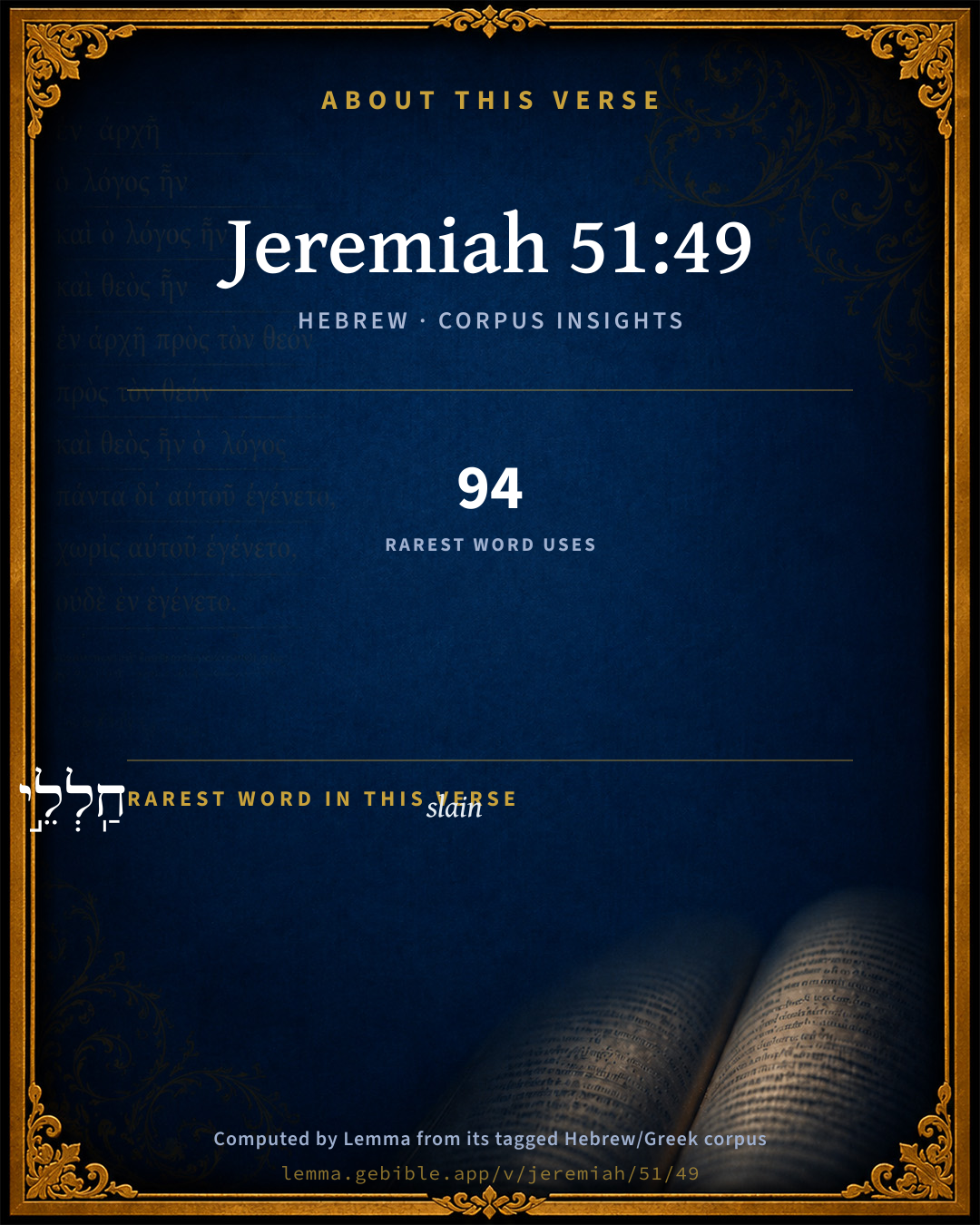
These counts appear in no published source. They are computed here, from the morphology-tagged text and Lemma’s own curated glosses. What Lemma adds →

11
words
7
distinct lemmas
Prophets
section

Grammatical profile

  • 2 verbs
  • 5 nouns
  • 2 adjectives
  • 2 particles

Verb forms

  • לִנְפֹּ֖ל Qal · Infinitive Construct
  • נָפְל֖וּ Qal · Perfect

Repetition

Words recur within this verse — often emphatic in Hebrew:

  • גַּם also H1571 ×2
  • בָּבֶ֕ל Babylon H894 ×2
  • לִנְפֹּ֖ל to fall H5307 ×2
  • חַֽלְלֵ֣י slain H2491 ×2

Cross-references

12

Topical passages linked to Jeremiah 51:49 in the Treasury of Scripture Knowledge — connected by theme and wording, ordered by reader-vote popularity; previews shown in the World English Bible.

  • Jeremiah 50:29 Call together the archers against Babylon, all those who bend the bow; encamp against her round about; let none of it escape: recompense her according to her work; according to all that she has done, do to her; for she has been proud against Yahweh, against the Holy One of Israel.
  • Jeremiah 51:24 I will render to Babylon and to all the inhabitants of Chaldea all their evil that they have done in Zion in your sight, says Yahweh.
  • Psalms 137:8–9 Daughter of Babylon, doomed to destruction, He will be happy who rewards you, As you have served us.
  • Judges 1:7 Adoni-bezek said, "Seventy kings, having their thumbs and their great toes cut off, gathered [their food] under my table: as I have done, so God has requited me." They brought him to Jerusalem, and he died there.
  • Jeremiah 50:11 Because you are glad, because you rejoice, O you who plunder my heritage, because you are wanton as a heifer that treads out [the grain], and neigh as strong horses;
  • Jeremiah 50:17–18 Israel is a hunted sheep; the lions have driven him away: first, the king of Assyria devoured him; and now at last Nebuchadrezzar king of Babylon has broken his bones.
  • Jeremiah 50:33–34 Thus says Yahweh of hosts: The children of Israel and the children of Judah are oppressed together; and all who took them captive hold them fast; they refuse to let them go.
  • Jeremiah 51:10–11 Yahweh has brought forth our righteousness: come, and let us declare in Zion the work of Yahweh our God.
  • Jeremiah 51:35 The violence done to me and to my flesh be on Babylon, shall the inhabitant of Zion say; and, My blood be on the inhabitants of Chaldea, shall Jerusalem say.
  • Matthew 7:2 For with whatever judgment you judge, you will be judged; and with whatever measure you measure, it will be measured to you.
  • James 2:13 For judgment is without mercy to him who has shown no mercy. Mercy triumphs over judgment.
  • Revelation 18:5–6 for her sins have reached to the sky, and God has remembered her iniquities.

Cross-references courtesy of OpenBible.info (CC BY 4.0).

Hebrew and Greek witnesses Masoretic Hebrew ↔ Greek Septuagint

The same verse in the two great witnesses to the Old Testament, shown verse-for-verse.

These are two independent witnesses, not word-aligned to each other, and the Septuagint is shown in lemma (dictionary) form.

Hebrew Jeremiah 51:49 Masoretic · Westminster Leningrad Codex

גַּם בָּבֶ֕ל לִנְפֹּ֖ל חַֽלְלֵ֣י יִשְׂרָאֵ֑ל גַּם לְבָבֶ֥ל נָפְל֖וּ חַֽלְלֵ֥י כָל הָאָֽרֶץ

As Babylon has caused the slain of Israel to fall, so at Babylon shall fall the slain of all the land.

World English Bible · Public Domain

Greek LXX Structure differs

In the Septuagint, Jeremiah is about an eighth shorter than the Hebrew and arranges its material differently — the Oracles Against the Nations (Hebrew chapters 46–51) appear in the middle of the Greek book, after 25:13. Because the chapter and verse boundaries do not line up, a verse-for-verse comparison with the Hebrew is not shown.

A verse-for-verse comparison isn’t shown here because the chapters and verses don’t line up. Switch to the LXX edition with the MT / LXX toggle above to read the Greek directly.

Hebrew: Westminster Leningrad Codex (CC BY 4.0). Greek: Septuagint (public domain); English from a public-domain English Septuagint. How the Septuagint differs from the Hebrew →

Targum (Aramaic paraphrase)

1

The Targum is the ancient Jewish Aramaic paraphrase of the Hebrew Scriptures — an interpretive translation, not the Hebrew text itself. Onkelos (literal) and Pseudo-Jonathan (expansive) render the Torah, and Jonathan the Prophets. Coverage is partial: where no permissively-licensed English translation exists for a verse, only the Aramaic is shown. This is verse-level text, not a word-by-word alignment to the Hebrew.

  1. Targum Jonathan Prophets (Joshua–Malachi)
    אַף בְּבָבֶל אִתְרְמִיאוּ קְטִילֵי יִשְׂרָאֵל אַף לְבָבֶל יִתְרְמוּן קְטִילֵי כָל אַרְעָא:

    (no public-domain English translation for this verse)

    Targum Jonathan — Aramaic: “Mikraot Gedolot” (public domain). English: “Sefaria Community Translation” (CC0 1.0 (public-domain dedication)); “London "Chaldee Paraphrase," 1871” (public domain). Text via Sefaria.

Commentary

Notes on Jeremiah 51:49 from classic Christian and Jewish commentators (each source and its license shown beneath its notes). The classic Christian expositions comment on the surrounding passage and are grouped to its opening verse, so a note may address several verses; the Jewish commentaries on the Tanakh (Rashi and others) are per-verse, so they appear only where the commentator wrote on this verse.

Lemma curates 59 commentaries, every one of them public domain or Creative Commons licensed, each selected and text-cleaned for this edition rather than reprinted as found. About our sources →

Jamieson, Fausset & Brown

Robert Jamieson, A. R. Fausset & David Brown

caused . . . to fall--literally, "has been for the falling," that is, as Babylon made this its one aim to fill all places with the slain of Israel, so at Babylon shall all the slain of that whole land (not as English Version, "of all the earth") [MAURER]. HENDERSON translates, "Babylon also shall fall, ye slain of Israel. Those also of Babylon shall fall, O ye slain of all the earth." But, "in the midst of her," Jer 51:47, plainly answers to "at Babylon," Jer 51:49, English Version.

Jamieson, Fausset & Brown — Commentary Critical and Explanatory on the Whole Bible (1871) — public domain (CC PDM 1.0). Text via the HelloAO Bible API.

Trapp's Complete Commentary

John Trapp

Jer 51:49 As Babylon [hath caused] the slain of Israel to fall, so at Babylon shall fall the slain of all the earth.

Ver. 49. So at Babylon shall fall the slain of all the earth.] Or rather, Of all the land - i.e., of all Babylon, or Assyria. When God once cometh to make inquisition for the blood of his saints, woe to the wicked, &c.

John Trapp, A Commentary or Exposition upon All the Books of the Old and New Testament (1647–1656) — public domain. Text from a community e-Sword module.

Tyndale Open Study Notes

Tyndale Open Resources

51:49-50 Babylon’s penalty would match the brutality it had poured out on the Israelites and other nations.

Tyndale Open Study Notes — © Tyndale Open Resources, licensed CC BY-SA 4.0. Text via the HelloAO Bible API.

Geneva Bible (1599)

Geneva Bible translators

Babylon did not only destroy Israel, but many other nations.

Geneva Bible (1599) marginal notes — public domain. Text via Bolls.life.

John Calvin's Commentaries

THE words literally read thus, “As Babylon, that they might fall, the slain of Israel, so for Babylon they shall fall, the slain of all the lands.” Some, omitting the ל, lamed, in the second clause, render the passage thus, “As the slain of Israel have fallen through Babylon, so by Babylon shall they fall: “and others render the last like the first, “through Babylon.” But the simpler rendering is that which I have given, even that this would be the reward which God would render Babylon, that they would fall everywhere through its whole land, as it had slain the people of Israel. For the Prophet no doubt had this in view, to alleviate the sorrow of the godly by some consolation; and the ground of consolation was, that God would be the avenger of all the evils which the Babylonians had brought on them. For it is a heavy trial when we think that we are disregarded by God, and that our enemies with impunity oppress us according to their own will. The Prophet, then, testifies that God would by no means suffer that so many of the Israelites should perish unpunished, for he would at length render to the Babylonians what they deserved, even that they who destroyed others should in their turn be destroyed.

We may now easily gather what the Prophet means, “As Babylon,” he says, “has made many in Israel to fall, so now the Babylonians themselves shall fall.” To render ל, lamed, by “through,” or, on account of, is improper. Then he says the Babylonians themselves shall fall, the slain of the whole land. By the whole land, I do not understand the whole world, as other interpreters, but Chaldea only. Then everywhere in Chaldea, they who had been so cruel as to shed innocent blood everywhere would perish. And though that saying is generally true, Whoso sheddeth man’s blood shall be punished; yet the word is especially addressed to the Church. God, then, avenges all slaughters, because he cannot bear his own image to be violated, which he has impressed on men. But as he has a paternal care for his Church, he is in an especial manner the avenger of that cruelty which the ungodly exercise towards the faithful.

In short, the Prophet means, that though God may suffer for a time the ungodly to rage against his Church, yet he will be at the suitable season its avenger, so that they shall everywhere be slain who have been thus cruel.

But we hence learn that we ought by no means to despair when God allows so much liberty to the ungodly, so that they slay the miserable and the innocent, for the same thing happened formerly to the ancient people. It was the Church of God in which the Chaldeans committed that carnage of which the Prophet speaks: the children of God were then slain as sheep. If the same thing should happen to us at this day, there would be no reason for us to despond, but to wait for the time of vengeance of which the Prophet speaks here; for experience will then show how precious to God is the life of all the godly. It now follows, —

John Calvin's Commentaries (1540-1563) — public domain. Text from the Calvin Translation Society English edition (1840s-50s) via the Christian Classics Ethereal Library (ccel.org). Calvin's coverage is partial (roughly two-thirds of the Bible); uncommented books and verses are honest gaps, never fabricated. The 19th-century editor's footnotes and remarks are omitted so the notes are faithfully Calvin's own voice.

Ellicott's Commentary for English Readers

(49) As Babylon hath caused . . .—The interpolated words and the marginal reading indicate that the construction is obscure, but the Authorised version probably comes close to the meaning of the original. The punishment that falls on Babylon comes on account of her slaughter of the Israelites, but in that punishment other nations from all parts of the earth who are mingled with her people should be involved. Perhaps, however. we should read the slain of all the land, as giving more emphatically the law of retribution. The rendering of the margin, “Both Babylon is to fall, O ye slain of Israel, and with Babylon . . .” is adopted by some recent commentators, but gives a less satisfactory meaning.

A Bible Commentary for English Readers, edited by Charles John Ellicott (1878–1897) — public domain. Text from a community e-Sword module.

The Cambridge Bible for Schools and Colleges

gen. ed. J. J. S. Perowne

49. As Babylon … so at, etc.] better, as mg. Both Babylon is to fall, O ye slain of Israel, and at, etc., or, repeating a Heb. consonant, for the slain of Israel. The ground for Babylon’s overthrow is to be her cruelty towards others.

The Cambridge Bible for Schools and Colleges (gen. ed. J. J. S. Perowne; Cambridge University Press, 1878–1918) — public domain. Text from a community e-Sword module.

John Gill's Exposition

We are confounded, because we have heard reproach,.... These are the words of the Jews, either objecting to their return to their land; or lamenting the desolation of it; and complaining of the reproach it lay under, being destitute of inhabitants; the land in general lying waste and uncultivated; the city of Jerusalem and temple in ruins; and the worship of God ceased; and the enemy insulting and reproaching; suggesting, that their God could not protect and save them; and, under these discouragements, they could not bear the thoughts of returning to it:

shame hath covered our faces; they knew not which way to look when they heard the report of the state of their country, and the reproach of the enemy, and through shame covered their faces:

for strangers are come into the sanctuaries of the Lord's house; the oracle, or the holy of holies; the temple, or the holy place, and the porch or court; so Kimchi and Abarbinel; into which the Chaldeans, strangers to God and the commonwealth of Israel, had entered, to the profanation of them, and had destroyed them.

John Gill's Exposition of the Whole Bible (1746–1763) — public domain (CC PDM 1.0). Text via the HelloAO Bible API.

Albert Barnes' Notes on the Bible

Render, “As Babylon caused the slain of Israel to fall, so because of Babylon, hare fallen the slain of (or, in) the whole earth.” Babylon has to answer for the general carnage caused by its wars.

Albert Barnes' Notes on the Bible (1834–1885) — public domain. Text from a community e-Sword/MySword module.

Matthew Poole's English Annotations

The words in the Hebrew have some difficulty, which is not so obvious to those not acquainted with that language, but hath given occasion to interpreters to vary in their particular translations of it; but they mostly agree in the general sense, viz. that these words are given as a reason why the whole earth should so much rejoice in the ruin of Babylon, because Babylon had caused Israel to fall. The latter term,

all the earth, must be understood in a restrained sense, for that earth; the Chaldeans coming up from all parts of Chaldea to help Babylon, should be slain there, as by the means of Babylon the Israelites were slain that came up from all parts of Judea to help Jerusalem.

Matthew Poole's English Annotations on the Holy Bible (1683–1685) — public domain. Text from a community e-Sword/MySword module.

The Pulpit Commentary

As Babylon hath caused, etc. The verse is very difficult. Ewald and others render thus: "Not only must Babylon fall, O ye slain ones of Israel, but slain ones of the whole earth have fallen because of Babylon." But why this address to the slain ones of Israel? Besides, the antithesis indicated in the Hebrew is thereby destroyed. Hell explains the antithesis thus: "Just as Babylon was intent on the fall of slain ones in Israel, so also there fall because of Babylonian slain ones of all the earth," viz. because there are to be found, in the capital of the empire, people from all quarters of the world, who are slain when Babylon is conquered. A better antithesis seems to be gained if we follow the Peshito, and read, at the end of the verse, "in the whole earth." It will then be asserted by the prophet that, just as Babylon was the cause of the slaying of Israelites, so (as a punishment) the Babylonian fugitives shall be slain wherever they may wander.

The Pulpit Commentary (1880–1919), ed. H.D.M. Spence-Jones & Joseph S. Exell — public domain. Text from a community e-Sword module.

John Wesley's Explanatory Notes

Of all the earth - This term must be understood in a restrained sense; the Chaldeans coming up from all parts of Chaldea to help Babylon, were slain there, as by the means of Babylon the Israelites were slain that came from all parts of Judea to help Jerusalem.

John Wesley, Explanatory Notes Upon the Whole Bible (1754–1765) — public domain. Text via the GEBible commentary corpus.

Rashi

Rabbi Shlomo Yitzchaki (Rashi)

As Babylon was [a cause] for the slain of Israel to fall therein.

so in Babylon shall fall the slain of all her land.

Rashi on the Tanakh — English translations: “The Judaica Press complete Tanach with Rashi, translated by A. J. Rosenberg” (CC BY 4.0); “Pentateuch with Rashi's commentary by M. Rosenbaum and A.M. Silbermann, 1929-1934” (public domain); “The Metsudah Tanach series, Lakewood, N.J” (CC BY 4.0); and “The Book of Joshua, Metsudah Publications, 1997” (CC BY 4.0). Text via Sefaria.

Lesson kit

Teaching starters — assembled from the data on this page, not authored interpretation. Every prompt links to the verse data it draws on. Edit before teaching.

Jeremiah, in the Prophets, opens this verse with 11 words (7 distinct Hebrew lemmas). Its most distinctive word is châlâl (“slain”). A historical commentator’s framing appears above. Read the whole chapter for the surrounding context.

Discussion questions

  1. The word châlâl carries the sense “slain.” How does it shape the verse?
  2. Jeremiah 50:29 shares this passage’s theme. How do the two illuminate each other?
  3. “also” occurs 2× in this one verse. What is the effect of the repetition?
  4. These translations render this verse differently; the difference is in the English rendering, not the original. What questions does that raise?
  5. The verb «לִנְפֹּ֖ל» is Qal Infinitive Construct. How does its form color the action?
  6. Reading how Jamieson, Fausset & Brown and Trapp's Complete Commentary read this verse, where do the two commentators agree and where do they part?

Things to notice

  • These translations choose different wording for 9 words in this verse.
  • “also” occurs 2× in this single verse.
  • 7 distinct Hebrew lemmas span 11 words in this verse.

Reading settings

Reading text

Shown beneath each verse's original-language words.

Old Testament
Old Testament edition

Read the OT as the Masoretic Hebrew (MT) or the Greek Septuagint (LXX).

English shown for the Greek Septuagint (in the Hebrew ↔ Greek comparison).

Comparing translations? Open the Compare panel on any verse page to stack up to four side by side.