
1 Chronicles 11:20

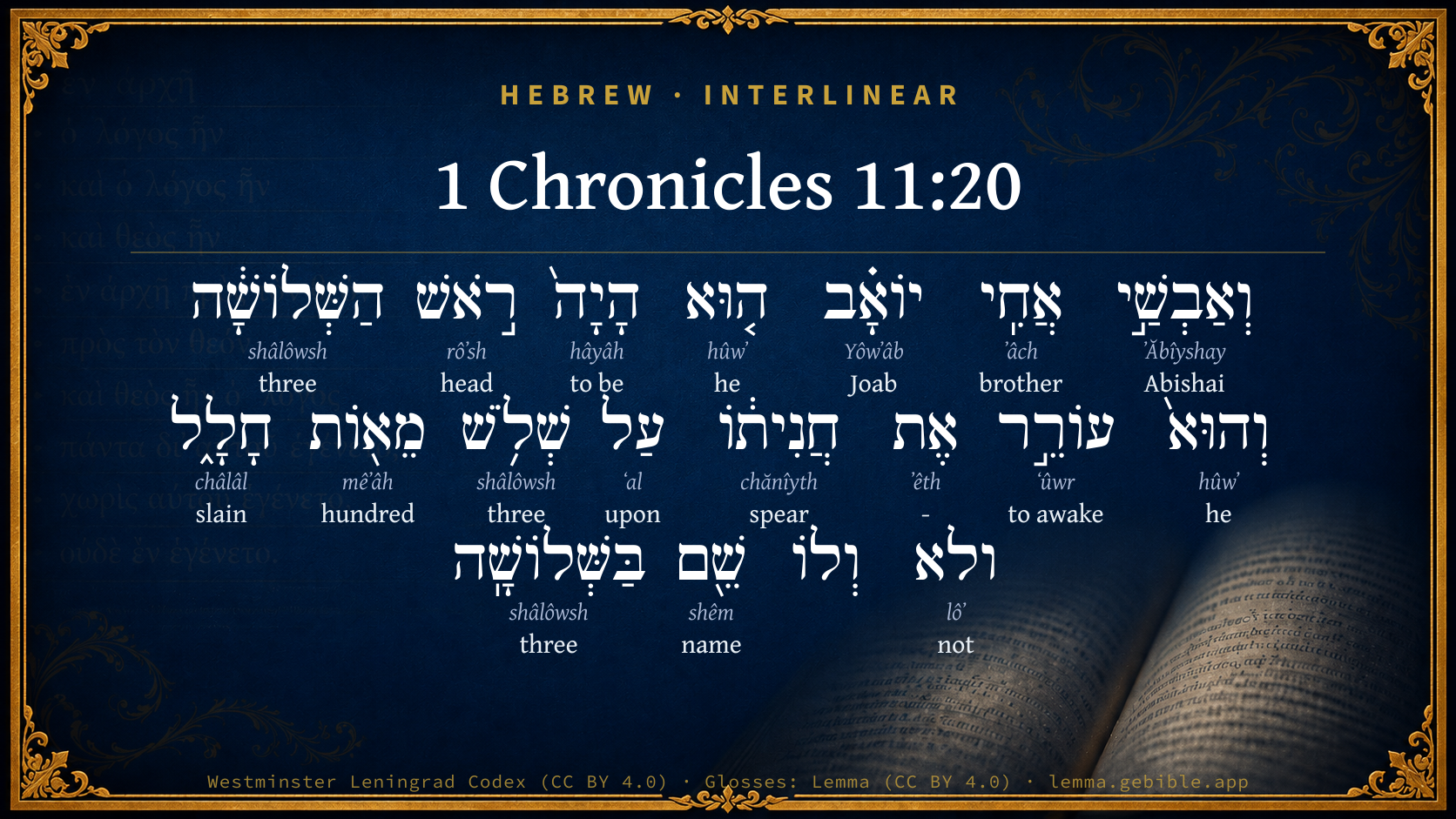
Hebrew (Westminster Leningrad Codex) 1 Chronicles 11:20 appears in the Hebrew Old Testament. The text above is from the Westminster Leningrad Codex. Each word links to its Strong’s number, a concise gloss, and parsing drawn from the Open Scriptures Hebrew Bible morphology. Click any word for its full Brown-Driver-Briggs (BDB) entry.
Download image
Cite this verse

1 Chronicles 11:20 (World English Bible). Public Domain. Lemma interlinear Bible study tool, https://lemma.gebible.app/v/1-chronicles/11/20.

Show BibTeX & RIS
BibTeX
RIS
English Translation
Abishai, the brother of Joab, he was chief of the three; for he lifted up his spear against three hundred and killed them, and had a name among the three.
World English Bible · Public Domain
Download a study sheet

One document with this verse’s original text, its word-by-word gloss line, the meaning frame, cross-references with their text, attributed commentary, and full source and license credits — printable, and it pastes into notes with its structure intact.

This verse Autodidact and up

Study sheet (.html) Plain text (.txt)

A passage Seminary Student

Up to 50 verses in one chapter. A passage sheet keeps up to 6 commentary sources and 12 cross-references per verse, in the order this page ranks them, and says so on the sheet whenever that leaves anything out. Ask for a single verse and you get the Autodidact verse sheet above.

Everything on this page stays free to read, with no account — the sheet is a download of what is already on screen, not access to it.

Want to remove ads? Support Godless Engineer
Compare translations 3

The same verse in 3 English versions, stacked beneath the original-language interlinear above. Click any original word for its lexicon entry.

Each is an independent rendering of the whole verse — the interlinear is not word-aligned to these translations.

Highlighted words mark where these versions differ — a whole-verse word diff, not a word-by-word alignment.

  • World English Bible Public Domain
    Abishai, the brother of Joab, he was chief of the three; for he lifted up his spear against three hundred and killed them, and had a name among the three.
  • King James Version Public Domain
    And Abishai the brother of Joab, he was chief of the three: for lifting up his spear against three hundred, he slew them, and had a name among the three.
  • unfoldingWord Literal Text CC BY-SA 4.0
    And Abishai, the brother of Joab, he was the head of the Three, and he was awakening his spear against 300, slain. And to him a name among the Three.

unfoldingWord Literal Text — © unfoldingWord, licensed CC BY-SA 4.0. Word-aligned USFM3 via Door43 (git.door43.org/unfoldingWord/en_ult).

Versions to compare (up to 4)

3 of 4 selected

Show all 18 translations

Every available English version of this verse, each an independent rendering of the whole verse.

  • World English Bible Public Domain
    Abishai, the brother of Joab, he was chief of the three; for he lifted up his spear against three hundred and killed them, and had a name among the three.
  • Berean Standard Bible Public Domain
    Now Abishai, the brother of Joab, was chief of the Three, and he lifted his spear against three hundred men, killed them, and won a name along with the Three.
  • Majority Standard Bible Public Domain
    Now Abishai, the brother of Joab, was chief of the Three, and he wielded his spear against three hundred men, killed them, and won a name along with the Three.
  • King James Version Public Domain
    And Abishai the brother of Joab, he was chief of the three: for lifting up his spear against three hundred, he slew them, and had a name among the three.
  • American Standard Version (1901) Public Domain
    And Abishai, the brother of Joab, he was chief of the three; for he lifted up his spear against three hundred and slew them, and had a name among the three.
  • Revised Version (1885) Public Domain
    And Abishai, the brother of Joab, he was chief of the three: for he lifted up his spear against three hundred and slew them, and had a name among the three.
  • Geneva Bible (1599) Public Domain
    And Abishai the brother of Ioab, he was chiefe of the three, and he lift vp his speare against three hundreth, and slew them, and had the name among the three.
  • Douay-Rheims (1899) Public Domain
    And Abisai the brother of Joab, he was chief of three, and he lifted up his spear against three hundred whom he slew, and he was renowned among the three,
  • Young's Literal Translation Public Domain
    And Abishai brother of Joab, he hath been head of the three: and he is lifting up his spear against three hundred -- wounded, and hath a name among three.
  • Literal Standard Version CC BY-SA 4.0
    And Abishai brother of Joab, he has been head of the three: and he is lifting up his spear against three hundred—wounded, and has a name among three.
  • Unlocked Literal Bible CC BY-SA 4.0
    Abishai brother of Joab was captain over the Three. He once used his spear against three hundred and killed them. He is mentioned along with the Three.
  • unfoldingWord Literal Text CC BY-SA 4.0
    And Abishai, the brother of Joab, he was the head of the Three, and he was awakening his spear against 300, slain. And to him a name among the Three.
  • Darby Bible Public Domain
    And Abishai the brother of Joab, he was the chief of three; and he brandished his spear against three hundred and slew them; and he had a name among the three.
  • World Messianic Bible Public Domain
    Abishai, the brother of Joab, was chief of the three; for he lifted up his spear against three hundred and killed them, and had a name among the three.
  • Webster's Bible Public Domain
    And Abishai the brother of Joab, he was chief of the three: for lifting his spear against three hundred, he slew them, and had a name among the three.
  • Free Bible Version CC BY-SA 4.0
    Abishai, Joab's brother, was leader of the second Three. Using his spear, he once killed 300 men, and became famous among the Three.
  • Bible in Basic English Public Domain
    And Abishai, the brother of Joab, was chief of the thirty, for he put to death three hundred with his spear, but he had not a name among the three.
  • JPS Tanakh (1917) Public Domain
    And Abishai, the brother of Joab, he was chief of the three; for he lifted up his spear against three hundred and slew them, and had a name among the three.

Literal Standard Version (2020), Covenant Press — licensed CC BY-SA 4.0. Text via the HelloAO Bible API (eBible.org). Unlocked Literal Bible (unfoldingWord) — licensed CC BY-SA 4.0. Text via the HelloAO Bible API (eBible.org). unfoldingWord Literal Text — © unfoldingWord, licensed CC BY-SA 4.0. Word-aligned USFM3 via Door43 (git.door43.org/unfoldingWord/en_ult). Free Bible Version, Dr. Jonathan Gallagher — licensed CC BY-SA 4.0. Text via the HelloAO Bible API (eBible.org).

Word by word

More ways to search: Search by grammar → Find every occurrence → Compare this word →

Practice this passage: Drill this verse → Learn its vocabulary →

וְאַבְשַׁ֣י
ʼĂbîyshay
H52
“and · Abishai”
Conjunction + Noun, Proper
Part of Speech
Conjunction + Noun
Type
Proper
Full BDB Definition

Origin: from H1 and H7862

TWOT: None

Abishai = "my father is Jesse" or " my father is a gift" - grandson of Jesse, nephew of David via his sister Zeruiah, brother of Joab
  1. אֲחִֽי ʼâch H251 “brother of” Noun, Common, Masculine, Singular, Construct
  2. יוֹאָ֗ב Yôwʼâb H3097 “Joab” Noun, Proper
  3. ה֤וּא hûwʼ H1931 “he” Pronoun, Personal, 3rd Person, Masculine, Singular
  4. הָיָה֙ hâyâh H1961 “to be” Verb, Qal, Perfect, 3rd Person, Masculine, Singular
  5. רֹ֣אשׁ rôʼsh H7218 “head of” Noun, Common, Masculine, Singular, Construct
  6. הַשְּׁלוֹשָׁ֔ה shâlôwsh H7969 “the · three” Particle, Definite Article + Adjective, Cardinal number, Masculine, Singular, Absolute
  7. וְהוּא֙ hûwʼ H1931 “and · he” Conjunction + Pronoun, Personal, 3rd Person, Masculine, Singular
  8. עוֹרֵ֣ר ʻûwr H5782 “to awake” Verb, Polel, Perfect, 3rd Person, Masculine, Singular
  9. אֶת ʼêth H853 “-” Particle, Direct Object
  10. חֲנִית֔וֹ chănîyth H2595 “spear · his” Noun, Common, Feminine, Singular, Construct + Suffix, Personal, 3rd Person, Masculine, Singular
  11. עַל ʻal H5921 “upon” Preposition
  12. שְׁלֹ֥שׁ shâlôwsh H7969 “three” Adjective, Cardinal number, Feminine, Singular, Absolute
  13. מֵא֖וֹת mêʼâh H3967 “hundred” Adjective, Cardinal number, Both, Plural, Absolute
  14. חָלָ֑ל châlâl H2491 “slain” Adjective, Adjective, Masculine, Singular, Absolute
  15. ולא lôʼ H3808 “and · not” Conjunction + Particle, Negative
  16. שֵׁ֖ם shêm H8034 “name” Noun, Common, Masculine, Singular, Absolute
  17. בַּשְּׁלוֹשָֽׁה shâlôwsh H7969 “in/at the · three” Preposition, Determined + Adjective, Cardinal number, Masculine, Singular, Absolute

About this verse

These counts appear in no published source. They are computed here, from the morphology-tagged text and Lemma’s own curated glosses. What Lemma adds →

19
words
15
distinct lemmas
Historical
section

Notable vocabulary

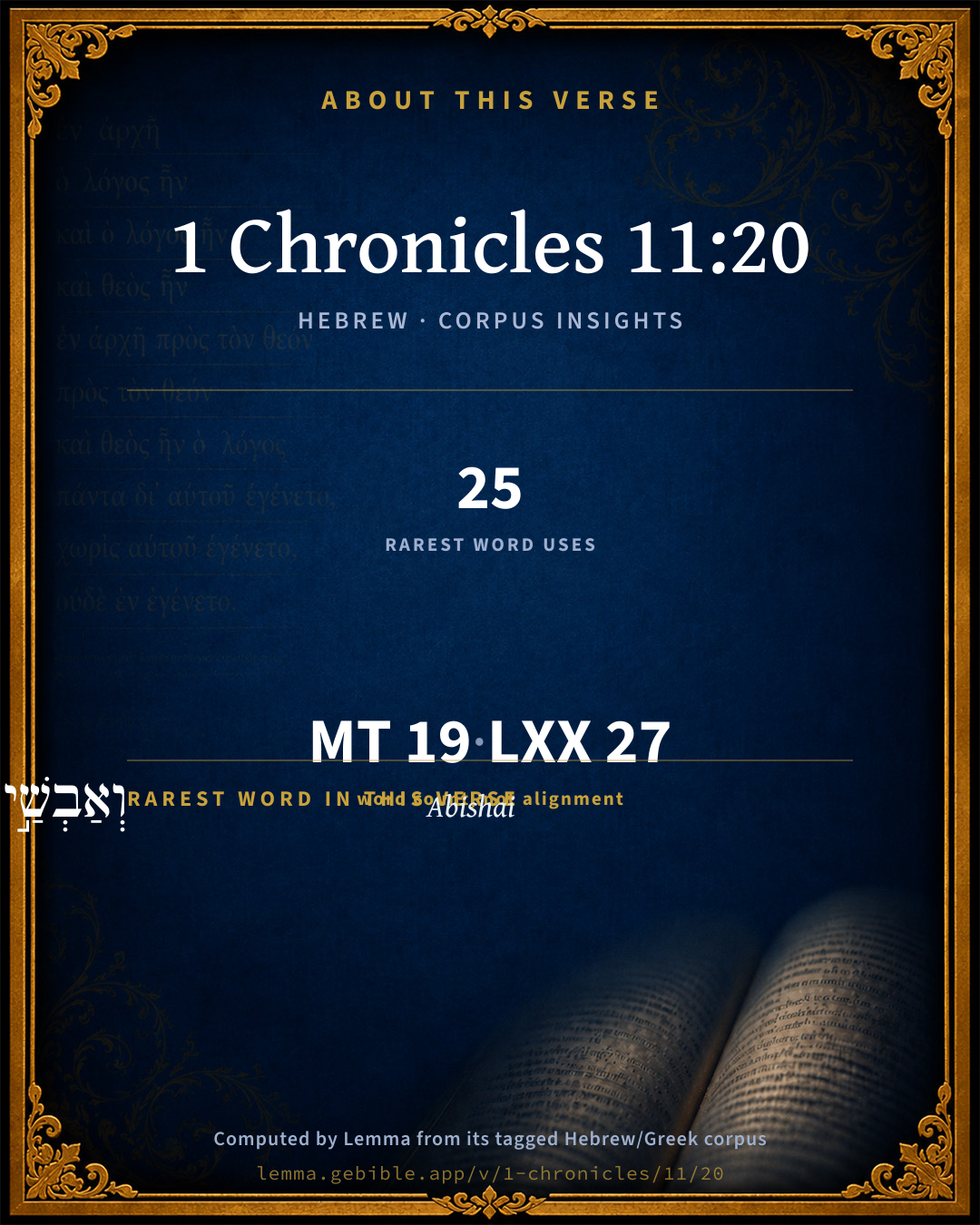
The rarest word here is וְאַבְשַׁ֣י Abishai H52 — appearing just 25 times in the whole Hebrew Bible.

Shared distinctive vocabulary

וְאַבְשַׁ֣י Abishai H52 occurs in 24 verses of the Hebrew Bible. Also found in:

Grammatical profile

  • 2 verbs
  • 6 nouns
  • 5 adjectives
  • 2 pronouns
  • 2 prepositions
  • 2 particles

Verb forms

  • הָיָה֙ Qal · Perfect
  • עוֹרֵ֣ר Polel · Perfect

Repetition

Words recur within this verse — often emphatic in Hebrew:

  • הַשְּׁלוֹשָׁ֔ה three H7969 ×3
  • ה֤וּא he H1931 ×2

Hebrew & Septuagint length

In English translation the verse runs 30 words from the Hebrew and 31 from the Septuagint (LXX English) — closely comparable.

A rough comparison of the two English renderings, which tokenize alike — not a word-level alignment.

Word counts can differ between the Hebrew and the Greek without any difference in meaning — e.g. the Hebrew direct-object marker אֵת has no separate Greek word, and Greek often adds the article ὁ.

In the original languages it is 19 Hebrew tokens and 27 Greek tokens — but the two are counted differently (Hebrew bundles its prefixes and suffixes into one token; the Greek is in lemma form), so that isn’t a like-for-like length.

Cross-references

8

Topical passages linked to 1 Chronicles 11:20 in the Treasury of Scripture Knowledge — connected by theme and wording, ordered by reader-vote popularity; previews shown in the World English Bible.

  • 1 Samuel 26:6 Then answered David and said to Ahimelech the Hittite, and to Abishai the son of Zeruiah, brother to Joab, saying, Who will go down with me to Saul to the camp? Abishai said, I will go down with you.
  • 2 Samuel 2:18 The three sons of Zeruiah were there, Joab, and Abishai, and Asahel: and Asahel was as light of foot as a wild gazelle.
  • 2 Samuel 3:30 So Joab and Abishai his brother killed Abner, because he had killed their brother Asahel at Gibeon in the battle.
  • 2 Samuel 18:2 David sent forth the people, a third part under the hand of Joab, and a third part under the hand of Abishai the son of Zeruiah, Joab's brother, and a third part under the hand of Ittai the Gittite. The king said to the people, I will surely go forth with you myself also.
  • 2 Samuel 20:6 David said to Abishai, Now will Sheba the son of Bichri do us more harm than did Absalom: take your lord's servants, and pursue after him, lest he get him fortified cities, and escape out of our sight.
  • 2 Samuel 21:17 But Abishai the son of Zeruiah helped him, and struck the Philistine, and killed him. Then the men of David swore to him, saying, You shall go no more out with us to battle, that you don't quench the lamp of Israel.
  • 2 Samuel 23:18–39 Abishai, the brother of Joab, the son of Zeruiah, was chief of the three. He lifted up his spear against three hundred and killed them, and had a name among the three.
  • 1 Chronicles 2:16 and their sisters were Zeruiah and Abigail. The sons of Zeruiah: Abishai, and Joab, and Asahel, three.

Cross-references courtesy of OpenBible.info (CC BY 4.0).

Hebrew and Greek witnesses Masoretic Hebrew ↔ Greek Septuagint

The same verse in the two great witnesses to the Old Testament, shown verse-for-verse.

These are two independent witnesses, not word-aligned to each other, and the Septuagint is shown in lemma (dictionary) form.

Hebrew 1 Chronicles 11:20 Masoretic · Westminster Leningrad Codex

וְאַבְשַׁ֣י אֲחִֽי יוֹאָ֗ב ה֤וּא הָיָה֙ רֹ֣אשׁ הַשְּׁלוֹשָׁ֔ה וְהוּא֙ עוֹרֵ֣ר אֶת חֲנִית֔וֹ עַל שְׁלֹ֥שׁ מֵא֖וֹת חָלָ֑ל ולא וְלוֹ שֵׁ֖ם בַּשְּׁלוֹשָֽׁה

Abishai, the brother of Joab, he was chief of the three; for he lifted up his spear against three hundred and killed them, and had a name among the three.

World English Bible · Public Domain

Greek LXX 1 Chronicles 11:20 Septuagint · lemma form

καί αβεσσα ἀδελφός ιωαβ οὗτος εἰμί ἄρχω ὁ τρεῖς οὗτος σπάω ὁ ῥομφαία αὐτός ἐπί τριακόσιοι τραυματίας ἐν καιρός εἷς καί οὗτος εἰμί ὀνομαστός ἐν ὁ τρεῖς

And Abisa the brother of Joab, he was chief of three: he drew his sword against three hundred slain at one time, and he had a name among the second three.

LXX2012 (modern English Septuagint) · Public Domain

On this verse, Haydock's Catholic Bible Commentary discusses the Septuagint’s reading. Read the note in Commentary ↓

Hebrew: Westminster Leningrad Codex (CC BY 4.0). Greek: Septuagint (public domain); English from LXX2012 (modern English Septuagint) (Public Domain). How the Septuagint differs from the Hebrew →

Commentary

Notes on 1 Chronicles 11:20 from classic Christian and Jewish commentators (each source and its license shown beneath its notes). The classic Christian expositions comment on the surrounding passage and are grouped to its opening verse, so a note may address several verses; the Jewish commentaries on the Tanakh (Rashi and others) are per-verse, so they appear only where the commentator wrote on this verse.

Lemma curates 59 commentaries, every one of them public domain or Creative Commons licensed, each selected and text-cleaned for this edition rather than reprinted as found. About our sources →

Joseph Benson's Commentary

1Ch 11:20-21. Lifting up his spear against three hundred, he slew them — He vanquished them all, and slew a great number of them: it is, however, not said that he slew them all at one time, as it is said of Jashobeam, 1Ch 11:11. He attained not unto the first three — He did not equal them in valiant exploits.

Joseph Benson's Commentary on the Old and New Testaments (1811–1818) — public domain. Text from a community e-Sword module.

Ellicott's Commentary for English Readers

(20) Abishai the brother of Joab.—Heb., Abshai, but in Samuel, Abishai. (Comp. Abram and Abiram.) Samuel adds “son of Zeruiah” after Joab. (Comp. 1Ch_2:16 and 1Ch_18:12; 1Ch_19:11 ff. for other deeds of Abishai.)

He was chief of the three.—Apparently the second triad, one of whose famous exploits has just been related (1Ch_11:15-19). The Hebrew text of Samuel seems to read “knights,” but some MSS., the Hebrew margin, and all the versions, agree with Chronicles.

For lifting up . . .—Literally, and he had bran. dished his spear over three hundred slain. The exploit of Jashobeam (1Ch_11:11).

And had a name among the three.—That is, among the second triad, of which he was captain.

(20-25) Feats of Abishai and Benaiah. (Comp. 2Sa_23:18-23, of which the present passage is little more than a duplicate.)

A Bible Commentary for English Readers, edited by Charles John Ellicott (1878–1897) — public domain. Text from a community e-Sword module.

The Cambridge Bible for Schools and Colleges

gen. ed. J. J. S. Perowne

20. chief of the three] In 2Sa_23:18 (C’thîb) Abishai is called by the same title (Heb. rôsh hasshâlîshi) as Josheb-basshebeth (ib. 2Sa_23:8). This title probably means chief of the third part [of the army]; cp. 2Sa_23:11, note. Chief of the three is a faulty reading.

for lifting up his spear] R.V. for he lifted up his spear; cp. 1Ch_11:11, note.

had a name among the three] Cp. 1Ch_11:24, where the same thing is said of Benaiah. The three meant are either the three of 1Ch_11:15-19 or else an unknown three; cp. next note.

The Cambridge Bible for Schools and Colleges (gen. ed. J. J. S. Perowne; Cambridge University Press, 1878–1918) — public domain. Text from a community e-Sword module.

Haydock's Catholic Bible Commentary

Abisai. His name is written without the middle i, in all this book. --- Three. Alexandrian Septuagint alone reads, "six." --- He was. Hebrew adds, "not;" evidently mistaking lo, "not," for lo, "ei." See 4 Kings viii. 10. "He lifted up his spear against 300 soldiers, and had a name among Three." (Kennicott)

George Leo Haydock (1774–1849), Haydock's Catholic Family Bible and Commentary, 1859 edition — public domain. Excludes Psalms (Douay-Rheims chapter numbering differs from Protestant) and Deuterocanonical books (Catholic canon only).

Matthew Poole's English Annotations

He slew them; he vanquished them all, and slew a great number of them; though it be not said that he slew them all at one time, as it is said of Jashobeam, above, 1Ch 11:11.

Matthew Poole's English Annotations on the Holy Bible (1683–1685) — public domain. Text from a community e-Sword/MySword module.

The Pulpit Commentary

Abishai was chief of the three. It is remarkable that again the name of one of the three is wanting, even if we take Benaiah of ver. 22 for the second.

The Pulpit Commentary (1880–1919), ed. H.D.M. Spence-Jones & Joseph S. Exell — public domain. Text from a community e-Sword module.

unfoldingWord translationNotes

Door43 World Missions Community

Abishai

See how you translated this man's name in 1 Chronicles 2:16.

captain over the Three

This means Abishai was the leader of the three who went and got water for David.

three hundred

"300 men" or "300 warriors" (See: Numbers)

He is mentioned along with the Three

This can be stated in active form. AT: "People often mentioned him when they spoke of the Three" (See: Active or Passive)

Of the Three, he was given double honor and became

This can be stated in active form. Possible meanings are 1) that he received double the honor that the Three received. AT: "People gave him twice as much honor as they gave the Three and he became" or 2) the Three honored him more than they honored others. AT: "The Three honored him more than they honored others and he became" (See: Active or Passive)

translationWords

Joab

spear

honor

unfoldingWord translationNotes — © Distant Shores Media and the Door43 World Missions Community, licensed CC BY-SA 4.0. Source: git.door43.org/Door43/en_tn.

Rashi

Rabbi Shlomo Yitzchaki (Rashi)

And Abshai, the brother of Joab, was the chief of the three of those three who broke through the Philistine camp and drew the water. The reason he does not mention Joab with the chiefs of the mighty men is that it is beneath his dignity to count him with these men, because he was the general of the army, the chief of them all.

and he had a name among the three It was reputed (lit., he had that name) that his heroism equaled all the heroic acts of them all, but it was an error.

Rashi on the Tanakh — English translations: “The Judaica Press complete Tanach with Rashi, translated by A. J. Rosenberg” (CC BY 4.0); “Pentateuch with Rashi's commentary by M. Rosenbaum and A.M. Silbermann, 1929-1934” (public domain); “The Metsudah Tanach series, Lakewood, N.J” (CC BY 4.0); and “The Book of Joshua, Metsudah Publications, 1997” (CC BY 4.0). Text via Sefaria.

Lesson kit

Teaching starters — assembled from the data on this page, not authored interpretation. Every prompt links to the verse data it draws on. Edit before teaching.

1 Chronicles, in the Historical, opens this verse with 19 words (15 distinct Hebrew lemmas). Its most distinctive word is ʼĂbîyshay (“Abishai”). A historical commentator’s framing appears above. Read the whole chapter for the surrounding context.

Discussion questions

  1. The word ʼĂbîyshay carries the sense “Abishai.” How does it shape the verse?
  2. How does 1 Samuel 26:6, which shares the word «Abishai», read alongside this verse?
  3. What does the repetition of “three” (3× in this one verse) do in this verse?
  4. These translations render this verse differently. What is at stake in choosing one wording over another?
  5. «הָיָה֙» is a Qal Perfect verb. How does that grammatical form shape the action described?
  6. Compare how Joseph Benson's Commentary and Ellicott's Commentary for English Readers read this verse. Where do they agree or differ?

Things to notice

Reading settings

Reading text

Shown beneath each verse's original-language words.

Old Testament
Old Testament edition

Read the OT as the Masoretic Hebrew (MT) or the Greek Septuagint (LXX).

English shown for the Greek Septuagint (in the Hebrew ↔ Greek comparison).

Comparing translations? Open the Compare panel on any verse page to stack up to four side by side.