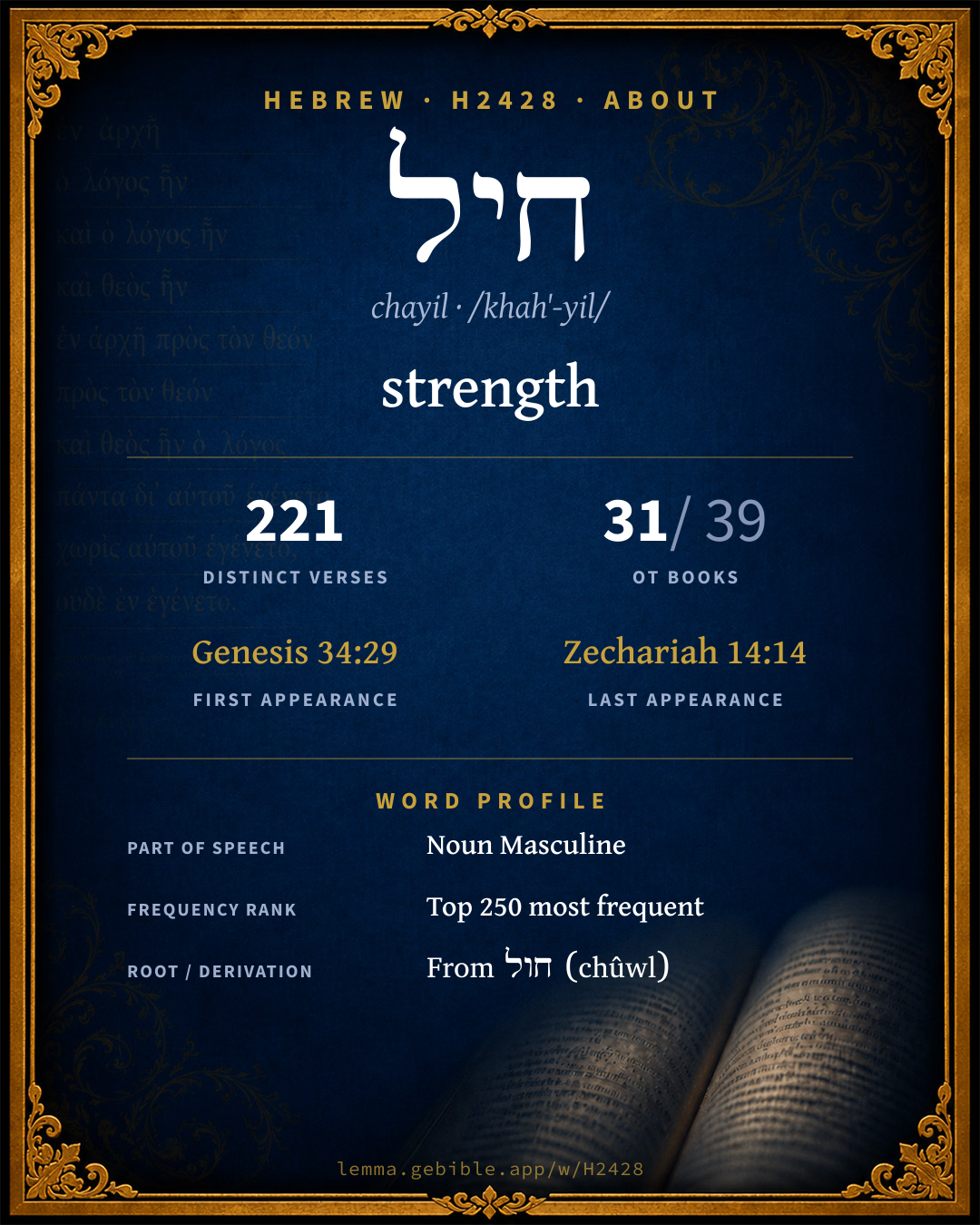
חַ֫יִל
strength
also: might, efficiency, wealth, army fuller range ↓
Full lexicon entry — Brown-Driver-Briggs (BDB)
From Brown-Driver-Briggs (BDB)
Where this word appears
See every Absolute-state word in the Hebrew Bible →
Grammar key — what these labels mean
Part of speech
- Noun
- A naming word — a person, place, thing, or idea.
Noun type
- Common
- A common noun — a general class of person, place, or thing (“king,” “city,” “water”), not a specific name.
- Proper
- A name of a specific person, place, or people (e.g. Abraham, Zion, Israel).
State
- Absolute
- The independent form of a noun, not bound to a following word.
- Construct
- A noun bound to a following noun in a possessive / “of” relationship (the construct chain).
Gender
- Masculine
- Grammatically masculine.
Number
- Singular
- One.
- Plural
- More than one (in Hebrew, generally three or more).
25 verses where H2428 appears in the Absolute state in the Book of 1 Chronicles. Filtered view — show all forms. Click any verse to open its interlinear word-by-word view. Verse text shown in the World English Bible for context — . Each verse’s Hebrew form is shown with its reference; the English is not keyword-highlighted, since the data carries no word-level English alignment. Use “Compare translations” on any verse to read it across multiple English versions. This concordance covers the Hebrew Bible; Septuagint (Greek Old Testament) occurrences are not indexed here.
1 Chronicles
- 1 Chronicles 5:18 חַיִל֒ n c ms The sons of Reuben, and the Gadites, and the half-tribe of Manasseh, of valiant men, men able to bear buckler and sword, and to shoot with bow, and skillful in war, were forty-four thousand seven hundred and sixty, that were able to go forth to war.
- 1 Chronicles 5:24 חַ֔יִל n c ms These were the heads of their fathers' houses: even Epher, and Ishi, and Eliel, and Azriel, and Jeremiah, and Hodaviah, and Jahdiel, mighty men of valor, famous men, heads of their fathers' houses.
- 1 Chronicles 7:2 חַ֖יִל n c ms The sons of Tola: Uzzi, and Rephaiah, and Jeriel, and Jahmai, and Ibsam, and Shemuel, heads of their fathers' houses, [to wit], of Tola; mighty men of valor in their generations: their number in the days of David was twenty-two thousand six hundred.
- 1 Chronicles 7:5 חֲיָלִ֑ים n c mp Their brothers among all the families of Issachar, mighty men of valor, reckoned in all by genealogy, were eighty-seven thousand.
- 1 Chronicles 7:7 חֲיָלִ֑ים n c mp The sons of Bela: Ezbon, and Uzzi, and Uzziel, and Jerimoth, and Iri, five; heads of fathers' houses, mighty men of valor; and they were reckoned by genealogy twenty-two thousand thirty-four.
- 1 Chronicles 7:9 חָ֑יִל n c ms They were reckoned by genealogy, after their generations, heads of their fathers' houses, mighty men of valor, twenty thousand two hundred.
- 1 Chronicles 7:11 חֲיָלִ֑ים n c mp All these were sons of Jediael, according to the heads of their fathers' [houses], mighty men of valor, seventeen thousand and two hundred, who were able to go forth in the host for war.
- 1 Chronicles 7:40 חֲיָלִ֔ים n c mp All these were the children of Asher, heads of the fathers' houses, choice and mighty men of valor, chief of the princes. The number of them reckoned by genealogy for service in war was twenty-six thousand men.
- 1 Chronicles 8:40 חַ֜יִל n c ms The sons of Ulam were mighty men of valor, archers, and had many sons, and sons' sons, one hundred fifty. All these were of the sons of Benjamin.
- 1 Chronicles 10:12 חַיִל֒ n c ms all the valiant men arose, and took away the body of Saul, and the bodies of his sons, and brought them to Jabesh, and buried their bones under the oak in Jabesh, and fasted seven days.
- 1 Chronicles 11:22 חַ֛יִל n c ms Benaiah the son of Jehoiada, the son of a valiant man of Kabzeel, who had done mighty deeds, he killed the two [sons of] Ariel of Moab: he went down also and killed a lion in the midst of a pit in time of snow.
- 1 Chronicles 11:26 הַ/חֲיָלִ֑ים ptcl def.art + n c mp Also the mighty men of the armies: Asahel the brother of Joab, Elhanan the son of Dodo of Bethlehem,
- 1 Chronicles 12:8 הַ/חַ֗יִל ptcl def.art + n c ms Of the Gadites there separated themselves to David to the stronghold in the wilderness, mighty men of valor, men trained for war, that could handle shield and spear; whose faces were like the faces of lions, and they were as swift as the roes on the mountains;
- 1 Chronicles 12:21 חַ֖יִל n c ms They helped David against the band of rovers: for they were all mighty men of valor, and were captains in the host.
- 1 Chronicles 12:25 חַ֨יִל֙ n c ms Of the children of Simeon, mighty men of valor for the war, seven thousand and one hundred.
- 1 Chronicles 12:28 חָ֑יִל n c ms and Zadok, a young man mighty of valor, and of his father's house twenty-two captains.
- 1 Chronicles 12:30 חַ֔יִל n c ms Of the children of Ephraim twenty thousand eight hundred, mighty men of valor, famous men in their fathers' houses.
- 1 Chronicles 26:6 חַ֖יִל n c ms Also to Shemaiah his son were sons born, who ruled over the house of their father; for they were mighty men of valor.
- 1 Chronicles 26:7 חָ֑יִל n c ms The sons of Shemaiah: Othni, and Rephael, and Obed, Elzabad, whose brothers were valiant men, Elihu, and Semachiah.
- 1 Chronicles 26:8 חַ֥יִל n c ms All these were of the sons of Obed-edom: they and their sons and their brothers, able men in strength for the service; sixty-two of Obed-edom.
- 1 Chronicles 26:9 חָ֖יִל n c ms Meshelemiah had sons and brothers, valiant men, eighteen.
- 1 Chronicles 26:30 חַ֜יִל n c ms Of the Hebronites, Hashabiah and his brothers, men of valor, one thousand seven hundred, had the oversight of Israel beyond the Jordan westward, for all the business of Yahweh, and for the service of the king.
- 1 Chronicles 26:31 חַ֖יִל n c ms Of the Hebronites was Jerijah the chief, even of the Hebronites, according to their generations by fathers' [houses]. In the fortieth year of the reign of David they were sought for, and there were found among them mighty men of valor at Jazer of Gilead.
- 1 Chronicles 26:32 חַ֗יִל n c ms His brothers, men of valor, were two thousand seven hundred, heads of fathers' [houses], whom king David made overseers over the Reubenites, and the Gadites, and the half-tribe of the Manassites, for every matter pertaining to God, and for the affairs of the king.
- 1 Chronicles 28:1 חָ֖יִל n c ms David assembled all the princes of Israel, the princes of the tribes, and the captains of the companies who served the king by division, and the captains of thousands, and the captains of hundreds, and the rulers over all the substance and possessions of the king and of his sons, with the officers, and the mighty men, even all the mighty men of valor, to Jerusalem.
About this entry
At a glance — auto-summarized from this page’s data, not written by a person. Every figure links to its source below. This summary describes the numbers; it doesn’t interpret them.
“strength” is the headline sense of the Hebrew noun חיל (chayil). Where the King James Version says “army,” newer translations reach for “valor” (unfoldingWord Literal Text); the renderings breakdown has the detail. It appears 221 verses across 31 books of the Hebrew Bible, among its common vocabulary. First canonically at Genesis 34:29, it enters the text early. Beyond “strength” it also covers “might”, “efficiency”, and “wealth” — see its full sense range. The sections below give every sense, occurrence, and version rendering.
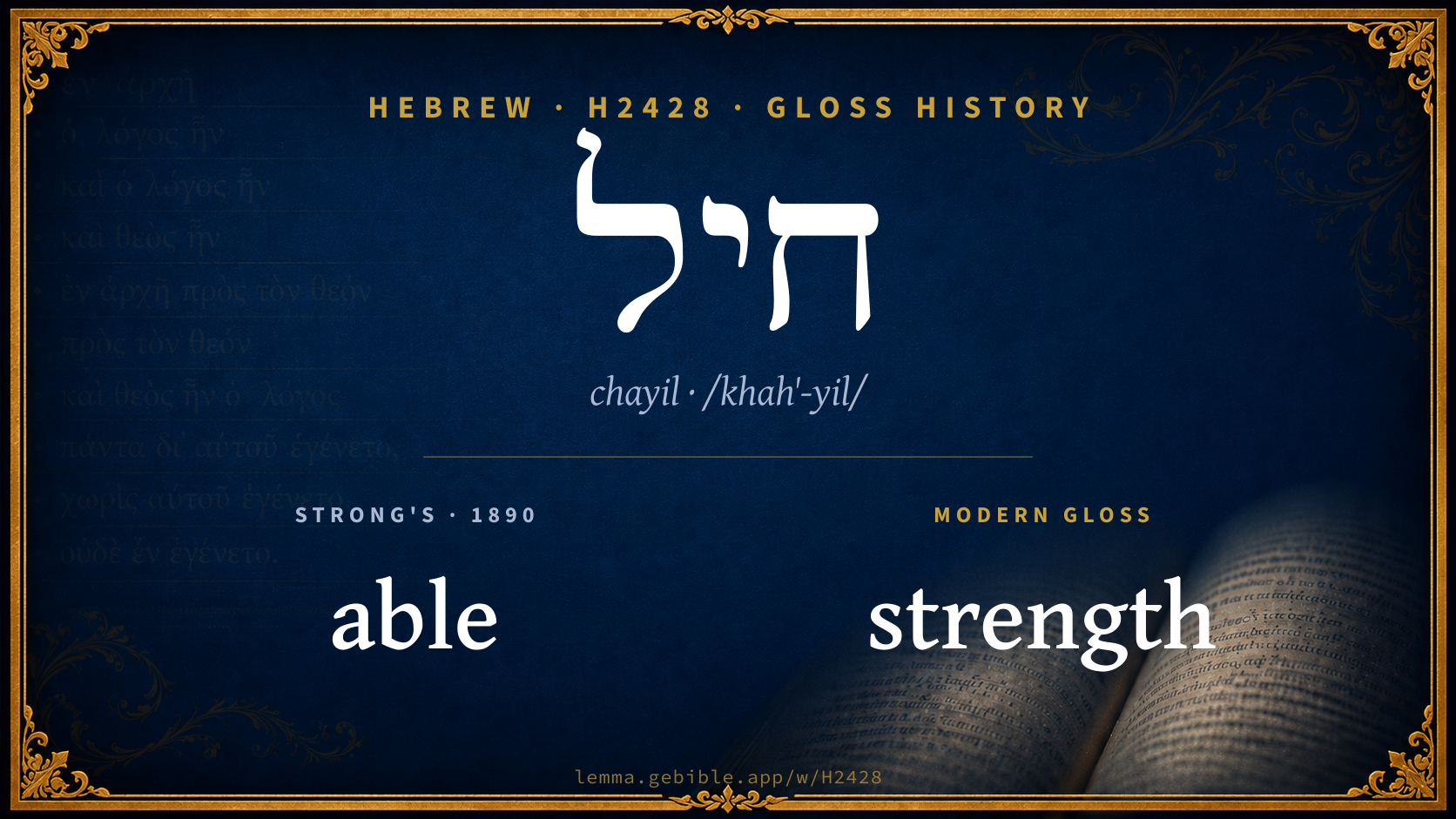
Gloss history
Strong's 1890 vs modern scholarship
About this word
Strong's H2428 catalogs a Hebrew word from the Hebrew Old Testament.
These counts are not copied from any lexicon or concordance. They are computed here, from the morphology-tagged Hebrew Old Testament. What Lemma adds →
- 221
- distinct verses
- The word appears in 221 distinct verses.
- 31 / 39
- OT books
- The word appears in 31 of 39 Old Testament books.
- #204
- by frequency
- Top 250 most frequent Hebrew words (rank 204 of 8,640 Hebrew words by occurrence).
View all 221 occurrences in the concordance →
Most concentrated in
- Jeremiah 29 verses 13%
- 1 Chronicles 26 verses 12%
- 2 Chronicles 21 verses 10%
By section of the Old Testament
By traditional corpus
Conventional, traditional groupings — biblical authorship is debated, so this is a traditional corpus grouping, not an authorship claim. Each share is this word’s portion of its verses in that division of the Hebrew canon. Each figure is a share of the word’s 221 distinct verses.
- Prophets (Nevi'im) 113 verses · 51%
- Writings (Ketuvim) 91 verses · 41%
- Torah (Pentateuch) 17 verses · 8%
How translations render this word
Counts come from each version’s own published word-to-Strong’s tagging or interlinear alignment — an approximate guide to how each version renders this word, not a word-level alignment the data otherwise carries. Because each total is that version’s own tagged count, the per-version totals vary from one another and need not match the appearance or distinct-verse counts above. These counts may also differ from a printed concordance because Lemma counts each distinctly tagged rendering and does not collapse phrase taggings into a single head-word total. This is a fixed set of word-tagged versions (KJV, ASV, BSB, ULT) and does not change with the reading translation you choose elsewhere. Each version’s license is shown beside its name below (and on Sources).
BDB lists this Strong’s number as 2 distinct words (homographs). Each count above pools all of them and is not split by sense — see the Senses section below. A low-frequency rendering may belong to a different one of those words, not the primary meaning.
- King James Version†: Army 35×, Valour 31×, Host 18×
- American Standard Version†: Army 30×, Valor 30×, Forces 13×
- Berean Standard Bible†: Army 72×, Valor 50×, Wealth 26×
- unfoldingWord Literal Text†: Valor 59×, Army 44×, Strength 28×
King James Version Public Domain
Renders H2428 across 238† tagged occurrences — most commonly:
Plus other, less common renderings. Plus 47 renderings that appear only once — usually multi-word phrases or single function words the recovered tagging swept in, not distinct renderings. Not rendered by a distinct English word in 5 further occurrences.
American Standard Version Public Domain
Renders H2428 across 237† tagged occurrences — most commonly:
Plus other, less common renderings. Plus 50 renderings that appear only once — usually multi-word phrases or single function words the recovered tagging swept in, not distinct renderings.
Berean Standard Bible Public Domain
Renders H2428 across 233† tagged occurrences — most commonly:
Plus other, less common renderings. Plus 32 renderings that appear only once — usually multi-word phrases or single function words the recovered tagging swept in, not distinct renderings. Not rendered by a distinct English word in 10 further occurrences.
unfoldingWord Literal Text CC BY-SA 4.0
Renders H2428 across 217† tagged occurrences — most commonly:
Plus other, less common renderings. Plus 18 renderings that appear only once — usually multi-word phrases or single function words the recovered tagging swept in, not distinct renderings.
7 senses and sub-senses in the full BDB
What do BDB’s symbols mean?
BDB uses these scholarly abbreviations:
| Symbol | Meaning |
|---|---|
| 𝔊 | the Septuagint (the ancient Greek translation, LXX) |
| 𝔙 | the Vulgate (the Latin translation) |
| 𝔖 | the Syriac version (the Peshitta) |
| 𝔗 | the Targum (the Aramaic translation) |
| ψ | the Psalms |
| √ | root (the underlying root or stem) |
| ‖ | parallel passage (a synonymous or contrasted parallel) |
| † | the dagger: every passage where the word occurs is cited |
The 7 senses and sub-senses the full Brown-Driver-Briggs lexicon distinguishes for this word, in lexicon order (not ranked by frequency), with BDB’s own verbatim wording and sub-sense lettering. Shown in Hebrew script with BDB’s own scholarly abbreviations. The condensed entry is in the Lexicon Entry tab. See also the Forms in the corpus table below.
- 1. strength, usually physical:
- a. seld. alone (chiefly poet.) 1 S 2:4 ψ 18:33, 40 = 2 S 22:33, 40; also גָּֽבְרוּ ח׳ Jb 21:7, cf. Ec 10:10; מֵחַיִל אֶל־חָ֑יִל ψ 84:8; בְּכֹחַ ח׳ 2 Ch 26:13; of virility Pr 31:3; of י׳’s power ψ 59:12; 110:3, cf. Hb 3:19; strength of horse ψ 33:17; fig. of product of vine and fig-tree Jo 2:22 (‖ פְּרִי). e.g. 1 Samuel 2:4
- b. of result or display of strength עשׂה ח׳ achieve might = do valiantly Nu 24:18 (JE), 1 S 14:48 ψ 60:14 = 108:14, 118:15, 16. e.g. Numbers 24:18
- c. often in phrases גִּבּוֹר(הַ)ח׳, גִּבּוֹרֵי(הַ)ח׳ hero(es) of strength, mighty man (men) of valour Jos 1:14 (D), 6:2; 8:3; 10:7 (all JE), Ju 6:12; 11:1; 1 S 9:1 16:18 1 K 11:28 2 K 5:1; 15:20; 24:14, 16 1 Ch 5:24; 7:2, 9; 8:40 + (very freq. in Ch), note especially הַגִּבּוֹרִים וכל גבורי ח׳ 28:1; also ג׳ ח׳ 2 Ch 13:3 (‖ ג׳ מלחמה); ג׳ (הַ)חֲיָלִים 1 Ch 7:5, 7, 11, 40; 11:26 (v. also גִּבּוֹר, p. 150); בֶּן־(הַ)ח׳, בְּנֵי(הַ)ח׳ Dt 3:18 Ju 18:2 + (v. בֵּן 8, p. 121); אִישׁ ח׳, אַנְשֵׁי ח׳ Ju 3:29; 20:44, 46 1 S 31:12; 2 S 11:16; 23:20; (Qr; Kt חי, on phr. בן־אישׁ חיל cf. Dr) = 1 Ch 11:22 (Kt חיל), 2 S 24:9 Na 2:4 Je 48:14 1 Ch 10:12 Ne 11:6 ψ 76:6; ironical א׳ ח׳ לִמְסֹךְ שֵׁבָר Is 5:22 (‖ גבורים לשׁתות יין); Ec 12:3 metaph. of legs. e.g. Joshua 1:14
- 2. ability, efficiency, often involving moral worth אַנְשֵׁי ח׳ Gn 47:6 (J), Ex 18:21, 25 (both E); of a woman אֵשֶׁת ח׳ Pr 12:4; 31:10 Ru 3:11; cf. 1 K 1:42, 52 (opp. רעה), and especially אַנְשֵׁי ח׳ יִרְאֵי אלהים אַנְשֵׁי אֱמֶת שׂנְאֵי בָּ֑צַע Ex 18:21 (E); עָשָׂה היל Pr 31:29 do worthily, efficiently, perhaps also Ru 4:11; late (with weakened meaning of גִּבּוֹר) גִּבּוֹרֵי חֵיל מְלֶאכֶת עֲבוֹדַת בֵּית הָאלהים 1 Ch 9:13, cf. אישׁ ח׳ בַּכֹּחַ לַעֲכֹדָה 26:8. So also 1 S 10:26 (read בְּנֵי ח׳, v. 𝔊 We Dr, men of worth, opp. בני בליעל v 27).for MT ח׳ force, band. e.g. Genesis 47:6
- 3. wealth Gn 34:29 Nu 31:9 (both P), Dt 8:17, 18; 33:11 Is 8:4; 10:14; 30:6 (‖ אוֹצְרֹתָם), 60:5 (‖ הֲמוֹן יָם), v 11; 61:6 Mi 4:13 Je 15:13; 17:3 (both ‖ אצרות), Zp 1:13 Ez 26:12; 28:4, 5(×2) Zc 14:14 Jb 5:5; 15:29; 20:15, 18; 31:25 ψ 49:7, 11; 62:11; 73:12 Pr 13:22. e.g. Genesis 34:29
- 4. force, army, very often Ex 14:4, 9, 17, 28 (all P), 15:4 (song), 1 S 17:20; 2 S 8:9 2 K 6:4, 15; 25:1, 5(×2), 10 2 Ch 13:3 (בְּחַיִל גִּבּוֹרֵי מלחמה), 14:7; 16:7; 23:14 +; so usually Jer.: Je 32:2; 34:1 +; freq. Ezek.: Ez 17:17; 27:10 +; Dn 11:7, 13, 25(×2), 26; = a band 1 S 10:26 (MT, but v. 2, ad fin.); of queen’s train ח׳ כָּבֵד 1 K 10:2 = 2 Ch 9:1; חֵיל כָּבֵד Is 36:2 = 2 K 18:17 (var. חַיִל) a powerful army (on form cf. Sta§ 194 c); also (late) חֵיל הַצָּבָא 1 Ch 20:1 2 Ch 26:13, חֵיל עָם Est 8:11; הֲמוֹן חֲיָלִים Dn 11:10; שַׂר־הח׳ 2 S 24:2 captain of the host, שָׂרֵי הח׳ v 4, 4; שָׂרֵי הַחֲיָלִים captains of armies (bands, divisions) 1 K 15:20 = 2 Ch 16:4, 2 K 25:23 Je 40:7, 13; 41:11, 13, 16; 42:1, 8; 43:4, 5; פִּקּוּדֵי החיל Nu 31:14 (P).—חֵילוֹ Ez 32:31 om. B Hi Co; for חֵילֵךְ Ez 27:11 read prob. a n.pr.loc., cf. Da; Co proposes חתלון (cf. 47:15; 48:1), HalMél. Epigr. 1874, 69 חלך = Cilicia, v. LagM i, 211. e.g. Exodus 14:4
Senses from the full Brown-Driver-Briggs lexicon (Brown, Driver, Briggs; Oxford 1906 — public domain), digitized via Sefaria, supplemented by the OpenScriptures HebrewLexicon (CC BY 4.0). Full attribution on Sources.
Word origin
I. n.m. 2 K 10:2 strength, efficiency, wealth, army;—abs. ח׳ Gn 47:6 +, חָ֑יִל ψ 60:14 +, חָ֑יִל ψ 60:14 +, חֵיל Is 36:2 2 K 18:17; cstr. חֵיל Ex 14:28 + (on ψ 10:10 v. חלכה); sf. חֵילִי Jb 31:25 + 2 times; חֵילְךָ Je 15:13 +; חֵילוֹ Ex 14:4 +, etc.; pl. חֲיָלִים 1 Ch 7:5 + 19 times; sf. חֵילֵיהֶם Is 30:6;—
I. v. sub I. II. חול supr.
— Brown-Driver-Briggs (Oxford 1906, public domain), digitized via Sefaria, supplemented by the OpenScriptures HebrewLexicon (CC BY 4.0). See Sources.
Derived from חול (chûwl) (H2342) — to writhe.
Jastrow Dictionary
A second Hebrew/Aramaic lexicon for comparison, covering Aramaic and post-biblical (Talmudic, Targumic, Midrashic) usage that the biblical-Hebrew BDB does not. Matched by lemma rather than by Strong’s number, so a lemma may carry more than one Jastrow headword (shown separately below), and the entries cover usage well beyond the Bible.
חַיִל
- , v. חַיִיל.—בְּרוֹר חַ׳, v. בְּרוֹר.
חֵיל I
- (חוּל, v. חַיִיל) surrounding, esp. Ḥel, a place within the fortification of the Temple. Midd. I, 5. Snh. 88ᵇ. Par. III, 11; Targ. Y. Num. XIX, 9; a. fr.
חִיל
- , Pa. חַיֵּיל, חַיֵּל (denom. of חֵילָא)
- 1. to strengthen. Targ. Job IV, 4. Ib. XVI, 5 (incorr. ed. אאח׳); a. e.
- 2. to serve. Targ. Num. IV, 23; a. e.
- 1. to be strengthened. Targ. Job VI, 16; a. fr.
- 2. to move into war, to gather together. Targ. Num. XXXI, 7. Targ. Job X, 17 (some ed. מתייחל׳, corr. acc.).
חֵיל II
- (v. חַיִל)
- 1. (adj.) strong. Targ. Job VIII, 2 Ms. (ed. רַבָּא). Keth. 62ᵃ דחיל מר כולי האי Ar. ed. Koh. (Var. דחֵילָא דמר; ed. דהכי) that you are so strong (that such is your strength).
- 2. (noun) strength. Targ. Job XX, 11 (ed. Lag. חִיּוּל׳; some ed. חֲיָיל׳). Targ. Prov. V, 10; a. fr.—Keth. 62ᵃ, v. supra. Y. B. Mets. IV, beg. 9ᶜ עד דהוה חֵילָךְ עלך while thou wast yet in thy strength (of manhood). Y. Yeb. IV, 6ᵇ לית בחֲיָילִי I cannot do it. B. Mets. 84ᵃ חילך לאורייתא give thy physical strength to the study of the Law; a. fr.—Trnsf. logical support, evidence, argument. Y. Pes. V, 32ᵃ top נסיב חֲיָילֵיה מן וכ׳ borrowed his argument from &c. Y. Maasr. I, 49ᵇ top; a. e.
- 3. army, host; service. Targ. Num. I, 3; a. fr.—Targ. Ps. LXVIII, 12 Ms. (ed. חֵילְוַת).—Pl. חֵילַיָּא, constr. חֵילֵי; חֵילְוָתָא, constr. חֵילְוַת. Targ. Ex. XII, 41. Targ. I Kings XXII, 19; a. fr.—Targ. Ps. XXXIII, 16; a. fr. Targ. II Esth. I, 4 ed. Amst. חֶלְוָתָא. Targ. Ps. XLIV, 10 ed. Lag. חֵילְוָתָנָא (oth. ed. חֵילְוָנָא, חַלְוָנָא).—Ḥull. 60ᵃ נפישן חֵילְוָותֵיה (not נפישי) his troops are too numerous.
A Dictionary of the Targumim, the Talmud Babli and Yerushalmi, and the Midrashic Literature (Marcus Jastrow; London, Luzac, 1903) — Public Domain. Digitized via Sefaria. Digitized via Sefaria. Full attribution on Sources.
Forms in the corpus
The 99 distinct written forms H2428 takes in the Hebrew Bible, most frequent first — each parse links to that state’s occurrences in the concordance. Hebrew forms include their vowel points and cantillation, so a single lemma takes many written forms.
The 60 most common forms are shown; 39 rarer forms follow in the full concordance.
Same root — word family
Other BDB entries built from the same root as H2428, grouped by Strong’s listed origin. These share a root / origin per the lexicon — not necessarily a shared meaning. Each links to that word’s own entry.
Derives from
Shares the same root
Derived from this word
Proper names from this root
People and places named from this root — a name, not an additional meaning of the word.
- חוילה Chăvîylâh H2341 Havilah
- חול Chûwl H2343 Hul
- חלחול Chalchûwl H2478 Halhul
- חילם Chêylâm H2431 Helam
- חילן Chîylên H2432 Hilen
- חלן Chêlôn H2497 Helon
Compare all same-root words → Showing 4 of 15 — not the complete family. 6 of the same-root words are proper names (people or places). They share a root, not necessarily a meaning.
Septuagint verse parallels
This word appears in 207 verses that also exist in the Greek Old Testament (Septuagint), out of the 221 Hebrew verses it occurs in. You can read those verses in Greek by switching the Old Testament edition to the Septuagint.
Read these verses in the Septuagint
- Genesis 34:29
- Exodus 14:4
- Numbers 24:18
- Deuteronomy 3:18
- Joshua 1:14
- Judges 3:29
- Ruth 2:1
- 1 Samuel 2:4
- 2 Samuel 2:7
- 1 Kings 1:42
- 2 Kings 2:16
- 1 Chronicles 5:18
This is a verse-level parallel only — the same verses exist in both the Hebrew and Greek Old Testaments. No word-level Hebrew↔Greek correspondence is claimed: the data carries no such alignment, so no Greek word is shown as this Hebrew word’s translation. Coverage is not total — the Septuagint omits the deuterocanon and renumbers the Psalms, so some Hebrew verses have no direct Greek parallel.