Judges 6:17

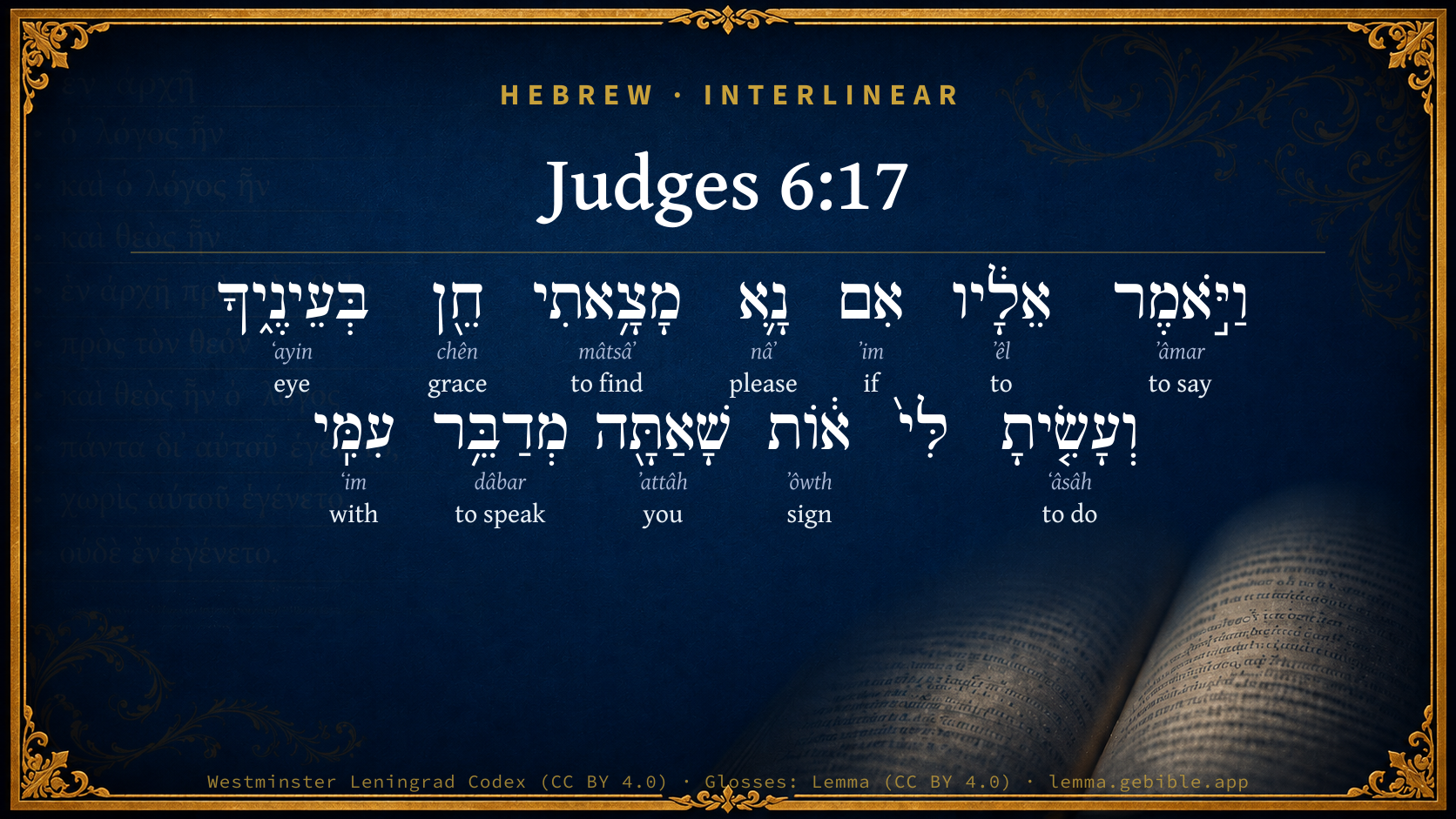
Hebrew (Westminster Leningrad Codex) Judges 6:17 appears in the Hebrew Old Testament. The text above is from the Westminster Leningrad Codex. Each word links to its Strong’s number, a concise gloss, and parsing drawn from the Open Scriptures Hebrew Bible morphology. Click any word for its full Brown-Driver-Briggs (BDB) entry.
Download image
Cite this verse

Judges 6:17 (World English Bible). Public Domain. Lemma interlinear Bible study tool, https://lemma.gebible.app/v/judges/6/17.

Show BibTeX & RIS
BibTeX
RIS
English Translation
He said to him, If now I have found favor in your sight, then show me a sign that it is you who talk with me.
World English Bible · Public Domain
Download a study sheet

One document with this verse’s original text, its word-by-word gloss line, the meaning frame, cross-references with their text, attributed commentary, and full source and license credits — printable, and it pastes into notes with its structure intact.

This verse Autodidact and up

Study sheet (.html) Plain text (.txt)

A passage Seminary Student

Up to 50 verses in one chapter. A passage sheet keeps up to 6 commentary sources and 12 cross-references per verse, in the order this page ranks them, and says so on the sheet whenever that leaves anything out. Ask for a single verse and you get the Autodidact verse sheet above.

Everything on this page stays free to read, with no account — the sheet is a download of what is already on screen, not access to it.

Want to remove ads? Support Godless Engineer
Compare translations 3

The same verse in 3 English versions, stacked beneath the original-language interlinear above. Click any original word for its lexicon entry.

Each is an independent rendering of the whole verse — the interlinear is not word-aligned to these translations.

Highlighted words mark where these versions differ — a whole-verse word diff, not a word-by-word alignment.

  • World English Bible Public Domain
    He said to him, If now I have found favor in your sight, then show me a sign that it is you who talk with me.
  • King James Version Public Domain
    And he said unto him, If now I have found grace in thy sight, then show me a sign that thou talkest with me.
  • unfoldingWord Literal Text CC BY-SA 4.0
    And he said to him, “Please, if I have found favor in your eyes, then do for me a sign that you speaking with me.

unfoldingWord Literal Text — © unfoldingWord, licensed CC BY-SA 4.0. Word-aligned USFM3 via Door43 (git.door43.org/unfoldingWord/en_ult).

Versions to compare (up to 4)

3 of 4 selected

Show all 18 translations

Every available English version of this verse, each an independent rendering of the whole verse.

  • World English Bible Public Domain
    He said to him, If now I have found favor in your sight, then show me a sign that it is you who talk with me.
  • Berean Standard Bible Public Domain
    Gideon answered, “If I have found favor in Your sight, give me a sign that it is You speaking with me.
  • Majority Standard Bible Public Domain
    Gideon answered, “If I have found favor in Your sight, give me a sign that it is You speaking with me.
  • King James Version Public Domain
    And he said unto him, If now I have found grace in thy sight, then show me a sign that thou talkest with me.
  • American Standard Version (1901) Public Domain
    And he said unto him, If now I have found favor in thy sight, then show me a sign that it is thou that talkest with me.
  • Revised Version (1885) Public Domain
    And he said unto him, If now I have found grace in thy sight, then shew me a sign that it is thou that talkest with me.
  • Geneva Bible (1599) Public Domain
    And he answered him, I pray thee, if I haue founde fauour in thy sight, then shewe me a signe, that thou talkest with me.
  • Douay-Rheims (1899) Public Domain
    And the Lord said to him: I will be with thee: and thou shalt cut off Madian as one man.
  • Young's Literal Translation Public Domain
    And he saith unto Him, `If, I pray Thee, I have found grace in Thine eyes, then Thou hast done for me a sign that Thou art speaking with me.
  • Literal Standard Version CC BY-SA 4.0
    And he says to Him, “Now if I have found grace in Your eyes, then You have done a sign for me that You are speaking with me.
  • Unlocked Literal Bible CC BY-SA 4.0
    Gideon said to him, “If you are pleased with me, then give me a sign that it is you who is speaking to me.
  • unfoldingWord Literal Text CC BY-SA 4.0
    And he said to him, “Please, if I have found favor in your eyes, then do for me a sign that you speaking with me.
  • Darby Bible Public Domain
    And he said to him, "If now I have found favor with thee, then show me a sign that it is thou who speakest with me.
  • World Messianic Bible Public Domain
    He said to him, “If now I have found favor in your sight, then show me a sign that it is you who talk with me.
  • Webster's Bible Public Domain
    And he said to him, If now I have found grace in thy sight, then show me a sign that thou talkest with me.
  • Free Bible Version CC BY-SA 4.0
    “Please, Lord, if you think well of me, give me a sign that it's really you telling me this,” Gideon asked.
  • Bible in Basic English Public Domain
    So he said to him, If now I have grace in your eyes, then give me a sign that it is you who are talking to me.
  • JPS Tanakh (1917) Public Domain
    And he said unto him: 'If now I have found favour in thy sight, then show me a sign that it is thou that talkest with me.

Literal Standard Version (2020), Covenant Press — licensed CC BY-SA 4.0. Text via the HelloAO Bible API (eBible.org). Unlocked Literal Bible (unfoldingWord) — licensed CC BY-SA 4.0. Text via the HelloAO Bible API (eBible.org). unfoldingWord Literal Text — © unfoldingWord, licensed CC BY-SA 4.0. Word-aligned USFM3 via Door43 (git.door43.org/unfoldingWord/en_ult). Free Bible Version, Dr. Jonathan Gallagher — licensed CC BY-SA 4.0. Text via the HelloAO Bible API (eBible.org).

Word by word

More ways to search: Search by grammar → Find every occurrence → Compare this word →

Practice this passage: Drill this verse → Learn its vocabulary →

חֵ֖ן
chên
H2580
“grace”
Noun, Common, Masculine, Singular, Absolute
Part of Speech
Noun
Type
Common
Gender
Masculine
Number
Singular
State
Absolute
Full BDB Definition

Origin: from H2603

TWOT: TWOT- 694a

favour, grace, charm - favour, grace, elegance - favour, acceptance
  1. וַיֹּ֣אמֶר ʼâmar H559 “and · to say” Conjunction + Verb, Qal, Sequential Imperfect, 3rd Person, Masculine, Singular
  2. אֵלָ֔יו ʼêl H413 “to · him” Preposition + Suffix, Personal, 3rd Person, Masculine, Singular
  3. אִם ʼim H518 “if” Conjunction
  4. נָ֛א nâʼ H4994 “please” Particle, Exhortation
  5. מָצָ֥אתִי mâtsâʼ H4672 “to find” Verb, Qal, Perfect, 1st Person, Common, Singular
  6. בְּעֵינֶ֑יךָ ʻayin H5869 “in/at · eyes · your” Preposition + Noun, Common, Both, Dual, Construct + Suffix, Personal, 2nd Person, Masculine, Singular
  7. וְעָשִׂ֤יתָ ʻâsâh H6213 “and · to do” Conjunction + Verb, Qal, Sequential Perfect, 2nd Person, Masculine, Singular
  8. א֔וֹת ʼôwth H226 “sign” Noun, Common, Both, Singular, Absolute
  9. שָׁאַתָּ֖ה ʼattâh H859 “who/which · you” Particle, Relative + Pronoun, Personal, 2nd Person, Masculine, Singular
  10. מְדַבֵּ֥ר dâbar H1696 “speaking” Verb, Piel, Participle Active, Masculine, Singular, Absolute
  11. עִמִּֽי ʻim H5973 “with · me” Preposition + Suffix, Personal, 1st Person, Common, Singular

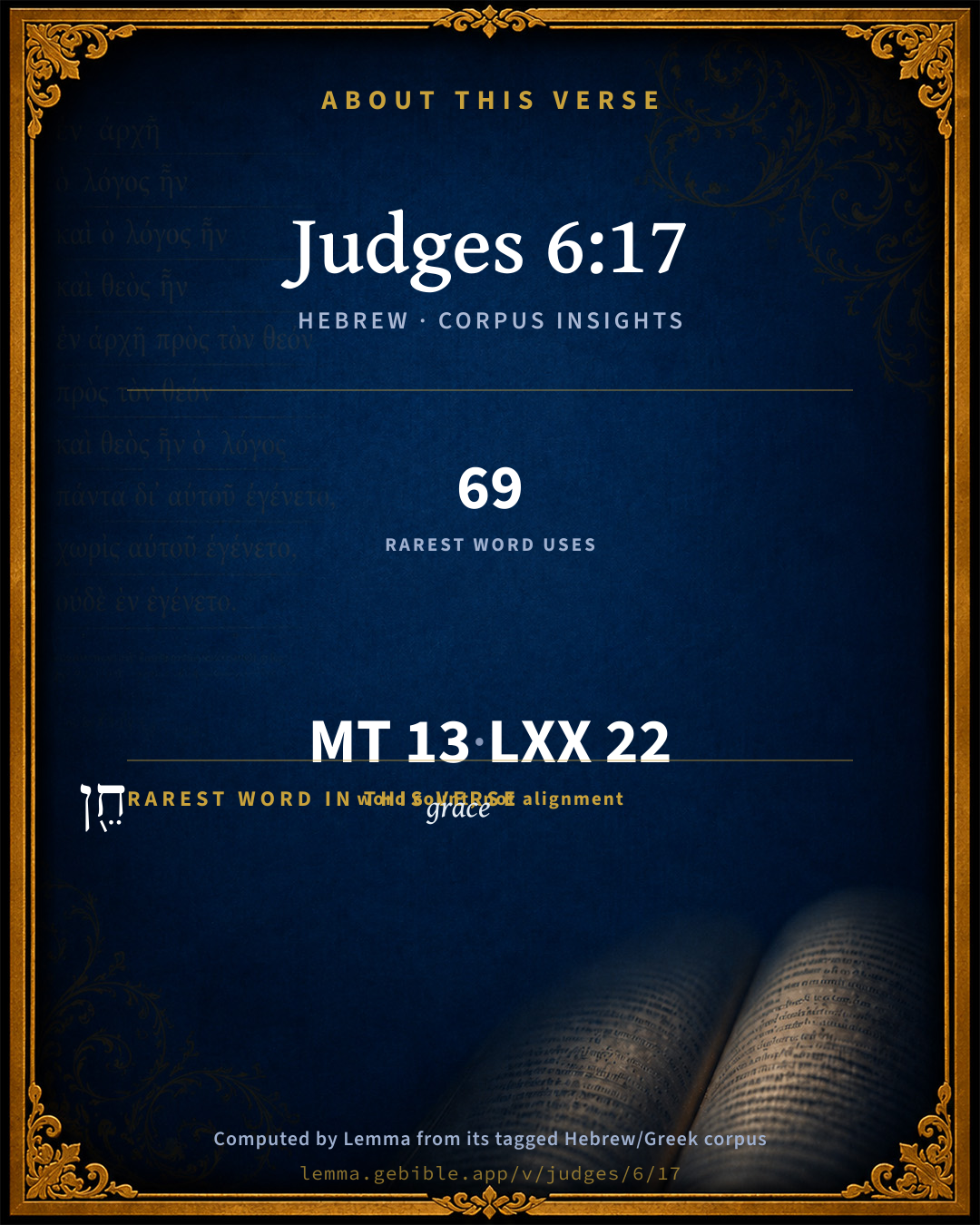
About this verse

These counts appear in no published source. They are computed here, from the morphology-tagged text and Lemma’s own curated glosses. What Lemma adds →

13
words
12
distinct lemmas
Historical
section

Grammatical profile

  • 4 verbs
  • 3 nouns
  • 1 pronoun
  • 3 prepositions
  • 1 conjunction
  • 1 particle

Verb forms

  • וַיֹּ֣אמֶר Qal · Sequential Imperfect
  • מָצָ֥אתִי Qal · Perfect
  • וְעָשִׂ֤יתָ Qal · Sequential Perfect
  • מְדַבֵּ֥ר Piel · Participle Active

Hebrew & Septuagint length

In English translation the verse runs 26 words from the Hebrew and 30 from the Septuagint (LXX English) — closely comparable.

A rough comparison of the two English renderings, which tokenize alike — not a word-level alignment.

Word counts can differ between the Hebrew and the Greek without any difference in meaning — e.g. the Hebrew direct-object marker אֵת has no separate Greek word, and Greek often adds the article ὁ.

In the original languages it is 13 Hebrew tokens and 22 Greek tokens — but the two are counted differently (Hebrew bundles its prefixes and suffixes into one token; the Greek is in lemma form), so that isn’t a like-for-like length.

Cross-references

9

Topical passages linked to Judges 6:17 in the Treasury of Scripture Knowledge — connected by theme and wording, ordered by reader-vote popularity; previews shown in the World English Bible.

  • Psalms 86:17 Show me a sign of your goodness, That those who hate me may see it, and be shamed, Because you, Yahweh, have helped me, and comforted me.
  • Exodus 33:13 Now therefore, if I have found favor in your sight, please show me now your ways, that I may know you, so that I may find favor in your sight: and consider that this nation is your people."
  • Isaiah 7:11 "Ask a sign of Yahweh your God; ask it either in the depth, or in the height above."
  • Genesis 15:8–17 He said, "Lord Yahweh, how will I know that I will inherit it?"
  • Exodus 33:16 For how would people know that I have found favor in your sight, I and your people? Isn't it in that you go with us, so that we are separated, I and your people, from all the people who are on the surface of the earth?"
  • Judges 6:36–40 Gideon said to God, If you will save Israel by my hand, as you have spoken,
  • Isaiah 38:7–8 This shall be the sign to you from Yahweh, that Yahweh will do this thing that he has spoken:
  • Exodus 4:1–9 Moses answered, "But, behold, they will not believe me, nor listen to my voice; for they will say, 'Yahweh has not appeared to you.'"
  • 2 Kings 20:8–11 Hezekiah said to Isaiah, What shall be the sign that Yahweh will heal me, and that I shall go up to the house of Yahweh the third day?

Cross-references courtesy of OpenBible.info (CC BY 4.0).

Hebrew and Greek witnesses Masoretic Hebrew ↔ Greek Septuagint

The same verse in the two great witnesses to the Old Testament, shown verse-for-verse.

These are two independent witnesses, not word-aligned to each other, and the Septuagint is shown in lemma (dictionary) form.

Hebrew Judges 6:17 Masoretic · Westminster Leningrad Codex

וַיֹּ֣אמֶר אֵלָ֔יו אִם נָ֛א מָצָ֥אתִי חֵ֖ן בְּעֵינֶ֑יךָ וְעָשִׂ֤יתָ לִּי֙ א֔וֹת שָׁאַתָּ֖ה מְדַבֵּ֥ר עִמִּֽי

He said to him, If now I have found favor in your sight, then show me a sign that it is you who talk with me.

World English Bible · Public Domain

Greek LXX Judges 6:17 Septuagint · lemma form

καί εἶπον πρός αὐτός γεδεων εἰ δέ εὑρίσκω ἔλεος ἐν ὀφθαλμός σύ καί ποιέω ἐγώ σήμερον πᾶς ὅς τις λαλέω μετά ἐγώ

And Gedeon said to him, If now I have found mercy in your eyes, and you will do this day for me all that you have spoken of with me,

LXX2012 (modern English Septuagint) · Public Domain

On this verse, Ellicott's Commentary for English Readers discusses the Septuagint’s reading. Read the note in Commentary ↓

Hebrew: Westminster Leningrad Codex (CC BY 4.0). Greek: Septuagint (public domain); English from LXX2012 (modern English Septuagint) (Public Domain). How the Septuagint differs from the Hebrew →

Targum (Aramaic paraphrase)

1

The Targum is the ancient Jewish Aramaic paraphrase of the Hebrew Scriptures — an interpretive translation, not the Hebrew text itself. Onkelos (literal) and Pseudo-Jonathan (expansive) render the Torah, and Jonathan the Prophets. Coverage is partial: where no permissively-licensed English translation exists for a verse, only the Aramaic is shown. This is verse-level text, not a word-by-word alignment to the Hebrew.

  1. Targum Jonathan Prophets (Joshua–Malachi)
    וַאֲמַר לֵיהּ אִם כְּעַן אַשְׁכָּחִית רַחֲמִין בְעֵינָךְ וְתַעְבֵּיד לִי אָת דִי אַתְּ מְמַלֵיל עִמִי:

    (no public-domain English translation for this verse)

    Targum Jonathan — Aramaic: “Mikraot Gedolot” (public domain). English: “Sefaria Community Translation” (CC0 1.0 (public-domain dedication)); “London "Chaldee Paraphrase," 1871” (public domain). Text via Sefaria.

Commentary

Notes on Judges 6:17 from classic Christian and Jewish commentators (each source and its license shown beneath its notes). The classic Christian expositions comment on the surrounding passage and are grouped to its opening verse, so a note may address several verses; the Jewish commentaries on the Tanakh (Rashi and others) are per-verse, so they appear only where the commentator wrote on this verse.

Lemma curates 59 commentaries, every one of them public domain or Creative Commons licensed, each selected and text-cleaned for this edition rather than reprinted as found. About our sources →

The Cambridge Bible for Schools and Colleges

gen. ed. J. J. S. Perowne

17. shew me a sign that it is thou] Gideon asks for a sign that it is indeed Jehovah who charges him with this great undertaking (Jdg_6:14; Jdg_6:16); but in the following verse Gideon clearly does not know who is addressing him. Jehovah wills partly to retain and partly to withdraw the disguise. His words suggest to Gideon that He is no ordinary stranger. But some scholars think that these words (Jdg_6:17 b) cannot come from the same hand as Jdg_6:18.

The Cambridge Bible for Schools and Colleges (gen. ed. J. J. S. Perowne; Cambridge University Press, 1878–1918) — public domain. Text from a community e-Sword module.

Trapp's Complete Commentary

John Trapp

Jdg 6:17 And he said unto him, If now I have found grace in thy sight, then shew me a sign that thou talkest with me.

Ver. 17. Then show me a sign,] sc., That thou art that "Captain of the Lord’s hosts," and of our salvation. This sign Gideon sought not, as the Pharisees did, out of curiosity or incredulity, but for further confirmation concerning his call to the work, that it was of God. A good cause, a good calling, and a good conscience, will make a good courage; and are all necessary, to a soldier especially.

John Trapp, A Commentary or Exposition upon All the Books of the Old and New Testament (1647–1656) — public domain. Text from a community e-Sword module.

Geneva Bible (1599)

Geneva Bible translators

So that we see how the flesh is enemy unto God’s vocation, which cannot be persuaded without signs.

Geneva Bible (1599) marginal notes — public domain. Text via Bolls.life.

Adam Clarke's Commentary

Verse 17. Show me a sign] Work a miracle, that I may know that thou hast wisdom and power sufficient to authorize and quality me for the work.

Adam Clarke's Commentary on the Bible (1810–1826) — public domain. Text from a community e-Sword/MySword module.

Ellicott's Commentary for English Readers

(17) I have found grace in thy sight.—A phrase found both in the Old and New Testament. (See Gen_6:8; Est_5:8.)

Shew me a sign that thou talkest with me.—Give me some clear proof that this is no mere vision, and that thy message is really from God, and portends me favour. (See Psa_86:17; Isa_7:11.)

Depart not hence.—Comp. 1Ki_13:15.

My present.—My minchah. The word means first “an offering,” but specially “an offering to God,” as throughout the Book of Leviticus for the meat-offering of flour, &c. Hence the LXX. render it “the sacrifice”: “and I will sacrifice before thee.” Gideon seems, however, purposely to use a neutral word, suspecting, but not yet being convinced, that the stranger under the terebinth is something more than man. The desire to be hospitable may have mingled with his deepening sense of awe. (Comp. Jdg_13:15; Gen_18:6.)

A Bible Commentary for English Readers, edited by Charles John Ellicott (1878–1897) — public domain. Text from a community e-Sword module.

John Gill's Exposition

Intending to go to his own, or his father's house, to fetch some food to entertain him with, and therefore entreats he would not quit the place where he was until he returned:

and bring forth my present, and set it before thee; to treat him with, as a stranger and a messenger of God; and perhaps he thought, by this means, the better to discover who he was, whether an angel or a man: the word for the "present" is "minchah", often used for a meat offering, therefore some have thought of a sacrifice; but it appears by what follows that it was not of the nature of a sacrifice; and, besides, Gideon was no priest, nor was this a place for sacrifice, nor was there here any altar; and, besides, as Gideon did not yet know that it was the Lord himself, he could never think of offering a sacrifice to him:

and he said, I will tarry until thou come again; which was a wonderful instance of divine condescension, it being some time he waited ere Gideon could prepare what he brought, as follows.

John Gill's Exposition of the Whole Bible (1746–1763) — public domain (CC PDM 1.0). Text via the HelloAO Bible API.

Albert Barnes' Notes on the Bible

A sign - If the Angel ate of Gideon’s present it would be a conclusive proof of the reality of the vision. (Compare Joh 21:9-13; Luk 24:37-43; Act 10:41.) It would also be a token of God’s goodwill to Gideon. Compare Gen 18:3.

Albert Barnes' Notes on the Bible (1834–1885) — public domain. Text from a community e-Sword/MySword module.

Haydock's Catholic Bible Commentary

Thou, the Lord, or his angel, capable of fulfilling these great promises; or be pleased, by some sign, to manifest thyself to me. (Calmet) --- He began to perceive that he was talking with some person of authority: (Haydock) yet still he did not suspect that it was a spirit, otherwise he would not have offered food, nor would he have been so such surprised and afraid, only when the angel disappeared so suddenly, ver. 22.

George Leo Haydock (1774–1849), Haydock's Catholic Family Bible and Commentary, 1859 edition — public domain. Excludes Psalms (Douay-Rheims chapter numbering differs from Protestant) and Deuterocanonical books (Catholic canon only).

Matthew Poole's English Annotations

That it is thou, to wit, an angel or messenger sent from God, that appears to me, and discourseth with me; and not a fancy or delusion; that thou art in truth what thou seemest and pretendest to be, Jdg 7:12. Or,

a sign of that which thou talkest with me, i.e. that thou wilt by me smite the Midianites.

Matthew Poole's English Annotations on the Holy Bible (1683–1685) — public domain. Text from a community e-Sword/MySword module.

Whedon's Commentary on the Bible

Daniel D. Whedon

17. Show me a sign — Give me some miraculous evidence that this is no illusion, and that Jehovah really speaks to me. Gideon’s several answers show a trembling heart and a wavering faith.

Daniel D. Whedon (gen. ed.), Commentary on the Old and New Testaments (1874–1909) — public domain. Text from a community e-Sword module.

The Pulpit Commentary

A sign that thou talkest with me that it is indeed thou thyself that speakest to me, even God, and that there is no illusion.

Asking for a sign.

The stranger said, Have not I sent thee? I will be with thee. Gideon wanted a proof that he was one who had authority, etc., to use such words. That he was a supernatural visitor he suspected; he wanted to be sure. But it was rather to ascertain the reality of his own heavenly calling, which at first he could hardly believe. There was no other evidence open to him; and he asked the evidence peculiar to his epoch. He was altogether different therefore from the Jews of Christ"s time, who required a sign, but no sign would be given them, save the sign of the prophet Jonas. They had signs enough already, but had no spiritual perception.

I THIS REQUEST AROSE NOT FROM WANT OF FAITH, BUT FROM SELF-DISTRUST. Might not this all be a dream? And who was he himself? It is the doubt of a mind suspicious of its own sanity, etc. All this argues a deep humility than which nothing could fit him better for the work he has to do. God forgives a desire like this, and answers it; but doubts as to himself and his character, etc., are of another sort.

II GOD ENCOURAGES ALL TRUE SERVANTS BY SOME TOKEN OF HIS PRESENCE AND HELP. Moses at Horeb; Paul in the temple in his trance for I will send thee far hence unto the Gentiles". (Act_22:21) Many holy men have had such inward urgings and impulses. And all earnest service is accompanied by tokens of the Divine blessing. We are encouraged, therefore, to look for these signs. Their absence ought to cause no concern. Their nature will depend upon the kind of work we are doing. M.

The Pulpit Commentary (1880–1919), ed. H.D.M. Spence-Jones & Joseph S. Exell — public domain. Text from a community e-Sword module.

John Wesley's Explanatory Notes

That thou - That it is thou, an angel or messenger sent from God, that appears to me, and discourseth with me. Or, a sign of that which thou talkest with me; that is, that thou wilt by me smite the Midianites.

John Wesley, Explanatory Notes Upon the Whole Bible (1754–1765) — public domain. Text via the GEBible commentary corpus.

Rashi

Rabbi Shlomo Yitzchaki (Rashi)

That you. The same as שֶׁאַתׇּה, with the segol vocalization. vocalization, which appears in the text, is the same as שֶׁאַתׇּה “that you.”

Rashi on the Tanakh — English translations: “The Judaica Press complete Tanach with Rashi, translated by A. J. Rosenberg” (CC BY 4.0); “Pentateuch with Rashi's commentary by M. Rosenbaum and A.M. Silbermann, 1929-1934” (public domain); “The Metsudah Tanach series, Lakewood, N.J” (CC BY 4.0); and “The Book of Joshua, Metsudah Publications, 1997” (CC BY 4.0). Text via Sefaria.

Lesson kit

Teaching starters — assembled from the data on this page, not authored interpretation. Every prompt links to the verse data it draws on. Edit before teaching.

Judges, in the Historical, opens this verse with 13 words (12 distinct Hebrew lemmas). Its most distinctive word is chên (“grace”). A historical commentator’s framing appears above. Read the whole chapter for the surrounding context.

Discussion questions

  1. How does “grace” (chên) shape what this verse is saying?
  2. Psalms 86:17 shares this passage’s theme. How do the two illuminate each other?
  3. These translations render this verse differently; the difference is in the English rendering, not the original. What questions does that raise?
  4. The verb «וַיֹּ֣אמֶר» is Qal Sequential Imperfect. How does its form color the action?
  5. Reading how The Cambridge Bible for Schools and Colleges and Trapp's Complete Commentary read this verse, where do the two commentators agree and where do they part?

Things to notice

Reading settings

Reading text

Shown beneath each verse's original-language words.

Old Testament
Old Testament edition

Read the OT as the Masoretic Hebrew (MT) or the Greek Septuagint (LXX).

English shown for the Greek Septuagint (in the Hebrew ↔ Greek comparison).

Comparing translations? Open the Compare panel on any verse page to stack up to four side by side.