
2 Kings 20:9

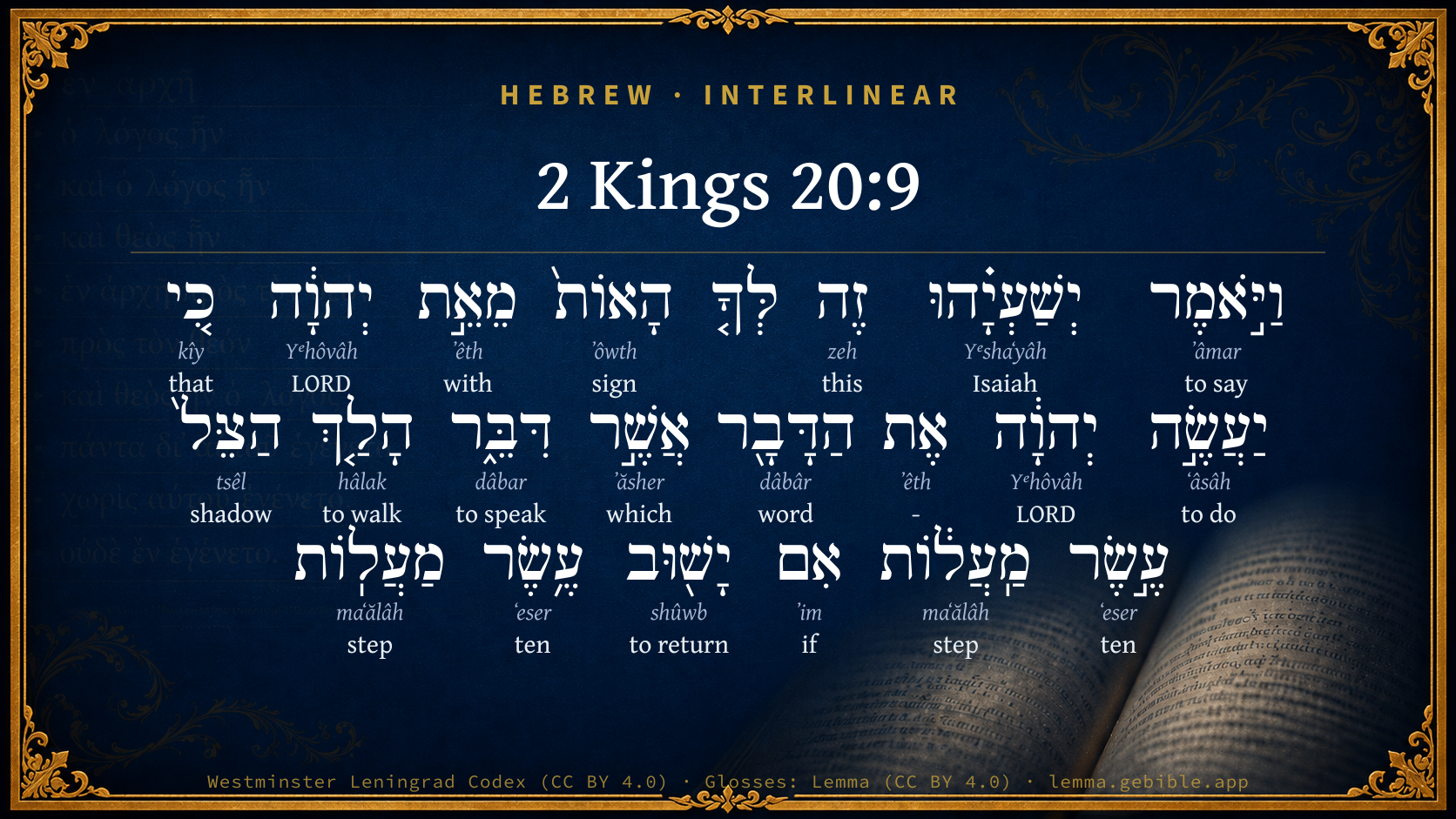
Hebrew (Westminster Leningrad Codex) 2 Kings 20:9 appears in the Hebrew Old Testament. The text above is from the Westminster Leningrad Codex. Each word links to its Strong’s number, a concise gloss, and parsing drawn from the Open Scriptures Hebrew Bible morphology. Click any word for its full Brown-Driver-Briggs (BDB) entry.
Download image
Cite this verse

2 Kings 20:9 (World English Bible). Public Domain. Lemma interlinear Bible study tool, https://lemma.gebible.app/v/2-kings/20/9.

Show BibTeX & RIS
BibTeX
RIS
English Translation
Isaiah said, This shall be the sign to you from Yahweh, that Yahweh will do the thing that he has spoken: shall the shadow go forward ten steps, or go back ten steps?
World English Bible · Public Domain
Download a study sheet

One document with this verse’s original text, its word-by-word gloss line, the meaning frame, cross-references with their text, attributed commentary, and full source and license credits — printable, and it pastes into notes with its structure intact.

This verse Autodidact and up

Study sheet (.html) Plain text (.txt)

A passage Seminary Student

Up to 50 verses in one chapter. A passage sheet keeps up to 6 commentary sources and 12 cross-references per verse, in the order this page ranks them, and says so on the sheet whenever that leaves anything out. Ask for a single verse and you get the Autodidact verse sheet above.

Everything on this page stays free to read, with no account — the sheet is a download of what is already on screen, not access to it.

Want to remove ads? Support Godless Engineer
Compare translations 3

The same verse in 3 English versions, stacked beneath the original-language interlinear above. Click any original word for its lexicon entry.

Each is an independent rendering of the whole verse — the interlinear is not word-aligned to these translations.

Highlighted words mark where these versions differ — a whole-verse word diff, not a word-by-word alignment.

  • World English Bible Public Domain
    Isaiah said, This shall be the sign to you from Yahweh, that Yahweh will do the thing that he has spoken: shall the shadow go forward ten steps, or go back ten steps?
  • King James Version Public Domain
    And Isaiah said, This sign shalt thou have of the LORD, that the LORD will do the thing that he hath spoken: shall the shadow go forward ten degrees, or go back ten degrees?
  • unfoldingWord Literal Text CC BY-SA 4.0
    And Isaiah said, “This the sign for you from Yahweh that Yahweh will do the thing that he has spoken. The shadow has gone forward ten steps. If it shall go back ten steps?”

unfoldingWord Literal Text — © unfoldingWord, licensed CC BY-SA 4.0. Word-aligned USFM3 via Door43 (git.door43.org/unfoldingWord/en_ult).

Versions to compare (up to 4)

3 of 4 selected

Show all 18 translations

Every available English version of this verse, each an independent rendering of the whole verse.

  • World English Bible Public Domain
    Isaiah said, This shall be the sign to you from Yahweh, that Yahweh will do the thing that he has spoken: shall the shadow go forward ten steps, or go back ten steps?
  • Berean Standard Bible Public Domain
    And Isaiah had replied, “This will be a sign to you from the LORD that He will do what He has promised: Would you like the shadow to go forward ten steps, or back ten steps?”
  • Majority Standard Bible Public Domain
    And Isaiah had replied, “This will be a sign to you from the LORD that He will do what He has promised: Would you like the shadow to go forward ten steps, or back ten steps?”
  • King James Version Public Domain
    And Isaiah said, This sign shalt thou have of the LORD, that the LORD will do the thing that he hath spoken: shall the shadow go forward ten degrees, or go back ten degrees?
  • American Standard Version (1901) Public Domain
    And Isaiah said, This shall be the sign unto thee from Jehovah, that Jehovah will do the thing that he hath spoken: shall the shadow go forward ten steps, or go back ten steps?
  • Revised Version (1885) Public Domain
    And Isaiah said, This shall be the sign unto thee from the LORD, that the LORD will do the thing that he hath spoken: shall the shadow go forward ten steps, or go back ten steps?
  • Geneva Bible (1599) Public Domain
    And Isaiah answered, This signe shalt thou haue of the Lord, that the Lord will doe that he hath spoken, Wilt thou that the shadowe goe forwarde ten degrees, or go backe ten degrees?
  • Douay-Rheims (1899) Public Domain
    And Isaias said to him: This shall be the sign from the Lord, that the Lord will do the word which he hath spoken: Wilt thou that the shadow go forward ten lines, or that it go back so many degrees?
  • Young's Literal Translation Public Domain
    And Isaiah saith, `This `is' to thee the sign from Jehovah, that Jehovah doth the thing that He hath spoken -- The shadow hath gone on ten degrees, or it doth turn back ten degrees?'
  • Literal Standard Version CC BY-SA 4.0
    And Isaiah says, “This [is] the sign to you from YHWH, that YHWH does the thing that He has spoken—[will] the shadow have gone on ten degrees, or does it turn back ten degrees?”
  • Unlocked Literal Bible CC BY-SA 4.0
    Isaiah replied, “This will be the sign for you from Yahweh, that Yahweh will do the thing that he has spoken. Shall the shadow go forward ten steps, or go back ten steps?”
  • unfoldingWord Literal Text CC BY-SA 4.0
    And Isaiah said, “This the sign for you from Yahweh that Yahweh will do the thing that he has spoken. The shadow has gone forward ten steps. If it shall go back ten steps?”
  • Darby Bible Public Domain
    And Isaiah said, This [shall be] the sign to thee from Jehovah, that Jehovah will do the thing that he hath spoken: shall the shadow go forward ten degrees, or go back ten degrees?
  • World Messianic Bible Public Domain
    Isaiah said, “This will be the sign to you from the LORD, that the LORD will do the thing that he has spoken: should the shadow go forward ten steps, or go back ten steps?”
  • Webster's Bible Public Domain
    And Isaiah said, This sign shalt thou have of the LORD, that the LORD will do the thing that he hath spoken: shall the shadow go forward ten degrees, or go back ten degrees?
  • Free Bible Version CC BY-SA 4.0
    Isaiah replied, “This is the sign from the Lord to you that the Lord will do what he promised: Do you want the shadow to go forward ten steps, or back ten steps?”
  • Bible in Basic English Public Domain
    And Isaiah said, This is the sign the Lord will give you, that he will do what he has said; will the shade go forward ten degrees or back?
  • JPS Tanakh (1917) Public Domain
    And Isaiah said: 'This shall be the sign unto thee from the LORD, that the LORD will do the thing that He hath spoken: shall the shadow go forward ten degrees, or go back ten degrees?

Literal Standard Version (2020), Covenant Press — licensed CC BY-SA 4.0. Text via the HelloAO Bible API (eBible.org). Unlocked Literal Bible (unfoldingWord) — licensed CC BY-SA 4.0. Text via the HelloAO Bible API (eBible.org). unfoldingWord Literal Text — © unfoldingWord, licensed CC BY-SA 4.0. Word-aligned USFM3 via Door43 (git.door43.org/unfoldingWord/en_ult). Free Bible Version, Dr. Jonathan Gallagher — licensed CC BY-SA 4.0. Text via the HelloAO Bible API (eBible.org).

Word by word

More ways to search: Search by grammar → Find every occurrence → Compare this word →

Practice this passage: Drill this verse → Learn its vocabulary →

יְשַׁעְיָ֗הוּ
Yᵉshaʻyâh
H3470
“Isaiah”
Noun, Proper
Part of Speech
Noun
Type
Proper
Full BDB Definition

Origin: from H3467 and H3050

TWOT: None

Isaiah or Jesaiah or Jeshaiah = "Jehovah has saved" - the major prophet, son of Amoz, who prophesied concerning Judah and Jerusalem during the days of kings Uzziah, Jotham, Ahaz, and Hezekiah of Judah; author of the prophetic book by his name; tradition has it that he was sawn asunder in the trunk of a carob tree by king Manasseh and that this is the incident referred to in Heb 11:37 - son of Hananiah, brother of Pelatiah, and grandson of Zerubbabel - a Benjamite - one of the 6 sons of Jeduthun - son of Rehabiah, a descendant of Moses through Gershom, and an ancestor of a Levite treasurer in the time of David - son of Athaliah and chief of the house of Elam who returned with Ezra - a chief of the descendants of Merari who returned with Ezra
  1. וַיֹּ֣אמֶר ʼâmar H559 “and · to say” Conjunction + Verb, Qal, Sequential Imperfect, 3rd Person, Masculine, Singular
  2. זֶה zeh H2088 “this” Pronoun, Demonstrative, Masculine, Singular
  3. הָאוֹת֙ ʼôwth H226 “the · sign” Particle, Definite Article + Noun, Common, Both, Singular, Absolute
  4. מֵאֵ֣ת ʼêth H854 “from · with” Preposition + Preposition
  5. יְהוָ֔ה Yᵉhôvâh H3068 “LORD” Noun, Proper
  6. כִּ֚י kîy H3588 “that” Conjunction
  7. יַעֲשֶׂ֣ה ʻâsâh H6213 “to do” Verb, Qal, Imperfect, 3rd Person, Masculine, Singular
  8. יְהוָ֔ה Yᵉhôvâh H3068 “LORD” Noun, Proper
  9. אֶת ʼêth H853 “-” Particle, Direct Object
  10. הַדָּבָ֖ר dâbâr H1697 “the · word” Particle, Definite Article + Noun, Common, Masculine, Singular, Absolute
  11. אֲשֶׁ֣ר ʼăsher H834 “which” Particle, Relative
  12. דִּבֵּ֑ר dâbar H1696 “to speak” Verb, Piel, Perfect, 3rd Person, Masculine, Singular
  13. הָלַ֤ךְ hâlak H1980 “to walk” Verb, Qal, Perfect, 3rd Person, Masculine, Singular
  14. הַצֵּל֙ tsêl H6738 “the · shadow” Particle, Definite Article + Noun, Common, Masculine, Singular, Absolute
  15. עֶ֣שֶׂר ʻeser H6235 “ten” Adjective, Cardinal number, Feminine, Singular, Absolute
  16. מַֽעֲל֔וֹת maʻălâh H4609 “steps” Noun, Common, Feminine, Plural, Absolute
  17. אִם ʼim H518 “if” Conjunction
  18. יָשׁ֖וּב shûwb H7725 “to return” Verb, Qal, Imperfect, 3rd Person, Masculine, Singular
  19. עֶ֥שֶׂר ʻeser H6235 “ten” Adjective, Cardinal number, Feminine, Singular, Absolute
  20. מַעֲלֽוֹת maʻălâh H4609 “steps” Noun, Common, Feminine, Plural, Absolute

About this verse

These counts appear in no published source. They are computed here, from the morphology-tagged text and Lemma’s own curated glosses. What Lemma adds →

22
words
18
distinct lemmas
Historical
section

Shared distinctive vocabulary

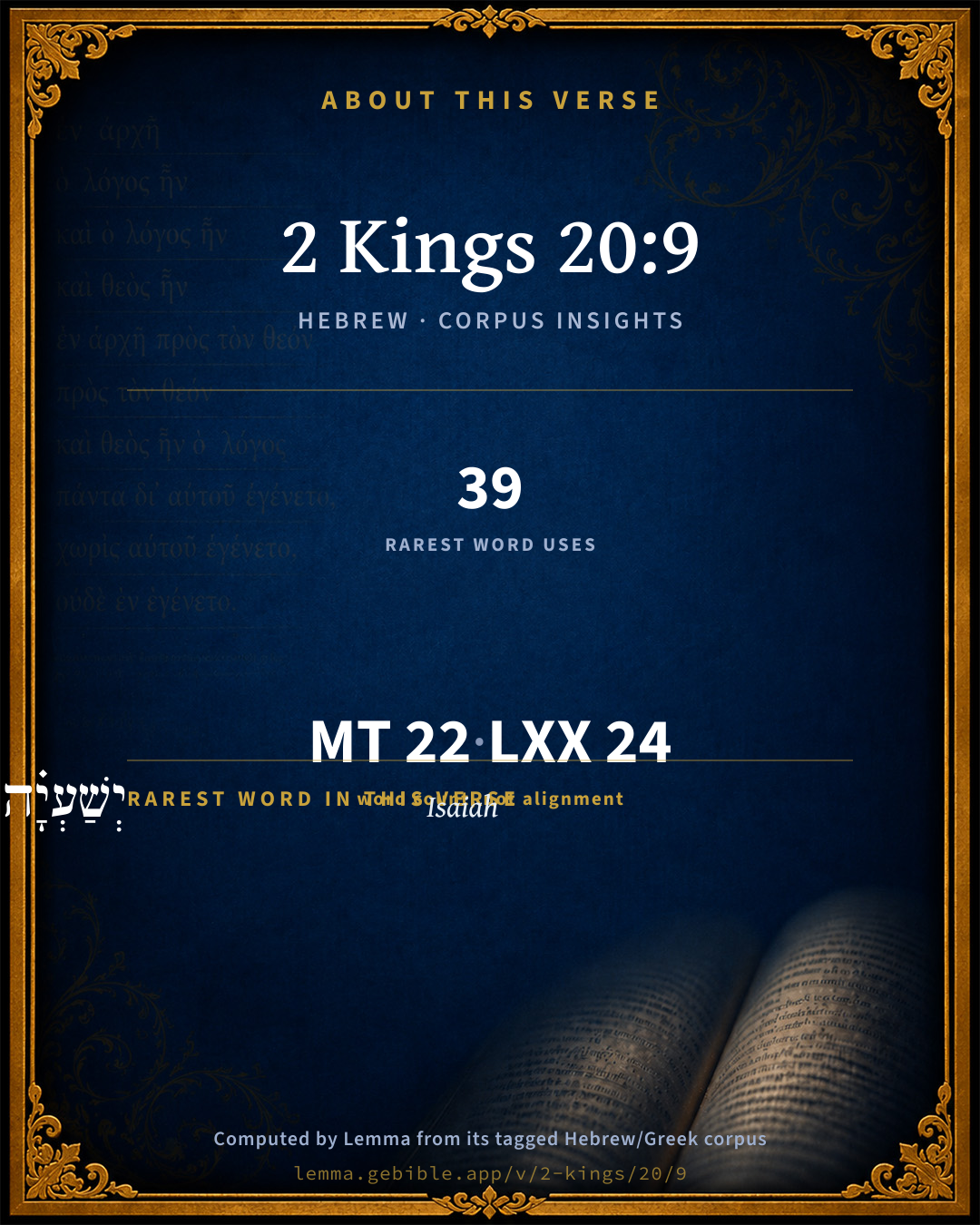
יְשַׁעְיָ֗הוּ Isaiah H3470 occurs in 39 verses of the Hebrew Bible. Also found in:

Grammatical profile

  • 5 verbs
  • 8 nouns
  • 2 adjectives
  • 1 pronoun
  • 2 prepositions
  • 2 conjunctions
  • 2 particles

Verb forms

  • וַיֹּ֣אמֶר Qal · Sequential Imperfect
  • יַעֲשֶׂ֣ה Qal · Imperfect
  • דִּבֵּ֑ר Piel · Perfect
  • הָלַ֤ךְ Qal · Perfect
  • יָשׁ֖וּב Qal · Imperfect

Repetition

Words recur within this verse — often emphatic in Hebrew:

  • יְהוָ֔ה LORD H3068 ×2
  • עֶ֣שֶׂר ten H6235 ×2
  • מַֽעֲל֔וֹת step H4609 ×2

Hebrew & Septuagint length

In English translation the verse runs 33 words from the Hebrew and 44 from the Septuagint (LXX English) — closely comparable.

A rough comparison of the two English renderings, which tokenize alike — not a word-level alignment.

Word counts can differ between the Hebrew and the Greek without any difference in meaning — e.g. the Hebrew direct-object marker אֵת has no separate Greek word, and Greek often adds the article ὁ.

In the original languages it is 22 Hebrew tokens and 24 Greek tokens — but the two are counted differently (Hebrew bundles its prefixes and suffixes into one token; the Greek is in lemma form), so that isn’t a like-for-like length.

Cross-references

4

Topical passages linked to 2 Kings 20:9 in the Treasury of Scripture Knowledge — connected by theme and wording, ordered by reader-vote popularity; previews shown in the World English Bible.

  • Isaiah 38:7–8 This shall be the sign to you from Yahweh, that Yahweh will do this thing that he has spoken:
  • Matthew 16:1–4 The Pharisees and Sadducees came, and testing him, asked him to show them a sign from heaven.
  • Mark 8:11–12 The Pharisees came out and began to question him, seeking from him a sign from heaven, and testing him.
  • Luke 11:29–30 When the multitudes were gathering together to him, he began to say, "This is an evil generation. It seeks after a sign. No sign will be given to it but the sign of Jonah, the prophet.

Cross-references courtesy of OpenBible.info (CC BY 4.0).

Hebrew and Greek witnesses Masoretic Hebrew ↔ Greek Septuagint

The same verse in the two great witnesses to the Old Testament, shown verse-for-verse.

These are two independent witnesses, not word-aligned to each other, and the Septuagint is shown in lemma (dictionary) form.

Hebrew 2 Kings 20:9 Masoretic · Westminster Leningrad Codex

וַיֹּ֣אמֶר יְשַׁעְיָ֗הוּ זֶה לְּךָ֤ הָאוֹת֙ מֵאֵ֣ת יְהוָ֔ה כִּ֚י יַעֲשֶׂ֣ה יְהוָ֔ה אֶת הַדָּבָ֖ר אֲשֶׁ֣ר דִּבֵּ֑ר הָלַ֤ךְ הַצֵּל֙ עֶ֣שֶׂר מַֽעֲל֔וֹת אִם יָשׁ֖וּב עֶ֥שֶׂר מַעֲלֽוֹת

Isaiah said, This shall be the sign to you from Yahweh, that Yahweh will do the thing that he has spoken: shall the shadow go forward ten steps, or go back ten steps?

World English Bible · Public Domain

Greek LXX 2 Kings 20:9 Septuagint · lemma form

καί εἶπον ησαιας οὗτος ὁ σημεῖον παρά κύριος ὅτι ποιέω κύριος ὁ λόγος ὅς λαλέω πορεύομαι ὁ σκιά δέκα βαθμός ἐάν ἐπιστρέφω δέκα βαθμός

And Esaias said, This is the sign from the Lord, that the Lord will perform the word which he has spoken, the shadow of the dial shall advance ten degrees: or if it should go back ten degrees this would also be the sign.

LXX2012 (modern English Septuagint) · Public Domain

On this verse, Ellicott's Commentary for English Readers discusses the Septuagint’s reading. Read the note in Commentary ↓

Hebrew: Westminster Leningrad Codex (CC BY 4.0). Greek: Septuagint (public domain); English from LXX2012 (modern English Septuagint) (Public Domain). How the Septuagint differs from the Hebrew →

Targum (Aramaic paraphrase)

1

The Targum is the ancient Jewish Aramaic paraphrase of the Hebrew Scriptures — an interpretive translation, not the Hebrew text itself. Onkelos (literal) and Pseudo-Jonathan (expansive) render the Torah, and Jonathan the Prophets. Coverage is partial: where no permissively-licensed English translation exists for a verse, only the Aramaic is shown. This is verse-level text, not a word-by-word alignment to the Hebrew.

  1. Targum Jonathan Prophets (Joshua–Malachi)
    וַאֲמַר יְשַׁעְיָה דֵין לָךְ אָתָא מִן קֳדָם יְיָ אֲרֵי יַעְבֵּד יְיָ יַת פִּתְגָמָא דְמַלֵיל הַיְהַךְ טוּלָא עֲסַר שָׁעִין אִם יְתוּב עֲסַר שָׁעִין:

    (no public-domain English translation for this verse)

    Targum Jonathan — Aramaic: “Mikraot Gedolot” (public domain). English: “Sefaria Community Translation” (CC0 1.0 (public-domain dedication)); “London "Chaldee Paraphrase," 1871” (public domain). Text via Sefaria.

Commentary

Notes on 2 Kings 20:9 from classic Christian and Jewish commentators (each source and its license shown beneath its notes). The classic Christian expositions comment on the surrounding passage and are grouped to its opening verse, so a note may address several verses; the Jewish commentaries on the Tanakh (Rashi and others) are per-verse, so they appear only where the commentator wrote on this verse.

Lemma curates 59 commentaries, every one of them public domain or Creative Commons licensed, each selected and text-cleaned for this edition rather than reprinted as found. About our sources →

Trapp's Complete Commentary

John Trapp

2Ki 20:9 And Isaiah said, This sign shalt thou have of the LORD, that the LORD will do the thing that he hath spoken: shall the shadow go forward ten degrees, or go back ten degrees?

Ver. 9. Shall the shadow go forward ten degrees?] This was in God Almighty stupenda dignatio, a wonderful condescension, thus to gratify a mortal man - stooping so low to his meanness. If Hezekiah were - as the Rabbis say he was - studious of the mathematics, how suitable was this sign! These degrees were half-hours, or quarters, or haply less. The shadow was that of the style of a sundial. Neither did the shadow only go backward, but the sun itself ran retrograde, {Isa 38:8} whereof the Rabbis give this foolish reason, that when wicked Ahaz was buried, the sun hastened faster than ordinary to his setting, that there might be no time for funeral rites, to recompense which loss of time then, the day was thus prolonged now. Those ancients do better, who, allegorising the text, tell us that sick Hezekiah signifieth all mankind as sick of sin; but this is an infallible sign of the saint’s recovery, that the sun hath gone ten degrees back in the dial. The Sun of righteousness Jesus Christ, hath for our sakes made himself lower by many degrees in the earth. "My Father is greater than I": there he is gone back ten degrees below his Father. "Thou hast made him lower than the angels": there he is gone back ten degrees below the angels. "I am a worm, and no man": there he has gone back ten degrees below men. "A live dog is better than a dead lion": there he has gone back ten degrees below worms: for he was not counted so good as a live worm, but was buried in the earth, as a dead lion, to be meat for the worms, if it had been possible for "his holy One to see corruption."

John Trapp, A Commentary or Exposition upon All the Books of the Old and New Testament (1647–1656) — public domain. Text from a community e-Sword module.

Ellicott's Commentary for English Readers

(9) Shall the shadow go forward ten degrees, or go back ten degrees?—Rather, the shadow hath marched (or travelled) ten steps; shall it return ten steps? This is what the Hebrew text seems to say at a first glance. But Hezekiah’s answer apparently implies an alternative; and we might render: “the shadow shall have travelled ten steps; or shall it return ten steps?” (Comp. the LXX. πορεύσεται.) The Targum has: “shall the shadow march ten hours or return ten hours?” The Vulgate also makes it a double question. The Syriac is: “the shadow shall march ten steps, or return ten steps.”

It is very probable that the Hebrew text is corrupt. We might read the first word as an infinitive instead of a perfect, after the analogy of 2Ki_19:29 (“ye shall eat”). Or we might read “shall it march?” as a question (hã-yçlçk); or better still, “shall it go up” (hã-yçlçk), after the hint afforded by the Vulgate: “Vis ut ascendat umbra . . . Et ait Ezeehias, Facile est umbram crescere,” &c. It is obvious that a kind of sun-dial is meant, though what kind is not so clear. The word “degrees” (ma‘ãlôth) means “steps” or “stairs” wherever it occurs. (See Exo_20:26; Eze_40:6; Eze_40:22; Eze_40:26; Eze_40:31, &c. 1Ki_10:20; Neh_3:15.) There is probability, therefore, in Knobel’s conjecture that “the dial of Ahaz” consisted of a column rising from a circular flight of steps, so as to throw the shadow of its top on the top step at noon, and morning and evening on the bottom step. This, or some similar device, was set up in the palace court, and was probably visible to Hezekiah lying on his sick bed and facing the window. Herodotus (ii. 9) ascribes the invention of the gnomon to the Babylonians. From the inscriptions we know that they divided time into periods of two hours, each called in Sumerian kasbumi, and in Assyrian asli. Each kasbu or aslu was subdivided into sixty equal parts.

A Bible Commentary for English Readers, edited by Charles John Ellicott (1878–1897) — public domain. Text from a community e-Sword module.

The Cambridge Bible for Schools and Colleges

gen. ed. J. J. S. Perowne

9. shall the shadow go forward ten degrees [R.V. steps], or go back ten degrees] R.V. steps. In the Hebrew there is no sign of interrogation in the first clause. But instances are not rare in which the interrogative sign is left out (cf. 1Sa_16:4; 2Sa_18:29). A greater difficulty is in the tense of the first verb. The clause, if it stood alone, would be translated, ‘The shadow hath gone forward ten steps, (what) if it shall go back ten steps? But Hezekiah’s answer implies that an alternative question was asked. Thus both A.V. and R.V. have translated it, but how the grammar is to be made to yield a double question is not easy to see. For if the omitted interrogation be supplied, we have still only, ‘Hath the shadow gone forward ten steps?’

The Cambridge Bible for Schools and Colleges (gen. ed. J. J. S. Perowne; Cambridge University Press, 1878–1918) — public domain. Text from a community e-Sword module.

John Gill's Exposition

And Hezekiah answered, it is a light thing for the shadow to go down ten degrees,.... That is, it was comparatively so, otherwise to go down ten degrees at once would be extraordinary and miraculous; but that was more agreeable to the nature and course of it to go forward, and so the miracle would be less apparent:

nay, but let the shadow return backward ten degrees; which was directly contrary to its natural order and course, whereby the miracle would appear more clear and manifest: these degrees are by some said (x) to be half hours, and not full ones, since it is observed the sun shines not twenty full hours on any dial, unless under the pole; the sun is supposed to have been now at the fifth full hour; the sun was brought back five whole hours, then came forward five, then came forward two degrees, or one hour, to the sixth hour; which made sixteen; then it was six hours to sunset; so that day was prolonged twenty two hours: the Chinese (y) relate, that, in the time of Kingcungus, the planet Mars, for sake of the king, went back three degrees.

(x) Weemse's Christ. Synagog. l. 1. c. 6. sect. 6. p. 167. See his Exposition of the Judicial Laws, c. 25. p. 90. &c. (y) Martin. Sinic. Hist. l. 4. p. 138.

John Gill's Exposition of the Whole Bible (1746–1763) — public domain (CC PDM 1.0). Text via the HelloAO Bible API.

Albert Barnes' Notes on the Bible

Ten degrees - literally, “ten steps.” It is not, perhaps, altogether certain whether the “dial of Ahaz” 2Ki 20:11 was really a dial with a gnomon in the center, and “degrees” marked round it, or a construction fur marking time by means of “steps.” Sundials proper had been invented by the Babylonians before the time of Herodotus; but the instrument here was probably an instrument consisting of a set of steps, or stairs, with an obelisk at the top, the shadow of which descended or ascended the steps according as the sun rose higher in the heavens or declined.

The question as to the mode whereby the return of the shadow was produced is one on which many opinions have been held. Recently, it has been urged that the true cause of the phenomenon was a solar eclipse, in which the moon obscured the entire upper limb of the sun; and it has been clearly shown that if such an occurrence took place a little before mid-day, it would have had the effect described as having taken place - i. e., during the obscuration of the sun’s upper limb shadows would be sensibly lengthened, and that of the obelisk would descend the stairs; as the obscuration passed off the reverse would take place, shadows would shorten, and that of the obelisk would once more retire up the steps. If this be the true account, the miracle would consist in Isaiah’s supernatural foreknowledge of an event which the astronomy of the age was quite incapable of predicting, and in the providential guidance of Hezekiah’s will, so that he chose the “sign” which in the natural course of things was about to be manifested.

Albert Barnes' Notes on the Bible (1834–1885) — public domain. Text from a community e-Sword/MySword module.

Whedon's Commentary on the Bible

Daniel D. Whedon

9. Shall the shadow go forward — A more accurate rendering of the Hebrew is that of Keil: The shadow has advanced ten degrees; if it should return ten degrees. This concise and idiomatic Hebrew might thus be paraphrased: The shadow has now advanced ten degrees; if it go back ten degrees, would that be a convincing sign to thee? Hezekiah’s answer in the next verse seems, however, to show that Isaiah had put it to him to decide whether the sign should be an advance or return of ten degrees, and so favours the common version.

Daniel D. Whedon (gen. ed.), Commentary on the Old and New Testaments (1874–1909) — public domain. Text from a community e-Sword module.

The Pulpit Commentary

And Isaiah said, This sign shalt thou have of the Lord, that the Lord will do the thing that he hath spoken. Hezekiah is no more reproved for asking for a sign than was Gideon. (Jud_1:6:37, 39) Ahaz, his father, had been reproved for not asking. (Isa_7:13) It would be faithless now for Christians to demand signs; but in an age of miracles, when there were prophets upon the earth empowered to give signs, faithful men might request them without incurring God"s displeasure. Shall the shadow go forward ten degrees? The Hebrew text will scarcely bear this translation, which, however, seems to be required by Hezekiah"s answer. Perhaps for we should read Or go back ten degrees? literally, in both clauses, ten steps. There are abundant reasons for believing that the early dials consisted of a gnomon set up on the top of a flight of steps, and that time was measured by the number of steps on which the shadow of the gnomon fell (see a paper by Mr. Bosanquet, in the "Transactions of the Society of Biblical Archaeology" for 1874, pp. 1-82).

The Pulpit Commentary (1880–1919), ed. H.D.M. Spence-Jones & Joseph S. Exell — public domain. Text from a community e-Sword module.

Rashi

Rabbi Shlomo Yitzchaki (Rashi)

Should the shade advance ten steps or should it go back ten steps? This is an abbreviated verse. The shade had already advanced the steps that are made [to measure] the hours of the day, like, oriloje, in O. F., the clocks that people make to determine the hour of the day. [He asked,] “Do you wish it to stay in the place where it is, for as long as it takes it to walk in ten hours, or should it go back up ten steps so that it will appear as though it is morning?”

Rashi on the Tanakh — English translations: “The Judaica Press complete Tanach with Rashi, translated by A. J. Rosenberg” (CC BY 4.0); “Pentateuch with Rashi's commentary by M. Rosenbaum and A.M. Silbermann, 1929-1934” (public domain); “The Metsudah Tanach series, Lakewood, N.J” (CC BY 4.0); and “The Book of Joshua, Metsudah Publications, 1997” (CC BY 4.0). Text via Sefaria.

Lesson kit

Teaching starters — assembled from the data on this page, not authored interpretation. Every prompt links to the verse data it draws on. Edit before teaching.

2 Kings, in the Historical, opens this verse with 22 words (18 distinct Hebrew lemmas). Its most distinctive word is Yᵉshaʻyâh (“Isaiah”). A historical commentator’s framing appears above. Read the whole chapter for the surrounding context.

Discussion questions

  1. What does “Isaiah” (Yᵉshaʻyâh) contribute to the verse as a whole?
  2. How does 2 Kings 19:2, which shares the word «Isaiah», read alongside this verse?
  3. What does the repetition of “LORD” (2× in this one verse) do in this verse?
  4. These translations render this verse differently; the difference is in the English rendering, not the original. What questions does that raise?
  5. «וַיֹּ֣אמֶר» is a Qal Sequential Imperfect verb. How does that grammatical form shape the action described?
  6. Compare how Trapp's Complete Commentary and Ellicott's Commentary for English Readers read this verse. Where do they agree or differ?

Things to notice

Reading settings

Reading text

Shown beneath each verse's original-language words.

Old Testament
Old Testament edition

Read the OT as the Masoretic Hebrew (MT) or the Greek Septuagint (LXX).

English shown for the Greek Septuagint (in the Hebrew ↔ Greek comparison).

Comparing translations? Open the Compare panel on any verse page to stack up to four side by side.