2 Kings 20:8

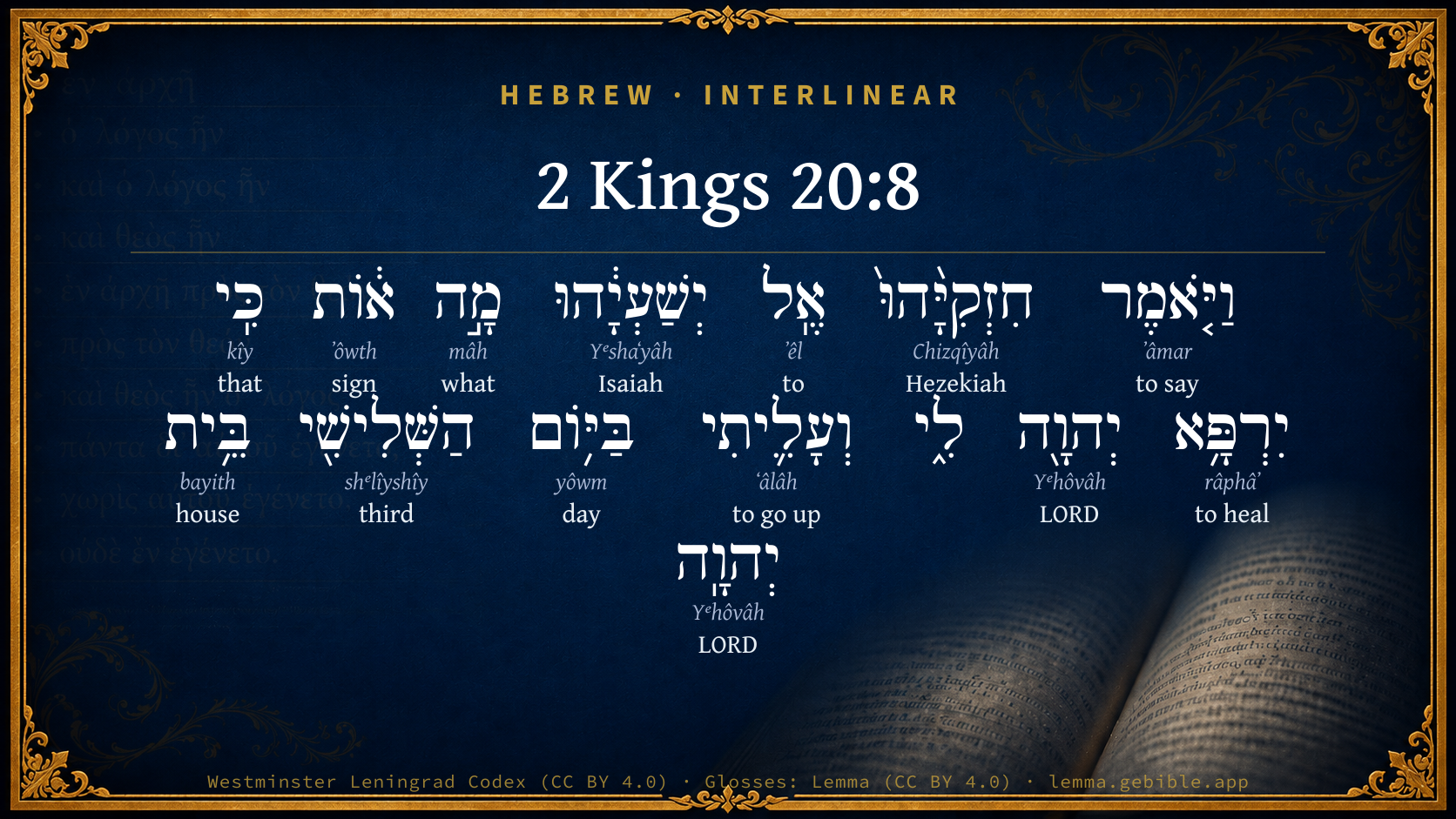
Hebrew (Westminster Leningrad Codex) 2 Kings 20:8 appears in the Hebrew Old Testament. The text above is from the Westminster Leningrad Codex. Each word links to its Strong’s number, a concise gloss, and parsing drawn from the Open Scriptures Hebrew Bible morphology. Click any word for its full Brown-Driver-Briggs (BDB) entry.
Download image
Cite this verse

2 Kings 20:8 (World English Bible). Public Domain. Lemma interlinear Bible study tool, https://lemma.gebible.app/v/2-kings/20/8.

Show BibTeX & RIS
BibTeX
RIS
English Translation
Hezekiah said to Isaiah, What shall be the sign that Yahweh will heal me, and that I shall go up to the house of Yahweh the third day?
World English Bible · Public Domain
Download a study sheet

One document with this verse’s original text, its word-by-word gloss line, the meaning frame, cross-references with their text, attributed commentary, and full source and license credits — printable, and it pastes into notes with its structure intact.

This verse Autodidact and up

Study sheet (.html) Plain text (.txt)

A passage Seminary Student

Up to 50 verses in one chapter. A passage sheet keeps up to 6 commentary sources and 12 cross-references per verse, in the order this page ranks them, and says so on the sheet whenever that leaves anything out. Ask for a single verse and you get the Autodidact verse sheet above.

Everything on this page stays free to read, with no account — the sheet is a download of what is already on screen, not access to it.

Want to remove ads? Support Godless Engineer
Compare translations 3

The same verse in 3 English versions, stacked beneath the original-language interlinear above. Click any original word for its lexicon entry.

Each is an independent rendering of the whole verse — the interlinear is not word-aligned to these translations.

Highlighted words mark where these versions differ — a whole-verse word diff, not a word-by-word alignment.

  • World English Bible Public Domain
    Hezekiah said to Isaiah, What shall be the sign that Yahweh will heal me, and that I shall go up to the house of Yahweh the third day?
  • King James Version Public Domain
    And Hezekiah said unto Isaiah, What shall be the sign that the LORD will heal me, and that I shall go up into the house of the LORD the third day?
  • unfoldingWord Literal Text CC BY-SA 4.0
    Now Hezekiah had said to Isaiah, “What the sign that Yahweh will heal me, that I will go up on the third day to the house of Yahweh?”

unfoldingWord Literal Text — © unfoldingWord, licensed CC BY-SA 4.0. Word-aligned USFM3 via Door43 (git.door43.org/unfoldingWord/en_ult).

Versions to compare (up to 4)

3 of 4 selected

Show all 18 translations

Every available English version of this verse, each an independent rendering of the whole verse.

  • World English Bible Public Domain
    Hezekiah said to Isaiah, What shall be the sign that Yahweh will heal me, and that I shall go up to the house of Yahweh the third day?
  • Berean Standard Bible Public Domain
    Now Hezekiah had asked Isaiah, “What will be the sign that the LORD will heal me and that I will go up to the house of the LORD on the third day?”
  • Majority Standard Bible Public Domain
    Now Hezekiah had asked Isaiah, “What will be the sign that the LORD will heal me and that I will go up to the house of the LORD on the third day?”
  • King James Version Public Domain
    And Hezekiah said unto Isaiah, What shall be the sign that the LORD will heal me, and that I shall go up into the house of the LORD the third day?
  • American Standard Version (1901) Public Domain
    And Hezekiah said unto Isaiah, What shall be the sign that Jehovah will heal me, and that I shall go up unto the house of Jehovah the third day?
  • Revised Version (1885) Public Domain
    And Hezekiah said unto Isaiah, What shall be the sign that the LORD will heal me, and that I shall go up unto the house of the LORD the third day?
  • Geneva Bible (1599) Public Domain
    For Hezekiah had saide vnto Isaiah, What shalbe the signe that the Lord will heale me, and that I shall goe vp into the house of the Lord the thirde day?
  • Douay-Rheims (1899) Public Domain
    And Ezechias had said to Isaias: What shall be the sign that the Lord will heal me, and that I shall go up to the temple of the Lord the third day?
  • Young's Literal Translation Public Domain
    And Hezekiah saith unto Isaiah, `What `is' the sign that Jehovah doth give healing to me, that I have gone up on the third day to the house of Jehovah?'
  • Literal Standard Version CC BY-SA 4.0
    And Hezekiah says to Isaiah, “What [is] the sign that YHWH gives healing to me, that I have gone up to the house of YHWH on the third day?”
  • Unlocked Literal Bible CC BY-SA 4.0
    Hezekiah said to Isaiah, “What will be the sign that Yahweh will heal me, and that I should go up to the temple of Yahweh on the third day?”
  • unfoldingWord Literal Text CC BY-SA 4.0
    Now Hezekiah had said to Isaiah, “What the sign that Yahweh will heal me, that I will go up on the third day to the house of Yahweh?”
  • Darby Bible Public Domain
    And Hezekiah said to Isaiah, What [shall be] the sign that Jehovah will heal me, and that I shall go up into the house of Jehovah the third day?
  • World Messianic Bible Public Domain
    Hezekiah said to Isaiah, “What will be the sign that the LORD will heal me, and that I will go up to the LORD’s house the third day?”
  • Webster's Bible Public Domain
    And Hezekiah said to Isaiah, What shall be the sign that the LORD will heal me, and that I shall go up into the house of the LORD the third day?
  • Free Bible Version CC BY-SA 4.0
    Hezekiah had previously asked Isaiah, “What is the sign to confirm that the Lord is going heal me and that I will go to the Lord's Temple in three days time?”
  • Bible in Basic English Public Domain
    And Hezekiah said to Isaiah, What is to be the sign that the Lord will make me well, and that I will go up to the house of the Lord on the third day?
  • JPS Tanakh (1917) Public Domain
    And Hezekiah said unto Isaiah: 'What shall be the sign that the LORD will heal me, and that I shall go up unto the house of the LORD the third day?'

Literal Standard Version (2020), Covenant Press — licensed CC BY-SA 4.0. Text via the HelloAO Bible API (eBible.org). Unlocked Literal Bible (unfoldingWord) — licensed CC BY-SA 4.0. Text via the HelloAO Bible API (eBible.org). unfoldingWord Literal Text — © unfoldingWord, licensed CC BY-SA 4.0. Word-aligned USFM3 via Door43 (git.door43.org/unfoldingWord/en_ult). Free Bible Version, Dr. Jonathan Gallagher — licensed CC BY-SA 4.0. Text via the HelloAO Bible API (eBible.org).

Word by word

More ways to search: Search by grammar → Find every occurrence → Compare this word →

Practice this passage: Drill this verse → Learn its vocabulary →

יְשַׁעְיָ֔הוּ
Yᵉshaʻyâh
H3470
“Isaiah”
Noun, Proper
Part of Speech
Noun
Type
Proper
Full BDB Definition

Origin: from H3467 and H3050

TWOT: None

Isaiah or Jesaiah or Jeshaiah = "Jehovah has saved" - the major prophet, son of Amoz, who prophesied concerning Judah and Jerusalem during the days of kings Uzziah, Jotham, Ahaz, and Hezekiah of Judah; author of the prophetic book by his name; tradition has it that he was sawn asunder in the trunk of a carob tree by king Manasseh and that this is the incident referred to in Heb 11:37 - son of Hananiah, brother of Pelatiah, and grandson of Zerubbabel - a Benjamite - one of the 6 sons of Jeduthun - son of Rehabiah, a descendant of Moses through Gershom, and an ancestor of a Levite treasurer in the time of David - son of Athaliah and chief of the house of Elam who returned with Ezra - a chief of the descendants of Merari who returned with Ezra
  1. וַיֹּ֤אמֶר ʼâmar H559 “and · to say” Conjunction + Verb, Qal, Sequential Imperfect, 3rd Person, Masculine, Singular
  2. חִזְקִיָּ֨הוּ֙ Chizqîyâh H2396 “Hezekiah” Noun, Proper
  3. אֶֽל ʼêl H413 “to” Preposition
  4. מָ֣ה mâh H4100 “what” Particle, Interrogative
  5. א֔וֹת ʼôwth H226 “sign” Noun, Common, Both, Singular, Absolute
  6. כִּֽי kîy H3588 “that” Conjunction
  7. יִרְפָּ֥א râphâʼ H7495 “to heal” Verb, Qal, Imperfect, 3rd Person, Masculine, Singular
  8. יְהוָ֖ה Yᵉhôvâh H3068 “LORD” Noun, Proper
  9. וְעָלִ֛יתִי ʻâlâh H5927 “and · to go up” Conjunction + Verb, Qal, Sequential Perfect, 1st Person, Common, Singular
  10. בַּיּ֥וֹם yôwm H3117 “in/at the · day” Preposition, Determined + Noun, Common, Masculine, Singular, Absolute
  11. הַשְּׁלִישִׁ֖י shᵉlîyshîy H7992 “the · third” Particle, Definite Article + Adjective, Ordinal number, Masculine, Singular, Absolute
  12. בֵּ֥ית bayith H1004 “house of” Noun, Common, Masculine, Singular, Construct
  13. יְהוָֽה Yᵉhôvâh H3068 “LORD” Noun, Proper

About this verse

These counts appear in no published source. They are computed here, from the morphology-tagged text and Lemma’s own curated glosses. What Lemma adds →

15
words
13
distinct lemmas
Historical
section

Shared distinctive vocabulary

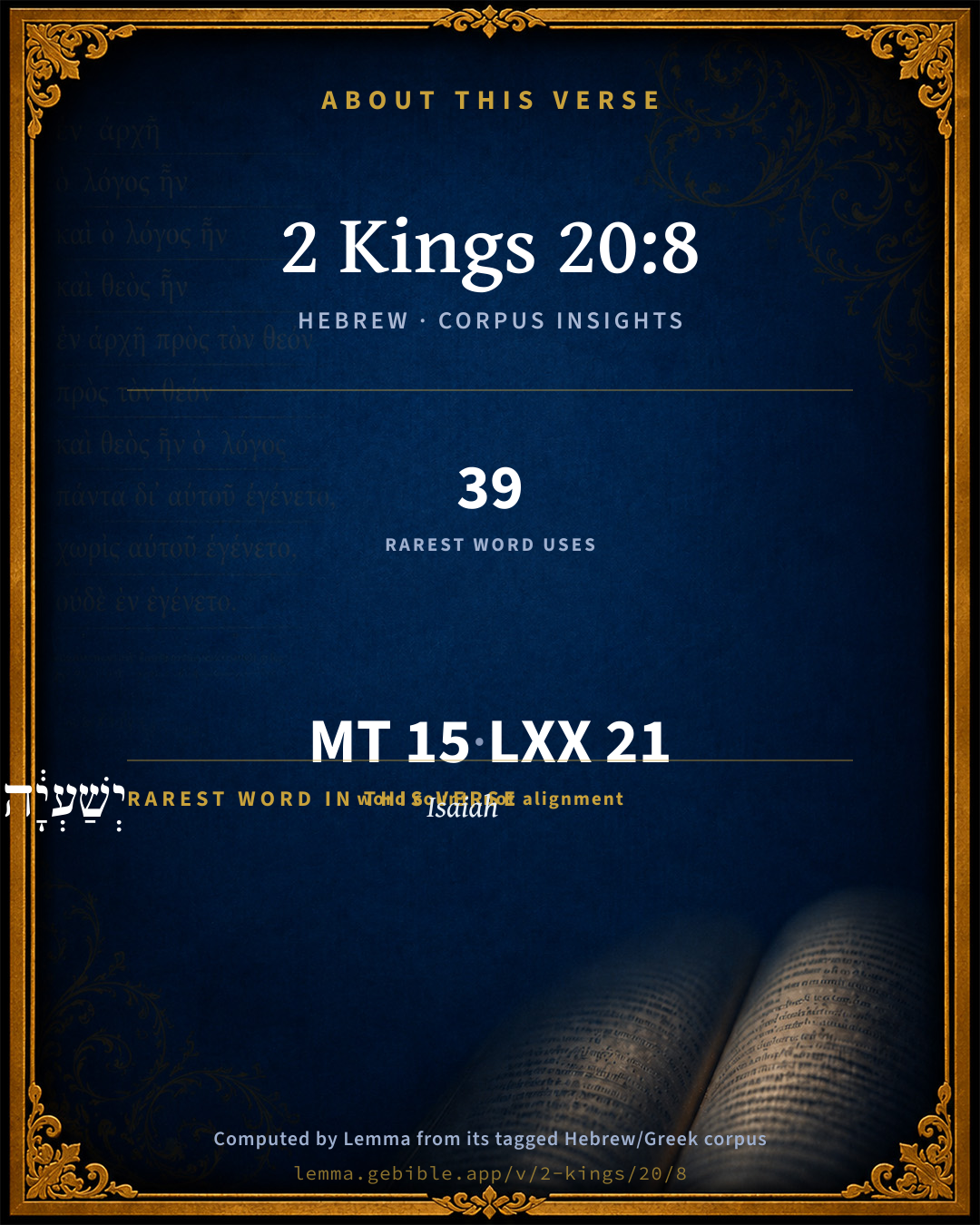
יְשַׁעְיָ֔הוּ Isaiah H3470 occurs in 39 verses of the Hebrew Bible. Also found in:

Grammatical profile

  • 3 verbs
  • 7 nouns
  • 1 adjective
  • 2 prepositions
  • 1 conjunction
  • 1 particle

Verb forms

  • וַיֹּ֤אמֶר Qal · Sequential Imperfect
  • יִרְפָּ֥א Qal · Imperfect
  • וְעָלִ֛יתִי Qal · Sequential Perfect

Repetition

A word recurs within this verse — often emphatic in Hebrew:

  • יְהוָ֖ה LORD H3068 ×2

Hebrew & Septuagint length

In English translation the verse runs 28 words from the Hebrew and 30 from the Septuagint (LXX English) — closely comparable.

A rough comparison of the two English renderings, which tokenize alike — not a word-level alignment.

Word counts can differ between the Hebrew and the Greek without any difference in meaning — e.g. the Hebrew direct-object marker אֵת has no separate Greek word, and Greek often adds the article ὁ.

In the original languages it is 15 Hebrew tokens and 21 Greek tokens — but the two are counted differently (Hebrew bundles its prefixes and suffixes into one token; the Greek is in lemma form), so that isn’t a like-for-like length.

Cross-references

8

Topical passages linked to 2 Kings 20:8 in the Treasury of Scripture Knowledge — connected by theme and wording, ordered by reader-vote popularity; previews shown in the World English Bible.

  • Judges 6:17 He said to him, If now I have found favor in your sight, then show me a sign that it is you who talk with me.
  • Isaiah 7:11 "Ask a sign of Yahweh your God; ask it either in the depth, or in the height above."
  • 2 Kings 19:29 This shall be the sign to you: You shall eat this year that which grows of itself, and in the second year that which springs of the same; and in the third year sow you, and reap, and plant vineyards, and eat the fruit of it.
  • 2 Kings 20:5 Turn back, and tell Hezekiah the prince of my people, Thus says Yahweh, the God of David your father, I have heard your prayer, I have seen your tears: behold, I will heal you; on the third day you shall go up to the house of Yahweh.
  • Hosea 6:2 After two days will he revive us. On the third day he will raise us up, And we will live before him.
  • Isaiah 7:14 Therefore the Lord himself will give you a sign. Behold, the virgin will conceive, and bear a son, and shall call his name Immanuel.
  • Isaiah 38:22 Hezekiah also had said, What is the sign that I shall go up to the house of Yahweh?
  • Judges 6:37–40 behold, I will put a fleece of wool on the threshing floor; if there be dew on the fleece only, and it be dry on all the ground, then shall I know that you will save Israel by my hand, as you have spoken.

Cross-references courtesy of OpenBible.info (CC BY 4.0).

Hebrew and Greek witnesses Masoretic Hebrew ↔ Greek Septuagint

The same verse in the two great witnesses to the Old Testament, shown verse-for-verse.

These are two independent witnesses, not word-aligned to each other, and the Septuagint is shown in lemma (dictionary) form.

Hebrew 2 Kings 20:8 Masoretic · Westminster Leningrad Codex

וַיֹּ֤אמֶר חִזְקִיָּ֨הוּ֙ אֶֽל יְשַׁעְיָ֔הוּ מָ֣ה א֔וֹת כִּֽי יִרְפָּ֥א יְהוָ֖ה לִ֑י וְעָלִ֛יתִי בַּיּ֥וֹם הַשְּׁלִישִׁ֖י בֵּ֥ית יְהוָֽה

Hezekiah said to Isaiah, What shall be the sign that Yahweh will heal me, and that I shall go up to the house of Yahweh the third day?

World English Bible · Public Domain

Greek LXX 2 Kings 20:8 Septuagint · lemma form

καί εἶπον εζεκιας πρός ησαιας τίς ὁ σημεῖον ὅτι ἰάομαι ἐγώ κύριος καί ἀναβαίνω εἰς οἶκος κύριος ὁ ἡμέρα ὁ τρίτος

And Ezekias said to Esaias, What is the sign that the Lord will heal me, and I shall go up to the house of the Lord on the third day?

LXX2012 (modern English Septuagint) · Public Domain

Hebrew: Westminster Leningrad Codex (CC BY 4.0). Greek: Septuagint (public domain); English from LXX2012 (modern English Septuagint) (Public Domain). How the Septuagint differs from the Hebrew →

Targum (Aramaic paraphrase)

1

The Targum is the ancient Jewish Aramaic paraphrase of the Hebrew Scriptures — an interpretive translation, not the Hebrew text itself. Onkelos (literal) and Pseudo-Jonathan (expansive) render the Torah, and Jonathan the Prophets. Coverage is partial: where no permissively-licensed English translation exists for a verse, only the Aramaic is shown. This is verse-level text, not a word-by-word alignment to the Hebrew.

  1. Targum Jonathan Prophets (Joshua–Malachi)
    וַאֲמַר חִזְקִיָהוּ לִישַׁעְיָהוּ מָא אָת אֲרֵי יַסֵי יְיָ לִי וְאֶסַק בְּיוֹמָא תְלִיתָאָה לְבֵית מַקְדְשָׁא דַיָי:

    (no public-domain English translation for this verse)

    Targum Jonathan — Aramaic: “Mikraot Gedolot” (public domain). English: “Sefaria Community Translation” (CC0 1.0 (public-domain dedication)); “London "Chaldee Paraphrase," 1871” (public domain). Text via Sefaria.

Commentary

Notes on 2 Kings 20:8 from classic Christian and Jewish commentators (each source and its license shown beneath its notes). The classic Christian expositions comment on the surrounding passage and are grouped to its opening verse, so a note may address several verses; the Jewish commentaries on the Tanakh (Rashi and others) are per-verse, so they appear only where the commentator wrote on this verse.

Lemma curates 59 commentaries, every one of them public domain or Creative Commons licensed, each selected and text-cleaned for this edition rather than reprinted as found. About our sources →

Jamieson, Fausset & Brown

Robert Jamieson, A. R. Fausset & David Brown

THE SUN GOES TEN DEGREES BACKWARD. (Kg2 20:8-20)

Hezekiah said unto Isaiah, What will be the sign that the Lord shall heal me--His recovery in the course of nature was so unlooked for, that the king asked for some token to justify his reliance on the truth of the prophet's communication; and the sign he specified was granted to him. The shadow of the sun went back upon the dial of Ahaz the ten degrees it had gone down. Various conjectures have been formed as to this dial. The word in the original is "degrees," or "steps," and hence many commentators have supposed that it was a stair, so artfully contrived, that the shadows on the steps indicated the hours and course of the sun. But it is more probable that it was a proper instrument, and, from the Hebrews having no term to designate it, that it was one of the foreign novelties imported from Babylon by Ahaz. It seems to have been of such magnitude, and so placed in the court, that Isaiah could point to it, and the king see it, from his chamber. The retrogression of the sun's shadow on the dial was miraculously accomplished by the omnipotent power of God; but the phenomenon was temporary, local, confined to the notice, and intended for the satisfaction, only of Hezekiah and his court.

Jamieson, Fausset & Brown — Commentary Critical and Explanatory on the Whole Bible (1871) — public domain (CC PDM 1.0). Text via the HelloAO Bible API.

Trapp's Complete Commentary

John Trapp

2Ki 20:8 And Hezekiah said unto Isaiah, What [shall be] the sign that the LORD will heal me, and that I shall go up into the house of the LORD the third day?

Ver. 8. And Hezekiah said.] Dixerat autem, He had said; sc., before the plaster was laid upon the boil.

What shall be the sign? &c.] That he should have a sign, he doubted, as his father Ahaz had, though unworthy. {Isa 7:10-14} See on Jdg 6:17; Jdg 6:37.

And that I shall go up into the house of the Lord the third day.] He maketh the utmost of the promise, as had done before him Jacob, {Gen 32:1-32} Noah, {Gen 9:11} and David. {1Ch 17:23-26} This is to suck and be satisfied. {Isa 66:11}

John Trapp, A Commentary or Exposition upon All the Books of the Old and New Testament (1647–1656) — public domain. Text from a community e-Sword module.

Joseph Benson's Commentary

2Ki 20:8. Hezekiah said to Isaiah — Or rather, had said; for it is evident this was said before his recovery, though his recovery be mentioned before it. What shall be the sign that the Lord will heal me? — He asks a sign, not because he distrusted the divine promise, but for the strengthening of his faith, which otherwise might have been shaken by the greatness of his danger, and by the contradiction between this and the prophet’s former message.

Joseph Benson's Commentary on the Old and New Testaments (1811–1818) — public domain. Text from a community e-Sword module.

Whedon's Commentary on the Bible

Daniel D. Whedon

THE SIGN ON THE DIAL OF AHAZ, 2Ki_20:8-11.

8. What shall be the sign — He cannot wait three days; he must have a sign immediately, for his emotion and anxiety are great.

Daniel D. Whedon (gen. ed.), Commentary on the Old and New Testaments (1874–1909) — public domain. Text from a community e-Sword module.

Tyndale Open Study Notes

Tyndale Open Resources

20:8 Hezekiah’s request for a sign as proof of his healing is understandable. He had quickly moved from having an incurable illness to being promised fifteen more years of life. God sometimes provided signs as visible symbols of his intentions (see also 19:29; Gen 9:12-17; Exod 4:1-9; 12:12-13; 31:12-13, 17; 1 Kgs 13:1-3).

Tyndale Open Study Notes — © Tyndale Open Resources, licensed CC BY-SA 4.0. Text via the HelloAO Bible API.

Adam Clarke's Commentary

Verse 8. What shall be the sign] He wished to be fully convinced that his cure was to be entirely supernatural; and, in order to this, he seeks one miracle to prove the truth of the other, that nothing might remain equivocal.

Adam Clarke's Commentary on the Bible (1810–1826) — public domain. Text from a community e-Sword/MySword module.

Ellicott's Commentary for English Readers

(8) What shall be the sign . . .?—Comp. 2Ki_19:29 and note; Isa_7:11 seq., where Isaiah requests Ahaz to choose a sign. The sign was obviously a token that the prophet’s word would come true.

A Bible Commentary for English Readers, edited by Charles John Ellicott (1878–1897) — public domain. Text from a community e-Sword module.

The Cambridge Bible for Schools and Colleges

gen. ed. J. J. S. Perowne

8. What shall be the sign] The king would have some token at once that the promise made to him should come to pass, and though the time was out very brief to wait, yet his request is granted. In Isa_7:11 there was a sign offered by God to Hezekiah’s father.

The Cambridge Bible for Schools and Colleges (gen. ed. J. J. S. Perowne; Cambridge University Press, 1878–1918) — public domain. Text from a community e-Sword module.

John Gill's Exposition

And Isaiah said, this sign shalt thou have of the Lord, that the Lord will do the thing that he hath spoken,.... Cure him of his disorder, so that he should be able to go to the temple on the third day:

shall the shadow go forward ten degrees, or go back ten degrees? that is, the shadow of the sun on a dial plate; it was left to his option to choose which he would, as the confirming sign of his recovery.

John Gill's Exposition of the Whole Bible (1746–1763) — public domain (CC PDM 1.0). Text via the HelloAO Bible API.

Albert Barnes' Notes on the Bible

And Hezekiah said - Previous to the actual recovery, Hezekiah, who at first may have felt himself no better, asked for a “sign” that he would indeed be restored to health.

Asking for a sign is a pious or a wicked act according to the spirit in which it is done. No blame is attached to the requests of Gideon Jdg 6:17, Jdg 6:37, Jdg 6:39, or to this of Hezekiah, because they were real wishes of the heart expressed humbly. The “evil generation” that “sought for a sign” in our Lord’s days did not really want one, but made the demand captiously, neither expecting nor wishing that it should be granted.

Albert Barnes' Notes on the Bible (1834–1885) — public domain. Text from a community e-Sword/MySword module.

Haydock's Catholic Bible Commentary

Signs. He is not incredulous, but gives the prophet an occasion of declaring by what authority he spoke thus. (Haydock)

George Leo Haydock (1774–1849), Haydock's Catholic Family Bible and Commentary, 1859 edition — public domain. Excludes Psalms (Douay-Rheims chapter numbering differs from Protestant) and Deuterocanonical books (Catholic canon only).

Matthew Poole's English Annotations

Hezekiah said; or rather, had said; for it is evident this was said before his recovery, though his recovery be mentioned before it; such transpositions being frequent in Scripture.

What shall be the sign? he asketh a sign, not because he distrusted it, but for the strengthening of his faith, which otherwise might be shaken by the greatness of his danger, and by the contradiction between this and his former message. Compare Jdg 6:17,37,39; Isa 7:11.

Matthew Poole's English Annotations on the Holy Bible (1683–1685) — public domain. Text from a community e-Sword/MySword module.

The Pulpit Commentary

And Hezekiah said unto Isaiah, What shall be the sign that the Lord will heal me? Having regard to the weakness of human faith, God, under the old covenant, often gave, or offered, near "signs" of promised blessings that were more remote, in order to sustain and encourage the doubtful and the wavering. (comp. Exo_3:12; 2Ki_19:29; Isa_7:11, Isa_7:14, etc.) Hezekiah assumes that a near "sign" will now he granted to him, and simply asks what the sign is to be. And that I shall go up into the house of the Lord the third day? Three days would be a long and weary time to wait. It was not unnatural that Hezekiah should crave some more immediate assurance that his prayer was indeed heard. Neither God nor the prophet was angry at his request.

The Pulpit Commentary (1880–1919), ed. H.D.M. Spence-Jones & Joseph S. Exell — public domain. Text from a community e-Sword module.

unfoldingWord translationNotes

Door43 World Missions Community

Shall the shadow go forward ten steps, or go back ten steps?

The source of "the shadow" can be stated clearly. AT: "Do you want Yahweh to make the shadow caused by the sunlight on the stairway to go forward ten steps or to go back ten steps?" (See: Assumed Knowledge and Implicit Information)

ten steps

This expression refers to the "stairway of Ahaz" in 2 Kings 20:11. This was probably a special stairway built for King Ahaz in such a way that its steps marked the hours of daylight as the sun's rays advanced along them. In this way, the staircase served to tell the time during the day.

translationWords

Hezekiah

Isaiah

sign

Yahweh

temple

shadow

unfoldingWord translationNotes — © Distant Shores Media and the Door43 World Missions Community, licensed CC BY-SA 4.0. Source: git.door43.org/Door43/en_tn.

Lesson kit

Teaching starters — assembled from the data on this page, not authored interpretation. Every prompt links to the verse data it draws on. Edit before teaching.

2 Kings, in the Historical, opens this verse with 15 words (13 distinct Hebrew lemmas). Its most distinctive word is Yᵉshaʻyâh (“Isaiah”). A historical commentator’s framing appears above. Read the whole chapter for the surrounding context.

Discussion questions

  1. How does “Isaiah” (Yᵉshaʻyâh) shape what this verse is saying?
  2. 2 Kings 19:2 shares the word «Isaiah» with this verse. How do the two illuminate each other?
  3. “LORD” occurs 2× in this one verse. What is the effect of the repetition?
  4. These translations render this verse differently; the difference is in the English rendering, not the original. What questions does that raise?
  5. The verb «וַיֹּ֤אמֶר» is Qal Sequential Imperfect. How does its form color the action?
  6. Reading how Jamieson, Fausset & Brown and Trapp's Complete Commentary read this verse, where do the two commentators agree and where do they part?

Things to notice

Reading settings

Reading text

Shown beneath each verse's original-language words.

Old Testament
Old Testament edition

Read the OT as the Masoretic Hebrew (MT) or the Greek Septuagint (LXX).

English shown for the Greek Septuagint (in the Hebrew ↔ Greek comparison).

Comparing translations? Open the Compare panel on any verse page to stack up to four side by side.