
Isaiah 38:7

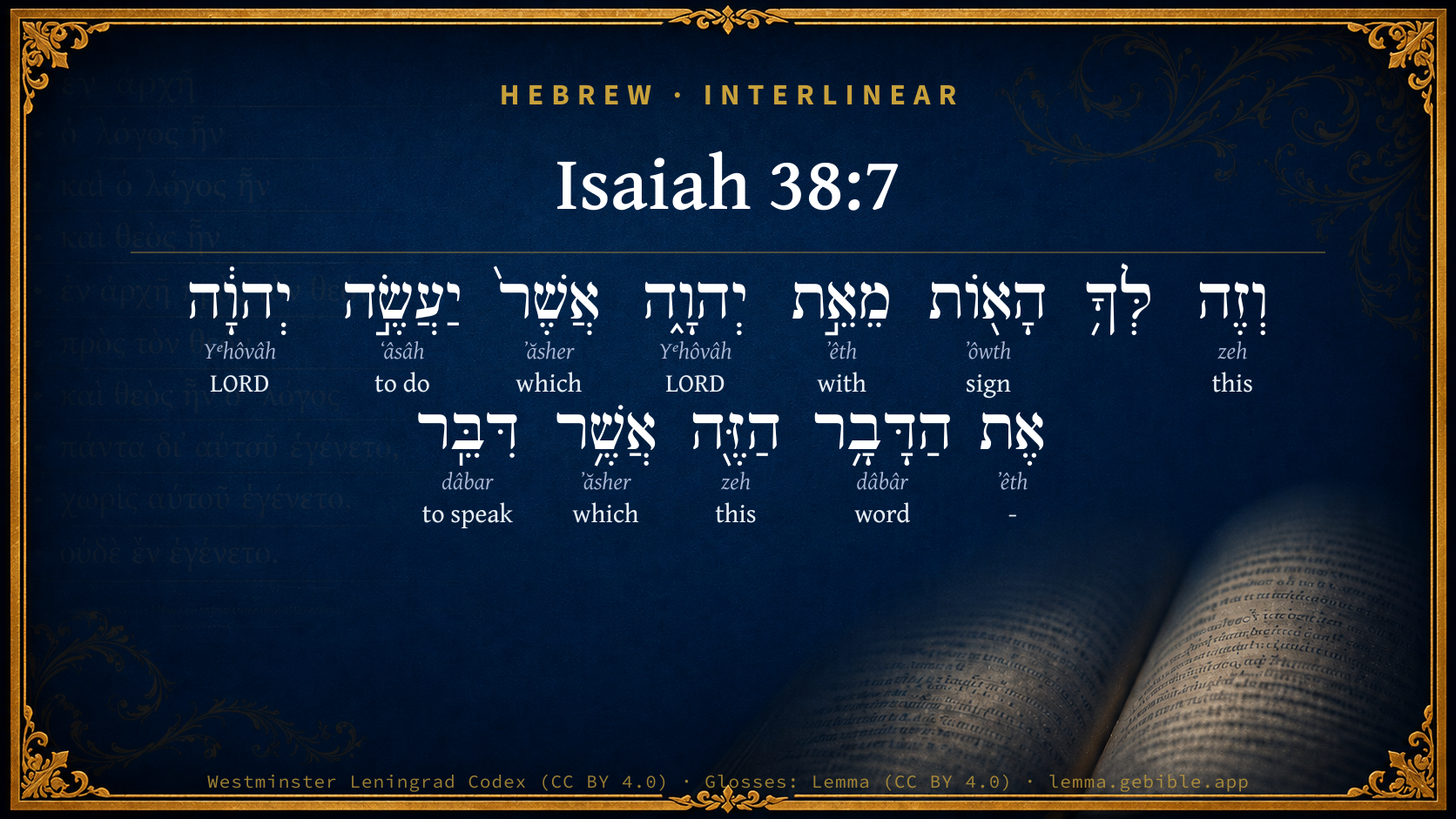
Hebrew (Westminster Leningrad Codex) Isaiah 38:7 appears in the Hebrew Old Testament. The text above is from the Westminster Leningrad Codex. Each word links to its Strong’s number, a concise gloss, and parsing drawn from the Open Scriptures Hebrew Bible morphology. Click any word for its full Brown-Driver-Briggs (BDB) entry.
Download image
Cite this verse

Isaiah 38:7 (World English Bible). Public Domain. Lemma interlinear Bible study tool, https://lemma.gebible.app/v/isaiah/38/7.

Show BibTeX & RIS
BibTeX
RIS
English Translation
This shall be the sign to you from Yahweh, that Yahweh will do this thing that he has spoken:
World English Bible · Public Domain
Download a study sheet

One document with this verse’s original text, its word-by-word gloss line, the meaning frame, cross-references with their text, attributed commentary, and full source and license credits — printable, and it pastes into notes with its structure intact.

This verse Autodidact and up

Study sheet (.html) Plain text (.txt)

A passage Seminary Student

Up to 50 verses in one chapter. A passage sheet keeps up to 6 commentary sources and 12 cross-references per verse, in the order this page ranks them, and says so on the sheet whenever that leaves anything out. Ask for a single verse and you get the Autodidact verse sheet above.

Everything on this page stays free to read, with no account — the sheet is a download of what is already on screen, not access to it.

Want to remove ads? Support Godless Engineer
Compare translations 3

The same verse in 3 English versions, stacked beneath the original-language interlinear above. Click any original word for its lexicon entry.

Each is an independent rendering of the whole verse — the interlinear is not word-aligned to these translations.

Highlighted words mark where these versions differ — a whole-verse word diff, not a word-by-word alignment.

  • World English Bible Public Domain
    This shall be the sign to you from Yahweh, that Yahweh will do this thing that he has spoken:
  • King James Version Public Domain
    And this shall be a sign unto thee from the LORD, that the LORD will do this thing that he hath spoken;
  • unfoldingWord Literal Text CC BY-SA 4.0
    And this the sign for you from Yahweh that Yahweh will do this thing that he has spoken.

unfoldingWord Literal Text — © unfoldingWord, licensed CC BY-SA 4.0. Word-aligned USFM3 via Door43 (git.door43.org/unfoldingWord/en_ult).

Versions to compare (up to 4)

3 of 4 selected

Show all 18 translations

Every available English version of this verse, each an independent rendering of the whole verse.

  • World English Bible Public Domain
    This shall be the sign to you from Yahweh, that Yahweh will do this thing that he has spoken:
  • Berean Standard Bible Public Domain
    This will be a sign to you from the LORD that He will do what He has promised:
  • Majority Standard Bible Public Domain
    This will be a sign to you from the LORD that He will do what He has promised:
  • King James Version Public Domain
    And this shall be a sign unto thee from the LORD, that the LORD will do this thing that he hath spoken;
  • American Standard Version (1901) Public Domain
    And this shall be the sign unto thee from Jehovah, that Jehovah will do this thing that he hath spoken:
  • Revised Version (1885) Public Domain
    And this shall he the sign unto thee from the LORD, that the LORD will do this thing that he hath spoken:
  • Geneva Bible (1599) Public Domain
    And this signe shalt thou haue of ye Lord, that ye Lord will do this thing that he hath spoken,
  • Douay-Rheims (1899) Public Domain
    And this shall be a sign to thee from the Lord, that the Lord will do this word which he hath spoken:
  • Young's Literal Translation Public Domain
    And this `is' to thee the sign from Jehovah, that Jehovah doth this thing that He hath spoken.
  • Literal Standard Version CC BY-SA 4.0
    And this [is] to you the sign from YHWH, that YHWH does this thing that He has spoken.
  • Unlocked Literal Bible CC BY-SA 4.0
    This will be the sign to you from Yahweh, that I will do what I have promised.
  • unfoldingWord Literal Text CC BY-SA 4.0
    And this the sign for you from Yahweh that Yahweh will do this thing that he has spoken.
  • Darby Bible Public Domain
    And this [shall be] the sign to thee from Jehovah, that Jehovah will do this thing that he hath spoken:
  • World Messianic Bible Public Domain
    This shall be the sign to you from the LORD, that the LORD will do this thing that he has spoken.
  • Webster's Bible Public Domain
    And this shall be a sign to thee from the LORD, that the LORD will do this thing that he hath spoken;
  • Free Bible Version CC BY-SA 4.0
    This is the sign from the Lord to you that the Lord will do what he promised:
  • Bible in Basic English Public Domain
    And Isaiah said, This is the sign the Lord will give you, that he will do what he has said:
  • JPS Tanakh (1917) Public Domain
    And this shall be the sign unto thee from the LORD, that the LORD will do this thing that He hath spoken:

Literal Standard Version (2020), Covenant Press — licensed CC BY-SA 4.0. Text via the HelloAO Bible API (eBible.org). Unlocked Literal Bible (unfoldingWord) — licensed CC BY-SA 4.0. Text via the HelloAO Bible API (eBible.org). unfoldingWord Literal Text — © unfoldingWord, licensed CC BY-SA 4.0. Word-aligned USFM3 via Door43 (git.door43.org/unfoldingWord/en_ult). Free Bible Version, Dr. Jonathan Gallagher — licensed CC BY-SA 4.0. Text via the HelloAO Bible API (eBible.org).

Word by word

More ways to search: Search by grammar → Find every occurrence → Compare this word →

Practice this passage: Drill this verse → Learn its vocabulary →

הָא֖וֹת
ʼôwth
H226
“the · sign”
Particle, Definite Article + Noun, Common, Both, Singular, Absolute
Part of Speech
Particle + Noun
Type
Common
Gender
Both
Number
Singular
State
Absolute
Full BDB Definition

Origin: probably from H225 (in the sense of appearing)

TWOT: 41a

sign, signal - a distinguishing mark - banner - remembrance - miraculous sign - omen - warning - token, ensign, standard, miracle, proof
  1. וְזֶה zeh H2088 “and · this” Conjunction + Pronoun, Demonstrative, Masculine, Singular
  2. מֵאֵ֣ת ʼêth H854 “from · with” Preposition + Preposition
  3. יְהוָ֑ה Yᵉhôvâh H3068 “LORD” Noun, Proper
  4. אֲשֶׁר֙ ʼăsher H834 “which” Particle, Relative
  5. יַעֲשֶׂ֣ה ʻâsâh H6213 “to do” Verb, Qal, Imperfect, 3rd Person, Masculine, Singular
  6. יְהוָ֔ה Yᵉhôvâh H3068 “LORD” Noun, Proper
  7. אֶת ʼêth H853 “-” Particle, Direct Object
  8. הַדָּבָ֥ר dâbâr H1697 “the · word” Particle, Definite Article + Noun, Common, Masculine, Singular, Absolute
  9. הַזֶּ֖ה zeh H2088 “the · this” Particle, Definite Article + Pronoun, Demonstrative, Masculine, Singular
  10. אֲשֶׁ֥ר ʼăsher H834 “which” Particle, Relative
  11. דִּבֵּֽר dâbar H1696 “to speak” Verb, Piel, Perfect, 3rd Person, Masculine, Singular

About this verse

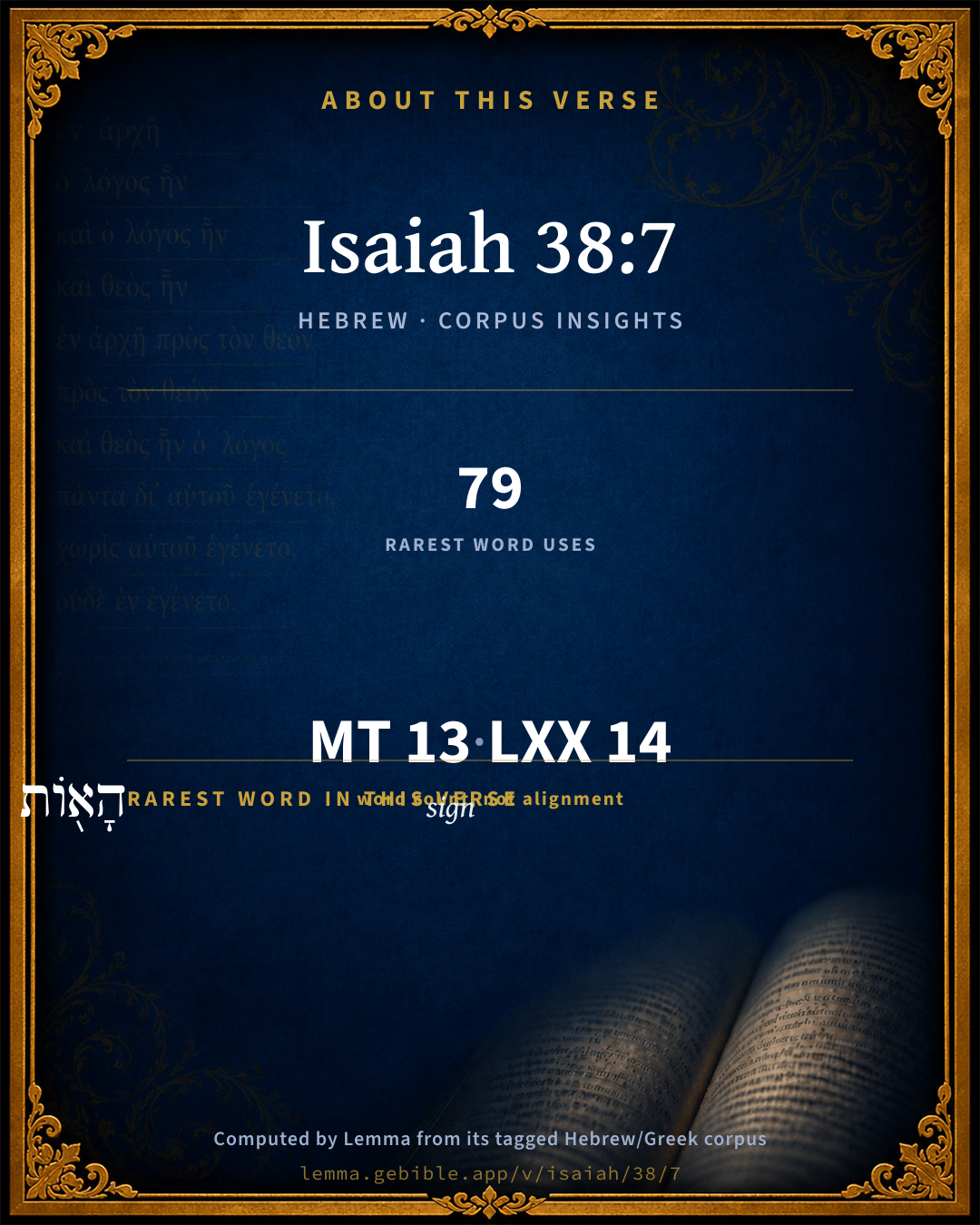
These counts appear in no published source. They are computed here, from the morphology-tagged text and Lemma’s own curated glosses. What Lemma adds →

13
words
9
distinct lemmas
Prophets
section

Grammatical profile

  • 2 verbs
  • 4 nouns
  • 2 pronouns
  • 2 prepositions
  • 3 particles

Verb forms

  • יַעֲשֶׂ֣ה Qal · Imperfect
  • דִּבֵּֽר Piel · Perfect

Repetition

Words recur within this verse — often emphatic in Hebrew:

  • יְהוָ֑ה LORD H3068 ×2
  • וְזֶה this H2088 ×2
  • אֲשֶׁר֙ which H834 ×2

Hebrew & Septuagint length

In English translation the verse runs 19 words from the Hebrew and 17 from the Septuagint (LXX English) — closely comparable.

A rough comparison of the two English renderings, which tokenize alike — not a word-level alignment.

Word counts can differ between the Hebrew and the Greek without any difference in meaning — e.g. the Hebrew direct-object marker אֵת has no separate Greek word, and Greek often adds the article ὁ.

In the original languages it is 13 Hebrew tokens and 14 Greek tokens — but the two are counted differently (Hebrew bundles its prefixes and suffixes into one token; the Greek is in lemma form), so that isn’t a like-for-like length.

Cross-references

7

Topical passages linked to Isaiah 38:7 in the Treasury of Scripture Knowledge — connected by theme and wording, ordered by reader-vote popularity; previews shown in the World English Bible.

  • Judges 6:37–39 behold, I will put a fleece of wool on the threshing floor; if there be dew on the fleece only, and it be dry on all the ground, then shall I know that you will save Israel by my hand, as you have spoken.
  • Isaiah 37:30 This shall be the sign to you: you shall eat this year that which grows of itself, and in the second year that which springs of the same; and in the third year sow you, and reap, and plant vineyards, and eat the fruit of it.
  • Judges 6:17–22 He said to him, If now I have found favor in your sight, then show me a sign that it is you who talk with me.
  • 2 Kings 20:8–21 Hezekiah said to Isaiah, What shall be the sign that Yahweh will heal me, and that I shall go up to the house of Yahweh the third day?
  • Isaiah 7:11–14 "Ask a sign of Yahweh your God; ask it either in the depth, or in the height above."
  • Genesis 9:13 I set my rainbow in the cloud, and it will be for a sign of a covenant between me and the earth.
  • Isaiah 38:22 Hezekiah also had said, What is the sign that I shall go up to the house of Yahweh?

Cross-references courtesy of OpenBible.info (CC BY 4.0).

Hebrew and Greek witnesses Masoretic Hebrew ↔ Greek Septuagint

The same verse in the two great witnesses to the Old Testament, shown verse-for-verse.

These are two independent witnesses, not word-aligned to each other, and the Septuagint is shown in lemma (dictionary) form.

Hebrew Isaiah 38:7 Masoretic · Westminster Leningrad Codex

וְזֶה לְּךָ֥ הָא֖וֹת מֵאֵ֣ת יְהוָ֑ה אֲשֶׁר֙ יַעֲשֶׂ֣ה יְהוָ֔ה אֶת הַדָּבָ֥ר הַזֶּ֖ה אֲשֶׁ֥ר דִּבֵּֽר

This shall be the sign to you from Yahweh, that Yahweh will do this thing that he has spoken:

World English Bible · Public Domain

Greek LXX Isaiah 38:7 Septuagint · lemma form

οὗτος δέ σύ ὁ σημεῖον παρά κύριος ὅτι ὁ θεός ποιέω ὁ ῥῆμα οὗτος

And this shall be a sign to you from the Lord, that God will do this thing;

LXX2012 (modern English Septuagint) · Public Domain

Hebrew: Westminster Leningrad Codex (CC BY 4.0). Greek: Septuagint (public domain); English from LXX2012 (modern English Septuagint) (Public Domain). How the Septuagint differs from the Hebrew →

Targum (Aramaic paraphrase)

1

The Targum is the ancient Jewish Aramaic paraphrase of the Hebrew Scriptures — an interpretive translation, not the Hebrew text itself. Onkelos (literal) and Pseudo-Jonathan (expansive) render the Torah, and Jonathan the Prophets. Coverage is partial: where no permissively-licensed English translation exists for a verse, only the Aramaic is shown. This is verse-level text, not a word-by-word alignment to the Hebrew.

  1. Targum Jonathan Prophets (Joshua–Malachi)
    וְדֵין לָךְ אָתָא מִן קֳדָם יְיָ דְיַעְבֵּיד יְיָ יַת פִּתְגָמָא הָדֵין דִי מַלֵיל:

    And this shall be a sign unto thee from before the Lord, that the Lord will do this thing that He hath promised.

    Targum Jonathan — Aramaic: “Mikraot Gedolot” (public domain). English: “Sefaria Community Translation” (CC0 1.0 (public-domain dedication)); “London "Chaldee Paraphrase," 1871” (public domain). Text via Sefaria.

Commentary

Notes on Isaiah 38:7 from classic Christian and Jewish commentators (each source and its license shown beneath its notes). The classic Christian expositions comment on the surrounding passage and are grouped to its opening verse, so a note may address several verses; the Jewish commentaries on the Tanakh (Rashi and others) are per-verse, so they appear only where the commentator wrote on this verse.

Lemma curates 59 commentaries, every one of them public domain or Creative Commons licensed, each selected and text-cleaned for this edition rather than reprinted as found. About our sources →

Trapp's Complete Commentary

John Trapp

Isa 38:7 And this [shall be] a sign unto thee from the LORD, that the LORD will do this thing that he hath spoken;

Ver. 7. See 2Ki 20:8 {See Trapp on "2Ki 20:8"}

John Trapp, A Commentary or Exposition upon All the Books of the Old and New Testament (1647–1656) — public domain. Text from a community e-Sword module.

The Biblical Illustrator

Joseph S. Exell

Isa_38:7-8

And this shall be a sign unto thee from the Lord

The shadow on the sun-dial of Ahaz

We are not to imagine that in this miracle any effect was wrought upon the motion of the earth round its axis.

A miraculous refraction of the suns rays was effected by God on a particular sun-dial, at the prayer of King Hezekiah. It was a miracle, wrought on a particular dial, in a particular place, showing that it concerned a particular person; and it was not wrought on the solar orb, but on the solar light. (Bp. Wordsworth.)

The shadow reversed on the sun-dial of Ahaz

This astounding miracle could only have been affected by a light. brighter than the sun, rising on the other side of the sun-dial. We all know how electric light reverses the shadow of gas light. At St. Pauls conversion, the light from heaven, the Shechinah brightness of Immanuel, outshone the splendour of the noonday sun. In the heavenly city there is no need of the sun to shine on it, nor of the moon to lighten it, for the glory of God and the Lamb is the light thereof. Unfortunately, we cannot tell on which side of the temple at Jerusalem the sun-dial of Ahaz was situated. It was probably a monolith or obelisk, resembling that on the Thames embankment, elevated on steps--translated degrees--and intended to regulate the hours of public worship. The setting sun had thrown the shadow across the steps; it had gone down ten degrees, when suddenly from the gate or window from the mercy-seat behind the veil of the naos, or temple proper, there flashed forth the majestic light of Divine glory that dwelt between the cherubim, reversing the shadow of the natural sun, and converting for Hezekiah the shadow of death into morning. (R. Balgarnie, D. D.)

The Light of the Mosaic past

To the ardent eyes of the old prophet the light that had reversed the shadow on the sundial was the old Light of the Mosaic past. It had illumined the land of Goshen in the days of supernatural darkness that overspread the rest of Egypt. It had flashed out with more than electric brightness upon the hosts of Israel as they struggled on through the night and the sea to escape the pursuing army of the Pharaoh. It had glided as a fiery pillar before the tribes through the rocky desert, warning off their enemies, and guiding the pilgrim army homeward to the fatherland. It had synchronised their movements with those convulsions of nature that arrested the Jordan at harvest flood, and shook down the walls of Jericho at the moment when they were prepared to cross and capture the devoted city. And it had stood over Gibeon as a sun that would not go down, and as a moon that would not withdraw, while Jehovah fought for Israel, and gave them their crowning victory over the idolatrous Canaanites. Isaiah knew the Light. (R. Balgarnie, D. D.)

Christ the glory of His people Israel

Was it this, I wonder, that evoked from Isaiah that unwonted outburst of enthusiasm in the chapter beginning, Arise, shine, for thy Light is come, and the glory of Jehovah is risen upon thee? Thy sun shall no more go down . . . for Jehovah shall be unto thee an everlasting Light, and thy God thy glory? If so, how appropriate the words to the occasion. It is easy to identify the Light of Israel with Christ, the Light of the world. (R. Balgarnie, D. D.)

Christ dispels and reverses lifes shadows

I do not consider that I am putting any undue strain upon the text in applying it to Christ. The Shechinah was the recognised token to Israel of the presence of her covenant God. It led the Magi to Bethlehem. It shone around the shepherds on the night of the nativity. It overwhelmed Saul of Tarsus on the way to Damascus. Christ is the Light that dispels and reverses our shadows. Christ has dispelled and reversed--

I. THE SHADOW OF, SIN.

II. THE SHADOW OF GRIEF.

III. THE SHADOW OF DEATH. If He be in thee, wrote John Pulsford, who is the Light of Life, very Light and very Life, then, when the candlelight of ,thy bodys life goes out, the sunlight of thy souls life shall be bright about thee. (R. Balgarnie, D. D.)

The great miracle

The miracle is how God Himself began. Why will men always attack the wrong point, as if it were a wonderful thing that a man should have fifteen years added to his life; and yet we omit the stupendous miracle that man ever began to live. Thus attack what mystery we may we only go backward and upward until we come to Deity Himself. That is the great mystery, and there is none other. (J. Parker, D. D.)

The Biblical Illustrator, edited by Joseph S. Exell (c. 1880s–1900s) — public domain. Text from a community e-Sword module.

Geneva Bible (1599)

Geneva Bible translators

For Hezekiah had asked for the confirmation of his faith, a sign, as verse 22, and 2 Kings 20:8, whereunto he was moved by the singular motion of God’s spirit.

Geneva Bible (1599) marginal notes — public domain. Text via Bolls.life.

Jamieson, Fausset & Brown

Robert Jamieson, A. R. Fausset & David Brown

sign--a token that God would fulfil His promise that Hezekiah should "go up into the house of the Lord the third day" (Kg2 20:5, Kg2 20:8); the words in italics are not in Isaiah.

Jamieson, Fausset & Brown — Commentary Critical and Explanatory on the Whole Bible (1871) — public domain (CC PDM 1.0). Text via the HelloAO Bible API.

Ellicott's Commentary for English Readers

(7) This shall be a sign unto thee . . .—The offer reminds us of that made to Ahaz; but it was received in a far different spirit. In 2Ki_20:8-11 the story is more fully told. Hezekiah asks for a sign, and is offered his choice. Shall the shadow go forward or backward? With something of a child-like simplicity he chooses the latter, as the more difficult of the two. The sun-dial of Ahaz, probably, like his altar (2Ki_16:10), copied from Syrian or Assyrian art [the mention of a sun-clock is ascribed by Herodotus (ii. 109) to the Chaldæans], would seem to have been of the form of an obelisk standing on steps (the literal meaning of the Hebrew word for dial), and casting its shadow so as to indicate the time, each step representing an hour or half-hour. The nature of the phenomenon seems as curiously limited as that of the darkness of the crucifixion. There was no prolongation of the day in the rest of Palestine or Jerusalem, for the backward movement was limited to the step-dial. At Babylon no such phenomenon had been observed, and one ostensible purpose of Merôdach-baladan’s embassy was to investigate its nature (2Ch_32:31). An inquiry into the causation of a miracle is almost a contradiction in terms, but the most probable explanation of the fact recorded is that it was the effect of a supernatural, but exceedingly circumscribed, refraction. A prolonged after glow following on the sunset; and reviving for a time the brightness of the day, might produce an effect such as is described to one who gazed upon the step-dial.

A Bible Commentary for English Readers, edited by Charles John Ellicott (1878–1897) — public domain. Text from a community e-Sword module.

The Cambridge Bible for Schools and Colleges

gen. ed. J. J. S. Perowne

7, 8. After Isa_38:6, 2 Kings describes the prophet’s prescription for the malady (see on Isa_38:21). The account of the sign also is given in a much fuller form there. It was granted at the express request of the king (see Isa_38:22), who had not his father’s fear of “tempting the Lord” (ch. Isa_7:12). Allowed to choose between a “going forward” and a “going backward” of the shadow, he decided for the latter as not so “light” a thing (i.e. less conceivable); when, at Isaiah’s intercession, the desired thing happened.

The Cambridge Bible for Schools and Colleges (gen. ed. J. J. S. Perowne; Cambridge University Press, 1878–1918) — public domain. Text from a community e-Sword module.

John Gill's Exposition

Behold, I will bring again the shadow of the degrees,.... Or lines made on a dial plate, to show the progress of the sun, and what time of day it was. Some think only the shadow was brought back by the power of God, the sun keeping its course as usual; but in the next clause the sun is expressly said to return ten degrees: besides, it is not easy to conceive how the shadow of the sun should go back, unless the sun itself did; if it had been only the shadow of it on Ahaz's dial, it would not have fallen under the notice of other nations, or have been the subject of their inquiry, as it was of the Babylonians, Ch2 32:31,

which is gone down on the sundial of Ahaz, the first sundial we read of; and though there might be others at this time, yet the lines or degrees might be more plain in this; and besides, this might be near the king's bedchamber, and to which he could look out at, and see the wonder himself, the shadow to return ten degrees backward; what those degrees, lines, or marks on the dial showed, is not certain. The Targum makes them to be hours, paraphrasing the words thus;

"behold, I will bring again the shadow of the stone of hours, by which the sun is gone down on the dial of Ahaz, backwards ten degrees; and the sun returned ten hours on the figure of the stone of hours, in which it went down;''

but others think they pointed out half hours; and others but quarters of hours; but, be it which it will, it matters not, the miracle was the same:

so the sun returned ten degrees, by which degrees it was gone down; and so this day was longer by these degrees than a common day, be they what they will, and according as we suppose the sun went back, suddenly, or as it usually moved, though in a retrograde way, and made the same progress again through these degrees. The Jews have a fable, that the day King Ahaz died was shortened ten hours, and now lengthened the same at this season, which brought time right again. According to Gussetius, these were not degrees or marks on a sundial, to know the time of day, for this was a later invention, ascribed to Anaximene's, a disciple of Anaximander (c), two hundred years after this; but were steps or stairs built by Ahaz, to go up from the ground to the roof of the house, on the outside of it, and which might consist of twenty steps or more; and on which the sun cast a shadow all hours of the day, "and this declined ten of these steps", which might be at the window of Hezekiah's bedchamber. (d).

(d) Plin. Nat. Hist. l. 2. c. 76. (d) Vid. Comment. Ebr. p. 859.

John Gill's Exposition of the Whole Bible (1746–1763) — public domain (CC PDM 1.0). Text via the HelloAO Bible API.

Albert Barnes' Notes on the Bible

And this shall be a sign unto thee - That is, a sign, or proof that God would do what he had promised, and that Hezekiah would recover and be permitted to go again to the temple of the Lord Isa 38:22; 2Ki 20:8. On the meaning of the word ‘sign,’ see Isa 7:11, note; Isa 7:14, note; compare the note at Isa 37:30. The promise was, that he should be permitted to go to the temple in three days 2Ki 20:5.

Albert Barnes' Notes on the Bible (1834–1885) — public domain. Text from a community e-Sword/MySword module.

Whedon's Commentary on the Bible

Daniel D. Whedon

7, 8. The corresponding narrative in 2 Kings xx, is more full and circumstantial, for comments on which, see Terry, WHEDON’S Commentary, 2Ki_20:1, etc.

A sign — A token of the truth of Isaiah’s prediction of lengthened life. This “sign” was the backward movement of the shadow on the dial, or degrees, or steps of Ahaz. Ahaz borrowed as much as he could from other nations — note his Damascus altar. It is known that astronomy was early cultivated beyond the Euphrates, and that Ahaz, being an idolatrous vassal to Tiglath-pileser, adopted at Jerusalem the eastern altars on the roof of his house for the adoration of the sun and the stars. A blameless result of all this was the measuring of time by the degrees, or advancing steps, of the sun on the dial, which may have consisted of a column or obelisk placed on the top of a terrace, so casting a shadow upon steps or stairs מעלות (ma’aloth) ascending on either side, as to mark spaces of time. Several devices are given by Terry (WHEDON’S Commentary on 2Ki_20:11,) to whose excellent comments the reader is referred.

Daniel D. Whedon (gen. ed.), Commentary on the Old and New Testaments (1874–1909) — public domain. Text from a community e-Sword module.

The Pulpit Commentary

And this shall be a sign unto thee from the Lord. It was the day of the free offering of "signs" by God to those whom his providence had placed at the head of his people. Ahaz had been offered a sign, (Isa_7:11) but had refused the offer made him; (Isa_7:12) the Lord had then "himself" given him a sign." Hezekiah received a sign to assure him of the complete discomfiture of Sennacherib; (Isa_37:30) an offer was here made him of a sign of a peculiar kind, and it was offered under peculiar conditions. We learn from 2 Kings that a choice was submitted to him he was to determine whether time, as measured by a certain timepiece or clock, which was known as "the dial of Ahaz," should make a sudden leap forward the shadow advancing ten degrees upon the dial, (2Ki_20:9) or whether it should retire backwards, the shadow upon the same dial receding ten degrees. Hezekiah determined in favour of the latter sign, from its appearing to him the more difficult of accomplishment; and on his declaring his decision, the shadow receded to the prescribed distance. Time was rolled backward, or at any rate appeared to be rolled backward; and the king, seeing so great a miracle, accepted without hesitation the further predictions that had been made to him. The Lord will do this thing that he hath spoken. By the nexus of this verse with the preceding, it would naturally be concluded that "the thing" to be done was the defence of Jerusalem; but ver. 22, which belongs properly to this part of the narrative, shows the contrary. Hezekiah had asked for a sign" that he should go up to the house of the Lord.

Vers. 7, 8. Signs for the help of faith.

In this case, as in that of Gideon, God granted signs. For the people of Palestine, and for his disciples, our Lord wrought miracles, which were signs; but he utterly refused to meet the demand of the Pharisees. "There shall no sign be given you." Our Lord, however, reproved the desire for signs as showing some weakness of character in those who desired them. "Except ye see signs and wonders ye will not believe." Exactly what the sign granted to Hezekiah was cannot certainly be ascertained. The shadow passing back on the dial may have suggested God"s putting back the death-angel for a while. Probably a shadow cast on a staircase by a column showed the height of the sun in the heavens. This shadow would travel upward as the day advanced, and its return down ten steps, beheld from Hezekiah"s sick-chamber, would be the most impressive emblem of the new lease of life bestowed. Miracles are never spoken of as mere wonders; they are signs, and have for their object to manifest forth God"s glory. They have been wrought in every age of the world. They would cease to do their work if they became ordinary Divine operations. We note that

I DIVINE SIGNS ARE NOT FOR THE CONVINCEMENT OF SCEPTICS. This our Lord declared in his refusal to do mighty works for the Pharisees, and illustrated in the parable of Dives and Lazarus. Dives wanted one from the dead to go and warn his brethren. Christ plainly intimated that the man who can put away ordinary influences wilt find out how to resist special ones. No miracle could be wrought which a man of sceptical disposition could not explain away. We should speak very guardedly of miracles as Christian evidences. They are to those in right moods of mind.

II DIVINE SIGNS ARE FOR THE PERSUASION OF THE WILLING AND OBEDIENT. "If a man is willing, he shall know of the doctrine." In some places our Lord "could not do many mighty works because of the unbelief." There are proper relations in which creatures should stand to their Creator, children to their parents, and men to God. Out of relations man"s wilfulness may resist anything and everything. The teacher demands a teachable spirit in the scholars; the master expects a willingness to learn in his apprentice; and God asks for "willingness and obedience," proper attitudes of mind and feeling, in those to whom he reveals himself. There is a proper "receptive mood.

III DIVINE SIGNS ARE FOR THE STRENGTHENING AND CHEERING OF GOD"S PEOPLE. They are the Divine response to those who unite firmness of will with frailty of body and mind, who are set on God, but battle hard with flesh and blood. "To will is present with them, but how to perform they find not." Gideon wanted to trust God and serve him, but circumstances made the commission entrusted to him most perilous; therefore God encouraged him with a sign. Hezekiah wanted to accept the Divine assurance, but the pain and depression of disease made trust nearly impossible, so God strengthened him with a sign. R.T.

The Pulpit Commentary (1880–1919), ed. H.D.M. Spence-Jones & Joseph S. Exell — public domain. Text from a community e-Sword module.

Keil & Delitzsch

C. F. Keil & F. Delitzsch

The pledge desired. "(K. Then Isaiah said) and (K. om.) let this be the sign to thee on the part of Jehovah, that (אשׁר, K. כּי) Jehovah will perform this (K. the) word which He has spoken; Behold, I make the shadow retrace the steps, which it has gone down upon the sun-dial of Ahaz through the sun, ten steps backward. And the sun went back ten steps upon the dial, which it had gone down" (K. "Shall the shadow go forward [הלך, read הלך according to Job 40:2, or הילך] ten steps, or shall it go back ten steps? Then Yechizkiyahu said, It is easy for the shadow to go down ten steps; no, but the shadow shall go back ten steps. Then Isaiah the prophet cried to Jehovah, and turned back the shadow by the steps that it had gone down upon the sun-dial of Ahaz, ten steps backward"). "Steps of Ahaz" was the name given to a sun-dial erected by him. As ma‛ălâh may signify either one of a flight of steps or a degree (syn. madrigâh), we might suppose the reference to be to a dial-plate with a gnomon; but, in the first place, the expression points to an actual succession of steps, that is to say, to an obelisk upon a square or circular elevation ascended by steps, which threw the shadow of its highest point at noon upon the highest steps, and in the morning and evening upon the lowest either on the one side or the other, so that the obelisk itself served as a gnomon. It is in this sense that the Targum on Kg2 9:13 renders gerem hamma‛ălōth by derag shâ‛ayyâ', step (flight of steps) of the sun-dial; and the obelisk of Augustus, on the Field of Mars at Rome, was one of this kind, which served as a sun-dial. The going forward, going down, or declining of the shadow, and its going back, were regulated by the meridian line, and under certain circumstances the same might be said of a vertical dial, i.e., of a sun-dial with a vertical dial-plate; but it applies more strictly to a step-dial, i.e., to a sun-dial in which the degrees that measure definite periods of time are really gradus. The step-dial of Ahaz may have consisted of twenty steps or more, which measured the time of day by half-hours, or even quarters. If the sign was given an hour before sunset, the shadow, by going back ten steps of half-an-hour each, would return to the point at which it stood at twelve o'clock. But how was this effected? Certainly not by giving an opposite direction to the revolution of the earth upon its axis, which would have been followed by the most terrible convulsions over the entire globe; and in all probability not even by an apparently retrograde motion of the sun (in which case the miracle would be optical rather than cosmical); but as the intention was to give a sign that should serve as a pledge, and therefore had not need whatever to be supernatural, it may have been simply through a phenomenon of refraction, since all that was required was that the shadow which was down at the bottom in the afternoon should be carried upwards by a sudden and unexpected refraction. Hamma‛ălōth (the steps) in Isa 38:8 does not stand in a genitive relation to tsēl (the shadow), as the accents would make it appear, but is an accusative of measure, equivalent to בּמּעלות in the sum of the steps (Kg2 20:11). To this accusative of measure there is appended the relative clause: quos (gradus) descendit (ירדה; צל being used as a feminine) in scala Ahasi per solem, i.e., through the onward motion of the sun. When it is stated that "the sun returned," this does not mean the sun in the heaven, but the sun upon the sun-dial, upon which the illuminated surface moved upwards as the shadow retreated; for when the shadow moved back, the sun moved back as well. The event is intended to be represented as a miracle; and a miracle it really was. The force of will proved itself to be a power superior to all natural law; the phenomenon followed upon the prophet's prayer as an extraordinary result of divine power, not effected through his astronomical learning, but simply through that faith which can move mountains, because it can set in motion the omnipotence of God.

Keil & Delitzsch — Biblical Commentary on the Old Testament (1861–1891) — public domain (CC PDM 1.0). Text via the HelloAO Bible API. (Old Testament only.)

J. A. Alexander on Isaiah

Joseph Addison Alexander

“And this (shall be) to thee the sign from Jehovah, that Jehovah will perform this word which He hath spoken.” The English Version has a sign; but the article is emphatic, the (appointed) sign (proceeding) from Jehovah (not merely from the Prophet). The parallel narrative in Kings is much more circumstantial. What occurs below, as the last two verses of this chapter, there stands in its regular chronological order, between the promise of recovery and the announcement of the sign, so that the latter appears to have been given in compliance with Hezekiah’s own request and choice. “And Isaiah said, This (shall be) to thee the sign from Jehovah, that Jehovah will perform the thing which He hath spoken; shall the shadow advance ten degrees, or shall it recede ten degrees? And Hezekiah said, It is a light thing for the shadow to decline ten degrees; nay, but let the shadow return backward ten degrees (2Ki 20:9-10). As to the transposition of vs. 21, 22, see below.

Joseph Addison Alexander, The Prophecies of Isaiah (1846–1847; New York: Scribner, 1870–1878) — public domain. Text from a community e-Sword module.

unfoldingWord translationNotes

Door43 World Missions Community

General Information:

Yahweh continues speaking to Hezekiah.

Look

Yahweh uses this word to draw the listener's attention to what is said next. AT: "Listen"

stairs of Ahaz

These stairs are referred to this way because they were built while Ahaz was king. You can make this information clear. (See: Assumed Knowledge and Implicit Information)

translationWords

sign

Yahweh

Ahaz

unfoldingWord translationNotes — © Distant Shores Media and the Door43 World Missions Community, licensed CC BY-SA 4.0. Source: git.door43.org/Door43/en_tn.

Rashi

Rabbi Shlomo Yitzchaki (Rashi)

And this is your sign That you shall be cured, and that your days shall be increased, as is explained below (v. 22), and in Kings (2 20:8) he asked, “What is the sign that I will go up?”

Rashi on the Tanakh — English translations: “The Judaica Press complete Tanach with Rashi, translated by A. J. Rosenberg” (CC BY 4.0); “Pentateuch with Rashi's commentary by M. Rosenbaum and A.M. Silbermann, 1929-1934” (public domain); “The Metsudah Tanach series, Lakewood, N.J” (CC BY 4.0); and “The Book of Joshua, Metsudah Publications, 1997” (CC BY 4.0). Text via Sefaria.

Lesson kit

Teaching starters — assembled from the data on this page, not authored interpretation. Every prompt links to the verse data it draws on. Edit before teaching.

Isaiah, in the Prophets, opens this verse with 13 words (9 distinct Hebrew lemmas). Its most distinctive word is ʼôwth (“sign”). A historical commentator’s framing appears above. Read the whole chapter for the surrounding context.

Discussion questions

  1. What does “sign” (ʼôwth) contribute to the verse as a whole?
  2. How does Judges 6:37–39, which shares this passage’s theme, read alongside this verse?
  3. What does the repetition of “LORD” (2× in this one verse) do in this verse?
  4. These translations render this verse differently. What is at stake in choosing one wording over another?
  5. «יַעֲשֶׂ֣ה» is a Qal Imperfect verb. How does that grammatical form shape the action described?
  6. Compare how Trapp's Complete Commentary and The Biblical Illustrator read this verse. Where do they agree or differ?

Things to notice

Reading settings

Reading text

Shown beneath each verse's original-language words.

Old Testament
Old Testament edition

Read the OT as the Masoretic Hebrew (MT) or the Greek Septuagint (LXX).

English shown for the Greek Septuagint (in the Hebrew ↔ Greek comparison).

Comparing translations? Open the Compare panel on any verse page to stack up to four side by side.