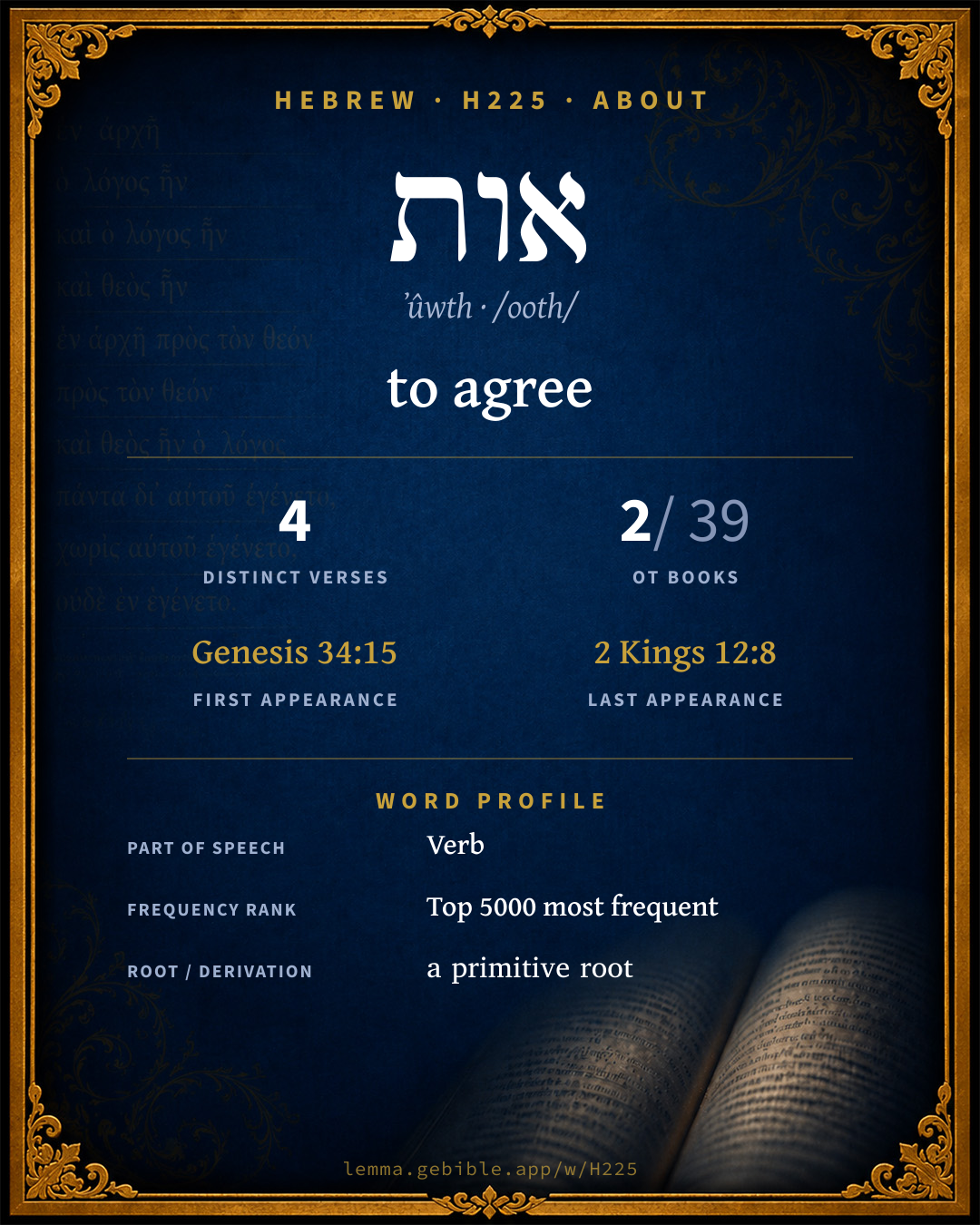
אוּת
to agree
Full lexicon entry — Brown-Driver-Briggs (BDB)
From Brown-Driver-Briggs (BDB)
Where this word appears
Grammar key — what these labels mean
Part of speech
- Verb
- An action or state-of-being word.
Stem
- Niphal
- Usually the simple passive or reflexive of the Qal (“he was written”).
Form
- Sequential Imperfect
- An imperfect with prefixed waw — the standard past-narrative form (waw-consecutive imperfect).
- Cohortative
- A first-person volitional form expressing wish or resolve (“let me / let us write”).
- Imperfect
- An incomplete, ongoing, or future action (“he will / would write”).
Person
- 3rd Person
- The one spoken about (“he / she / it / they”).
- 1st Person
- The speaker (“I / we”).
Gender
- Masculine
- Grammatically masculine.
- Common
- Either gender — not distinguished for this form.
Number
- Plural
- More than one (in Hebrew, generally three or more).
Grammatical forms
- Verb, Niphal, Sequential Imperfect, 3rd Person, Masculine, Plural 1 time (25%)
- Verb, Niphal, Cohortative, 1st Person, Common, Plural 1 time (25%)
- Verb, Niphal, Imperfect, 1st Person, Common, Plural 1 time (25%)
- Verb, Niphal, Imperfect, 3rd Person, Masculine, Plural 1 time (25%)
Parsed forms decoded from the imported morphology (morphhb / Westminster Leningrad Codex — WLC text public domain, morphhb tagging CC BY 4.0), counted across 4 parsed occurrences — not distinct verses.
Every verse where H225 appears — 4 distinct verses across 2 books. Click any verse to open its interlinear word-by-word view. Verse text shown in the World English Bible for context — . Each verse’s Hebrew form is shown with its reference; the English is not keyword-highlighted, since the data carries no word-level English alignment. Use “Compare translations” on any verse to read it across multiple English versions. This concordance covers the Hebrew Bible; Septuagint (Greek Old Testament) occurrences are not indexed here.
Genesis 3 verses
- Genesis 34:15 נֵא֣וֹת Niphal impf 1cp Only on this condition will we consent to you. If you will be as we are, that every male of you be circumcised;
- Genesis 34:22 יֵאֹ֨תוּ Niphal impf 3mp Only on this condition will the men consent to us to dwell with us, to become one people, if every male among us be circumcised, as they are circumcised.
- Genesis 34:23 נֵא֣וֹתָה Niphal coh 1cp Won't their cattle and their substance and all their animals be ours? Only let us give our consent to them, and they will dwell with us."
2 Kings 1 verse
About this entry
At a glance — auto-summarized from this page’s data, not written by a person. Every figure links to its source below. This summary describes the numbers; it doesn’t interpret them.
“to agree” is the headline sense of the Hebrew verb אות (ʼûwth). It is rare — just 4 verses in the entire Hebrew Bible. It clusters heavily in Genesis, which alone accounts for 75% of its uses. First canonically at Genesis 34:15, it enters the text early. From the same root come אות and אתה. See the sense tree, 4-verse concordance, and the renderings breakdown below.
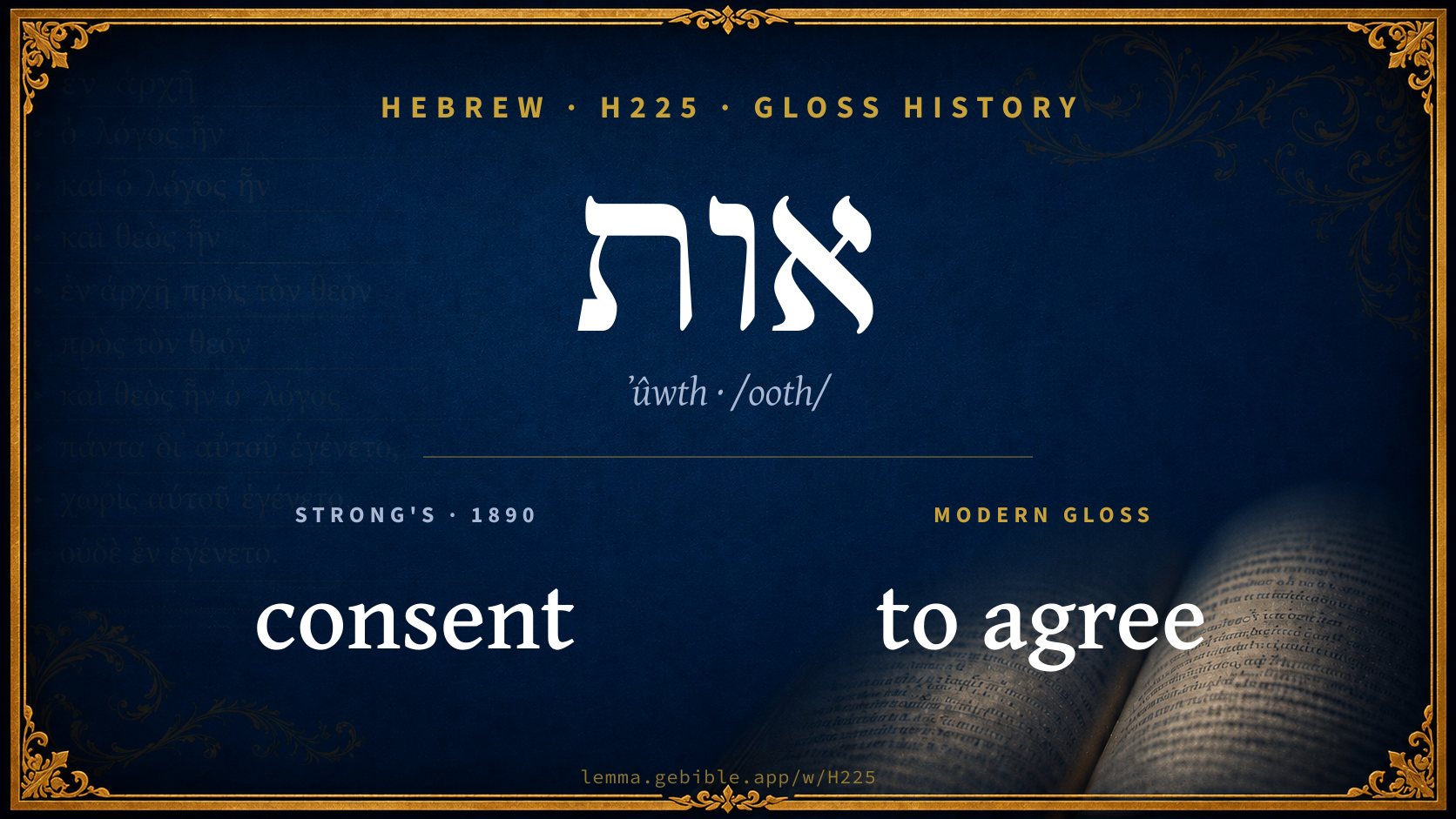
Gloss history
Strong's 1890 vs modern scholarship
About this word
Strong's H225 catalogs a Hebrew word from the Hebrew Old Testament.
These counts are not copied from any lexicon or concordance. They are computed here, from the morphology-tagged Hebrew Old Testament. What Lemma adds →
- 4
- distinct verses
- The word appears in 4 distinct verses.
- 2 / 39
- OT books
- The word appears in 2 of 39 Old Testament books.
- #3,696
- by frequency
- Top 5000 most frequent Hebrew words (rank 3,696 of 8,640 Hebrew words by occurrence).
View all 4 occurrences in the concordance →
By traditional corpus
Conventional, traditional groupings — biblical authorship is debated, so this is a traditional corpus grouping, not an authorship claim. Each share is this word’s portion of its verses in that division of the Hebrew canon. Each figure is a share of the word’s 4 distinct verses.
- Torah (Pentateuch) 3 verses · 75%
- Prophets (Nevi'im) 1 verse · 25%
How translations render this word
Counts come from each version’s own published word-to-Strong’s tagging or interlinear alignment — an approximate guide to how each version renders this word, not a word-level alignment the data otherwise carries. Because each total is that version’s own tagged count, the per-version totals vary from one another and need not match the appearance or distinct-verse counts above. These counts may also differ from a printed concordance because Lemma counts each distinctly tagged rendering and does not collapse phrase taggings into a single head-word total. This is a fixed set of word-tagged versions (KJV, ASV, BSB, ULT) and does not change with the reading translation you choose elsewhere. Each version’s license is shown beside its name below (and on Sources).
- King James Version: Consent 1×, Consented 1×, Theirs be ours only let us consent 1×
- American Standard Version: Be ours 1×, Condition will we consent 1×, Consent 1×
- Berean Standard Bible: Agree 1×, Agreed 1×, Let us consent 1×
- unfoldingWord Literal Text: Agreed 1×, And 1×, Consent 1×
King James Version Public Domain
Renders H225 across 4 tagged occurrences — most commonly:
American Standard Version Public Domain
Renders H225 across 4 tagged occurrences — most commonly:
Berean Standard Bible Public Domain
Renders H225 across 4 tagged occurrences — most commonly:
unfoldingWord Literal Text CC BY-SA 4.0
Renders H225 across 6 tagged occurrences — most commonly:
Senses in BDB
The 1 sense BDB distinguishes for this word, in lexicon order (not ranked by frequency or importance). The full entry — with sub-senses — is in the Lexicon Entry tab.
- (Niphal) to consent, agree
Word origin
[ אוּת ] vb. only Niph. Impf. consent, agree
— Brown-Driver-Briggs (Oxford 1906, public domain), digitized via Sefaria, supplemented by the OpenScriptures HebrewLexicon (CC BY 4.0). See Sources.
Origin: a primitive root
Jastrow Dictionary
A second Hebrew/Aramaic lexicon for comparison, covering Aramaic and post-biblical (Talmudic, Targumic, Midrashic) usage that the biblical-Hebrew BDB does not. Matched by lemma rather than by Strong’s number, so a lemma may carry more than one Jastrow headword (shown separately below), and the entries cover usage well beyond the Bible.
אוֹת I
- to join, fit.
- (b. h.) to be suited, pleased, whence to be gratified, to enjoy. Y. Ber. III, 6ᶜ top ראה את עצמו נ׳ וכ׳ he dreamt he felt sexual gratification; Y. Yoma VII, 44ᵈ bot.; Y. Taan. I, 64ᶜ bot.—Y. Bets. I, 61ᵃ כל שנֵאותין בו בי"ט whatever you are permitted to make use of on Holy Days.—Fut. יֵאוֹת. Ber. VIII, 6 עד שיֵאוֹתוּ לאורו until being near enough to enjoy its light. Y. Ab. Zar. I, 39ᶜ top, a. e., differences as to spelling יֵאוֹתוּ or יֵעוּתוּ.—Denom. הֲנָאָה, נָאֶה, נָאוֶה, נוֹי.
אוֹת II
- c. (b. h.; v. אוי,
- 1. mark, sign, emblem; test, signal, military ensign. Ḥag. 16ᵃ (play on ואתה Deut. XXXIII, 2; cmp. foreg.) אות הוא וכ׳ He is the ensign among his myriad; v. דּוּגְמָא. M. Kat. 25ᵇ אל תזניחנו בא׳ וכ׳ forsake us not in the symbolic trial of bitter waters (in our trials). Pl. אוֹתוֹת. Kil. IX, 10 א׳ הגרדין וכ׳ the marks which the weavers &c. put on goods in their charge. B. Kam. 119ᵇ you must not buy from the dyer לא א׳ ולא דוגמות either tests (pieces cut off to test the color) or samples (as specimens of color). e.g. Deuteronomy 33:2
- 2. letter, writing, symbol. B. Bath. 15ᵃ אות אחת one letter. Sabb. 103ᵃ; a. fr.—Pl. אוֹתִיּוֹת (fr. אוֹתוּת or אוֹתִית). Kidd. 30ᵃ סופרים כל הא׳ recorded (or counted) all the letters of the Torah. Snh. X, 1 השם באוֹתִיוֹתָיו the Divine Name with the letters in which it is written (Jehovah). Kidd. 71ᵃ שם בן ארבע א׳ the quadriliteral Name; cmp. שֵׁם.—Lev. R. s. 26, beg. ח׳ א׳ eight letters. Sabb. XII, 3; a. fr.—Trnsf. notes, documents. Tosef. Kidd. I, 7; B. Bath. 75ᵇ; a. e.
אוֹת III
- v. אֵת) only with pronominal suffix
- 1. indicating the objective case, אוֹתִי me, אוֹתְךָ thee, &c.—2) with pronom., &c.
- 2. with pronom. suffix of third person, for emphasizing the subject, אוֹתוֹ he himself, this one, the same, he who &c. Gen. R. s. 2, beg. ישב לו א׳ וכ׳ the latter now sat there confounded &c. Y. Git. VI, 47ᵈ באותו ענין on this very subject (divorce). Sabb. 13ᵇ זכור אותו האיש וכ׳ may that man be remembered for good. Ber. V, 3 באוֹתָהּ שעה in that hour; a. fr.—אותו מקום euphem. for pudenda. Nidd. 47ᵇ. Git. 69ᵇ; a. e.—אותו ואת בנו the law concerning the killing of the young with its mother on the same day (Lev. XXII, 28). Ḥull. V, 1; a. fr.—Pl. אוֹתָן. Y. Meg. IV, 74ᵈ top א׳ שבפה those laws delivered orally. Keth. 4ᵃ כל א׳ הימים all those days; a. fr. [In later writings אותו האיש is freq. used for Jesus of Nazareth. e.g. Leviticus 22:28
A Dictionary of the Targumim, the Talmud Babli and Yerushalmi, and the Midrashic Literature (Marcus Jastrow; London, Luzac, 1903) — Public Domain. Digitized via Sefaria. Digitized via Sefaria. Full attribution on Sources.
Forms in the corpus
The 4 distinct written forms H225 takes in the Hebrew Bible, most frequent first — each parse links to that stem’s occurrences in the concordance. Hebrew forms include their vowel points and cantillation, so a single lemma takes many written forms.
| Form | Parsing | Example | Uses |
|---|---|---|---|
| וַ/יֵּאֹ֖תוּ | Verb, Niphal, Sequential Imperfect, 3rd Person, Masculine, Plural | 2 Kings 12:8 | 1 |
| יֵאֹ֨תוּ | Verb, Niphal, Imperfect, 3rd Person, Masculine, Plural | Genesis 34:22 | 1 |
| נֵא֣וֹת | Verb, Niphal, Imperfect, 1st Person, Common, Plural | Genesis 34:15 | 1 |
| נֵא֣וֹתָה | Verb, Niphal, Cohortative, 1st Person, Common, Plural | Genesis 34:23 | 1 |
Same root — word family
Other BDB entries built from the same root as H225, grouped by Strong’s listed origin. These share a root / origin per the lexicon — not necessarily a shared meaning. Each links to that word’s own entry.
Derived from this word
Compare all same-root words → They share a root, not necessarily a meaning.
Septuagint verse parallels
This word appears in 4 verses that also exist in the Greek Old Testament (Septuagint), out of the 4 Hebrew verses it occurs in. You can read those verses in Greek by switching the Old Testament edition to the Septuagint.
Read these verses in the Septuagint
This is a verse-level parallel only — the same verses exist in both the Hebrew and Greek Old Testaments. No word-level Hebrew↔Greek correspondence is claimed: the data carries no such alignment, so no Greek word is shown as this Hebrew word’s translation. Coverage is not total — the Septuagint omits the deuterocanon and renumbers the Psalms, so some Hebrew verses have no direct Greek parallel.