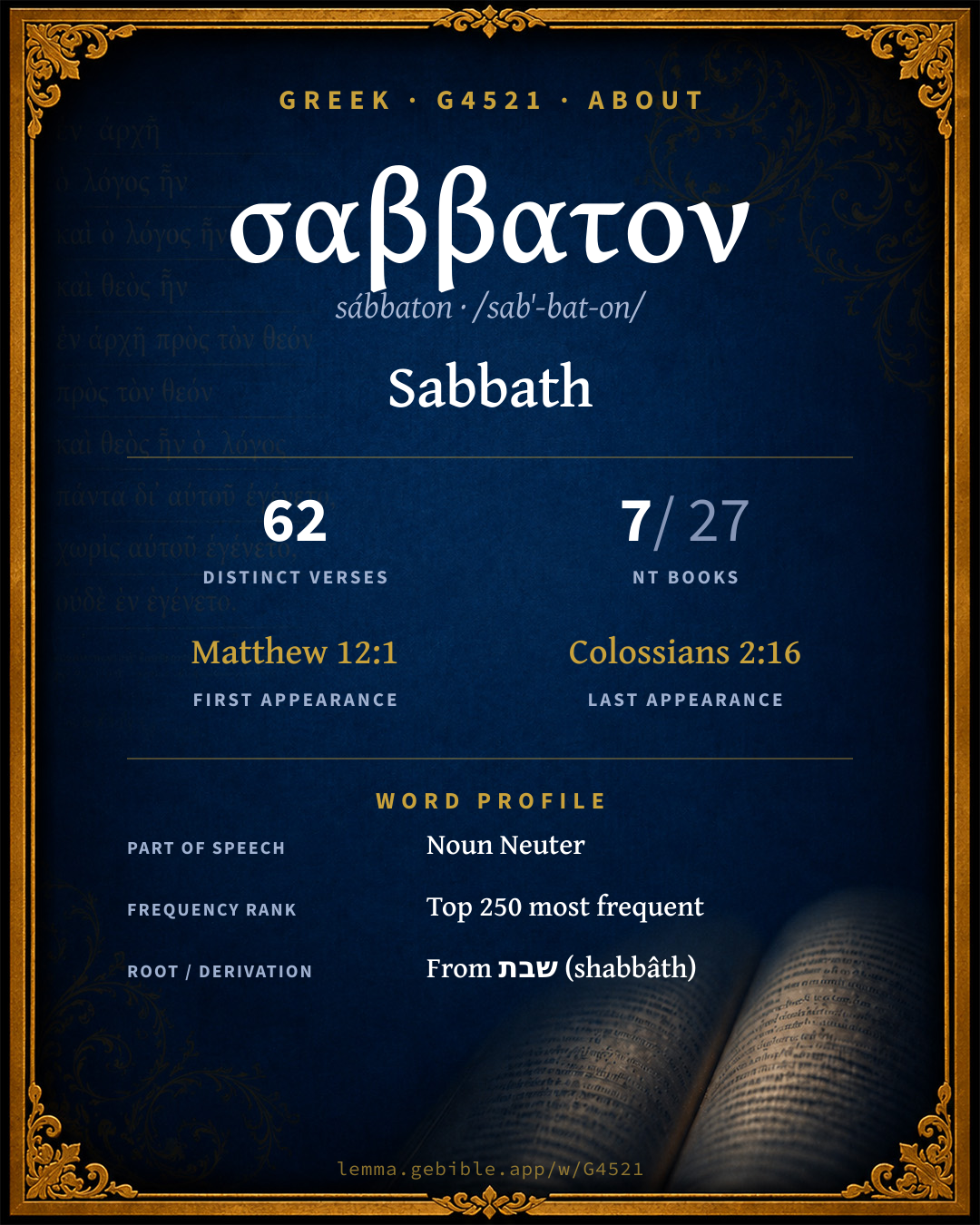
σάββατον
Sabbath
Thayer's lists 2 entries for ‘Sabbath’ fuller range ↓
Full lexicon entry — Thayer's Greek Lexicon
From Thayer's Greek Lexicon
Where this word appears
See every Dative-case word in the Greek New Testament →
Grammar key — what these labels mean
Part of speech
- Noun
- A naming word — a person, place, thing, or idea.
Case
- Dative
- The case of the indirect object, means, or location — “to / for / with / in.”
- Genitive
- The case of source, possession, or “of” — answers “whose / from what.”
- Accusative
- The case of the direct object and of extent.
- Nominative
- The case of the subject (and the predicate nominative).
Gender
- Neuter
- Grammatically neuter.
Number
- Singular
- One.
- Plural
- More than one.
Grammatical forms
- Noun, Dative, Singular, Neuter 16 times (24%)
- Noun, Dative, Plural, Neuter 13 times (19%)
- Noun, Genitive, Singular, Neuter 13 times (19%)
- Noun, Genitive, Plural, Neuter 11 times (16%)
- Noun, Accusative, Singular, Neuter 9 times (13%)
- Noun, Nominative, Singular, Neuter 5 times (7%)
- Noun, Accusative, Plural, Neuter 1 time (1%)
Parsed forms decoded from the imported morphology (Robinson–Tischendorf, public domain), counted across 68 parsed occurrences — not distinct verses.
Every verse where G4521 appears — 62 distinct verses across 7 books. Click any verse to open its interlinear word-by-word view. Verse text shown in the World English Bible for context — . Each verse’s Greek form is shown with its reference; the English is not keyword-highlighted, since the data carries no word-level English alignment. Use “Compare translations” on any verse to read it across multiple English versions. This concordance covers the Greek New Testament; Septuagint (Greek Old Testament) occurrences of this word are not indexed here.
Matthew 9 verses
- Matthew 12:1 σάββασιν n dat pl neut At that time, Jesus went on the Sabbath day through the grain fields. His disciples were hungry and began to pluck heads of grain and to eat.
- Matthew 12:2 σαββάτῳ n dat sg neut But the Pharisees, when they saw it, said to him, "Behold, your disciples do what is not lawful to do on the Sabbath."
- Matthew 12:5 σάββασιν σάββατον n dat pl neut n acc sg neut Or have you not read in the law, that on the Sabbath day, the priests in the temple profane the Sabbath, and are guiltless?
- Matthew 12:8 σαββάτου n gen sg neut For the Son of Man is Lord of the Sabbath."
- Matthew 12:10 σάββασιν n dat pl neut And behold there was a man with a withered hand. They asked him, "Is it lawful to heal on the Sabbath day?" that they might accuse him.
- Matthew 12:11 σάββασιν n dat pl neut He said to them, "What man is there among you, who has one sheep, and if this one falls into a pit on the Sabbath day, won't he grab on to it, and lift it out?
- Matthew 12:12 σάββασιν n dat pl neut Of how much more value then is a man than a sheep! Therefore it is lawful to do good on the Sabbath day."
- Matthew 24:20 σαββάτῳ n dat sg neut Pray that your flight will not be in the winter, nor on a Sabbath,
- Matthew 28:1 σαββάτων σαββάτων n gen pl neut n gen pl neut Now after the Sabbath, as it began to dawn on the first day of the week, Mary Magdalene and the other Mary came to see the tomb.
Mark 11 verses
- Mark 1:21 σάββασιν n dat pl neut They went into Capernaum, and immediately on the Sabbath day he entered into the synagogue and taught.
- Mark 2:23 σάββασιν n dat pl neut It happened that he was going on the Sabbath day through the grain fields, and his disciples began, as they went, to pluck the ears of grain.
- Mark 2:24 σάββασιν n dat pl neut The Pharisees said to him, "Behold, why do they do that which is not lawful on the Sabbath day?"
- Mark 2:27 σάββατον σάββατον n nom sg neut n acc sg neut He said to them, "The Sabbath was made for man, not man for the Sabbath.
- Mark 2:28 σαββάτου n gen sg neut Therefore the Son of Man is lord even of the Sabbath."
- Mark 3:2 σάββασιν n dat pl neut They watched him, whether he would heal him on the Sabbath day, that they might accuse him.
- Mark 3:4 σάββασιν n dat pl neut He said to them, "Is it lawful on the Sabbath day to do good, or to do harm? To save a life, or to kill?" But they were silent.
- Mark 6:2 σαββάτου n gen sg neut When the Sabbath had come, he began to teach in the synagogue, and many hearing him were astonished, saying, "Where did this man get these things?" and, "What is the wisdom that is given to this man, that such mighty works come about by his hands?
- Mark 16:1 σαββάτου n gen sg neut When the Sabbath was past, Mary Magdalene, and Mary the mother of James, and Salome, bought spices, that they might come and anoint him.
- Mark 16:2 σαββάτων n gen pl neut Very early on the first day of the week, they came to the tomb when the sun had risen.
- Mark 16:9 σαββάτου n gen sg neut Now when he had risen early on the first day of the week, he appeared first to Mary Magdalene, from whom he had cast out seven demons.
Luke 19 verses
- Luke 4:16 σαββάτων n gen pl neut He came to Nazareth, where he had been brought up. He entered, as was his custom, into the synagogue on the Sabbath day, and stood up to read.
- Luke 4:31 σάββασιν n dat pl neut He came down to Capernaum, a city of Galilee. He was teaching them on the Sabbath day,
- Luke 6:1 σαββάτῳ n dat sg neut Now it happened on the second Sabbath after the first, that he was going through the grain fields. His disciples plucked the heads of grain, and ate, rubbing them in their hands.
- Luke 6:2 σάββασιν n dat pl neut But some of the Pharisees said to them, "Why do you do that which is not lawful to do on the Sabbath day?"
- Luke 6:5 σαββάτου n gen sg neut He said to them, "The Son of Man is lord of the Sabbath."
- Luke 6:6 σαββάτῳ n dat sg neut It also happened on another Sabbath that he entered into the synagogue and taught. There was a man there, and his right hand was withered.
- Luke 6:7 σαββάτῳ n dat sg neut The scribes and the Pharisees watched him, to see whether he would heal on the Sabbath, that they might find an accusation against him.
- Luke 6:9 σαββάτῳ n dat sg neut Then Jesus said to them, "I will ask you something: Is it lawful on the Sabbath to do good, or to do harm? To save a life, or to kill?"
- Luke 13:10 σάββασιν n dat pl neut He was teaching in one of the synagogues on the Sabbath day.
- Luke 13:14 σαββάτῳ σαββάτου n dat sg neut n gen sg neut The ruler of the synagogue, being indignant because Jesus had healed on the Sabbath, said to the multitude, "There are six days in which men ought to work. Therefore come on those days and be healed, and not on the Sabbath day!"
- Luke 13:15 σαββάτῳ n dat sg neut Therefore the Lord answered him, "You hypocrites! Doesn't each one of you free his ox or his donkey from the stall on the Sabbath, and lead him away to water?
- Luke 13:16 σαββάτου n gen sg neut Ought not this woman, being a daughter of Abraham, whom Satan had bound eighteen long years, be freed from this bondage on the Sabbath day?"
- Luke 14:1 σαββάτῳ n dat sg neut It happened, when he went into the house of one of the rulers of the Pharisees on a Sabbath to eat bread, that they were watching him.
- Luke 14:3 σαββάτῳ n dat sg neut Jesus, answering, spoke to the lawyers and Pharisees, saying, "Is it lawful to heal on the Sabbath?"
- Luke 14:5 σαββάτου n gen sg neut He answered them, "Which of you, if your son or an ox fell into a well, wouldn't immediately pull him out on a Sabbath day?"
- Luke 18:12 σαββάτου n gen sg neut I fast twice a week. I give tithes of all that I get.'
- Luke 23:54 σάββατον n nom sg neut It was the day of the Preparation, and the Sabbath was drawing near.
- Luke 23:56 σάββατον n acc sg neut They returned, and prepared spices and ointments. On the Sabbath they rested according to the commandment.
- Luke 24:1 σαββάτων n gen pl neut But on the first day of the week, at early dawn, they and some others came to the tomb, bringing the spices which they had prepared.
John 11 verses
- John 5:9 σάββατον n nom sg neut Immediately, the man was made well, and took up his mat and walked. Now it was the Sabbath on that day.
- John 5:10 σάββατόν n nom sg neut So the Jews said to him who was cured, "It is the Sabbath. It is not lawful for you to carry the mat."
- John 5:16 σαββάτῳ n dat sg neut For this cause the Jews persecuted Jesus, and sought to kill him, because he did these things on the Sabbath.
- John 5:18 σάββατον n acc sg neut For this cause therefore the Jews sought all the more to kill him, because he not only broke the Sabbath, but also called God his own Father, making himself equal with God.
- John 7:22 σαββάτῳ n dat sg neut Moses has given you circumcision (not that it is of Moses, but of the fathers), and on the Sabbath you circumcise a boy.
- John 7:23 σαββάτῳ σαββάτῳ n dat sg neut n dat sg neut If a boy receives circumcision on the Sabbath, that the law of Moses may not be broken, are you angry with me, because I made a man every bit whole on the Sabbath?
- John 9:14 σάββατον n nom sg neut It was a Sabbath when Jesus made the mud and opened his eyes.
- John 9:16 σάββατον n acc sg neut Some therefore of the Pharisees said, "This man is not from God, because he doesn't keep the Sabbath." Others said, "How can a man who is a sinner do such signs?" There was division among them.
- John 19:31 σαββάτῳ σαββάτου n dat sg neut n gen sg neut Therefore the Jews, because it was the Preparation Day, so that the bodies wouldn't remain on the cross on the Sabbath (for that Sabbath was a special one), asked of Pilate that their legs might be broken, and that they might be taken away.
- John 20:1 σαββάτων n gen pl neut Now on the first day of the week, Mary Magdalene went early, while it was still dark, to the tomb, and saw the stone taken away from the tomb.
- John 20:19 σαββάτων n gen pl neut When therefore it was evening, on that day, the first day of the week, and when the doors were locked where the disciples were assembled, for fear of the Jews, Jesus came and stood in the midst, and said to them, "Peace be to you."
Acts 10 verses
- Acts 1:12 σαββάτου n gen sg neut Then they returned to Jerusalem from the mountain called Olivet, which is near Jerusalem, a Sabbath day's journey away.
- Acts 13:14 σαββάτων n gen pl neut But they, passing on from Perga, came to Antioch of Pisidia. They went into the synagogue on the Sabbath day, and sat down.
- Acts 13:27 σάββατον n acc sg neut For those who dwell in Jerusalem, and their rulers, because they didn't know him, nor the voices of the prophets which are read every Sabbath, fulfilled them by condemning him.
- Acts 13:42 σάββατον n acc sg neut So when the Jews went out of the synagogue, the Gentiles begged that these words might be preached to them the next Sabbath.
- Acts 13:44 σαββάτῳ n dat sg neut The next Sabbath almost the whole city was gathered together to hear the word of God.
- Acts 15:21 σάββατον n acc sg neut For Moses from generations of old has in every city those who preach him, being read in the synagogues every Sabbath."
- Acts 16:13 σαββάτων n gen pl neut On the Sabbath day we went forth outside of the city by a riverside, where we supposed there was a place of prayer, and we sat down, and spoke to the women who had come together.
- Acts 17:2 σάββατα n acc pl neut Paul, as was his custom, went in to them, and for three Sabbath days reasoned with them from the Scriptures,
- Acts 18:4 σάββατον n acc sg neut He reasoned in the synagogue every Sabbath, and persuaded Jews and Greeks.
- Acts 20:7 σαββάτων n gen pl neut On the first day of the week, when the disciples were gathered together to break bread, Paul talked with them, intending to depart on the next day, and continued his speech until midnight.
1 Corinthians 1 verse
Colossians 1 verse
About this entry
At a glance — auto-summarized from this page’s data, not written by a person. Every figure links to its source below. This summary describes the numbers; it doesn’t interpret them.
The Greek name σαββατον centers on the idea of “Sabbath.” Its earliest occurrence is Matthew 12:1. Spanning 62 verses in 7 books, it ranks among the moderately common words of the Greek New Testament. Luke dominates its distribution — 19 of 62 verses. Dig into 62-verse concordance and the renderings breakdown below.
Gloss history
Strong's 1890 vs modern scholarship
About this word
Strong's G4521 catalogs a Greek word from the Greek New Testament.
These counts are not copied from any lexicon or concordance. They are computed here, from the morphology-tagged Greek New Testament. What Lemma adds →
- 62
- distinct verses
- The word appears in 62 distinct verses.
- 7 / 27
- NT books
- The word appears in 7 of 27 New Testament books.
- #243
- by frequency
- Top 250 most frequent Greek words (rank 243 of 5,347 Greek words by occurrence).
View all 62 occurrences in the concordance →
By section of the New Testament
By traditional corpus
Conventional, traditional groupings — biblical authorship is debated, so this is a traditional corpus grouping, not an authorship claim. Some books belong to more than one corpus (Luke is in both the Gospels and the Lukan corpus, and so on), so these shares overlap and need not total 100%. Each figure is a share of the word’s 62 distinct verses.
- Gospels 50 verses · 81%
- Lukan (Luke–Acts) 29 verses · 47%
- Johannine 11 verses · 18%
- Pauline corpus 2 verses · 3%
How translations render this word
Counts come from each version’s own published word-to-Strong’s tagging or interlinear alignment — an approximate guide to how each version renders this word, not a word-level alignment the data otherwise carries. Because each total is that version’s own tagged count, the per-version totals vary from one another and need not match the appearance or distinct-verse counts above. These counts may also differ from a printed concordance because Lemma counts each distinctly tagged rendering and does not collapse phrase taggings into a single head-word total. This is a fixed set of word-tagged versions (KJV, ASV, BSB, ULT) and does not change with the reading translation you choose elsewhere. Each version’s license is shown beside its name below (and on Sources).
- King James Version: Sabbath 27×, Sabbath day 25×, Day of the week 8×
- American Standard Version: Sabbath 40×, Sabbath day 15×, Day of the week 7×
- Berean Standard Bible: Sabbath 56×, Week 9×
- unfoldingWord Literal Text: Sabbath 44×, Sabbaths 15×, Week 9×
King James Version Public Domain
Renders G4521 across 68 tagged occurrences — most commonly:
Plus 1 rendering that appears only once — usually multi-word phrases or single function words the recovered tagging swept in, not distinct renderings.
American Standard Version Public Domain
Renders G4521 across 66 tagged occurrences — most commonly:
Plus 2 renderings that appear only once — usually multi-word phrases or single function words the recovered tagging swept in, not distinct renderings.
Berean Standard Bible Public Domain
Renders G4521 across 68 tagged occurrences — most commonly:
Plus 3 renderings that appear only once — usually multi-word phrases or single function words the recovered tagging swept in, not distinct renderings.
unfoldingWord Literal Text CC BY-SA 4.0
Renders G4521 across 70 tagged occurrences — most commonly:
Plus 2 renderings that appear only once — usually multi-word phrases or single function words the recovered tagging swept in, not distinct renderings.
Senses in Thayer's
The 2 senses Thayer's distinguishes for this word, in lexicon order (not ranked by frequency or importance). The full entry — with sub-senses — is in the Lexicon Entry tab.
- the seventh day of each week which was a sacred festival on which the Israelites were required to abstain from all work
- seven days, a week
Word origin
Derived from שבת (shabbâth) (H7676) — Sabbath.
Of hebrew origin [ H7676 ]; the Sabbath (that is Shabbath ) or day of weekly repose from secular avocations (also the observance or institution itself); by extension a se'nnight that is the interval between two Sabbaths; likewise the plural in all the above applications : - sabbath (day) week.
— Strong’s Exhaustive Concordance (1890), public domain.
Forms in the corpus
The 7 distinct written forms G4521 takes in the Greek New Testament, most frequent first — each parse links to that case’s occurrences in the concordance.
| Form | Parsing | Example | Uses |
|---|---|---|---|
| σαββάτῳ sabbátō | Noun, Dative, Singular, Neuter | Matthew 12:2 | 16 |
| σάββατον sábbaton | Noun, Accusative, Singular, Neuter | Matthew 12:5 | 13 |
| σάββασιν sábbasin | Noun, Dative, Plural, Neuter | Matthew 12:1 | 13 |
| σαββάτου sabbátou | Noun, Genitive, Singular, Neuter | Matthew 12:8 | 13 |
| σαββάτων sabbátōn | Noun, Genitive, Plural, Neuter | Matthew 28:1 | 11 |
| σάββατα sábbata | Noun, Accusative, Plural, Neuter | Acts 17:2 | 1 |
| σάββατόν sábbatón | Noun, Nominative, Singular, Neuter | John 5:10 | 1 |
Same root — word family
Other Thayer's entries built from the same root as G4521, grouped by Strong’s listed origin. These share a root / origin per the lexicon — not necessarily a shared meaning. Each links to that word’s own entry.
Derives from
Derived from this word
Proper names from this root
People and places named from this root — a name, not an additional meaning of the word.
Compare all same-root words → Showing 4 of 5 — not the complete family. 3 of the same-root words are proper names (people or places). They share a root, not necessarily a meaning.
Bible dictionary
Public-domain dictionary articles matched to this entry by name (Sabbath). A biblical name can be shared by more than one person or place, so an article may treat several.
Easton's Bible Dictionary · M. G. Easton, 1897
(Heb. verb shabbath, meaning "to rest from labour"), the day of rest. It is first mentioned as having been instituted in Paradise, when man was in innocence (Gen. 2:2). "The sabbath was made for man," as a day of rest and refreshment for the body and of blessing to the soul.
It is next referred to in connection with the gift of manna to the children of Israel in the wilderness (Ex. 16:23); and afterwards, when the law was given from Sinai (20:11), the people were solemnly charged to "remember the sabbath day, to keep it holy." Thus it is spoken of as an institution already existing.
In the Mosaic law strict regulations were laid down regarding its observance (Ex. 35:2, 3; Lev. 23:3; 26:34). These were peculiar to that dispensation.
In the subsequent history of the Jews frequent references are made to the sanctity of the Sabbath (Isa. 56:2, 4, 6, 7; 58:13, 14; Jer. 17:20-22; Neh. 13:19). In later times they perverted the Sabbath by their traditions. Our Lord rescued it from their perversions, and recalled to them its true nature and intent (Matt. 12:10-13; Mark 2:27; Luke 13:10-17).
The Sabbath, originally instituted for man at his creation, is of permanent and universal obligation. The physical necessities of man require a Sabbath of rest. He is so constituted that his bodily welfare needs at least one day in seven for rest from ordinary labour. Experience also proves that the moral and spiritual necessities of men also demand a Sabbath of rest. "I am more and more sure by experience that the reason for the observance of the Sabbath lies deep in the everlasting necessities of human nature, and that as long as man is man the blessedness of keeping it, not as a day of rest only, but as a day of spiritual rest, will never be annulled. I certainly do feel by experience the eternal obligation, because of the eternal necessity, of the Sabbath. The soul withers without it. It thrives in proportion to its observance. The Sabbath was made for man. God made it for men in a certain spiritual state because they needed it. The need, therefore, is deeply hidden in human nature. He who can dispense with it must be holy and spiritual indeed. And he who, still unholy and unspiritual, would yet dispense with it is a man that would fain be wiser than his Maker" (F. W. Robertson).
The ancient Babylonian calendar, as seen from recently recovered inscriptions on the bricks among the ruins of the royal palace, was based on the division of time into weeks of seven days. The Sabbath is in these inscriptions designated Sabattu, and defined as "a day of rest for the heart" and "a day of completion of labour."
The change of the day. Originally at creation the seventh day of the week was set apart and consecrated as the Sabbath. The first day of the week is now observed as the Sabbath. Has God authorized this change? There is an obvious distinction between the Sabbath as an institution and the particular day set apart for its observance. The question, therefore, as to the change of the day in no way affects the perpetual obligation of the Sabbath as an institution. Change of the day or no change, the Sabbath remains as a sacred institution the same. It cannot be abrogated.
If any change of the day has been made, it must have been by Christ or by his authority. Christ has a right to make such a change (Mark 2:23-28). As Creator, Christ was the original Lord of the Sabbath (John 1:3; Heb. 1:10). It was originally a memorial of creation. A work vastly greater than that of creation has now been accomplished by him, the work of redemption. We would naturally expect just such a change as would make the Sabbath a memorial of that greater work.
True, we can give no text authorizing the change in so many words. We have no express law declaring the change. But there are evidences of another kind. We know for a fact that the first day of the week has been observed from apostolic times, and the necessary conclusion is, that it was observed by the apostles and their immediate disciples. This, we may be sure, they never would have done without the permission or the authority of their Lord.
After his resurrection, which took place on the first day of the week (Matt. 28:1; Mark 16:2; Luke 24:1; John 20:1), we never find Christ meeting with his disciples on the seventh day. But he specially honoured the first day by manifesting himself to them on four separate occasions (Matt. 28:9; Luke 24:34, 18-33; John 20:19-23). Again, on the next first day of the week, Jesus appeared to his disciples (John 20:26).
Some have calculated that Christ's ascension took place on the first day of the week. And there can be no doubt that the descent of the Holy Ghost at Pentecost was on that day (Acts 2:1). Thus Christ appears as instituting a new day to be observed by his people as the Sabbath, a day to be henceforth known amongst them as the "Lord's day." The observance of this "Lord's day" as the Sabbath was the general custom of the primitive churches, and must have had apostolic sanction (comp. Acts 20:3-7; 1 Cor. 16:1, 2) and authority, and so the sanction and authority of Jesus Christ.
The words "at her sabbaths" (Lam. 1:7, A.V.) ought probably to be, as in the Revised Version, "at her desolations."
Smith's Bible Dictionary · William Smith, 1863
(shabbath), "a day of rest," from shabath "to cease to do to," "to rest"). The name is applied to divers great festivals, but principally and usually to the seventh day of the week, the strict observance of which is enforced not merely in the general Mosaic code, but in the Decalogue itself. The consecration of the Sabbath was coeval with the creation. The first scriptural notice of it, though it is not mentioned by name, is to be found in (Genesis 2:3) at the close of the record of the six-days creation. There are not wanting indirect evidences of its observance, as the intervals between Noah's sending forth the birds out of the ark, an act naturally associated with the weekly service, (Genesis 8:7-12) and in the week of a wedding celebration, (Genesis 29:27,28) but when a special occasion arises, in connection with the prohibition against gathering manna on the Sabbath, the institution is mentioned as one already known. (Exodus 16:22-30) And that this (All this is confirmed by the great antiquity of the division of time into weeks, and the naming the days after the sun, moon and planets.) was especially one of the institutions adopted by Moses from the ancient patriarchal usage is implied in the very words of the law "Remember the Sabbath day, to keep it holy." But even if such evidence were wanting, the reason of the institution would be a sufficient proof. It was to be a joyful celebration of God's completion of his creation. It has indeed been said that Moses gives quite a different reason for the institution of the Sabbath, as a memorial of the deliverance front Egyptian bondage. (5:15) The words added in Deuteronomy are a special motive for the joy with which the Sabbath should be celebrated and for the kindness which extended its blessings to the slave and the beast of burden as well as to the master: "that thy man servant and thy maidservant may rest as well as thought. (5:14) These attempts to limit the ordinance proceed from an entire misconception of its spirit, as if it were a season of stern privation rather than of special privilege. But in truth, the prohibition of work is only subsidiary to the positive idea of joyful rest and recreation in communion with Jehovah, who himself "rested and was refreshed." (Exodus 31:17) comp. (Exodus 23:12) It is in (Exodus 16:23-29) that we find the first incontrovertible institution of the day, as one given to and to be kept by the children of Israel. Shortly afterward it was re-enacted in the Fourth Commandment. This beneficent character of the Fourth Commandment is very apparent in the version of it which we find in Deuteronomy. (5:12-15) The law and the Sabbath are placed upon the same ground, and to give rights to classes that would otherwise have been without such--to the bondman and bondmaid may, to the beast of the field-is viewed here as their main end. "The stranger," too is comprehended in the benefit. But the original proclamation of it in Exodus places it on a ground which, closely connected no doubt with these others is yet higher and more comprehensive. The divine method of working and rest is there propose to work and to rest. Time then to man as the model after which presented a perfect whole it is most important to remember that the Fourth Commandment is not limited to a mere enactment respecting one day, but prescribes the due distribution of a week, and enforces the six days' work as much as the seventh day's rest. This higher ground of observance was felt to invest the Sabbath with a theological character, and rendered if the great witness for faith in a personal and creating God. It was to be a sacred pause in the ordinary labor which man earns his bread the curse the fall was to be suspended for one and, having spent that day in joyful remembrance of God's mercies, man had a fresh start in his course of labor. A great snare, too, has always been hidden in the word work, as if the commandment forbade occupation and imposed idleness. The terms in the commandment show plainly enough the sort of work which is contemplated-servile work and business. The Pentateuch presents us with but three applications of the general principle-- (Exodus 16:29; 35:3; Numbers 15:32-36) The reference of Isaiah to the Sabbath gives us no details. The references in Jeremiah and Nehemiah show that carrying goods for sale, and buying such, were equally profanations of the day. A consideration of the spirit of the law and of Christ's comments on it will show that it is work for worldly gain that was to be suspended; and hence the restrictive clause is prefaced with the restrictive command. "Six days shalt thou labor, and do all thy work;" for so only could the sabbatic rest be fairly earned. Hence, too, the stress constantly laid on permitting the servant and beast of burden to share the rest which selfishness would grudge to them. Thus the spirit of the Sabbath was joy, refreshment and mercy, arising from remembrance of God's goodness as Creator and as the Deliverer from bondage. The Sabbath was a perpetual sign and covenant, and the holiness of the day is collected with the holiness of the people; "that ye may know that I am Jehovah that doth sanctify you." (Exodus 31:12-17; Ezekiel 20:12) Joy was the key-note Of their service. Nehemiah commanded the people, on a day holy to Jehovah "Mourn not, nor weep: eat the fat, and drink: the sweet, and send portions to them for whom nothing is prepared." (Nehemiah 8:9-13) The Sabbath is named as a day of special worship in the sanctuary. (Leviticus 19:30; 26:2) It was proclaimed as a holy convocation. (Leviticus 23:3) In later times the worship of the sanctuary was enlivened by sacred music. (Psalms 68:25-27; 150:1)... etc. On this day the people were accustomed to consult their prophets, (2 Kings 4:23) and to give to their children that instruction in the truths recalled to memory by the day which is so repeatedly enjoined as the duty of parents; it was "the Sabbath of Jehovah" not only in the sanctuary, but "in all their dwellings." (Leviticus 23:3) When we come to the New Testament we find the most marked stress laid on the Sabbath. In whatever ways the Jew might err respecting it, he had altogether ceased to neglect it. On the contrary wherever he went its observance became the most visible badge of his nationality. Our Lord's mode of observing the Sabbath was one of the main features of his life, which his Pharisaic adversaries meet eagerly watched and criticized. They had invented many prohibitions respecting the Sabbath of which we find nothing in the original institution. Some of these prohibitions were fantastic and arbitrary, in the number of those "heavy burdens and grievous to be borne" while the latter expounders of the law "laid on men's shoulders." Comp. (Matthew 12:1-13; John 5:10) That this perversion of the Sabbath had become very general in our Saviour's time is apparent both from the recorded objections to acts of his on that day and from his marked conduct on occasions to which those objections were sure to be urged. (Matthew 12:1-16; Mark 3:2; Luke 6:1-5; 13:10-17; John 6:2-18; 7:23; 9:1-34) Christ's words do not remit the duty of keeping the Sabbath, but only deliver it from the false methods of keeping which prevented it from bestowing upon men the spiritual blessings it was ordained to confer.
Classic public-domain reference works; full attribution on Sources.
Septuagint usage
The same Greek word σαββατον appears 109 times in the Greek Old Testament (Septuagint), across 90 verses in 15 books.
- 109
- LXX occurrences
- Tagged occurrences of this Greek word in the Septuagint.
- 90
- verses
- Distinct Septuagint verses containing this word.
- 15 / 39
- OT books
- The word appears in 15 of the 39 Old Testament books.
Sample Septuagint occurrences
- Exodus 16:23 σάββατον
- Leviticus 16:31 σάββατον
- Numbers 15:32 σάββατον
- Deuteronomy 5:12 σάββατον
- 2 Kings 4:23 σάββατον
- 1 Chronicles 9:32 σάββατον
- 2 Chronicles 2:3 σάββατον
- Ezra 19:14 σάββατον
- Psalms 23:1 σαββάτον
- Isaiah 1:13 σάββατον
- Jeremiah 17:21 σάββατον
- Lamentations 2:6 σάββατον
Septuagint occurrences (same lexeme)
Every verse where the same Strong’s number (G4521) appears in the Greek Septuagint — showing the first 50 of 90. Verse text shown in the World English Bible for context; the Greek form is the matched word — the English is not keyword-highlighted.
- Exodus 16:23 σάββατον He said to them, "This is that which Yahweh has spoken, 'Tomorrow is a solemn rest, a holy Sabbath to Yahweh. Bake that which you want to bake, and boil that which you want to boil; and all that remains over lay up for yourselves to be kept until the morning."
- Exodus 16:25 σάββατον Moses said, "Eat that today, for today is a Sabbath to Yahweh. Today you shall not find it in the field.
- Exodus 16:26 σάββατον Six days you shall gather it, but on the seventh day is the Sabbath. In it there shall be none."
- Exodus 16:29 σάββατον Behold, because Yahweh has given you the Sabbath, therefore he gives you on the sixth day the bread of two days. Everyone stay in his place. Let no one go out of his place on the seventh day."
- Exodus 20:8 σάββατον "Remember the Sabbath day, to keep it holy.
- Exodus 20:10 σάββατον but the seventh day is a Sabbath to Yahweh your God. You shall not do any work in it, you, nor your son, nor your daughter, your man-servant, nor your maid-servant, nor your cattle, nor your stranger who is within your gates;
- Exodus 31:13 σάββατον "Speak also to the children of Israel, saying, 'Most assuredly you shall keep my Sabbaths: for it is a sign between me and you throughout your generations; that you may know that I am Yahweh who sanctifies you.
- Exodus 31:14 σάββατον You shall keep the Sabbath therefore; for it is holy to you. Everyone who profanes it shall surely be put to death; for whoever does any work therein, that soul shall be cut off from among his people.
- Exodus 31:15 σάββατον Six days shall work be done, but on the seventh day is a Sabbath of solemn rest, holy to Yahweh. Whoever does any work on the Sabbath day shall surely be put to death.
- Exodus 31:16 σάββατον Therefore the children of Israel shall keep the Sabbath, to observe the Sabbath throughout their generations, for a perpetual covenant.
- Exodus 35:2 σάββατον 'Six days shall work be done, but on the seventh day there shall be a holy day for you, a Sabbath of solemn rest to Yahweh: whoever does any work in it shall be put to death.
- Exodus 35:3 σάββατον You shall kindle no fire throughout your habitations on the Sabbath day.'"
- Leviticus 16:31 σάββατον It is a Sabbath of solemn rest to you, and you shall afflict your souls; it is a statute forever.
- Leviticus 19:3 σάββατον "'Each one of you shall respect his mother and his father. You shall keep my Sabbaths. I am Yahweh your God.
- Leviticus 19:30 σάββατον "'You shall keep my Sabbaths, and reverence my sanctuary; I am Yahweh.
- Leviticus 23:3 σάββατον "'Six days shall work be done: but on the seventh day is a Sabbath of solemn rest, a holy convocation; you shall do no manner of work. It is a Sabbath to Yahweh in all your dwellings.
- Leviticus 23:15 σάββατον "'You shall count from the next day after the Sabbath, from the day that you brought the sheaf of the wave offering; seven Sabbaths shall be completed:
- Leviticus 23:32 σάββατον It shall be a Sabbath of solemn rest for you, and you shall deny yourselves. In the ninth day of the month at evening, from evening to evening, you shall keep your Sabbath."
- Leviticus 23:38 σάββατον besides the Sabbaths of Yahweh, and besides your gifts, and besides all your vows, and besides all your freewill offerings, which you give to Yahweh.
- Leviticus 24:8 σάββατον Every Sabbath day he shall set it in order before Yahweh continually. It is on the behalf of the children of Israel an everlasting covenant.
- Leviticus 25:2 σάββατον "Speak to the children of Israel, and tell them, 'When you come into the land which I give you, then the land shall keep a Sabbath to Yahweh.
- Leviticus 25:4 σάββατον but in the seventh year there shall be a Sabbath of solemn rest for the land, a Sabbath to Yahweh. You shall not sow your field or prune your vineyard.
- Leviticus 25:6 σάββατον The Sabbath of the land shall be for food for you; for yourself, for your servant, for your maid, for your hired servant, and for your stranger, who lives as a foreigner with you.
- Leviticus 26:2 σάββατον "'You shall keep my Sabbaths, and have reverence for my sanctuary. I am Yahweh.
- Leviticus 26:34 σάββατον Then the land will enjoy its sabbaths as long as it lies desolate and you are in your enemies' land. Even then the land will rest and enjoy its sabbaths.
- Leviticus 26:35 σάββατον As long as it lies desolate it shall have rest, even the rest which it didn't have in your sabbaths, when you lived on it.
- Leviticus 26:43 σάββατον The land also will be left by them, and will enjoy its sabbaths while it lies desolate without them: and they will accept the punishment of their iniquity; because, even because they rejected my ordinances, and their soul abhorred my statutes.
- Numbers 15:32 σάββατον While the children of Israel were in the wilderness, they found a man gathering sticks on the Sabbath day.
- Numbers 15:33 σάββατον Those who found him gathering sticks brought him to Moses and Aaron, and to all the congregation.
- Numbers 28:9 σάββατον On the Sabbath day two he-lambs a year old without blemish, and two tenth parts [of an ephah] of fine flour for a meal-offering, mixed with oil, and the drink-offering of it:
- Numbers 28:10 σάββατον this is the burnt offering of every Sabbath, besides the continual burnt-offering, and the drink-offering of it.
- Deuteronomy 5:12 σάββατον "Observe the Sabbath day, to keep it holy, as Yahweh your God commanded you.
- Deuteronomy 5:14 σάββατον but the seventh day is a Sabbath to Yahweh your God: [in it] you shall not do any work, you, nor your son, nor your daughter, nor your man-servant, nor your maid-servant, nor your ox, nor your donkey, nor any of your cattle, nor your stranger who is within your gates; that your man-servant and your maid-servant may rest as well as you.
- Deuteronomy 5:15 σάββατον You shall remember that you were a servant in the land of Egypt, and Yahweh your God brought you out of there by a mighty hand and by an outstretched arm: therefore Yahweh your God commanded you to keep the Sabbath day.
- 2 Kings 4:23 σάββατον He said, Why will you go to him today? it is neither new moon nor Sabbath. She said, It shall be well.
- 2 Kings 11:5 σάββατον He commanded them, saying, This is the thing that you shall do: a third part of you, who come in on the Sabbath, shall be keepers of the watch of the king's house;
- 2 Kings 11:7 σάββατον The two companies of you, even all who go forth on the Sabbath, shall keep the watch of the house of Yahweh about the king.
- 2 Kings 11:9 σάββατον The captains over hundreds did according to all that Jehoiada the priest commanded; and they took every man his men, those who were to come in on the Sabbath, with those who were to go out on the Sabbath, and came to Jehoiada the priest.
- 1 Chronicles 9:32 σάββατον Some of their brothers, of the sons of the Kohathites, were over the show bread, to prepare it every Sabbath.
- 1 Chronicles 23:31 σάββατον and to offer all burnt offerings to Yahweh, on the Sabbaths, on the new moons, and on the set feasts, in number according to the ordinance concerning them, continually before Yahweh;
- 2 Chronicles 2:3 σάββατον Solomon sent to Huram the king of Tyre, saying, As you dealt with David my father, and sent him cedars to build him a house in which to dwell, [even so deal with me].
- 2 Chronicles 8:13 σάββατον even as the duty of every day required, offering according to the commandment of Moses, on the Sabbaths, and on the new moons, and on the set feasts, three times in the year, [even] in the feast of unleavened bread, and in the feast of weeks, and in the feast of tents.
- 2 Chronicles 23:4 σάββατον This is the thing that you shall do: a third part of you, who come in on the Sabbath, of the priests and of the Levites, shall be porters of the thresholds;
- 2 Chronicles 23:8 σάββατον So the Levites and all Judah did according to all that Jehoiada the priest commanded: and they took every man his men, those who were to come in on the Sabbath; with those who were to go out on the Sabbath; for Jehoiada the priest didn't dismiss the shift.
- 2 Chronicles 31:3 σάββατον [He appointed] also the king's portion of his substance for the burnt-offerings, [to wit], for the morning and evening burnt offerings, and the burnt offerings for the Sabbaths, and for the new moons, and for the set feasts, as it is written in the law of Yahweh.
- 2 Chronicles 36:21 σάββατον to fulfill the word of Yahweh by the mouth of Jeremiah, until the land had enjoyed its Sabbaths: [for] as long as it lay desolate it kept Sabbath, to fulfill seventy years.
- Ezra 19:14 σάββατον
- Ezra 20:32 σάββατον
- Ezra 20:34 σάββατον
- Ezra 23:15 σάββατον
These are occurrences of the same Greek lexeme (G4521) in the Septuagint — not a translation of any one Hebrew word. The store carries no word-level Hebrew↔Greek alignment, so no Hebrew original is asserted here. Counts come from the recovered LXX Strong's tagging — high-frequency vocabulary is well covered, while rare or late forms may be untagged — so they reflect tagged occurrences and may slightly undercount.