2 Kings 11:7

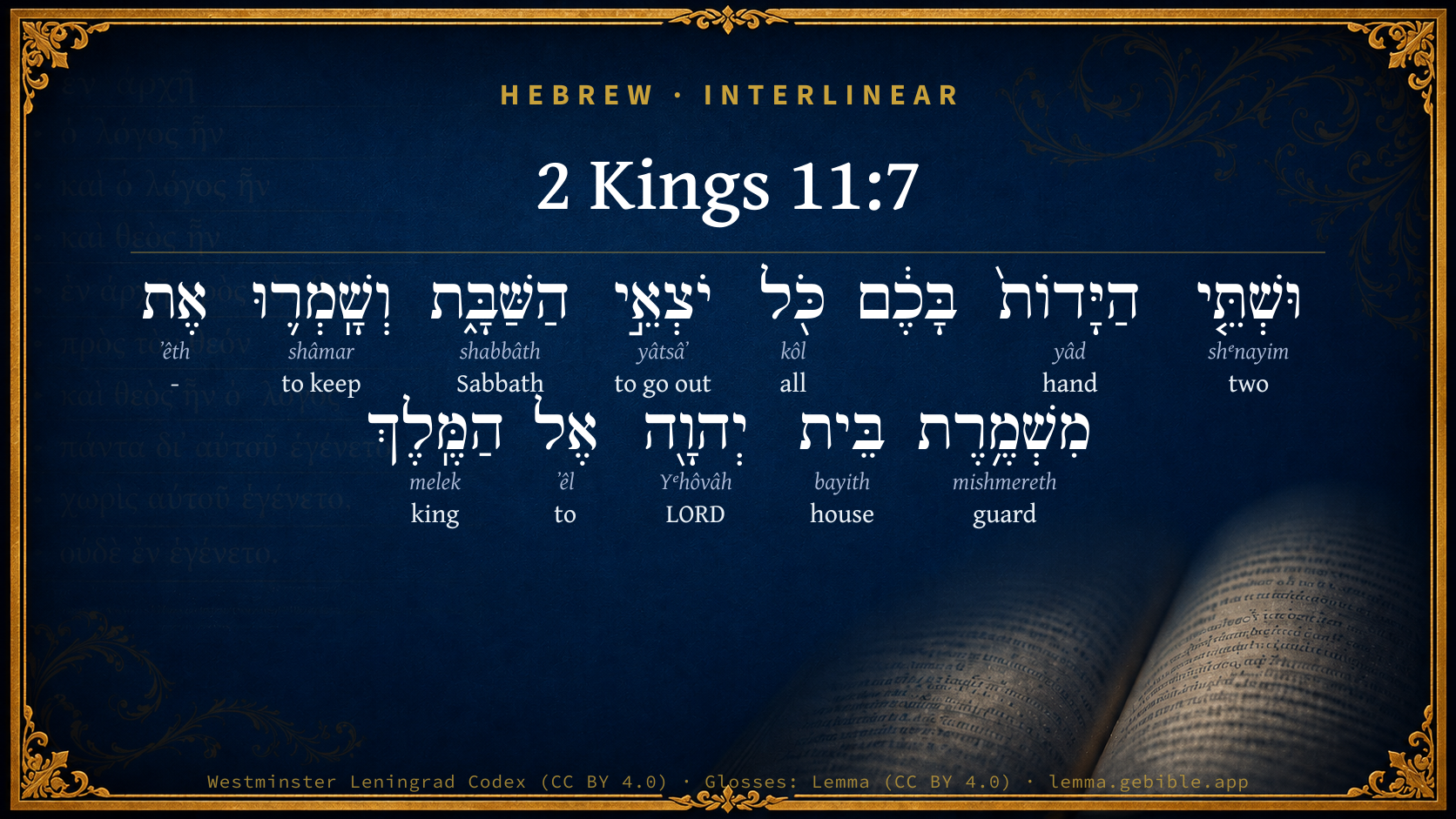
Hebrew (Westminster Leningrad Codex) 2 Kings 11:7 appears in the Hebrew Old Testament. The text above is from the Westminster Leningrad Codex. Each word links to its Strong’s number, a concise gloss, and parsing drawn from the Open Scriptures Hebrew Bible morphology. Click any word for its full Brown-Driver-Briggs (BDB) entry.
Download image
Cite this verse

2 Kings 11:7 (World English Bible). Public Domain. Lemma interlinear Bible study tool, https://lemma.gebible.app/v/2-kings/11/7.

Show BibTeX & RIS
BibTeX
RIS
English Translation
The two companies of you, even all who go forth on the Sabbath, shall keep the watch of the house of Yahweh about the king.
World English Bible · Public Domain
Download a study sheet

One document with this verse’s original text, its word-by-word gloss line, the meaning frame, cross-references with their text, attributed commentary, and full source and license credits — printable, and it pastes into notes with its structure intact.

This verse Autodidact and up

Study sheet (.html) Plain text (.txt)

A passage Seminary Student

Up to 50 verses in one chapter. A passage sheet keeps up to 6 commentary sources and 12 cross-references per verse, in the order this page ranks them, and says so on the sheet whenever that leaves anything out. Ask for a single verse and you get the Autodidact verse sheet above.

Everything on this page stays free to read, with no account — the sheet is a download of what is already on screen, not access to it.

Want to remove ads? Support Godless Engineer
Compare translations 3

The same verse in 3 English versions, stacked beneath the original-language interlinear above. Click any original word for its lexicon entry.

Each is an independent rendering of the whole verse — the interlinear is not word-aligned to these translations.

Highlighted words mark where these versions differ — a whole-verse word diff, not a word-by-word alignment.

  • World English Bible Public Domain
    The two companies of you, even all who go forth on the Sabbath, shall keep the watch of the house of Yahweh about the king.
  • King James Version Public Domain
    And two parts of all you that go forth on the sabbath, even they shall keep the watch of the house of the LORD about the king.
  • unfoldingWord Literal Text CC BY-SA 4.0
    And the two of the hands among you, everyone going out on the Sabbath, even they shall keep the keeping of the house of Yahweh for the king.

unfoldingWord Literal Text — © unfoldingWord, licensed CC BY-SA 4.0. Word-aligned USFM3 via Door43 (git.door43.org/unfoldingWord/en_ult).

Versions to compare (up to 4)

3 of 4 selected

Show all 18 translations

Every available English version of this verse, each an independent rendering of the whole verse.

  • World English Bible Public Domain
    The two companies of you, even all who go forth on the Sabbath, shall keep the watch of the house of Yahweh about the king.
  • Berean Standard Bible Public Domain
    the two divisions that would go off duty on the Sabbath are to guard the house of the LORD for the king.
  • Majority Standard Bible Public Domain
    the two divisions that would go off duty on the Sabbath are to guard the house of the LORD for the king.
  • King James Version Public Domain
    And two parts of all you that go forth on the sabbath, even they shall keep the watch of the house of the LORD about the king.
  • American Standard Version (1901) Public Domain
    And the two companies of you, even all that go forth on the sabbath, shall keep the watch of the house of Jehovah about the king.
  • Revised Version (1885) Public Domain
    And the two companies of you, even all that go forth on the sabbath, shall keep the watch of the house of the LORD about the king.
  • Geneva Bible (1599) Public Domain
    And two parts of you, that is, all that goe out on the Sabbath day, shall keepe the watch of the house of the Lord about the King.
  • Douay-Rheims (1899) Public Domain
    But let two parts of you, all that go forth on the sabbath, keep the watch of the house of the Lord about the king.
  • Young's Literal Translation Public Domain
    and two parts of you, all going out on the sabbath -- they have kept the charge of the house of Jehovah about the king,
  • Literal Standard Version CC BY-SA 4.0
    and two parts of you, all going out on the Sabbath—they have kept the charge of the house of YHWH about the king,
  • Unlocked Literal Bible CC BY-SA 4.0
    The two other groups who are not serving on the Sabbath, you must keep the watch over the house of Yahweh for the king.
  • unfoldingWord Literal Text CC BY-SA 4.0
    And the two of the hands among you, everyone going out on the Sabbath, even they shall keep the keeping of the house of Yahweh for the king.
  • Darby Bible Public Domain
    And the two parts of you, all those that go forth on the sabbath, even they shall keep the watch of the house of Jehovah about the king.
  • World Messianic Bible Public Domain
    The two companies of you, even all who go out on the Sabbath, shall keep the watch of the LORD’s house around the king.
  • Webster's Bible Public Domain
    And two parts of all you that go forth on the sabbath, even they shall keep the watch of the house of the LORD about the king.
  • Free Bible Version CC BY-SA 4.0
    The two divisions that would normally go off duty on the Sabbath will guard the Lord's Temple for the king.
  • Bible in Basic English Public Domain
    And the two divisions of you, who go out on the Sabbath and keep the watch of the house of the Lord,
  • JPS Tanakh (1917) Public Domain
    And the other two parts of you, even all that go forth on the sabbath, shall keep the watch of the house of the LORD about the king.

Literal Standard Version (2020), Covenant Press — licensed CC BY-SA 4.0. Text via the HelloAO Bible API (eBible.org). Unlocked Literal Bible (unfoldingWord) — licensed CC BY-SA 4.0. Text via the HelloAO Bible API (eBible.org). unfoldingWord Literal Text — © unfoldingWord, licensed CC BY-SA 4.0. Word-aligned USFM3 via Door43 (git.door43.org/unfoldingWord/en_ult). Free Bible Version, Dr. Jonathan Gallagher — licensed CC BY-SA 4.0. Text via the HelloAO Bible API (eBible.org).

Word by word

More ways to search: Search by grammar → Find every occurrence → Compare this word →

Practice this passage: Drill this verse → Learn its vocabulary →

מִשְׁמֶ֥רֶת
mishmereth
H4931
“guard of”
Noun, Common, Feminine, Singular, Construct
Part of Speech
Noun
Type
Common
Gender
Feminine
Number
Singular
State
Construct
Full BDB Definition

Origin: from H4929

TWOT: 2414g

guard, charge, function, obligation, service, watch - guard, watch, house of detention or confinement - keeping, preserving - charge, injunction - office, function (ceremonial)
  1. וּשְׁתֵּ֤י shᵉnayim H8147 “and · two” Conjunction + Adjective, Cardinal number, Feminine, Dual, Construct
  2. הַיָּדוֹת֙ yâd H3027 “the · hands” Particle, Definite Article + Noun, Common, Both, Plural, Absolute
  3. כֹּ֖ל kôl H3605 “all of” Noun, Common, Masculine, Singular, Construct
  4. יֹצְאֵ֣י yâtsâʼ H3318 “going out” Verb, Qal, Participle Active, Masculine, Plural, Construct
  5. הַשַּׁבָּ֑ת shabbâth H7676 “the · Sabbath” Particle, Definite Article + Noun, Common, Both, Singular, Absolute
  6. וְשָֽׁמְר֛וּ shâmar H8104 “and · to keep” Conjunction + Verb, Qal, Sequential Perfect, 3rd Person, Common, Plural
  7. אֶת ʼêth H853 “-” Particle, Direct Object
  8. בֵּית bayith H1004 “house of” Noun, Common, Masculine, Singular, Construct
  9. יְהוָ֖ה Yᵉhôvâh H3068 “LORD” Noun, Proper
  10. אֶל ʼêl H413 “to” Preposition
  11. הַמֶּֽלֶךְ melek H4428 “the · king” Particle, Definite Article + Noun, Common, Masculine, Singular, Absolute

About this verse

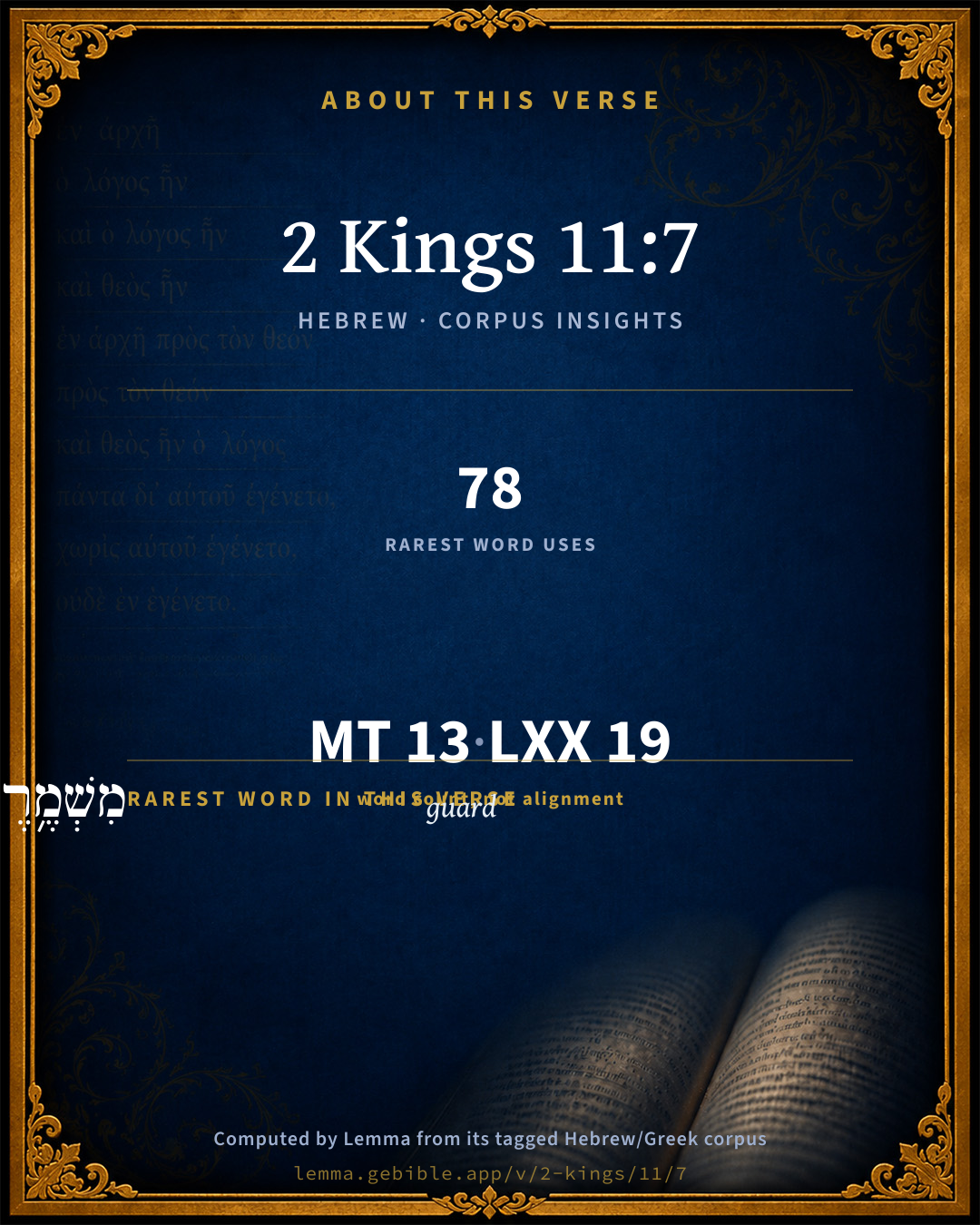
These counts appear in no published source. They are computed here, from the morphology-tagged text and Lemma’s own curated glosses. What Lemma adds →

13
words
12
distinct lemmas
Historical
section

Grammatical profile

  • 2 verbs
  • 7 nouns
  • 1 adjective
  • 2 prepositions
  • 1 particle

Verb forms

  • יֹצְאֵ֣י Qal · Participle Active
  • וְשָֽׁמְר֛וּ Qal · Sequential Perfect

Hebrew & Septuagint length

In English translation the verse runs 25 words from the Hebrew and 30 from the Septuagint (LXX English) — closely comparable.

A rough comparison of the two English renderings, which tokenize alike — not a word-level alignment.

Word counts can differ between the Hebrew and the Greek without any difference in meaning — e.g. the Hebrew direct-object marker אֵת has no separate Greek word, and Greek often adds the article ὁ.

In the original languages it is 13 Hebrew tokens and 19 Greek tokens — but the two are counted differently (Hebrew bundles its prefixes and suffixes into one token; the Greek is in lemma form), so that isn’t a like-for-like length.

Cross-references

2

Topical passages linked to 2 Kings 11:7 in the Treasury of Scripture Knowledge — connected by theme and wording, ordered by reader-vote popularity; previews shown in the World English Bible.

  • 2 Kings 11:5 He commanded them, saying, This is the thing that you shall do: a third part of you, who come in on the Sabbath, shall be keepers of the watch of the king's house;
  • 2 Chronicles 23:6 But let none come into the house of Yahweh, save the priests, and those who minister of the Levites; they shall come in, for they are holy: but all the people shall keep the charge of Yahweh.

Cross-references courtesy of OpenBible.info (CC BY 4.0).

Hebrew and Greek witnesses Masoretic Hebrew ↔ Greek Septuagint

The same verse in the two great witnesses to the Old Testament, shown verse-for-verse.

These are two independent witnesses, not word-aligned to each other, and the Septuagint is shown in lemma (dictionary) form.

Hebrew 2 Kings 11:7 Masoretic · Westminster Leningrad Codex

וּשְׁתֵּ֤י הַיָּדוֹת֙ בָּכֶ֔ם כֹּ֖ל יֹצְאֵ֣י הַשַּׁבָּ֑ת וְשָֽׁמְר֛וּ אֶת מִשְׁמֶ֥רֶת בֵּית יְהוָ֖ה אֶל הַמֶּֽלֶךְ

The two companies of you, even all who go forth on the Sabbath, shall keep the watch of the house of Yahweh about the king.

World English Bible · Public Domain

Greek LXX 2 Kings 11:7 Septuagint · lemma form

καί δύο χείρ ἐν σύ πᾶς ὁ ἐκπορεύομαι ὁ σάββατον καί φυλάσσω ὁ φυλακή οἶκος κύριος πρός ὁ βασιλεύς

And there shall be two parties among you, even every one that goes out on the Sabbath, and they shall keep the guard of the Lord's house before the king.

LXX2012 (modern English Septuagint) · Public Domain

Hebrew: Westminster Leningrad Codex (CC BY 4.0). Greek: Septuagint (public domain); English from LXX2012 (modern English Septuagint) (Public Domain). How the Septuagint differs from the Hebrew →

Targum (Aramaic paraphrase)

1

The Targum is the ancient Jewish Aramaic paraphrase of the Hebrew Scriptures — an interpretive translation, not the Hebrew text itself. Onkelos (literal) and Pseudo-Jonathan (expansive) render the Torah, and Jonathan the Prophets. Coverage is partial: where no permissively-licensed English translation exists for a verse, only the Aramaic is shown. This is verse-level text, not a word-by-word alignment to the Hebrew.

  1. Targum Jonathan Prophets (Joshua–Malachi)
    וּתְרֵין חוּלָקִין בְּכוֹן כָּל נַפְקֵי שַׁבָּא וְתִטְרוּן יַת מַטְרַת בֵּית מַקְדְשָׁא דַייָ עַל מַלְכָּא:

    (no public-domain English translation for this verse)

    Targum Jonathan — Aramaic: “Mikraot Gedolot” (public domain). English: “Sefaria Community Translation” (CC0 1.0 (public-domain dedication)); “London "Chaldee Paraphrase," 1871” (public domain). Text via Sefaria.

Commentary

Notes on 2 Kings 11:7 from classic Christian and Jewish commentators (each source and its license shown beneath its notes). The classic Christian expositions comment on the surrounding passage and are grouped to its opening verse, so a note may address several verses; the Jewish commentaries on the Tanakh (Rashi and others) are per-verse, so they appear only where the commentator wrote on this verse.

Lemma curates 59 commentaries, every one of them public domain or Creative Commons licensed, each selected and text-cleaned for this edition rather than reprinted as found. About our sources →

Trapp's Complete Commentary

John Trapp

2Ki 11:7 And two parts of all you that go forth on the sabbath, even they shall keep the watch of the house of the LORD about the king.

Ver. 7. Shall keep the watch of the house of the Lord.] To keep the place from pollution, and the young king from danger.

John Trapp, A Commentary or Exposition upon All the Books of the Old and New Testament (1647–1656) — public domain. Text from a community e-Sword module.

Joseph Benson's Commentary

2Ki 11:7-8. Two parts that go forth on the sabbath — Who, having finished their course, should have gone home, but were detained, 2Ch 23:8. Shall keep — While the rest guard the entrances into the temple, these shall have a special care of the king’s person. Ye shall compass the king, &c. — When you have set your watches and guards, all the rest of you shall draw near to the king, to preserve his royal person from all assaults and dangers. He that cometh within the ranges — Or fences, the walls wherewith the courts of the temple were environed; or your ranks. If any of Athaliah’s guard shall attempt to break in upon you, or come within your bounds. As he goeth out, and as he cometh in — Whether the king shall go out of the temple to assault and subdue his enemies, or retire hither to defend himself, do you always accompany him.

Joseph Benson's Commentary on the Old and New Testaments (1811–1818) — public domain. Text from a community e-Sword module.

Geneva Bible (1599)

Geneva Bible translators

Whose charge is ended.

Geneva Bible (1599) marginal notes — public domain. Text via Bolls.life.

Ellicott's Commentary for English Readers

(7, 8) The whole body of guards relieved on the Sabbath are to guard the Temple and the young prince.

(7) And two parts of all you . . . sabbath.—Rather, and the two branches among you, all that go out on the Sabbath. The two “branches” means the two fundamental divisions—viz., Carians (or executioners) and Couriers. The troops relieved on the Sabbath were not to be posted in three companies at three different points, like those who came on duty in their place; but they were to form in two ranks—Carians on one side and Couriers on the other—for the purpose of guarding the Temple, and especially the king’s person.

About.—Literally, in the direction of—i.e., with regard to, over. “The house of the Lord” is obviously contrasted with “the king’s house” (2Ki_11:5).

(8) Ye shall compass the king round about.—They were to form two lines, between which the king might walk safely from the Temple to the palace.

The ranges.—Rather, the ranks—scil., the two lines of the guard formed for the protection of the king. If any one attempted to force his way through the ranks in order to attack the king he was to be slain.

Be ye with the king . . . cometh in.—When he leaves the Temple, and when he enters the palace.

A Bible Commentary for English Readers, edited by Charles John Ellicott (1878–1897) — public domain. Text from a community e-Sword module.

The Cambridge Bible for Schools and Colleges

gen. ed. J. J. S. Perowne

7. And two parts of all you that go forth] R.V. And the two companies of you, even all that go forth. All those men who were going off duty at the palace were to divide themselves into two bodies, and go and serve at the temple to protect the king. The ‘of you’ refers to the purely military body, as in verse 5. We see in verse 2 that their duty was outside the temple building, while the narrative in Chronicles in almost identical language appoints the Levites for duty within the temple.

The Cambridge Bible for Schools and Colleges (gen. ed. J. J. S. Perowne; Cambridge University Press, 1878–1918) — public domain. Text from a community e-Sword module.

John Gill's Exposition

And two parts of all you that go forth on the sabbath,.... The course that went out of service at the end of the sabbath; these were not suffered, not any of them, to go into the country, but were detained for the present purpose, and divided into two parts:

even they shall keep the watch of the house of the Lord about the king, these were placed in the temple where the king was, or where he should be brought forth, and be a guard on his right and left; this interpretation seems to be agreeably to the order of the text here, and is the sense of Jarchi; but there is this objection to it, that, by such a distribution of both courses, no provision is made for the services of the temple; wherefore Dr. Lightfoot (c) divides them into six parts, each into three, one third of the course that came in for service, the other to keep the watch at the king's house, and the other third at the gate Sur; and the course that went out, one third of them was placed at the gate behind the guard, and the other two to keep the watch of the house for the king's safety; but according to the account in Ch2 23:4, there were but three ranks or orders of them in all; wherefore the sense of Kimchi, Ben Gersom, and Abarbinel, seems most agreeable, that the first consisted of those that went in on the sabbath, not of all, but half of them, the other half being employed in the service of the sanctuary; and the other two of the course that went out, even all of them, they being entirely at leisure, who were divided into two parts, and disposed of as above.

(c) Prospect of the Temple, c. 20.

John Gill's Exposition of the Whole Bible (1746–1763) — public domain (CC PDM 1.0). Text via the HelloAO Bible API.

Haydock's Catholic Bible Commentary

Of you. Levites, who waited on the king’s person alternately. (Calmet) --- They were divided into three parts, being in actual service, ver. 6. Those who went out of office were twice the number, and are here told what to do. Sa thinks that those who entered upon duty, and those who went out, formed two thirds of the Levites, ver. 9., and 2 Paralipomenon xxiii. 8. (Menochius)

George Leo Haydock (1774–1849), Haydock's Catholic Family Bible and Commentary, 1859 edition — public domain. Excludes Psalms (Douay-Rheims chapter numbering differs from Protestant) and Deuterocanonical books (Catholic canon only).

Matthew Poole's English Annotations

You that go forth on the sabbath, i.e. who having finished their course and week, should have gone home, but were detained, 2Ch 23:8.

They shall keep the watch of the house of the Lord about the king; whilst the rest guard the doors and entrances into the temple, these shall have a special care of the king’s person, part on his right, and part on his left hand.

Matthew Poole's English Annotations on the Holy Bible (1683–1685) — public domain. Text from a community e-Sword/MySword module.

Whedon's Commentary on the Bible

Daniel D. Whedon

7. Two parts of all you that go forth on the sabbath — Those who went forth on the Sabbath were the course of Levites who were relieved on that day from their term of temple service by the coming in of another course. Instead of departing from the temple and returning home, as usual they were to form themselves into two parts or divisions, (literally, hands,) and to be the immediate bodyguard of the youthful king. Their particular duty is more fully given in 2Ki_11:8, and they are identical with the guard mentioned in 2Ki_11:11.

Daniel D. Whedon (gen. ed.), Commentary on the Old and New Testaments (1874–1909) — public domain. Text from a community e-Sword module.

The Pulpit Commentary

And two parts of all you that go forth on the sabbath. Three-fifths of the guard having been disposed of about the palace, there remained only two-fifths, or two "companies" (margin of Authorized Version). These Jehoiada commanded to enter the temple and protect the young king. Even they shall keep the watch of the house of the Lord about the king. According to Chronicles, (2Ch_23:7) the great body of the Levites gathered from the cities of Judah was also to be in the temple, and to assist in the protection of the monarch.

The Pulpit Commentary (1880–1919), ed. H.D.M. Spence-Jones & Joseph S. Exell — public domain. Text from a community e-Sword module.

John Wesley's Explanatory Notes

That go, &c. - Who having finished their course, should have gone home, but were detained, 2 Chron. xxiii, 8. Shall keep - While the rest guard the entrances into the temple; these shall have a special care of the king's person.

John Wesley, Explanatory Notes Upon the Whole Bible (1754–1765) — public domain. Text via the GEBible commentary corpus.

unfoldingWord translationNotes

Door43 World Missions Community

General Information:

Jehoiada continues giving directions to the soldiers who will protect King Joash.

for the king

They were to keep watch for the purpose of protecting the king from harm. AT: "in order to protect King Joash" (See: Assumed Knowledge and Implicit Information)

Whoever enters within your ranks

"Anyone who tries to go past you while you are protecting King Joash." A rank refers to a line of soldiers.

let him be killed

This can be stated in active form. AT: "you must kill him" (See: Active or Passive)

You must stay with the king when he goes out, and when he comes in

These two opposite things are a merism that refers to everything the king does. AT: "You must stay near the king at all times" (See: Merism)

translationWords

servant

unfoldingWord translationNotes — © Distant Shores Media and the Door43 World Missions Community, licensed CC BY-SA 4.0. Source: git.door43.org/Door43/en_tn.

Rashi

Rabbi Shlomo Yitzchaki (Rashi)

The two groups of you. Who I said should be in the Sur Gate and in the Gate of the Runners, and with them all those who leave on Shabbos, [i.e.,] all the men of the departing watch.

Will guard Beis [Hamikdosh] of Adonoy for the king. That no harm befall him from within the Beis [Hamikdosh] of Adonoy. He did not require all this except for the first Shabbos, until Atalyoh was killed and her allies fled from the city.

Rashi on the Tanakh — English translations: “The Judaica Press complete Tanach with Rashi, translated by A. J. Rosenberg” (CC BY 4.0); “Pentateuch with Rashi's commentary by M. Rosenbaum and A.M. Silbermann, 1929-1934” (public domain); “The Metsudah Tanach series, Lakewood, N.J” (CC BY 4.0); and “The Book of Joshua, Metsudah Publications, 1997” (CC BY 4.0). Text via Sefaria.

Lesson kit

Teaching starters — assembled from the data on this page, not authored interpretation. Every prompt links to the verse data it draws on. Edit before teaching.

2 Kings, in the Historical, opens this verse with 13 words (12 distinct Hebrew lemmas). Its most distinctive word is mishmereth (“guard”). A historical commentator’s framing appears above. Read the whole chapter for the surrounding context.

Discussion questions

  1. How does “guard” (mishmereth) shape what this verse is saying?
  2. How does 2 Kings 11:5, which shares this passage’s theme, read alongside this verse?
  3. These translations render this verse differently; the difference is in the English rendering, not the original. What questions does that raise?
  4. «יֹצְאֵ֣י» is a Qal Participle Active verb. How does that grammatical form shape the action described?
  5. Compare how Trapp's Complete Commentary and Joseph Benson's Commentary read this verse. Where do they agree or differ?

Things to notice

Reading settings

Reading text

Shown beneath each verse's original-language words.

Old Testament
Old Testament edition

Read the OT as the Masoretic Hebrew (MT) or the Greek Septuagint (LXX).

English shown for the Greek Septuagint (in the Hebrew ↔ Greek comparison).

Comparing translations? Open the Compare panel on any verse page to stack up to four side by side.