Leviticus 26:35

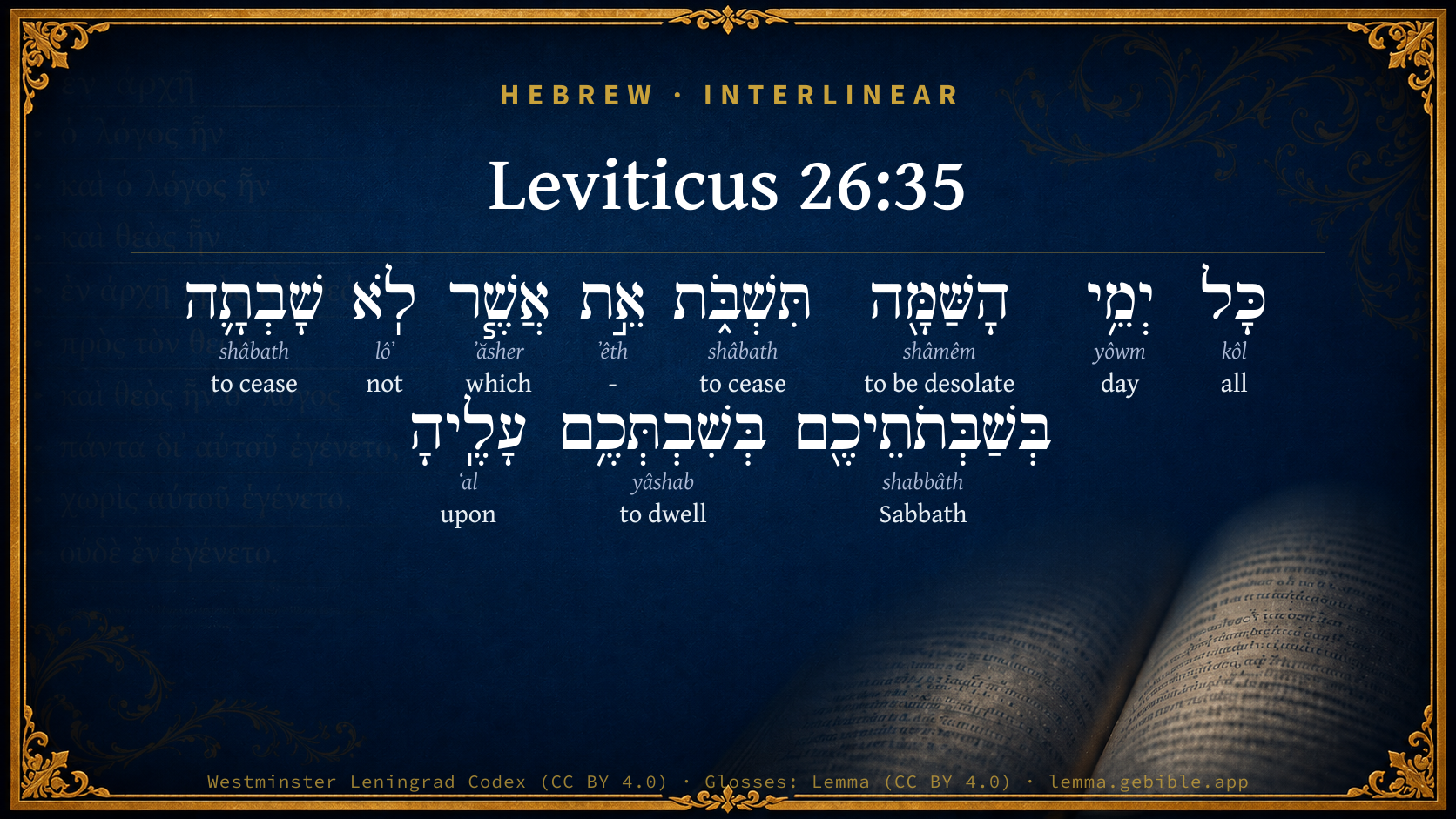
Hebrew (Westminster Leningrad Codex) Leviticus 26:35 appears in the Hebrew Old Testament. The text above is from the Westminster Leningrad Codex. Each word links to its Strong’s number, a concise gloss, and parsing drawn from the Open Scriptures Hebrew Bible morphology. Click any word for its full Brown-Driver-Briggs (BDB) entry.
Download image
Cite this verse

Leviticus 26:35 (World English Bible). Public Domain. Lemma interlinear Bible study tool, https://lemma.gebible.app/v/leviticus/26/35.

Show BibTeX & RIS
BibTeX
RIS
English Translation
As long as it lies desolate it shall have rest, even the rest which it didn't have in your sabbaths, when you lived on it.
World English Bible · Public Domain
Download a study sheet

One document with this verse’s original text, its word-by-word gloss line, the meaning frame, cross-references with their text, attributed commentary, and full source and license credits — printable, and it pastes into notes with its structure intact.

This verse Autodidact and up

Study sheet (.html) Plain text (.txt)

A passage Seminary Student

Up to 50 verses in one chapter. A passage sheet keeps up to 6 commentary sources and 12 cross-references per verse, in the order this page ranks them, and says so on the sheet whenever that leaves anything out. Ask for a single verse and you get the Autodidact verse sheet above.

Everything on this page stays free to read, with no account — the sheet is a download of what is already on screen, not access to it.

Want to remove ads? Support Godless Engineer
Compare translations 3

The same verse in 3 English versions, stacked beneath the original-language interlinear above. Click any original word for its lexicon entry.

Each is an independent rendering of the whole verse — the interlinear is not word-aligned to these translations.

Highlighted words mark where these versions differ — a whole-verse word diff, not a word-by-word alignment.

  • World English Bible Public Domain
    As long as it lies desolate it shall have rest, even the rest which it didn't have in your sabbaths, when you lived on it.
  • King James Version Public Domain
    As long as it lieth desolate it shall rest; because it did not rest in your sabbaths, when ye dwelt upon it.
  • unfoldingWord Literal Text CC BY-SA 4.0
    All the days of its desolation it will rest, what it did not rest in your sabbaths, when you dwelt on it.

unfoldingWord Literal Text — © unfoldingWord, licensed CC BY-SA 4.0. Word-aligned USFM3 via Door43 (git.door43.org/unfoldingWord/en_ult).

Versions to compare (up to 4)

3 of 4 selected

Show all 18 translations

Every available English version of this verse, each an independent rendering of the whole verse.

  • World English Bible Public Domain
    As long as it lies desolate it shall have rest, even the rest which it didn't have in your sabbaths, when you lived on it.
  • Berean Standard Bible Public Domain
    As long as it lies desolate, the land will have the rest it did not receive during the Sabbaths when you lived in it.
  • Majority Standard Bible Public Domain
    As long as it lies desolate, the land will have the rest it did not receive during the Sabbaths when you lived in it.
  • King James Version Public Domain
    As long as it lieth desolate it shall rest; because it did not rest in your sabbaths, when ye dwelt upon it.
  • American Standard Version (1901) Public Domain
    As long as it lieth desolate it shall have rest, even the rest which it had not in your sabbaths, when ye dwelt upon it.
  • Revised Version (1885) Public Domain
    As long as it lieth desolate it shall have rest; even the rest which it had not in your sabbaths, when ye dwelt upon it.
  • Geneva Bible (1599) Public Domain
    All the dayes that it lieth voide, it shall rest, because it did not rest in your Sabbaths, when ye dwelt vpon it.
  • Douay-Rheims (1899) Public Domain
    In the enemy's land, she shall keep a sabbath, and rest in the sabbaths of her desolation, because she did not rest in your sabbaths when you dwelt therein.
  • Young's Literal Translation Public Domain
    all the days of the desolation it resteth that which it hath not rested in your sabbaths in your dwelling on it.
  • Literal Standard Version CC BY-SA 4.0
    it rests all the days of the desolation [for] that which it has not rested in your Sabbaths, in your dwelling on it.
  • Unlocked Literal Bible CC BY-SA 4.0
    As long as it lies abandoned, it will have rest, which will be the rest that it did not have with your Sabbaths, when you lived in it.
  • unfoldingWord Literal Text CC BY-SA 4.0
    All the days of its desolation it will rest, what it did not rest in your sabbaths, when you dwelt on it.
  • Darby Bible Public Domain
    All the days of the desolation it shall rest, [the days in] which it did not rest on your sabbaths, when ye dwelt therein.
  • World Messianic Bible Public Domain
    As long as it lies desolate it shall have rest, even the rest which it didn’t have in your Sabbaths when you lived on it.
  • Webster's Bible Public Domain
    As long as it lieth desolate, it shall rest; because it did not rest in your sabbaths, when ye dwelt upon it.
  • Free Bible Version CC BY-SA 4.0
    The whole time it's abandoned the land will observe the Sabbaths of rest that it wasn't able to do while you were living there.
  • Bible in Basic English Public Domain
    All the days while it is waste will the land have rest, such rest as it never had in your Sabbaths, when you were living in it.
  • JPS Tanakh (1917) Public Domain
    As long as it lieth desolate it shall have rest; even the rest which it had not in your sabbaths, when ye dwelt upon it.

Literal Standard Version (2020), Covenant Press — licensed CC BY-SA 4.0. Text via the HelloAO Bible API (eBible.org). Unlocked Literal Bible (unfoldingWord) — licensed CC BY-SA 4.0. Text via the HelloAO Bible API (eBible.org). unfoldingWord Literal Text — © unfoldingWord, licensed CC BY-SA 4.0. Word-aligned USFM3 via Door43 (git.door43.org/unfoldingWord/en_ult). Free Bible Version, Dr. Jonathan Gallagher — licensed CC BY-SA 4.0. Text via the HelloAO Bible API (eBible.org).

Word by word

More ways to search: Search by grammar → Find every occurrence → Compare this word →

Practice this passage: Drill this verse → Learn its vocabulary →

תִּשְׁבֹּ֑ת
shâbath
H7673
“to cease”
Verb, Qal, Imperfect, 3rd Person, Feminine, Singular
Part of Speech
Verb
Stem
Qal
Form
Imperfect
Person
3rd Person
Gender
Feminine
Number
Singular
Full BDB Definition

Origin: a primitive root

TWOT: 2323 , 2323c

to cease, desist, rest - (Qal) - to cease - to rest, desist (from labour) - (Niphal) to cease - (Hiphil) - to cause to cease, put an end to - to exterminate, destroy - to cause to desist from - to remove - to cause to fail - (Qal) to keep or observe the sabbath
  1. כָּל kôl H3605 “all of” Noun, Common, Masculine, Singular, Construct
  2. יְמֵ֥י yôwm H3117 “days of” Noun, Common, Masculine, Plural, Construct
  3. הָשַּׁמָּ֖ה shâmêm H8074 “to be desolate · her” Verb, Hophal, Infinitive Construct + Suffix, Personal, 3rd Person, Feminine, Singular
  4. אֵ֣ת ʼêth H853 “-” Particle, Direct Object
  5. אֲשֶׁ֧ר ʼăsher H834 “which” Particle, Relative
  6. לֹֽא lôʼ H3808 “not” Particle, Negative
  7. שָׁבְתָ֛ה shâbath H7673 “to cease” Verb, Qal, Perfect, 3rd Person, Feminine, Singular
  8. בְּשַׁבְּתֹתֵיכֶ֖ם shabbâth H7676 “in/at · Sabbaths · your” Preposition + Noun, Common, Both, Plural, Construct + Suffix, Personal, 2nd Person, Masculine, Plural
  9. בְּשִׁבְתְּכֶ֥ם yâshab H3427 “in/at · to dwell · you” Preposition + Verb, Qal, Infinitive Construct + Suffix, Personal, 2nd Person, Masculine, Plural
  10. עָלֶֽיהָ ʻal H5921 “upon · her” Preposition + Suffix, Personal, 3rd Person, Feminine, Singular

About this verse

These counts appear in no published source. They are computed here, from the morphology-tagged text and Lemma’s own curated glosses. What Lemma adds →

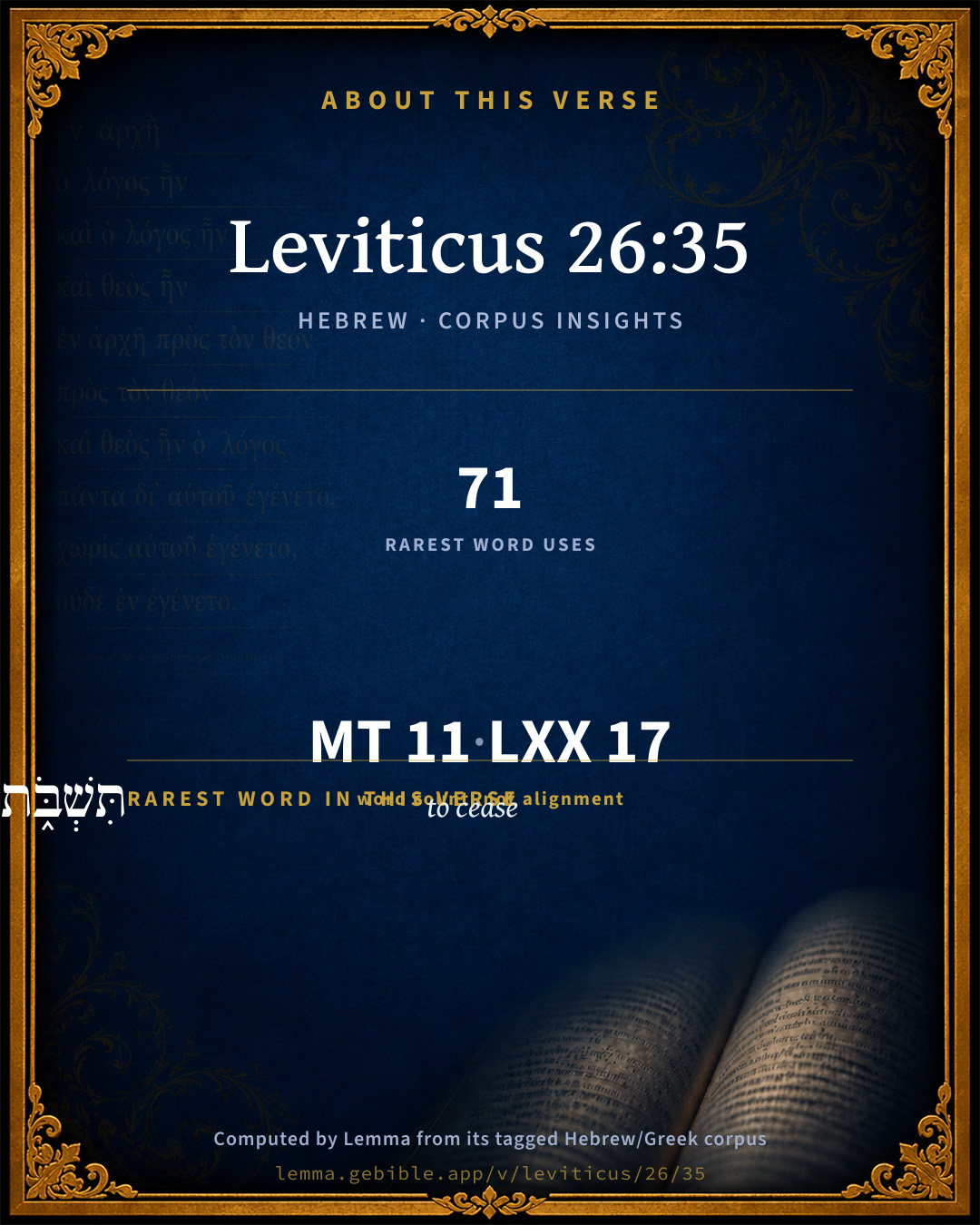
11
words
10
distinct lemmas
Pentateuch
section

Grammatical profile

  • 4 verbs
  • 3 nouns
  • 1 preposition
  • 3 particles

Verb forms

  • הָשַּׁמָּ֖ה Hophal · Infinitive Construct
  • תִּשְׁבֹּ֑ת Qal · Imperfect
  • שָׁבְתָ֛ה Qal · Perfect
  • בְּשִׁבְתְּכֶ֥ם Qal · Infinitive Construct

Repetition

A word recurs within this verse — often emphatic in Hebrew:

  • תִּשְׁבֹּ֑ת to cease H7673 ×2

Hebrew & Septuagint length

In English translation the verse runs 25 words from the Hebrew and 46 from the Septuagint (LXX English) — the Septuagint runs noticeably longer here. See the side-by-side →

A rough comparison of the two English renderings, which tokenize alike — not a word-level alignment.

Word counts can differ between the Hebrew and the Greek without any difference in meaning — e.g. the Hebrew direct-object marker אֵת has no separate Greek word, and Greek often adds the article ὁ.

In the original languages it is 11 Hebrew tokens and 17 Greek tokens — but the two are counted differently (Hebrew bundles its prefixes and suffixes into one token; the Greek is in lemma form), so that isn’t a like-for-like length.

Cross-references

2

Topical passages linked to Leviticus 26:35 in the Treasury of Scripture Knowledge — connected by theme and wording, ordered by reader-vote popularity; previews shown in the World English Bible.

  • Isaiah 24:5–6 The earth also is polluted under the inhabitants of it; because they have transgressed the laws, violated the statutes, broken the everlasting covenant.
  • Romans 8:22 For we know that the whole creation groans and travails in pain together until now.

Cross-references courtesy of OpenBible.info (CC BY 4.0).

Hebrew and Greek witnesses Masoretic Hebrew ↔ Greek Septuagint

The same verse in the two great witnesses to the Old Testament, shown verse-for-verse.

Here the Septuagint runs noticeably longer than the Hebrew — LXX2012 (modern English Septuagint) 46 words vs World English Bible 25. A rough length comparison of the two English translations, not a word-level alignment — read both below.

These are two independent witnesses, not word-aligned to each other, and the Septuagint is shown in lemma (dictionary) form.

Hebrew Leviticus 26:35 Masoretic · Westminster Leningrad Codex

כָּל יְמֵ֥י הָשַּׁמָּ֖ה תִּשְׁבֹּ֑ת אֵ֣ת אֲשֶׁ֧ר לֹֽא שָׁבְתָ֛ה בְּשַׁבְּתֹתֵיכֶ֖ם בְּשִׁבְתְּכֶ֥ם עָלֶֽיהָ

As long as it lies desolate it shall have rest, even the rest which it didn't have in your sabbaths, when you lived on it.

World English Bible · Public Domain

Greek LXX Leviticus 26:35 Septuagint · lemma form

πᾶς ὁ ἡμέρα ὁ ἐρήμωσις αὐτός σαββατίζω ὅς οὐ σαββατίζω ἐν ὁ σάββατον σύ ἡνίκα καταοἰκέω αὐτός

And you⌃ shall be in the land of your enemies; then the land shall keep its sabbaths, and the land shall enjoy its sabbaths all the days of its desolation: it shall keep sabbaths which it kept not among your sabbaths, when you⌃ lived in it.

LXX2012 (modern English Septuagint) · Public Domain

Hebrew: Westminster Leningrad Codex (CC BY 4.0). Greek: Septuagint (public domain); English from LXX2012 (modern English Septuagint) (Public Domain). How the Septuagint differs from the Hebrew →

Targum (Aramaic paraphrase)

2

The Targum is the ancient Jewish Aramaic paraphrase of the Hebrew Scriptures — an interpretive translation, not the Hebrew text itself. Onkelos (literal) and Pseudo-Jonathan (expansive) render the Torah, and Jonathan the Prophets. Coverage is partial: where no permissively-licensed English translation exists for a verse, only the Aramaic is shown. This is verse-level text, not a word-by-word alignment to the Hebrew.

  1. Targum Onkelos Torah (Genesis–Deuteronomy)
    כָּל יוֹמִין דִי צְדִיאַת תַּשְׁמֵט יָת דִי לָא שְׁמֵטַת בִּשְׁמִטֵיכוֹן כַּד הֲוֵיתוּן יָתְבִין עֲלַהּ

    (no public-domain English translation for this verse)

    Targum Onkelos — Aramaic: “Onkelos Genesis” (public domain); “Onkelos Exodus” (public domain); “Onkelos Leviticus” (public domain); “Onkelos Numbers” (public domain); “Onkelos Deuteronomy” (public domain). English: “Sefaria Community Translation” (CC0 1.0 (public-domain dedication)); “J.W. Etheridge. The Targums of Onkelos and Jonathan Ben Uzziel on the Pentateuch. London: Longmans, Green, 1862” (public domain). Text via Sefaria.

  2. Targum Pseudo-Jonathan Torah (Genesis–Deuteronomy)
    כָּל יוֹמִין דְהִיא צַדְיָא מִנְכוֹן תִּתְנַיַיח הֵי כְּמָא דְלָא אִתְנַיְיחַת יַת שְׁנֵי שְׁמִיטֵיכוֹן כַּד הֲוֵיתוּן שַׁרְיָין עֲלָהּ

    All the days that it is forsaken by you it shall rest, because it was not at rest in the years of the times for repose when you were dwellers upon it.

    Targum Pseudo-Jonathan — Aramaic: “Targum Jonathan on Genesis” (public domain); “Targum Jonathan on Exodus” (public domain); “Targum Jonathan on Leviticus” (public domain); “Targum Jonathan on Numbers” (public domain); “Targum Jonathan on Deuteronomy” (public domain). English: “The Targum of Jonathan ben Uzziel, trans. J. W. Etheridge, London, 1862” (public domain). Text via Sefaria.

Commentary

Notes on Leviticus 26:35 from classic Christian and Jewish commentators (each source and its license shown beneath its notes). The classic Christian expositions comment on the surrounding passage and are grouped to its opening verse, so a note may address several verses; the Jewish commentaries on the Tanakh (Rashi and others) are per-verse, so they appear only where the commentator wrote on this verse.

Lemma curates 59 commentaries, every one of them public domain or Creative Commons licensed, each selected and text-cleaned for this edition rather than reprinted as found. About our sources →

Trapp's Complete Commentary

John Trapp

Lev 26:35 As long as it lieth desolate it shall rest; because it did not rest in your sabbaths, when ye dwelt upon it.

Ver. 35. {See Trapp on "Lev 26:34"}

John Trapp, A Commentary or Exposition upon All the Books of the Old and New Testament (1647–1656) — public domain. Text from a community e-Sword module.

Geneva Bible (1599)

Geneva Bible translators

Which I commanded you to keep.

Geneva Bible (1599) marginal notes — public domain. Text via Bolls.life.

Ellicott's Commentary for English Readers

(35) As long as it lieth desolate it shall rest; because it did not rest . . . —Better, All the days of its desolation shall it keep that rest which it did not rest, &c, that is, the land during its desolation will not be cultivated but will lie fallow, and thus be enabled to make up by its long rest for the many sabbaths and sabbatical years of which it had been deprived by the lawless Israelites during their sojourn in it. (Comp. Jer_34:17; 2Ch_36:21.)

A Bible Commentary for English Readers, edited by Charles John Ellicott (1878–1897) — public domain. Text from a community e-Sword module.

John Gill's Exposition

And upon them that are left alive of you,.... In the land of Judea, or rather scattered about among the nations, suggesting that these would be comparatively few:

I will send a faintness into their hearts in the lands of their enemies; or "a softness" (y); so that they should be effeminate, pusillanimous, and cowardly, have nothing of a manly spirit and courage in them; but be mean spirited and faint hearted, as the Jews are noted to be at this day, as Bishop Patrick observes; who also adds,"it being scarce ever heard, that a Jew listed himself for a soldier, or engaged in the defence of his country where he lives:"

and the sound of a shaken leaf shall chase them; either the sound of a leaf that falls from the tree, as the Targum of Jonathan, or which the wind beats one against another, as Jarchi, which makes some little noise; even this should terrify them, taking it to be the noise of some enemy near at hand, just ready to fall on them; such poor faint hearted creatures should they be:

and they shall flee as fleeing from the sword; as if there were an army of soldiers with their swords drawn pursuing them:

and they shall fall when none pursueth; fall upon the ground, and into a fit, and drop down as if dead, as if they had been really wounded with a sword and slain, see Pro 28:1.

(y) "mollitiem", Montanus, Vatablus, Junius & Tremellius, Piscator, Drusius.

John Gill's Exposition of the Whole Bible (1746–1763) — public domain (CC PDM 1.0). Text via the HelloAO Bible API.

Haydock's Catholic Bible Commentary

Your sabbaths, holidays and years of rest, and of jubilee. The earth is represented as entering into the views of God, and rejoicing at his judgments. (Haydock)

George Leo Haydock (1774–1849), Haydock's Catholic Family Bible and Commentary, 1859 edition — public domain. Excludes Psalms (Douay-Rheims chapter numbering differs from Protestant) and Deuterocanonical books (Catholic canon only).

Whedon's Commentary on the Bible

Daniel D. Whedon

35. Because it did not rest — The divine government has its compensations. What it does not receive as a willing offering it extorts in the form of penalty. The riches gained by unlawfully tilling the soil during these sabbatic years were wasted in the captivity, and the despised law received its due in one payment.

Daniel D. Whedon (gen. ed.), Commentary on the Old and New Testaments (1874–1909) — public domain. Text from a community e-Sword module.

Rashi

Rabbi Shlomo Yitzchaki (Rashi)

כל ימי השמה — The word השמה expresses the idea of something being done (passive infinitive; here Hophal); and the מ has a Dagesh in place of doubling that letter in the root שמם.

את אשר לא שבתה BECAUSE IT DID NOT REST [IN YOUR SABBATHS] — The seventy years of the Babylonian exile exactly corresponded to the seventy Sabbatical and Jubilee years that were due in those years when Israel was provoking the anger of the Omnipresent whilststill in their land, i. e. in 430 years. Three hundred and ninety were their years of sin from the time they entered the Land until the Ten Tribes went into exile. The people of the Kingdom of Judah provoked Him still another forty years, — from the exile of the Ten Tribes until the destruction of Jerusalem (in the days of king Jehoiachin; cf. 2 Kings 24:10 ff.). It is this that is mentioned in the case of Ezekiel (4:4—6): “Moreover lie thou upon thy left, [and lay the iniquity of the house of Israel upon it: according to the number of the days that thou shalt lie upon it, thou shalt bear their iniquity. For I have appointed the years of their iniquity to be unto thee a number of days, even three hundred and ninety days…]. And again, when thou hast accomplished these, thou shalt lie on thy right side, and shalt bear the iniquity of the house of Judah forty days [each day for a year have I appointed it unto thee]”. This prophecy was spoken to Ezekiel in the fifth year of king Jeoiachin’s captivity (cf. Ezekiel 1:2). They spent another six years in the Land until Zedekiah (the last king, who reigned eleven years) went into exile; thus you have altogether forty-six years. — And if you say “But this period must have covered more than forty-six years because the years of the reign of Manasseh (the son of Hezekiah during whose reign the Ten Tribes became exiled), were alone 55 years, and there followed other kings also until the destruction of the Temple!” Then I reply that Manasseh lived in a state of repentence 33 years of these and that the years of his wickedness with which alone we are concerned were only twenty-two, as it is said, (2 Kings 21:3) “For he (Manasseh)… made an Asherah, as did Ahab king of Israel”, and Ahab reigned 22 years, just as they (the Rabbis) stated (i. e. they stated that this comparison of Manasseh with Ahab shows that the latter was wicked for 22 years only) in the chapter Chelek (Sanhedrin 103a). Then we have the years of his successor, Amon, two; eleven of Jehoiakin, and a similar number of Zedekiah, the last king of Judah — altogether 46 years. Now, go and calculate for four hundred and thirty-six years the number of Sabbatical and Jubilee periods contained in them and you will find that they are sixteen for every hundred years, viz., fourteen Sabbatical periods and two Jubilee-periods; so for four hundred years there are sixty-four. For the remaining thirty-six there are five Sabbatical periods, making seventy less one. There is yet one year over (the thirty-sixth, since five Sabbatical periods give only thirty-five years) which entered into (began) the Sabbatical period and which completes seventy such periods, each terminating in a Sabbatical year. And because of them (i. e. because of the neglect of these seventy years) exactly seventy years of exile were decreed against them. Thus, too, it is said in Chronicles, (II Chronicles 36:21) “[and them that had escaped from the sword carried he away to Babylon…] until the land had enjoyed her Sabbaths [for as long as she lay desolate she kept Sabbaths] to fulfill three score and ten years” (Seder Olam).

Rashi on the Tanakh — English translations: “The Judaica Press complete Tanach with Rashi, translated by A. J. Rosenberg” (CC BY 4.0); “Pentateuch with Rashi's commentary by M. Rosenbaum and A.M. Silbermann, 1929-1934” (public domain); “The Metsudah Tanach series, Lakewood, N.J” (CC BY 4.0); and “The Book of Joshua, Metsudah Publications, 1997” (CC BY 4.0). Text via Sefaria.

Lesson kit

Teaching starters — assembled from the data on this page, not authored interpretation. Every prompt links to the verse data it draws on. Edit before teaching.

Leviticus, in the Pentateuch, opens this verse with 11 words (10 distinct Hebrew lemmas). Its most distinctive word is shâbath (“to cease”). The Greek Septuagint runs longer here. A historical commentator’s framing appears above. Read the whole chapter for the surrounding context.

Discussion questions

  1. What does “to cease” (shâbath) contribute to the verse as a whole?
  2. Isaiah 24:5–6 shares this passage’s theme. How do the two illuminate each other?
  3. “to cease” occurs 2× in this one verse. What is the effect of the repetition?
  4. Compared with the Hebrew, the Septuagint runs longer here. What questions does that raise?
  5. These translations render this verse differently. What is at stake in choosing one wording over another?
  6. The verb «הָשַּׁמָּ֖ה» is Hophal Infinitive Construct. How does its form color the action?
  7. Reading how Trapp's Complete Commentary and Geneva Bible (1599) read this verse, where do the two commentators agree and where do they part?

Things to notice

Reading settings

Reading text

Shown beneath each verse's original-language words.

Old Testament
Old Testament edition

Read the OT as the Masoretic Hebrew (MT) or the Greek Septuagint (LXX).

English shown for the Greek Septuagint (in the Hebrew ↔ Greek comparison).

Comparing translations? Open the Compare panel on any verse page to stack up to four side by side.