Luke 18:12

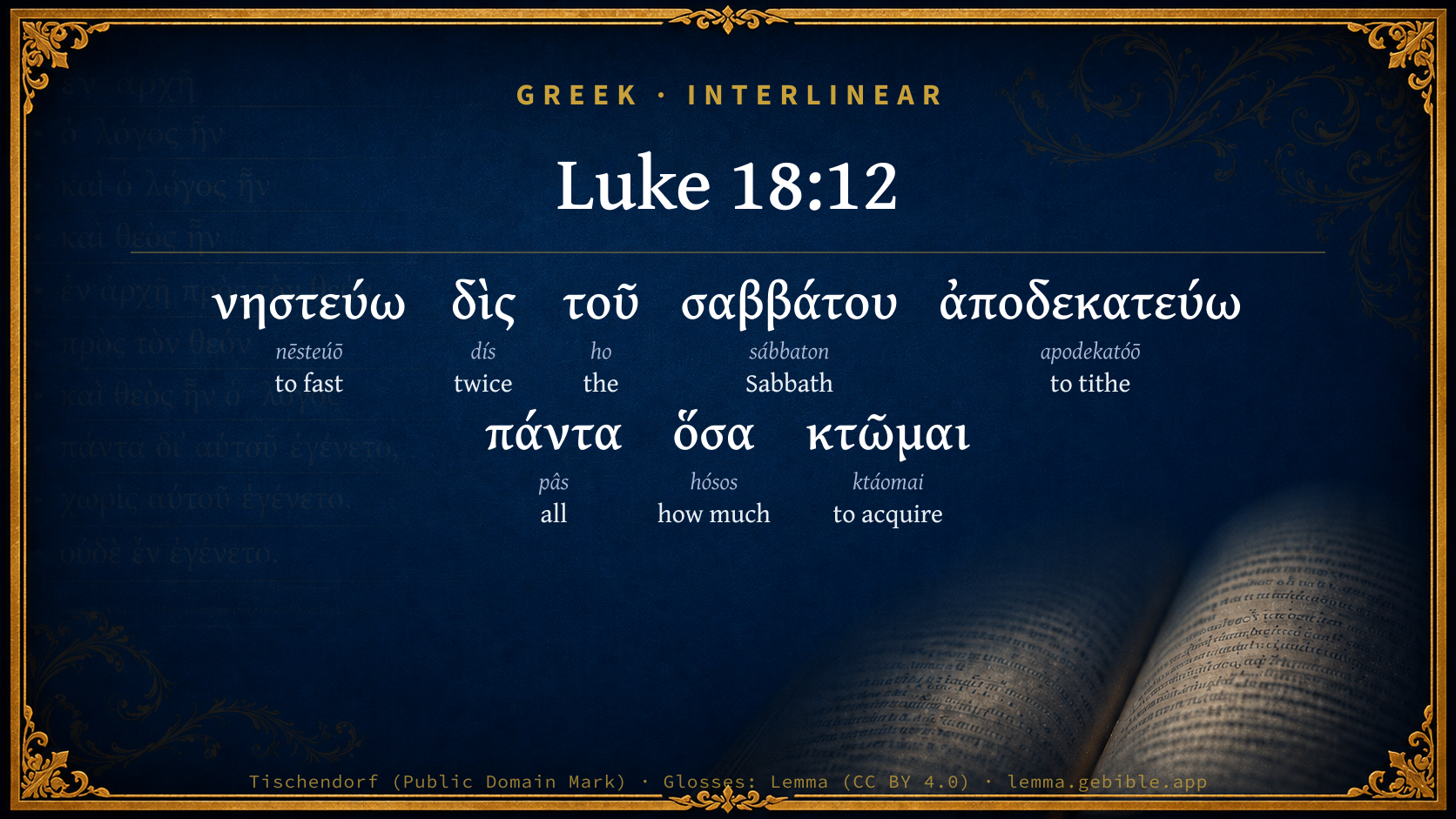
Greek (Tischendorf 8th ed.) Luke 18:12 appears in the Greek New Testament. The text above is from the Tischendorf 8th edition. Each word links to its Strong’s number and a concise gloss. Click any word for its full Thayer’s Greek Lexicon entry.
Download image
Cite this verse

Luke 18:12 (World English Bible). Public Domain. Lemma interlinear Bible study tool, https://lemma.gebible.app/v/luke/18/12.

Show BibTeX & RIS
BibTeX
RIS
English Translation
I fast twice a week. I give tithes of all that I get.'
World English Bible · Public Domain
Download a study sheet

One document with this verse’s original text, its word-by-word gloss line, the meaning frame, cross-references with their text, attributed commentary, and full source and license credits — printable, and it pastes into notes with its structure intact.

This verse Autodidact and up

Study sheet (.html) Plain text (.txt)

A passage Seminary Student

Up to 50 verses in one chapter. A passage sheet keeps up to 6 commentary sources and 12 cross-references per verse, in the order this page ranks them, and says so on the sheet whenever that leaves anything out. Ask for a single verse and you get the Autodidact verse sheet above.

Everything on this page stays free to read, with no account — the sheet is a download of what is already on screen, not access to it.

Want to remove ads? Support Godless Engineer
Compare translations 3

The same verse in 3 English versions, stacked beneath the original-language interlinear above. Click any original word for its lexicon entry.

Each is an independent rendering of the whole verse — the interlinear is not word-aligned to these translations.

Highlighted words mark where these versions differ — a whole-verse word diff, not a word-by-word alignment.

  • World English Bible Public Domain
    I fast twice a week. I give tithes of all that I get.'
  • King James Version Public Domain
    I fast twice in the week, I give tithes of all that I possess.
  • unfoldingWord Literal Text CC BY-SA 4.0
    I fast twice a week. I tithe all that I acquire.’

unfoldingWord Literal Text — © unfoldingWord, licensed CC BY-SA 4.0. Word-aligned USFM3 via Door43 (git.door43.org/unfoldingWord/en_ult).

Versions to compare (up to 4)

3 of 4 selected

Show all 19 translations

Every available English version of this verse, each an independent rendering of the whole verse.

  • World English Bible Public Domain
    I fast twice a week. I give tithes of all that I get.'
  • Berean Standard Bible Public Domain
    I fast twice a week and pay tithes of all that I acquire.’
  • Majority Standard Bible Public Domain
    I fast twice a week and pay tithes of all that I acquire.’
  • King James Version Public Domain
    I fast twice in the week, I give tithes of all that I possess.
  • American Standard Version (1901) Public Domain
    I fast twice in the week; I give tithes of all that I get.
  • Revised Version (1885) Public Domain
    I fast twice in the week; I give tithes of all that I get.
  • Geneva Bible (1599) Public Domain
    I fast twise in the weeke: I giue tithe of all that euer I possesse.
  • Douay-Rheims (1899) Public Domain
    I fast twice in a week: I give tithes of all that I possess.
  • Young's Literal Translation Public Domain
    I fast twice in the week, I give tithes of all things -- as many as I possess.
  • Literal Standard Version CC BY-SA 4.0
    I fast twice in the week, I give tithes of all things—as many as I possess.
  • Unlocked Literal Bible CC BY-SA 4.0
    I fast two times every week. I give tithes of all that I get.'
  • unfoldingWord Literal Text CC BY-SA 4.0
    I fast twice a week. I tithe all that I acquire.’
  • Darby Bible Public Domain
    I fast twice in the week, I tithe everything I gain.
  • World Messianic Bible Public Domain
    I fast twice a week. I give tithes of all that I get.’
  • Webster's Bible Public Domain
    I fast twice in the week, I give tithes of all that I possess.
  • Free Bible Version CC BY-SA 4.0
    I fast twice a week, and I pay tithe on my income.’
  • Bible in Basic English Public Domain
    Twice in the week I go without food; I give a tenth of all I have.
  • Text-Critical English NT CC BY 4.0
    I fast twice a week, and I give tithes of all that I get.’
  • Tyndale New Testament (1534) Public Domain
    I fast twyse in the weke. I geve tythe of all that I possesse.

Literal Standard Version (2020), Covenant Press — licensed CC BY-SA 4.0. Text via the HelloAO Bible API (eBible.org). Unlocked Literal Bible (unfoldingWord) — licensed CC BY-SA 4.0. Text via the HelloAO Bible API (eBible.org). unfoldingWord Literal Text — © unfoldingWord, licensed CC BY-SA 4.0. Word-aligned USFM3 via Door43 (git.door43.org/unfoldingWord/en_ult). Free Bible Version, Dr. Jonathan Gallagher — licensed CC BY-SA 4.0. Text via the HelloAO Bible API (eBible.org).

Word by word

More ways to search: Search by grammar → Find every occurrence → Compare this word →

Practice this passage: Drill this verse → Learn its vocabulary →

About this verse

These counts appear in no published source. They are computed here, from the morphology-tagged text and Lemma’s own curated glosses. What Lemma adds →

8
words
8
distinct lemmas
Gospels
section

Notable vocabulary

The rarest word here is ἀποδεκατεύω to tithe G586 — appearing just 4 times in the whole Greek New Testament.

Shared distinctive vocabulary

ἀποδεκατεύω to tithe G586 occurs in 4 verses of the Greek New Testament. Also found in:

Cross-references

23

Topical passages linked to Luke 18:12 in the Treasury of Scripture Knowledge — connected by theme and wording, ordered by reader-vote popularity; previews shown in the World English Bible.

  • Luke 11:42 But woe to you Pharisees! For you tithe mint and rue and every herb, but you bypass justice and the love of God. You ought to have done these, and not to have left the other undone.
  • Matthew 23:23–24 "Woe to you, scribes and Pharisees, hypocrites! For you tithe mint, dill, and cumin, and have left undone the weightier matters of the law: justice, mercy, and faith. But you ought to have done these, and not to have left the other undone.
  • Matthew 9:14 Then John's disciples came to him, saying, "Why do we and the Pharisees fast often, but your disciples don't fast?"
  • Luke 17:10 Even so you also, when you have done all the things that are commanded you, say, 'We are unworthy servants. We have done our duty.'"
  • Malachi 3:8 Will a man rob God? Yet you rob me! But you say, 'How have we robbed you?' In tithes and offerings.
  • Matthew 6:1 "Be careful that you don't do your charitable giving before men, to be seen by them, or else you have no reward from your Father who is in heaven.
  • Matthew 15:7–9 You hypocrites! Well did Isaiah prophesy of you, saying,
  • 1 Timothy 4:8 For bodily exercise has some value, but godliness has value for all things, having the promise of the life which is now, and of that which is to come.
  • Leviticus 27:30–33 "'All the tithe of the land, whether of the seed of the land or of the fruit of the trees, is Yahweh's. It is holy to Yahweh.
  • Numbers 18:24 For the tithe of the children of Israel, which they offer as a heave-offering to Yahweh, I have given to the Levites for an inheritance: therefore I have said to them, Among the children of Israel they shall have no inheritance.
  • Numbers 23:4 God met Balaam: and he said to him, I have prepared the seven altars, and I have offered up a bull and a ram on every altar.
  • 1 Samuel 15:13 Samuel came to Saul; and Saul said to him, Blessed are you by Yahweh: I have performed the commandment of Yahweh.
  • 2 Kings 10:16 He said, Come with me, and see my zeal for Yahweh. So they made him ride in his chariot.
  • Isaiah 1:15 When you spread forth your hands, I will hide my eyes from you; Yes, when you make many prayers, I will not hear. Your hands are full of blood.
  • Isaiah 58:2–3 Yet they seek me daily, and delight to know my ways: as a nation that did righteousness, and didn't forsake the ordinance of their God, they ask of me righteous judgments; they delight to draw near to God.
  • Zechariah 7:5–6 "Speak to all the people of the land, and to the priests, saying, 'When you fasted and mourned in the fifth and in the seventh month for these seventy years, did you at all fast to me, really to me?
  • Matthew 6:5 "When you pray, you shall not be as the hypocrites, for they love to stand and pray in the synagogues and in the corners of the streets, that they may be seen by men. Most assuredly, I tell you, they have received their reward.
  • Matthew 6:16 "Moreover when you fast, don't be like the hypocrites, with sad faces. For they disfigure their faces, that they may be seen by men to be fasting. Most assuredly I tell you, they have received their reward.
  • Romans 3:27 Where then is the boasting? It is excluded. By what manner of law? Of works? No, but by a law of faith.
  • Romans 10:1–3 Brothers, my heart's desire and my prayer to God is for Israel, that they may be saved.
  • 1 Corinthians 1:29 that no flesh should boast before God.
  • Galatians 1:14 I advanced in the Jews' religion beyond many of my own age among my countrymen, being more exceedingly zealous for the traditions of my fathers.
  • Ephesians 2:9 not of works, that no one would boast.

Cross-references courtesy of OpenBible.info (CC BY 4.0).

Commentary

Notes on Luke 18:12 from classic Christian and Jewish commentators (each source and its license shown beneath its notes). The classic Christian expositions comment on the surrounding passage and are grouped to its opening verse, so a note may address several verses; the Jewish commentaries on the Tanakh (Rashi and others) are per-verse, so they appear only where the commentator wrote on this verse.

Lemma curates 59 commentaries, every one of them public domain or Creative Commons licensed, each selected and text-cleaned for this edition rather than reprinted as found. About our sources →

Tyndale Open Study Notes

Tyndale Open Resources

18:12 I fast twice a week, and I give you a tenth of my income: Fasting and tithing were signs of piety in Judaism. The law required fasting only once a year (Lev 16:29-31), but pious Jews in Jesus’ day fasted twice a week (see also Luke 5:33; 11:41-42).

Tyndale Open Study Notes — © Tyndale Open Resources, licensed CC BY-SA 4.0. Text via the HelloAO Bible API.

Bengel's Gnomon

Johann Albrecht Bengel

Luk 18:12. Νηστεύω, I fast) The Pharisee boastingly shows that he is righteous towards God by his present prayers; and in relation to himself, by fasting: and towards other men, by paying tithes, etc.—δὶς, twice) on the second and fifth days of the week (Monday and Thursday).—τοῦ Σαββάτου, the Sabbath, literally) i.e. the week. Synecdoche [a part of the week put for the whole].—πάντα ὅσα, all things whatsoever) He boasts of his possessions.

Bengel's Gnomon of the New Testament — English translation (T&T Clark, Edinburgh, 1860) — public domain. Text from a community e-Sword module.

Expositor's Greek Testament

ed. W. Robertson Nicoll

Luk 18:12 . δὶς τ . σ ., twice in the week: voluntary fasts on Mondays and Thursdays, ultra-legal in his zeal. ἀποδεκατ - ῶ (- εύω , W. and H [141] ) = δεκατεύω in Greek writers: tithing a typical instance of Pharisaic strictness. πάντα , all, great and small, even garden herbs, again ultra-legal. κτῶμαι , all I get (R.V [142] ).

[141] Westcott and Hort.

[142] Revised Version.

The Expositor's Greek Testament, edited by W. Robertson Nicoll (1897–1910) — public domain. Text from a community e-Sword module.

Adam Clarke's Commentary

Verse 12. I give tithes of all that I possess.] Or, of all I acquire, κτωμαι. Raphelius has well observed, that this verb, in the present tense, signifies to acquire - in the preter, to possess: the Pharisee's meaning seems to be, "As fast as I gain any thing, I give the tenth part of it to the house of God and to the poor." Those who dedicate a certain part of their earnings to the Lord should never let it rest with themselves, lest possession should produce covetousness. This was the Pharisee's righteousness, and the ground on which he builded his hope of final salvation. That the Pharisees had a strong opinion of their own righteousness, the following history will prove:-

"Rabbi Simeon, the son of Jochai, said: The whole world is not worth thirty righteous persons, such as our father Abraham. If there were only thirty righteous persons in the world, I and my son should make two of them; but if there were but twenty, I and my son would be of the number; and if there were but ten, I and my son would be of the number: and if there were but five, I and my son would be of the five; and if there were but two, I and my son would be those two; and if there were but one, myself should be that one." Bereshith Rabba, s. 35, fol. 34. This is a genuine specimen of Pharisaic pride. No wonder that our Lord accused these of pride and vain glory: they were far from humility, and consequently far from righteousness.

Adam Clarke's Commentary on the Bible (1810–1826) — public domain. Text from a community e-Sword/MySword module.

Ellicott's Commentary for English Readers

(12) I fast twice in the week.—From the negative side of his self-analysis the Pharisee passes to the positive. The Stoic Emperor is a little less systematic, or rather groups his thanksgiving after a different plan, and, it must be owned, with a higher ethical standard. On the fasts of the Pharisees on the third and fifth days of the week, see Note on Mat_6:16.

I give tithes of all that I possess.—Better, of all that I acquire, as in Mat_10:9; Act_1:18. Tithe was a tax on produce, not on property. The boast of the Pharisee is, that he paid the lesser tithes, as well as the greater—of mint, anise, and cummin (Mat_23:23), as well as of corn and wine and oil. There is something obviously intended to be significant in the man’s selection of the good deeds on which he plumes himself. He does not think, as Job did in his boasting mood, that he had been “a father to the poor,” and had “made the widow’s heart to sing for joy” (Job_29:13; Job_29:16), nor look back, as Nehemiah looked, upon good deeds done for his country (Neh_13:14; Neh_13:22; Neh_13:31) in the work of reformation. For him fasting and tithes have come to supersede the “weightier matters of the Law” (Mat_23:23).

A Bible Commentary for English Readers, edited by Charles John Ellicott (1878–1897) — public domain. Text from a community e-Sword module.

The Cambridge Bible for Schools and Colleges

gen. ed. J. J. S. Perowne

12. Ifast twice in the week] This practice had no divine sanction. The Law appointed only a single fast-day in the year, the Day of Atonement (Lev_16:29). By the time of Zechariah there seem to have been four yearly fasts (Zec_8:19). The bi-weekly fast of the Pharisees was a mere burden imposed by the oral Law. The days chosen were Thursday and Monday, because on those days Moses was believed to have ascended and descended from Sinai, Babha Kama, f. 82, 1. The man boasts of his empty ceremonialism.

I give tithes of all that I possess] Rather, of all that I acquire. As though he were another Jacob! (Gen_28:22; comp. Tob_1:7-8). Here too he exceeds the Written Law, which only commanded tithes of corn, wine, oil, and cattle (Deu_14:22-23), and not of mint, anise, and cummin (Mat_23:23). The fact that he does not say a word about his sins shews how low was his standard. “He that covereth his sins shall not prosper,” Pro_28:13. He was clothed with phylacteries and fringes, not with humility, 1Pe_5:5. A Talmudic treatise, the Berachoth (Schwab, p. 336), furnishes us with a close analogy to the prayer of the Pharisee in that of Rabbi Nechounia Ben Hakana, who on leaving his school used to say, ‘I thank thee, O Eternal, my God, for having given me part with those who attend this school instead of running through the shops. I rise early like them, but it is to study the Law, not for futile ends. I take trouble as they do, but I shall be rewarded, and they will not; we run alike, but I for the future life, while they will only arrive at the pit of destruction.’

The Cambridge Bible for Schools and Colleges (gen. ed. J. J. S. Perowne; Cambridge University Press, 1878–1918) — public domain. Text from a community e-Sword module.

John Gill's Exposition

I fast twice in the week,.... Not "on the sabbath", as the words may be literally rendered, and as they are in the Vulgate Latin and Ethiopic versions; for the sabbath was not a fasting, but a feasting day with the Jews; for they were obliged to eat three meals, or feasts, on a sabbath day, one in the morning, another at evening, and another at the time of the meat offering: even the poorest man in Israel, who was maintained by alms, was obliged to keep these three feasts (f). It was forbidden a man to fast, until the sixth hour, on a sabbath day; that is, till noon (g): wherefore, it is a great mistake in Justin (h) and Suetonius (i), that the sabbath was kept by the Jews as a fast. But the word is rightly rendered, "in the week"; the whole seven days, or week, were by the Jews commonly called the sabbath; hence, , "the first of the sabbath", and the second of the sabbath, and the third of the sabbath (k); that is, the first, second, and third days of the week. Now the two days in the week on which they fasted were Monday and Thursday, the second and fifth days; on which days the law of Moses, and the book of Esther were read, by the order of Ezra (l); and fasts for the congregation were appointed on those days (m); and so a private person, or a single man, as in this instance, took upon him, or chose to fast on the same (n): the reason of this is, by some, said to be, because Moses went up to Mount Sinai on a Thursday, and came down on a Monday (o). But though these men fasted so often, they took care not to hurt themselves; for they allowed themselves to eat in the night till break of day. It is asked (p),

"how long may a man eat and drink, i.e. on a fast day? until the pillar of the morning ascends (day breaks); these are the words of Rabbi (Judah): R. Eliezer ben Simeon says, until cock crowing.''

So that they had not so much reason to boast of these performances: he adds,

I give tithes of all that I possess; not only of what was tithable by the law of Moses, as the produce of his ground; and by the traditions of the elders, as the herbs in his garden, Mat 23:23 but of every thing he had, which was not required by either of them; upon which he thought himself a very righteous person, and more than a common man: it is asked (q),

"who is a plebeian? (one of the people of the earth, or the common people) whoever does not eat his common food with purity with hands washed; these are the words of R. Meir; but the wise men say, whoever does not tithe his fruit.''

This man would not be thought to be such an one.

(f) Maimon. Hilch. Sabbat, c. 30. sect. 9. (g) T. Hieros. Nedarim, fol. 40. 4. (h) L. 36. c. 2. (i) Octav. Aug. c. 76. (k) Maimon. Hilch. Mechosre Caphara, c. 2. sect, 8. (l) T. Bab. Bava Kama, fol. 82. 1. Megilla, 31. 1, 2. (m) Maimon. Hilchot Taaniot, c. 1. sect. 5. (n) T. Bab. Taanith, fol. 12. 1. (o) Godwin Moses & Aaron, l. 1. c. 10. Vid. T. Bab. Sabbat, fol. 88. 1. (p) T. Bab. Taanith, fol. 12. 1. (q) T. Bab. Gittin, fol. 61. 1.

John Gill's Exposition of the Whole Bible (1746–1763) — public domain (CC PDM 1.0). Text via the HelloAO Bible API.

Trapp's Complete Commentary

John Trapp

12 I fast twice in the week, I give tithes of all that I possess.

Ver. 12. I fast twice a week] Cardinal Bellarmine did more, for he fasted thrice a week, saith he that writes his life. John, Archbishop of Constantinople, he who first affected the style of Universal Bishop, was surnamed Nesteutes, from his frequent fasting. Monday and Thursday were the Pharisees’ fasting days, because Moses went up to the mount on a Thursday, and came down on a Monday, saith Drusius. The Manichees fasted on the sabbath, from whence the whole week here taketh its denomination in the original.

I give tithes] He braggingly made a gift of that which he was bound to pay.

John Trapp, A Commentary or Exposition upon All the Books of the Old and New Testament (1647–1656) — public domain. Text from a community e-Sword module.

Albert Barnes' Notes on the Bible

I fast twice ... - This was probably the Jewish custom. The Pharisees are said to have fasted regularly on the second and fifth days of every week in private. This was “in addition” to the public days of fasting required in the law of Moses, and they, therefore, made more a matter of “merit” of it because it was voluntary.

I give tithes - A tithe means the tenth part of a thing. A tenth part of the possessions of the Jews was required for the support of the Levites, Num 18:21. In addition to the tithes required strictly by law, the Pharisees had tithed everything which they possessed even the smallest matters - as mint, anise, cummin, etc., Luk 11:42. It was “this,” probably, on which he so particularly prided himself. As this could not be proved to be strictly “required” in the law, it had more the “appearance” of great piety, and, therefore, he particularly dwelt on it.

I possess - This may mean either all which I “have,” or all which I “gain” or acquire. It is not material which meaning be considered the true one.

The religion of the Pharisee, therefore, consisted in:

1.Abstaining from injustice to others; in pretending to live a harmless, innocent, and upright life; and,

2.A regular observance of all the external duties of religion.

His “fault” consisted in relying on this kind of righteousness; in not feeling and acknowledging that he was a sinner; in not seeking a religion that should dwell in the “heart” and regulate the feelings; and in making public and ostentatious professions of his own goodness. Most of all was this abominable in the sight of God, who “looks into the heart,” and who sees wickedness there when the external actions may be blameless. We may learn from the case of the Pharisee:

That it is not the man who has the most orthodox belief that has, of course, the most piety; That people may be externally moral, and not be righteous in the sight of God; That they may be very exact in the external duties of religion, and even go beyond the strict letter of the law; that they may assume a great appearance of sanctity, and still be strangers to true piety; and, That ostentation in religion, or a “boasting” before God of what we are and of what we have done, is abominable in his sight. This spoils everything, even if the life “should be” tolerably blameless, and if there should be real piety.

Albert Barnes' Notes on the Bible (1834–1885) — public domain. Text from a community e-Sword/MySword module.

Haydock's Catholic Bible Commentary

See how the Pharisee here, by pride, lays open to the enemy his heart, which he had in vain shut against him by fasting and prayer. It is in vain to defend a city, if you leave the enemy a single passage, by which he may enter in. (St. Gregory, mor. lib. xix. chap. 12.)

George Leo Haydock (1774–1849), Haydock's Catholic Family Bible and Commentary, 1859 edition — public domain. Excludes Psalms (Douay-Rheims chapter numbering differs from Protestant) and Deuterocanonical books (Catholic canon only).

Matthew Poole's English Annotations

Twice in the sabbath, saith the Greek, but that is ordinary, to denominate the days of the week from the sabbath; the meaning is, twice between sabbath and sabbath. Those learned in the Jewish Rabbins tell us, that the Jews were wont to fast twice in a week, that is, the Pharisees and the more devout sort of them; once on the second, another time on the fifth day (which are those days which we call Monday and Thursday). From whence some tell us that Wednesday and Friday come to be with us fasting days or fish days. The Christians in former times, thinking it beneath them to be less in these exercises than the Jews, would have also two fasting days each week; and those not the same with the Jews, that they might not be thought to Judaize. If that custom had any true antiquity, I doubt not but they fasted after another rate than the papists or others now do, who pretend a religion to those days. But neither was the Pharisees practice, nor the practice of Christians, in this thing to be much admired or applauded. For fasting was always used in extraordinary cases; and the bringing extraordinary duties into ordinary practice usually ends in a mere formality. It is a good rule, neither to make ordinary duties extraordinary or rare, nor yet extraordinary duties ordinary: the doing of the first ordinarily issues in the loss of them, and quite leaving them off; the latter, in a formal lifeless performance of them.

I give tithes of all that I possess. The emphasis lieth in the word all. Others paid tithe of apples, and some fruits of the earth (of which alone tithe was due); but the Pharisees would pay tithes of those things, as to which it was generally held that the law did not strictly require them, such as pot herbs, eggs milk, cheese. Our Saviour bare them this testimony, that they paid tithe of mint, anise, and cummin, Mat 23:23; rue, and all manner of herbs, Luk 11:42. This Pharisee boasteth of his exactness in two things, neither of which were required particularly by the law of God. Nor did he amiss in them, if he had not omitted the weightier things of the law, as our Saviour charges them to have done in both the texts before mentioned. But how came these things to make him a plea for his justification before God? Will he plead his righteousness, because he did things which God did not command him, while in the mean time he omitted those things which God had commanded? Or, what did these things signify; if they were not done out of a root of love? The law is, Thou shalt love the Lord thy God with all thy heart; and how could they be performed out of love, when love was one of the things which our Saviour charges them to have omitted? Of the same nature are other works, such as building of churches, and hospitals, and alms houses: the fruit is good, if the root be good; but if they be done out of ostentation, or opinion of meriting at God’s hands, men’s money (notwithstanding these things) will perish with them, for heaven is not to be purchased by our money.

Matthew Poole's English Annotations on the Holy Bible (1683–1685) — public domain. Text from a community e-Sword/MySword module.

Whedon's Commentary on the Bible

Daniel D. Whedon

12. I fast—From his mere virtues, the Pharisee proceeds to his pieties. He has works of supererogation to tell.

Twice in the week—By the Mosaic law, required but once a year. So that these two fasts a week were extra and voluntary holiness and merit to spare.

Tithes—The tenth parts.

All I possess—This translation scarcely does credit to the Pharisee’s piety. It should be rendered all that I acquire. He gave tithes both of property and income.

Daniel D. Whedon (gen. ed.), Commentary on the Old and New Testaments (1874–1909) — public domain. Text from a community e-Sword module.

The Pulpit Commentary

I fast twice in the week. There was no such precept in the Law of Moses. There only a single fast-day in the year was enjoined, the Day of Atonement. (Lev_16:29) By the time of Zechariah the prophet (Zec_8:19) the one fast-day had grown into four. But this fasting twice every week was a burthensome observance imposed in the later oral Law. Thursday and Monday were the appointed fasting-days, because tradition related how, on those days, Moses ascended and descended from Sinai. Compare the Talmud (treatise "Bava Khama," fol. 82. 1). I give tithes of all that I possess. Here, again, the Mosaic ordinance only enjoined tithes of corn, wine, oil, and cattle. The later rabbinic schools directed that everything should be tithed, down to the mint and anise and cummin. And so this poor deluded Pharisee dreamed he had earned his eternal salvation, forgetting that the tithes he so prided himself on paying were merely tithes of goods of which he was steward for a little time, tithes, too, given back to their real Owner God. Could this be counted a claim upon God? He boasted, too, that he was no extortioner: did he forget how often he had coveted? He was no adulterer: what of those wicked thoughts which so often found a home in his heart? He rejoiced that he was not like the publican and others of that same class: did he think of the sore temptations to which these and the like were exposed, and from which he was free? He gloried in his miserable tithes and offerings: did he remember how really mean and selfish he was? did he think of his luxury and abundance, and of the want and misery of thousands round him? did his poor pitiful generosity constitute a claim to salvation? All this and more is shrined in the exquisite story of Jesus, who shows men that salvation if it be given to men at all must be given entirely as a free gift of God.

The Pulpit Commentary (1880–1919), ed. H.D.M. Spence-Jones & Joseph S. Exell — public domain. Text from a community e-Sword module.

John Wesley's Explanatory Notes

I fast twice in the week - So did all the strict Pharisees: every Monday and Thursday. I give tithes of all that I possess - Many of them gave one full tenth of their income in tithes, and another tenth in alms, the sum of this plea is, I do no harm: I use all the means of grace: I do all the good I can.

John Wesley, Explanatory Notes Upon the Whole Bible (1754–1765) — public domain. Text via the GEBible commentary corpus.

Cambridge Greek Testament for Schools and Colleges

12. νηστεύω δὶς τοῦ σαββάτου. Mar 2:18. This practice had no divine sanction. The Law appointed only a single fast-day in the year, the Day of Atonement (Lev 16:29). By the time of Zechariah there seem to have been four yearly fasts (Zec 8:19). The bi-weekly fast of the Pharisees was a mere burden imposed by the oral Law. The days chosen were Thursday and Monday, because on those days Moses was believed to have ascended and descended from Sinai, Babha Kama, f. 82, 1. The man boasts of his empty ceremonialism. τοῦ σαββάτου is a partitive genitive.

πάντα ὅσα κτῶμαι. ‘Of al that I acquire.’ The incorrect “possess” of the A.V[325] comes from the Vulg[326] possideo, which would require κέκτημαι. Comp. Luk 21:19, ‘acquire,’ or ‘ye shall acquire’ your souls. The Pharisee speaks as though he were another Jacob! (Gen 28:22; comp. Tob 1:7-8). Here too he exceeds the Written Law, which only commanded tithes of corn, wine, oil, and cattle (Deu 14:22-23), and not of mint, anise, and cummin (Mat 23:23). The fact that he does not say a word about his sins shews how low was his standard. “He that covereth his sins shall not prosper,” Pro 28:13. He was clothed with phylacteries and fringes, not with humility, 1Pe 5:5. A Talmudic treatise, the Berachôth (Schwab, p. 336), furnishes us with a close analogy to the prayer of the Pharisee in that of Rabbi Nechounia Ben Hakana, who on leaving his school used to say, ‘I thank thee, O Eternal, my God, for having given me part with those who attend this school instead of running through the shops. I rise early like them, but it is to study the Law, not for futile ends. I take trouble as they do, but I shall be rewarded, and they will not; we run alike, but I for the future life, while they will only arrive at the pit of destruction.’

[325] A.V. Authorised Version.

[326] Vulg. Vulgate.

Cambridge Greek Testament for Schools and Colleges (Cambridge University Press, 1896; 21 vols, various authors incl. Carr, Maclear, Plummer, Farrar, Lumby, Moule, M. R. James, Simcox) — public domain. Text from a community e-Sword module.

Alford’s Greek Testament

Henry Alford

12. νηστ. δὶς τ. σ.] This was a voluntary fast, on the Mondays and Thursdays; the only prescribed fast in the year being the great day of atonement, see Lev 16:29: Num 29:7. So that he is boasting of his works of supererogation.

ἀποδ. πάντα] Here again, the law perhaps (but cf. Abraham’s practice, Gen 14:20; and Jacob’s, Gen 28:22) only required tithe of the fruit of the field, and the produce of the cattle: see on Mat 23:23.

κτῶμαι] Not I possess, which would be κέκτημαι—but I acquire;—of all my increase: see Deu 14:22. His speech shews admirably what his πεποίθησις ἐφʼ ἑαυτῷ was.

Henry Alford, The Greek Testament (1849–1861) — public domain. Text from a community e-Sword module.

International Critical Commentary

12. He cites these good works as instances of the ways in which he is still further superior to other men. He is superior not only in what he avoids, but in what he performs. Characteristically he names just those things on which Pharisees prided themselves (Mat 9:14, Mat 23:23).

δὶς τοῦ σαββάτου. Mondays and Thursdays. Moses was supposed to have ascended the mount on the fifth day, and to have come down on the second. For the sing. of σάββατον in the sense of “a week” comp. Mar 16:9; 1Co 16:2. It is amazing that any should have taken this as meaning “I fast twice on the sabbath,” which would be unintelligible. The jejuno bis in sabbato of the Vulg. might mislead those who knew no Greek. The frequent statement that the Pharisees observed the second and fifth days as fasts all through the year (D. B.2 1:2. p. 1054), and held that this was enjoined by the oral Law, is without foundation: and those who make it are inconsistent in saying that this Pharisee boasts of works of supererogation. In that case he merely States that he keeps the Law in its entirety. The Mosaic Law enjoins only one fast in the year, the Day of Atonement. Other annuaj fasts were gradually established in memory of national calainities (Zec 8:19). Occasional fasts were from time to time ordered in seasons of drought and other public calamities, and these additional fasts were always held on Mondays and Thursdays. Thus, a five days’ fast would not last from Monday to Friday inclusive, but would be held on all Mondays and Thursdays until the five days were made up (see the Didache, 8:1; Apost. const. vii. 23, 1). But many individuals imposed extra fasts on themselves, and there were some who fasted on Mondays and Thursdays all the year round. Such cases would be commonest among the Pharisees, and the Pharisee in the parable is one of them: but there is no evidence that all Pharisees adopted this practice or tried to make it a general obligation (Schülrer, Jewish People in the T. of J. C. II. 2. p. 118; Edersh. L. & T. 2. p. 291; Wetstein and Lightfoot, ad loc.). The man, therefore, is boasting of a work of supererogation. What is told us about Jewish fasting in the N.T. (5:33; Mat 6:16, Mat 6:9:14; Mar 2:18; Act 27:9) is confirmed by the Mishna. Note that the Pharisee has dropped even the form of thanksgiving.

With δὶς τοῦ σαββάτου comp. ἑπτάκις τῆς ἡέρας (17:4). The genitives in 24:1; Mat 2:14, 25:6, 28:13; Gal 6:17 are not parallel.

ἀποδεκατεύω πάντα. Here again, in paying tithe of everything, he seems to boast of doing more than the Law required. Tithe was due (Num 18:21; Deu 24:22), but not of small garden herbs (Mat 23:23). There is something for which God owes thanks to him.

The rare form ἀποδεκατεύω is found in B א* here in place of the not very common ἀποδεκατόω or ἀποδεκατῶ. WH. 2. App. p. 171. The simple δεκατεύω is more usual.

ὅσα κτῶμαι. “All that I get” (RV.): quæcunque adquiro (i q), quæ adquiro (d). It was on what he acquired, not on what he possessed, that he paid tithe; on his income, not on his capital. All English Versions prior to RV. go wrong here with Vulg. (quæ possideo), Luth. (das ich habe), and Beta. “Possess” would be κέκτημαι. There is a similar error 21:19. Excepting Mat 10:9 and 1Th 4:4, the verb is peculiar to Lk. in N.T. (Act 1:18, Act 8:20, Act 22:28): it is freq. in LXX.

International Critical Commentary — older volumes (1896–1929), various authors — public domain. Text from a community e-Sword module.

Vincent's Word Studies in the New Testament

Marvin R. Vincent

Twice in the week. The law required only one fast in the year, that on the great day of Atonement (Lev 16:29; Num 29:7); though public memorial fasts were added, during the Captivity, on the anniversaries of national calamities. The Pharisees fasted every Monday and Thursday during the weeks between the Passover and Pentecost, and again between the Feast of Tabernacles and that of the Dedication of the Temple.

I give tithes [αποδεκατω] . See on Mt 23:23.

Possess [κτωμαι] . Wrong. The Israelite did not pay tithes of his possessions, but only of his gains - his annual increase. See Gen 28:22; Deu 14:22. Besides, the verb, in the present tense, does not mean to possess, but to acquire; the meaning possess being confined to the perfect and pluperfect. Rev., get. Compare Mt 10:9 (Rev.); Act 22:28; Luk 21:19 (on which see note); 1Th 4:4 (Rev.).

Marvin R. Vincent, Word Studies in the New Testament (1887–1900) — public domain. Text from a community e-Sword/MySword module.

Lesson kit

Teaching starters — assembled from the data on this page, not authored interpretation. Every prompt links to the verse data it draws on. Edit before teaching.

Luke, in the Gospels, opens this verse with 8 words (8 distinct Greek lemmas). Its most distinctive word is apodekatóō (“to tithe”). A historical commentator’s framing appears above. Read the whole chapter for the surrounding context.

Discussion questions

  1. What does “to tithe” (apodekatóō) contribute to the verse as a whole?
  2. How does Matthew 23:23, which shares the word «to tithe», read alongside this verse?
  3. These translations render this verse differently. What is at stake in choosing one wording over another?
  4. Compare how Tyndale Open Study Notes and Bengel's Gnomon read this verse. Where do they agree or differ?

Things to notice

Reading settings

Reading text

Shown beneath each verse's original-language words.

Old Testament
Old Testament edition

Read the OT as the Masoretic Hebrew (MT) or the Greek Septuagint (LXX).

English shown for the Greek Septuagint (in the Hebrew ↔ Greek comparison).

Comparing translations? Open the Compare panel on any verse page to stack up to four side by side.