Luke 23:54

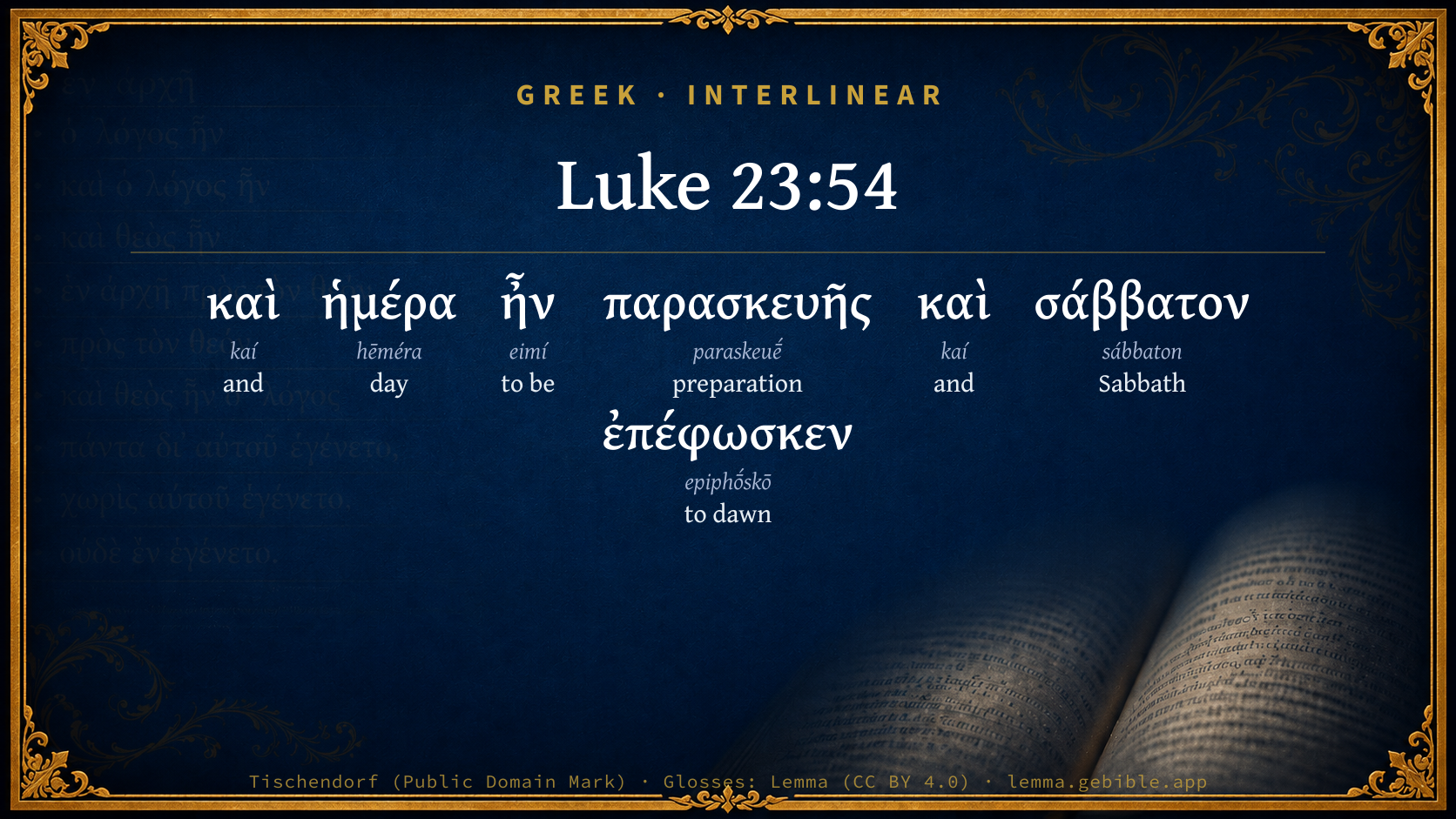
Greek (Tischendorf 8th ed.) Luke 23:54 appears in the Greek New Testament. The text above is from the Tischendorf 8th edition. Each word links to its Strong’s number and a concise gloss. Click any word for its full Thayer’s Greek Lexicon entry.
Download image
Cite this verse

Luke 23:54 (World English Bible). Public Domain. Lemma interlinear Bible study tool, https://lemma.gebible.app/v/luke/23/54.

Show BibTeX & RIS
BibTeX
RIS
English Translation
It was the day of the Preparation, and the Sabbath was drawing near.
World English Bible · Public Domain
Download a study sheet

One document with this verse’s original text, its word-by-word gloss line, the meaning frame, cross-references with their text, attributed commentary, and full source and license credits — printable, and it pastes into notes with its structure intact.

This verse Autodidact and up

Study sheet (.html) Plain text (.txt)

A passage Seminary Student

Up to 50 verses in one chapter. A passage sheet keeps up to 6 commentary sources and 12 cross-references per verse, in the order this page ranks them, and says so on the sheet whenever that leaves anything out. Ask for a single verse and you get the Autodidact verse sheet above.

Everything on this page stays free to read, with no account — the sheet is a download of what is already on screen, not access to it.

Want to remove ads? Support Godless Engineer
Compare translations 3

The same verse in 3 English versions, stacked beneath the original-language interlinear above. Click any original word for its lexicon entry.

Each is an independent rendering of the whole verse — the interlinear is not word-aligned to these translations.

Highlighted words mark where these versions differ — a whole-verse word diff, not a word-by-word alignment.

  • World English Bible Public Domain
    It was the day of the Preparation, and the Sabbath was drawing near.
  • King James Version Public Domain
    And that day was the preparation, and the sabbath drew on.
  • unfoldingWord Literal Text CC BY-SA 4.0
    And it was the Day of Preparation, and the Sabbath was dawning.

unfoldingWord Literal Text — © unfoldingWord, licensed CC BY-SA 4.0. Word-aligned USFM3 via Door43 (git.door43.org/unfoldingWord/en_ult).

Versions to compare (up to 4)

3 of 4 selected

Show all 19 translations

Every available English version of this verse, each an independent rendering of the whole verse.

  • World English Bible Public Domain
    It was the day of the Preparation, and the Sabbath was drawing near.
  • Berean Standard Bible Public Domain
    It was Preparation Day, and the Sabbath was beginning.
  • Majority Standard Bible Public Domain
    It was Preparation Day, and the Sabbath was beginning.
  • King James Version Public Domain
    And that day was the preparation, and the sabbath drew on.
  • American Standard Version (1901) Public Domain
    And it was the day of the Preparation, and the sabbath drew on.
  • Revised Version (1885) Public Domain
    And it was the day of the Preparation, and the sabbath drew on.
  • Geneva Bible (1599) Public Domain
    And that day was the preparation, and the Sabbath drewe on.
  • Douay-Rheims (1899) Public Domain
    And it was the day of the Parasceve, and the sabbath drew on.
  • Young's Literal Translation Public Domain
    And the day was a preparation, and sabbath was approaching,
  • Literal Standard Version CC BY-SA 4.0
    And it was [the] Day of Preparation, and Sabbath was approaching,
  • Unlocked Literal Bible CC BY-SA 4.0
    It was the Day of the Preparation, and the Sabbath was about to begin.
  • unfoldingWord Literal Text CC BY-SA 4.0
    And it was the Day of Preparation, and the Sabbath was dawning.
  • Darby Bible Public Domain
    And it was preparation day, and [the] sabbath twilight was coming on.
  • World Messianic Bible Public Domain
    It was the day of the Preparation, and the Sabbath was drawing near.
  • Webster's Bible Public Domain
    And that day was the preparation, and the sabbath drew on.
  • Free Bible Version CC BY-SA 4.0
    It was preparation day and the Sabbath would soon begin.
  • Bible in Basic English Public Domain
    Now it was the day of making ready and the Sabbath was coming on.
  • Text-Critical English NT CC BY 4.0
    It was the day of Preparation, and the Sabbath was approaching.
  • Tyndale New Testament (1534) Public Domain
    And that daye was the Saboth even and the Saboth drue on.

Literal Standard Version (2020), Covenant Press — licensed CC BY-SA 4.0. Text via the HelloAO Bible API (eBible.org). Unlocked Literal Bible (unfoldingWord) — licensed CC BY-SA 4.0. Text via the HelloAO Bible API (eBible.org). unfoldingWord Literal Text — © unfoldingWord, licensed CC BY-SA 4.0. Word-aligned USFM3 via Door43 (git.door43.org/unfoldingWord/en_ult). Free Bible Version, Dr. Jonathan Gallagher — licensed CC BY-SA 4.0. Text via the HelloAO Bible API (eBible.org).

Word by word

More ways to search: Search by grammar → Find every occurrence → Compare this word →

Practice this passage: Drill this verse → Learn its vocabulary →

About this verse

These counts appear in no published source. They are computed here, from the morphology-tagged text and Lemma’s own curated glosses. What Lemma adds →

7
words
6
distinct lemmas
Gospels
section

Notable vocabulary

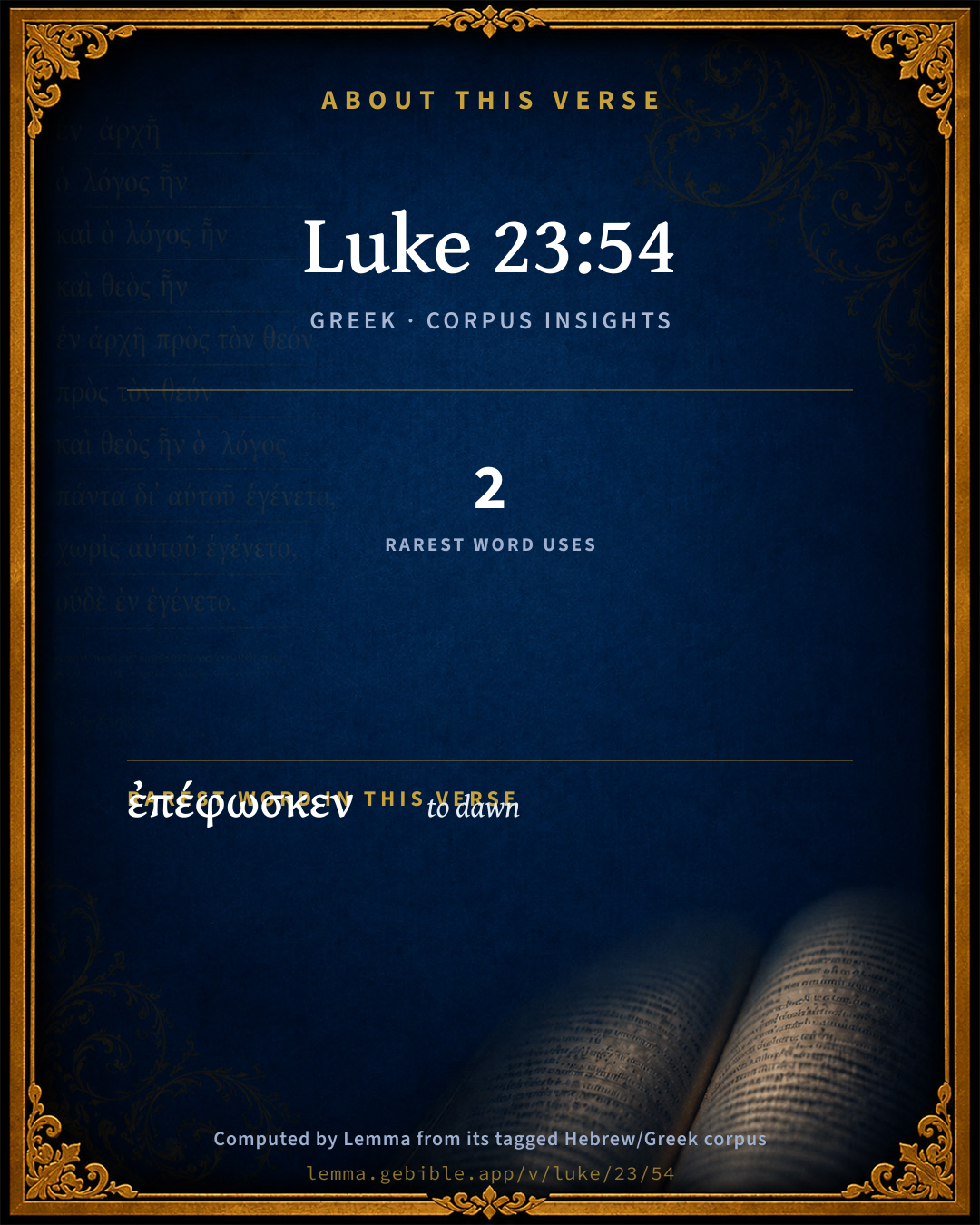
The rarest word here is ἐπέφωσκεν to dawn G2020 — appearing just 2 times in the whole Greek New Testament.

Shared distinctive vocabulary

ἐπέφωσκεν to dawn G2020 occurs in 2 verses of the Greek New Testament. Also found in:

Repetition

A word recurs within this verse:

Cross-references

5

Topical passages linked to Luke 23:54 in the Treasury of Scripture Knowledge — connected by theme and wording, ordered by reader-vote popularity; previews shown in the World English Bible.

  • Matthew 27:62 Now on the next day, which was the day after the Preparation Day, the chief priests and the Pharisees were gathered together to Pilate,
  • John 19:31 Therefore the Jews, because it was the Preparation Day, so that the bodies wouldn't remain on the cross on the Sabbath (for that Sabbath was a special one), asked of Pilate that their legs might be broken, and that they might be taken away.
  • Mark 15:42 When evening had now come, because it was the Preparation Day, that is, the day before the Sabbath,
  • John 19:14 Now it was the Preparation Day of the Passover, at about the sixth hour. He said to the Jews, "Behold, your King!"
  • John 19:42 Then because of the Jews' Preparation Day (for the tomb was near at hand) they laid Jesus there.

Cross-references courtesy of OpenBible.info (CC BY 4.0).

Commentary

Notes on Luke 23:54 from classic Christian and Jewish commentators (each source and its license shown beneath its notes). The classic Christian expositions comment on the surrounding passage and are grouped to its opening verse, so a note may address several verses; the Jewish commentaries on the Tanakh (Rashi and others) are per-verse, so they appear only where the commentator wrote on this verse.

Lemma curates 59 commentaries, every one of them public domain or Creative Commons licensed, each selected and text-cleaned for this edition rather than reprinted as found. About our sources →

Tyndale Open Study Notes

Tyndale Open Resources

23:54 This was done late on Friday afternoon, the day of preparation: The Greek text does not explicitly refer to Friday, but simply to the day of preparation for the Sabbath of Passover week; the Sabbath began Friday evening. • as the Sabbath was about to begin: The body had to be buried quickly, because the Jews could not work during the Sabbath, which began at sunset.

Tyndale Open Study Notes — © Tyndale Open Resources, licensed CC BY-SA 4.0. Text via the HelloAO Bible API.

Bengel's Gnomon

Johann Albrecht Bengel

Luk 23:54. Ἡμέρα ἦν παρασκχευὴ, the day was the preparation) The term παρασκευὴ, is put as an epithet (“It was the preparation-day”).—ἐπέφωσκε, was drawing on [lit. was dawning]) The beginning of the Sabbath was in the evening: and yet the expression used is, was beginning to dawn; for even the night has its own light, especially at the full moon, which was shining at the time.[267]

[267] Rather ἐπέφωσκεν is naturally used, though by catachresis, where day is the subject, even though counted artificially from evening. So the Jews called the evening אוֹר, light, denominating even the beginning of the twenty-four hours day, a potiori parte, viz. the light.—E. and T.

Bengel's Gnomon of the New Testament — English translation (T&T Clark, Edinburgh, 1860) — public domain. Text from a community e-Sword module.

Expositor's Greek Testament

ed. W. Robertson Nicoll

Luk 23:54 . ἐπέφωσκε , was about to dawn, illucescebat , Vulgate. The evening is meant, and the word seems inappropriate. Lk. may have used it as if he had been speaking of a natural day (as in Mat 28:1 ) by a kind of inadvertence, or it may have been used with reference to the candles lit in honour of the day, or following the Jewish custom of calling the night light justified by the text, Psa 148:3 , “Praise Him, all ye stars of light ” ( vide Lightfoot, Hor. Heb. ). Or it may be a touch of poetry, likening the rising of the moon to a dawn. So Casaubon, Exercit. anti-Baronianae , p. 416.

The Expositor's Greek Testament, edited by W. Robertson Nicoll (1897–1910) — public domain. Text from a community e-Sword module.

Geneva Bible (1599)

Geneva Bible translators

Word for word, dawning, as now beginning, for the light of the former day drew toward the going down, and that was the day of preparation for the feast which was to be kept the day following.

Geneva Bible (1599) marginal notes — public domain. Text via Bolls.life.

Adam Clarke's Commentary

Verse 54. And the Sabbath drew on.] Or, The Sabbath was lighting up, επεφωσκε, i.e. with the candles which the Jews light just before six in the evening, when the Sabbath commences. The same word is used for the dawning of the day, Mt 28:1. Wakefield. The Jews always lighted up candles on the Sabbath; and it was a solemn precept that, "if a man had not bread to eat, he must beg from door to door to get a little oil to set up his Sabbath light." The night of the Sabbath drew on, which the Jews were accustomed to call the light. See Lightfoot.

Adam Clarke's Commentary on the Bible (1810–1826) — public domain. Text from a community e-Sword/MySword module.

Ellicott's Commentary for English Readers

(54) That day was the preparation.—See Note on Mat_27:52.

The sabbath drew on.—Literally, the Sabbath was dawning. It is a question whether the word is used here of the actual beginning of the Sabbath—which was, of course, at sunset after the Crucifixion—or, as St. Matthew appears to use it (28:1), for the actual dawn. The later Rabbis appear to have spoken of the day “dawning” in the sense of its beginning at sunset, and so far support the former interpretation. It was possible, however, under the emergencies of the case, that the entombment began before the sunset, and may have been finished during the night, or that, in common speech and usage, the Sabbath, though theoretically beginning on Friday evening at sunset, was not practically recognised till Saturday at sunrise.

A Bible Commentary for English Readers, edited by Charles John Ellicott (1878–1897) — public domain. Text from a community e-Sword module.

The Cambridge Bible for Schools and Colleges

gen. ed. J. J. S. Perowne

54. the preparation] This word paraskeue became the ordinary Greek word for Friday, because on Friday the Jews diligently prepared for the Sabbath, which began at sunset. The afternoon is called prosabbaton in Mar_15:42. Jos. Antt. xvi. 6. We are told that Shammai, the almost contemporary founder of the most rigid school of legalists, used to spend the whole week in meditating how he could best observe the Sabbath.

drew on] Literally, “began to dawn.” This expression is used, although the Sabbath began at sunset (Mar_15:42), because the whole period of darkness was regarded as anticipatory of the dawn. Hence the Jews sometimes called the evening of Friday ‘the daybreak.’ When St John (Joh_19:31) calls the coming Sabbath “a high day,” the expression seems clearly to imply that it was both the Sabbath and the day of the Passover.

The Cambridge Bible for Schools and Colleges (gen. ed. J. J. S. Perowne; Cambridge University Press, 1878–1918) — public domain. Text from a community e-Sword module.

Trapp's Complete Commentary

John Trapp

54 And that day was the preparation, and the sabbath drew on.

Ver. 54. See Mat 27:61.

John Trapp, A Commentary or Exposition upon All the Books of the Old and New Testament (1647–1656) — public domain. Text from a community e-Sword module.

Haydock's Catholic Bible Commentary

Parasceve. That is, the eve or day of preparation for the sabbath. (Challoner) --- And the sabbath drew near. Literally, shined. The sabbath began in the evening, at sunset. It may, perhaps, be said to shine by the moonlight, at full-moon, or because of a great many lights that used to be set up at that time, on account of the great sabbath. (Witham) --- We learn from Maimon, that all the Jews were so strictly bound to keep a light in their dwellings on the sabbath-day, that although a man had not bread to eat, he was expected to be from door to door, to purchase oil for his lamp. (Pastorini)

====================

George Leo Haydock (1774–1849), Haydock's Catholic Family Bible and Commentary, 1859 edition — public domain. Excludes Psalms (Douay-Rheims chapter numbering differs from Protestant) and Deuterocanonical books (Catholic canon only).

Matthew Poole's English Annotations

Greek, σάββατον ἐπέφωσκε, the sabbath shined. What preparation was here intended, whether to the weekly sabbath of the Jews, (that it was most certainly), or to the passover also, which some will have to have been this year put off to that day, because of the concurrence of the weekly and the annual feast, I shall not determine, though the most judicious interpreters skilled in the Hebrew writings, think the passover this year was kept in its season, the night before.

And the sabbath, that is, the seventh day, drew on. The Greek word signifies shined, the propriety of which term hath cost critics some pains to make out, for it rather began to be dark than lightsome, their sabbath beginning after the setting of the sun. Some think the word referred to the evening star, which began to shine. Others, that it referred to a lamp or candle, which they were wont to set up, they call it luminare discriminationis, the light of discrimination, which being set up in their several families, the sabbath was accounted to be begun. Others think it referred to the following day. But there need not much labour in the case, for by the same reason that it is said, the evening and the morning made the sabbath day, the sabbath might be said επιφωσκειν (that is, to begin) when it began to be dark, not taking the word in a proper, but in a metaphorical sense.

Matthew Poole's English Annotations on the Holy Bible (1683–1685) — public domain. Text from a community e-Sword/MySword module.

The Pulpit Commentary

And that day was the preparation, and the sabbath drew on. It was the preparation for the sabbath, but more especially for the great Passover Feast. St. John, for this reason, calls the coming sabbath "a high day." Drew on ; literally began to dawn; although the sabbath began at sunset, the whole time of darkness was regarded as anticipatory of the dawn. The evening of Friday was sometimes even called "the daybreak."

The Pulpit Commentary (1880–1919), ed. H.D.M. Spence-Jones & Joseph S. Exell — public domain. Text from a community e-Sword module.

unfoldingWord translationNotes

Door43 World Missions Community

the Day of the Preparation

"the day when people got ready for the Jewish day of rest called the Sabbath"

the Sabbath was about to begin

For the Jews, the day began at sunset. AT: "it was soon going to be sunset, the start of the Sabbath" (See: Metaphor)

who had come with Jesus out of Galilee

"who had traveled with Jesus from the region of Galilee"

followed and saw the tomb and how his body was laid

This can be translated in active form. AT: "walked along behind Joseph and the men who were with him; the women saw the tomb and how the men laid Jesus' body inside the tomb" (See: Active or Passive)

They returned

"The women went to the houses where the women were staying"

prepared spices and ointments

Because they had had no time to honor Jesus by putting fragrant spices and ointments on his body on the day he died, they were going to do it on the morning of the first day of the week. AT: "prepared spices and ointments to put on Jesus' body" (See: Assumed Knowledge and Implicit Information)

they rested

"the women did no work"

according to the commandment

"according to the Jewish law" or "as the Jewish law required." They were not allowed to prepare his body on the Sabbath according to the law.

translationWords

Sabbath

Galilee

command

unfoldingWord translationNotes — © Distant Shores Media and the Door43 World Missions Community, licensed CC BY-SA 4.0. Source: git.door43.org/Door43/en_tn.

Cambridge Greek Testament for Schools and Colleges

54. παρασκευῆς, אBL, Vulg[394] Copt. Sah[395] La[396] Ti[397]

[394] Vulg. Vulgate.

[395] Sah. Sahidic Version.

[396] La. Lachmann.

[397] Ti. Tischendorf.

54. παρασκευῆς. This word παρασκευὴ became the ordinary Greek word for Friday, because on Friday the Jews diligently prepared for the Sabbath, which began at sunset. The afternoon is called προσάββατον in Mar 15:42. Jos. Antt. XVI. 6. We are told that Shammai, the almost contemporary founder of the most rigid school of legalists, used to spend the whole week in meditating how he could best observe the Sabbath. Caspari rightly observes that if the day of the Crucifixion had been Nisan 15 the actual day of the Passover Feast, and not Nisan 14 the day before the Feast, it is inconceivable that St Luke should merely have used the ordinary Jewish word for Friday, and spoken of the day, not as the Great Passover Day, but only as the Preparation for the Sabbath.

ἐπέφωσκεν. Literally, “began to dawn.” This expression is used, although the Sabbath began at sunset (Mar 15:42), because the whole period of darkness was regarded as anticipatory of the dawn. Hence the Rabbis sometimes called the evening of Friday ‘the daybreak.’ When St John (Joh 19:31) calls the coming Sabbath “a high day,” the expression seems clearly to imply that it was both the Sabbath and the day of the Passover.

Cambridge Greek Testament for Schools and Colleges (Cambridge University Press, 1896; 21 vols, various authors incl. Carr, Maclear, Plummer, Farrar, Lumby, Moule, M. R. James, Simcox) — public domain. Text from a community e-Sword module.

Alford’s Greek Testament

Henry Alford

54.] παρασκευή—‘the day before the sabbath,’—which now ἐπέφωσκεν, drew on;—a natural word, used of the conventional (Jewish) day beginning at sunset. There is no reference to the lighting of candles in the evening or on the sabbath. Lightfoot (in loc.) has shewn that such use of the word was common among the Jews, who called the evening (the beginning) of a day אוֹר, ‘light.’

Henry Alford, The Greek Testament (1849–1861) — public domain. Text from a community e-Sword module.

International Critical Commentary

54. παρασκευῆς. The word may mean either the eve of the sabbath or the eve of the Passover: and on this occasion the sabbath probably coincided with Nisan 15, the first day of the Passover. This fist day ranked as a sabbath (Exo 12:16; Lev 23:7), and therefore was doubly holy when it coincided with an ordinary sabbath. If the Passover had begun the previous evening, would Lk. and Mk. (15:42) speak of its first day as the eve of an ordinary sabbath? Just as we should hardly speak of “the first Sunday in April,” if that Sunday was Easter Day. But, although the day was a παρασκευή to both sabbath and Passover, it is the former that is probably meant. Comp, Mar 15:42. Caspari (§ 157) would take it the other way.

For παρασκευῆς (א B C* L 13 346, cenæ puræ a b c l parasceues Vulg.) A C2 P X etc., f ff2 have παρασκευή, Syr-Cur. feria sexta. For the whole verse D substitutes ἦν δὲ ἡ ἡμέρα προσαββάτου erat autem dies antesabbatum.

σάββατον ἐπέφωσκεν. An inaccurate expression; because the sabbath began, not at dawn, but at sunset. But “it was dawning” easily comes to mean “it was beginning,” and is transferred to things which cannot “dawn.” In the Gospel of Peter, when Pilate before the Crucifixion asks Herod for the body of Jesus, Herod replies that in any case the body would have been buried that day, ἐπεὶ καὶ σάββατον ἐπιφώσκει, γεγραπται γὰρ ἐν τῷ νόμῳ, ἥλιον μὴδῦναι ἐπὶ πεφονευμένῳ. The verb has nothing to do with lighting lamps at the beginning of the sabbath (J. Lightfoot, Wetst.), nor is the rising of the stars or the glow of sunset meant (Hahn).

International Critical Commentary — older volumes (1896–1929), various authors — public domain. Text from a community e-Sword module.

Lesson kit

Teaching starters — assembled from the data on this page, not authored interpretation. Every prompt links to the verse data it draws on. Edit before teaching.

Luke, in the Gospels, opens this verse with 7 words (6 distinct Greek lemmas). Its most distinctive word is epiphṓskō (“to dawn”). A historical commentator’s framing appears above. Read the whole chapter for the surrounding context.

Discussion questions

  1. What does “to dawn” (epiphṓskō) contribute to the verse as a whole?
  2. How does Matthew 28:1, which shares the word «to dawn», read alongside this verse?
  3. What does the repetition of “and” (2× in this one verse) do in this verse?
  4. These translations render this verse differently. What is at stake in choosing one wording over another?
  5. Compare how Tyndale Open Study Notes and Bengel's Gnomon read this verse. Where do they agree or differ?

Things to notice

  • These translations choose different wording for 4 words in this verse.
  • “and” occurs 2× in this single verse.
  • 6 distinct Greek lemmas span 7 words in this verse.

Reading settings

Reading text

Shown beneath each verse's original-language words.

Old Testament
Old Testament edition

Read the OT as the Masoretic Hebrew (MT) or the Greek Septuagint (LXX).

English shown for the Greek Septuagint (in the Hebrew ↔ Greek comparison).

Comparing translations? Open the Compare panel on any verse page to stack up to four side by side.