Exodus 31:16

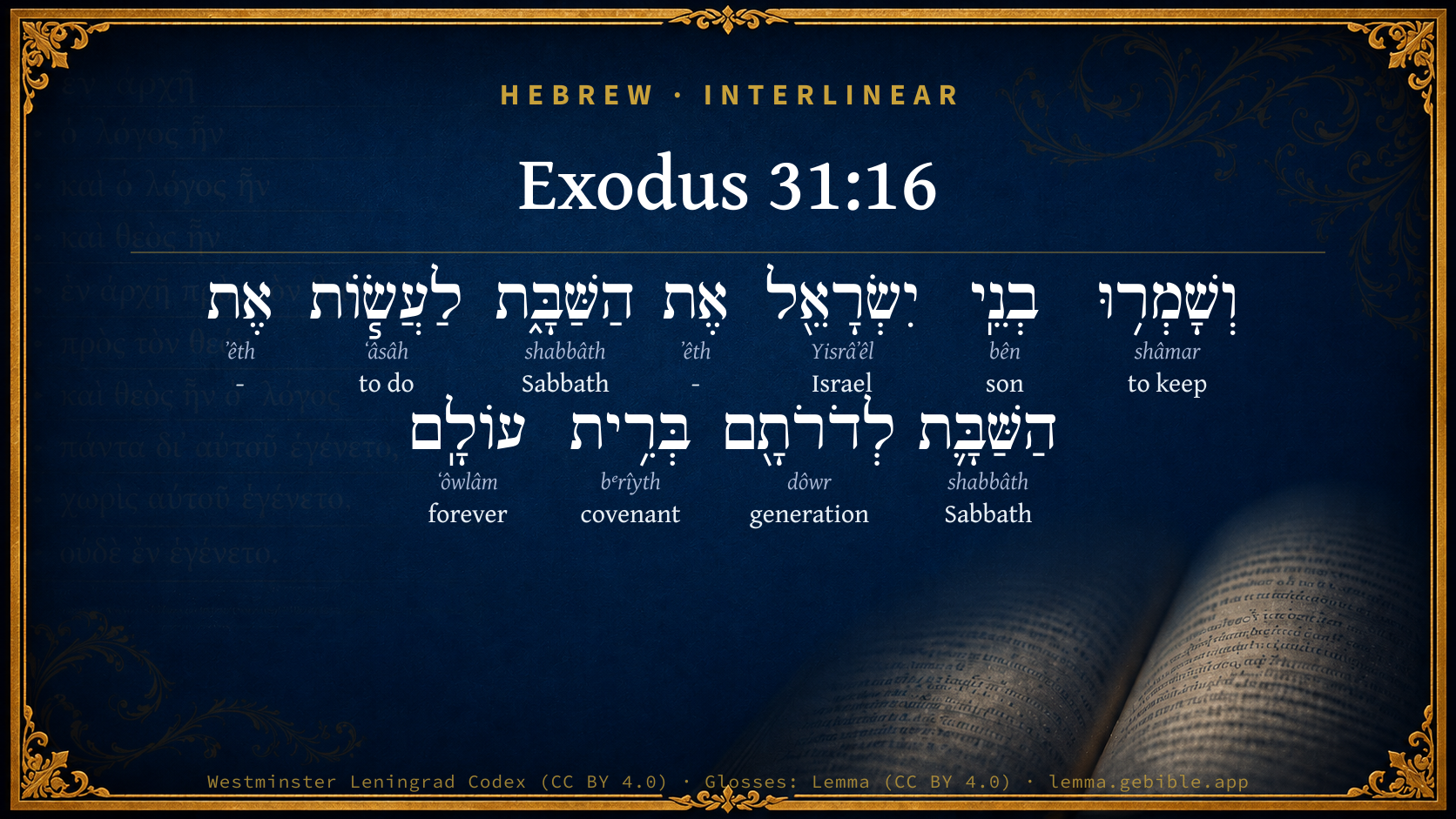
Hebrew (Westminster Leningrad Codex) Exodus 31:16 appears in the Hebrew Old Testament. The text above is from the Westminster Leningrad Codex. Each word links to its Strong’s number, a concise gloss, and parsing drawn from the Open Scriptures Hebrew Bible morphology. Click any word for its full Brown-Driver-Briggs (BDB) entry.
Download image
Cite this verse

Exodus 31:16 (World English Bible). Public Domain. Lemma interlinear Bible study tool, https://lemma.gebible.app/v/exodus/31/16.

Show BibTeX & RIS
BibTeX
RIS
English Translation
Therefore the children of Israel shall keep the Sabbath, to observe the Sabbath throughout their generations, for a perpetual covenant.
World English Bible · Public Domain
Download a study sheet

One document with this verse’s original text, its word-by-word gloss line, the meaning frame, cross-references with their text, attributed commentary, and full source and license credits — printable, and it pastes into notes with its structure intact.

This verse Autodidact and up

Study sheet (.html) Plain text (.txt)

A passage Seminary Student

Up to 50 verses in one chapter. A passage sheet keeps up to 6 commentary sources and 12 cross-references per verse, in the order this page ranks them, and says so on the sheet whenever that leaves anything out. Ask for a single verse and you get the Autodidact verse sheet above.

Everything on this page stays free to read, with no account — the sheet is a download of what is already on screen, not access to it.

Want to remove ads? Support Godless Engineer
Compare translations 3

The same verse in 3 English versions, stacked beneath the original-language interlinear above. Click any original word for its lexicon entry.

Each is an independent rendering of the whole verse — the interlinear is not word-aligned to these translations.

Highlighted words mark where these versions differ — a whole-verse word diff, not a word-by-word alignment.

  • World English Bible Public Domain
    Therefore the children of Israel shall keep the Sabbath, to observe the Sabbath throughout their generations, for a perpetual covenant.
  • King James Version Public Domain
    Wherefore the children of Israel shall keep the sabbath, to observe the sabbath throughout their generations, for a perpetual covenant.
  • unfoldingWord Literal Text CC BY-SA 4.0
    And the sons of Israel shall keep the Sabbath to celebrate the Sabbath throughout their generations. A covenant of eternity

unfoldingWord Literal Text — © unfoldingWord, licensed CC BY-SA 4.0. Word-aligned USFM3 via Door43 (git.door43.org/unfoldingWord/en_ult).

Versions to compare (up to 4)

3 of 4 selected

Show all 18 translations

Every available English version of this verse, each an independent rendering of the whole verse.

  • World English Bible Public Domain
    Therefore the children of Israel shall keep the Sabbath, to observe the Sabbath throughout their generations, for a perpetual covenant.
  • Berean Standard Bible Public Domain
    The Israelites must keep the Sabbath, celebrating it as a permanent covenant for the generations to come.
  • Majority Standard Bible Public Domain
    The Israelites must keep the Sabbath, celebrating it as a permanent covenant for the generations to come.
  • King James Version Public Domain
    Wherefore the children of Israel shall keep the sabbath, to observe the sabbath throughout their generations, for a perpetual covenant.
  • American Standard Version (1901) Public Domain
    Wherefore the children of Israel shall keep the sabbath, to observe the sabbath throughout their generations, for a perpetual covenant.
  • Revised Version (1885) Public Domain
    Wherefore the children of Israel shall keep the sabbath, to observe the sabbath throughout their generations, for a perpetual covenant.
  • Geneva Bible (1599) Public Domain
    Wherfore the children of Israel shall keepe the Sabbath, that they may obserue the rest throughout their generations for an euerlasting couenant.
  • Douay-Rheims (1899) Public Domain
    Let the children of Israel keep the sabbath, and celebrate it in their generations. It is an everlasting covenant
  • Young's Literal Translation Public Domain
    and the sons of Israel have observed the sabbath; to keep the sabbath to their generations `is' a covenant age-during,
  • Literal Standard Version CC BY-SA 4.0
    and the sons of Israel have observed the Sabbath; to keep the Sabbath throughout their generations [is] a perpetual covenant—
  • Unlocked Literal Bible CC BY-SA 4.0
    Therefore the Israelites must keep the Sabbath. They must observe it throughout their people's generations as a permanent law.
  • unfoldingWord Literal Text CC BY-SA 4.0
    And the sons of Israel shall keep the Sabbath to celebrate the Sabbath throughout their generations. A covenant of eternity
  • Darby Bible Public Domain
    And the children of Israel shall keep the sabbath, to observe the sabbath throughout their generations -- [it is] an everlasting covenant.
  • World Messianic Bible Public Domain
    Therefore the children of Israel shall keep the Sabbath, to observe the Sabbath throughout their generations, for a perpetual covenant.
  • Webster's Bible Public Domain
    Wherefore the children of Israel shall keep the sabbath, to observe the sabbath throughout their generations, for a perpetual covenant.
  • Free Bible Version CC BY-SA 4.0
    The Israelites must keep the Sabbath, observing the Sabbath as an everlasting agreement for generations to come.
  • Bible in Basic English Public Domain
    And the children of Israel are to keep the Sabbath holy, from generation to generation, by an eternal agreement.
  • JPS Tanakh (1917) Public Domain
    Wherefore the children of Israel shall keep the sabbath, to observe the sabbath throughout their generations, for a perpetual covenant.

Literal Standard Version (2020), Covenant Press — licensed CC BY-SA 4.0. Text via the HelloAO Bible API (eBible.org). Unlocked Literal Bible (unfoldingWord) — licensed CC BY-SA 4.0. Text via the HelloAO Bible API (eBible.org). unfoldingWord Literal Text — © unfoldingWord, licensed CC BY-SA 4.0. Word-aligned USFM3 via Door43 (git.door43.org/unfoldingWord/en_ult). Free Bible Version, Dr. Jonathan Gallagher — licensed CC BY-SA 4.0. Text via the HelloAO Bible API (eBible.org).

Word by word

More ways to search: Search by grammar → Find every occurrence → Compare this word →

Practice this passage: Drill this verse → Learn its vocabulary →

הַשַּׁבָּ֑ת
shabbâth
H7676
“the · Sabbath”
Particle, Definite Article + Noun, Common, Both, Singular, Absolute
Part of Speech
Particle + Noun
Type
Common
Gender
Both
Number
Singular
State
Absolute
Full BDB Definition

Origin: intensive from H7673

TWOT: 2323b

Sabbath - sabbath - day of atonement - sabbath year - week - produce (in sabbath year)
  1. וְשָׁמְר֥וּ shâmar H8104 “and · to keep” Conjunction + Verb, Qal, Sequential Perfect, 3rd Person, Common, Plural
  2. בְנֵֽי bên H1121 “sons of” Noun, Common, Masculine, Plural, Construct
  3. יִשְׂרָאֵ֖ל Yisrâʼêl H3478 “Israel” Noun, Proper
  4. אֶת ʼêth H853 “-” Particle, Direct Object
  5. לַעֲשׂ֧וֹת ʻâsâh H6213 “to do” Preposition + Verb, Qal, Infinitive Construct
  6. אֶת ʼêth H853 “-” Particle, Direct Object
  7. הַשַּׁבָּ֛ת shabbâth H7676 “the · Sabbath” Particle, Definite Article + Noun, Common, Both, Singular, Absolute
  8. לְדֹרֹתָ֖ם dôwr H1755 “to/for · generations · their” Preposition + Noun, Common, Masculine, Plural, Construct + Suffix, Personal, 3rd Person, Masculine, Plural
  9. בְּרִ֥ית bᵉrîyth H1285 “covenant of” Noun, Common, Feminine, Singular, Construct
  10. עוֹלָֽם ʻôwlâm H5769 “forever” Noun, Common, Masculine, Singular, Absolute

About this verse

These counts appear in no published source. They are computed here, from the morphology-tagged text and Lemma’s own curated glosses. What Lemma adds →

11
words
9
distinct lemmas
Pentateuch
section

Grammatical profile

  • 2 verbs
  • 7 nouns
  • 2 particles

Verb forms

  • וְשָׁמְר֥וּ Qal · Sequential Perfect
  • לַעֲשׂ֧וֹת Qal · Infinitive Construct

Repetition

A word recurs within this verse — often emphatic in Hebrew:

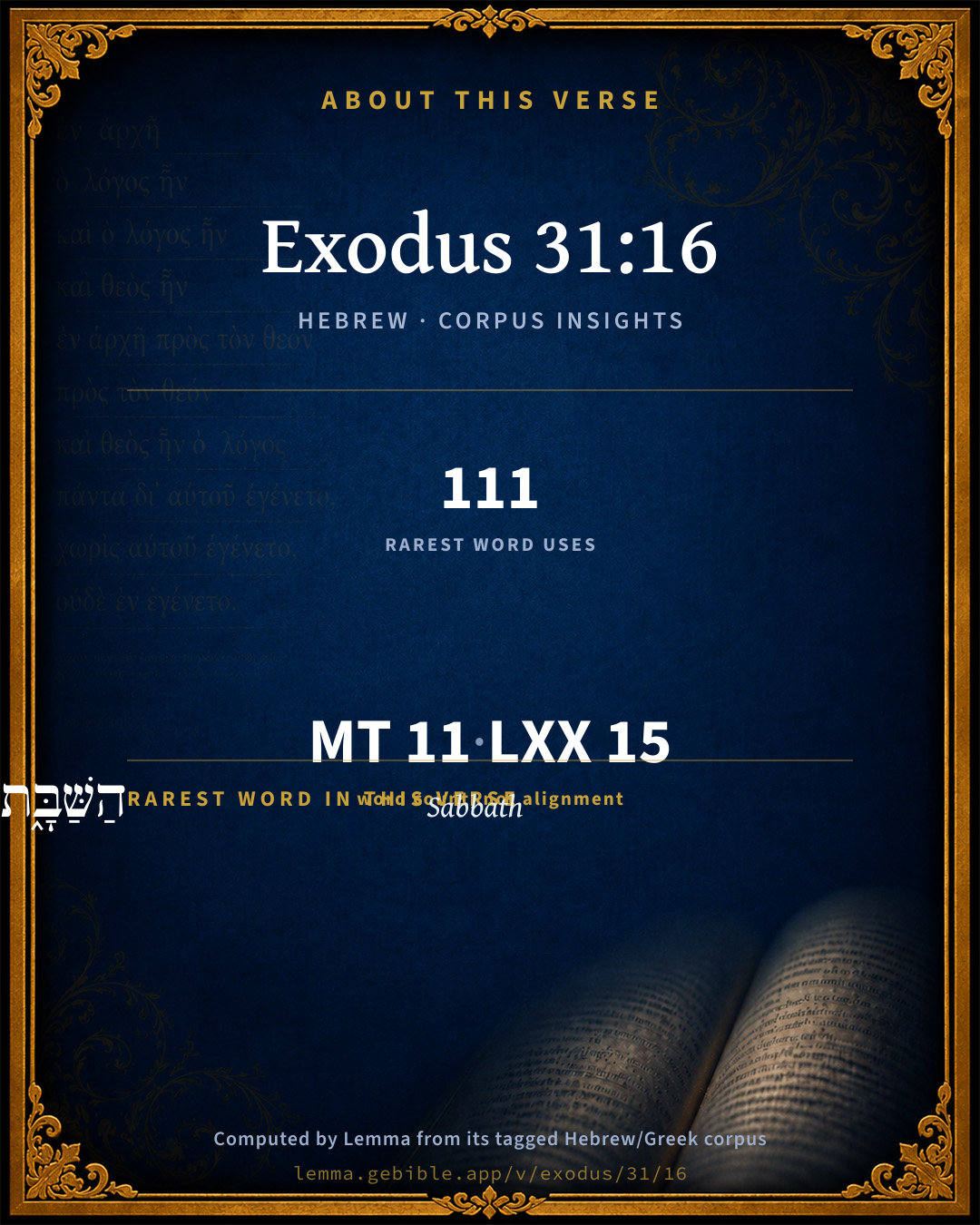
  • הַשַּׁבָּ֑ת Sabbath H7676 ×2

Hebrew & Septuagint length

In English translation the verse runs 20 words from the Hebrew and 15 from the Septuagint (LXX English) — closely comparable.

A rough comparison of the two English renderings, which tokenize alike — not a word-level alignment.

Word counts can differ between the Hebrew and the Greek without any difference in meaning — e.g. the Hebrew direct-object marker אֵת has no separate Greek word, and Greek often adds the article ὁ.

In the original languages it is 11 Hebrew tokens and 15 Greek tokens — but the two are counted differently (Hebrew bundles its prefixes and suffixes into one token; the Greek is in lemma form), so that isn’t a like-for-like length.

Cross-references

3

Topical passages linked to Exodus 31:16 in the Treasury of Scripture Knowledge — connected by theme and wording, ordered by reader-vote popularity; previews shown in the World English Bible.

  • Jeremiah 50:5 They shall inquire concerning Zion with their faces turned toward it, [saying], Come you, and join yourselves to Yahweh in an everlasting covenant that shall not be forgotten.
  • Genesis 17:11 You shall be circumcised in the flesh of your foreskin. It will be a token of a covenant between me and you.
  • Genesis 9:13 I set my rainbow in the cloud, and it will be for a sign of a covenant between me and the earth.

Cross-references courtesy of OpenBible.info (CC BY 4.0).

Hebrew and Greek witnesses Masoretic Hebrew ↔ Greek Septuagint

The same verse in the two great witnesses to the Old Testament, shown verse-for-verse.

These are two independent witnesses, not word-aligned to each other, and the Septuagint is shown in lemma (dictionary) form.

Hebrew Exodus 31:16 Masoretic · Westminster Leningrad Codex

וְשָׁמְר֥וּ בְנֵֽי יִשְׂרָאֵ֖ל אֶת הַשַּׁבָּ֑ת לַעֲשׂ֧וֹת אֶת הַשַּׁבָּ֛ת לְדֹרֹתָ֖ם בְּרִ֥ית עוֹלָֽם

Therefore the children of Israel shall keep the Sabbath, to observe the Sabbath throughout their generations, for a perpetual covenant.

World English Bible · Public Domain

Greek LXX Exodus 31:16 Septuagint · lemma form

καί φυλάσσω ὁ υἱός ἰσραήλ ὁ σάββατον ποιέω αὐτός εἰς ὁ γενεά αὐτός διαθήκη αἰώνιος

And the children of Israel shall keep the sabbaths, to observe them throughout their generations.

LXX2012 (modern English Septuagint) · Public Domain

Hebrew: Westminster Leningrad Codex (CC BY 4.0). Greek: Septuagint (public domain); English from LXX2012 (modern English Septuagint) (Public Domain). How the Septuagint differs from the Hebrew →

Targum (Aramaic paraphrase)

2

The Targum is the ancient Jewish Aramaic paraphrase of the Hebrew Scriptures — an interpretive translation, not the Hebrew text itself. Onkelos (literal) and Pseudo-Jonathan (expansive) render the Torah, and Jonathan the Prophets. Coverage is partial: where no permissively-licensed English translation exists for a verse, only the Aramaic is shown. This is verse-level text, not a word-by-word alignment to the Hebrew.

  1. Targum Onkelos Torah (Genesis–Deuteronomy)
    וְיִטְרוּן בְּנֵי יִשְׂרָאֵל יָת שַׁבְּתָא לְמֶעְבַּד יָת שַׁבְּתָא לְדָרֵיהוֹן קְיַם עָלָם:

    (no public-domain English translation for this verse)

    Targum Onkelos — Aramaic: “Onkelos Genesis” (public domain); “Onkelos Exodus” (public domain); “Onkelos Leviticus” (public domain); “Onkelos Numbers” (public domain); “Onkelos Deuteronomy” (public domain). English: “Sefaria Community Translation” (CC0 1.0 (public-domain dedication)); “J.W. Etheridge. The Targums of Onkelos and Jonathan Ben Uzziel on the Pentateuch. London: Longmans, Green, 1862” (public domain). Text via Sefaria.

  2. Targum Pseudo-Jonathan Torah (Genesis–Deuteronomy)
    וְיִנְטְרוּן בְּנֵי יִשְרָאֵל יַת שַׁבְּתָא לְמֶעֱבַד תַּפְנוּקֵי שַׁבְּתָא לְדָרֵיהוֹן קְיַים עֲלָם

    The sons of Israel shall therefore keep the Sabbath, to perform the delightful exercises of the Sabbath; (it is) for your generations an everlasting statute;

    Targum Pseudo-Jonathan — Aramaic: “Targum Jonathan on Genesis” (public domain); “Targum Jonathan on Exodus” (public domain); “Targum Jonathan on Leviticus” (public domain); “Targum Jonathan on Numbers” (public domain); “Targum Jonathan on Deuteronomy” (public domain). English: “The Targum of Jonathan ben Uzziel, trans. J. W. Etheridge, London, 1862” (public domain). Text via Sefaria.

Commentary

Notes on Exodus 31:16 from classic Christian and Jewish commentators (each source and its license shown beneath its notes). The classic Christian expositions comment on the surrounding passage and are grouped to its opening verse, so a note may address several verses; the Jewish commentaries on the Tanakh (Rashi and others) are per-verse, so they appear only where the commentator wrote on this verse.

Lemma curates 59 commentaries, every one of them public domain or Creative Commons licensed, each selected and text-cleaned for this edition rather than reprinted as found. About our sources →

Trapp's Complete Commentary

John Trapp

Exo 31:16 Wherefore the children of Israel shall keep the sabbath, to observe the sabbath throughout their generations, [for] a perpetual covenant.

Ver. 16. For a perpetual covenant.] So the Sabbath is called by way of eminency; as if nothing of God’s covenant were kept, if this were not Philo Judaeus saith, The fourth commandment is a famous precept, and profitable to excite all kind of virtue and piety.

John Trapp, A Commentary or Exposition upon All the Books of the Old and New Testament (1647–1656) — public domain. Text from a community e-Sword module.

Geneva Bible (1599)

Geneva Bible translators

Or, Sabbath.

Geneva Bible (1599) marginal notes — public domain. Text via Bolls.life.

Adam Clarke's Commentary

Verse 16. A perpetual covenant.] Because it is a sign of this future rest and blessedness, therefore the religious observance of it must be perpetually kept up. The type must continue in force till the antitype come.

Adam Clarke's Commentary on the Bible (1810–1826) — public domain. Text from a community e-Sword/MySword module.

The Cambridge Bible for Schools and Colleges

gen. ed. J. J. S. Perowne

16. Wherefore] The Heb. is simply And.

to observe] to hold. See on Exo_12:47.

a perpetual (or, as the same Heb. is rendered elsewhere, everlasting) covenant] An expression frequent in P: Gen_9:16 (of the rainbow), Gen_17:7; Gen_17:13; Gen_17:19 (of circumcision), Lev_24:8, cf. Num_18:19; Num_25:13; also Eze_16:60; Eze_37:26, Jer_50:5, Isa_24:5; Isa_55:3; Isa_61:8, Psa_105:10†. Here, as the context shews (cf. p. 175), the stress lies not on the divine promise, but on Israel’s obligation to observe the terms on which the covenant is based.

16, 17. The main thoughts of vv. 13–15 repeated, and emphasized, in P’s manner: cf. on Exo_6:27.

The Cambridge Bible for Schools and Colleges (gen. ed. J. J. S. Perowne; Cambridge University Press, 1878–1918) — public domain. Text from a community e-Sword module.

John Gill's Exposition

Wherefore the children of Israel shall keep the sabbath,.... On whom the sabbath of the seventh day was only enjoined, as well as that of the seventh and of the fiftieth years, being all ceremonial and shadowy:

to observe the sabbath throughout their generations; so long as the Mosaic dispensation lasted, and their civil polity and church state continued, even until the Messiah came, when all those Jewish shadows, rites, and ceremonies, fled away and disappeared:

for a perpetual covenant; just in the same sense as circumcision was, Gen 17:13.

John Gill's Exposition of the Whole Bible (1746–1763) — public domain (CC PDM 1.0). Text via the HelloAO Bible API.

Matthew Poole's English Annotations

Or, shall keep the sabbath by observing or celebrating the sabbath, i. e. by observing or celebrating it, the antecedent being put for the relative, as is frequently done. So here is another most emphatical repetition to oblige us to the greater caution and diligence in this great duty, and to show what stress God lays upon it, who hath therefore placed this in the midst of the commands of the decalogue, as the heart which gives life and rigour to all the rest. Or it may be rendered thus; shall observe the day of rest to celebrate the sabbath; and so the phrase is like that in the fourth command, Remember the sabbath day to keep it holy. So here, Observe the sabbath. i.e. watch its coming and approach, consider attentively the nature and use of it, and that not as a matter of idle speculation, but of serious practice; or, so that you may do or celebrate the sabbath, i.e. perform all the duties of it. Or thus, shall observe the sabbath, to make it a sabbath or day of rest, and that no idle or carnal rest, but a rest, holy to the Lord, as it is called in the foregoing verse.

For a perpetual covenant, or, by a perpetual covenant, or, it is a perpetual covenant, i. e. condition or part of that agreement made between me and them. They have solemnly covenanted or promised that they will do all that I commanded them, Exo 24:7,8, among which this is a chief branch; and I have covenanted to bless and sanctify them in so doing. And this word perpetual, as also the word for ever, being added to it in the next verse, may intimate that this hath a longer perpetuity than the ceremonies, to which this phrase is sometimes ascribed, the rather because the reason of this perpetuity given in the next verse is such as hath its force not only till Christ, but even till the end of the world, and it is fit and just that men should retain this monument or memorial of the world’s creation even till its dissolution.

Matthew Poole's English Annotations on the Holy Bible (1683–1685) — public domain. Text from a community e-Sword/MySword module.

The Pulpit Commentary

For a perpetual covenant. The sabbath is itself a covenanti.e. , a part of the covenant between God and Israel (Exo_24:4) and it is, also, a sign of covenanti.e. , a perceptible indication that the nation has entered into a special agreement with God, and undertaken the observance of special laws.

The Pulpit Commentary (1880–1919), ed. H.D.M. Spence-Jones & Joseph S. Exell — public domain. Text from a community e-Sword module.

John Wesley's Explanatory Notes

It was to be observed throughout their generations, in every age, for a perpetual covenant - This was to be one of the most lasting tokens of the covenant between God and Israel.

John Wesley, Explanatory Notes Upon the Whole Bible (1754–1765) — public domain. Text via the GEBible commentary corpus.

unfoldingWord translationNotes

Door43 World Missions Community

General Information:

Yahweh continues telling Moses what he must tell the people of Israel.

must keep the Sabbath

God speaks of obeying his instructions about the Sabbath as keeping the Sabbath. AT: "must obey Yahweh's instructions about the Sabbath" (See: Metaphor)

They must observe it throughout their people's generations

"They and all the generations of their descendants must observe it." See how you translated "throughout their people's generations" in Exodus 12:42.

permanent law

"a law the will not end." See how you translated this in Exodus 28:43.

translationWords

Israel

Sabbath

generation

sign

heaven

earth

rest

unfoldingWord translationNotes — © Distant Shores Media and the Door43 World Missions Community, licensed CC BY-SA 4.0. Source: git.door43.org/Door43/en_tn.

Lesson kit

Teaching starters — assembled from the data on this page, not authored interpretation. Every prompt links to the verse data it draws on. Edit before teaching.

Exodus, in the Pentateuch, opens this verse with 11 words (9 distinct Hebrew lemmas). Its most distinctive word is shabbâth (“Sabbath”). A historical commentator’s framing appears above. Read the whole chapter for the surrounding context.

Discussion questions

  1. The word shabbâth carries the sense “Sabbath.” How does it shape the verse?
  2. How does Jeremiah 50:5, which shares this passage’s theme, read alongside this verse?
  3. What does the repetition of “Sabbath” (2× in this one verse) do in this verse?
  4. These translations render this verse differently; the difference is in the English rendering, not the original. What questions does that raise?
  5. «וְשָׁמְר֥וּ» is a Qal Sequential Perfect verb. How does that grammatical form shape the action described?
  6. Compare how Trapp's Complete Commentary and Geneva Bible (1599) read this verse. Where do they agree or differ?

Things to notice

Reading settings

Reading text

Shown beneath each verse's original-language words.

Old Testament
Old Testament edition

Read the OT as the Masoretic Hebrew (MT) or the Greek Septuagint (LXX).

English shown for the Greek Septuagint (in the Hebrew ↔ Greek comparison).

Comparing translations? Open the Compare panel on any verse page to stack up to four side by side.