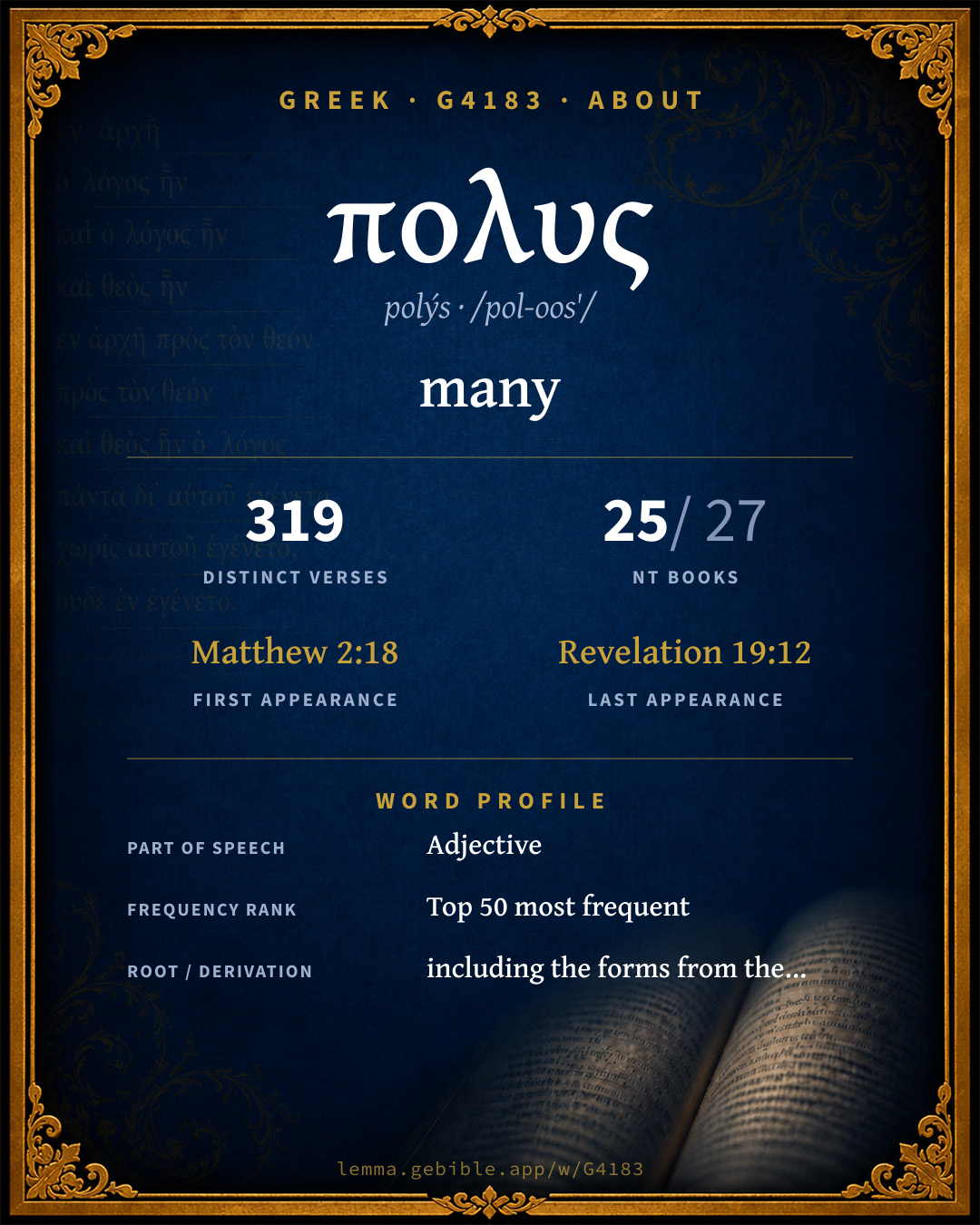
πολυς
many
Full lexicon entry — Thayer's Greek Lexicon
From Thayer's Greek Lexicon
Where this word appears
See every Accusative-case word in the Greek New Testament →
Grammar key — what these labels mean
Part of speech
- Adjective
- A word that describes or qualifies a noun.
Case
- Nominative
- The case of the subject (and the predicate nominative).
- Accusative
- The case of the direct object and of extent.
- Genitive
- The case of source, possession, or “of” — answers “whose / from what.”
- Dative
- The case of the indirect object, means, or location — “to / for / with / in.”
Gender
- Masculine
- Grammatically masculine.
- Neuter
- Grammatically neuter.
- Feminine
- Grammatically feminine.
Number
- Plural
- More than one.
- Singular
- One.
2 verses where G4183 appears in the Dative case in the Book of 1 Timothy. Filtered view — show all forms. Click any verse to open its interlinear word-by-word view. Verse text shown in the World English Bible for context — . Each verse’s Greek form is shown with its reference; the English is not keyword-highlighted, since the data carries no word-level English alignment. Use “Compare translations” on any verse to read it across multiple English versions. This concordance covers the Greek New Testament; Septuagint (Greek Old Testament) occurrences of this word are not indexed here.
1 Timothy
- 1 Timothy 3:8 πολλῷ adj dat sg masc Deacons, in the same way, must be reverent, not double-tongued, not addicted to much wine, not greedy for money;
- 1 Timothy 6:10 πολλαῖς adj dat pl fem For the love of money is a root of all kinds of evil. Some have been led astray from the faith in their greed, and have pierced themselves through with many sorrows.
About this entry
At a glance — auto-summarized from this page’s data, not written by a person. Every figure links to its source below. This summary describes the numbers; it doesn’t interpret them.
The Greek adjective πολυς centers on the idea of “many.” Debuting at Matthew 2:18, it then recurs through the corpus. Spanning 319 verses in 25 books, it ranks among the common words of the Greek New Testament. Sharing its root, it stands alongside πλειστος, πλειων and πολλακις. For the data behind this summary, explore the sense tree and the renderings breakdown below.
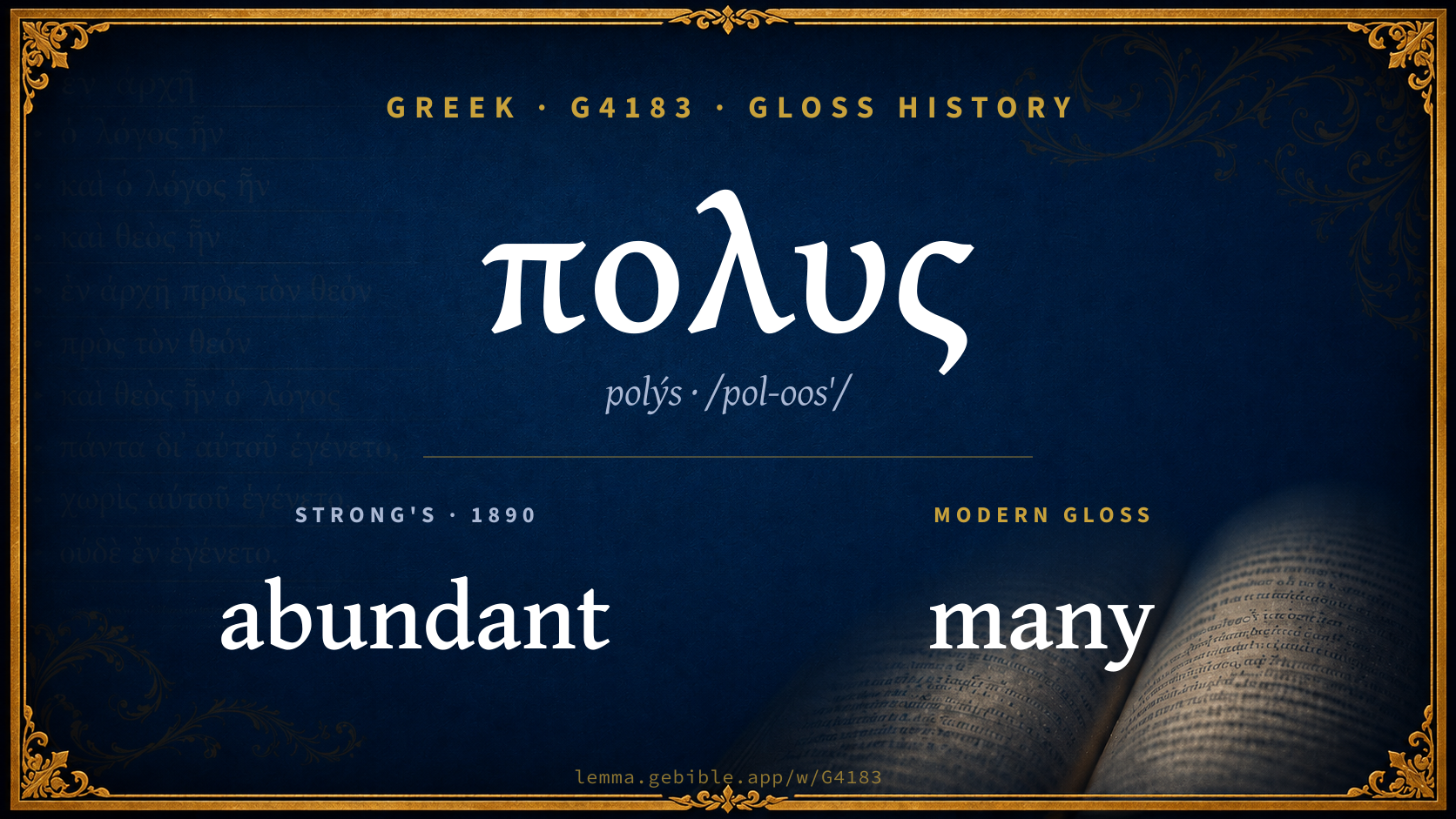
Gloss history
Strong's 1890 vs modern scholarship
About this word
Strong's G4183 catalogs a Greek word from the Greek New Testament.
These counts are not copied from any lexicon or concordance. They are computed here, from the morphology-tagged Greek New Testament. What Lemma adds →
- 319
- distinct verses
- The word appears in 319 distinct verses.
- 25 / 27
- NT books
- The word appears in 25 of 27 New Testament books.
- #50
- by frequency
- Top 50 most frequent Greek words (rank 50 of 5,347 Greek words by occurrence).
View all 319 occurrences in the concordance →
By section of the New Testament
By traditional corpus
Conventional, traditional groupings — biblical authorship is debated, so this is a traditional corpus grouping, not an authorship claim. Some books belong to more than one corpus (Luke is in both the Gospels and the Lukan corpus, and so on), so these shares overlap and need not total 100%. Each figure is a share of the word’s 319 distinct verses.
- Gospels 173 verses · 54%
- Lukan (Luke–Acts) 89 verses · 28%
- Pauline corpus 71 verses · 22%
- Johannine 53 verses · 17%
- Revelation 13 verses · 4%
- General (Catholic) Epistles 10 verses · 3%
- Hebrews 7 verses · 2%
How translations render this word
Counts come from each version’s own published word-to-Strong’s tagging or interlinear alignment — an approximate guide to how each version renders this word, not a word-level alignment the data otherwise carries. Because each total is that version’s own tagged count, the per-version totals vary from one another and need not match the appearance or distinct-verse counts above. These counts may also differ from a printed concordance because Lemma counts each distinctly tagged rendering and does not collapse phrase taggings into a single head-word total. This is a fixed set of word-tagged versions (KJV, ASV, BSB, ULT) and does not change with the reading translation you choose elsewhere. Each version’s license is shown beside its name below (and on Sources).
- King James Version: Many 172×, Much 72×, Great 56×
- American Standard Version: Many 170×, Much 63×, Great 53×
- Berean Standard Bible: Many 167×, Great 37×, Large 30×
- unfoldingWord Literal Text: Many 189×, Much 63×, Great 31×
King James Version Public Domain
Renders G4183 across 364 tagged occurrences — most commonly:
Plus 24 renderings that appear only once — usually multi-word phrases or single function words the recovered tagging swept in, not distinct renderings. Not rendered by a distinct English word in 3 further occurrences.
American Standard Version Public Domain
Renders G4183 across 354 tagged occurrences — most commonly:
Plus other, less common renderings. Plus 28 renderings that appear only once — usually multi-word phrases or single function words the recovered tagging swept in, not distinct renderings.
Berean Standard Bible Public Domain
Renders G4183 across 338 tagged occurrences — most commonly:
Plus other, less common renderings. Plus 33 renderings that appear only once — usually multi-word phrases or single function words the recovered tagging swept in, not distinct renderings. Not rendered by a distinct English word in 14 further occurrences.
unfoldingWord Literal Text CC BY-SA 4.0
Renders G4183 across 343 tagged occurrences — most commonly:
Plus other, less common renderings. Plus 7 renderings that appear only once — usually multi-word phrases or single function words the recovered tagging swept in, not distinct renderings.
Senses in Thayer's
The 1 sense Thayer's distinguishes for this word, in lexicon order (not ranked by frequency or importance). The full entry — with sub-senses — is in the Lexicon Entry tab.
- many, much, large
Word origin
Origin: including the forms from the alternate pollos
Including the forms from the alternate pollos; (singular) much (in any respect) or (plural) many ; neuter (singular) as adverb largely ; neuter (plural) as adverb or noun often mostly largely : - abundant + altogether common + far (passed spent) (+ be of a) great (age deal -ly while) long many much oft (-en [-times]) plenteous sore straitly. Compare G4118 G4119 .
— Strong’s Exhaustive Concordance (1890), public domain.
Forms in the corpus
The 30 distinct written forms G4183 takes in the Greek New Testament, most frequent first — each parse links to that case’s occurrences in the concordance.
Same root — word family
Other Thayer's entries built from the same root as G4183, grouped by Strong’s listed origin. These share a root / origin per the lexicon — not necessarily a shared meaning. Each links to that word’s own entry.
Derived from this word
- πλειστος pleîstos G4118 most
- πλειων pleíōn G4119 greater
- πολλακις pollákis G4178 often
- πολλαπλασιων pollaplasíōn G4179 manifold
- πολυλογια polylogía G4180 much speaking
- πολυμερως polymerōs G4181 by many times
- πολυποικιλος polypoíkilos G4182 much variegated
- πολυσπλαγχνος polýsplanchnos G4184 compassionate
- πολυτελης polytelḗs G4185 precious
- πολυτιμος polýtimos G4186 very valuable
- πολυτροπως polytrópōs G4187 in many ways
Compare all same-root words → Showing 4 of 12 — not the complete family. They share a root, not necessarily a meaning.
Septuagint usage
The same Greek word πολυς appears 543 times in the Greek Old Testament (Septuagint), across 509 verses in 35 books.
- 543
- LXX occurrences
- Tagged occurrences of this Greek word in the Septuagint.
- 509
- verses
- Distinct Septuagint verses containing this word.
- 35 / 39
- OT books
- The word appears in 35 of the 39 Old Testament books.
Sample Septuagint occurrences
- Genesis 6:1 πολύς
- Exodus 1:12 πολύς
- Leviticus 15:25 πολύς
- Numbers 9:19 πολύς
- Deuteronomy 1:28 πολύς
- Joshua 5:6 πολύς
- Judges 7:2 πολύς
- 1 Samuel 2:5 πολύς
- 2 Samuel 1:4 πολύς
- 1 Kings 2:35 πολύς
- 2 Kings 6:16 πολύς
- 1 Chronicles 4:27 πολύς
Septuagint occurrences (same lexeme)
Every verse where the same Strong’s number (G4183) appears in the Greek Septuagint — showing the first 50 of 509. Verse text shown in the World English Bible for context; the Greek form is the matched word — the English is not keyword-highlighted.
- Genesis 6:1 πολύς It happened, when men began to multiply on the surface of the ground, and daughters were born to them,
- Genesis 13:6 πολύς The land was not able to bear them, that they might live together: for their substance was great, so that they could not live together.
- Genesis 15:1 πολύς After these things the word of Yahweh came to Abram in a vision, saying, "Don't be afraid, Abram. I am your shield, your exceedingly great reward."
- Genesis 15:14 πολύς I will also judge that nation, whom they will serve. Afterward they will come out with great substance.
- Genesis 17:5 πολύς Neither will your name any more be called Abram, but your name will be Abraham; for the father of a multitude of nations have I made you.
- Genesis 18:18 πολύς seeing that Abraham has surely become a great and mighty nation, and all the nations of the earth will be blessed in him?
- Genesis 21:34 πολύς Abraham lived as a foreigner in the land of the Philistines many days.
- Genesis 24:25 πολύς She said moreover to him, "We have both straw and provender enough, and room to lodge in."
- Genesis 26:14 πολύς He had possessions of flocks, possessions of herds, and a great household. The Philistines envied him.
- Genesis 29:7 πολύς He said, "Behold, it is still the middle of the day, not time to gather the cattle together. Water the sheep, and go and feed them."
- Genesis 30:43 πολύς The man increased exceedingly, and had large flocks, maid-servants and men-servants, and camels and donkeys.
- Genesis 33:9 πολύς Esau said, "I have enough, my brother; let that which you have be yours."
- Genesis 36:7 πολύς For their substance was too great for them to dwell together, and the land of their travels couldn't bear them because of their cattle.
- Genesis 37:34 πολύς Jacob tore his clothes, and put sackcloth on his loins, and mourned for his son many days.
- Genesis 41:29 πολύς Behold, there come seven years of great plenty throughout all the land of Egypt.
- Genesis 41:49 πολύς Joseph laid up grain as the sand of the sea, very much, until he stopped counting, for it was without number.
- Genesis 46:29 πολύς Joseph made ready his chariot, and went up to meet Israel, his father, in Goshen. He presented himself to him, and fell on his neck, and wept on his neck a good while.
- Genesis 48:16 πολύς the angel who has redeemed me from all evil, bless the lads, and let my name be named on them, and the name of my fathers Abraham and Isaac. Let them grow into a multitude in the midst of the earth."
- Genesis 50:20 πολύς As for you, you meant evil against me, but God meant it for good, to bring to pass, as it is this day, to save many people alive.
- Exodus 1:12 πολύς But the more they afflicted them, the more they multiplied and the more they spread out. They were grieved because of the children of Israel.
- Exodus 2:11 πολύς It happened in those days, when Moses had grown up, that he went out to his brothers, and looked at their burdens. He saw an Egyptian striking a Hebrew, one of his brothers.
- Exodus 2:23 πολύς It happened in the course of those many days, that the king of Egypt died, and the children of Israel sighed because of the bondage, and they cried, and their cry came up to God because of the bondage.
- Exodus 3:8 πολύς I have come down to deliver them out of the hand of the Egyptians, and to bring them up out of that land to a good and large land, to a land flowing with milk and honey; to the place of the Canaanite, the Hittite, the Amorite, the Perizzite, the Hivite, and the Jebusite.
- Exodus 4:19 πολύς Yahweh said to Moses in Midian, "Go, return into Egypt; for all the men who sought your life are dead."
- Exodus 9:18 πολύς Behold, tomorrow about this time I will cause it to rain a very grievous hail, such as has not been in Egypt since the day it was founded even until now.
- Exodus 9:24 πολύς So there was very severe hail, and lightning mixed with the hail, such as had not been in all the land of Egypt since it became a nation.
- Exodus 10:4 πολύς Or else, if you refuse to let my people go, behold, tomorrow I will bring locusts into your country,
- Exodus 10:14 πολύς The locusts went up over all the land of Egypt, and rested in all the borders of Egypt. They were very grievous. Before them there were no such locusts as they, neither after them shall be such.
- Exodus 12:38 πολύς A mixed multitude went up also with them, with flocks, herds, and even very much cattle.
- Exodus 16:17 πολύς The children of Israel did so, and gathered some more, some less.
- Exodus 16:18 πολύς When they measured it with an omer, he who gathered much had nothing over, and he who gathered little had no lack. They gathered every man according to his eating.
- Exodus 23:2 πολύς You shall not follow a crowd to do evil; neither shall you testify in court to side with a multitude to pervert justice;
- Exodus 23:29 πολύς I will not drive them out from before you in one year, lest the land become desolate, and the animals of the field multiply against you.
- Leviticus 15:25 πολύς "'If a woman has a discharge of her blood many days not in the time of her period, or if she has a discharge beyond the time of her period; all the days of the discharge of her uncleanness shall be as in the days of her period: she is unclean.
- Leviticus 25:16 πολύς According to the length of the years you shall increase the price of it, and according to the shortness of the years you shall diminish the price of it; for he is selling the number of the crops to you.
- Leviticus 25:51 πολύς If there are yet many years, according to them he shall give back the price of his redemption out of the money that he was bought for.
- Numbers 9:19 πολύς When the cloud stayed on the tabernacle many days, then the children of Israel kept the charge of Yahweh, and didn't travel.
- Numbers 13:18 πολύς and see the land, what it is; and the people who dwell therein, whether they are strong or weak, whether they are few or many;
- Numbers 14:12 πολύς I will strike them with the pestilence, and disinherit them, and will make of you a nation greater and mightier than they.
- Numbers 20:11 πολύς Moses lifted up his hand, and struck the rock with his rod twice: and water came forth abundantly, and the congregation drank, and their cattle.
- Numbers 20:15 πολύς how our fathers went down into Egypt, and we lived in Egypt a long time; and the Egyptians dealt ill with us, and our fathers:
- Numbers 21:6 πολύς Yahweh sent fiery serpents among the people, and they bit the people; and much people of Israel died.
- Numbers 22:3 πολύς Moab was sore afraid of the people, because they were many: and Moab was distressed because of the children of Israel.
- Numbers 22:15 πολύς Balak sent yet again princes, more, and more honorable than they.
- Numbers 24:7 πολύς Water shall flow from his buckets, His seed shall be in many waters, His king shall be higher than Agag, His kingdom shall be exalted.
- Numbers 26:54 πολύς To the more you shall give the more inheritance, and to the fewer you shall give the less inheritance: to everyone according to those who were numbered of him shall his inheritance be given.
- Numbers 26:56 πολύς According to the lot shall their inheritance be divided between the more and the fewer.
- Numbers 33:54 πολύς You shall inherit the land by lot according to your families; to the more you shall give the more inheritance, and to the fewer you shall give the less inheritance: wherever the lot falls to any man, that shall be his; according to the tribes of your fathers shall you inherit.
- Numbers 35:8 πολύς Concerning the cities which you shall give of the possession of the children of Israel, from the many you shall take many; and from the few you shall take few: everyone according to his inheritance which he inherits shall give of his cities to the Levites.
- Deuteronomy 1:28 πολύς Where are we going up? our brothers have made our heart to melt, saying, The people are greater and taller than we; the cities are great and fortified up to the sky; and moreover we have seen the sons of the Anakim there.
These are occurrences of the same Greek lexeme (G4183) in the Septuagint — not a translation of any one Hebrew word. The store carries no word-level Hebrew↔Greek alignment, so no Hebrew original is asserted here. Counts come from the recovered LXX Strong's tagging — high-frequency vocabulary is well covered, while rare or late forms may be untagged — so they reflect tagged occurrences and may slightly undercount.