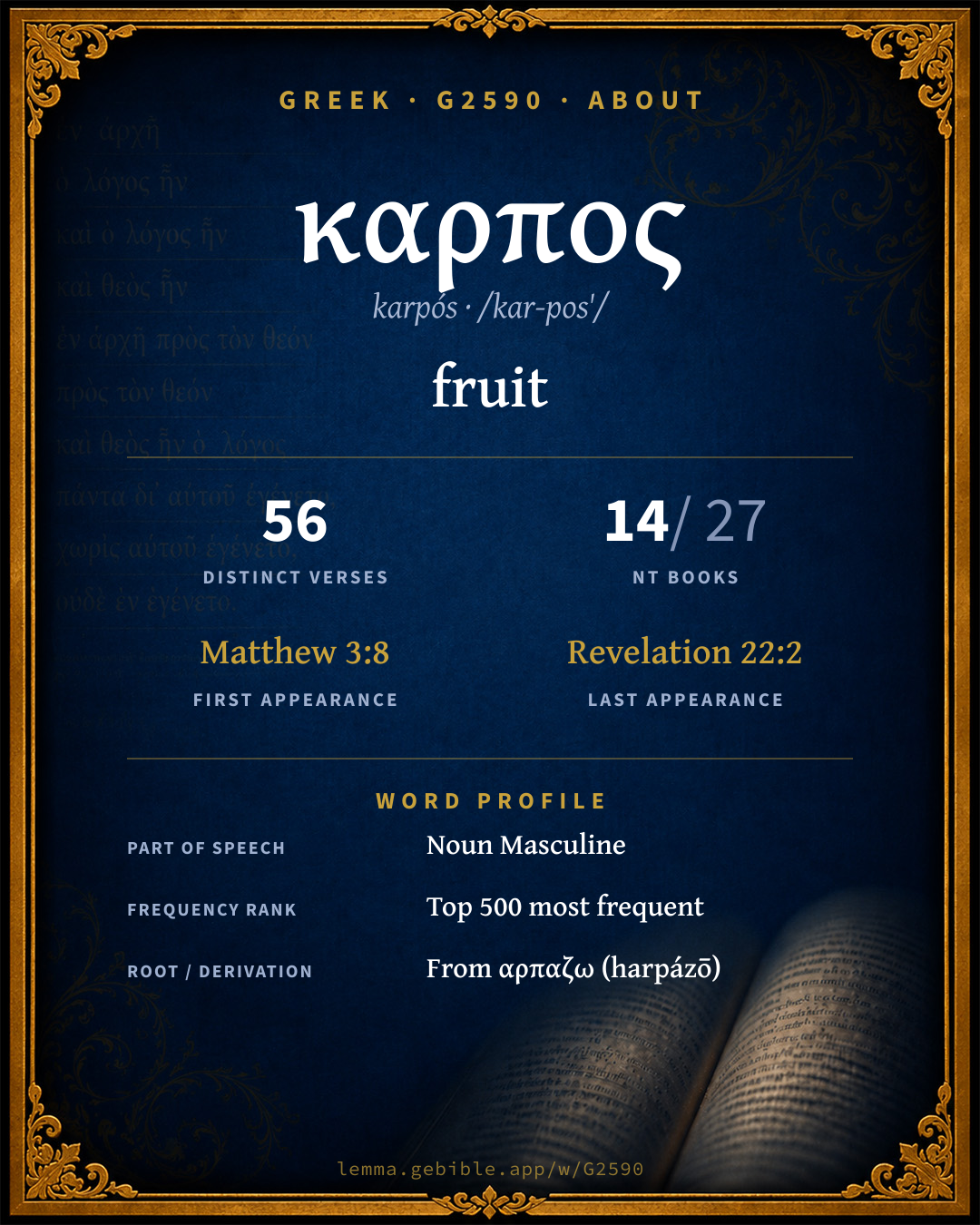
καρπός
fruit
‘fruit’ is one of 2 main senses fuller range ↓
Full lexicon entry — Thayer's Greek Lexicon
From Thayer's Greek Lexicon
Where this word appears
See every Accusative-case word in the Greek New Testament →
Grammar key — what these labels mean
Part of speech
- Noun
- A naming word — a person, place, thing, or idea.
Case
- Accusative
- The case of the direct object and of extent.
- Nominative
- The case of the subject (and the predicate nominative).
- Genitive
- The case of source, possession, or “of” — answers “whose / from what.”
Gender
- Masculine
- Grammatically masculine.
Number
- Singular
- One.
- Plural
- More than one.
Grammatical forms
- Noun, Accusative, Singular, Masculine 38 times (58%)
- Noun, Accusative, Plural, Masculine 10 times (15%)
- Noun, Nominative, Singular, Masculine 8 times (12%)
- Noun, Genitive, Plural, Masculine 6 times (9%)
- Noun, Genitive, Singular, Masculine 4 times (6%)
Parsed forms decoded from the imported morphology (Robinson–Tischendorf, public domain), counted across 66 parsed occurrences — not distinct verses.
Every verse where G2590 appears — 56 distinct verses across 14 books. Click any verse to open its interlinear word-by-word view. Verse text shown in the World English Bible for context — . Each verse’s Greek form is shown with its reference; the English is not keyword-highlighted, since the data carries no word-level English alignment. Use “Compare translations” on any verse to read it across multiple English versions. This concordance covers the Greek New Testament; Septuagint (Greek Old Testament) occurrences of this word are not indexed here.
Matthew 14 verses
- Matthew 3:8 καρπὸν n acc sg masc Therefore bring forth fruit worthy of repentance!
- Matthew 3:10 καρπὸν n acc sg masc "Even now the axe lies at the root of the trees. Therefore, every tree that doesn't bring forth good fruit is cut down, and cast into the fire.
- Matthew 7:16 καρπῶν n gen pl masc By their fruits you will know them. Do you gather grapes from thorns, or figs from thistles?
- Matthew 7:17 καρποὺς καρποὺς n acc pl masc n acc pl masc Even so, every good tree produces good fruit; but the corrupt tree produces evil fruit.
- Matthew 7:18 καρποὺς καρποὺς n acc pl masc n acc pl masc A good tree can't produce evil fruit, neither can a corrupt tree produce good fruit.
- Matthew 7:19 καρπὸν n acc sg masc Every tree that doesn't grow good fruit is cut down, and thrown into the fire.
- Matthew 7:20 καρπῶν n gen pl masc Therefore, by their fruits you will know them.
- Matthew 12:33 καρπὸν καρπὸν καρποῦ n acc sg masc n acc sg masc n gen sg masc "Either make the tree good, and its fruit good, or make the tree corrupt, and its fruit corrupt; for the tree is known by its fruit.
- Matthew 13:8 καρπόν n acc sg masc and others fell on good soil, and yielded fruit: some one hundred times as much, some sixty, and some thirty.
- Matthew 13:26 καρπὸν n acc sg masc But when the blade sprang up and brought forth fruit, then the darnel appeared also.
- Matthew 21:19 καρπὸς n nom sg masc Seeing a fig tree by the road, he came to it, and found nothing on it but leaves. He said to it, "Let there be no fruit from you forever!" Immediately the fig tree withered away.
- Matthew 21:34 καρπῶν καρποὺς n gen pl masc n acc pl masc When the season for the fruit drew near, he sent his servants to the farmers, to receive his fruit.
- Matthew 21:41 καρποὺς n acc pl masc They told him, "He will miserably destroy those miserable men, and will lease out the vineyard to other farmers, who will give him the fruit in its season."
- Matthew 21:43 καρποὺς n acc pl masc "Therefore I tell you, the Kingdom of God will be taken away from you, and will be given to a nation bringing forth its fruits.
Mark 5 verses
- Mark 4:7 καρπὸν n acc sg masc Others fell among the thorns, and the thorns grew up, and choked it, and it yielded no fruit.
- Mark 4:8 καρπὸν n acc sg masc Others fell into the good ground, and yielded fruit, growing up and increasing. Some brought forth thirty times, some sixty times, and some one hundred times as much."
- Mark 4:29 καρπός n nom sg masc But when the fruit is ripe, immediately he puts forth the sickle, because the harvest has come."
- Mark 11:14 καρπὸν n acc sg masc Jesus told it, "May no one ever eat fruit from you again!" and his disciples heard it.
- Mark 12:2 καρπῶν n gen pl masc When it was time, he sent a servant to the farmer to get from the farmer his share of the fruit of the vineyard.
Luke 11 verses
- Luke 1:42 καρπὸς n nom sg masc She called out with a loud voice, and said, "Blessed are you among women, and blessed is the fruit of your womb!
- Luke 3:8 καρποὺς n acc pl masc Bring forth therefore fruits worthy of repentance, and don't begin to say among yourselves, 'We have Abraham for our father;' for I tell you that God is able to raise up children to Abraham from these stones!
- Luke 3:9 καρπὸν n acc sg masc Even now the axe also lies at the root of the trees. Every tree therefore that doesn't bring forth good fruit is cut down, and thrown into the fire."
- Luke 6:43 καρπὸν καρπὸν n acc sg masc n acc sg masc For there is no good tree that brings forth rotten fruit; nor again a rotten tree that brings forth good fruit.
- Luke 6:44 καρποῦ n gen sg masc For each tree is known by its own fruit. For people don't gather figs from thorns, nor do they gather grapes from a bramble bush.
- Luke 8:8 καρπὸν n acc sg masc Other fell into the good ground, and grew, and brought forth fruit one hundred times." As he said these things, he called out, "He who has ears to hear, let him hear!"
- Luke 12:17 καρπούς n acc pl masc He reasoned within himself, saying, 'What will I do, because I don't have room to store my crops?'
- Luke 13:6 καρπὸν n acc sg masc He spoke this parable. "A certain man had a fig tree planted in his vineyard, and he came seeking fruit on it, and found none.
- Luke 13:7 καρπὸν n acc sg masc He said to the vine dresser, 'Behold, these three years I have come looking for fruit on this fig tree, and found none. Cut it down. Why does it waste the soil?'
- Luke 13:9 καρπὸν n acc sg masc If it bears fruit, fine; but if not, after that, you can cut it down.'"
- Luke 20:10 καρποῦ n gen sg masc At the proper season, he sent a servant to the farmers to collect his share of the fruit of the vineyard. But the farmers beat him, and sent him away empty.
John 7 verses
- John 4:36 καρπὸν n acc sg masc He who reaps receives wages, and gathers fruit to eternal life; that both he who sows and he who reaps may rejoice together.
- John 12:24 καρπὸν n acc sg masc Most assuredly I tell you, unless a grain of wheat falls into the earth and dies, it remains by itself alone. But if it dies, it bears much fruit.
- John 15:2 καρπόν καρπὸν καρπὸν n acc sg masc n acc sg masc n acc sg masc Every branch in me that doesn't bear fruit, he takes away. Every branch that bears fruit, he prunes, that it may bear more fruit.
- John 15:4 καρπὸν n acc sg masc Remain in me, and I in you. As the branch can't bear fruit by itself, unless it remains in the vine, so neither can you, unless you remain in me.
- John 15:5 καρπὸν n acc sg masc I am the vine. You are the branches. He who remains in me, and I in him, the same bears much fruit, for apart from me you can do nothing.
- John 15:8 καρπὸν n acc sg masc "In this is my Father glorified, that you bear much fruit; and so you will be my disciples.
- John 15:16 καρπὸν καρπὸς n acc sg masc n nom sg masc You didn't choose me, but I chose you, and appointed you, that you should go and bear fruit, and that your fruit should remain; that whatever you will ask of the Father in my name, he may give it to you.
Acts 1 verse
Romans 4 verses
- Romans 1:13 καρπὸν n acc sg masc Now I don't desire to have you unaware, brothers, that I often planned to come to you, and was hindered so far, that I might have some fruit among you also, even as among the rest of the Gentiles.
- Romans 6:21 καρπὸν n acc sg masc What fruit then did you have at that time in the things of which you are now ashamed? For the end of those things is death.
- Romans 6:22 καρπὸν n acc sg masc But now, being made free from sin, and having become servants of God, you have your fruit of sanctification, and the result of eternal life.
- Romans 15:28 καρπὸν n acc sg masc When therefore I have accomplished this, and have sealed to them this fruit, I will go on by way of you to Spain.
1 Corinthians 1 verse
Galatians 1 verse
Ephesians 1 verse
Philippians 3 verses
- Philippians 1:11 καρπὸν n acc sg masc being filled with the fruits of righteousness, which are through Jesus Christ, to the glory and praise of God.
- Philippians 1:22 καρπὸς n nom sg masc But if I live on in the flesh, this will bring fruit from my work; yet I don't make known what I will choose.
- Philippians 4:17 καρπὸν n acc sg masc Not that I seek for the gift, but I seek for the fruit that increases to your account.
2 Timothy 1 verse
Hebrews 2 verses
- Hebrews 12:11 καρπὸν n acc sg masc All chastening seems for the present to be not joyous but grievous; yet afterward it yields the peaceful fruit of righteousness to those who have been exercised thereby.
- Hebrews 13:15 καρπὸν n acc sg masc Through him, then, let us offer up a sacrifice of praise to God continually, that is, the fruit of lips which make confession to his name.
James 4 verses
- James 3:17 καρπῶν n gen pl masc But the wisdom that is from above is first pure, then peaceful, gentle, reasonable, full of mercy and good fruits, without partiality, and without hypocrisy.
- James 3:18 καρπὸς n nom sg masc Now the fruit of righteousness is sown in peace by those who make peace.
- James 5:7 καρπὸν n acc sg masc Be patient therefore, brothers, until the coming of the Lord. Behold, the farmer waits for the precious fruit of the earth, being patient over it, until it receives the early and late rain.
- James 5:18 καρπὸν n acc sg masc He prayed again, and the sky gave rain, and the earth brought forth its fruit.
Revelation 1 verse
About this entry
At a glance — auto-summarized from this page’s data, not written by a person. Every figure links to its source below. This summary describes the numbers; it doesn’t interpret them.
“fruit” is the headline sense of the Greek noun καρπος (karpós). Its earliest occurrence is Matthew 3:8. It turns up in 56 verses across 14 books, a moderately common footprint. It concentrates in Matthew, which alone accounts for 25% of its uses. Lexicons map it across 2 senses. The sections below give every sense, occurrence, and version rendering.
Gloss history
Strong's 1890 vs modern scholarship
About this word
Strong's G2590 catalogs a Greek word from the Greek New Testament.
These counts are not copied from any lexicon or concordance. They are computed here, from the morphology-tagged Greek New Testament. What Lemma adds →
- 56
- distinct verses
- The word appears in 56 distinct verses.
- 14 / 27
- NT books
- The word appears in 14 of 27 New Testament books.
- #251
- by frequency
- Top 500 most frequent Greek words (rank 251 of 5,347 Greek words by occurrence).
View all 56 occurrences in the concordance →
By section of the New Testament
By traditional corpus
Conventional, traditional groupings — biblical authorship is debated, so this is a traditional corpus grouping, not an authorship claim. Some books belong to more than one corpus (Luke is in both the Gospels and the Lukan corpus, and so on), so these shares overlap and need not total 100%. Each figure is a share of the word’s 56 distinct verses.
- Gospels 37 verses · 66%
- Lukan (Luke–Acts) 12 verses · 21%
- Pauline corpus 11 verses · 20%
- Johannine 8 verses · 14%
- General (Catholic) Epistles 4 verses · 7%
- Hebrews 2 verses · 4%
- Revelation 1 verse · 2%
How translations render this word
Counts come from each version’s own published word-to-Strong’s tagging or interlinear alignment — an approximate guide to how each version renders this word, not a word-level alignment the data otherwise carries. Because each total is that version’s own tagged count, the per-version totals vary from one another and need not match the appearance or distinct-verse counts above. These counts may also differ from a printed concordance because Lemma counts each distinctly tagged rendering and does not collapse phrase taggings into a single head-word total. This is a fixed set of word-tagged versions (KJV, ASV, BSB, ULT) and does not change with the reading translation you choose elsewhere. Each version’s license is shown beside its name below (and on Sources).
- King James Version: Fruit 52×, Fruits 11×, Is the fruit 2×
- American Standard Version: Fruit 47×, Fruits 11×
- Berean Standard Bible: Fruit 45×, Crop 6×, Crops 3×
- unfoldingWord Literal Text: Fruit 48×, Fruits 15×
King James Version Public Domain
Renders G2590 across 66 tagged occurrences — most commonly:
Plus 1 rendering that appears only once — usually multi-word phrases or single function words the recovered tagging swept in, not distinct renderings.
American Standard Version Public Domain
Renders G2590 across 63 tagged occurrences — most commonly:
Plus 5 renderings that appear only once — usually multi-word phrases or single function words the recovered tagging swept in, not distinct renderings.
Berean Standard Bible Public Domain
Renders G2590 across 63 tagged occurrences — most commonly:
Plus 5 renderings that appear only once — usually multi-word phrases or single function words the recovered tagging swept in, not distinct renderings. Not rendered by a distinct English word in 2 further occurrences.
unfoldingWord Literal Text CC BY-SA 4.0
Renders G2590 across 67 tagged occurrences — most commonly:
Plus 4 renderings that appear only once — usually multi-word phrases or single function words the recovered tagging swept in, not distinct renderings.
Senses in Thayer's
The 2 senses Thayer's distinguishes for this word, in lexicon order (not ranked by frequency or importance). The full entry — with sub-senses — is in the Lexicon Entry tab.
- fruit
- that which originates or comes from something, an effect, result
Word origin
Derived from αρπαζω (harpázō) (G726) — to seize.
Probably from the base of G726 ; fruit (as plucked ) literally or figuratively : - fruit.
— Strong’s Exhaustive Concordance (1890), public domain.
Forms in the corpus
The 8 distinct written forms G2590 takes in the Greek New Testament, most frequent first — each parse links to that case’s occurrences in the concordance.
| Form | Parsing | Example | Uses |
|---|---|---|---|
| καρπὸν karpòn | Noun, Accusative, Singular, Masculine | Matthew 3:8 | 36 |
| καρποὺς karpoùs | Noun, Accusative, Plural, Masculine | Matthew 7:17 | 9 |
| καρπὸς karpòs | Noun, Nominative, Singular, Masculine | Matthew 21:19 | 7 |
| καρπῶν karpō̂n | Noun, Genitive, Plural, Masculine | Matthew 7:16 | 6 |
| καρποῦ karpoû | Noun, Genitive, Singular, Masculine | Matthew 12:33 | 4 |
| καρπόν karpón | Noun, Accusative, Singular, Masculine | Matthew 13:8 | 2 |
| καρπούς karpoús | Noun, Accusative, Plural, Masculine | Luke 12:17 | 1 |
| καρπός karpós | Noun, Nominative, Singular, Masculine | Mark 4:29 | 1 |
Same root — word family
Other Thayer's entries built from the same root as G2590, grouped by Strong’s listed origin. These share a root / origin per the lexicon — not necessarily a shared meaning. Each links to that word’s own entry.
Derives from
Shares the same root
- αρπαγη harpagḗ G724 plunder
- αρπαγμος harpagmós G725 seizing
- αρπαξ hárpax G727 rapacious
- κραιπαλη kraipálē G2897 drunkenness
Derived from this word
Proper names from this root
People and places named from this root — a name, not an additional meaning of the word.
Compare all same-root words → Showing 4 of 8 — not the complete family. 1 of the same-root words is a proper name (a person or place). They share a root, not necessarily a meaning.
Septuagint usage
The same Greek word καρπος appears 107 times in the Greek Old Testament (Septuagint), across 104 verses in 26 books.
- 107
- LXX occurrences
- Tagged occurrences of this Greek word in the Septuagint.
- 104
- verses
- Distinct Septuagint verses containing this word.
- 26 / 39
- OT books
- The word appears in 26 of the 39 Old Testament books.
Sample Septuagint occurrences
- Genesis 1:11 καρπός
- Exodus 10:12 καρπός
- Leviticus 19:23 καρπός
- Numbers 13:20 καρπός
- Deuteronomy 1:25 καρπός
- Judges 6:4 καρπός
- 1 Samuel 5:4 καρπός
- 2 Kings 19:29 καρπός
- Ezra 19:36 καρπός
- Job 22:21 καρπός
- Psalms 1:3 καρπός
- Proverbs 1:31 καρπός
Septuagint occurrences (same lexeme)
Every verse where the same Strong’s number (G2590) appears in the Greek Septuagint — showing the first 50 of 104. Verse text shown in the World English Bible for context; the Greek form is the matched word — the English is not keyword-highlighted.
- Genesis 1:11 καρπός God said, "Let the earth put forth grass, herbs yielding seed, and fruit trees bearing fruit after their kind, with its seed in it, on the earth," and it was so.
- Genesis 1:12 καρπός The earth brought forth grass, herbs yielding seed after their kind, and trees bearing fruit, with its seed in it, after their kind: and God saw that it was good.
- Genesis 1:29 καρπός God said, "Behold, I have given you every herb yielding seed, which is on the surface of all the earth, and every tree, which bears fruit yielding seed. It will be your food.
- Genesis 3:2 καρπός The woman said to the serpent, "Of the fruit of the trees of the garden we may eat,
- Genesis 3:3 καρπός but of the fruit of the tree which is in the midst of the garden, God has said, 'You shall not eat of it, neither shall you touch it, lest you die.'"
- Genesis 3:6 καρπός When the woman saw that the tree was good for food, and that it was a delight to the eyes, and that the tree was to be desired to make one wise, she took of the fruit of it, and ate; and she gave some to her husband with her, and he ate.
- Genesis 4:3 καρπός As time passed, it happened that Cain brought an offering to Yahweh from the fruit of the ground.
- Genesis 30:2 καρπός Jacob's anger was kindled against Rachel, and he said, "Am I in God's place, who has withheld from you the fruit of the womb?"
- Genesis 43:11 καρπός Their father, Israel, said to them, "If it be so now, do this. Take from the choice fruits of the land in your bags, and carry down a present for the man, a little balm, a little honey, spices and myrrh, nuts, and almonds;
- Exodus 10:12 καρπός Yahweh said to Moses, "Stretch out your hand over the land of Egypt for the locusts, that they may come up on the land of Egypt, and eat every herb of the land, even all that the hail has left."
- Exodus 10:15 καρπός For they covered the surface of the whole earth, so that the land was darkened, and they ate every herb of the land, and all the fruit of the trees which the hail had left. There remained nothing green, either tree or herb of the field, through all the land of Egypt.
- Leviticus 19:23 καρπός "'When you come into the land, and have planted all kinds of trees for food, then you shall count their fruit as forbidden. Three years shall they be forbidden to you. It shall not be eaten.
- Leviticus 19:24 καρπός But in the fourth year all its fruit shall be holy, for giving praise to Yahweh.
- Leviticus 19:25 καρπός In the fifth year you shall eat its fruit, that it may yield its increase to you. I am Yahweh your God.
- Leviticus 23:40 καρπός You shall take on the first day the fruit of goodly trees, branches of palm trees, and boughs of thick trees, and willows of the brook; and you shall rejoice before Yahweh your God seven days.
- Leviticus 25:3 καρπός Six years you shall sow your field, and six years you shall prune your vineyard, and gather in its fruits;
- Leviticus 26:4 καρπός then I will give you your rains in their season, and the land shall yield its increase, and the trees of the field shall yield their fruit.
- Leviticus 26:20 καρπός and your strength will be spent in vain; for your land won't yield its increase, neither will the trees of the land yield their fruit.
- Leviticus 27:30 καρπός "'All the tithe of the land, whether of the seed of the land or of the fruit of the trees, is Yahweh's. It is holy to Yahweh.
- Numbers 13:20 καρπός and what the land is, whether it is fat or lean, whether there is wood therein, or not. Be of good courage, and bring of the fruit of the land. Now the time was the time of the first-ripe grapes.
- Numbers 13:26 καρπός They went and came to Moses, and to Aaron, and to all the congregation of the children of Israel, to the wilderness of Paran, to Kadesh; and brought back word to them, and to all the congregation, and shown them the fruit of the land.
- Numbers 13:27 καρπός They told him, and said, We came to the land where you sent us; and surely it flows with milk and honey; and this is the fruit of it.
- Deuteronomy 1:25 καρπός They took of the fruit of the land in their hands, and brought it down to us, and brought us word again, and said, It is a good land which Yahweh our God gives to us.
- Deuteronomy 7:13 καρπός and he will love you, and bless you, and multiply you; he will also bless the fruit of your body and the fruit of your ground, your grain and your new wine and your oil, the increase of your cattle and the young of your flock, in the land which he swore to your fathers to give you.
- Deuteronomy 11:17 καρπός and the anger of Yahweh be kindled against you, and he shut up the sky, so that there shall be no rain, and the land shall not yield its fruit; and you perish quickly from off the good land which Yahweh gives you.
- Deuteronomy 26:2 καρπός that you shall take of the first of all the fruit of the ground, which you shall bring in from your land that Yahweh your God gives you; and you shall put it in a basket, and shall go to the place which Yahweh your God shall choose, to cause his name to dwell there.
- Judges 6:4 καρπός and they encamped against them, and destroyed the increase of the earth, until you come to Gaza, and left no sustenance in Israel, neither sheep, nor ox, nor donkey.
- 1 Samuel 5:4 καρπός When they arose early on the next day morning, behold, Dagon was fallen on his face to the ground before the ark of Yahweh; and the head of Dagon and both the palms of his hands [lay] cut off on the threshold; only [the stump of] Dagon was left to him.
- 2 Kings 19:29 καρπός This shall be the sign to you: You shall eat this year that which grows of itself, and in the second year that which springs of the same; and in the third year sow you, and reap, and plant vineyards, and eat the fruit of it.
- 2 Kings 19:30 καρπός The remnant that has escaped of the house of Judah shall again take root downward, and bear fruit upward.
- Ezra 19:36 καρπός
- Ezra 20:36 καρπός
- Ezra 20:38 καρπός
- Job 22:21 καρπός "Acquaint yourself with him, now, and be at peace. Thereby good shall come to you.
- Psalms 1:3 καρπός He will be like a tree planted by the streams of water, That brings forth its fruit in its season, Whose leaf also does not wither. Whatever he does shall prosper.
- Psalms 20:11 καρπός
- Psalms 57:12 καρπός
- Psalms 66:7 καρπός He rules by his might forever. His eyes watch the nations. Don't let the rebellious rise up against him. Selah.
- Psalms 71:16 καρπός I will come with the mighty acts of the Lord Yahweh. I will make mention of your righteousness, even of yours alone.
- Psalms 77:46 καρπός
- Psalms 84:13 καρπός
- Psalms 103:13 καρπός Like a father has compassion on his children, So Yahweh has compassion on those who fear him.
- Psalms 104:35 καρπός Let sinners be consumed out of the earth. Let the wicked be no more. Bless Yahweh, my soul. Praise Yah!
- Psalms 106:37 καρπός Yes, they sacrificed their sons and their daughters to demons.
- Psalms 126:3 καρπός Yahweh has done great things for us, And we are glad.
- Psalms 127:2 καρπός It is vain for you to rise up early, To stay up late, Eating the bread of toil; For he gives sleep to his loved ones.
- Psalms 131:11 καρπός
- Proverbs 1:31 καρπός Therefore they will eat of the fruit of their own way, And be filled with their own schemes.
- Proverbs 3:9 καρπός Honor Yahweh with your substance, With the first fruits of all your increase:
- Proverbs 10:16 καρπός The labor of the righteous leads to life. The increase of the wicked leads to sin.
These are occurrences of the same Greek lexeme (G2590) in the Septuagint — not a translation of any one Hebrew word. The store carries no word-level Hebrew↔Greek alignment, so no Hebrew original is asserted here. Counts come from the recovered LXX Strong's tagging — high-frequency vocabulary is well covered, while rare or late forms may be untagged — so they reflect tagged occurrences and may slightly undercount.