
Psalms 103:13

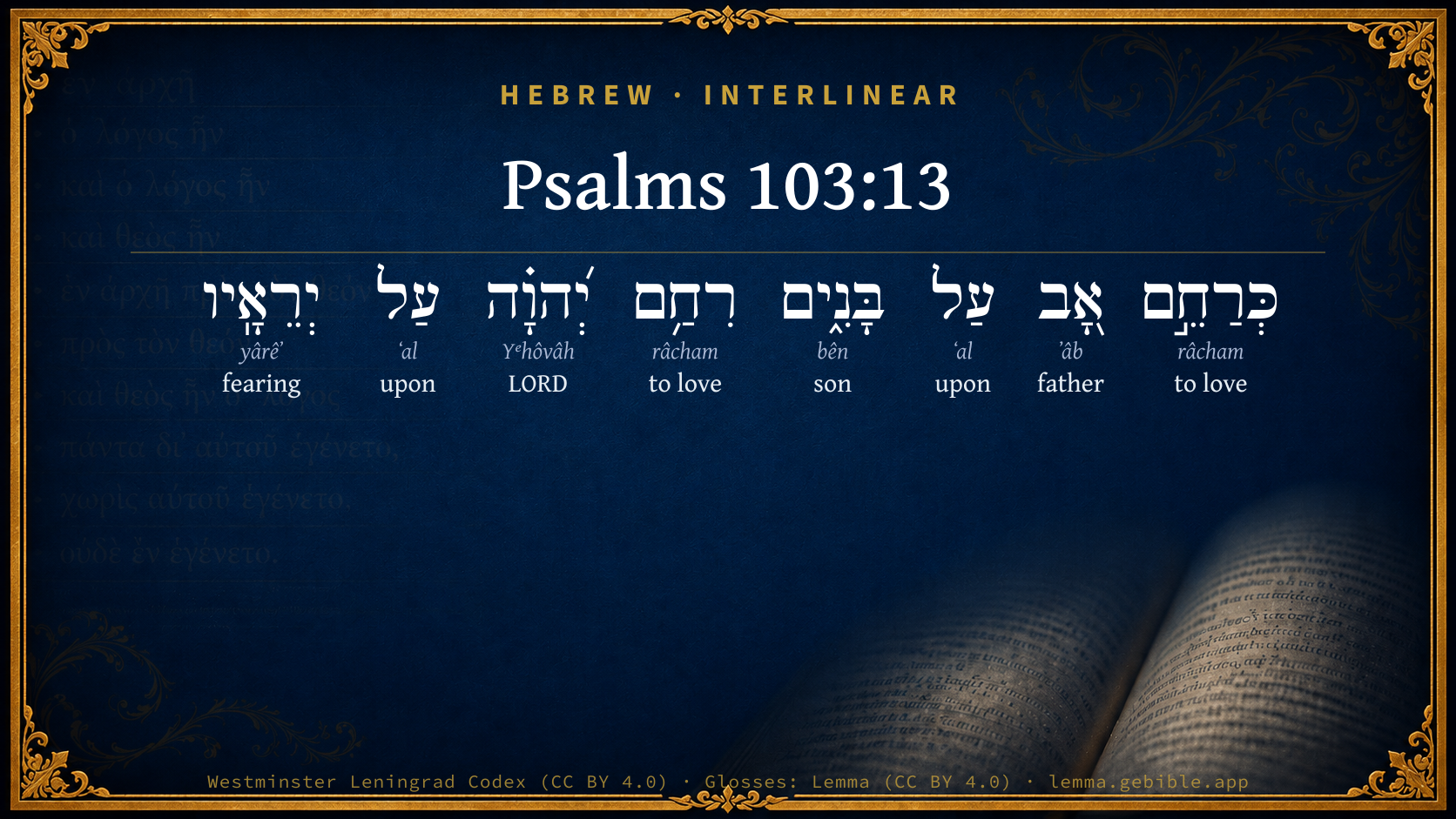
Hebrew (Westminster Leningrad Codex) Psalms 103:13 appears in the Hebrew Old Testament. The text above is from the Westminster Leningrad Codex. Each word links to its Strong’s number, a concise gloss, and parsing drawn from the Open Scriptures Hebrew Bible morphology. Click any word for its full Brown-Driver-Briggs (BDB) entry.
Download image
Cite this verse

Psalms 103:13 (World English Bible). Public Domain. Lemma interlinear Bible study tool, https://lemma.gebible.app/v/psalms/103/13.

Show BibTeX & RIS
BibTeX
RIS
English Translation
Like a father has compassion on his children, So Yahweh has compassion on those who fear him.
World English Bible · Public Domain
Download a study sheet

One document with this verse’s original text, its word-by-word gloss line, the meaning frame, cross-references with their text, attributed commentary, and full source and license credits — printable, and it pastes into notes with its structure intact.

This verse Autodidact and up

Study sheet (.html) Plain text (.txt)

A passage Seminary Student

Up to 50 verses in one chapter. A passage sheet keeps up to 6 commentary sources and 12 cross-references per verse, in the order this page ranks them, and says so on the sheet whenever that leaves anything out. Ask for a single verse and you get the Autodidact verse sheet above.

Everything on this page stays free to read, with no account — the sheet is a download of what is already on screen, not access to it.

Want to remove ads? Support Godless Engineer
Compare translations 3

The same verse in 3 English versions, stacked beneath the original-language interlinear above. Click any original word for its lexicon entry.

Each is an independent rendering of the whole verse — the interlinear is not word-aligned to these translations.

Highlighted words mark where these versions differ — a whole-verse word diff, not a word-by-word alignment.

  • World English Bible Public Domain
    Like a father has compassion on his children, So Yahweh has compassion on those who fear him.
  • King James Version Public Domain
    Like as a father pitieth his children, so the LORD pitieth them that fear him.
  • unfoldingWord Literal Text CC BY-SA 4.0
    As a father has compassion on his children, Yahweh has compassion on those fearing him.

unfoldingWord Literal Text — © unfoldingWord, licensed CC BY-SA 4.0. Word-aligned USFM3 via Door43 (git.door43.org/unfoldingWord/en_ult).

Versions to compare (up to 4)

3 of 4 selected

Show all 18 translations

Every available English version of this verse, each an independent rendering of the whole verse.

  • World English Bible Public Domain
    Like a father has compassion on his children, So Yahweh has compassion on those who fear him.
  • Berean Standard Bible Public Domain
    As a father has compassion on his children, so the LORD has compassion on those who fear Him.
  • Majority Standard Bible Public Domain
    As a father has compassion on his children, so the LORD has compassion on those who fear Him.
  • King James Version Public Domain
    Like as a father pitieth his children, so the LORD pitieth them that fear him.
  • American Standard Version (1901) Public Domain
    Like as a father pitieth his children, So Jehovah pitieth them that fear him.
  • Revised Version (1885) Public Domain
    Like as a father pitieth his children, so the LORD pitieth them that fear him.
  • Geneva Bible (1599) Public Domain
    As a father hath compassion on his children, so hath the Lord compassion on them that feare him.
  • Douay-Rheims (1899) Public Domain
    As a father hath compassion on his children, so hath the Lord compassion on them that fear him:
  • Young's Literal Translation Public Domain
    As a father hath mercy on sons, Jehovah hath mercy on those fearing Him.
  • Literal Standard Version CC BY-SA 4.0
    As a father has mercy on sons, || YHWH has mercy on those fearing Him.
  • Unlocked Literal Bible CC BY-SA 4.0
    As a father has compassion on his children, so Yahweh has compassion on those who honor him.
  • unfoldingWord Literal Text CC BY-SA 4.0
    As a father has compassion on his children, Yahweh has compassion on those fearing him.
  • Darby Bible Public Domain
    As a father pitieth [his] children, so Jehovah pitieth them that fear him.
  • World Messianic Bible Public Domain
    Like a father has compassion on his children, so the LORD has compassion on those who fear him.
  • Webster's Bible Public Domain
    Like as a father pitieth his children, so the LORD pitieth them that fear him.
  • Free Bible Version CC BY-SA 4.0
    Like a loving father, the Lord is kind and compassionate to those who follow him.
  • Bible in Basic English Public Domain
    As a father has pity on his children, so the Lord has pity on his worshippers.
  • JPS Tanakh (1917) Public Domain
    Like as a father hath compassion upon his children, so hath the LORD compassion upon them that fear Him.

Literal Standard Version (2020), Covenant Press — licensed CC BY-SA 4.0. Text via the HelloAO Bible API (eBible.org). Unlocked Literal Bible (unfoldingWord) — licensed CC BY-SA 4.0. Text via the HelloAO Bible API (eBible.org). unfoldingWord Literal Text — © unfoldingWord, licensed CC BY-SA 4.0. Word-aligned USFM3 via Door43 (git.door43.org/unfoldingWord/en_ult). Free Bible Version, Dr. Jonathan Gallagher — licensed CC BY-SA 4.0. Text via the HelloAO Bible API (eBible.org).

Word by word

More ways to search: Search by grammar → Find every occurrence → Compare this word →

Practice this passage: Drill this verse → Learn its vocabulary →

About this verse

These counts appear in no published source. They are computed here, from the morphology-tagged text and Lemma’s own curated glosses. What Lemma adds →

8
words
6
distinct lemmas
Wisdom
section

Shared distinctive vocabulary

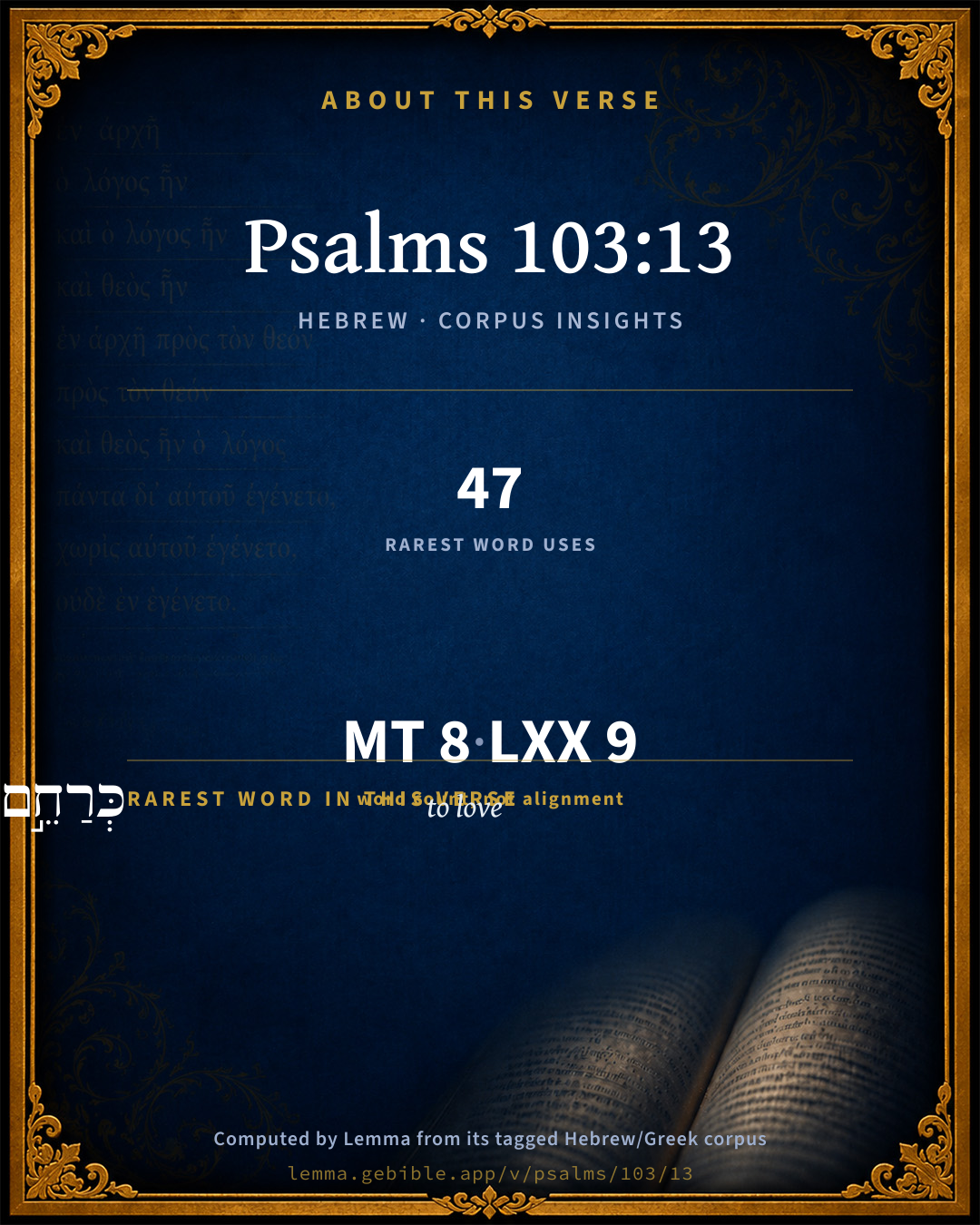
כְּרַחֵ֣ם to love H7355 occurs in 43 verses of the Hebrew Bible. Also found in:

Grammatical profile

  • 2 verbs
  • 3 nouns
  • 1 adjective
  • 2 prepositions

Verb forms

  • כְּרַחֵ֣ם Piel · Infinitive Construct
  • רִחַ֥ם Piel · Perfect

Repetition

Words recur within this verse — often emphatic in Hebrew:

  • כְּרַחֵ֣ם to love H7355 ×2
  • עַל upon H5921 ×2

Hebrew & Septuagint length

In English translation the verse runs 17 words from the Hebrew and 13 from the Septuagint (LXX English) — closely comparable.

A rough comparison of the two English renderings, which tokenize alike — not a word-level alignment.

Word counts can differ between the Hebrew and the Greek without any difference in meaning — e.g. the Hebrew direct-object marker אֵת has no separate Greek word, and Greek often adds the article ὁ.

In the original languages it is 8 Hebrew tokens and 9 Greek tokens — but the two are counted differently (Hebrew bundles its prefixes and suffixes into one token; the Greek is in lemma form), so that isn’t a like-for-like length.

Cross-references

18

Topical passages linked to Psalms 103:13 in the Treasury of Scripture Knowledge — connected by theme and wording, ordered by reader-vote popularity; previews shown in the World English Bible.

  • Luke 11:11–12 "Which of you fathers, if your son asks for bread, will give him a stone? Or if he asks for a fish, he won't give him a snake instead of a fish, will he?
  • Hebrews 12:5–11 and you have forgotten the exhortation which reasons with you as with children, "My son, don't take lightly the chastening of the Lord, Nor faint when you are reproved by him;
  • Psalms 103:17 But Yahweh's loving kindness is from everlasting to everlasting with those who fear him, His righteousness to children's children;
  • Luke 15:21–22 The son said to him, 'Father, I have sinned against heaven, and in your sight. I am no longer worthy to be called your son.'
  • Jeremiah 31:20 Is Ephraim my dear son? is he a darling child? for as often as I speak against him, I do earnestly remember him still: therefore my heart yearns for him; I will surely have mercy on him, says Yahweh.
  • Proverbs 3:12 For whom Yahweh loves, he reproves; Even as a father reproves the son in whom he delights.
  • Jeremiah 31:9 They shall come with weeping; and with petitions will I lead them: I will cause them to walk by rivers of waters, in a straight way in which they shall not stumble; for I am a father to Israel, and Ephraim is my firstborn.
  • Psalms 147:11 Yahweh takes pleasure in those who fear him, In those who hope in his loving kindness.
  • Malachi 4:2 But to you who fear my name shall the sun of righteousness arise with healing in its wings. You will go out, and leap like calves of the stall.
  • Malachi 3:16–17 Then those who feared Yahweh spoke one with another; and Yahweh listened, and heard, and a book of memory was written before him, for those who feared Yahweh, and who honored his name.
  • Matthew 6:32 For the Gentiles seek after all these things, for your heavenly Father knows that you need all these things.
  • Isaiah 63:15–16 Look down from heaven, and see from the habitation of your holiness and of your glory: where are your zeal and your mighty acts? the yearning of your heart and your compassion is restrained toward me.
  • Psalms 103:11 For as the heavens are high above the earth, So great is his loving kindness toward those who fear him.
  • Deuteronomy 3:5 All these were cities fortified with high walls, gates, and bars; besides the unwalled towns a great many.
  • Matthew 6:9 Pray like this: 'Our Father in heaven, may your name be kept holy.
  • Numbers 11:12 Have I conceived all this people? have I brought them forth, that you should tell me, Carry them in your bosom, as a nursing-father carries the sucking child, to the land which you swore to their fathers?
  • John 20:17 Jesus said to her, "Don't touch me, for I haven't yet ascended to my Father; but go to my brothers, and tell them, 'I am ascending to my Father and your Father, to my God and your God.'"
  • Acts 13:26 Brothers, children of the stock of Abraham, and those among you who fear God, the word of this salvation is sent out to you.

Cross-references courtesy of OpenBible.info (CC BY 4.0).

Hebrew and Greek witnesses Masoretic Hebrew ↔ Greek Septuagint

The same verse in the two great witnesses to the Old Testament, shown verse-for-verse.

You’re reading Greek Psalm 102 (Hebrew Psalm 103). The Septuagint counts the superscription, so verse numbers can differ from the Hebrew — chapter-level alignment, not verse-by-verse. Numbering follows Rahlfs.

These are two independent witnesses, not word-aligned to each other, and the Septuagint is shown in lemma (dictionary) form.

Hebrew Psalms 103:13 Masoretic · Westminster Leningrad Codex

כְּרַחֵ֣ם אָ֭ב עַל בָּנִ֑ים רִחַ֥ם יְ֝הוָ֗ה עַל יְרֵאָֽיו

Like a father has compassion on his children, So Yahweh has compassion on those who fear him.

World English Bible · Public Domain

Greek LXX Greek Psalm 102:13 Septuagint · lemma form

καθώς οἰκτείρω πατήρ υἱός οἰκτείρω κύριος ὁ φοβέω αὐτός

As a father pities his children, the Lord pities them that fear him.

LXX2012 (modern English Septuagint) · Public Domain

On this verse, John Gill's Exposition discusses the Septuagint’s reading. Read the note in Commentary ↓

Hebrew: Westminster Leningrad Codex (CC BY 4.0). Greek: Septuagint (public domain); English from LXX2012 (modern English Septuagint) (Public Domain). How the Septuagint differs from the Hebrew →

Commentary

Notes on Psalms 103:13 from classic Christian and Jewish commentators (each source and its license shown beneath its notes). The classic Christian expositions comment on the surrounding passage and are grouped to its opening verse, so a note may address several verses; the Jewish commentaries on the Tanakh (Rashi and others) are per-verse, so they appear only where the commentator wrote on this verse.

Lemma curates 59 commentaries, every one of them public domain or Creative Commons licensed, each selected and text-cleaned for this edition rather than reprinted as found. About our sources →

Trapp's Complete Commentary

John Trapp

Psa 103:13 Like as a father pitieth [his] children, [so] the LORD pitieth them that fear him.

Ver. 13. Like as a father pitieth] There is an ocean of love in a father’s heart. See Luk 15:20 Gen 33:2; Gen 33:13-14; Gen 34:3, how hardly and with what caution Jacob parted with Benjamin. Sozomen maketh mention of a certain merchant, who offering himself to be put to death for his two sons who were sentenced to die, and it being granted that one of the two (whom he should choose) should be upon that condition delivered; the miserable father, aequali utriusque amore victus, equally affected to them both, could not yield that either, of them should die, but remained hovering about both, till both were put to death.

So the Lord pitieth, &c.] So and ten thousand times more than so; for he is the Father of all mercies, and the Father of all the fatherhoods ( Parentela) in heaven and earth, Eph 3:15.

John Trapp, A Commentary or Exposition upon All the Books of the Old and New Testament (1647–1656) — public domain. Text from a community e-Sword module.

The Biblical Illustrator

Joseph S. Exell

Psa_103:13-14

Like as a father pitieth his children, so the Lord pitieth them that fear Him.

The tender pity of the Lord

With a text from the Old Testament, I purpose to take you straight away to the New, and the tenderness and pitifulness of the Father shall be illustrated by the meekness and lowliness of the Son towards His immediate disciples, the apostles. While the Holy Spirit shows you thus the pity of Jesus Christ towards His own personal attendants, you will see as in a glass His pity towards you.

I. The Divine patience of our Lord Jesus towards the apostles. He kept no register of their faults, He never rehearsed the list of their shortcomings, but, on the contrary, His main rebuke was His own perfect example, and He ever treated them as His friends and brethren. Think of this, and you will see in Christ Jesus that like as a father pitieth his children, etc. Much forbearance He had with their lack of understanding. The apostles, before Pentecost, were very gross and unspiritual in judgment. Their eyes were holden in more senses than one. Many a master would have grown weary of such pupils, but infinite love brought to its succour infinite patience, and He continued still to teach them though they were so slow to learn. Like as a father pitieth, etc. He taught them humility by His humility; He taught them gentleness by His gentleness; He did not point out their defects in words, He did not dwell upon their errors, but He rather let them see their own spots by His purity, their own defects by His perfection. Oh, the marvellous tenderness of Christ, who so paternally pitied them that feared Him!

II. The reasons of this Divine patience in the case of our Lord. Doubtless we must find the first reason in what He is. Our Lord was so greatly good that He could bear with poor frail humanity. When you and I cannot bear with other people it is because we are so weak ourselves. I would to God we could copy His love and borrow His meekness so divine. He bore with them and pitied them because of His relationship to them. He had loved them as He has loved many of us, from before the foundation of the world. He was their Shepherd, and He pitied the diseases of His flock; He was their brother born for adversity, and He stooped to be familiar with their frailties. Another reason for His patience was His intention to become perfect as the Captain of our salvation, through suffering. In order that He might be a complete High Priest, and know all the temptations of all His servants, He bears with the infirmities and sins of His disciples whom He could have perfected at once if He had willed, but whom He did not choose to perfect because He desired to reveal His tender pity towards them, and to obtain by experience complete likeness to His brethren. Did He not also do this that He might honour the Holy Spirit? If Jesus had perfected the apostles, they would not have seen so manifestly the glory of the Holy Ghost. Until the Holy Ghost was come, what poor creatures the eleven were! but when the Holy Ghost was given, what brave men, what heroes, how deeply instructed, how powerful in speech, how eminent in every virtue they became! It is the object of Jesus Christ to glorify the Spirit, even as it is the design of the Holy Spirit to glorify Christ in our hearts.

III. The teaching to de derived from this patience.

1. If the Lord had thus had pity upon you as He had on His apostles, do ye even so to others. Look at the bright side of your brother, and the black side of yourself, instead of reversing the order as many do. Remember there are points about every Christian from which you may learn a lesson. Look to their excellences, and initiate them. Think, too, that small as the faith of some of your brethren is, it will grow, and you do not know what it will grow to. Though they be now so sadly imperfect, yet if they are the Lords people, think of what they will be one day.

2. In your own case, have firm faith in the gentleness and forbearance of Christ. Think of how gentle He was with the apostles, and remember He is the same still. Change of place has not changed His character. The exaltations of heaven have not removed from Him the tenderness of His heart; He will accept you still. (C H. Spurgeon.)

The Divine pity

No word better brings home the truth of Divine lovingkindness than pity--the pity of the Lord. There is love and mercy shown in passing by our sin, and forgiving us; but it is the love shown in the pity of the Lord that touches us most directly, and at once reaches the quick of our nature. And the reasons for this are not difficult to understand.

I. The pity of God is condescending love. It is the love of one who is infinitely our superior. Abject penitence on the one hand, and reliance upon the Divine compassion on the other--that is the truest and best relation in which the sinner and God can stand.

II. The pity of God is understandable. The pity of God is most welcome to us, because it is that which best corresponds to our own thoughts concerning ourselves. It is true, we are unworthy; and so unworthy, the very thought of it often repels us from God and makes us ashamed to seek His forgiveness and help; but we can say very sincerely that, however great our sins may be, there is need so great, weakness and helplessness so great, that, apart from our deserts, we ought to be the objects of the pity of a compassionate and loving God.

III. Gods interest in humanity. The wounds of the patriot who has bled for his country become eloquent appeals to his countrymen if he come to be in want; the distresses of the poor become appeals to our hearts, even when they are brought about by their own sin. In the hour of distress we fail to be judges. There is only one feeling of compassion to a fellow-creature in distress. Shall not God be as much moved by the sight of human need as we are? (James Ross.)

Our heavenly Fathers pity

I. The displays of this pity.

1. God pities His children, in all their ignorance; He is not angry with them, nor doth He speak sharply to them; but He leadeth them on by His Spirit, until they understand His truth, and receive His Word.

2. What pity has the Lord had upon you and me, in all our wanderings.

3. In actual transgressions and downright sin.

4. In sickness.

5. In all our manifold trials, of whatever kind they are, and from whatever quarter they proceed

6. Sometimes Gods people have wrongs; and a father pities his children, if they have wrongs that are unrevenged. There never was a wrong done to one of Gods people that God did not avenge; there has never been an ill deed done towards them yet but He hath punished the doer of it.

II. The spirit of Gods pity.

1. There is no contempt in it.

2. It is not the pity of inaction.

3. It is not the pity of mere sensitiveness. Go to Him now if you are poor; tell Him all your care, and see if He will not help you. Go and try Him, for His pity is a heavenly pity; it is the very nard of Paradise, that healeth sores effectually.

III. The people whom God pities. The Lord pitieth them that fear Him. Oh, that ye would tremble at His presence; and, then, oh, that ye could know yourselves to be His children, and fear Him as children do their parents! Oh, that ye did reverence His name, and keep His Sabbaths! Oh, that ye did obey His commandments, and have His fear ever before your eyes! Then should your peace be like a river, and your righteousness like the waves of the sea. (C. H. Spurgeon.)

Gods pity

I. It is like that of a tender and merciful father. 1 He forbears summary punishment.

2. He encourages us when we try to serve Him.

3. He ceases to chastise when chastisement has accomplished the purpose for which it was sent.

II. Why God shows such pity to His children.

1. It is His character to be pitiful.

2. He feels to us as a Father. (W. Handcock.)

The best need the pity of God

It is like tolling the death-knell of all our pride to talk about God pitying us. Why, we shed our pity profusely upon the ungodly; we are often pitying the wicked, the profane, the blasphemer, the Sabbath-breaker; but here we find a God pitying us. Even David, the mighty psalmist, is pitied; a prophet, a priest, a king, each of these shall have pity from God, for He pitieth them that fear Him, and finds good reasons for pitying them, however high their station, however holy their character, or however happy their position. We are pitiable beings. (C. H. Spurgeon.)

A fathers great love

How much a father loves his son is shown in the story of the nobleman who went all the way from Capernaum to Cana for the sake of his boy. The other day an American father gave the great Austrian, Dr. Lorenz, £6,000 to make his crippled daughter able to walk. Many other fathers and mothers brought their children to this great doctor, and he treated as many of them as he had time to do. We never know how much our parents love us until we are sick or in danger. Then it is mother who sits by our bed and never goes to sleep until the danger is over. Then it is father who thinks no toil or sacrifice too great for his darling boy or girl. (Freeman.)

The Biblical Illustrator, edited by Joseph S. Exell (c. 1880s–1900s) — public domain. Text from a community e-Sword module.

J. A. Alexander on Psalms

Joseph Addison Alexander

13. (Psa 103:13) As a father has compassion, on (his) children, Jehovah has compassion on his fearers. The compound phrase, has compassion, is here substituted for the simple verb pity, in order to retain the preposition on, which follows it in Hebrew, and also because the plural form, compassions, was necessarily employed in Psa 103:4 to translate the cognate noun. The Hebrew verb is peculiarly appropriate in speaking of parental love. See above, on Psa 18:1. The preterite forms represent the fact alleged as one already known and well attested by experience.

Joseph Addison Alexander, The Psalms Translated and Explained (1850) — public domain. Text from a community e-Sword module.

Scofield Reference Notes

C. I. Scofield

fear

Also Psa 103:13, (See Scofield "Psa 19:9").

The Scofield Reference Bible (1917 edition), notes by C. I. Scofield — public domain. Text from a community e-Sword module.

Tyndale Open Study Notes

Tyndale Open Resources

103:13 The Lord is like a father to his children: This analogy forms the basis for Jesus’ teaching about God’s fatherhood (see Matt 5:43-48; 6:1; 10:19-20; 12:50; Luke 6:36; 12:29-32; John 8:31-59; 15:1-8; see also 2 Sam 7:14; Jer 3:19; 31:9; Mal 1:6; 2 Cor 6:16-18).

Tyndale Open Study Notes — © Tyndale Open Resources, licensed CC BY-SA 4.0. Text via the HelloAO Bible API.

Adam Clarke's Commentary

Verse 13. Like as a father pitieth his children] This is a very emphatic verse, and may be thus translated: "As the tender compassions of a father towards his children; so the tender compassions of Jehovah towards them that fear him." Nothing can place the tenderness and concern of God for his creatures in a stronger light than this. What yearnings of bowels does a father feel toward the disobedient child, who, sensible of his ingratitude and disobedience, falls at his parent's feet, covered with confusion and melted into tears, with, "Father, I have sinned against heaven, and before thee, and am not worthy to be called thy son!" The same in kind, but infinitely more exquisite, does God feel when the penitent falls at his feet, and implores his mercy through Christ crucified.

Adam Clarke's Commentary on the Bible (1810–1826) — public domain. Text from a community e-Sword/MySword module.

John Calvin's Commentaries

13. As a father is compassionate towards his children, The Psalmist not only explains by a comparison what he has already stated, but he at the same time assigns the cause why God so graciously forgives us, which is, because he is a father It is then in consequence of God’s having freely and sovereignly adopted us as his children that he continually pardons our sins, and accordingly we are to draw from that fountain the hope of forgiveness. And as no man has been adopted on the ground of his own merit, it follows that sins are freely pardoned. God is compared to earthly fathers, not because he is in every respect like them, but because there is no earthly image by which his unparalleled love towards us can be better expressed. That God’s fatherly goodness may not be perverted as an encouragement to sin, David again repeats that God is thus favorable only to those who are his sincere worshippers. It is indeed a proof of no ordinary forbearance for God to “make his sun to rise on the evil and on the good,” (Matthew 5:45;) but the subject here treated is the free imputation of the righteousness by which we are accounted the children of God. Now this righteousness is offered only to those who entirely devote themselves to so bountiful a Father, and reverently submit to his word. But as our attainments in godliness in this world, whatever they may be, come far short of perfection, there remains only one pillar on which our salvation can securely rest, and that is the goodness of God.

John Calvin's Commentaries (1540-1563) — public domain. Text from the Calvin Translation Society English edition (1840s-50s) via the Christian Classics Ethereal Library (ccel.org). Calvin's coverage is partial (roughly two-thirds of the Bible); uncommented books and verses are honest gaps, never fabricated. The 19th-century editor's footnotes and remarks are omitted so the notes are faithfully Calvin's own voice.

Ellicott's Commentary for English Readers

(13) Father.—This anticipation of Christ’s revelation of the paternal heart of God, is found also in the prophets.

A Bible Commentary for English Readers, edited by Charles John Ellicott (1878–1897) — public domain. Text from a community e-Sword module.

The Cambridge Bible for Schools and Colleges

gen. ed. J. J. S. Perowne

13. Cp. Psa_27:10; Isa_49:15; Luk_15:20.

pitieth] Hath compassion on. The A.V. misses the connexion with “full of compassion” in Psa_103:8.

The Cambridge Bible for Schools and Colleges (gen. ed. J. J. S. Perowne; Cambridge University Press, 1878–1918) — public domain. Text from a community e-Sword module.

John Gill's Exposition

For he knoweth our frame,.... The outward frame of their bodies, what brittle ware, what earthen vessels, they be; he being the potter, they the clay, he knows what they are able to bear, and what not; that if he lays his hand too heavy, or strikes too hard, or repeats his strokes too often, they will fall in pieces: he knows the inward frame of their minds, the corruption of their nature, how prone they are to sin; and therefore does not expect perfect services from them: how impotent they are to that which is good; that they can do nothing of themselves; nor think a good thought, nor do a good action; and that their best frames are very uncertain ones; and that, though the spirit may be willing, the flesh is weak. The word used is the same that is rendered "imagination", Gen 6:5, and by which the Jews generally express the depravity and corruption of nature; and so the Targum here paraphrases it,

"for he knows our evil concupiscence, which causes us to sin;''

and to this sense Kimchi.

He remembereth that we are dust (b); are of the dust originally, and return to it again at death; and into which men soon crumble when he lays his hand upon them; this he considers, see Psa 78:38. The Targum is,

"it is remembered before him, that we are of the dust:''

the Septuagint version makes a petition of it, "remember that we are dust"; and so the Arabic version. And we should remember it ourselves, and be humble before God; and wonder at his grace and goodness to us, Gen 18:27.

(b) "Pulvis et umbra sumus", Horat. Carmin. l. 4. Ode 7. v. 16.

John Gill's Exposition of the Whole Bible (1746–1763) — public domain (CC PDM 1.0). Text via the HelloAO Bible API.

Albert Barnes' Notes on the Bible

Like as a father pitieth his children - Hebrew, “Like the compassion of a father for his children.” See the notes at Mat 7:7-11. God often compares himself with a father, and it is by carrying out our ideas of what enters into the parental character that we get our best conceptions of the character of God. See the notes at Mat 6:9. That which is referred to here, is the natural affection of the parent for the child; the tender love which is borne by the parent for his offspring; the disposition to care for its needs; the readiness to forgive when an offence has been committed. Compare Luk 15:22-24. Such, in an infinitely higher degree, is the compassion - the kindness - which God has for those that love him.

So the Lord pitieth them that fear him - He has compassion on them. He exercises toward them the paternal feeling.

Albert Barnes' Notes on the Bible (1834–1885) — public domain. Text from a community e-Sword/MySword module.

The Treasury of David

Charles H. Spurgeon

Ver. 13. Like as a father pitieth his children, so the Lord pitieth them that fear him. To those who truly reverence his holy name, the Lord is a father and acts as such. These he pities, for in the very best of men the Lord sees much to pity, and when they are at their best state they still need his compassion. This should check every propensity to pride, though at the same time it should yield us the richest comfort. Fathers feel for their children, especially when they are in pain, they would like to suffer in their stead, their sighs and groans cut them to the quick: thus sensitive towards us is our heavenly Father. We do not adore a god of stone, but the living God, who is tenderness itself. He is at this moment compassionating us, for the word is in the present tense; his pity never fails to flow, and we never cease to need it.

Ver. 13. Like as a father pitieth his children, etc. A chaplain to seamen, at an American port, visited a sailor who appeared to be near death. He spoke kindly to the man upon the state of his soul, and directed him to cast himself on Jesus. With an oath, the sick man bade him begone. The chaplain then told him that he must be faithful to him, for if he died impenitent he would be lost for ever. The man was sullen and silent, and pretentted to fall asleep. The visit was repeated more than once, with similar ill success. At length the chaplain, suspecting that the sailor was a Scotchman, repeated a verse of the old version of the Psalms:

"Such pity as a father hath

Unto his children dear.

Like pity shows the Lord to such

As worship him in fear."

Tears started into the sailor's eyes as he listened to these words. The chaplain asked him if he had not had a pious mother. The man broke into tears. Yes, his mother had, in years gone by, taught him these words, and had also prayed to God for him. Since then he had been a wanderer by sea and land; but the memory of her faith and love moved his heart. The appeals made to him were blessed by the Spirit of God. His life was spared, and proved the reality of his conversion.

Ver. 13. Like as a father. It is to be observed in this verse, what kind of mercy the prophet attributes to God. He says not, As man pities man, as the rich the poor man, as the strong the feeble, as the freeman the captive, but he makes mention of that pity which a father shows to his son, which is the greatest of all. The word Mxr itself supports this view, as it properly signifies viscarum commotis. An example of this we have in 1Ki 3:23-27 in the case of the woman who could not bear the slaughter of her child... And afterwards in the case of the father of the prodigal. Lu 15:11-32. Musculus.

Ver. 13. As a father pitieth his children. The father pitieth his children that are weak in knowledge, and instructs them; pities them when they are froward, and bears with them; pities them when they are sick, and comforts them; when they are fallen, and helps them up again; when they have offended, and upon their submission, forgives them; when they are wronged, and rights them. Thus "the Lord pitieth them that fear him." Matthew Henry.

Ver. 13. So the Lord pitieth, &c. So and ten thousand times more than so. For he is the "Father of all mercies, "and the Father of all the fatherhoods in heaven and earth. Eph 3:15. John Trapp.

Ver. 13. The Load pitieth. Though it be commonly said, "It is better to be envied, than pitied; "yet here it is not so: but it is a far happier thing to be pitied of God, than to be envied of men. Sir R. Baker.

Ver. 13. Them that fear him. The fear of God is that deference to God which leads you to subordinate your will to his; makes you intent on pleasing him; penitent in view of past wilfulness; happy in his present smile; transported by his love; hopeful of his glory. George Bowen.

Ver. 13. Them that fear him. It may be understood of those who have not yet "received the spirit of adoption, "but are yet "trembling at his word, "those he "pities." Matthew Henry.

Ver. 13-14. The good father doth not turn off the child for being weak and sickly; but is so much the more indulgent as his necessity requires succour. If his stomach refuse meat, or cannot answer it with digestion, will he put him out of doors? No; when the Shunamite's son complains of his head, she lays him in her bosom. A mother is good to all the fruit of her womb, most kind to the sick infant: when it lies with its eyes fixed on her, not able to declare its grief, or to call for what it desires, this doubles her compassion: "So the Lord doth pity us, remembering our frame, considering that we are but dust"; that our soul works by a lame instrument; and therefore he requires not that of an elemental composition, which he doth of angelical spirits. The son is commanded to write out such a copy fairly; he doth his best, far short of the original; yet the father doth not chide, but encourage him. Or he gives him a bow and arrows, bids him shoot to such a mark; he draws his utmost strength, lets go cheerfully: the arrow drops far short, yet the son is praised, the father pleased. Temptation assaults us, lust buffets us, secular business diverts us, manifold is our weakness, but not beyond our Father's forgiveness: "He will spare us, as a man spareth his own son that serveth him, " Mal 3:17. Thomas Adams.

Ver. 13-14. "The Tender Pity of the Lord." See "Spurgeon's Sermons, "No. 941.

Ver 13-14.

1. Whom God pities; "them that fear him."

2. How he pities "as a father pitieth his children."

3. Why he pities; "for he knoweth our frame." He hath reason to know out frame, for he framed us, and having himself made man of the dust, "he remembers that we are dust." Matthew Henry.

Psalms 103:14*

Charles H. Spurgeon's The Treasury of David (1869–1885) — public domain. Psalms only. Text from a community e-Sword/MySword module.

The Pulpit Commentary

Like as a father pitieth his children, so the Lord pitieth them that fear him. (comp. Deu_32:6 Job_10:8 Isa_29:16 Isa_63:16 Isa_64:8, etc.) (For the nature of the "fear" spoken of, both here and in ver. 11, see the description in vers. 17, 18.) It must be a fear that produces obedience, or, in New Testament phrase, that is a "godly fear". (Heb_12:28)

Vers. 13-18. Wherefore another gospel when we have this?

It should seem as if no gospel could be more full, precious, clear, and heart uplifting than this. It is paralleled but not surpassed by St. John"s word, "God is love." Why, then, was it needful for Christ to come in order to reveal to us another gospel? Have we not everything here, in this utterance of the Old Testament, and in those others in the same Old Testament, which are like unto it? What more, then, could be needed? We reply

I THE MISSION OF CHRIST WAS NEEDED IN ORDER TO REVIVE AND QUICKEN THE KNOWLEDGE OF THE TRUTH OF THE LOVE OF GOD. It had been, when our Lord came, so limited, petrified, and practically lost, that it was almost as if it had not been. Pharisaism and Sadduceeism had so overlaid or lessened it, that only a few elect souls knew of it or believed it. God"s Fatherhood was not much more in our Lord"s day than a dead letter.

II TO MAKE IT REAL TO MEN. True, our text stood there in the psalm, but the life of the Lord here on earth could alone make it stand out as a real, living truth. Then there was held up placarded, as St. Paul says (Gal_3:1) before the eyes of all men, what the pity and love of God could do and endure for the sake of sinful men. And so, as our Lord said, "I, if I be lifted up, will draw all," etc.

III TO ENSURE ITS BEING SPREAD ABROAD. The Jews, we well know, would never have allowed this. Their inveterate exclusiveness and scorn of all other nations would have kept it to themselves alone. It was necessary that Christ should come and command his disciples to "go into all the world, and preach," etc.

IV TO REVEAL ITS ENLARGED SCOPE AND AIM. Life and immortality were brought to light by the gospel. Death, till Christ came, kept its sting, and the grave its victory, but he took both away. Such were some of the reasons wherefore God became man, and lived and suffered and died in the Person of Christ. Doubtless there are others, but amongst them all that horrible one, so sadly dear to theologians of a bygone age, is not to be found that it was to turn the heart of God from anger to love, for God was and eternally is Love S.C.

The pity of God.

I THE FULL, CLEAR DECLARATION OF THIS IS FOUND ONLY IN THE BALE.

1. It is not in ancient mythology. The gods of the heathen were strong and much else, but not pitiful.

2. Nor in Nature. How heartless, how cruel, how utterly unsympathizing, she is! The dearly loved, the precious, the innocent, suffer, die in thousands, and Nature has not a solitary tear for them.

3. Nor in society. Law, the bond of society, cannot pity, it can only enforce its commands.

II NEVERTHELESS, SUGGESTIONS OF IT ARE TO BE FOUND. The lower animals seem to have no affection for their offspring; but:

1. Such suggestions are traceable amongst the higher orders of animal life. See the affection of the mother bird or beast. See the affection of the dog for his master. And of the horse. A blackbird has been known to care for and feed a young robin that had fallen from its nest.

2. And amongst men. Not much amongst savages; but pity advances as we observe the higher races and the more civilized.

III BUT FAR MORE IS HUMAN PITY SEEN IN THE HUMAN FAMILY AND HOME.

1. There we get the idea most of all realized. "Like as a father," etc. God has made use of our happy familiarity with parental love and pity to teach us what he himself is.

2. And there we learn what pity is and will do. It will inflict pain. Every father and mother do, but not, if they be wise, in anger, in revenge, or in passion, or carelessly, but ever out of love, for the sake of the child.

IV THUS WE LEARN THE PITY OF GOD.

1. It will inflict pain if for our good.

2. But such infliction does not argue that the sufferer is shut out from the love of God. Man"s punishments too often are utterly loveless. See how we treat our criminals, both in prison and when they come out. What a contrast to the Lord"s way I See how the father of the prodigal forgave, but the elder brother did not. See the parable of the two debtors.

3. It bids us trust it utterly and forever. S.C.

The pity of the Lord.

"Like as a father pitieth his children, so the Lord pitieth them that fear him." In the Old Testament revelation of God there are bursts and flashes of light in startling contrast to the ordinary conceptions of him under that dispensation. There are grand conceptions of his power, omniscience, wisdom, and providence prevailing; but sometimes there are the tenderer conceptions of his goodness and mercy, as in the Psalms and prophets.

I THE REASONS OF GOD"S PITY. Pity is sympathy for persons on account of weakness, suffering, or calamity. God feels pity for us:

1. On account of our weakness. "He knoweth our frame; he remembereth that we are dust." We are poor and insignificant compared with the spiritual and mighty angels. We are allied to the dust in one important part of our nature. And we are but children in the germ and infancy of our being. How weak we are in the body to contend against the mighty forces of nature, to encounter accident, to endure suffering! How weak in mind! how ignorant! how feeble in the power of our convictions! how poor in the power of our will!

2. He pities us for our sins and mistakes. In how many ways do we go wrong, not of set purpose, but unwittingly; or from the force of education and outward circumstances! We sin through ignorance. And we sin with knowledge. And God pities the sinner while he punishes. If he did not pity, he would not punish. Punishment is love seeking to recover the sinful child. God"s anger is nothing but love chastising.

3. He pities us in our sufferings. He would not be a Father if he did not. Some of our sufferings are sent by him such as we could not avoid. "But he doth not willingly afflict nor grieve the children of men." Many of our sufferings are self-incurred such as we might have avoided. But he, nevertheless, pities us then.

II THE NATURE OF GOD"S PITY. That of a father.

1. A father"s pity is helpful. A neighbour"s pity or a friend"s is not always helpful; they are either unwilling or unable to relieve and help us. But a father will do all in his power to help his child. And has not God helped us in our low estate by coming to us in the Person of his Son? He has not sat and looked on and done nothing.

2. It is bountiful. Infinite in disposition to help, and in resources for our relief. "Exceeding abundantly." God said to the Jews, "What more could I have done for my vineyard?" And surely, in view of the gospel, he might say the same to us. Only one thing to limit his help his help is to enable us to help ourselves. What we can do for ourselves that he leaves to us. His aim is to make us strong and great.

3. His pity is enduring. Human pity is soon exhausted. "But the mercy of the Lord is from everlasting to everlasting." It has borne with each of us very long, and will continue to the end. S.

The Pulpit Commentary (1880–1919), ed. H.D.M. Spence-Jones & Joseph S. Exell — public domain. Text from a community e-Sword module.

Lesson kit

Teaching starters — assembled from the data on this page, not authored interpretation. Every prompt links to the verse data it draws on. Edit before teaching.

Psalms, in the Wisdom, opens this verse with 8 words (6 distinct Hebrew lemmas). Its most distinctive word is râcham (“to love”). A historical commentator’s framing appears above. Read the whole chapter for the surrounding context.

Discussion questions

  1. The word râcham carries the sense “to love.” How does it shape the verse?
  2. Exodus 33:19 shares the word «to love» with this verse. How do the two illuminate each other?
  3. “to love” occurs 2× in this one verse. What is the effect of the repetition?
  4. The translations on this page render this verse differently — a whole-verse word diff, not a word-by-word alignment. What might account for the different wordings?
  5. The verb «כְּרַחֵ֣ם» is Piel Infinitive Construct. How does its form color the action?
  6. Reading how Trapp's Complete Commentary and The Biblical Illustrator read this verse, where do the two commentators agree and where do they part?

Things to notice

Reading settings

Reading text

Shown beneath each verse's original-language words.

Old Testament
Old Testament edition

Read the OT as the Masoretic Hebrew (MT) or the Greek Septuagint (LXX).

English shown for the Greek Septuagint (in the Hebrew ↔ Greek comparison).

Comparing translations? Open the Compare panel on any verse page to stack up to four side by side.