Ephesians 5:9

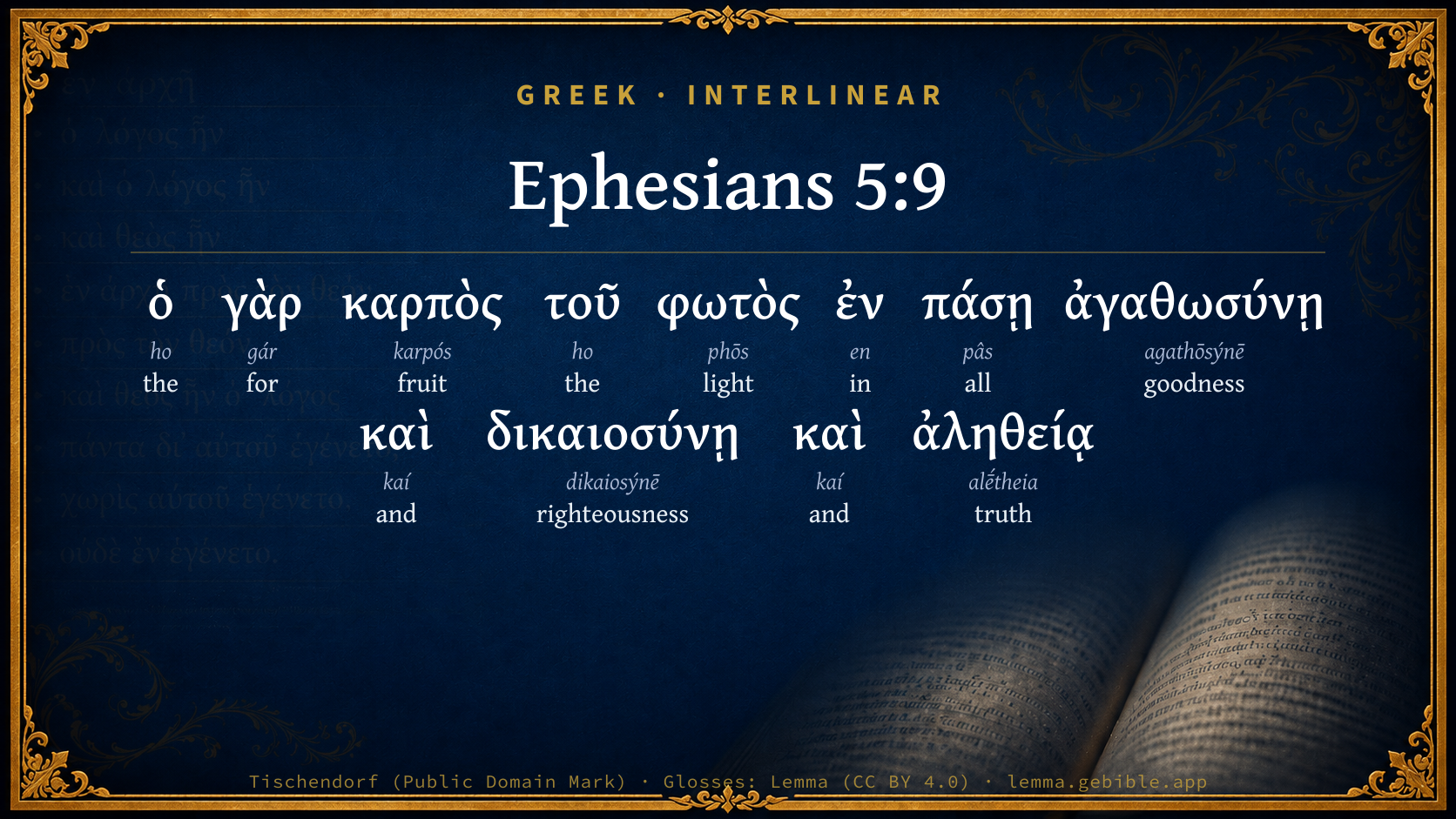
Greek (Tischendorf 8th ed.) Ephesians 5:9 appears in the Greek New Testament. The text above is from the Tischendorf 8th edition. Each word links to its Strong’s number and a concise gloss. Click any word for its full Thayer’s Greek Lexicon entry.
Download image
Cite this verse

Ephesians 5:9 (World English Bible). Public Domain. Lemma interlinear Bible study tool, https://lemma.gebible.app/v/ephesians/5/9.

Show BibTeX & RIS
BibTeX
RIS
English Translation
for the fruit of the Spirit is in all goodness and righteousness and truth,
World English Bible · Public Domain
Download a study sheet

One document with this verse’s original text, its word-by-word gloss line, the meaning frame, cross-references with their text, attributed commentary, and full source and license credits — printable, and it pastes into notes with its structure intact.

This verse Autodidact and up

Study sheet (.html) Plain text (.txt)

A passage Seminary Student

Up to 50 verses in one chapter. A passage sheet keeps up to 6 commentary sources and 12 cross-references per verse, in the order this page ranks them, and says so on the sheet whenever that leaves anything out. Ask for a single verse and you get the Autodidact verse sheet above.

Everything on this page stays free to read, with no account — the sheet is a download of what is already on screen, not access to it.

Want to remove ads? Support Godless Engineer
Compare translations 3

The same verse in 3 English versions, stacked beneath the original-language interlinear above. Click any original word for its lexicon entry.

Each is an independent rendering of the whole verse — the interlinear is not word-aligned to these translations.

Highlighted words mark where these versions differ — a whole-verse word diff, not a word-by-word alignment.

  • World English Bible Public Domain
    for the fruit of the Spirit is in all goodness and righteousness and truth,
  • King James Version Public Domain
    (For the fruit of the Spirit is in all goodness and righteousness and truth;)
  • unfoldingWord Literal Text CC BY-SA 4.0
    (for the fruit of the light consists in all goodness and righteousness and truth),

unfoldingWord Literal Text — © unfoldingWord, licensed CC BY-SA 4.0. Word-aligned USFM3 via Door43 (git.door43.org/unfoldingWord/en_ult).

Versions to compare (up to 4)

3 of 4 selected

Show all 19 translations

Every available English version of this verse, each an independent rendering of the whole verse.

  • World English Bible Public Domain
    for the fruit of the Spirit is in all goodness and righteousness and truth,
  • Berean Standard Bible Public Domain
    for the fruit of the light consists in all goodness, righteousness, and truth.
  • Majority Standard Bible Public Domain
    for the fruit of the Spirit consists in all goodness, righteousness, and truth.
  • King James Version Public Domain
    (For the fruit of the Spirit is in all goodness and righteousness and truth;)
  • American Standard Version (1901) Public Domain
    (for the fruit of the light is in all goodness and righteousness and truth),
  • Revised Version (1885) Public Domain
    (for the fruit of the light is in all goodness and righteousness and truth),
  • Geneva Bible (1599) Public Domain
    (For the fruit of the Spirit is in al goodnes, and righteousnes, and trueth)
  • Douay-Rheims (1899) Public Domain
    For the fruit of the light is in all goodness, and justice, and truth;
  • Young's Literal Translation Public Domain
    for the fruit of the Spirit `is' in all goodness, and righteousness, and truth,
  • Literal Standard Version CC BY-SA 4.0
    for the fruit of the light [is] in all goodness, and righteousness, and truth,
  • Unlocked Literal Bible CC BY-SA 4.0
    (for the fruit of the light consists in all goodness, righteousness, and truth),
  • unfoldingWord Literal Text CC BY-SA 4.0
    (for the fruit of the light consists in all goodness and righteousness and truth),
  • Darby Bible Public Domain
    (for the fruit of the light [is] in all goodness and righteousness and truth,)
  • World Messianic Bible Public Domain
    for the fruit of the Spirit is in all goodness and righteousness and truth,
  • Webster's Bible Public Domain
    (For the fruit of the Spirit is in all goodness, and righteousness, and truth;)
  • Free Bible Version CC BY-SA 4.0
    (and the fruit of light is everything that's good and right and true),
  • Bible in Basic English Public Domain
    (Because the fruit of the light is in all righteousness and in everything which is good and true),
  • Text-Critical English NT CC BY 4.0
    (for the fruit of the Spirit is found in all goodness, righteousness, and truth).
  • Tyndale New Testament (1534) Public Domain
    For the frute of the sprete is in all goodnes rightewesnes and trueth.

Literal Standard Version (2020), Covenant Press — licensed CC BY-SA 4.0. Text via the HelloAO Bible API (eBible.org). Unlocked Literal Bible (unfoldingWord) — licensed CC BY-SA 4.0. Text via the HelloAO Bible API (eBible.org). unfoldingWord Literal Text — © unfoldingWord, licensed CC BY-SA 4.0. Word-aligned USFM3 via Door43 (git.door43.org/unfoldingWord/en_ult). Free Bible Version, Dr. Jonathan Gallagher — licensed CC BY-SA 4.0. Text via the HelloAO Bible API (eBible.org).

Word by word

More ways to search: Search by grammar → Find every occurrence → Compare this word →

Practice this passage: Drill this verse → Learn its vocabulary →

About this verse

These counts appear in no published source. They are computed here, from the morphology-tagged text and Lemma’s own curated glosses. What Lemma adds →

12
words
10
distinct lemmas
Pauline Epistles
section

Notable vocabulary

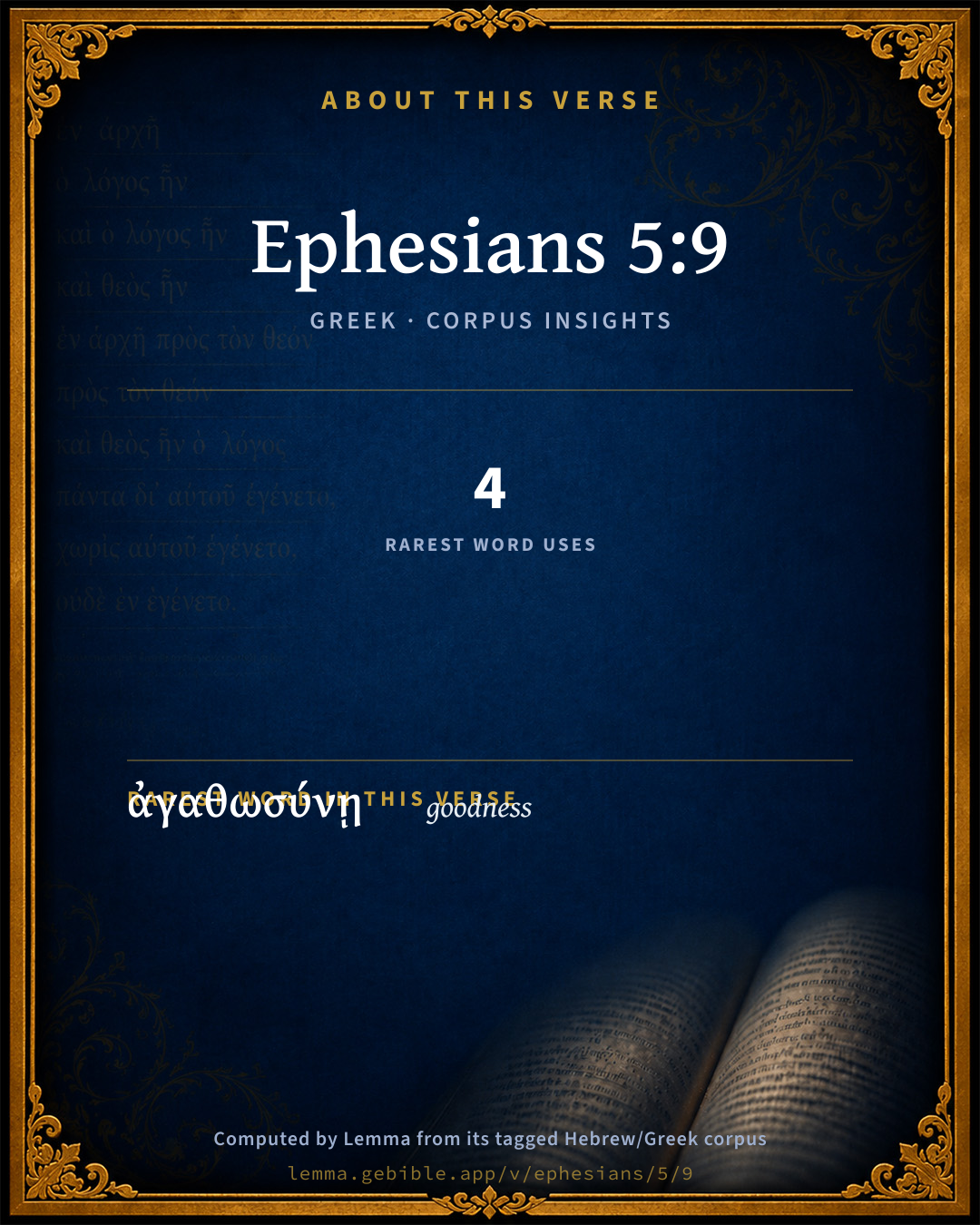
The rarest word here is ἀγαθωσύνῃ goodness G19 — appearing just 4 times in the whole Greek New Testament.

Shared distinctive vocabulary

ἀγαθωσύνῃ goodness G19 occurs in 4 verses of the Greek New Testament. Also found in:

Repetition

Words recur within this verse:

Cross-references

16

Topical passages linked to Ephesians 5:9 in the Treasury of Scripture Knowledge — connected by theme and wording, ordered by reader-vote popularity; previews shown in the World English Bible.

  • Galatians 5:22–23 But the fruit of the Spirit is love, joy, peace, patience, kindness, goodness, faithfulness,
  • 3 John 1:11 Beloved, don't imitate that which is evil, but that which is good. He who does good is of God. He who does evil hasn't seen God.
  • 1 John 3:9–10 Whoever is born of God doesn't commit sin, because his seed remains in him; and he can't sin, because he is born of God.
  • Romans 15:14 I myself am also persuaded about you, my brothers, that you yourselves are full of goodness, filled with all knowledge, able also to admonish others.
  • Ephesians 6:14 Stand therefore, having the utility belt of truth buckled around your waist, and having put on the breastplate of righteousness,
  • 1 Timothy 6:11 But you, man of God, flee these things, and follow after righteousness, godliness, faith, love, patience, and gentleness.
  • Philippians 1:11 being filled with the fruits of righteousness, which are through Jesus Christ, to the glory and praise of God.
  • Psalms 16:2–3 My soul, you have said to Yahweh, "You are my Lord. Apart from you I have no good thing."
  • 1 Peter 2:24–25 who his own self bore our sins in his body on the tree, that we, having died to sins, might live to righteousness; by whose stripes you were healed.
  • Romans 2:4 Or do you despise the riches of his goodness, forbearance, and patience, not knowing that the goodness of God leads you to repentance?
  • Ephesians 4:15 but speaking truth in love, we may grow up in all things into him, who is the head, Christ;
  • Hebrews 11:33 who, through faith subdued kingdoms, worked out righteousness, obtained promises, stopped the mouths of lions,
  • 1 John 2:29 If you know that he is righteous, you know that everyone who practices righteousness is born of him.
  • John 1:47 Jesus saw Nathanael coming to him, and said about him, "Behold, an Israelite indeed, in whom is no deceit!"
  • Ephesians 4:25 Therefore, putting away falsehood, speak truth each one with his neighbor. For we are members one of another.
  • Hebrews 1:8 but of the Son he says, "Your throne, O God, is forever and ever; The scepter of uprightness is the scepter of your Kingdom.

Cross-references courtesy of OpenBible.info (CC BY 4.0).

Where the printed editions differ

1 variant

Places in this verse where the major printed Greek editions disagree on the wording in a way that affects the translation — a comparison of editions, not a manuscript-by-manuscript collation. The editions are the modern critical texts (Nestlé-Aland 28/27, SBL, Westcott-Hort, Tregelles, Tyndale House) and the traditional texts behind the KJV (the Textus Receptus and the Byzantine/Majority text). It is not a claim about which reading is original.

  1. Different wording
    φωτὸς

    “light [is]”

    In NA28NA27TynSBLWHTreg Not in TRByz

    πνεύματος (pneumatos) 'spirit' occurs in traditional manuscripts (TR+Byz) instead of φωτὸς (phōtos) 'light [is]' in older manuscripts (NA28+NA27+Tyn+SBL+WH+Treg)

Textual data: Translators Amalgamated Greek New Testament (STEPBible TAGNT) · CC BY 4.0.

Commentary

Notes on Ephesians 5:9 from classic Christian and Jewish commentators (each source and its license shown beneath its notes). The classic Christian expositions comment on the surrounding passage and are grouped to its opening verse, so a note may address several verses; the Jewish commentaries on the Tanakh (Rashi and others) are per-verse, so they appear only where the commentator wrote on this verse.

Lemma curates 59 commentaries, every one of them public domain or Creative Commons licensed, each selected and text-cleaned for this edition rather than reprinted as found. About our sources →

The Biblical Illustrator

Joseph S. Exell

Eph_5:9

For the fruit of the Spirit is in all goodness and righteousness and truth.

The fruit of the Spirit

1. The author, the Holy Spirit.

2. The fruits of His sanctifying operations enumerated, All goodness, and righteousness, and truth.

This is the conversation that may be called Walking as children of the light.

1. The apostle, for examples sake, mentioneth some parts of the holy life, not to exclude, but imply the rest; for there is a secret and such like understood. When he saith, This is the fruit of the Spirit, you must not think it is all. When we bring a sample of a commodity we bring a little to show the quality of the rest, not as if that were all we had to sell: so these graces are mentioned, but not to exclude the rest.

2. He instanceth in such cases as concern the second table, kindness, justice, and fidelity, as is usual in such cases. The world is most capable of knowing and approving these things, but they suppose higher graces; for all our goodness, justice, and truth must come from love and obedience to God, and faith in Christ, as their true and proper principle, or else they are but moral virtues, not Christian graces (Job_1:1; Luk_23:50).

3. These are spoken of as in combination. We must not so follow after one as to neglect the other.

4. I observe that there is a note of universality joined to the word goodness. All goodness, to show this is of chief regard, and that we must not be good in one sort or kind only, but fruitful in every good work (Col_1:10). A Christian should he made up of goodness; his very constitution and trade must be goodness.

5. I observe that these are called fruit, not only by a Hebraism, who are wont to express the works of a man by the term fruit; for man is, or should be, a tree of righteousness; but there is a distinction: Gal_5:19; Gal_5:22, now the works of the flesh are manifest, but the fruit of the Spirit; so also here compare the text with verse 11, Unfruitful works of darkness. But why is it called fruit? Partly to show it is the native and genuine product of the Spirit in our hearts, as fruit groweth on a tree; and partly to show that sin is an unprofitable drudgery, but holiness is fruit.

6. All these graces, and duties consequent, are fruits of the Spirit.

7. He speaks of habits, not of acts. When the soul is thus constituted it is hard to do otherwise.

8. These are ascribed to the Spirit for two reasons.

(1) Partly because of mans incapacity to produce these things of himself.

(2) And partly because all the effects carry such a resemblance with the Spirit.

(9) This Spirit God has sent us by the preaching of the gospel. We receive the Spirit more plentifully by the gospel than by the law, and we receive it by faith in Christ.

Having made this way, I come now to propound a particular point.

1. That the Spirit which we receive by the gospel worketh all goodness in the hearts of believers.

I. What is goodness? I answer--Goodness is either moral or beneficial.

1. Moral goodness is our whole duty required by the law of God, whatever is just and equal for us to perform (Deu_30:15).

2. There is beneficial goodness, which is a branch of the former, and implieth a readiness to do good to others to the utmost of our capacity; for all good is communicative of itself (Heb_13:16).

II. That this is the fruit and product of the Spirit by the gospel.

First: What the gospel doth to promote this goodness in the world.

1. By the laws and precepts of it, or the duties it requireth; it requireth us to be good and to do good.

(1) To be good; for we are first made good before we can do good (Luk_6:45).

(2) To do good, both as to God and men.

(a) As to God, the great duty is love; that we should love Him, and obey Him as our rightful Lord and chief good and happiness.

(b) To do good to men (Gal_6:10). We cannot take delight in all, for some are an offence to the new nature which is in us; but we must do good to all, and seek their happiness. We cannot take pleasure in sinners, but yet must do them good. Suppose they have disobliged us, yet enemies are not excepted (Mat_5:44).

2. By the discoveries it maketh. The greatest, truest, and fullest prospect of Gods goodness to mankind we have in the gospel. There the kindness and love of God our Saviour towards man appeared (Tit_3:4).

3. The examples it propoundeth to our imitation, not mean and blemished ones, such as we may find among our fellow creatures, but the high and glorious examples of God and Christ Himself.

4. The arguments by which it enforceth this goodness, or the rewards and encouragements which it offereth, which is the supreme blessedness or the chief good.

Secondly: Upon what grounds we may expect the Spirit to cooperate herewith.

1. Because God worketh congruously, as with respect to the subject upon which He worketh, so with respect to the object by which He worketh. The subject is the heart of man, and therefore He draweth us with the cords of a man (Hos_11:4). The object is the gospel, a good word, or the good knowledge of God, and therefore a suitable means to work goodness in us. There we have good precepts and good promises, and an account of Gods wonderful goodness and love in Christ; and therefore the fruit of His Spirit is in all goodness.

2. The Spirit produceth this effect as a witness of the truth of the gospel, which being a supernatural doctrine, needed to be attested from heaven, that the truth of it might be known by the mighty power of God which doth accompany it, working in our hearts effects suitable to the tenor of the word. Whatever doctrine can change the soul of man, and convert it to God, is of God, and owned by God.

3. That thereby God may signify His peculiar and elective love to His people. When He worketh all goodness in their hearts by His Spirit, they come to discern that He loveth them by a special love.

4. God maketh an offer of His grace to invite us to seriousness in attending on this gospel. He excludeth none in the offer, and therefore we must not exclude ourselves. That one choice fruit of the Spirit wrought in the children of light is righteousness.

I. What is righteousness? Sometimes it is taken as largely as holiness, for that grace which doth incline us to perform our duty to God and man; for there is a righteousness even in godliness, or giving God His due honour and worship (Mat_22:21). More strictly it is taken for that grace which doth dispose and incline us to give everyone his due, and is a branch of that love and charity which is the sum of the whole second table (Rom_13:7-8). To evidence which--First: What is the office and part of justice and righteousness? To seek the peace and welfare of the several communities and societies in which we live, or in preferring the public good before our own.

2. To give to every man his due; to use faithful dealing in all the duties we owe to others, or in all actions wherein we are employed and entrusted by others.

3. Fidelity in our relations is another part of justice; for all these relations imply a right which is due to others. So we must be just to superiors and inferiors.

Secondly: To what a height Christianity advanceth these things.

1. Because it deduceth things from a higher principle, the fixed principle of a nature renewed by Christ. There are in it three things --

(1) Another nature put into us, a fixed principle;

(2) And this by the Spirits operation, and so it is a supernatural principle;

(3) This working after a kindly manner, by faith in Christ, and love to God in Christ, and so it is a forcible principle.

2. Because it measureth and directeth things by a more perfect rule than the law of nature. Our rule is Gods Word, which is a more pure and perfect rule than so much of the law as remaineth written upon mans heart after the Fall.

3. Because it referreth them to a more noble end, which is the glory of God (1Co_10:31).

II. That this is one of the fruits of the Spirit. It must needs be so, because it suiteth with His office and personal operations. The Spirit is to be our guide, sanctifier, and comforter. As our guide, He doth direct and enlighten our minds; as our sanctifier, He doth change our hearts; and as our comforter, He doth pacify and clear and quiet our consciences. Now this fruit of righteousness is conducible to all these ends, or agreeable with these offices.

III. It is a choice fruit of the Spirit.

1. Because it conduceth so much to the good of human society.

2. Because of the many promises of God, both as to the world to come and the present life.

3. That to make a Christian complete in his carriage towards men, to goodness and righteousness there must be added truth. Let me inquire here--

(1) What is truth.

(2) That it must be made conscience of by the children of light.

(3) Why truth must be added to goodness and righteousness.

I. What is meant by truth? Sincerity or uprightness in all our speeches and dealings with men. But because integrity of life, and uprightness in our commerce and dealings with others, is a great branch of righteousness, therefore here we must consider it as an opposite to falsehood or a lie in speech; yet not excluding either godly sincerity, which is the root of it: Behold, Thou desirest truth in the inward parts (Psa_2:6); or internal integrity and righteousness (Jer_5:1). The matter of a lie is falsehood, the formality of it is an intention to deceive; the outward sign is speech. Gestures are a sign by which we discover our mind, but an imperfect sign; the special instrument of human commerce is speech. Now there is a two-fold lying--a lying to God, and a lying to men.

II. Why must it be made conscience of by the children of light, or those who are light in the Lord? I answer For these reasons:

1. Because it is a sin most contrary to the nature of God, who is truth itself; it is not only contrary to His will but to His nature: Tit_1:2, In hope of eternal life, which God, that cannot lie, promised before the world began. He can do all things, but He cannot lie.

2. Because when God was incarnate, and came not only to represent the goodness of the Divine nature, but also the holiness of it as a pattern for our imitation, Jesus Christ, this God incarnate, was eminent for this part of holiness, for sincerity and truth (1Pe_2:22).

3. Nothing maketh us more like the devil, who is a liar from the beginning, and the father of lies (Joh_8:44).

4. It is a sin most contrary to the new nature wrought in the saints, and seemeth to offer more violence to it than other sins.

5. It is a sin most contrary to human society.

6. Lying is a sin very hateful to God, and against which He hath expressed much of His displeasure. A lying tongue is reckoned among those six things which God hateth (Pro_6:17).

7. It is a sin shameful and odious in the eyes of men. The more common honesty any man hath, the further he is from it, especially the more he hath of the spirit of grace (Pro_13:5).

III. Why this must be added to goodness and righteousness.

1. Because they cannot be preserved without it.

2. The life of goodness and righteousness lieth in truth, and so they cannot be thoroughly exercised unless truth be added. Sincerity runs through all the graces. (T. Manton, D. D.)

The connection between a gracious state and a holy life

The scope of the text is to show that there is a necessary connection betwixt a gracious state and a holy life; which are so joined by the appointment of God, and the nature of things, that they cannot be put asunder. The reasoning is founded on that fundamental maxim of practical Christianity, that the Holy Spirit, the Spirit of Light, abides, acts, and produceth fruit in all the children of light, in all those who are light in the Lord. It is by the communion of His Spirit that we receive of His influences to make us fruitful. The Spirit uniting the soul to Christ, the fountain of light and life, it immediately partakes of the light and life, as a candle is lighted by a burning lamp touching it; but the candle, separated from the lamp, would continue to burn, as having in itself that which feeds the flame. But the creature is empty in itself, and therefore must be fed continually from Jesus Christ, by the communion of His Spirit maintaining the bond of union betwixt Christ and the soul, and taking of Christ and giving to it. So that if it were possible that the Spirit should once totally depart from the child of light, and the union be broken, that moment he would return to his former darkness. Now the fruit of the Spirit, thus abiding and acting in the children of light, is in all goodness, righteousness, and truth; therefore it necessarily follows, that they that are light in the Lord, will walk as children of light. We are now--

2. To consider what is said of this fruit of the Spirit. It is in all goodness, etc. There is an ellipsis here of the copulating. Our translators supply the word, is. Some versions supply the word, consists. Whatever be supplied, that seems to be the sense, namely, that the fruit of the Spirit consists in all goodness, etc. Thus we read (Col_1:10) of being fruitful in every good work. The fruit of the Spirit is not only in some goodness, righteousness, and truth--though many deceive themselves with parcels and shreds of these things--but it is in all goodness in ones self and to his neighbour; in all righteousness towards man; in all truth with respect to God, our neighbour, and ourselves. And these things are interwoven one with another, in the fruit of the Spirit. The goodness is true, and jostles out no sort of righteousness or justice, communicative nor distributive, remunerative nor punitive. The righteousness is true and good; from right principles, motives, and ends. So is the truth, as it is here distinguished, proceeding from a good principle. Meanwhile, this extent of the fruit of the Spirit is to be understood not in a legal, but an evangelical sense; of a perfection of parts, not of degrees.

Lastly. Let us show how these are the fruit of the Holy Ghost in the children of light. They are so in three respects.

1. He implants them in the soul, giving it a good, righteous, and true inclination and propensity, agreeable to the holy law, according to that, I will, saith the Lord, put My law into their minds, and write them in their hearts; and I will be to them a God, and they shall be to Me a people.

2. He preserves these graces when implanted (1Pe_1:5), without which they would die out. And--

3. He excites, quickens, and brings them forth to action, in the heart and life of the children of light (Son_4:16). (T. Boston, D. D.)

The fruits of the Spirit, the same with moral virtues

I shall briefly explain the importance of these three words, goodness, and righteousness, and truth; and then proceed to make some observations from the text.

I. Goodness. And what that is, the apostle takes it for granted that everybody knows; he does not go about to define it or explain it, but appeals to every mans mind and conscience to tell him what it is. It is not anything that is disputed and controverted among men, which some call good, and others evil; but that which mankind is agreed in, and which is universally approved by the light of nature, by heathens as well as Christians; it is that which is substantially good, and that which is unquestionably so. It consists in the following particulars, viz., obedience to our superiors and governors, and a conscientious care of the duties of our several relations; sincere love and charity, compassion, humility, peace and unity, abstaining from wrath and revenge, and rendering good for evil; these are unquestionable instances of goodness, and pass for current among all mankind, are on all hands agreed to be good, and have an universal approbation among all parties and professions, how wide soever their differences may be in other matters. The other two fruits of the Spirit which are added in the text, righteousness and truth, which respect likewise our conversation with men, more especially in the way of commerce, are rather parts or branches of goodness, than really distinct from it. I now proceed to make some observations.

1. That the fruits of the Spirit are real and sensible effects, appearing in the dispositions and lives of men. The apostle here speaks of what is visible in the lives and conversations of men; for he exhorts Christians to walk as children of the light; now walking is a metaphor which signifies the outward conversation and actions of men. For religion is not an invisible thing, consisting in mere belief, in height of speculation, and niceties of opinion, or in abstruseness of mystery. The Scripture does not place it in things remote from the sight and observation of men, but in real and visible effects; such as may be plainly discerned, and even felt, in the conversation of men; not in abstracted notions, but in substantial virtues, and in a sensible power and efficacy upon the lives of men, in all the instances of piety and virtue, of holy and excellent actions.

2. That these fruits of the Spirit, here mentioned, goodness, and righteousness, and truth, are of an eternal and immutable nature, and of perpetual and indispensable obligation.

3. That moral virtues are the graces and fruits of the Spirit. So that grace and virtue are but two names that signify the same thing. Virtue signifies the absolute nature and goodness of these things; grace denotes the cause and principle by which these virtues are wrought and produced, and are preserved and increased in us; namely, by the free gift of Gods Holy Spirit to us.

4. That since these very things which are called moral virtues, are in their nature the very same with the graces and fruits of the Spirit, therefore they are by no means to be slighted as low and mean attainments in religion, but to be looked upon and esteemed as a main and substantial part of Christianity. They are called the fruits of the Spirit; that is, the natural and genuine effects of that Divine power and influence upon the hearts and lives of men, which accompanies the Christian religion; or the happy effects of the Christian religion wrought in men by the immediate operation and assistance of the Holy Spirit of God, which is conferred upon all Christians in their baptism, and does continually dwell and reside in them, if by wilful sins they do not grieve Him, and drive Him away, and provoke Him to withdraw Himself from them. (Archbishop Tillotson.)

Righteousness in all things

Just as the quality of life may be as perfect in the minutest animalculae, of which there may be millions in a cubic inch, and generations may die in an hour--just as perfect in the smallest insect as in behemoth, biggest born of earth; so righteousness may be as completely embodied, as perfectly set forth, as fully operative in the tiniest action that I can do as in the largest that an immortal spirit can be set to perform. The circle that is in a gnats eye is as true a circle as the one that holds within its sweep all the stars; and the sphere that a dewdrop makes is as perfect a sphere as that of the world. All duties are the same which are done from the same motive; all acts which are not so done are alike sins. (A. Maclaren, D. D.)

The Biblical Illustrator, edited by Joseph S. Exell (c. 1880s–1900s) — public domain. Text from a community e-Sword module.

MacLaren's Expositions of Holy Scripture

Alexander MacLaren

EPHESIANS

THE FRUIT OF THE LIGHT

Eph 5:9

This is one of the cases in which the Revised Version has done service by giving currency to an unmistakably accurate and improved reading. That which stands in our Authorised Version, ‘the fruit of the Spirit’ seems to have been a correction made by some one who took offence at the violent metaphor, as he conceived it, that ‘light’ should bear ‘fruit’ and desired to tinker the text so as to bring it into verbal correspondence with another passage in the Epistle to the Galatians, where ‘the fruits of the Spirit’ are enumerated. But the reading, ‘the fruit of the light,’ has not only the preponderance of manuscript authority in its favour, but is preferable because it preserves a striking image, and is in harmony with the whole context.

The Apostle has just been exhorting his Ephesian friends to walk as ‘children of the light’ and before he goes on to expand and explain that injunction he interjects this parenthetical remark, as if he would say, To be true to the light that is in you is the sum of duty, and the condition of perfectness, ‘for the fruit of the light is in all goodness and righteousness and truth’ That connection is entirely destroyed by the substitution of ‘spirit.’ The whole context, both before and after my text, is full of references to the light as working in the life; and a couple of verses after it we read about ‘the unfruitful works of darkness’ an expression which evidently looks back to my text.

So please do understand that our text in this sermon is-’The fruit of the light consists in all goodness and righteousness and truth.’

I. Now, first of all, I have just a word to say about this light which is fruitful.

Note-for it is, I think, not without significance-a minute variation in the Apostle’s language in this verse and in the context. He has been speaking of ‘light,’ now he speaks of ‘the light’; and that, I think, is not accidental. The expression, ‘walk as children of light,’ is more general and vague. The expression, ‘the fruit of the light,’ points to some specific source from which all light flows. And observe, also, that we have in the previous context, ‘Ye were sometime darkness, but now are ye light in the Lord,’ which evidently implies that the light of which my text speaks is not natural to men, but is the result of the entrance into their darkness of a new element.

Now I do not suppose that we should be entitled to say that Paul here is formally anticipating the deep teaching of the Apostle John that Jesus Christ is ‘the Light of men,’ and especially of Christian men. But he is distinctly asserting, I think, that the light which blesses and hallows humanity is no diffused glow, but is all gathered and concentrated into one blazing centre, from which it floods the hearts of men. Or, to put away the metaphor, he is here asserting that the only way by which any man can cease to be, in the doleful depths of his nature, darkness in its saddest sense is by opening his heart through faith, that into it there may rush, as the light ever does where an opening-be it only a single tiny cranny-is made, the light which is Christ, and without whom is darkness.

I know, of course, that, apart altogether from the exercise of faith in Jesus Christ, there do shine in men’s hearts rays of the light of knowledge and of purity; but if we believe the teaching of Scripture, these, too, are from Christ, in His universally-diffused work, by which, apart altogether from individual faith, or from a knowledge of revelation, He is ‘the light that lighteth every man coming into the world.’ And I hold that, wheresoever there is conscience, wheresoever there is judgment and reason, wheresoever there are sensitive desires after excellence and nobleness, there is a flickering of a light which I believe to be from Christ Himself. But that light, as widely diffused as humanity, fights with, and is immersed in, darkness. In the physical world, light and darkness are mutually exclusive: where the one is the other comes not; but in the spiritual world the paradox is true that the two co-exist. Apart from revelation and the acceptance of Jesus Christ’s person and work by our humble faith, the light struggles with the darkness, and the darkness obstinately refuses to admit its entrance, and ‘comprehendeth it not.’ And so, ineffectual but to make restless and to urge to vain efforts and to lay up material for righteous judgment, is the light that shines in men whose hearts are shut against Christ. The fruitful light is Christ within us, and, unless we know and possess it by the opening of heart and mind and will, the solemn words preceding my text are true of us: ‘Ye were sometime darkness.’ Oh, brother! do you see to it that the subsequent words are true of you: ‘Now are ye light in the Lord.’ Only if you are in Christ are you truly light.

II. Now, secondly, notice the fruitfulness of this indwelling light.

Of course the metaphor that light, like a tree, grows and blossoms and puts forth fruit, is a very strong one. And its very violence and incongruity help its force. Fruit is generally used in Scripture in a good sense. It conveys the notion of something which is the natural outcome of a vital power, and so, when we talk about the light being fruitful, we are setting, in a striking image, the great Christian thought that, if you want to get right conduct, you must have renewed character; and that if you have renewed character you will get right conduct. This is the principle of my text. The light has in it a productive power; and the true way to adorn a life with all things beautiful, solemn, lovely, is to open the heart to the entrance of Jesus Christ.

God’s way is-first, new life, then better conduct. Men’s way is, ‘cultivate morality, seek after purity, try to be good.’ And surely conscience and experience alike tell us that that is a hopeless effort. To begin with what should be second is an anachronism in morals, and will be sure to result in failure in practice. He is not a wise man that tries to build a house from the chimneys downwards. And to talk about making a man’s doings good before you have secured a radical change in the doer, by the infusion into him of the very life of Jesus Christ Himself, is to begin at the top story, instead of at the foundation. Many of us are trying to put the cart before the horse in that fashion. Many of us have made the attempt over and over again, and the attempt always has failed and always will fail. You may do much for the mending of your characters and for the incorporation in your lives of virtues and graces which do not grow there naturally and without effort. I do not want to cut the nerves of any man’s stragglings, I do not want to darken the brightness of any man’s aspirations, but I do say that the people who, apart from Jesus Christ, and the entrance into their souls by faith of His quickening power, are seeking, some of them nobly, some of them sadly, and all of them vainly, to cure their faults of character, will never attain anything but a superficial and fragmentary goodness, because they have begun at the wrong end.

But ‘make the tree good’ and its fruit will be good. Get Christ into your heart, and all fair things will grow as the natural outcome of His indwelling. The fruitfulness of the light is not put upon its right basis until we come to understand that the light is Christ Himself, who, dwelling in our hearts by faith, is made in us as well as ‘unto us wisdom, and righteousness, and salvation, and redemption.’ The beam that is reflected from the mirror is the very beam that falls on the mirror, and the fair things in life and conduct which Christian people bring forth are in very deed the outcome of the vital power of Jesus Christ which has entered into them. ‘I live, yet not I, but Christ liveth in me,’ is the Apostle’s declaration in the midst of his struggles; and the perfected saints before the throne cast their crowns at His feet, and say, ‘Not unto us! not unto us, but unto Thy name be the glory.’ The talent is the Lord’s, only the spending of it is the servant’s. And so the order of the Divine appointment is, first, the entrance of the light, and then the conduct that flows from it.

Note, too, how this same principle of the fruitfulness of the light gives instruction as to the true place of effort in the Christian life. The main effort ought to be to get more of the light into ourselves. ‘Abide in Me, and I in you.’ And so, and only so, will fruit come.

And such an effort has to take in hand all the circumference of our being, and to fix thoughts that wander, and to still wishes that clamour, and to empty hearts that are full of earthly loves, and to clear a space in minds that are crammed with thoughts about the transient and the near, in order that the mind may keep in steadfast contemplation of Jesus, and the heart may be bound to Him by cords of love that are not capable of being snapped, and scarcely of being stretched, and the will may in patience stand saying, ‘Speak, Lord! for Thy servant heareth’; and the whole tremulous nature may be rooted and built up in and on Him. Ah, brother! if we understand all that goes to the fulfilment of that one sweet and merciful injunction, ‘Abide in Me,’ we shall recognise that there is the field on which Christian effort is mainly to be occupied.

But that is not all. For there must be likewise the effort to appropriate, and still more to manifest in conduct, the fruit-bringing properties of that indwelling light. ‘Giving all diligence add to your faith.’ ‘Having these promises, let us cleanse ourselves from all filthiness of flesh and spirit, perfecting holiness in the fear of the Lord.’ We are often told that just as we trust Christ for our forgiveness and acceptance, so we are to trust Him for our sanctifying and perfecting. It is true, and yet it is not true. We are to trust Him for our sanctifying and our perfecting. But the faith which trusts Him for these is not a substitute for effort, but it is the foundation of effort. And the more we rely on His power to cleanse us from all evil, the more are we bound to make the effort in His power and in dependence on Him, to cleanse ourselves from all evil, and to secure as our own the natural outcomes of His dwelling within us, which are ‘the fruits of the light.’

III. And so, lastly, notice the specific fruits which the Apostle here dwells upon.

They consist, says he, in all goodness and righteousness and truth. Now ‘goodness’ here seems to me to be used in its narrower sense, just as the same Apostle uses it in the Epistle to the Romans, in contrast with ‘righteousness,’ where he says, ‘for a good man some would even dare to die.’ There he means by ‘good,’ as he does here by ‘goodness,’ not the general expression for all forms of virtue and gracious conduct, but the specific excellence of kindliness, amiability, or the like. ‘Righteousness’ again, is that which rigidly adheres to the strict law of duty, and carefully desires to give to every man what belongs to him, and to every relation of life what it requires. And ‘truth’ is rather the truth of sincerity, as opposed to hypocrisy and lies and shams, than the intellectual truth as opposed to error.

Now, all these three types of excellence-kindliness, righteousness, truthfulness-are apt to be separated. For the first of them-amiability, kindliness, gentleness-is apt to become too soft, to lose its grip of righteousness, and it needs the tonic of the addition of those other graces, just as you need lime in water if it is to make bone. Righteousness, on the other hand, is apt to become stern, and needs the softening of goodness to make it human and attractive. The rock is grim when it is bare; it wants verdure to drape it if it is to be lovely. Truth needs kindliness and righteousness, and they need truth. For there are men who pride themselves on ‘speaking out,’ and take rudeness and want of regard for other people’s sensitive feelings to be sincerity. And, on the other hand, it is possible that amiability may be sweeter than truth is, and that righteousness may be hypocritical and insincere. So Paul says, ‘Let this white light be resolved in the prism of your characters into the threefold rays of kindliness, righteousness, truthfulness.’

And then, again, he desires that each of us should try to make our own a fully developed, all-round perfection-all goodness and righteousness and truth; of every sort, that is, and in every degree. We are all apt to cultivate graces of character which correspond to our natural disposition and make. We are all apt to become torsos, fragmentary, one-sided, like the trees that grow against a brick wall, or those which stand exposed to the prevailing blasts from one quarter of the sky. But we should seek to appropriate types of excellence to which we are least inclined, as well as those which are most in harmony with our natural dispositions. If you incline to kindliness, try to brace yourselves with righteousness; if you incline to righteousness, to take the stern, strict view of duty, and to give to every man what he deserves, remember that you do not give men their dues unless you give them a great deal more than their deserts, and that righteousness does not perfectly allot to our fellows what they ought to receive from us, unless we give them pity and indulgence and forbearance and forgiveness when it is needed. The one light breaks into all colours-green in the grass, purple and red in the flowers, flame-coloured in the morning sky, blue in the deep sea. The light that is in us ought, in like manner, to be analysed into, and manifested in, ‘whatsoever things are lovely and of good report.’

And so, dear friends, here is a test for us all. Devout emotion, orthodox creed, practical diligence in certain forms of benevolence and philanthropic work, are all very well; but Jesus Christ came to make us like Himself, and to turn our darkness into light that betrays its source by its resemblance, though it be a weakened one, to the sun from which it came. We have no right to call ourselves Christ’s followers unless we are, in some measure, Christ’s pictures.

Here is a message of cheer and hope for us all. We have all tried, and tried, and tried, over and over again, to purge and mend these poor characters of ours. How long the toil, how miserable and poor the results! A million candles will not light the night; but when God’s mercy of sunrise comes above the hills, beasts of prey slink to their dens and birds begin to sing, and flowers open, and growth resumes again. We cannot mend ourselves except partially and superficially; but we can open will, heart, and mind, by faith, for His entrance; and where He comes, there He slays the evil creatures that live in and love the dark, and all gracious things will blossom into beauty. If we are in the Lord we shall be light; and if the Lord, who is the Light, is in us, we, too, shall bear fruits of ‘all righteousness and goodness and truth.’

Alexander MacLaren, Expositions of Holy Scripture (1904–1910) — public domain. Text from a community e-Sword module.

Tyndale Open Study Notes

Tyndale Open Resources

5:9 God’s people are to do what is good and right and true, in harmony with God’s light (cp. Rom 12:2; some early manuscripts read Spirit instead of light; cp. Eph 4:22-24; Matt 7:16-20; Gal 5:22-23).

Tyndale Open Study Notes — © Tyndale Open Resources, licensed CC BY-SA 4.0. Text via the HelloAO Bible API.

Bengel's Gnomon

Johann Albrecht Bengel

Eph 5:9. Ὁ καρπὸς τοῦ φωτὸς,[80] the fruit of light) The antithesis is, the unfruitful works of darkness, Eph 5:11.—ἐν, in) is in, consists in, etc.—ἀγαθωσύνῃ καὶ δικαιοσύνῃ καὶ ἀληθείᾳ, in goodness, and righteousness, and truth) These are opposed to the vices just before described, from ch. Eph 4:25, and onwards.

[80] Rec. Text has πνεύματος with later Syr. But ABD(Δ) corrected later, Gfg Vulg. Lucif. have φωτὸς.—ED.

Bengel's Gnomon of the New Testament — English translation (T&T Clark, Edinburgh, 1860) — public domain. Text from a community e-Sword module.

Meyer's Critical & Exegetical Commentary

Heinrich August Wilhelm Meyer

Eph_5:9. Parenthetic incitement to the observance of the preceding summons, by holding forth the glorious fruit which the Christian illumination bears; δοκιμάζοντες is then (Eph_5:10) accompanying definition to περιπατεῖτε, and the μὴ συγκοινωνεῖτε, Eph_5:11, continues the imperative form of address. For taking the participle of Eph_5:10 as grammatically incorrect in the sense of the imperative (Bleek, following Koppe) there is absolutely no ground.

γάρ] for, not the merely explanatory namely, which introduces into the whole paraenetic chain of the discourse something feeble and alien.

ὁ καρπὸς τοῦ φωτός] indicates in a figurative manner the aggregate of the moral effects (καρπός collective, as in Mat_3:8; Php_1:11) which the Christian enlightenment has as its result. Comp. on Gal_5:22.[260]

ἐν πάσῃ ἀγαθωσύνῃ] sc. ἐστί, so that every kind of probity (ἀγαθωσ., see on Rom_15:14; Gal_5:22), etc., is thought of as that, in which the fruit is contained (consists). Comp. Matthiae, p. 1342.

δικαιοσύνῃ] moral rectitude, Rom_6:13; Rom_14:17. See on Php_1:11.[261]

ἈΛΗΘΕΊᾼ] moral truth, opposed to hypocrisy as ethical ψεῦδος, 1Co_5:8; Php_1:18; Php_4:8; Joh_3:21. The general nature of these three words, which together embrace the whole of Christian morality, and that under the three different points of view good, right, true, forbids the assumption of more special contrasts, as e.g. in Chrysostom: ἀγαθωσ. is opposed to wrath, ΔΙΚΑΙΟΣ. to seduction and deceit, ἈΛΗΘ. to lying. Others present the matter otherwise; see Theophylact, Erasmus, Grotius.

[260] Where what is here termed καρπ. τοῦ φωτός is called καρπ. τοῦ πνεύματος. Not as though πνεῦμα and φῶς were one and the same thing (Delitzsch, Bibl. Psychol. p. 390), but the Spirit, through whom God and Christ dwell in the heart. Rom_8:9, produces the φῶς in the heart (2Co_4:6; Eph_1:17 f.), so that the fruit of the Spirit is also the fruit of the light, and vice versâ. Nor is the fruit of the word sown upon the good ground anything different.

[261] According to Php_1:11, the Christian moral rectitude has again its καρπός in the several Christian virtues, which are the expressions of its life.

Meyer — Critical and Exegetical Commentary on the New Testament — English translation by Peter Christie, edited by Frederick Crombie (T&T Clark, 1880) — public domain. Text from a community e-Sword module.

Expositor's Greek Testament

ed. W. Robertson Nicoll

Eph 5:9 . ὁ γὰρ καρπὸς τοῦ πνεύματος [ φωτός ]: for the fruit of the Spirit [ the light ]. The reading of the TR, τοῦ πνεύματος , which is that of such uncials as [540] 3 [541] [542] , most cursives, Syr.-P., Chrys., etc., must give place to τοῦ φωτός , which is supported by [543] [544] [545] [546] * [547] [548] , 67 2 , Vulg., Goth., Boh., Arm., Orig., etc. The πνεύματος is probably a correction from Gal 5:22 . The whole verse is in effect a parenthesis, and is printed as such by the RV. But it is a parenthesis with a purpose, the γάρ being at once explanatory and confirmatory. It gives a reason for the previous injunction and an enforcement of it; the point being this “Walk as I charge you; for anything else would be out of keeping with what is proper to the light and is produced by it”. καρπός , fruit , a figurative term for the moral results of the light, its products as a whole; cf. Mat 3:8 ; Phi 1:11 , etc. In the corresponding statement in Gal 5:22 , where the καρπὸς τοῦ πνεύματος is contrasted with τὰ ἔργα τῆς σαρκός , the singular term may also suggest the idea of the unity of the life and character resulting from the Spirit. ἐν πάσῃ ἀγαθωσύνῃ : is in all goodness . ἐστι , is, consists , is left unexpressed after καρπός . The πάσῃ here again has the force of “every form of,” in goodness in all its forms. The noun ἀγαθωσύνη appears again in Rom 16:14 ; Gal 5:22 ; 2Th 1:11 . Thus it occurs only four times in the Pauline writings. It is used in the LXX, but appears not to belong to classical Greek. It varies somewhat in sense. In the OT it means sometimes good as opposed to evil (Psa 38:20 ; Psa 52:3 ), sometimes enjoyment (Ecc 4:8 ), sometimes benevolence , the bountiful goodness of God (Neh 9:25 ). Here and in the other Pauline passages it is taken by some in the sense of uprightness , but appears rather to mean active goodness, beneficence ; cf. Trench, Syn. , p. 218. καὶ δικαιοσύνῃ : and righteousness . δικαιοσύνη here has the sense of rectitude, probity , freedom from the morally wrong or imperfect, as in Mat 3:15 ; Mat 5:6 ; Mat 5:10 ; Mat 5:20 , etc., and as also in such Pauline passages as Rom 6:13 ; Rom 6:16 ; Rom 6:18-20 ; Rom 8:10 ; 2Co 6:7 ; 2Co 6:14 , etc. καὶ ἀληθείᾳ : and truth . ἀλήθεια here in the subjective sense of moral truth, sincerity and integrity as opposed to falsehood, hypocrisy and the like; cf. Joh 3:21 ; 1Co 5:8 ; Phi 1:18 , etc. Here, then, Christian morality is given in its three great forms of the good , the just , the true . Abbott compares the “justice, mercy, and truth” of the Gospels and Butler’s “justice, truth, and regard to the common good”.

[540] Codex Claromontanus (sæc. vi.), a Græco-Latin MS. at Paris, edited by Tischendorf in 1852.

[541] Codex Mosquensis (sæc. ix.), edited by Matthæi in 1782.

[542] Codex Angelicus (sæc. ix.), at Rome, collated by Tischendorf and others.

[543] Codex Vaticanus (sæc. iv.), published in photographic facsimile in 1889 under the care of the Abbate Cozza-Luzi.

[544] Codex Sinaiticus (sæc. iv.), now at St. Petersburg, published in facsimile type by its discoverer, Tischendorf, in 1862.

[545] Codex Alexandrinus (sæc. v.), at the British Museum, published in photographic facsimile by Sir E. M. Thompson (1879).

[546] Codex Claromontanus (sæc. vi.), a Græco-Latin MS. at Paris, edited by Tischendorf in 1852.

[547] Codex Boernerianus (sæc. ix.), a Græco-Latin MS., at Dresden, edited by Matthæi in 1791. Written by an Irish scribe, it once formed part of the same volume as Codex Sangallensis ( δ ) of the Gospels. The Latin text, g, is based on the O.L. translation.

[548] Codex Porphyrianus (sæc. ix.), at St. Petersburg, collated by Tischendorf. Its text is deficient for chap. Eph 2:13-16 .

The Expositor's Greek Testament, edited by W. Robertson Nicoll (1897–1910) — public domain. Text from a community e-Sword module.

Hodge's Commentary on Romans, Ephesians & First Corinthians

Charles Hodge

Eph_5:9

For the fruit of light,‹17› i.e. the fruit or effect of divine illumination is in all, i.e. consists in all the forms of goodness, righteousness, and truth. Goodness, ἀγαθωσύνῃ, is that which makes a man ἀγαθός, good; and righteousncss, δικαιοσύνῃ is that which makes a man δίκαιος, righteous. These Greek words differ very much as the corresponding English terms do. Goodness is benevolence and beneficence; righteousness is adherence to the rule of right. Yet both are used for moral excellence in general. The evil and the good, included all classes of the vicious and the virtuous. Good works are works of any kind which are morally excellent. When however the words are contrasted as in Rom_5:7 or distinguished as in Rom_7:12, good means benevolent or beneficent; and righteous, just or upright. Goodness is that quality which adapts a thing to the end for which it was designed, and renders it serviceable. Hence we speak of a good tree, of good soil, as well as of a good man. Righteousness can properly be predicated only of persons or of what is susceptible of moral character; as it means conformity to law; or if predicated of the law itself, it means conformity to the nature of God, the ultimate standard of rectitude. Truth, here means religious or moral truth, or religion itself. The fruits of light, therefore, are all the forms of piety and virtue.

Charles Hodge — Commentary on Romans (1835), First Corinthians (1857), and Ephesians (1856) — public domain. Text from a community e-Sword module.

Geneva Bible (1599)

Geneva Bible translators

By whose force we are made light in the Lord.

Geneva Bible (1599) marginal notes — public domain. Text via Bolls.life.

Jamieson, Fausset & Brown

Robert Jamieson, A. R. Fausset & David Brown

fruit of the Spirit--taken by transcribers from Gal 5:22. The true reading is that of the oldest manuscripts, "The fruit of THE LIGHT"; in contrast with "the unfruitful works of darkness" (Eph 5:11). This verse is parenthetic. Walk as children of light, that is, in all good works and words, "FOR the fruit of the light is [borne] in [ALFORD; but BENGEL, 'consists in'] all goodness [opposed to 'malice,' Eph 4:31], righteousness [opposed to 'covetousness,' Eph 5:3] and truth [opposed to 'lying,' Eph 4:25]."

Jamieson, Fausset & Brown — Commentary Critical and Explanatory on the Whole Bible (1871) — public domain (CC PDM 1.0). Text via the HelloAO Bible API.

Adam Clarke's Commentary

Verse 9. For the fruit of the Spirit] Instead of Spirit, πνευματος, ABD*EFG, the Syriac, Coptic, Sahidic, AEthiopic, Armenian, Vulgate, and Itala, together with several of the fathers, read φωτος, light, which is supposed by most critics to be the true reading, because there is no mention made of the Spirit in any part of the context. As light, Eph 5:8, not only means the Divine influence upon the soul, but also the Gospel, with great propriety it may be said: The fruit of the light, i.e. of the Gospel, is in all goodness, and righteousness, and truth. Goodness, αγαθωσυνη, in the principle and disposition; righteousness, δικαιοσυνη, the exercise of that goodness in the whole conduct of life; truth, αληθεια, the director of that principle, and its exercise, to the glorification of God and the good of mankind.

Adam Clarke's Commentary on the Bible (1810–1826) — public domain. Text from a community e-Sword/MySword module.

John Calvin's Commentaries

9. For the fruit of the light. This parenthesis is introduced, to point out the road in which the children of light ought to walk. A complete description is not given, but a few parts of a holy and pious life are introduced by way of example. To give them a general view of duty, their attention is again directed to the will of God. Whoever desires to live in a proper and safe manner, let him resolve to obey God, and to take his will as the rule. To regulate life entirely by his command is, as he says in another Epistle, a reasonable service, (Romans 12:1,) or, as another inspired man expresses it, To obey is better than sacrifice. (1 Samuel 15:22.) I wonder how the word Spirit (πνεὐματος) has crept into many Greek manuscripts, as the other reading is more consistent, — the fruit of the light Paul’s meaning indeed is not affected; for in either case it will be this, that believers must walk in the light, because they are “children of the light.” This is done, when they do not live according to their own will, but devote themselves entirely to obedience to God, — when they undertake nothing but by his command. Besides, such obedience is testified by its fruits, such as goodness, righteousness, and truth.

John Calvin's Commentaries (1540-1563) — public domain. Text from the Calvin Translation Society English edition (1840s-50s) via the Christian Classics Ethereal Library (ccel.org). Calvin's coverage is partial (roughly two-thirds of the Bible); uncommented books and verses are honest gaps, never fabricated. The 19th-century editor's footnotes and remarks are omitted so the notes are faithfully Calvin's own voice.

Ellicott's Commentary for English Readers

(9) For the fruit . . .—The true reading is, of the Light, for which the easier phrase, “the fruit of the Spirit,” has been substituted, to the great detriment of the force and coherency of the whole passage. Light has its fruits; darkness (see Eph_5:11) is “unfruitful.” The metaphor is striking, but literally correct, inasmuch as light is the necessary condition of that vegetative life which grows and yields fruit, while darkness is the destruction, if not of life, at any rate of fruit-bearing perfection.

Goodness and righteousness and truth.—These are practical exhibitions of the “being true in love,” described in Eph_4:15 as the characteristic of the Christ-like soul. For “goodness” is love in practical benevolence, forming, in Gal_5:22, a climax to “longsuffering” and “kindness,” and, in 2Th_1:11, distinguished as practical from the “faith” which underlies practice. The other two qualities, “righteousness” and “truth”—that is, probably, truthfulness-are both parts of the great principle of “being true.”

A Bible Commentary for English Readers, edited by Charles John Ellicott (1878–1897) — public domain. Text from a community e-Sword module.

The Cambridge Bible for Schools and Colleges

gen. ed. J. J. S. Perowne

9. for] The suppressed link of thought is, “Walk in a path wholly unlike that of the disobedient; for the path of the light must be such.”

the fruit of the Spirit] Cp. Gal_5:22. But the literary evidence here supports the reading the fruit of the light. The metaphor “fruit” (found here only in the Epistle) gives the idea not only of result but of natural and congenial result; growth rather than elaboration. Christian virtue is, in its true essence, grace having its way.

is in] Consists in, comes out in.

all] Observe here, as continually, the absoluteness in idea of the Christian character. It is an unsinning character. “Whosoever is born of God, doth not commit sin” (1Jn_3:9). The Christian, as a Christian, sins not: a truth at once humiliating and stimulating.

goodness] The Gr. word occurs besides, Rom_15:14; Gal_5:22; 2Th_1:11. The Gr. word like the English, while properly meaning the whole quality opposite to evil, tends to mean specially the goodness of beneficence, or at least benevolence. Such, on the whole, is the evidence of the LXX. usage. But the context here favours the wider and more original reference; all that is anti-vicious.

St Chrysostom sees in it here a special antithesis to anger; but this is surely too narrow a reference. See further on the word, Trench, N.T. Synonyms, § 1.

righteousness] See above on Eph_4:24. And cp. Tit_2:12. The special reference here doubtless is to the observance of God’s Law in regard of the rights of others, in things of honesty and purity.

truth] The deep, entire reality which is the opposite to the state of “the simular of virtue that is incestuous” (King Lear, iii. 3).

The Cambridge Bible for Schools and Colleges (gen. ed. J. J. S. Perowne; Cambridge University Press, 1878–1918) — public domain. Text from a community e-Sword module.

John Gill's Exposition

Proving what is acceptable unto the Lord. There are many things that are acceptable to God, as the person of Christ, his righteousness, sacrifice, sufferings, death, and mediation; the persons of his people, their services, sufferings, sacrifices of prayer, and praise to him, and of bounty and liberality to the poor; their graces, and the exercise of them; and the actions of their lives and conversations, when they are becoming the Gospel, are according to the will of God, and are done in faith, and are directed to his glory: and these things which are acceptable to God, as all the truths of the Gospel, and duties of religion are, should be proved, or tried by men; and in order to the trial of spiritual things, it is necessary that the mind be renewed, the understanding be enlightened, the spiritual senses be in exercise, and all be under the influence and directions of the Spirit of God: and the trial is to be made, not according to human reason, which is corrupt and fallible; and besides, there are some things in revelation above it; but according to the Scriptures, which are the word of God, and the rule of faith and practice; and whither the prophets, Christ, and his apostles, always sent men for the trial of divine things; and things being here tried, and found to be right, should be approved of, valued, and esteemed, cleaved to and held fast.

Proving what is acceptable unto the Lord. There are many things that are acceptable to God, as the person of Christ, his righteousness, sacrifice, sufferings, death, and mediation; the persons of his people, their services, sufferings, sacrifices of prayer, and praise to him, and of bounty and liberality to the poor; their graces, and the exercise of them; and the actions of their lives and conversations, when they are becoming the Gospel, are according to the will of God, and are done in faith, and are directed to his glory: and these things which are acceptable to God, as all the truths of the Gospel, and duties of religion are, should be proved, or tried by men; and in order to the trial of spiritual things, it is necessary that the mind be renewed, the understanding be enlightened, the spiritual senses be in exercise, and all be under the influence and directions of the Spirit of God: and the trial is to be made, not according to human reason, which is corrupt and fallible; and besides, there are some things in revelation above it; but according to the Scriptures, which are the word of God, and the rule of faith and practice; and whither the prophets, Christ, and his apostles, always sent men for the trial of divine things; and things being here tried, and found to be right, should be approved of, valued, and esteemed, cleaved to and held fast.

Ephesians 5:11

eph 5:11

eph 5:11

eph 5:11And have no fellowship with the unfruitful works of darkness,.... It is not said with the workers of darkness, or with the men of the world, who are in darkness, and are darkness itself; to have fellowship with them in a civil way, or to dwell among them, is not prohibited; it is allowed of, and countenanced by the greatest examples; and especially it is lawful and right, when there is any prospect of doing good to the souls of men; and even when natural right, relation, and necessity require it; and indeed, the contrary is impracticable: conversation with them in things sinful and superstitious should be abstained from; and when it tends to draw off the soul from Christ and his interest, and is infectious; and when weak ones are offended, and sinners are hereby hardened and confirmed in sin; and the name of God is blasphemed, and the Gospel is evil spoken of: but fellowship is not to be maintained "with the works of darkness"; which are sins, so called, because they are opposite to light; to the light of nature, to the light of the divine word, both law and Gospel, to the light of grace, to God the fountain of light, and to Christ the light of the world; and because the source and spring of them are the original darkness of the mind, and Satan the prince of darkness; and because they are generally committed in the dark; and because the effect and consequence of them is utter darkness, and blackness of darkness: and these are "unfruitful"; they are of no profit and advantage, they bring forth no fruit, unless it be guilt, fear, shame, corruption, and death; wherefore no fellowship should be had with them, by committing the same, by assisting in them, by consenting to them, by approving of them, by receiving any worldly advantage from them, and by winking and conniving at them: it is contrary to the character of saints to have fellowship with such, as the apostle says, Co2 6:14, where he gives the mystical explanation of the law, in Deu 22:10; agreeably to which, and to the passage here, is the sense of a Jewish commentators (l) who upon it observes, that that law

"intimates that a righteous man, , "should have no fellowship" with a wicked man;''

this is to be unequally yoked, signified by the ox and the ass ploughing together:

but rather reprove them; both by words and by deeds, by an agreeable life and conversation, which last seems to be the design of the apostle here; because it is not a brother, but such who are in darkness, and live in works of darkness; yea, not sinners, but sins are to be reproved, which can be done no other way; nor are all saints proper to reprove verbally, nor are they qualified for it; but all should, and may by facts; and the light discovers darkness, by its own splendour; and this appears from the apostle's reasoning in the next words.

(l) Baal Hatturira in Deut. xxii. 10.

John Gill's Exposition of the Whole Bible (1746–1763) — public domain (CC PDM 1.0). Text via the HelloAO Bible API.

Trapp's Complete Commentary

John Trapp

9 (For the fruit of the Spirit is in all goodness and righteousness and truth;)

Ver. 9. For the fruit of the Spirit] Why grace is called fruit, see note: {See Trapp on "Gal 5:22"}

John Trapp, A Commentary or Exposition upon All the Books of the Old and New Testament (1647–1656) — public domain. Text from a community e-Sword module.

Albert Barnes' Notes on the Bible

For the fruit of the Spirit - That is, since the Holy Spirit through the gospel produces goodness, righteousness, and truth, see that you exhibit these in your lives, and thus show that you are the children of light. On the fruits of the Spirit, see the notes on Gal 5:22-23.

Is in all goodness - Is seen in producing all kinds of goodness. He who is not good is not a Christian.

Albert Barnes' Notes on the Bible (1834–1885) — public domain. Text from a community e-Sword/MySword module.

Haydock's Catholic Bible Commentary

For the fruit of the light. So the Latin and divers Greek copies; not the fruit of the spirit, as we read in many Greek manuscripts; and in this Dr. Wells thought fit to change the Protestant translation. (Witham)

George Leo Haydock (1774–1849), Haydock's Catholic Family Bible and Commentary, 1859 edition — public domain. Excludes Psalms (Douay-Rheims chapter numbering differs from Protestant) and Deuterocanonical books (Catholic canon only).

Matthew Poole's English Annotations

The fruit of the Spirit; either in the fruit or work of the new nature, or of the Holy Ghost, by whom we are made light in the Lord: see Gal 5:22.

In all goodness; either a general virtue in opposition to wickedness, or benignity and bounty.

Righteousness; in opposition to injustice, by covetousness, fraud, &c.

Truth; in opposition to error, lies, hypocrisy. He shows what it is to walk as children of light.

Matthew Poole's English Annotations on the Holy Bible (1683–1685) — public domain. Text from a community e-Sword/MySword module.

Whedon's Commentary on the Bible

Daniel D. Whedon

9. Fruit… Spirit—A better reading substitutes light for Spirit. The graces produced by the power of the true Christian light, namely, goodness, opposed to all the sins of appetite and lust; righteousness, to all unjust and dishonest dealing to men; and truth, to all insincerity, and falseness to God or man.

Daniel D. Whedon (gen. ed.), Commentary on the Old and New Testaments (1874–1909) — public domain. Text from a community e-Sword module.

The Pulpit Commentary

For the fruit of light is shown in all goodness and righteousness and truth. The exhortation is confirmed by this statement of what is the natural result of light goodness, the disposition that leads to good works; righteousness, rectitude, or integrity, which is most careful against all disorder and injustice, and renders to all their due, and especially to God the things that are God"s; and truth, meaning a regard for truth in every form and way believing it, reverencing it, speaking it, acting according to it, hoping and rejoicing in it, being sincere and honest, not false or treacherous.

The fruit of the light.

It is shown or seen in all the forms of "goodness and righteousness and truth." The good, the right, the true, are only to be realized through the light that streams from the Sun of righteousness true light" that "now shineth." The apostle says the fruit, not the fruits, of the light as if to show that it takes all the three colors to make this light. Christianity would be a very imperfect; manifestation of God if a single one of these elements were missing from the true light.

I GOODNESS. It is spoken of elsewhere as a fruit of the Spirit, (Gal_5:22) and therefore is not mere beneficence, for it has its source in religious principle. This excellence, in its various aspects of kindness and generosity, is kindled by the light that illuminates the understanding.

II RIGHTEOUSNESS. The light which communicates a knowledge of righteousness to the mind also infuses a love of righteousness into the affections. This principle has a due sense of Divine obligation, and subjects the believer in every relation of life to the guidance of Divine Law.

III TRUTH. This is a direct emanation of the light. It is religious truth, working ultimately to truth of character in all the genuine forms of Christian life. T.C.

The Pulpit Commentary (1880–1919), ed. H.D.M. Spence-Jones & Joseph S. Exell — public domain. Text from a community e-Sword module.

John Wesley's Explanatory Notes

The fruit of the light - Opposite to " the unfruitful works of darkness," chap. iv, 11. Is in - That is, consists in. Goodness and righteousness and truth - Opposite to the sins spoken of, chap. iv, 25,&c.

John Wesley, Explanatory Notes Upon the Whole Bible (1754–1765) — public domain. Text via the GEBible commentary corpus.

Scofield Reference Notes

C. I. Scofield

righteousness

(See Scofield "1Jn 3:7").

The Scofield Reference Bible (1917 edition), notes by C. I. Scofield — public domain. Text from a community e-Sword module.

Burkitt's Expository Notes on the New Testament

William Burkitt

These words contain a reason why the Ephesians, who were once darkness, but then enlightened by the Holy Spirit, should walk as children of the light; namely, because the fruits of that light, or of the Holy Spirit, the author of that light which they had received, is in all goodness, righteousness, and truth, that is, it consisted in these things, these are the fruits of the enlightening and enlivening Spirit of God.

So that the force of the argument lies thus: such a walking as is here directed to, namely, in the love and practice of universal righteousness and goodness, is the genuine fruit and natural result of the Holy Spirit, and accordingly as such they were obliged to it. None can walk as children of the light, but such as are renewed and quickened by the Holy Spirit of God, and made children of light; and such will be found in the practice of those duties, wherein that walk consisteth.

Proving what is acceptable unto the Lord; that is,

1. To study the word, and find what is pleasing unto God.

2. Embrace with our hearts what we find to be so.

And, 3. To practise in our lives what we embrace with our hearts.

The scripture acquaints us with some persons and some performances which are very acceptable unto God; such persons as live most by faith, as are very upright in their walking, very sincere in all they do, such are greatly acceptable, namely, when we do justice and judgment, this is more acceptable to the Lord than sacrifice; both commutative and distributive justice betwixt man and man, more pleasing to God than the highest acts of worship performed to him without this, Pro 21:3. To serve Christ with a pure intention, with good will, or a willing mind, and to suffer patiently for well-doing, this is highly pleasing and acceptable unto God,1Pe 2:20.

William Burkitt's Expository Notes on the New Testament (1700–1703) — public domain. Text from a community e-Sword module.

The People's New Testament

B. W. Johnson

9. For the fruit of the Spirit. To walk as children of light is to bear the fruit of the Spirit. This is shown by goodness and righteousness. See Gal. 5:22.

B. W. Johnson's The People's New Testament with Notes (1889–1891) — public domain. Electronic text from the Christian Classics Ethereal Library (CCEL) ThML edition.

Cambridge Greek Testament for Schools and Colleges

9. ὁ γὰρ καρπὸς τοῦ φωτὸς. See Eph 5:1. This clause defines both the character of the children of light and the blessings inherent in the light which they are called to radiate.

ἀγαθωσύνῃ. Kindness in action, active benevolence, the opposite of κακία Eph 4:31; part of the fruit of the Spirit in Gal 5:22. δικαιοσύνῃ. ‘Justice’ recognizing the claims of men Eph 4:24, Eph 6:14. ἀληθείᾳ. ‘Truthfulness’ Eph 4:21, Eph 6:14; 1Co 5:8. Sincerity in word and deed, the opposite of ὑπόκρισις.

Cambridge Greek Testament for Schools and Colleges (Cambridge University Press, 1896; 21 vols, various authors incl. Carr, Maclear, Plummer, Farrar, Lumby, Moule, M. R. James, Simcox) — public domain. Text from a community e-Sword module.

International Critical Commentary

9. ὁ γὰρ καρπὸς τοῦ φωτός. The walk to which I exhort you is that which becomes children of the light, for etc.

The Rec. Text. has πνεύματος for φωτός, with Dc K L, Syr-Pesh, Chrys. and most cursives.

φωτός is the reading of א A B D* G P 672, It, Vulg., Goth., Boh., Arm., Origen, Jerome.

It might be thought possible that φωτός had come in from recollection of the same word just preceding, but the figure of “light” governs the whole passage, and ἔργα ἄκαρπα σκότους, ver. 10, corresponds to καρπὸς φωτός here. Καρπὸς πνεύματος undoubtedly came in from the parallel, Gal 5:22, where the contrast is with ἔργα σαρκός, ver. 19; cf. 17, 18. The variation is an important one for the estimate of the character of the authorities that support the two readings respectively.

ἐν πάσῃ ἀγαθωσύνῃ καὶ δικαιοσύνῃ καὶ ἀληθείᾳ.“In all (i.e. every kind of) goodness and righteousness and truth,” the opposites of κακία, ἀδικία, ψεῦδος. ἀγαθωσύνη is not found in classical Greek, but is used by St. Paul in three other places, viz. Rom 16:14; Gal 5:22; 2Th 1:11. The use of it in the Sept. gives us little help. In Eccles., where it occurs several times, it is used for “enjoyment.” In Neh 9:25, Neh 9:35, it is used of the goodness of God. In Psa 3:3 (li. Sept.) it is “good “in general as opposed to “evil”; and so in 38(37):20. In St. Paul it would seem to mean “goodness” in the special sense of benevolence; and thus the threefold enumeration here would correspond to that in the Gospels: “justice, mercy, and truth,” and to Butler’s “justice, truth, and regard to common good” (comp. Rom 5:7).

As a metaphor the expression “fruit of the light” cannot be called “strictly correct,” as if it referred to the necessity of light for the production of fruit, etc. The words “children of light” convey no intimation of such a figure.

International Critical Commentary — older volumes (1896–1929), various authors — public domain. Text from a community e-Sword module.

Vincent's Word Studies in the New Testament

Marvin R. Vincent

Is in. Consists in. The verse is parenthetical.

Marvin R. Vincent, Word Studies in the New Testament (1887–1900) — public domain. Text from a community e-Sword/MySword module.

Lesson kit

Teaching starters — assembled from the data on this page, not authored interpretation. Every prompt links to the verse data it draws on. Edit before teaching.

Ephesians, in the Pauline Epistles, opens this verse with 12 words (10 distinct Greek lemmas). Its most distinctive word is agathōsýnē (“goodness”). A historical commentator’s framing appears above. Read the whole chapter for the surrounding context.

Discussion questions

  1. The word agathōsýnē carries the sense “goodness.” How does it shape the verse?
  2. Romans 15:14 shares the word «goodness» with this verse. How do the two illuminate each other?
  3. “the” occurs 2× in this one verse. What is the effect of the repetition?
  4. These translations render this verse differently; the difference is in the English rendering, not the original. What questions does that raise?
  5. Reading how The Biblical Illustrator and MacLaren's Expositions of Holy Scripture read this verse, where do the two commentators agree and where do they part?

Things to notice

Reading settings

Reading text

Shown beneath each verse's original-language words.

Old Testament
Old Testament edition

Read the OT as the Masoretic Hebrew (MT) or the Greek Septuagint (LXX).

English shown for the Greek Septuagint (in the Hebrew ↔ Greek comparison).

Comparing translations? Open the Compare panel on any verse page to stack up to four side by side.