

Philippians 4:17
Greek (Tischendorf 8th ed.) Philippians 4:17 appears in the Greek New Testament. The text above is from the Tischendorf 8th edition. Each word links to its Strong’s number and a concise gloss. Click any word for its full Thayer’s Greek Lexicon entry.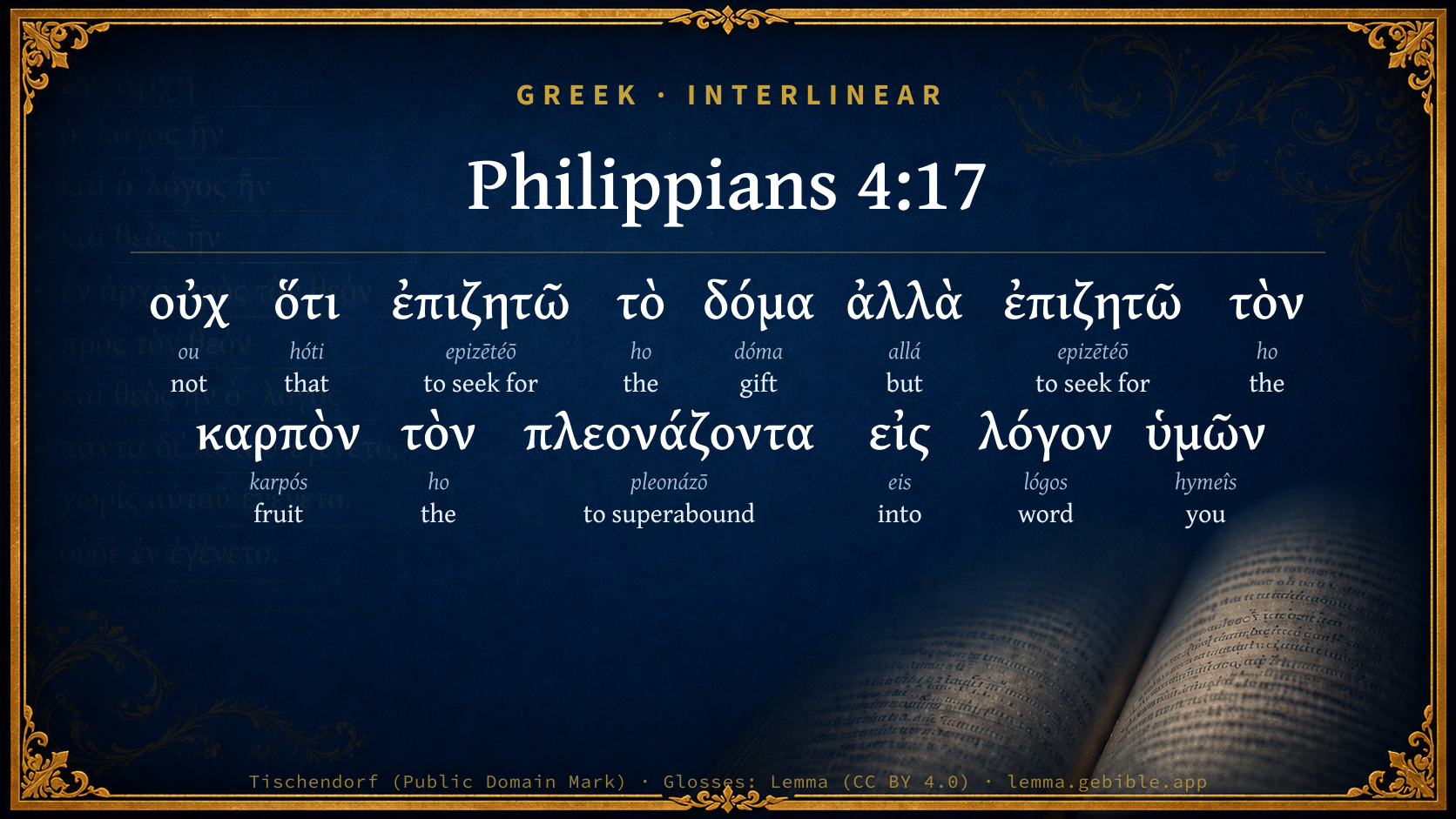
Not that I seek for the gift, but I seek for the fruit that increases to your account.
Download a study sheet
One document with this verse’s original text, its word-by-word gloss line, the meaning frame, cross-references with their text, attributed commentary, and full source and license credits — printable, and it pastes into notes with its structure intact.
This verse Autodidact and up
A passage Seminary Student
Up to 50 verses in one chapter. A passage sheet keeps up to 6 commentary sources and 12 cross-references per verse, in the order this page ranks them, and says so on the sheet whenever that leaves anything out. Ask for a single verse and you get the Autodidact verse sheet above.
Everything on this page stays free to read, with no account — the sheet is a download of what is already on screen, not access to it.
Compare translations 3
The same verse in 3 English versions, stacked beneath the original-language interlinear above. Click any original word for its lexicon entry.
Each is an independent rendering of the whole verse — the interlinear is not word-aligned to these translations.
Highlighted words mark where these versions differ — a whole-verse word diff, not a word-by-word alignment.
-
World English Bible Public Domain
Not that I seek for the gift, but I seek for the fruit that increases to your account.
-
King James Version Public Domain
Not because I desire a gift: but I desire fruit that may abound to your account.
-
unfoldingWord Literal Text CC BY-SA 4.0
Not that I seek the gift, but I seek the fruit that is increasing to your account.
unfoldingWord Literal Text — © unfoldingWord, licensed CC BY-SA 4.0. Word-aligned USFM3 via Door43 (git.door43.org/unfoldingWord/en_ult).
Show all 19 translations
Every available English version of this verse, each an independent rendering of the whole verse.
-
World English Bible Public Domain
Not that I seek for the gift, but I seek for the fruit that increases to your account.
-
Berean Standard Bible Public Domain
Not that I am seeking a gift, but I am looking for the fruit that may be credited to your account.
-
Majority Standard Bible Public Domain
Not that I am seeking a gift, but I am looking for the fruit that may be credited to your account.
-
King James Version Public Domain
Not because I desire a gift: but I desire fruit that may abound to your account.
-
American Standard Version (1901) Public Domain
Not that I seek for the gift; but I seek for the fruit that increaseth to your account.
-
Revised Version (1885) Public Domain
Not that I seek for the gift; but I seek for the fruit that increaseth to your account.
-
Geneva Bible (1599) Public Domain
Not that I desire a gift: but I desire the fruit which may further your reckoning.
-
Douay-Rheims (1899) Public Domain
Not that I seek the gift, but I seek the fruit that may abound to your account.
-
Young's Literal Translation Public Domain
not that I seek after the gift, but I seek after the fruit that is overflowing to your account;
-
Literal Standard Version CC BY-SA 4.0
not that I seek after the gift, but I seek after the fruit that is overflowing to your account;
-
Unlocked Literal Bible CC BY-SA 4.0
It is not that I seek the gift. Instead, I seek the fruit that increases to your credit.
-
unfoldingWord Literal Text CC BY-SA 4.0
Not that I seek the gift, but I seek the fruit that is increasing to your account.
-
Darby Bible Public Domain
Not that I seek gift, but I seek fruit abounding to your account.
-
World Messianic Bible Public Domain
Not that I seek for the gift, but I seek for the fruit that increases to your account.
-
Webster's Bible Public Domain
Not because I desire a gift: but I desire fruit that may abound to your account.
-
Free Bible Version CC BY-SA 4.0
Not that I'm looking for a donation—I'm looking for your “account” to increase in “profit.”
-
Bible in Basic English Public Domain
Not that I am looking for an offering, but for fruit which may be put to your credit.
-
Text-Critical English NT CC BY 4.0
Not that I seek the gift, but I seek the fruit that abounds to your account.
-
Tyndale New Testament (1534) Public Domain
not that I desyre gyftes: but I desyre aboudant frute on youre parte.
Literal Standard Version (2020), Covenant Press — licensed CC BY-SA 4.0. Text via the HelloAO Bible API (eBible.org). Unlocked Literal Bible (unfoldingWord) — licensed CC BY-SA 4.0. Text via the HelloAO Bible API (eBible.org). unfoldingWord Literal Text — © unfoldingWord, licensed CC BY-SA 4.0. Word-aligned USFM3 via Door43 (git.door43.org/unfoldingWord/en_ult). Free Bible Version, Dr. Jonathan Gallagher — licensed CC BY-SA 4.0. Text via the HelloAO Bible API (eBible.org).
Word by word
More ways to search: Search by grammar → Find every occurrence → Compare this word →
Practice this passage: Drill this verse → Learn its vocabulary →
- Appears 4× in the Greek New Testament
- First appears at Matthew 7:11
- Part of Speech
- Noun
- Case
- Accusative
- Number
- Singular
- Gender
- Neuter
Full Thayer's Definition
- οὐχ ou G3756 “not” Particle, Negative
- ὅτι hóti G3754 “that” Conjunction
- ἐπιζητῶ epizētéō G1934 “to seek for” Verb, Present, Active, Indicative, 1st person, Singular
- τὸ ho G3588 “the” Article, Accusative, Singular, Neuter
- δόμα dóma G1390 “gift” Noun, Accusative, Singular, Neuter
- ἀλλὰ allá G235 “but” Conjunction
- ἐπιζητῶ epizētéō G1934 “to seek for” Verb, Present, Active, Indicative, 1st person, Singular
- τὸν ho G3588 “the” Article, Accusative, Singular, Masculine
- καρπὸν karpós G2590 “fruit” Noun, Accusative, Singular, Masculine
- τὸν ho G3588 “the” Article, Accusative, Singular, Masculine
- πλεονάζοντα pleonázō G4121 “to superabound” Verb, Present, Active, Participle, Accusative, Singular, Masculine
- εἰς eis G1519 “into” Preposition
- λόγον lógos G3056 “word” Noun, Accusative, Singular, Masculine
- ὑμῶν hymeîs G5210 “you” Personal pronoun, 2nd person, Genitive, Plural
About this verse
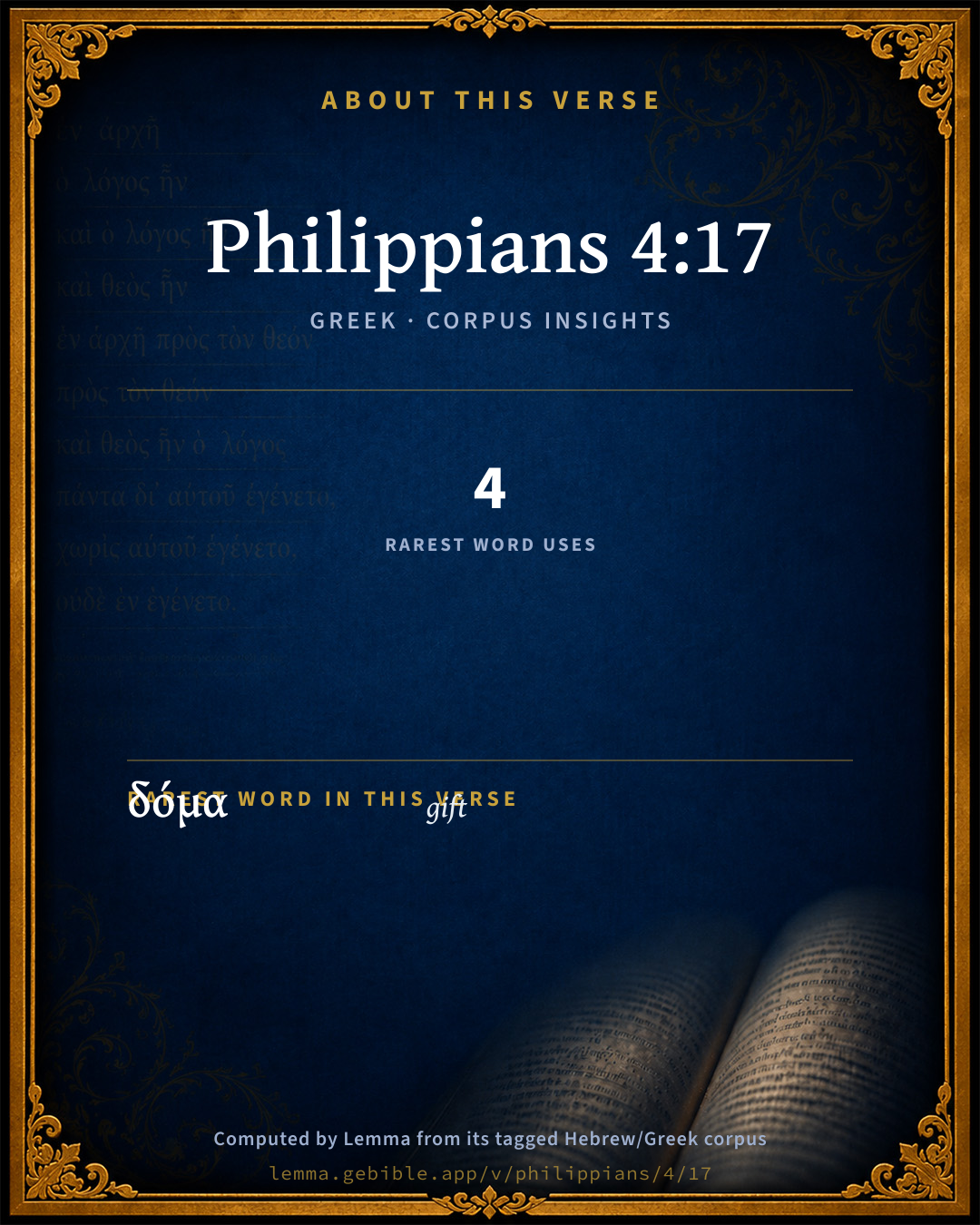
These counts appear in no published source. They are computed here, from the morphology-tagged text and Lemma’s own curated glosses. What Lemma adds →
- 14
- words
- 11
- distinct lemmas
- Pauline Epistles
- section
Cross-references
26Topical passages linked to Philippians 4:17 in the Treasury of Scripture Knowledge — connected by theme and wording, ordered by reader-vote popularity; previews shown in the World English Bible.
- Titus 3:14 Let our people also learn to maintain good works for necessary uses, that they may not be unfruitful.
- Hebrews 6:10 For God is not unrighteous, so as to forget your work and the labor of love which you showed toward his name, in that you served the saints, and still do serve them.
- 2 Corinthians 9:9–13 As it is written, "He has scattered abroad, he has given to the poor. His righteousness remains forever."
- John 15:8 "In this is my Father glorified, that you bear much fruit; and so you will be my disciples.
- Luke 14:12–14 He also said to the one who had invited him, "When you make a dinner or a supper, don't call your friends, nor your brothers, nor your kinsmen, nor rich neighbors, or perhaps they might also return the favor, and pay you back.
- John 15:16 You didn't choose me, but I chose you, and appointed you, that you should go and bear fruit, and that your fruit should remain; that whatever you will ask of the Father in my name, he may give it to you.
- 2 Corinthians 9:5 I thought it necessary therefore to entreat the brothers that they would go before to you, and arrange ahead of time the generous gift that you promised before, that the same might be ready as a matter of generosity, and not of greediness.
- Philippians 4:11 Not that I speak in respect to lack, for I have learned in whatever state I am, to be content in it.
- Titus 1:7 For the overseer must be blameless, as God's steward; not self-pleasing, not easily angered, not given to wine, not violent, not greedy for dishonest gain;
- 1 Peter 5:2 Shepherd the flock of God which is among you, exercising the oversight, not under compulsion, but voluntarily, not for dishonest gain, but willingly;
- Matthew 25:34–40 Then the King will tell those on his right hand, 'Come, blessed of my Father, inherit the Kingdom prepared for you from the foundation of the world;
- Romans 15:28 When therefore I have accomplished this, and have sealed to them this fruit, I will go on by way of you to Spain.
- 1 Thessalonians 2:5 For neither were we at any time found using words of flattery, as you know, nor a cloak of covetousness (God is witness),
- Proverbs 19:17 He who has pity on the poor lends to Yahweh; He will reward him.
- Malachi 1:10 "Oh that there were one among you who would shut the doors, that you might not kindle fire on my altar in vain! I have no pleasure in you," says Yahweh of hosts, "neither will I accept an offering at your hand.
- Matthew 10:40–42 He who receives you receives me, and he who receives me receives him who sent me.
- Acts 20:33–34 I coveted no one's silver, or gold, or clothing.
- 1 Corinthians 9:11–15 If we sowed to you spiritual things, is it a great thing if we reap your fleshly things?
- 2 Corinthians 11:16 I say again, let no one think me foolish. But if so, yet receive me as foolish, that I also may boast a little.
- Philippians 1:11 being filled with the fruits of righteousness, which are through Jesus Christ, to the glory and praise of God.
- Micah 7:1 Misery is mine! Indeed, I am like one who gathers the summer fruits, as gleanings of the vinyard: There is no cluster of grapes to eat. My soul desires to eat the early fig.
- 1 Timothy 3:3 not a drinker, not violent, not greedy for money, but gentle, not quarrelsome, not covetous;
- 2 Peter 2:3 In covetousness they will exploit you with deceptive words: whose sentence now from of old doesn't linger, and their destruction will not slumber.
- 2 Peter 2:15 forsaking the right way, they went astray, having followed the way of Balaam the son of Beor, who loved the wages of wrong-doing;
- Jude 1:11 Woe to them! For they went in the way of Cain, and ran riotously in the error of Balaam for hire, and perished in Korah's rebellion.
- 1 Timothy 6:10 For the love of money is a root of all kinds of evil. Some have been led astray from the faith in their greed, and have pierced themselves through with many sorrows.
Cross-references courtesy of OpenBible.info (CC BY 4.0).
Lesson kit
Teaching starters — assembled from the data on this page, not authored interpretation. Every prompt links to the verse data it draws on. Edit before teaching.
Philippians, in the Pauline Epistles, opens this verse with 14 words (11 distinct Greek lemmas). Its most distinctive word is dóma (“gift”). A historical commentator’s framing appears above. Read the whole chapter for the surrounding context.
Discussion questions
- The word dóma carries the sense “gift.” How does it shape the verse?
- How does Matthew 7:11, which shares the word «gift», read alongside this verse?
- What does the repetition of “to seek for” (2× in this one verse) do in this verse?
- The translations on this page render this verse differently — a whole-verse word diff, not a word-by-word alignment. What might account for the different wordings?
- Compare how The Biblical Illustrator and Tyndale Open Study Notes read this verse. Where do they agree or differ?
Things to notice
- These translations choose different wording for 7 words in this verse.
- “to seek for” occurs 2× in this single verse.
- 11 distinct Greek lemmas span 14 words in this verse.
Commentary
Notes on Philippians 4:17 from classic Christian and Jewish commentators (each source and its license shown beneath its notes). The classic Christian expositions comment on the surrounding passage and are grouped to its opening verse, so a note may address several verses; the Jewish commentaries on the Tanakh (Rashi and others) are per-verse, so they appear only where the commentator wrote on this verse.
Lemma curates 59 commentaries, every one of them public domain or Creative Commons licensed, each selected and text-cleaned for this edition rather than reprinted as found. About our sources →
The Biblical Illustrator
Joseph S. Exell
The Biblical Illustrator, edited by Joseph S. Exell (c. 1880s–1900s) — public domain. Text from a community e-Sword module.
Tyndale Open Study Notes
Tyndale Open Resources
Tyndale Open Study Notes — © Tyndale Open Resources, licensed CC BY-SA 4.0. Text via the HelloAO Bible API.
Bengel's Gnomon
Johann Albrecht Bengel
Bengel's Gnomon of the New Testament — English translation (T&T Clark, Edinburgh, 1860) — public domain. Text from a community e-Sword module.
Meyer's Critical & Exegetical Commentary
Heinrich August Wilhelm Meyer
Meyer — Critical and Exegetical Commentary on the New Testament — English translation by Peter Christie, edited by Frederick Crombie (T&T Clark, 1880) — public domain. Text from a community e-Sword module.
Expositor's Greek Testament
ed. W. Robertson Nicoll
The Expositor's Greek Testament, edited by W. Robertson Nicoll (1897–1910) — public domain. Text from a community e-Sword module.
Geneva Bible (1599)
Geneva Bible translators
Geneva Bible (1599) marginal notes — public domain. Text via Bolls.life.
Jamieson, Fausset & Brown
Robert Jamieson, A. R. Fausset & David Brown
Jamieson, Fausset & Brown — Commentary Critical and Explanatory on the Whole Bible (1871) — public domain (CC PDM 1.0). Text via the HelloAO Bible API.
Adam Clarke's Commentary
Adam Clarke's Commentary on the Bible (1810–1826) — public domain. Text from a community e-Sword/MySword module.
John Calvin's Commentaries
John Calvin's Commentaries (1540-1563) — public domain. Text from the Calvin Translation Society English edition (1840s-50s) via the Christian Classics Ethereal Library (ccel.org). Calvin's coverage is partial (roughly two-thirds of the Bible); uncommented books and verses are honest gaps, never fabricated. The 19th-century editor's footnotes and remarks are omitted so the notes are faithfully Calvin's own voice.
Ellicott's Commentary for English Readers
A Bible Commentary for English Readers, edited by Charles John Ellicott (1878–1897) — public domain. Text from a community e-Sword module.
The Cambridge Bible for Schools and Colleges
gen. ed. J. J. S. Perowne
The Cambridge Bible for Schools and Colleges (gen. ed. J. J. S. Perowne; Cambridge University Press, 1878–1918) — public domain. Text from a community e-Sword module.
John Gill's Exposition
John Gill's Exposition of the Whole Bible (1746–1763) — public domain (CC PDM 1.0). Text via the HelloAO Bible API.
Trapp's Complete Commentary
John Trapp
John Trapp, A Commentary or Exposition upon All the Books of the Old and New Testament (1647–1656) — public domain. Text from a community e-Sword module.
Albert Barnes' Notes on the Bible
Albert Barnes' Notes on the Bible (1834–1885) — public domain. Text from a community e-Sword/MySword module.
Matthew Poole's English Annotations
Matthew Poole's English Annotations on the Holy Bible (1683–1685) — public domain. Text from a community e-Sword/MySword module.
Whedon's Commentary on the Bible
Daniel D. Whedon
Daniel D. Whedon (gen. ed.), Commentary on the Old and New Testaments (1874–1909) — public domain. Text from a community e-Sword module.
The Pulpit Commentary
The Pulpit Commentary (1880–1919), ed. H.D.M. Spence-Jones & Joseph S. Exell — public domain. Text from a community e-Sword module.
John Wesley's Explanatory Notes
John Wesley, Explanatory Notes Upon the Whole Bible (1754–1765) — public domain. Text via the GEBible commentary corpus.
Burkitt's Expository Notes on the New Testament
William Burkitt
William Burkitt's Expository Notes on the New Testament (1700–1703) — public domain. Text from a community e-Sword module.
The People's New Testament
B. W. Johnson
B. W. Johnson's The People's New Testament with Notes (1889–1891) — public domain. Electronic text from the Christian Classics Ethereal Library (CCEL) ThML edition.
Cambridge Greek Testament for Schools and Colleges
Cambridge Greek Testament for Schools and Colleges (Cambridge University Press, 1896; 21 vols, various authors incl. Carr, Maclear, Plummer, Farrar, Lumby, Moule, M. R. James, Simcox) — public domain. Text from a community e-Sword module.
Alford’s Greek Testament
Henry Alford
Henry Alford, The Greek Testament (1849–1861) — public domain. Text from a community e-Sword module.
International Critical Commentary
International Critical Commentary — older volumes (1896–1929), various authors — public domain. Text from a community e-Sword module.