Philippians 1:11

Greek (Tischendorf 8th ed.) Philippians 1:11 appears in the Greek New Testament. The text above is from the Tischendorf 8th edition. Each word links to its Strong’s number and a concise gloss. Click any word for its full Thayer’s Greek Lexicon entry.

Download image
Cite this verse

Philippians 1:11 (World English Bible). Public Domain. Lemma interlinear Bible study tool, https://lemma.gebible.app/v/philippians/1/11.

Show BibTeX & RIS
BibTeX
RIS
English Translation
being filled with the fruits of righteousness, which are through Jesus Christ, to the glory and praise of God.
World English Bible · Public Domain
Download a study sheet

One document with this verse’s original text, its word-by-word gloss line, the meaning frame, cross-references with their text, attributed commentary, and full source and license credits — printable, and it pastes into notes with its structure intact.

This verse Autodidact and up

Study sheet (.html) Plain text (.txt)

A passage Seminary Student

Up to 50 verses in one chapter. A passage sheet keeps up to 6 commentary sources and 12 cross-references per verse, in the order this page ranks them, and says so on the sheet whenever that leaves anything out. Ask for a single verse and you get the Autodidact verse sheet above.

Everything on this page stays free to read, with no account — the sheet is a download of what is already on screen, not access to it.

Want to remove ads? Support Godless Engineer
Compare translations 3

The same verse in 3 English versions, stacked beneath the original-language interlinear above. Click any original word for its lexicon entry.

Each is an independent rendering of the whole verse — the interlinear is not word-aligned to these translations.

Highlighted words mark where these versions differ — a whole-verse word diff, not a word-by-word alignment.

  • World English Bible Public Domain
    being filled with the fruits of righteousness, which are through Jesus Christ, to the glory and praise of God.
  • King James Version Public Domain
    Being filled with the fruits of righteousness, which are by Jesus Christ, unto the glory and praise of God.
  • unfoldingWord Literal Text CC BY-SA 4.0
    being filled with the fruit of righteousness through Jesus Christ to the glory and praise of God.

unfoldingWord Literal Text — © unfoldingWord, licensed CC BY-SA 4.0. Word-aligned USFM3 via Door43 (git.door43.org/unfoldingWord/en_ult).

Versions to compare (up to 4)

3 of 4 selected

Show all 19 translations

Every available English version of this verse, each an independent rendering of the whole verse.

  • World English Bible Public Domain
    being filled with the fruits of righteousness, which are through Jesus Christ, to the glory and praise of God.
  • Berean Standard Bible Public Domain
    filled with the fruit of righteousness that comes through Jesus Christ, to the glory and praise of God.
  • Majority Standard Bible Public Domain
    filled with the fruits of righteousness that come through Jesus Christ, to the glory and praise of God.
  • King James Version Public Domain
    Being filled with the fruits of righteousness, which are by Jesus Christ, unto the glory and praise of God.
  • American Standard Version (1901) Public Domain
    being filled with the fruits of righteousness, which are through Jesus Christ, unto the glory and praise of God.
  • Revised Version (1885) Public Domain
    being filled with the fruits of righteousness, which are through Jesus Christ, unto the glory and praise of God.
  • Geneva Bible (1599) Public Domain
    Filled with the fruites of righteousnesse, which are by Iesus Christ vnto the glorie and praise of God.
  • Douay-Rheims (1899) Public Domain
    Filled with the fruit of justice, through Jesus Christ, unto the glory and praise of God.
  • Young's Literal Translation Public Domain
    being filled with the fruit of righteousness, that `is' through Jesus Christ, to the glory and praise of God.
  • Literal Standard Version CC BY-SA 4.0
    being filled with the fruit of righteousness, that [is] through Jesus Christ, to the glory and praise of God.
  • Unlocked Literal Bible CC BY-SA 4.0
    I pray that you also will be filled with the fruit of righteousness that comes through Jesus Christ, to the glory and praise of God.
  • unfoldingWord Literal Text CC BY-SA 4.0
    being filled with the fruit of righteousness through Jesus Christ to the glory and praise of God.
  • Darby Bible Public Domain
    being complete as regards the fruit of righteousness, which [is] by Jesus Christ, to God's glory and praise.
  • World Messianic Bible Public Domain
    being filled with the fruits of righteousness which are through Yeshua the Messiah, to the glory and praise of God.
  • Webster's Bible Public Domain
    Being filled with the fruits of righteousness, which are by Jesus Christ, to the glory and praise of God.
  • Free Bible Version CC BY-SA 4.0
    filled with the fruits of living right that come through Jesus Christ and give glory and praise to God.
  • Bible in Basic English Public Domain
    Being full of the fruits of righteousness, which are through Jesus Christ, to the glory and praise of God.
  • Text-Critical English NT CC BY 4.0
    filled with the fruits of righteousness that come through Jesus Christ, to the glory and praise of God.
  • Tyndale New Testament (1534) Public Domain
    filled with the frutes of rightewesnes which frutes come by Iesus Christ vnto the glory and laude of God.

Literal Standard Version (2020), Covenant Press — licensed CC BY-SA 4.0. Text via the HelloAO Bible API (eBible.org). Unlocked Literal Bible (unfoldingWord) — licensed CC BY-SA 4.0. Text via the HelloAO Bible API (eBible.org). unfoldingWord Literal Text — © unfoldingWord, licensed CC BY-SA 4.0. Word-aligned USFM3 via Door43 (git.door43.org/unfoldingWord/en_ult). Free Bible Version, Dr. Jonathan Gallagher — licensed CC BY-SA 4.0. Text via the HelloAO Bible API (eBible.org).

Word by word

More ways to search: Search by grammar → Find every occurrence → Compare this word →

Practice this passage: Drill this verse → Learn its vocabulary →

About this verse

These counts appear in no published source. They are computed here, from the morphology-tagged text and Lemma’s own curated glosses. What Lemma adds →

12
words
12
distinct lemmas
Pauline Epistles
section

Notable vocabulary

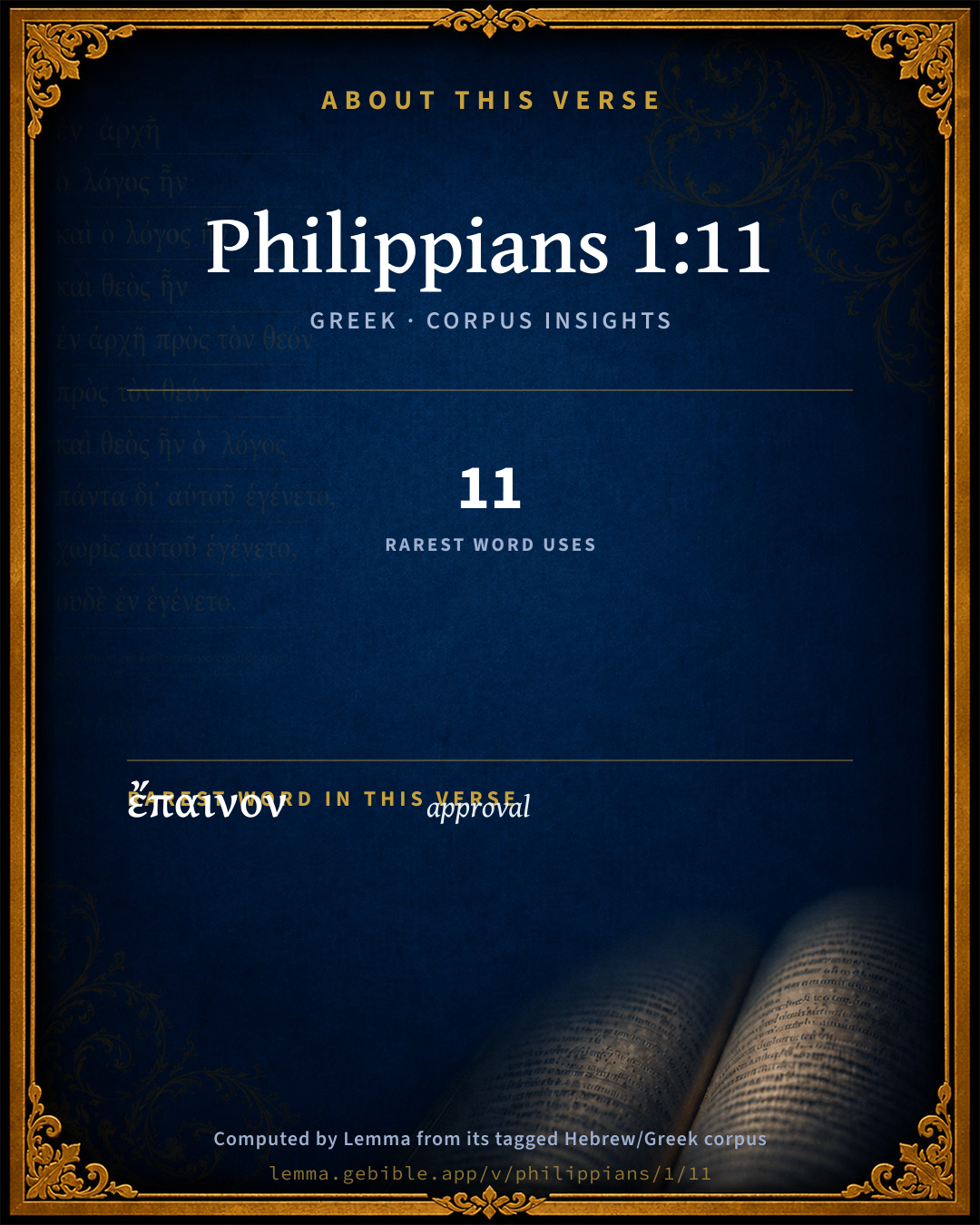
The rarest word here is ἔπαινον approval G1868 — appearing just 11 times in the whole Greek New Testament.

Shared distinctive vocabulary

ἔπαινον approval G1868 occurs in 11 verses of the Greek New Testament. Also found in:

Cross-references

32

Topical passages linked to Philippians 1:11 in the Treasury of Scripture Knowledge — connected by theme and wording, ordered by reader-vote popularity; previews shown in the World English Bible.

  • Hebrews 12:11 All chastening seems for the present to be not joyous but grievous; yet afterward it yields the peaceful fruit of righteousness to those who have been exercised thereby.
  • John 15:8 "In this is my Father glorified, that you bear much fruit; and so you will be my disciples.
  • Colossians 1:10 that you may walk worthily of the Lord, to please him in all respects, bearing fruit in every good work, and increasing in the knowledge of God;
  • John 15:4–5 Remain in me, and I in you. As the branch can't bear fruit by itself, unless it remains in the vine, so neither can you, unless you remain in me.
  • Galatians 5:22–23 But the fruit of the Spirit is love, joy, peace, patience, kindness, goodness, faithfulness,
  • Philippians 4:17 Not that I seek for the gift, but I seek for the fruit that increases to your account.
  • James 3:17–18 But the wisdom that is from above is first pure, then peaceful, gentle, reasonable, full of mercy and good fruits, without partiality, and without hypocrisy.
  • Isaiah 61:11 For as the earth brings forth its bud, and as the garden causes the things that are sown in it to spring forth; so the Lord Yahweh will cause righteousness and praise to spring forth before all the nations.
  • Romans 6:22 But now, being made free from sin, and having become servants of God, you have your fruit of sanctification, and the result of eternal life.
  • Ephesians 1:14 who is a pledge of our inheritance, to the redemption of God's own possession, to the praise of his glory.
  • Colossians 1:6 which has come to you; even as it is in all the world and is bearing fruit and growing, as it does in you also, since the day you heard and knew the grace of God in truth;
  • 1 Peter 4:10–11 According as each has received a gift, be ministering it among yourselves, as good stewards of the grace of God in its various forms.
  • Matthew 5:16 Even so, let your light shine before men; that they may see your good works, and glorify your Father who is in heaven.
  • 1 Corinthians 10:31 Whether therefore you eat, or drink, or whatever you do, do all to the glory of God.
  • Ephesians 5:9 for the fruit of the Spirit is in all goodness and righteousness and truth,
  • 2 Thessalonians 1:12 that the name of our Lord Jesus may be glorified in you, and you in him, according to the grace of our God and the Lord Jesus Christ.
  • Hebrews 13:15–16 Through him, then, let us offer up a sacrifice of praise to God continually, that is, the fruit of lips which make confession to his name.
  • 1 Peter 2:9 But you are a chosen race, a royal priesthood, a holy nation, a people for God's own possession, that you may show forth the excellencies of him who called you out of darkness into his marvelous light:
  • Ephesians 1:12 to the end that we should be to the praise of his glory, we who had before hoped in Christ:
  • Ephesians 2:10 For we are his workmanship, created in Christ Jesus for good works, which God prepared before that we would walk in them.
  • 1 Peter 2:5 You also, as living stones, are built up as a spiritual house, to be a holy priesthood, to offer up spiritual sacrifices, acceptable to God through Jesus Christ.
  • 1 Peter 2:12 having good behavior among the nations, so in that which they speak against you as evil-doers, they may by your good works, which they see, glorify God in the day of visitation.
  • 1 Peter 4:14 If you are insulted for the name of Christ, blessed are you; because the Spirit of glory and of God rests on you. On their part he is blasphemed, but on your part he is glorified.
  • Psalms 1:3 He will be like a tree planted by the streams of water, That brings forth its fruit in its season, Whose leaf also does not wither. Whatever he does shall prosper.
  • Psalms 92:12–15 The righteous shall flourish like the palm tree. He will grow like a cedar in Lebanon.
  • Isaiah 60:21 Your people also shall be all righteous; they shall inherit the land forever, the branch of my planting, the work of my hands, that I may be glorified.
  • Isaiah 61:3 to appoint to those who mourn in Zion, to give to them a garland for ashes, the oil of joy for mourning, the garment of praise for the spirit of heaviness; that they may be called trees of righteousness, the planting of Yahweh, that he may be glorified.
  • Luke 13:6–9 He spoke this parable. "A certain man had a fig tree planted in his vineyard, and he came seeking fruit on it, and found none.
  • John 15:2 Every branch in me that doesn't bear fruit, he takes away. Every branch that bears fruit, he prunes, that it may bear more fruit.
  • John 15:16 You didn't choose me, but I chose you, and appointed you, that you should go and bear fruit, and that your fruit should remain; that whatever you will ask of the Father in my name, he may give it to you.
  • 2 Corinthians 9:10 Now may he who supplies seed to the sower and bread for food, supply and multiply your seed for sowing, and increase the fruits of your righteousness;
  • Isaiah 5:2 He dug it up, Gathered out its stones, Planted it with the choicest vine, Built a tower in its midst, And also cut out a winepress therein. He looked for it to yield grapes, But it yielded wild grapes.

Cross-references courtesy of OpenBible.info (CC BY 4.0).

Where the printed editions differ

1 variant

Places in this verse where the major printed Greek editions disagree on the wording in a way that affects the translation — a comparison of editions, not a manuscript-by-manuscript collation. The editions are the modern critical texts (Nestlé-Aland 28/27, SBL, Westcott-Hort, Tregelles, Tyndale House) and the traditional texts behind the KJV (the Textus Receptus and the Byzantine/Majority text). It is not a claim about which reading is original.

  1. Different wording
    καρπὸν

    “with [the] fruit”

    In NA28NA27TynSBLWHTreg Not in TRByz

    καρπῶν (karpōn) 'fruits' occurs in traditional manuscripts (TR+Byz) instead of καρπὸν (karpon) 'with [the] fruit' in older manuscripts (NA28+NA27+Tyn+SBL+WH+Treg)

Textual data: Translators Amalgamated Greek New Testament (STEPBible TAGNT) · CC BY 4.0.

Commentary

Notes on Philippians 1:11 from classic Christian and Jewish commentators (each source and its license shown beneath its notes). The classic Christian expositions comment on the surrounding passage and are grouped to its opening verse, so a note may address several verses; the Jewish commentaries on the Tanakh (Rashi and others) are per-verse, so they appear only where the commentator wrote on this verse.

Lemma curates 59 commentaries, every one of them public domain or Creative Commons licensed, each selected and text-cleaned for this edition rather than reprinted as found. About our sources →

The Biblical Illustrator

Joseph S. Exell

Php_1:11

Being titled with the fruits of righteousness--

Divine culture:

I.

The field--The loving heart.

II. The seed--Righteousness.

III. The fruit--Abundant.

IV. The husbandman--Jesus Christ.

V. The end--The glory and praise of God. (G. G. Ballard.)

Righteousness

I. Its nature.

II. Its fruits.

III. Its source.

IV. Its end. (J. Lyth, D. D.)

I. The fruit.

II. The power by which it is produced.

III. The motive.

IV. The measure of righteousness. (J. Lyth, D. D.)

The fruits of righteousness

I. What they are: good works, so called because they spring from righteousness as fruit from a tree. We must first be righteous, by the righteousness of God in us before we can do the works that are good. What this righteousness is Paul explains in Rom_3:9.

1. Learn to beware of them who tell you that our good works are that righteousness whereby we are justified before God. As well say that the fruit is the tree.

2. Beware of them that tell you that men not begotten in the faith of Christ are able to do the things that are good and pleasing to God.

3. Let this teach us how to examine our works whether they be good or no. Do they proceed from a lively faith in Christ Jesus?

II. Their author. Christ who is the author of every good thing in us by the grace of His Holy Spirit (2Co_3:5; Php_2:13).

1. Let this warn us against them who would persuade us that we are able of ourselves to do that which is good.

2. Let this teach us to give all the praise to Him to whom it is due (Rev_5:13).

III. Their end (1Co_10:31; Mat_5:16; 1Pe_2:12). Let this try our motives. Do we do good that we may gain heaven or that we may glorify God? (H. Airay, D. D.)

Gospel holiness

I. The experience--Fruits of righteousness. Righteousness is right-mindedness.

1. Integrity is the fruit toward God and man.

2. Tenderness of conscience.

3. With these and other virtues we are to be filled.

4. Although the world may reproach us.

II. The means--Union with Christ. Granted this, good works are inevitable, as a good tree must produce good fruits.

III. The end. God can take delight in nothing but holiness. It is His own nature. (J. Summerfield, A. M.)

Spiritual attainment

I. Righteousness of heart precedes righteousness of life.

II. Righteousness of heart is self-disseminating. Its fruit is--

1. Living.

2. Of harmonious unity.

3. Luxuriant.

III. Righteousness of heart, the only thing that can fill the capacities of man.

IV. Fulness of righteousness--fruit, is all Divine. It is Divine--

1. In its source--God giveth the increase.

2. In its medium of communication--which is by Jesus Christ.

3. In its end--unto the glory and praise of God.

(1) To His glory before men.

(2) To His praise among men. (G. G. Ballard.)

Fruits of righteousness

Just as the fruits which men, with grateful and rejoicing hearts, gather in at harvest home are not only much in quantity, but also many in variety, so in the Church, the garden of the Lord, His planting that He may be glorified, there are manifold good thoughts and deeds and impulses, all springing up from the one seed of love, and maturing to life eternal to be garnered in when the harvest of the earth is ripe. (J. Hutchison, D. D.)

Abounding fruitfulness

It is not enough to give no offence, you must edify; to abstain from evil, you must do good. As the perfection of a tree is to bring forth good fruits, and not simply that it should not bear bad. For according to that, those which bear no fruit at all might pass for good trees. Thus the praise of a Christian is to lead a life which is not only exempt from the corruption of sin, but which abounds in all kinds of virtues, which is covered and enriched by holy acts worthy of the name by which we are called. For He has snatched us from the soil of the world, or more properly of hell, where, like the plants of Sodom, we bore but empty and useless fruits, and those which were poisonous and deadly. He has transplanted us into the paradise of God, His Church; where, by the efficacy of His blood, His Word, and His Spirit, He hath shed in us thoughts, hopes, and affections totally different from those we had formerly, namely, hatred and contempt for the world and sin, admiration and love for heaven and holiness. (J. Daille.)

Advantages of advanced piety

Fighting faults is the most discouraging thing in the world. When corn reaches a certain height, no more weeds can grow among it. The corn overshadows and grows them down. Let men fill themselves full of good things. Let them make their love, and purity, and kindness to grow up like corn that every evil and noxious thing within them may be overshadowed and die. (H. W. Beecher.)

The trees of righteousness blossoming, and bringing forth fruit

I. How a Christian brings forth fruit. I answer: he brings forth fruit in the vine; by nature we are barren; there is not one good blossom growing on us; but when by faith we are engrafted into Christ, then we grow and fructify; as the branch cannot bear fruit of itself, except it abide in the vine, no more can ye except ye abide in Me. Jesus Christ is that blessed root which shoots up that sap of grace into His branches.

II. What that fruit is which a good Christian brings forth.

1. A Christian brings forth inward fruit: love, joy, peace, long suffering, gentleness, goodness, faith.

2. A Christian brings forth outward fruit.

(1) The fruit of good discourse; a wholesome tongue is a tree of life. Gracious speeches fall from the lips of a godly man, as fruit from a tree.

(2) The fruit of good works. God will say at the last day, Show Me thy faith by thy works.

3. A Christian brings forth kindly fruit. The godly man bringeth forth his fruit; that is, he brings forth that fruit which is proper for him to bear. But what is this kindly and proper fruit? I answer, when we are good in our callings and relations; in a magistrate, justice is kindly fruit; in a minister, zeal; in a parent, instruction; in a child, reverence; in a master, good example; in a servant, obedience; in the husband, love; in the wife, submission; in a tradesman, diligence; in a soldier, innocence. A tree of Gods planting brings forth His fruit, that which is suitable and proper. I shall never believe him to be good, that doth not bear kindly fruit; a good Christian, but a bad master; a good Christian, but a bad parent, doth not sound well. The excellency of a Christian is to bring forth proper fruit; wherein lies the good ness of a member in the body, but to discharge its proper office? the eye is to see, the ear to hear, etc. So the excellency of a Christian is to bring forth that fruit which God hath assigned to him: what is a thing good for which doth not do its proper work? what is a clock good for that will not strike? what is a ship good for that will not sail? what is a rose good for that doth not smell? what is that professor good for that doth not send forth a sweet perfume in his relation? the commendation of a thing is when it puts forth its proper virtue. Not to bring forth suitable fruit, spoils all the other fruit which we bring forth. If a man were to make a medicine, and should leave out the chief ingredient, the medicine would lose its virtue. Relative graces do much beautify and set off a Christian; it is the beauty of a star to shine in its proper orb; relative grace doth bespangle a Christian.

4. A good Christian brings forth seasonable fruit, he that bringeth forth fruit in his season; everything is beautiful in his time. That may be good at one time, which at another may be out of season. There is a great deal of skill in the right timing of a thing; duties of religion must be performed in the fit juncture of time.

(1) Christian duties that relate to our neighbour must be observed in their season. Our reproving others must be seasonable. Affliction opens the ear to discipline. Our comforting others must be seasonable; a word spoken in due season, how good is it?

(2) Duties of religion that relate to God must be performed in their season. To read at home, when the word is a preaching, or the sacrament celebrating, is unseasonable, nay, sinful; as Hushai said, the counsel is not good at this time: one duty is to prepare for another, but not to jostle out another; fruit must put forth seasonably. Let all the trees of righteousness bring forth season able fruit; in prosperity be thankful, in adversity patient.

I. It shows us who is a Christian in Gods calendar, namely, the fruit-bearing Christian. As soon as the sap of grace is infused, it puts forth itself in evangelical fruit.

II. Here is an indictment against three sorts.

1. Such as bring forth no fruit; Israel is an empty vine. O how many unfruitful hearers are there, who evaporate into nothing but froth and fume, being like those ears which run out all into straw I they give God neither the early fruit nor the latter. To the unfruitful Christian let me say four things.

(1) Unfruitfulness is a shame: barrenness of old was counted a great shame.

(2) What account can the unfruitful Christian give to God?

(3) They that do not bring forth good fruit, shall never taste of the fruits that grow in heaven.

2. It reproves such as bring forth evil fruit.

3. It reproves such as bring forth good fruit, but to a bad end; Israel is an empty vine, he bringeth forth fruit unto himself: a man had as good bring forth no fruit, as bring forth fruit unto himself. What is it for one to bring forth fruit unto himself? Prayer is good; but when a man prays only to showy his parts, this is to bring forth fruit unto himself. Works of mercy are good, but when a man gives alms, not so much to feed the poor, as to feed his pride, now he brings forth fruit to himself, and this fruit is worm eaten.

III. 1. Let this exhort all to fruitfulness.

(1) Fruit is that which God expects from us, we are His plantations; and, who planteth a vineyard, and eateth not of the fruit thereof?

(2) Fruitfulness is one of the most distinctive characters of a Christian; the root of the righteous yieldeth fruit. But may not hypocrites bring forth fruit?

(a) They do not bring forth fruit in the Vine they bring forth in the strength of parts, not in the strength of Christ.

(b) Hypocrites bring forth something like fruit, but it is not the right fruit. The fruit they bear is not sweet.

(3) Fruitfulness adorns a Christian; the fruit adorns the tree; a fruit-bearing Christian is an ornament to religion; the more fruitful the branch is, the more fair to look on. A dead tree, as it is unserviceable, so it is uncomely. A Christian, decked with the fruits of righteousness, is beautiful and glorious.

(4) Fruitfulness is a good evidence to show for heaven; the fruits of love, humility, good works, are, as St. Bernard saith, seeds of hope, signs of predestination, the happy presages of future glory. The righteousness of faith is always accompanied with the fruits of righteousness. He that can show good fruit, goes full sail to heaven.

2. It exhorts them that do bear fruit, that they would bring forth more fruit; do not think you have fruit enough, but bring forth further degrees of sanctity; every branch that beareth fruit, he pruneth it, that it may bring forth more fruit.

(1) This is the end why we have new cost laid out upon us, that we should bring forth more fruit.

(2) The fuller we are of fruit, the more we are like Christ, who was full of grace and truth. He received the Spirit without measure.

(3) Bearing much fruit will usher in abundance of comfort into the soul in these two exigencies. Store of fruit will give comfort in the hour of death: a little trace will make us above the fear of death. O what joy will it be on the deathbed, when a Christian can bring his sheaves full of corn! when he can show his five talents that he hath gained by trading! when there is not only a drop or two of oil, but his lamp full of oil! what though the devil show God our debts, if we can show Him our fruit?

(4) The more your fruit is increased, the more your glory is increased; he whose pound gained ten, was made ruler over ten cities.

IV. The last use is of direction. I shall lay down some means to fruitfulness.

1. Be sensible of unfruitfulness.

2. If you would be fruitful, remove those things which will hinder fruitfulness. Cherishing any secret lust in the heart; sin lived in, is like vermin to the tree, which destroys the fruit; grace cannot thrive in a sinful heart.

3. The third means to fruitfulness is weeping for sin. Moisture helps germination in trees; holy tears do water the trees of God, and make them more fruitful.

4. If you would be fruitful often apply the blood of Christ, and the promises.

(1) Apply the blood of Christ. Naturalists say, that blood applied to the root of some trees makes them bear better. Sure I am, the blood of Christ applied to the heart, makes it flourish more in holiness.

(2) Apply the promises.

5. Another means to fruitfulness is humility. The low grounds are most fruitful: the valleys are covered with corn; the humble heart is the fruitful heart.

6. If you would be fruitful in grace, be much in good conference; then they that feared the Lord spake often one to another.

7. If you would be fruit-bearing trees, be near the water of the sanctuary; he shall be like a tree planted by the waters, and that spreadeth out the roots by the river; her leaf shall be green, nor shall it cease from yielding fruit.

8. And lastly, if you would fructify apace, go, to God and desire Him to make you fruitful; God is called the Husbandman, and He hath an art above all other husbandmen; they can plant and prune trees, but if they be dead they cannot make them bear. (T. Watson.)

The Biblical Illustrator, edited by Joseph S. Exell (c. 1880s–1900s) — public domain. Text from a community e-Sword module.

Tyndale Open Study Notes

Tyndale Open Resources

1:11 Righteous character cannot be produced by human effort; it comes only through the Spirit of Christ working in people’s hearts. • Glory and praise to God is the ultimate purpose for which God’s people live (see Eph 1:6, 12, 14).

Tyndale Open Study Notes — © Tyndale Open Resources, licensed CC BY-SA 4.0. Text via the HelloAO Bible API.

Bengel's Gnomon

Johann Albrecht Bengel

Php 1:11. Πεπληρωμένοι καρπὸν δικαιοσύνης, κ.τ.λ., filled with the fruits of righteousness) The same construction is found at Col 1:9, ἵνα πληρωθῆτε τὴν ἐπίγνωσιν; and the fruit of righteousness is generally used in the singular number, Heb 12:11; Jas 3:18; also Rom 6:22, precisely as Paul elsewhere speaks of the fruit of the Spirit, of light, of the lips. The more common reading is πεπληρωμένοι καρπῶν, κ.τ.λ.[6]

[6] ABD(Δ)Gfg Vulg. (except Fuld. MS. corrected by Victor of Capua), read καρπόν. No old authority except Syr. supports the καοπῶν of the Rec. Text.—ED.

Bengel's Gnomon of the New Testament — English translation (T&T Clark, Edinburgh, 1860) — public domain. Text from a community e-Sword module.

Expositor's Greek Testament

ed. W. Robertson Nicoll

Phi 1:11 . Critical evidence (see above) fixes καρπὸν … τόν as the correct reading. We should, of course, expect the gen. (see the v.1. ), but one of the most marked features in later Greek is the enlarging of the sphere of the accus. It is quite common to find it with verbs like κληρονομεῖν and κρατεῖν κ . τ . λ . Cf. in modern Greek γέμω χρήματα , “I am full of possessions” (see See Hatz., Einl (Hatzidakis, Einleitung in die Neugriech. Grammatik ), pp. 220 223; F. Krebs, Rection d. Casus in d. späteren histor. Gräcität , Heft i., pp. 3 4, ii., p. 3 ff.). καρπ . δικ . A frequent phrase in Prov. (LXX). A showing forth of the results of righteousness. There is nothing here about justification, as Moule supposes. It is right conduct the Apostle has in view. But it is hardly needful to note that with Paul there can be no dissociation of the two ideas. δικαιοσύνη is always with him the right relation between God and man, made possible through Christ, which asserts itself, under the Holy Spirit’s influence, in righteous conduct. διὰ Ἰ . Χ . The καρπός as well as the δικ . is due to Christ ( cf. chap. Phi 4:13 ). εἰς δ . κ . ἔπ . Θ . Cf. the refrain in Eph 1:6 ; Eph 1:12 ; Eph 1:14 , and Christ’s words in Joh 17:4 , ἐγώ σε ἐδόξασα ἐπὶ τῆς γῆς . The disciple must be as the Master.

The Expositor's Greek Testament, edited by W. Robertson Nicoll (1897–1910) — public domain. Text from a community e-Sword module.

International Critical Commentary

11. πεπληρωμένοι καρπὸν δικαιοσύνης: ‘being filled with the fruit of righteousness.’ Πεπλ. agrees with the subject of ἦτε in vs. 10, and defines εἰλικρινεῖς and ἀπρόσκοποι more fully. Καρπὸν is the accus. of the remote object, as Col 1:9; 2Th 1:11. (Comp. LXX, Exo 31:3.) Paul elsewhere uses πληροῦν with the genit. or dat. (See Rom 1:29, Rom 1:15:13, Rom 1:14; 2Co 7:4.)

The reading of TR καρπων … των is feebly supported.

Καρπὸς in its moral and religious sense occurs in vs. 22, 4:17; Rom 1:13, Rom 1:6:21, Rom 1:22, Rom 1:15:28; Gal 5:22, nearly always of a good result. The phrase ‘fruit of righteousness’ is from the O.T. (See Pro 11:30; Amo 6:13. Comp. Jas 3:18.) The genit. δικαιοσύνης is not appositional, ‘fruit which consists in righteousness,’ but, as Gal 5:22; Eph 5:9; Jas 3:18, ‘the fruit which righteousness produces.’

Δικαιοσύνη, not in Paul’s more technical sense of ‘righteousness by faith,’ but moral rightness; righteousness of life; though, as Mey. justly observes, it is a moral condition which is the moral consequence, because the necessary vital expression of the righteousness of faith. (Comp. Rom 7:4; Col 1:10.) “The technical and the moral conceptions of righteousness may be dogmatically distinguished, but not in fact, since the latter cannot exist without the former” (Weiss). This appears from the next clause—τὸν διὰ Ἰησοῦ Χριστοῦ. Notice the defining force of τὸν.

Righteousness without Christ cannot be fruitful (Joh 15:5, Joh 15:8, Joh 15:16).

εἰς δόξαν καὶ ἔπαινον θεοῦ: Construe with the whole preceding sentence, and not with καρπὸν only.

Δόξα is not used in N.T. in the classical sense of ‘notion’ or ‘opinion.’ In the sense of ‘reputation’ (Joh 12:43; Rom 2:7, Rom 2:10). As ‘brightness’ or ‘splendor’ (Act 22:11; Rom 9:4; 1Co 15:40). ‘The glory of God’ expresses the sum total of the divine perfections. It is prominent in the redemptive revelation (Isa 60:1; Rom 5:2, Rom 4:4). It expresses the form in which God reveals himself in the economy of salvation (Rom 9:23; Eph 1:12; 1Ti 1:11). It is the means by which the redemptive work is carried on; in calling (2Pe 1:3); in raising up Christ and believers with him (Rom 6:4); in imparting strength to believers (Eph 3:16; Col 1:11). It is the goal of Christian hope (Rom 5:2, Rom 5:8:18, Rom 5:21; Tit 2:13). It is the redemptive aspect of the phrase which gives the key to its meaning here. The love of God’s children, abounding in discriminating knowledge, their being filled with the fruit of righteousness, redounds to (εἰς) his glory as a redeeming God. It honors him in respect of that which is preëminently his glory. Every holy character is a testimony to the divine character and efficiency of the work of redemption.

ἔπαινον: The homage rendered to God as a God of ‘glory.’ (See Eph 1:6, Eph 1:12, Eph 1:14; 1Pe 1:7.)

The apostle now enters upon the subject-matter of the letter. From vs. 12 to vs. 26 he treats of—

International Critical Commentary — older volumes (1896–1929), various authors — public domain. Text from a community e-Sword module.

Geneva Bible (1599)

Geneva Bible translators

If righteousness be the tree, and good works the fruits, then must the papists needs be deceived, when they say that works are the cause of righteousness.

Geneva Bible (1599) marginal notes — public domain. Text via Bolls.life.

Jamieson, Fausset & Brown

Robert Jamieson, A. R. Fausset & David Brown

The oldest manuscripts read the singular, "fruit." So Gal 5:22 (see on Gal 5:22); regarding the works of righteousness, however manifold, as one harmonious whole, "the fruit of the Spirit" (Eph 5:9) Jam 3:18, "the fruit of righteousness" (Heb 12:11); Rom 6:22, "fruit unto holiness."

which are--"which is by (Greek, 'through') Jesus Christ." Through His sending to us the Spirit from the Father. "We are wild and useless olive trees till we are grafted into Christ, who, by His living root, makes us fruit-bearing branches" [CALVIN].

Jamieson, Fausset & Brown — Commentary Critical and Explanatory on the Whole Bible (1871) — public domain (CC PDM 1.0). Text via the HelloAO Bible API.

Adam Clarke's Commentary

Verse 11. Being filled with the fruits of righteousness] By righteousness we may understand, here, the whole work of the Spirit of God, in the soul of a believer; and by the fruits of righteousness, all holy tempers, holy words, and right actions. And with these they are to be filled, πεπληρωμενοι, filled up, filled full; the whole soul and life occupied with them, ever doing something by which glory is brought to God, or good done to man.

By Jesus Christ] That is, according to his doctrine, through the power of his grace, and by the agency of his Spirit.

Unto the glory and praise of God.] God being honoured when the work of his grace thus appears to men in the fruits of righteousness; and God is praised by all the faithful when his work thus appears. Every genuine follower of God has his glory in view by all that he does, says, or intends. He loves to glorify God, and he glorifies him by showing forth in his conversion the glorious working of the glorious power of the Lord.

Adam Clarke's Commentary on the Bible (1810–1826) — public domain. Text from a community e-Sword/MySword module.

John Calvin's Commentaries

11 Filled with the fruits of righteousness. This now belongs to the outward life, for a good conscience produces its fruits by means of works. Hence he desires that they may be fruitful in good works for the glory of God. Such fruits, he says, are by Christ, because they flow from the grace of Christ. For the beginning of our well-doing is, when we are sanctified by his Spirit, for he rested upon him, that we might all receive of his fullness. (John 1:16.) And as Paul here derives a similitude from trees, we are wild olive-trees, (Romans 11:24,) and unproductive, until we are ingrafted into Christ, who by his living root makes us fruitbearing trees, in accordance with that saying, (John 15:1,) I am the vine, ye are the branches. He at the same time shews the end — that we may promote the glory of God. For no life is so excellent in appearance as not to be corrupted and become offensive in the view of God, if it is not directed towards this object.

Paul’s speaking here of works under the term righteousness, is not at all inconsistent with the gratuitous righteousness of faith. For it does not immediately follow that there is righteousness wherever there are the fruits of righteousness, inasmuch as there is no righteousness in the sight of God, unless there be a full and complete obedience to the law, which is not found in any one of the saints, though, nevertheless, they bring forth, according to the measure, the good and pleasant fruits of righteousness, and for this reason, that, as God begins righteousness in us, through the regeneration of the Spirit, so what is wanting is amply supplied through the remission of sins, in such a way that all righteousness, nevertheless, depends upon faith.

John Calvin's Commentaries (1540-1563) — public domain. Text from the Calvin Translation Society English edition (1840s-50s) via the Christian Classics Ethereal Library (ccel.org). Calvin's coverage is partial (roughly two-thirds of the Bible); uncommented books and verses are honest gaps, never fabricated. The 19th-century editor's footnotes and remarks are omitted so the notes are faithfully Calvin's own voice.

Ellicott's Commentary for English Readers

(11) The fruits of righteousness is an Old Testament phrase (see Pro_11:30; Amo_6:12), used also in Jas_3:18; Heb_12:11. It may mean (as in these last two passages) “righteousness as a result,” or (in the common sense of “fruit”) the “result of righteousness.” As the participle is properly “having been filled,” thus referring, not to the future day of Christ, but to the whole time which that day shall complete, the former sense seems preferable. The righteousness which is “through Jesus Christ,” “not” (as St. Paul says below, Php_3:9) “our own righteousness, which is of the Law, but that which is through the faith of Christ, the righteousness which is of God,” is clearly the likeness of Christ, and therefore in itself an all-sufficient fruit. Filled with it, we are (see Eph_3:19) “filled with all the fulness of God.”

Unto the glory and praise of God.—(Comp Eph_1:6; Eph_1:12; Eph_1:14.) In accordance with our Lord’s own teaching: “Let your light so shine before men, that they may see your good works, and glorify your Father which is in heaven.” (See also 1Co_10:31.)

A Bible Commentary for English Readers, edited by Charles John Ellicott (1878–1897) — public domain. Text from a community e-Sword module.

The Cambridge Bible for Schools and Colleges

gen. ed. J. J. S. Perowne

11. Being filled] Lit. and better, having been filled. He anticipates the great Day, and sees the Philippians as then, completed and developed as to the results of grace. His prayer for them is that they may be then found “filled” with such results; bearers of no scanty or partial “fruit”; trees whose every branch has put forth the produce described Gal_5:22-23.

fruits] Rather, on documentary evidence, fruit; as in Gal_5:22. The results of grace are manifold, and yet a total, a unity; effects and manifestations of one secret, ingredients in one character, which, if it lacks one of them, is not fully “itself.”

of righteousness] The phrase “fruit of righteousness” occurs in the LXX., Pro_11:30; Pro_13:2; Amo_6:12; and in St James, Jas_3:18. By analogy with such phrases as e.g. “fruit of the Spirit,” it means not “fruit which is righteousness,” but “fruit which springs from righteousness.”—“Righteousness” is properly a condition satisfactory to Divine law. Thus it often means the practical rectitude of the regenerate will; and so probably here. But often in St Paul we can trace an underlying reference to that great truth which he was specially commissioned to explain, the Divine way of Justification; the acceptance of the guilty, for Christ’s sake, as in Him satisfactory to the Law, broken by them, but kept and vindicated by Him. See further below, on Php_3:9. Such an inner reference may be present here; the “fruit” may be the fruit not merely of a rectified will, but of a person accepted in Christ.

which are] Read, which is.

by Jesus Christ] Through Him, as both the procuring cause, by His merits, of the new life of the saints, and the true basis and secret of it, in their union with His life. Cp. Rom_5:17.

unto the glory and praise of God] The true goal and issue of the whole work of grace, which never terminates in the individual, or in the Church, but in the manifestation of Divine power, love, and holiness in the saving process and its result. “To Him are all things; to whom be glory for ever. Amen” (Rom_11:36).—“God” here is distinctively the Eternal Father, glorified in the members of His Son.

The Cambridge Bible for Schools and Colleges (gen. ed. J. J. S. Perowne; Cambridge University Press, 1878–1918) — public domain. Text from a community e-Sword module.

John Gill's Exposition

Being filled with the fruits of righteousness,.... Good works. Some think alms deeds, or acts of liberality and bounty, are here particularly intended; and that respect is had to the generosity of these Philippians to the apostle, and others: and true it is, that these are sometimes so called, as in Co2 9:10, but rather good works in general are meant, which are called "fruits", because, like fruits, they spring from a seed, even from the incorruptible seed of grace in the heart, implanted there in regeneration; and because they are owing, as the fruits of the earth are, to divine bounty and goodness, to the dews of grace, the rising and bright shining of the sun of righteousness, and to the south gale of the blessed Spirit, when brought forth aright; and also because they are pleasant and delightful, they are well pleasing to Christ, and are acceptable to God through Christ; and likewise, because they are profitable, not to God, but to men: and they are styled fruits of "righteousness", either of imputed righteousness, the righteousness of Christ imputed without works, the effects of which are good works; for nothing more strongly influences and engages men to the performance of good works, than a view of their free justification by the righteousness of Christ; hence there can be no justification by works, since these are the fruits and effects of justification, and not the cause: or of righteousness and holiness implanted in the soul by the Spirit of God, the new man, which is created unto good works, and in or unto righteousness and true holiness; and which naturally tends thereunto, and which stimulates and qualifies men for the performance of the same: or good works are so called, because they are performed by a righteous man; for as none but a good tree can bring forth good fruit, so none but a tree of righteousness can bear fruits of righteousness; or none but a righteous man do works of righteousness, which are truly such: or because they are such as are done according to the righteous law of God; for this is a necessary requisite of a good work, that it be according to the command and will of God; for otherwise, let it have never such a show of religion and goodness, it is no good work. The Alexandrian copy, the Vulgate Latin, and Ethiopic versions, read, "fruit", in the singular number, but other copies and versions, read, "fruits"; and the apostle wishes, that these saints might be "filled" with them; that is, that they might be like trees laden with fruit, which have fruit on every branch, bough, and twig; that they might abound in the performance of them, be ready to, and fruitful in every good work; not doing a few of one sort only, but performing continually all manner of good works; and so be like fruitful trees that yield their fruit in their season, and do not cease from so doing, but still bring forth fruit, and that in large quantities:

which are by Jesus Christ; who is the green fir tree, from whom all fruit, as of grace, so of good works, is found; for all good works, which are truly and properly so, spring from union to Christ, and are owing to his grace: souls are married to Christ, that they may bring forth fruit unto God; they are created in him unto good works, and are ingrafted in him the true vine; and through abiding in him, and deriving life, grace, and strength from him, bear fruit, which otherwise they could not do: without Christ no good work can be performed; it is through him, strengthening his people, they do all they do; for they are insufficient to do anything of themselves, but his grace is sufficient for them, and his strength is made perfect in their weakness. He is the exemplar and pattern, according to which they do their good works; and they are motives drawn and taken from him, from his love, from the doctrines of grace relating to him, which are the most powerful, and do most strongly work upon the saints to perform these things; and which, under his grace, and the influence of it, are directed

unto the glory and praise of God: they are done by believers in Christ, not in order to obtain eternal life and happiness for themselves, which they know is the gift of God, and entirely owing to his free grace and abundant mercy; nor to gain honour and applause from men, but to glorify God; who is glorified when his people bring forth much fruit, and which also is the occasion of others glorifying him likewise: and this end is necessary to a good work, that it be done to the glory of God; for if anything else is in view and not that, let it have ever such an appearance of a good work, it is none at all: and indeed, here we have all the requisites of a good work; as that it should be done according to the righteous law and will of God; that it springs from a principle of grace and holiness; that it be performed in the name, grace, and strength of Christ, and with a view to the honour and glory of God. The Ethiopic version reads, "in" or "to his Christ's glory, and the praise of God"; and the Arabic version thus, "to the glory of God and his praise"; and so the design of the clause is to show, either that both the glory of Christ and the praise of God are concerned in every truly good work; or that the glory of God secretly, and his praise openly, are to be sought therein; even all honour and glory, an abundance of it, and that continually; ascribing nothing to ourselves, but attributing all to him, acknowledging, when we have done all we can, we are but unprofitable servants.

John Gill's Exposition of the Whole Bible (1746–1763) — public domain (CC PDM 1.0). Text via the HelloAO Bible API.

Trapp's Complete Commentary

John Trapp

11 Being filled with the fruits of righteousness, which are by Jesus Christ, unto the glory and praise of God.

Ver. 11. Being filled with the fruits] The excellency of a Christian is to follow God fully, as Caleb, Num 14:24; to have a heart full of goodness, as those, Rom 15:14; a life full of good works, as Tabitha, Act 9:33. {See Trapp on "Gal 5:22"}

John Trapp, A Commentary or Exposition upon All the Books of the Old and New Testament (1647–1656) — public domain. Text from a community e-Sword module.

Albert Barnes' Notes on the Bible

Being filled with the fruits of righteousness - That which righteousness in the heart produces. The fruits, or results, will be seen in the life; and those fruits are - honesty, truth, charity, kindness, meekness, goodness. The wish of the apostle is, that they might show abundantly by their lives that they were truly righteous. He does not refer to liberality merely, but to everything which true piety in the heart is fitted to produce in the life.

Which are by Jesus Christ -

(1) Which his religion is fitted to produce.

(2) Which result from endeavoring to follow his example.

(3) Which are produced by his agency on the heart.

Unto the glory and praise of God - His honor is never more promoted than by the eminent holiness of his friends; see the notes at Joh 15:8. If we wish, therefore, to honor God, it should not be merely with the lips, or by acts of prayer and praise; it should be by a life devoted to him. It is easy to render the service of the lips; it is far more difficult to render that service which consists in a life of patient and consistent piety; and in proportion to the difficulty of it, is its value in his sight.

Albert Barnes' Notes on the Bible (1834–1885) — public domain. Text from a community e-Sword/MySword module.

Matthew Poole's English Annotations

Being filled with the fruits of righteousness; i.e. not only bringing forth some single, yea, or singular fruit, but replenished, plurally, with the fruits of righteousness, Act 9:36; Col 1:10; elsewhere called the fruits of the Spirit, Gal 5:22; Eph 5:9; in all goodness and truth, as well as righteousness. These are such good works as are not (whatever the papists conceive) causal of righteousness, but are, through the Spirit, (who regenerates the persons, and directs the internal and external actions of those who walk in the steps of the faith of their father Abraham, Rom 4:12), wrought by supernatural grace in the heart joined unto the Lord, with whom they are one spirit, 1Co 6:17.

Which are by Jesus Christ; and without whom, from their own stock and strength, till they be ingrafted into him, Joh 15:1,5, trees of righteousness, of the Lord’s planting, Isa 61:3, and his workmanship, created unto good works, Eph 2:10, they cannot bring forth fruits, and do such good works as are acceptable unto God, 2Co 13:5; but Christ living and dwelling in them by faith, Gal 2:20; Eph 3:17, and God working in them both to will and to do, Phi 2:13, they can do all through Christ, Phi 4:13, so that they shall be accepted in him.

Unto the glory and praise of God; not being empty vines, bringing forth fruit to themselves, Hos 10:1, but to the eternal honour of him who hath called them, Mat 5:16; 1Co 10:31; Eph 1:6,12,14; 1Pe 2:12; 1Pe 4:11; Rev 5:13.

Matthew Poole's English Annotations on the Holy Bible (1683–1685) — public domain. Text from a community e-Sword/MySword module.

Whedon's Commentary on the Bible

Daniel D. Whedon

11. Filled with… fruits of righteousness—Here is the moral state into which God brings the justified soul, the fruits of which is found in the graces, tempers, activities, and godly life that are indispensable to the fullest Christian development. This fruit is the proper product of the new nature, and is possible only through Christ. Men in whom it appears always bring glory to the God whose grace works such great results. This is the positive side of Christian growth, and implies the employment of the whole nature in active obedience to the will of Christ.

Daniel D. Whedon (gen. ed.), Commentary on the Old and New Testaments (1874–1909) — public domain. Text from a community e-Sword module.

The Pulpit Commentary

Being filled with the fruits of righteousness. The best manuscripts read "fruit." He prays that their love may abound, not only in knowledge and discernment, but also in the fruit of holy living. The fruit of righteousness is sanctification, which springs from justification, and manifests itself in holy living. (comp. Amo_6:12 Gal_5:22) Which are by Jesus Christ; rather, through. The righteousness of God"s saints is not that" which is of the Law, but that which is through the faith of Christ". (comp. Joh_15:4) The branch lives by the life of the vine; the Christian lives by the life of Christ. It is his life, living in, assimilated by the Christian soul, which brings forth the fruit of righteousness. Unto the glory and praise of God. The righteousness of God"s saints, springing from the abiding presence of Christ, shows forth the glory of God. The glory of God is his majesty in itself; praise is the acknowledgment of this majesty by the voice and heart of man. The glory of God is the end of all Christian effort.

The Pulpit Commentary (1880–1919), ed. H.D.M. Spence-Jones & Joseph S. Exell — public domain. Text from a community e-Sword module.

John Wesley's Explanatory Notes

Being filled with the fruits of righteousness, which are through Jesus Christ, to the glory and praise of God - Here are three properties of that sincerity which is acceptable to God:

1. It must bear fruits, the fruits of righteousness, all inward and outward holiness, all good tempers, words, and works; and that so abundantly, that we may be filled with them.

2. The branch and the fruits must derive both their virtue and their very being from the all - supporting, all - supplying root, Jesus Christ.

3. As all these flow from the grace of Christ, so they must issue in the glory and praise of God.

John Wesley, Explanatory Notes Upon the Whole Bible (1754–1765) — public domain. Text via the GEBible commentary corpus.

Scofield Reference Notes

C. I. Scofield

righteousness

(See Scofield "1Jn 3:7").

The Scofield Reference Bible (1917 edition), notes by C. I. Scofield — public domain. Text from a community e-Sword module.

The People's New Testament

B. W. Johnson

11. Being filled with the fruits of righteousness. This must follow from being “sincere,” etc. Those who are earnest and sincere occupy themselves with works of righteousness, such as are due to faith in Jesus Christ and his help, and which are unto the glory and praise of God. In no way can we glorify God more than by living holy, helpful lives.

B. W. Johnson's The People's New Testament with Notes (1889–1891) — public domain. Electronic text from the Christian Classics Ethereal Library (CCEL) ThML edition.

Cambridge Greek Testament for Schools and Colleges

11. πεπληρωμένοι. The perfect participle seems to anticipate “the day.” He sees the Philippians as they will be then, “having been filled,” and therefore then full; trees whose every branch had put forth, in their earthly life, “the fruit” described Gal 5:22-23.—On the reading, see critical note.—The accusative is “of reference.”—Here, as in Gal., l.c., the singular (καρπόν) is significant. The results of grace are manifold, yet as to their material they are one; and each is necessary to the fulness of the rest.

δικαιοσύνης. So Jas 3:18. And in LXX. see Pro 11:30; Pro 13:2; Amo 6:12. The “fruit” is a result yielded by “righteousness.” “Righteousness” is here probably the rightness of the regenerate will, regarded as in accord with Divine law. But there is a possible reference also, in a Pauline writing (see further on ch. Php 3:9), to that aspect of the word so prominent in the Roman Epistle, satisfactoriness to the law in respect of the atoning Satisfaction of Christ; so that the “fruit” would be the outcome not only of a renewed will but of an accepted person.

διὰ Ἰησοῦ Χριστοῦ. Who is alike, by His merit, the procuring Cause of the new life, and so of its fruits, and, by His Life, the true Basis of it.

εἰς δόξαν κτλ. The true goal of the whole process of salvation. “To Him are all things; to Whom be glory for ever. Amen” (Rom 11:36).—On the use of θεός here, distinctively, as often, for the Eternal Father, see above on Php 1:2.

Cambridge Greek Testament for Schools and Colleges (Cambridge University Press, 1896; 21 vols, various authors incl. Carr, Maclear, Plummer, Farrar, Lumby, Moule, M. R. James, Simcox) — public domain. Text from a community e-Sword module.

Alford’s Greek Testament

Henry Alford

11. πεπληρωμένοι καρπὸν δικαιοσ.] filled with (the accusative of reference or secondary government, reff.) the fruit of righteousness (that result of work for God’s glory which is the product of a holy life: δικαιοσ. being here, the whole purified moral habit of the regenerate and justified man. Cf. καρπ. τοῦ πνεύματος, Gal 5:22,—τ. φωτός, Eph 5:9,—δικαιοσύνης, Jas 3:18) which is (specifies the καρπός—that it is not of nor by man, but) through Jesus Christ (by the working of the Spirit which He sends from the Father: “Silvestres sumus oleastri et inutiles, donee in Christum sumus insiti, qui viva sua radice frugiferas arbores nos reddit.” Calvin) unto the glory and praise of God (belongs to πεπληρωμένοι).

Henry Alford, The Greek Testament (1849–1861) — public domain. Text from a community e-Sword module.

Vincent's Word Studies in the New Testament

Marvin R. Vincent

Fruit of righteousness [καρπον δικαιοσυνης] . The phrase occurs Jas 3:18. Compare Pro 11:30.

Glory and praise of God. For glory of God, see on Rom 3:23. That God 's glory may be both manifested and recognized. Compare Eph 1:6.

Marvin R. Vincent, Word Studies in the New Testament (1887–1900) — public domain. Text from a community e-Sword/MySword module.

Lesson kit

Teaching starters — assembled from the data on this page, not authored interpretation. Every prompt links to the verse data it draws on. Edit before teaching.

Philippians, in the Pauline Epistles, opens this verse with 12 words (12 distinct Greek lemmas). Its most distinctive word is épainos (“approval”). A historical commentator’s framing appears above. Read the whole chapter for the surrounding context.

Discussion questions

  1. What does “approval” (épainos) contribute to the verse as a whole?
  2. Romans 2:29 shares the word «approval» with this verse. How do the two illuminate each other?
  3. The translations on this page render this verse differently — a whole-verse word diff, not a word-by-word alignment. What might account for the different wordings?
  4. Reading how The Biblical Illustrator and Tyndale Open Study Notes read this verse, where do the two commentators agree and where do they part?

Things to notice

Reading settings

Reading text

Shown beneath each verse's original-language words.

Old Testament
Old Testament edition

Read the OT as the Masoretic Hebrew (MT) or the Greek Septuagint (LXX).

English shown for the Greek Septuagint (in the Hebrew ↔ Greek comparison).

Comparing translations? Open the Compare panel on any verse page to stack up to four side by side.