
Proverbs 3:9

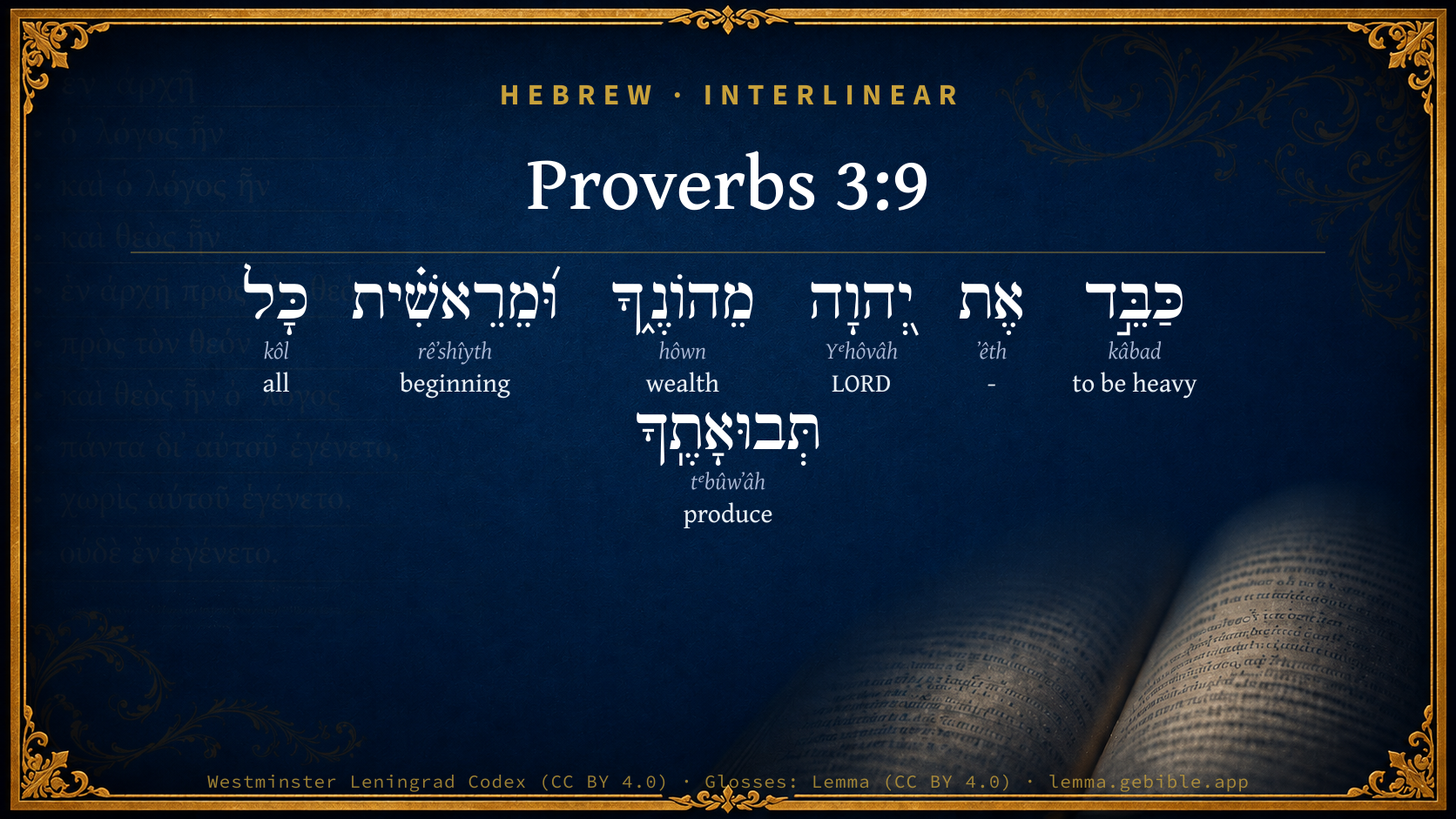
Hebrew (Westminster Leningrad Codex) Proverbs 3:9 appears in the Hebrew Old Testament. The text above is from the Westminster Leningrad Codex. Each word links to its Strong’s number, a concise gloss, and parsing drawn from the Open Scriptures Hebrew Bible morphology. Click any word for its full Brown-Driver-Briggs (BDB) entry.
Download image
Cite this verse

Proverbs 3:9 (World English Bible). Public Domain. Lemma interlinear Bible study tool, https://lemma.gebible.app/v/proverbs/3/9.

Show BibTeX & RIS
BibTeX
RIS
English Translation
Honor Yahweh with your substance, With the first fruits of all your increase:
World English Bible · Public Domain
Download a study sheet

One document with this verse’s original text, its word-by-word gloss line, the meaning frame, cross-references with their text, attributed commentary, and full source and license credits — printable, and it pastes into notes with its structure intact.

This verse Autodidact and up

Study sheet (.html) Plain text (.txt)

A passage Seminary Student

Up to 50 verses in one chapter. A passage sheet keeps up to 6 commentary sources and 12 cross-references per verse, in the order this page ranks them, and says so on the sheet whenever that leaves anything out. Ask for a single verse and you get the Autodidact verse sheet above.

Everything on this page stays free to read, with no account — the sheet is a download of what is already on screen, not access to it.

Want to remove ads? Support Godless Engineer
Compare translations 3

The same verse in 3 English versions, stacked beneath the original-language interlinear above. Click any original word for its lexicon entry.

Each is an independent rendering of the whole verse — the interlinear is not word-aligned to these translations.

Highlighted words mark where these versions differ — a whole-verse word diff, not a word-by-word alignment.

  • World English Bible Public Domain
    Honor Yahweh with your substance, With the first fruits of all your increase:
  • King James Version Public Domain
    Honour the LORD with thy substance, and with the firstfruits of all thine increase:
  • unfoldingWord Literal Text CC BY-SA 4.0
    Honor Yahweh from your wealth and from the first of all your produce,

unfoldingWord Literal Text — © unfoldingWord, licensed CC BY-SA 4.0. Word-aligned USFM3 via Door43 (git.door43.org/unfoldingWord/en_ult).

Versions to compare (up to 4)

3 of 4 selected

Show all 18 translations

Every available English version of this verse, each an independent rendering of the whole verse.

  • World English Bible Public Domain
    Honor Yahweh with your substance, With the first fruits of all your increase:
  • Berean Standard Bible Public Domain
    Honor the LORD with your wealth and with the firstfruits of all your harvest;
  • Majority Standard Bible Public Domain
    Honor the LORD with your wealth and with the firstfruits of all your crops;
  • King James Version Public Domain
    Honour the LORD with thy substance, and with the firstfruits of all thine increase:
  • American Standard Version (1901) Public Domain
    Honor Jehovah with thy substance, And with the first-fruits of all thine increase:
  • Revised Version (1885) Public Domain
    Honour the LORD with thy substance, and with the firstfruits of all thine increase:
  • Geneva Bible (1599) Public Domain
    Honour the Lord with thy riches, and with the first fruites of all thine increase.
  • Douay-Rheims (1899) Public Domain
    Honour the Lord with thy substance, and give him of the first of all thy fruits:
  • Young's Literal Translation Public Domain
    Honour Jehovah from thy substance, And from the beginning of all thine increase;
  • Literal Standard Version CC BY-SA 4.0
    Honor YHWH from your substance, || And from the beginning of all your increase;
  • Unlocked Literal Bible CC BY-SA 4.0
    Honor Yahweh with your wealth and with the firstfruits of all your produce,
  • unfoldingWord Literal Text CC BY-SA 4.0
    Honor Yahweh from your wealth and from the first of all your produce,
  • Darby Bible Public Domain
    Honour Jehovah with thy substance, and with the first-fruits of all thine increase;
  • World Messianic Bible Public Domain
    Honor the LORD with your substance, with the first fruits of all your increase;
  • Webster's Bible Public Domain
    Honor the LORD with thy substance, and with the first-fruits of all thy increase:
  • Free Bible Version CC BY-SA 4.0
    Honor the Lord with your wealth and with the firstfruits of all the crops you grow.
  • Bible in Basic English Public Domain
    Give honour to the Lord with your wealth, and with the first-fruits of all your increase:
  • JPS Tanakh (1917) Public Domain
    Honour the LORD with thy substance, and with the first-fruits of all thine increase;

Literal Standard Version (2020), Covenant Press — licensed CC BY-SA 4.0. Text via the HelloAO Bible API (eBible.org). Unlocked Literal Bible (unfoldingWord) — licensed CC BY-SA 4.0. Text via the HelloAO Bible API (eBible.org). unfoldingWord Literal Text — © unfoldingWord, licensed CC BY-SA 4.0. Word-aligned USFM3 via Door43 (git.door43.org/unfoldingWord/en_ult). Free Bible Version, Dr. Jonathan Gallagher — licensed CC BY-SA 4.0. Text via the HelloAO Bible API (eBible.org).

Word by word

More ways to search: Search by grammar → Find every occurrence → Compare this word →

Practice this passage: Drill this verse → Learn its vocabulary →

מֵהוֹנֶ֑ךָ
hôwn
H1952
“from · wealth · your”
Preposition + Noun, Common, Masculine, Singular, Construct + Suffix, Personal, 2nd Person, Masculine, Singular
Part of Speech
Preposition + Noun
Type
Common
Gender
Masculine
Number
Singular
State
Construct
Full BDB Definition

Origin: from the same as H1951 in the sense of H202

TWOT: 487a

wealth, riches, substance (noun masculine) - wealth - price, high value - enough!, sufficiency (interjection)
  1. כַּבֵּ֣ד kâbad H3513 “be heavy” Verb, Piel, Imperative, 2nd Person, Masculine, Singular
  2. אֶת ʼêth H853 “-” Particle, Direct Object
  3. יְ֭הוָה Yᵉhôvâh H3068 “LORD” Noun, Proper
  4. וּ֝מֵרֵאשִׁ֗ית rêʼshîyth H7225 “and · from · beginning of” Conjunction + Preposition + Noun, Common, Feminine, Singular, Construct
  5. כָּל kôl H3605 “all of” Noun, Common, Masculine, Singular, Construct
  6. תְּבוּאָתֶֽךָ tᵉbûwʼâh H8393 “produce · your” Noun, Common, Feminine, Singular, Construct + Suffix, Personal, 2nd Person, Masculine, Singular

About this verse

These counts appear in no published source. They are computed here, from the morphology-tagged text and Lemma’s own curated glosses. What Lemma adds →

7
words
7
distinct lemmas
Wisdom
section

Shared distinctive vocabulary

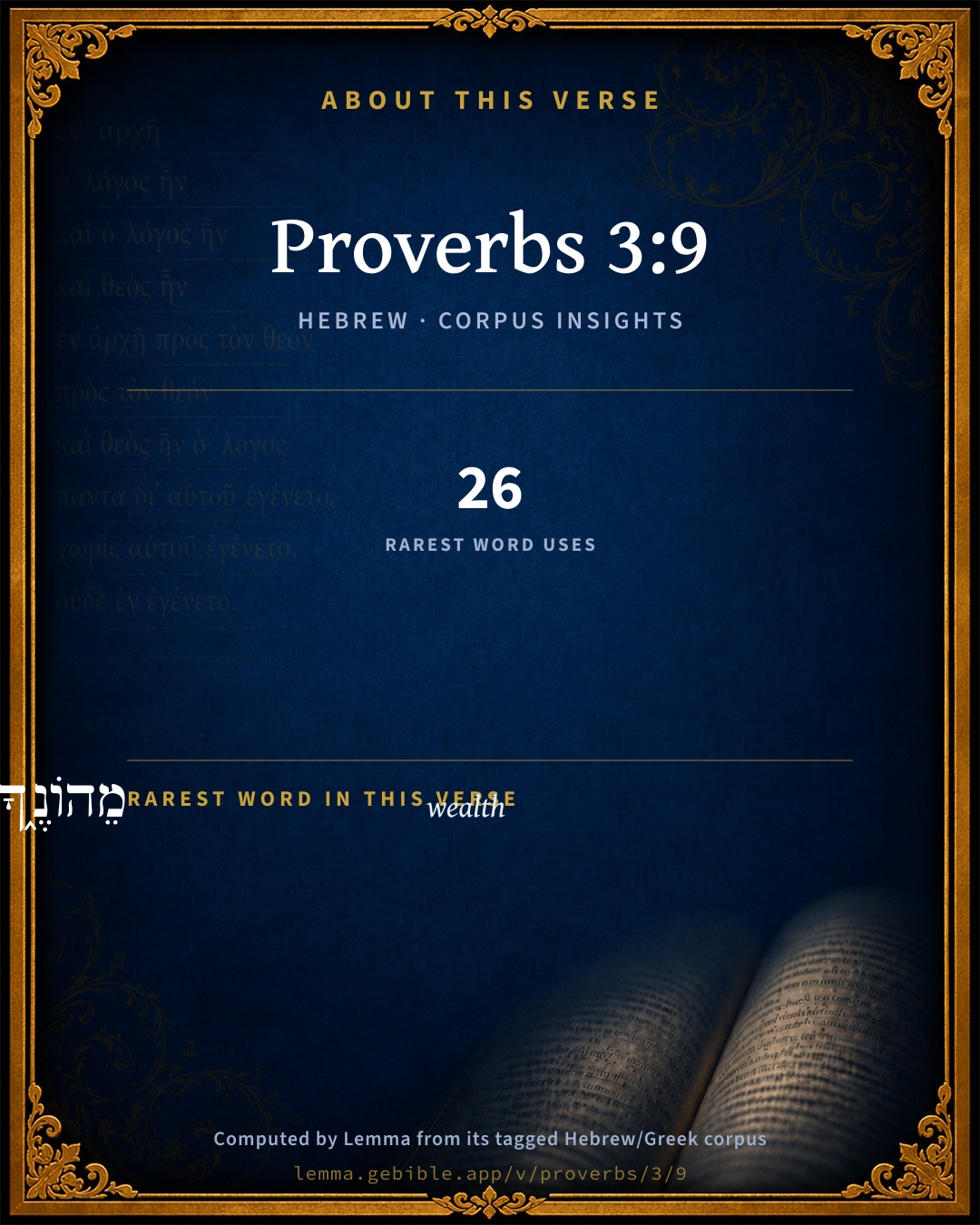
מֵהוֹנֶ֑ךָ wealth H1952 occurs in 26 verses of the Hebrew Bible. Also found in:

Grammatical profile

  • 1 verb
  • 5 nouns
  • 1 particle

Verb forms

  • כַּבֵּ֣ד Piel · Imperative

Hebrew & Septuagint length

In English translation the verse runs 13 words from the Hebrew and 17 from the Septuagint (LXX English) — closely comparable.

A rough comparison of the two English renderings, which tokenize alike — not a word-level alignment.

Word counts can differ between the Hebrew and the Greek without any difference in meaning — e.g. the Hebrew direct-object marker אֵת has no separate Greek word, and Greek often adds the article ὁ.

Cross-references

20

Topical passages linked to Proverbs 3:9 in the Treasury of Scripture Knowledge — connected by theme and wording, ordered by reader-vote popularity; previews shown in the World English Bible.

  • Deuteronomy 26:2–15 that you shall take of the first of all the fruit of the ground, which you shall bring in from your land that Yahweh your God gives you; and you shall put it in a basket, and shall go to the place which Yahweh your God shall choose, to cause his name to dwell there.
  • 1 Corinthians 16:2 On the first day of the week, let each one of you save, as he may prosper, that no collections be made when I come.
  • Exodus 23:19 The first of the first fruits of your ground you shall bring into the house of Yahweh your God. "You shall not boil a kid in its mother's milk.
  • Proverbs 14:31 He who oppresses the poor shows contempt for his Maker, But he who is kind to the needy honors him.
  • Philippians 4:17–18 Not that I seek for the gift, but I seek for the fruit that increases to your account.
  • Exodus 22:29 "You shall not delay to offer from your harvest and from the outflow of your presses. "You shall give the firstborn of your sons to me.
  • Malachi 3:8–10 Will a man rob God? Yet you rob me! But you say, 'How have we robbed you?' In tithes and offerings.
  • Haggai 1:4–9 "Is it a time for you yourselves to dwell in your paneled houses, while this house lies waste?
  • 2 Corinthians 8:2–3 how that in much proof of affliction the abundance of their joy and their deep poverty abounded to the riches of their liberality.
  • Exodus 34:26 You shall bring the first of the first fruits of your ground to the house of Yahweh your God. You shall not boil a young goat in its mother's milk."
  • Exodus 35:20–29 All the congregation of the children of Israel departed from the presence of Moses.
  • 2 Corinthians 8:8–9 I speak not by way of commandment, but as proving through the earnestness of others the sincerity also of your love.
  • 1 John 3:17–18 But whoever has the world's goods, and sees his brother in need, and closes his heart of compassion against him, how does the love of God remain in him?
  • Mark 14:7–8 For you always have the poor with you, and whenever you want to, you can do them good; but you will not always have me.
  • Luke 14:13–14 But when you make a feast, ask the poor, the maimed, the lame, or the blind;
  • Genesis 14:18–21 Melchizedek king of Salem brought forth bread and wine: and he was priest of God Most High.
  • Numbers 7:2–89 that the princes of Israel, the heads of their fathers' houses, offered. These were the princes of the tribes. These are they who were over those who were numbered:
  • Genesis 28:22 then this stone, which I have set up for a pillar, will be God's house. Of all that you will give me I will surely give the tenth to you."
  • Numbers 31:50–54 We have brought Yahweh's offering, what every man has gotten, of jewels of gold, ankle-chains, and bracelets, signet-rings, ear-rings, and armlets, to make atonement for our souls before Yahweh.
  • Mark 14:10–21 Judas Iscariot, who was one of the twelve, went away to the chief priests, that he might deliver him to them.

Cross-references courtesy of OpenBible.info (CC BY 4.0).

Hebrew and Greek witnesses Masoretic Hebrew ↔ Greek Septuagint

The same verse in the two great witnesses to the Old Testament, shown verse-for-verse.

These are two independent witnesses, not word-aligned to each other, and the Septuagint is shown in lemma (dictionary) form.

Hebrew Proverbs 3:9 Masoretic · Westminster Leningrad Codex

כַּבֵּ֣ד אֶת יְ֭הוָה מֵהוֹנֶ֑ךָ וּ֝מֵרֵאשִׁ֗ית כָּל תְּבוּאָתֶֽךָ

Honor Yahweh with your substance, With the first fruits of all your increase:

World English Bible · Public Domain

Greek LXX Proverbs 3:9 Septuagint · lemma form

τιμάω ὁ κύριος ἀπό σός δίκαιος πόνος καί ἀποἄρχω αὐτός ἀπό σός καρπός δικαιοσύνη

Honor the Lord with your just labors, and give him the first of your fruits of righteousness:

LXX2012 (modern English Septuagint) · Public Domain

On this verse, The Cambridge Bible for Schools and Colleges discusses the Septuagint’s reading. Read the note in Commentary ↓

Hebrew: Westminster Leningrad Codex (CC BY 4.0). Greek: Septuagint (public domain); English from LXX2012 (modern English Septuagint) (Public Domain). How the Septuagint differs from the Hebrew →

Commentary

Notes on Proverbs 3:9 from classic Christian and Jewish commentators (each source and its license shown beneath its notes). The classic Christian expositions comment on the surrounding passage and are grouped to its opening verse, so a note may address several verses; the Jewish commentaries on the Tanakh (Rashi and others) are per-verse, so they appear only where the commentator wrote on this verse.

Lemma curates 59 commentaries, every one of them public domain or Creative Commons licensed, each selected and text-cleaned for this edition rather than reprinted as found. About our sources →

Trapp's Complete Commentary

John Trapp

Pro 3:9 Honour the LORD with thy substance, and with the firstfruits of all thine increase:

Ver. 9. Honour the Lord with thy substance.] Freely expending it in pious and charitable uses. {Exo 25:19 Deu 26:2} {See Trapp on "Exo 25:19"} {See Trapp on "Deu 26:2"} See also my "Commonplace of Alms."

John Trapp, A Commentary or Exposition upon All the Books of the Old and New Testament (1647–1656) — public domain. Text from a community e-Sword module.

The Biblical Illustrator

Joseph S. Exell

Pro_3:9

Honour the Lord with thy substance.

The highest giving, the condition of the highest getting

I. The highest giving.

1. Giving to the Best Being.

2. Giving the best things to the Best Being. The surrender of self is essential to give virtue and acceptance to all other contributions (Rom_12:1).

II. The highest getting. By giving this you get back--what? The choicest and fullest Divine blessings.

1. He who yields his all to God attends to the conditions of all true prosperity--industry, temperance, economy, forethought, etc.

2. He who yields his all to God will insure the special favour of Heaven (see Heb_6:10.) (David Thomas, D.D.)

Giving, a privilege

This rule of sacrifice is a costly precept to the worldling and the formalist; but to the servant of God it is a privilege to lay aside a portion of substance with a sacred stamp on it, bearing the inscription, This is for God. Well may we think our substance due, where we owe ourselves. (C. Bridges, M.A.)

The duty of honouring God with our substance

I. A duty enjoined. Honouring the Lord with our substance.

1. We are to honour God in the expenditure of our substance upon causes of piety and benevolance. Our money--even our time, our health, our talents--is not our own. The humblest and the greatest are but stewards. Whatever they have is a trust.

2. God is to be first considered in the distribution and expenditure of our means. Our general plan is to see whether we have anything left for God. To honour the Lord is our positive, our first, duty.

3. Charitable and religious expenditure should be systematic.

II. A promise annexed to the discharge of the duty: Thy barns be filled with plenty. Expenditure here is gain. Have faith in God. There is that scattereth and yet increaseth. Christian liberality is gain, because it is giving unto the Lord. You cannot lose by faith, you cannot lose by obedience. Do not narrow too hastily, too selfishly, too covetously, the limits of what you think you can spare. Shrink not from self-denial. The test for us is our comparative expenditure for self and for God. (John C. Miller, M. A.)

Honouring the Lord with our substance

Under the old dispensation the Divine directions respecting religious observances and the use of property were more precise and definite than they are under the new. With the Jew it was in no sense optional whether or not he should contribute to the maintenance of the institutions of religion, nor whether he should contribute little or much. Under the Christian dispensation giving is voluntary. This may weaken the sense of obligation in many minds.

I. The duty here enjoined. We do not honour the Lord with our substance when we use it for purposes of display or of self-gratification. God is honoured--

1. When we relieve the physical wants of our fellow-creatures.

2. By devoting it to the maintenance of gospel institutions.

3. By employing it for the diffusion of the gospel in the benighted portions of the earth.

II. The promise by which we are encouraged to perform the duty. (W. M. Birchard.)

The Biblical Illustrator, edited by Joseph S. Exell (c. 1880s–1900s) — public domain. Text from a community e-Sword module.

Joseph Benson's Commentary

Pro 3:9-10. Honour the Lord with thy substance — Lay out thy estate, not to please thyself, but to glorify God; and with the first-fruits of all thy increase — Or, with the chief, or best; which answers to the first-fruits under the law. So shall thy barns be filled with plenty — This is not the way to diminish thy estate, as covetous and profane persons allege, but rather to increase it.

Joseph Benson's Commentary on the Old and New Testaments (1811–1818) — public domain. Text from a community e-Sword module.

Keil & Delitzsch

C. F. Keil & F. Delitzsch

9 Honour Jahve with thy wealth,

And with the first-fruits of all thine increase:

10 Then shall thy barns be filled with plenty,

And thy vats overflow with must.

It may surprise us that the Chokma, being separated from the ceremonial law, here commends the giving of tithes. But in the first place, the consciousness of the duty of giving tithes is older than the Mosaic law, Gen 28:22; in this case, the giving of tithes is here a general ethical expression. עשּׂר and מעשׂר do not occur in the Book of Proverbs; in the post-biblical phraseology the tithes are called חלק הגּבהּ, the portion of the Most High. כּבּד, as the Arab. waḳḳra, to make heavy, then to regard and deal with as weighty and solemn (opp. קלּל, to regard and treat as light, from קלל = Arab. hân, to be light). הון, properly lightness in the sense of aisance, opulency, forms with כּבּד an oxymoron (fac Jovam gravem de levitate tua), but one aimed at by the author neither at Pro 1:13 nor here. מן (in מהונך and 'מר, Pro 3:9) is in both cases partitive, as in the law of the Levitical tenths, Lev 27:30, and of the Challa (heave-offering of dough), Num 15:21, where also ראשׁית (in Heb 7:4, ἀκροθίνια) occurs in a similar sense, cf. Num 18:12 (in the law of the Theruma or wave-offering of the priests), as also תּבוּאה in the law of the second tenths, Deu 14:22, cf. Num 18:30 (in the law of the tenths of the priests).

Pro 3:10

With ו apodosis imperativi the conclusion begins. שׂבע, satisfaction, is equivalent to fulness, making satisfied, and that, too, richly satisfied; תּירושׁ ;deif also is such an accusative, as verbs of filling govern it, for פּרץ, to break through especially to overflow, signifies to be or become overflowingly full (Job 1:10). אסם (from אסם, Chald. אסן, Syr. âsan, to lay up in granaries) is the granary, of the same meaning as the Arab. âkhzan (from khazan = חסן, Isa 23:18, recondere), whence the Spanish magazen, the French and German magazin. יקב (from יקב, Arab. wakab, to be hollow) is the vat or tub into which the must flows from the wine-press (גּת or פּוּרה), λάκκος or ὑπολήνιον. Cf. the same admonition and promise in the prophetic statement of Mal 3:10-12.

Keil & Delitzsch — Biblical Commentary on the Old Testament (1861–1891) — public domain (CC PDM 1.0). Text via the HelloAO Bible API. (Old Testament only.)

Tyndale Open Study Notes

Tyndale Open Resources

3:9-10 God receives honor and blesses his people when they recognize him as the source of all they have and when they give him the best part of everything they produce (Gen 4:3-5; 18:6; Num 18:12, 29).

Tyndale Open Study Notes — © Tyndale Open Resources, licensed CC BY-SA 4.0. Text via the HelloAO Bible API.

Geneva Bible (1599)

Geneva Bible translators

As was commanded in the Law, Exod. 23:19; Deut. 26:2, and by this they acknowledged that God was the giver of all things, and that they were ready to bestow all at his commandment.

Geneva Bible (1599) marginal notes — public domain. Text via Bolls.life.

Jamieson, Fausset & Brown

Robert Jamieson, A. R. Fausset & David Brown

(Compare Pro 11:25; Exo 23:19; Deu 18:4; Isa 32:8; Co2 9:13).

Jamieson, Fausset & Brown — Commentary Critical and Explanatory on the Whole Bible (1871) — public domain (CC PDM 1.0). Text via the HelloAO Bible API.

Adam Clarke's Commentary

Verse 9. Honour the Lord with thy substance] The מנחה MINCHAH or gratitude-offering to God, commanded under the law, is of endless obligation. It would be well to give a portion of the produce of every article by which we get our support to God, or to the poor, the representatives of Christ. This might be done either in kind, or by the worth in money. Whatever God sends us in the way of secular prosperity, there is a portion of it always for the poor, and for God's cause. When that portion is thus disposed of, the rest is sanctified; when it is withheld, God's curse is upon the whole. Give to the poor, and God will give to thee.

Adam Clarke's Commentary on the Bible (1810–1826) — public domain. Text from a community e-Sword/MySword module.

The Cambridge Bible for Schools and Colleges

gen. ed. J. J. S. Perowne

9. substance … increase] Perhaps (as Speaker’s Comm.) capital, and revenue. It is interesting that (as there pointed out) the LXX. qualify both words, by restricting them to “righteous,” well-gotten wealth: ἀπὸ σῶν δικαίων πόνων … ἀπὸ σῶν καρπῶν δικαιοσύνης. Restitution is the true consecration of unrighteous gain, Luk_19:8.

The Cambridge Bible for Schools and Colleges (gen. ed. J. J. S. Perowne; Cambridge University Press, 1878–1918) — public domain. Text from a community e-Sword module.

John Gill's Exposition

Honour the Lord with thy substance,.... Or, "out of thy substance" (n); for as it should be a man's own that he gives, and not another's, and therefore called "thy substance"; or, as the Septuagint version, "out of thy just labours", what is righteously and lawfully gotten, and not by fraud and oppression; so it is only a part of it, and not all, that is required; what in proportion to his substance can be prudently spared, and is sufficient and suitable to the call in Providence. A man's "substance" are his wealth and riches; his "mammon", as the Targum; which, in comparison of heavenly things, indeed have no substance in them: yet these are worldly substance, and of account; and as with these God has honoured men, they should honour him with them again, by giving to the poor, especially his poor saints; for as an oppressing of them is a reproaching of him, so having mercy on them is honouring him, Pro 14:31; and especially by contributing to the support of his worship, the keeping up the interest and credit of religion, and for the spread of the Gospel; and chiefly by communicating to the ministers of it, giving them the "double honour" which is due to them, and which, when given them, the Lord takes as done to himself, as an honouring him, Ti1 5:17;

and with the firstfruits of all thine increase; or, "out of the chief of all thine increase" (o); God must have the best, and in the first place. The allusion is either to the maintenance of the priests and Levites under the law, and the manner of doing it; which, among other things, was out of the annual produce of the earth, and the firstfruits of it; and may respect the comfortable support of Gospel ministers under the present dispensation; see Co1 9:13; or to the firstfruits of every kind offered to the Lord, and to the feast kept sacred to him at the ingathering the fruits of the earth, Lev 23:10; and even among the Heathens formerly were something of the same kind. Aristotle says (p) the ancient sacrifices and assemblies were instituted as firstfruits, after the gathering of the fruits, at which time especially they ceased from working.

(n) "e substantia tua", Montanus; "de substantia tua", Baynus, Junius & Tremellius, Piscator; "de divitiis tuis", Mercerus, Gejerus; "de opibus tuis", Tigurine version, Cocceius, Michaelis, Schultens. (o) "de praecipuo totius proventus tui", Junius & Tremellius. (p) Ethic. l. 8. c. 11.

John Gill's Exposition of the Whole Bible (1746–1763) — public domain (CC PDM 1.0). Text via the HelloAO Bible API.

Albert Barnes' Notes on the Bible

“Substance” points to capital, “increase” to revenue. The Septuagint as if to guard against ill-gotten gains being offered as an atonement for the ill-getting, inserts the quaifying words, “honor the Lord from thy righteous labors.”

Albert Barnes' Notes on the Bible (1834–1885) — public domain. Text from a community e-Sword/MySword module.

Haydock's Catholic Bible Commentary

Fruits. Septuagint add, "of justice;" to intimate that no presents will be acceptable, which have been unjustly acquired.

George Leo Haydock (1774–1849), Haydock's Catholic Family Bible and Commentary, 1859 edition — public domain. Excludes Psalms (Douay-Rheims chapter numbering differs from Protestant) and Deuterocanonical books (Catholic canon only).

Matthew Poole's English Annotations

With thy substance; or, with thy riches. Lay out thy estate not only to please and advance thyself or family, but also to glorify God; which is done by the payment of all those offerings and dues which God hath required; by giving according to thy abilities whatsoever is necessary for the support and advancement of God’s worship and service in the world; by free and liberal contributions to those whom God hath made his deputies, and, as I may say, the receivers of his rents, to wit, faithful ministers and good Christians, and all others who need and require thy help. The performance of these duties is here called an honouring of God, partly because that word is sometimes used for giving of gifts, as 1Ti 5:17, and elsewhere; and partly because it is, a testimony of our respects to God, of our obedience to him as our sovereign Lord, and that in hard and costly duties, of our thankfulness to him as our chief Benefactor and Donor of all that we have, and of our belief of his promises made to the faithful practisers of this duty; which if they were believed, the most covetous persons would be the most charitable.

With the first-fruits; or, with the chief, or best, or first, which answers to the first-fruits under the law.

Matthew Poole's English Annotations on the Holy Bible (1683–1685) — public domain. Text from a community e-Sword/MySword module.

Whedon's Commentary on the Bible

Daniel D. Whedon

9. Honour — Miller well says, Honour, in a connexion like this, grew to include the idea of giving. We see it in the Greek τιμα. 1Ti_5:3; 1Ti_5:17; Act_5:2; Pro_19:19. Substance points to capital, increase, to revenue, income. In verse six the teacher had said, “In all thy ways acknowledge him, and he shall direct [smooth] thy paths.” This thought is resumed and illustrated in an important particular. To show our gratitude to God for blessings bestowed is a leading duty. The laws of the old economy directed, that of all the firstfruits an offering should be presented. (See Exo_23:14; Exo_23:16; Exo_23:19; also Exo_22:29-30; Lev_2:12; Lev_2:16; Lev_19:23-24; Deu_18:4-5.) This was a thank offering for the blessings of life, and a contribution to the support of religion. These offerings of our substance are dictates of sanctified reason. The ordinances and ministries of religion being appointed by God for the benefit of men, it is the will of God that they should be supported by men, to whom, here and elsewhere, he gives the promise that in proportion to the liberality of their contributions as compared with their means, will he return them liberal dispensations of his providence and grace. Under the old dispensation the return, in kind, of temporal blessings was prominent, the spiritual being included; under the new, the spiritual blessings returned occupy the foreground, but the temporal, also, are included. He that makes temporal sacrifices for the cause of religion shall receive manifold more in this life, and in the world to come everlasting life. Mat_19:29-30; Mar_10:29-30; Luk_18:29-30. This is the general rule.

The subject and principles of systematic beneficence deserve more attention than they have hitherto received from modern Christians. Comparatively few give systematically a percentage of their income or gains. This was a principle of the old law, and the proportion was in some particulars definitely determined. Under the new economy the principle is as plainly obligatory as under the old, but each Christian is left to determine for himself what portion he shall devote to the Lord, under the stimulating promise, “He which soweth sparingly shall reap also sparingly; and he which soweth bountifully shall reap also bountifully.” 2Co_9:6.

Daniel D. Whedon (gen. ed.), Commentary on the Old and New Testaments (1874–1909) — public domain. Text from a community e-Sword module.

The Pulpit Commentary

Honour the Lord with thy substance, etc. An exhortation to self-sacrificing devotion by the appropriation and use of wealth to the service of Jehovah. With thy substance (mehonehka); Vulgate, de tua substantia ; LXX, apo swn dikaiwn ponwn . Hon, properly "lightness," is "opulence," "wealth," as in Pro_1:13. The min in composition with hon is not partitive, as Delitzsch and Berthean take it, but signifies "with" or "by means of," as in Psa_38:7 Isa_58:12 Eze_23:10 Oba_1:9. The insertion of dikaiov by the LXX limits the wealth to that which is justly acquired, and so guards against the erroneous idea that God is honoured by the appropriation to his use of unlawful wealth or gain (Plumptre). The Israelites "honoured Jehovah with their substance" when they contributed towards the erection of the tabernacle in the wilderness, and later when they assisted in the preparations for the building of the temple, and in the payment of tithes. The injunction may undoubtedly refer to tithes, and is in accordance with the requirement of the Mosaic Law on that and other points as to oblations, free will offerings, etc.; but it has a wider bearing and contemplates the use of wealth for all pious and charitable purposes. (see Pro_14:31) The word maaser, "tithe," does not occur in the Proverbs. With the firstfruits (mere-shith); Vulgate, de primitiis. So Targum Jonathan, Syriac, and Arabic. The law of the firstfruits is found in Exo_22:29 Exo_23:19 Exo_34:20 Num_18:12 Deu_18:4 Deu_26:1-3. The firstfruits were presented by every Israelite to the priests, in token of gratitude and humble thankfulness to Jehovah, and consisted of the produce of the land in its natural state, or prepared for human food (Maclear, "Old Test. Hist.," bk. 4, c. 3, a). The "firstfruits" also carried with it the idea of the best. The custom of offering the firstfruits of the field and other revenues as a religious obligation was observed by ancient pagan nations (see Diod. Sic., 1:14; Plut., "De Iside," p. 377; Pliny, "Hist. Nat.," 18:2) (Zockler). Some of the ancient commentators find in this verse an argument for the support of the ministry. It is well known that the priests "lived of the sacrifice," and were "partakers of the altar," and as their support by these means tended to the maintenance of Divine worship, so those who supported them were in the highest degree "honoring God." The injunctions also show that the honouring of God does not consist simply of lip service, of humility and confidence in him, but also of external worship, and in corporeal things. They are not peculiar to Israel, but are binding on all. They oppose all selfish use of God"s temporal gifts, and lead to the thought that, in obeying them, we are only giving back to God what are his own. "The silver and the gold is mine, saith the Lord of hosts". (Hag_2:23) "We give thee but thine own, Whate"er the gift may be; All that we have is thine shine, A trust, O Lord, from thee. (Day"s "Psalter.")

So shall thy barns be filled with plenty. The promise held out to encourage the devotion of one"s wealth to Jehovah"s service, while supplying a motive which at first sight appears selfish and questionable, is in reality a trial of faith. Few persons find it easy to realize that giving away will increase their store (Wardlaw). The teacher is warranted in bringing forward this promise by the language of Moses in Deu_28:1-8, whine, among other things, he promises that Jehovah will command a blessing upon the "storehouses" and industry of those who honour God. The principle is otherwise expressed in Pro_11:25, "The liberal soul shall be made fat, and he that watereth shall be also watered himself;" and it is exemplified in Hag_1:3-11 Hag_2:15, 19 Mal_3:10-12, and in the New Testament in Php_4:14-19 2Co_9:6-8. Thy barns; asameykha, the only form in which asam, "a storehouse," "barn," or "granary," occurs. The Hebrew asam is the same as the Latin horreum (Vulgate) and the Greek tamieion (LXX). With plenty (sava); Vulgate, saturitas; i.e. fulness, abundance, plenty. The root sava is "to become satisfied," and that richly satisfied. This expression and the following, and thy presses shall burst out with new wine, depict the greatest abundance. Thy presses (y"kaveykhu). The word here translated "presses" is, strictly speaking," vats" or "reservoirs," into which the must from the wine press flowed. The wine press consisted of two parts, the gath (equivalent to the Latin torcularium, torculum, or torcular; Greek, lhnov , Mat_21:33), into which the grapes were collected from the surrounding vineyard, and there trodden underfoot by several persons, (Neh_13:15 Isa_63:3 Lam_1:15) whose movements were regulated by singing or shouting, (Isa_16:10 Jer_48:33) as among the Greeks (see "Athen.," 5. p. 199, a; Anacreon, "Od.," 17:1, 52; cf. Theocritus, 7:25) and Egyptians (Wilkinson, "Man. and Cust.," vol. 2. pp. 152-157); and the yekev, used here, which was a trough of corresponding size, dug into the ground, or cut out of a rack, at a lower level, to receive the must. The yekev corresponded with the Greek upolhnion , mentioned in Mar 12:l, and the Latin lacus (Ovid, "Fasti," 5:888; Pliny, "Epist.," 9:20; "Colum. de Rust.," 12:18): Cajeterus, indeed, reads, lacus torcularii. The word yekev is, however, used for the wine press itself in Job_24:11 and 2Ki_6:27. Shall burst out ( yiph"rotsu); literally, they shall extend themselves; i.e. shall overflow. Parats, "to break," is here used metaphorically in the sense of "to be redundant," "to overflow". (cf. 2Sa_5:20) It is employed intransitively of a people spreading themselves abroad, or increasing, in Gen_28:14 Exo_1:12. New wine (tirosh); Vulgate, Arabic, and Syriac, vino; LXX, oinw ; properly, as in the Authorized Version, "new wine;" Latin, mustum. (see Deu_33:28 Isa_36:17 Isa_55:1)

Vers. 9, 10. Consecrated property.

I WE CAN HONOUR GOD WITH OUR PROPERTY. It is not to be supposed that because religion is a wholly spiritual power it has no bearing on material things. Our religion is a mockery unless it affects the way in which we spend our money, as well as all other concerns of life. Property can be consecrated to God by being spent in conscious obedience to his will and by being used for the promotion of his glory, as in the maintenance of worship, the extension of missions, the relief of the poor, the sick, the widow and orphan.

II GOD HAS CLAIMS UPON OUR PROPERTY.

1. It originally came from him. He created the materials and powers of nature. He gave to us our faculties. We sow the seed, but God gives the increase.

2. It is only lent to us for a season. Till recently it was not ours; soon we must leave it. While we have it, it is a talent to be used in our great Master"s service, and for which we shall have to give an account. Rich men will be called to a Divine audit, where all their wealth will be reckoned and their method of spending it apprised. But so also will the poor; for we are all answerable for the use we make of our possessions, whether they be much or little. The one talent must be accounted for as well as the five talents.

III OUR WHOLE PROPERTY SHOULD BE CONSECRATED TO GOD. It was all given to us by God. We shall have to give account of the use we make of all of it of the substance or capital and of the increase or yearly income. We cannot compound for the abuse of the larger part of our goods by sacrificing to God a small proportion of them. If we give a tithe of our possessions to God, we do not thereby receive a dispensation to give the rest to Mammon. Is the mendicant friar, then, the typical Christian? No. An enlightened Christianity will teach us how to consecrate our possessions to God, while retaining the control of them. We are to be stewards, not beggars.

IV THE BEST OF OUR PROPERTY SHOULD BE MORE DIRECTLY OFFERED TO THE SERVICE OF GOD. While all we have should be held sacred to God, some should be spent on objects that plainly involve self-sacrifice, and that manifestly concern the kingdom of heaven. We must not make the lofty thought of the consecration of all our property an excuse for low selfishness in spending the whole on ourselves. God expects the best. He should have the firstfruits; his claims should be recognized before all others. People often give to religious objects what they think they can spare after satisfying all other calls. They should give to these first, and see afterwards what is spared for more selfish things.

V IT IS WELL TO DISPOSE OF OUR PROPERTY ON A CERTAIN METHOD. People who give to religious and philanthropic objects on a system of setting apart a certain portion of their income for such purposes, find that they can thus give most readily and justly. It is for each to settle in his own conscience and before God according to what proportion he should give. One may find a tithe too much, considering his duty to his family etc. Another may find it far too little, considering his ease and affluence and the needs of the world.

VI THIS CONSECRATION OF PROPERTY TO GOD BRINGS A BLESSING ON THE OWNER. If it is not always rewarded with temporal riches, it is repaid in better treasures pleasures of sympathy and benevolence and the smile of God.

Vers. 9, 10. The Divine responsiveness.

There are two ways in which God blesses us unconditionally and conditionally. We receive very much from him in virtue of his originating and spontaneous goodness. We may, if we will, receive much from him also as the result of his faithful response to our appeal. The text suggests to us the truth, which has manifold illustrations, that if we take toward him the attitude which he desires us to assume, he will visit us with appropriate and corresponding blessings.

I IF WE LOVE HIM, HE WILL LOVE US. True, indeed, it is that "we love him because he first loved us", (1Jn_4:19) his own Divine beneficence is the source of all human affection; but it is also true that "if a man love me (Christ), he will keep my words, and my Father will love him". (Joh_14:23) Our love of God, of Jesus Christ, will meet with a large response in the outpouring of Divine affection toward us. God will love us with the fulness of parental, rejoicing love.

II IF WE TRUST HIM, HE WILL TRUST US. Those who believe in the Lord Jesus Christ, and thus become his sons, (Joh_1:12) are the objects of his Divine trust. God does not prescribe, to his reconciled children the hours, places, forms, methods, and means of service. He leaves these to the promptings of the filial spirit, to the decision of the understanding which has been consecrated to him. He makes known to us his will, that he should be served and his creatures blessed and saved; then be trusts us to put out our energies in all wise ways to fulfil his purpose. His treatment of us is in response to our attitude towards him.

III IF WE HONOUR HIM, HE WILL HONOUR US. (1Sa_2:30)

IV IF WE GIVE OF OUR SUBSTANCE TO HIM, HE WILL ENRICH US. This is the illustration which our text supplies (see Deuteronomy 26). The children of Israel were encouraged to bring of their firstfruits and to present them unto the Lord, and to expect that, if they gave thus to God, he would give, in like way, to them, enlarging and enriching them. (Mal_3:10-12) And not only were they taught thus to look on gifts of piety, but also of charity; these should be repaid by the observing and responsive Lord. (Pro_19:17) It may be asked how far we may go in anticipating like rewards at the hand of God now. And the answer is:

1. We are not to expect that God will enrich us in substance irrespective of other conditions. (2Th_3:10) This would be a premium on idleness and imprudence. It will always be "the hand of the diligent that will make rich.

2. But labour and frugality being understood, the man who "seeks first the kingdom of God," who "acknowledges him in all his ways" (ver. 6), and who liberally gives to his cause (specially remembering his "little ones his poor), may look for large blessings at his hand. At least sufficiency now, (Mat_6:33 Php_4:19) and glorious abundance soon and forever. C. (Joh_14:13, 14 16:9)

The Pulpit Commentary (1880–1919), ed. H.D.M. Spence-Jones & Joseph S. Exell — public domain. Text from a community e-Sword module.

John Wesley's Explanatory Notes

Substance - Lay out thy estate not to please thyself, but to glorify God. First-fruits - Or, with the chief or best; which answers to the first-fruits under the law.

John Wesley, Explanatory Notes Upon the Whole Bible (1754–1765) — public domain. Text via the GEBible commentary corpus.

Bridges on Proverbs

Charles Bridges

This rule of sacrifice is a costly precept to the worldling and the formalist. But to the servant of God, is it not a privilege to lay aside a portion of substance with this sacred stamp, — "This is for God"? (1Co 16:2 .) The first-fruits of the increase were the acknowledgment of redemption from Egypt (Exo 13:12-13 . Deu 26:1-10 .) And shall we, redeemed from sin, Satan, death, and hell, deny the claim? (1Co 6:19-20 .) ’Well, may we think our substance due, where we owe ourselves.’†1 Nay, could we be happy in spending that substance on ourselves, which he has given us wherewith to honour him? (Luk 19:13 . Contrast Luk 12:16-22.) What a value, what a dignity, does it give to the talent, that he should condescend to employ it for his own grand, eternal purposes! This sacred devotedness is, moreover, the true road to riches. (Pro 11:24 .) God challenges us to "prove him now herewith," if the abundant harvest, and the overflowing vintage, shall not put unbelief and covetousness to shame. (Mal 3:10 . 2Ch 31:5-10 .) A niggardly spirit is, therefore, narrow policy; contracting the harvest, by sparing the seed-corn. (2Co 9:6 . Hag 1:4-6 .) There is no presumption, or enthusiasm in looking for the literal fulfillment of the promise. If we doubt the temporal, should we not suspect our assumed confidence in the spiritual, engagements? For if the Lord’s word be insufficient security for our substance: much more must it be for the infinitely weightier deposit of our soul!

The rule and obligation are therefore clear. The law dealt with us as children, and prescribed the exact amount. The gospel treats us as men, and leaves it to circumstance, principle, and conscience. This consecration of substance, as the seed-corn for the harvest, is as strange to the world, as would be the casting of the seed in the earth to an untutored savage. Yet is the result secure in both cases; only with this difference, that the temper of the earthly sower has no influence on the harvest; whereas the fruitfulness of the spiritual harvest mainly depends upon the principles of the work. Most important is it to beware of bye-ends and selfish principles; that we honour the LORD, not ourselves. Let there be a self-renouncing spirit (1Ch 29:14-16 . Mat 6:1-4 ; Mat 25:37-39 ), implicit faith (1Ki 17:12-16 ), constraining love (Rom 12:1 . 2Co 5:14-15 . Mat 10:42 ), special regard to his own people. And doubt not, but he will affix his own seal — "Those that honour me, I will honour." (1Sa 2:30 . Compare Pro 11:25 ; Pro 22:9 ; Heb 6:10 .)

Footnotes

†1 Bishop Hall.

Charles Bridges, An Exposition of the Book of Proverbs (1846) — public domain. Text from a community e-Sword module.

unfoldingWord translationNotes

Door43 World Missions Community

all your produce

"all the food you harvest"

your storehouses will be filled up

This can be stated in active form. AT: "your storehouses will be full" (See: Active or Passive)

storehouses

buildings or rooms where food is stored

your vats will be bursting

your storage containers will be extremely full, as if ready to break open.

translationWords

honor

Yahweh

firstfruits

wine

unfoldingWord translationNotes — © Distant Shores Media and the Door43 World Missions Community, licensed CC BY-SA 4.0. Source: git.door43.org/Door43/en_tn.

Rashi

Rabbi Shlomo Yitzchaki (Rashi)

from your substance From whatever He favored you [with], even from a pleasant voice. (Do not read: from your substance [מהונך] but: from your throat [מגרונך].)

and from the first (These are the terumoth and the tithes.)

Rashi on the Tanakh — English translations: “The Judaica Press complete Tanach with Rashi, translated by A. J. Rosenberg” (CC BY 4.0); “Pentateuch with Rashi's commentary by M. Rosenbaum and A.M. Silbermann, 1929-1934” (public domain); “The Metsudah Tanach series, Lakewood, N.J” (CC BY 4.0); and “The Book of Joshua, Metsudah Publications, 1997” (CC BY 4.0). Text via Sefaria.

Lesson kit

Teaching starters — assembled from the data on this page, not authored interpretation. Every prompt links to the verse data it draws on. Edit before teaching.

Proverbs, in the Wisdom, opens this verse with 7 words (7 distinct Hebrew lemmas). Its most distinctive word is hôwn (“wealth”). A historical commentator’s framing appears above. Read the whole chapter for the surrounding context.

Discussion questions

  1. The word hôwn carries the sense “wealth.” How does it shape the verse?
  2. How does Psalms 44:12, which shares the word «wealth», read alongside this verse?
  3. These translations render this verse differently. What is at stake in choosing one wording over another?
  4. «כַּבֵּ֣ד» is a Piel Imperative verb. How does that grammatical form shape the action described?
  5. Compare how Trapp's Complete Commentary and The Biblical Illustrator read this verse. Where do they agree or differ?

Things to notice

Reading settings

Reading text

Shown beneath each verse's original-language words.

Old Testament
Old Testament edition

Read the OT as the Masoretic Hebrew (MT) or the Greek Septuagint (LXX).

English shown for the Greek Septuagint (in the Hebrew ↔ Greek comparison).

Comparing translations? Open the Compare panel on any verse page to stack up to four side by side.