
Psalms 106:37

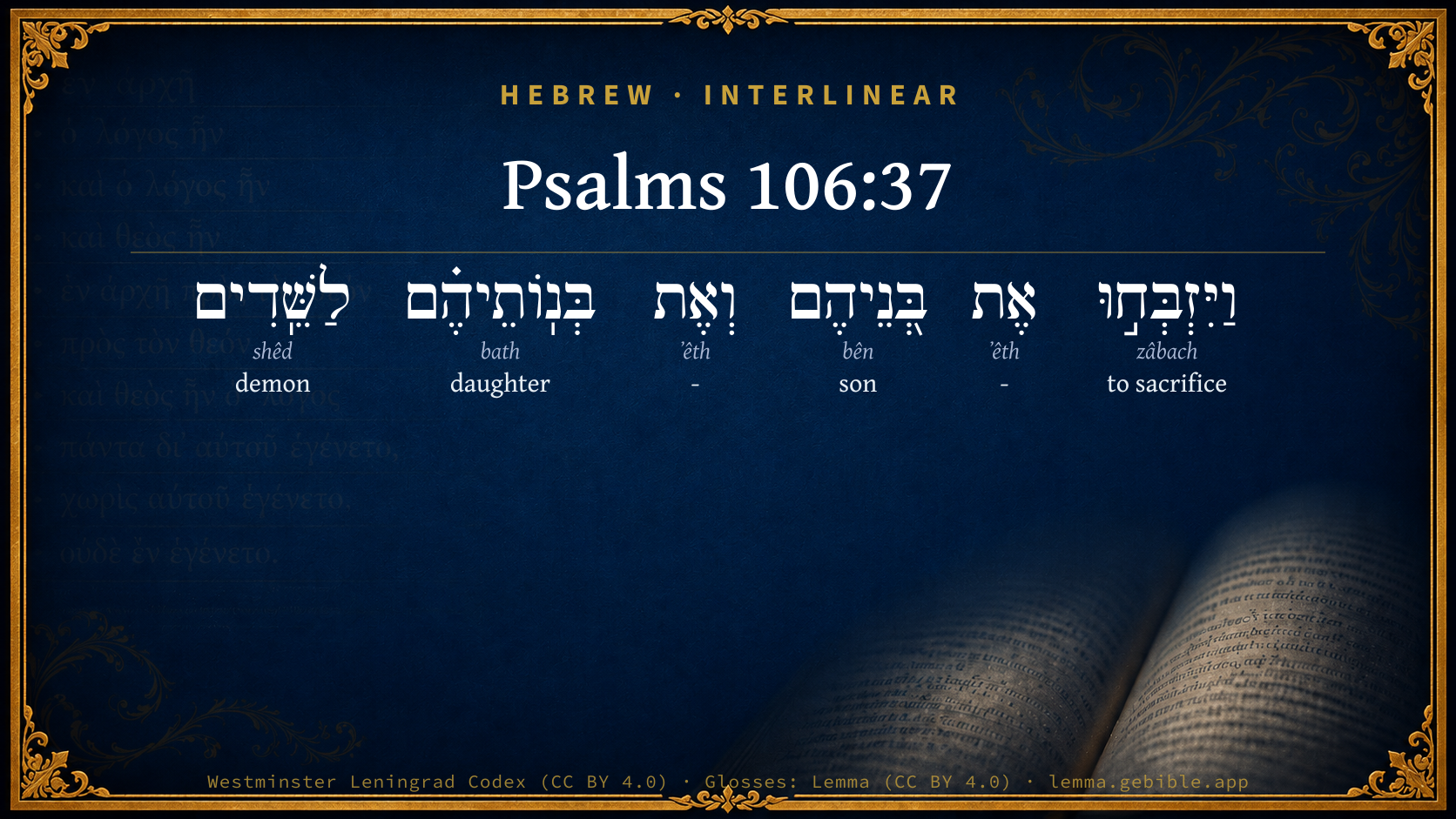
Hebrew (Westminster Leningrad Codex) Psalms 106:37 appears in the Hebrew Old Testament. The text above is from the Westminster Leningrad Codex. Each word links to its Strong’s number, a concise gloss, and parsing drawn from the Open Scriptures Hebrew Bible morphology. Click any word for its full Brown-Driver-Briggs (BDB) entry.
Download image
Cite this verse

Psalms 106:37 (World English Bible). Public Domain. Lemma interlinear Bible study tool, https://lemma.gebible.app/v/psalms/106/37.

Show BibTeX & RIS
BibTeX
RIS
English Translation
Yes, they sacrificed their sons and their daughters to demons.
World English Bible · Public Domain
Download a study sheet

One document with this verse’s original text, its word-by-word gloss line, the meaning frame, cross-references with their text, attributed commentary, and full source and license credits — printable, and it pastes into notes with its structure intact.

This verse Autodidact and up

Study sheet (.html) Plain text (.txt)

A passage Seminary Student

Up to 50 verses in one chapter. A passage sheet keeps up to 6 commentary sources and 12 cross-references per verse, in the order this page ranks them, and says so on the sheet whenever that leaves anything out. Ask for a single verse and you get the Autodidact verse sheet above.

Everything on this page stays free to read, with no account — the sheet is a download of what is already on screen, not access to it.

Want to remove ads? Support Godless Engineer
Compare translations 3

The same verse in 3 English versions, stacked beneath the original-language interlinear above. Click any original word for its lexicon entry.

Each is an independent rendering of the whole verse — the interlinear is not word-aligned to these translations.

Highlighted words mark where these versions differ — a whole-verse word diff, not a word-by-word alignment.

  • World English Bible Public Domain
    Yes, they sacrificed their sons and their daughters to demons.
  • King James Version Public Domain
    Yea, they sacrificed their sons and their daughters unto devils,
  • unfoldingWord Literal Text CC BY-SA 4.0
    And they sacrificed their sons and their daughters to demons.

unfoldingWord Literal Text — © unfoldingWord, licensed CC BY-SA 4.0. Word-aligned USFM3 via Door43 (git.door43.org/unfoldingWord/en_ult).

Versions to compare (up to 4)

3 of 4 selected

Show all 18 translations

Every available English version of this verse, each an independent rendering of the whole verse.

  • World English Bible Public Domain
    Yes, they sacrificed their sons and their daughters to demons.
  • Berean Standard Bible Public Domain
    They sacrificed their sons and their daughters to demons.
  • Majority Standard Bible Public Domain
    They sacrificed their sons and their daughters to demons.
  • King James Version Public Domain
    Yea, they sacrificed their sons and their daughters unto devils,
  • American Standard Version (1901) Public Domain
    Yea, they sacrificed their sons and their daughters unto demons,
  • Revised Version (1885) Public Domain
    Yea, they sacrificed their sons and their daughters unto demons,
  • Geneva Bible (1599) Public Domain
    Yea, they offered their sonnes, and their daughters vnto deuils,
  • Douay-Rheims (1899) Public Domain
    And they sacrificed their sons, and their daughters to devils.
  • Young's Literal Translation Public Domain
    And they sacrifice their sons And their daughters to destroyers,
  • Literal Standard Version CC BY-SA 4.0
    And they sacrifice their sons and their daughters to the demons,
  • Unlocked Literal Bible CC BY-SA 4.0
    They sacrificed their sons and their daughters to demons.
  • unfoldingWord Literal Text CC BY-SA 4.0
    And they sacrificed their sons and their daughters to demons.
  • Darby Bible Public Domain
    And they sacrificed their sons and their daughters unto demons,
  • World Messianic Bible Public Domain
    Yes, they sacrificed their sons and their daughters to demons.
  • Webster's Bible Public Domain
    Yes, they sacrificed their sons and their daughters to demons,
  • Free Bible Version CC BY-SA 4.0
    The even sacrificed their sons and daughters to these demons.
  • Bible in Basic English Public Domain
    They even made offerings of their sons and their daughters to evil spirits,
  • JPS Tanakh (1917) Public Domain
    Yea, they sacrificed their sons and their daughters unto demons,

Literal Standard Version (2020), Covenant Press — licensed CC BY-SA 4.0. Text via the HelloAO Bible API (eBible.org). Unlocked Literal Bible (unfoldingWord) — licensed CC BY-SA 4.0. Text via the HelloAO Bible API (eBible.org). unfoldingWord Literal Text — © unfoldingWord, licensed CC BY-SA 4.0. Word-aligned USFM3 via Door43 (git.door43.org/unfoldingWord/en_ult). Free Bible Version, Dr. Jonathan Gallagher — licensed CC BY-SA 4.0. Text via the HelloAO Bible API (eBible.org).

Word by word

More ways to search: Search by grammar → Find every occurrence → Compare this word →

Practice this passage: Drill this verse → Learn its vocabulary →

About this verse

These counts appear in no published source. They are computed here, from the morphology-tagged text and Lemma’s own curated glosses. What Lemma adds →

6
words
5
distinct lemmas
Wisdom
section

Notable vocabulary

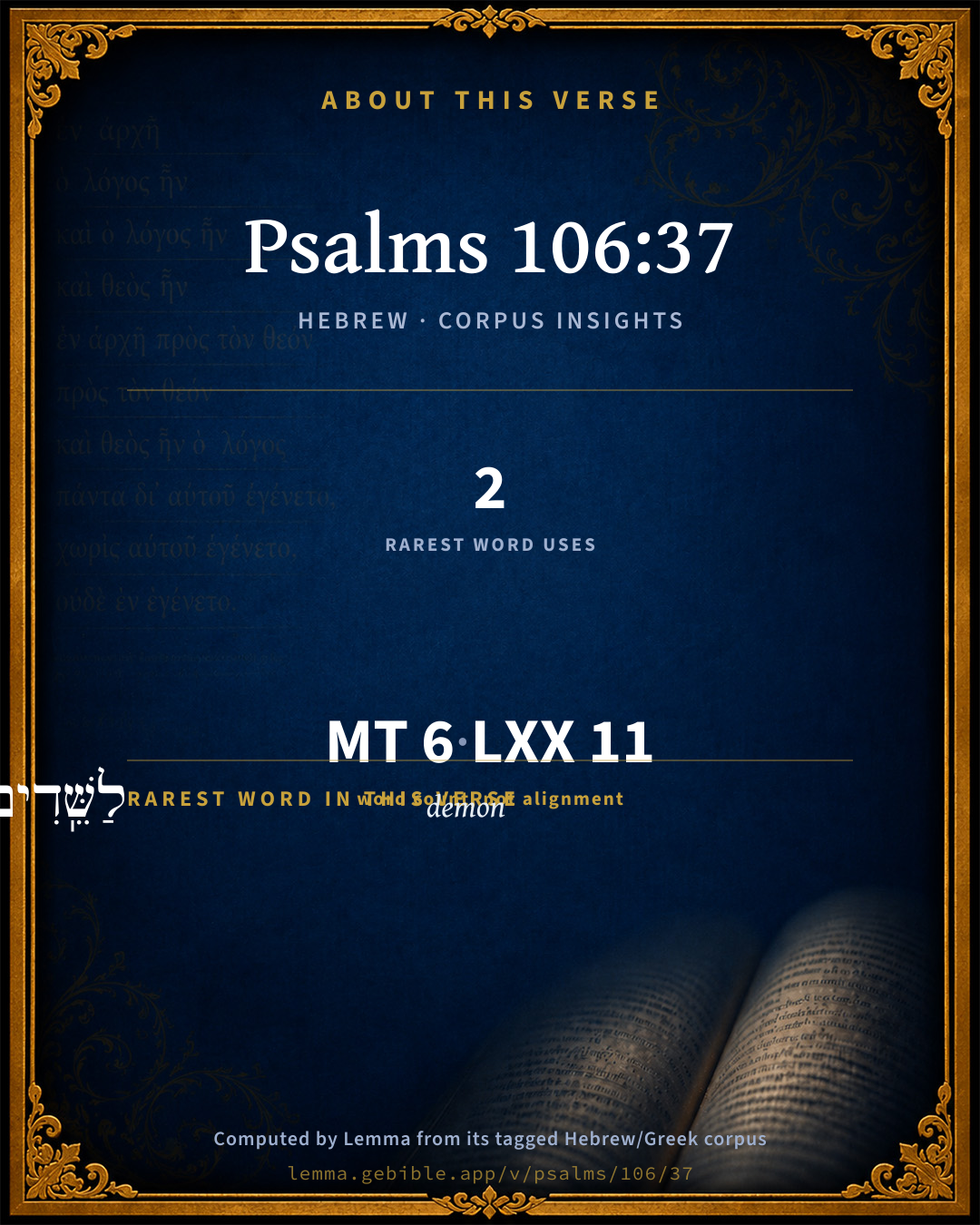
The rarest word here is לַשֵּֽׁדִים demon H7700 — appearing just 2 times in the whole Hebrew Bible.

Shared distinctive vocabulary

לַשֵּֽׁדִים demon H7700 occurs in 2 verses of the Hebrew Bible. Also found in:

Grammatical profile

  • 1 verb
  • 3 nouns
  • 2 particles

Verb forms

  • וַיִּזְבְּח֣וּ Qal · Sequential Imperfect

Hebrew & Septuagint length

In English translation the verse runs 10 words from the Hebrew and 10 from the Septuagint (LXX English) — the same length.

A rough comparison of the two English renderings, which tokenize alike — not a word-level alignment.

Word counts can differ between the Hebrew and the Greek without any difference in meaning — e.g. the Hebrew direct-object marker אֵת has no separate Greek word, and Greek often adds the article ὁ.

In the original languages it is 6 Hebrew tokens and 11 Greek tokens — but the two are counted differently (Hebrew bundles its prefixes and suffixes into one token; the Greek is in lemma form), so that isn’t a like-for-like length.

Cross-references

17

Topical passages linked to Psalms 106:37 in the Treasury of Scripture Knowledge — connected by theme and wording, ordered by reader-vote popularity; previews shown in the World English Bible.

  • 2 Kings 16:3 But he walked in the way of the kings of Israel, yes, and made his son to pass through the fire, according to the abominations of the nations, whom Yahweh cast out from before the children of Israel.
  • 2 Kings 17:17 They caused their sons and their daughters to pass through the fire, and used divination and enchantments, and sold themselves to do that which was evil in the sight of Yahweh, to provoke him to anger.
  • Deuteronomy 32:17 They sacrificed to demons, [which were] no God, To gods that they didn't know, To new [gods] that came up of late, Which your fathers didn't dread.
  • Jeremiah 7:31 They have built the high places of Topheth, which is in the valley of the son of Hinnom, to burn their sons and their daughters in the fire; which I didn't command, neither came it into my mind.
  • Deuteronomy 12:30–31 take heed to yourself that you not be ensnared to follow them, after that they are destroyed from before you; and that you not inquire after their gods, saying, How do these nations serve their gods? even so will I do likewise.
  • Ezekiel 23:37 For they have committed adultery, and blood is in their hands; and with their idols have they committed adultery; and they have also caused their sons, whom they bore to me, to pass through [the fire] to them to be devoured.
  • Leviticus 17:7 They shall no more sacrifice their sacrifices to the goat idols, after which they play the prostitute. This shall be a statute forever to them throughout their generations.'
  • Deuteronomy 18:10 There shall not be found with you anyone who makes his son or his daughter to pass through the fire, one who uses divination, one who practices sorcery, or an enchanter, or a sorcerer,
  • 2 Kings 21:6 He made his son to pass through the fire, and practiced sorcery, and used enchantments, and dealt with those who had familiar spirits, and with wizards: he worked much evil in the sight of Yahweh, to provoke him to anger.
  • Isaiah 57:5 you who inflame yourselves among the oaks, under every green tree; who kill the children in the valleys, under the clefts of the rocks?
  • Jeremiah 32:35 They built the high places of Baal, which are in the valley of the son of Hinnom, to cause their sons and their daughters to pass through [the fire] to Molech; which I didn't command them, neither did it come into my mind, that they should do this abomination, to cause Judah to sin.
  • Ezekiel 16:20–21 Moreover you have taken your sons and your daughters, whom you have borne to me, and these have you sacrificed to them to be devoured. Were your prostitution a small matter,
  • Ezekiel 20:26 and I polluted them in their own gifts, in that they caused to pass through [the fire] all that opens the womb, that I might make them desolate, to the end that they might know that I am Yahweh.
  • 1 Corinthians 10:20 But I say that the things which the Gentiles sacrifice, they sacrifice to demons, and not to God, and I don't desire that you would have communion with demons.
  • 2 Chronicles 11:15 and he appointed him priests for the high places, and for the male goats, and for the calves which he had made.
  • Ezekiel 23:47 The company shall stone them with stones, and dispatch them with their swords; they shall kill their sons and their daughters, and burn up their houses with fire.
  • Romans 9:20 But indeed, O man, who are you to reply against God? Will the thing formed ask him who formed it, "Why did you make me like this?"

Cross-references courtesy of OpenBible.info (CC BY 4.0).

Hebrew and Greek witnesses Masoretic Hebrew ↔ Greek Septuagint

The same verse in the two great witnesses to the Old Testament, shown verse-for-verse.

You’re reading Greek Psalm 105 (Hebrew Psalm 106). The Septuagint counts the superscription, so verse numbers can differ from the Hebrew — chapter-level alignment, not verse-by-verse. Numbering follows Rahlfs.

These are two independent witnesses, not word-aligned to each other, and the Septuagint is shown in lemma (dictionary) form.

Hebrew Psalms 106:37 Masoretic · Westminster Leningrad Codex

וַיִּזְבְּח֣וּ אֶת בְּ֭נֵיהֶם וְאֶת בְּנֽוֹתֵיהֶ֗ם לַשֵּֽׁדִים

Yes, they sacrificed their sons and their daughters to demons.

World English Bible · Public Domain

Greek LXX Greek Psalm 105:37 Septuagint · lemma form

καί θύω ὁ υἱός αὐτός καί ὁ θυγάτηρ αὐτός ὁ δαιμόνιον

And they sacrificed their sons and their daughters to devils,

LXX2012 (modern English Septuagint) · Public Domain

On this verse, J. A. Alexander on Psalms discusses the Septuagint’s reading. Read the note in Commentary ↓

Hebrew: Westminster Leningrad Codex (CC BY 4.0). Greek: Septuagint (public domain); English from LXX2012 (modern English Septuagint) (Public Domain). How the Septuagint differs from the Hebrew →

Commentary

Notes on Psalms 106:37 from classic Christian and Jewish commentators (each source and its license shown beneath its notes). The classic Christian expositions comment on the surrounding passage and are grouped to its opening verse, so a note may address several verses; the Jewish commentaries on the Tanakh (Rashi and others) are per-verse, so they appear only where the commentator wrote on this verse.

Lemma curates 59 commentaries, every one of them public domain or Creative Commons licensed, each selected and text-cleaned for this edition rather than reprinted as found. About our sources →

Trapp's Complete Commentary

John Trapp

Psa 106:37 Yea, they sacrificed their sons and their daughters unto devils,

Ver. 37. Yea, they sacrificed their sons, &c.] The devils are here called Shedim, destroyers (in opposition to Shaddai, the Almighty), and worthily; for they make it their work to waste and spoil people of their dearest children, as here, of their precious souls, with the blood whereof they do daily glut themselves.

John Trapp, A Commentary or Exposition upon All the Books of the Old and New Testament (1647–1656) — public domain. Text from a community e-Sword module.

J. A. Alexander on Psalms

Joseph Addison Alexander

37. (Psa 106:37) And they sacrificed their sons and their daughters to the demons. This last is the Septuagint version, and, if not directly sanctioned, is at least referred to in the New Testament (1Co 10:20). That the worship of idols was connected with that of fallen spirits, is neither improbable in itself nor contradictory to Scripture. According to the modern etymologists, the Hebrew word means lords or masters, and is a poetical equivalent to Baalim, which means the same thing. Compare Deu 32:17, and 1Co 8:5. The word translated devils in Lev 17:7 is entirely different.

Joseph Addison Alexander, The Psalms Translated and Explained (1850) — public domain. Text from a community e-Sword module.

Tyndale Open Study Notes

Tyndale Open Resources

106:37 Pagan gods were demons (see Deut 32:17).

Tyndale Open Study Notes — © Tyndale Open Resources, licensed CC BY-SA 4.0. Text via the HelloAO Bible API.

Geneva Bible (1599)

Geneva Bible translators

He showeth how monstrous a thing idolatry is, which can win us to things abhorring to nature, whereas God’s word cannot obtain most small things.

Geneva Bible (1599) marginal notes — public domain. Text via Bolls.life.

Adam Clarke's Commentary

Verse 37. They sacrificed their sons and their daughters unto devils.] See the places referred to in the margin (2Kg 16:3; Isa 57:5; Eze 16:20; Eze 20:26). That causing their sons and their daughters to pass through the fire to Moloch did not always mean they burnt them to death in the flames, is very probable. But all the heathen had human sacrifices; of this their history is full. Unto devils, לשדים lashshedim, to demons. Devil is never in Scripture used in the plural; there is but ONE devil, though there are MANY demons.

Adam Clarke's Commentary on the Bible (1810–1826) — public domain. Text from a community e-Sword/MySword module.

John Calvin's Commentaries

37. And they sacrificed The prophet here mentions one species of superstition which demonstrates the awful blindness of the people; their not hesitating to sacrifice their sons and daughters to devils. In applying such an abominable designation to the sin of the people, he means to exhibit it in more hateful colors. From this we learn that inconsiderate zeal is a flimsy pretext in favor of any act of devotion. For by how much the Jews were under the influence of burning zeal, by so much does the prophet convict them with being guilty of greater wickedness; because their madness carried them away to such a pitch of enthusiasm, that they did not spare even their own offspring. Were good intentions meritorious, as idolaters suppose, then indeed the laying aside of all natural affection in sacrificing their own children was a deed deserving of the highest praise. But when men act under the impulse of their own capricious humor, the more they occupy themselves with acts of external worship, the more do they increase their guilt. For what difference was there between Abraham and those persons of whom the prophet makes mention, but that the former, under the influence of faith, was ready to offer up his son, while the latter, carried away by the impulse of intemperate zeal, cast off all natural affection, and imbrued their hands in the blood of their own offspring.

John Calvin's Commentaries (1540-1563) — public domain. Text from the Calvin Translation Society English edition (1840s-50s) via the Christian Classics Ethereal Library (ccel.org). Calvin's coverage is partial (roughly two-thirds of the Bible); uncommented books and verses are honest gaps, never fabricated. The 19th-century editor's footnotes and remarks are omitted so the notes are faithfully Calvin's own voice.

Ellicott's Commentary for English Readers

(37) Devils.—Literally, lords, meaning, of course, the false deities. The word is, no doubt, chosen to represent the meaning of the heathen gods’ names Ba’alîm, Adonîm. For the same Hebrew word, see Deu_32:17 (Jdg_2:11, Baalim).

The Arabic equivalent of the Hebrew word became in Spain the Cid, and exists still in the Moorish sidi, i.e., “my lord.”

A Bible Commentary for English Readers, edited by Charles John Ellicott (1878–1897) — public domain. Text from a community e-Sword module.

The Cambridge Bible for Schools and Colleges

gen. ed. J. J. S. Perowne

37. unto devils) Better, demons (LXX Syr. Targ. Jer.). From Deu_32:17, “they sacrificed unto demons, which were no god,” the only other passage in the O.T. where the word shçdîm occurs. “In Assyrian, shîdu is the name of the divinities represented by the bull-colossi, so often found in the front of Assyrian palaces, who were regarded apparently not as gods properly so called, but as subordinate spirits, demi-gods or genii, invested with power for good or evil.” Etymologically the Heb. word may mean lords, but the precise idea attached to it cannot now be determined. Most probably it “denotes some kind of subordinate spirit or demi-god.” Driver on Deu_32:17.

The Cambridge Bible for Schools and Colleges (gen. ed. J. J. S. Perowne; Cambridge University Press, 1878–1918) — public domain. Text from a community e-Sword module.

John Gill's Exposition

And shed innocent blood,.... The blood of innocent persons; not that any of Adam's posterity, descending from him by ordinary generation, are strictly and properly innocent, or free from sin; self-righteous persons have thought themselves, touching the righteousness of the law, blameless; and some perfectionists have pretended to be free from sin, but are not such; they who are justified by the righteousness of Christ, and washed in his blood, are, so considered, all fair and without spot; are without fault before the throne, and unreproveable in the sight of God: but, considered in themselves, are not without sin; only the man Christ Jesus is perfectly holy and free from sin, being born of a virgin, under the overshadowing of the Holy Ghost; otherwise all descending from Adam sinned in him, are conceived in sin, and polluted with it; nor can a clean thing be brought out of an unclean, no, not one: though infants may be said to be innocent in comparison of adult persons, guilty of actual transgressions, who have lived in sin, and committed many gross iniquities; as also they may be so called as being undeserving of such barbarous and inhuman usage here mentioned.

Even the blood of their sons and of their daughters, whom they sacrificed unto the idols of Canaan; this was a further aggravation of their wickedness, that it was not only innocent blood, but the blood of their own children, they shed; their own flesh and blood, pieces of themselves; and their near alliance to them gave them no power over their lives; but, on the contrary, the nearer they were in blood to them, the greater and more horrid was their sin; and what still added to it was, that they were the idols of Canaan, of that people whom the Lord abhorred, and had drove out before them, and had given their land; to them they sacrificed them; so that here was a complication of wickedness in this affair.

And the land was polluted with blood; with innocent blood, the blood of their own children; with the sins of murder, as the Targum; which only can be cleansed with the blood of the murderers, Num 35:33, even the land which the Lord separated from all others for his people; in which his tabernacle was placed, and his worship set up, and therefore called the holy land, Zac 2:12.

John Gill's Exposition of the Whole Bible (1746–1763) — public domain (CC PDM 1.0). Text via the HelloAO Bible API.

Albert Barnes' Notes on the Bible

Yea, they sacrificed their sons and their daughters - See 2Ki 16:3; Eze 16:20; Eze 20:31; Isa 57:5.

Unto devils - Hebrew, שׁדים shêdiym. The Septuagint, δαιμονίοις daimoniois, “demons.” So the Vulgate, “daemoniis.” The word is used only in the plural number, and is applied to idols. It occurs only in this place, and in Deu 32:17. On the meaning of this, see the notes at 1Co 10:20.

Albert Barnes' Notes on the Bible (1834–1885) — public domain. Text from a community e-Sword/MySword module.

Matthew Poole's English Annotations

Of which heathenish practice, See Poole "Lev 18:21".

Unto devils; by which expression he informeth them that they did not worship God, as they pretended and sometimes designed, but devils in their idols; and that those spirits which were supposed by the heathen idolaters to inhabit in their images, and which they worshipped in them, were not gods or good spirits, as they imagined, but evil spirits or devils. See Lev 17:7; Deu 32:17; 1Co 10:20; Rev 9:20.

Matthew Poole's English Annotations on the Holy Bible (1683–1685) — public domain. Text from a community e-Sword/MySword module.

The Treasury of David

Charles H. Spurgeon

Ver. 37. Yea, they sacrificed their sons and their daughters unto devils. This was being snared indeed; they were spell bound by the cruel superstition, and were carried so far as even to become murderers of their own children, in honour of the most detestable deities, which were rather devils than gods. "And shed innocent blood." The poor little ones whom they put to death in sacrifice had not been partakers of their sin, and God looked with the utmost indignation upon the murder of the innocent. "Even the blood of their sons and of their daughters, whom they sacrificed unto the idols of Canaan." Who knows how far evil will go? It drove men to be unnatural as well as ungodly. Had they but thought for a moment, they must have seen that a deity who could be pleased with the blood of babes spilt by their own sires could not be a deity at all, but must be a demon, worthy to be detested and not adored.

How could they prefer such service to that of Jehovah? Did he tear their babes from their bosoms and smile at their death throes? Men will sooner wear the iron yoke of Satan than carry the pleasant burden of the Lord; does not this prove to a demonstration the deep depravity of their hearts? If man be not totally depraved, what worse would he do if he were? Does not this verse describe the ne plus ultra of iniquity?

And the land was polluted with blood. The promised land, the holy land, which was the glory of all lands, for God was there, was defiled with the reeking gore of innocent babes, and by the blood red hands of their parents, who slew them in order to pay homage to devils. Alas! alas! What vexation was this to the spirit of the Lord.

Ver. 37. Yea, they sacrificed their sons and their daughters unto devils. We need no better argument to discover the nature of these gods than this very service in my text accepted of them: for both by the record of sacred writ, and relation of heathen authors and other writers, we know that nothing was so usually commanded nor gratefully accepted by these heathenish gods, as was the shedding of man's blood, and the sacrificing of men, maids, and children unto them, as appears by the usual practice of men in former times. From the testimonies of Scripture, I give only the example of the king of Moab, mentioned in 2Ki 3:27, where it is said, that, being in some straits, "He took his eldest son that should have reigned in his stead, and offered him for a burnt offering upon the wall."

The stories likewise of the heathen are full of like examples. When the oracle of Apollo was asked by the Athenians how they might make amends for their killing of Androgens, it willed them to send yearly to king Minos seven bodies of each sex to appease the wrath of god. Now this kind of yearly sacrifice continued still in Athens in the time of Socrates. Thus the Carthaginians, being vanquished by Agathocles, king of Sicily, and supposing their god to be displeased, to appease him did sacrifice two hundred noble men's children. This custom was ancient even before the Trojan war, for then was Iphigenia sacrificed. Thus we read that the Latins sacrificed the tenth of their children to Jupiter; that men and children were usually sacrificed to Saturn in many places in Candia, Rhodomene, Phoenice, Africa, and those commonly the choice and dearest of their children and most nobly descended. The manner of sacrificing their children to Saturn, Diodorus relates to be this: bringing their children to the statue or image of Saturn, which was of huge greatness, they gave them into his hands, which were made so hollow and winding that the children offered slipped and fell down through into a cave and furnace of fire. These sacrifices continued in use till the birth and death of our Saviour Christ, who came to destroy the work of the devil; for such sacrifices were first forbidden by Augustus Caesar; after more generally by Tiberius (in whose reign our Saviour suffered) who, as Tertullian writes, so straitly forbade them, that he crucified the priests who offered them: howbeit, even in Tertullian's time, and after in Eusebius' and Lactantius' times, such sacrifices were offered (but closely) to Jupiter Latialis.

Who can now doubt, seeing such exceeding superstitious cruelty, but that the gods commanding such sacrifices were very devils and enemies to mankind? God commands no such thing, but forbids it, and threatens plagues to his people, because they had forsaken him and "built also the high places of Baal, to burn their sons with fire for burnt offerings unto Baal, which I commanded not, not spake it, neither came it into my mind" (Jer 19:5). Most infallibly then we may conclude that none but Satan, that arch devil, with his angels, were the commanders of such service, for this agrees right well with his nature, who hath been a murderer from the beginning. Robert Jenison, in "The Height of Israel's Heathenish Idolatrie, in Sacrificing their Children to the Devil", 1621.

Ver. 37. Yea, they sacrificed their sons, etc. From this we learn that inconsiderate zeal is a flimsy pretext in favour of any act of devotion. For by how much the Jews were under the influence of burning zeal, by so much does the prophet convict them of being guilty of greater wickedness; because their madness carried them away to such a pitch of enthusiasm, that they did not spare even their own offspring. Were good intentions meritorious, as idolaters suppose, then indeed the laying aside of all natural affection in sacrificing their own children was a deed deserving the highest praise. But when men act under the impulse of their own capricious humour, the more they occupy themselves with acts of external worship, the more do they increase their guilt. For what difference was there between Abraham and those persons of whom the prophet makes mention, but that the former, under the influence of faith was ready to offer up his son, while the latter, carried away by the impulse of intemperate zeal, cast off all natural affection, and imbrued their hands in the blood of their own offspring. John Calvin.

Ver. 37. Devils, Mydv, Shedim. It appears that children were sacrificed to the deities thus named; that they were considered to be of an angry nature, and inimical to the human race, and thus the object of the homage rendered to them was to avert calamities. The name Mydv may signify either lord or master, or anything that is black, it being derived from an Arabic Ain Vav verb viz., to be black, or to be master. John Jahn, in "Biblical Antiquities."

Ver. 37-38. We stand astonished, doubtless, at this horrid, barbarous, and unnatural impiety, of offering children by fire to a Moloch: but how little is it considered, that children, brought up in the ways of ignorance, error, vanity, folly, and vice, are more effectually sacrificed to the great adversary of man kind! George Horne.

Ver. 37. Moloch worship in modern times. Children sacrificed to fashion, wealth, and loveless marriage among the higher classes. Bad example, drinking customs, etc., among the poorer sort. A needful subject.

Psalms 106:38*

see Exposition of Verse 37

see Notes of Verse 37

see Hints of Verse 37

Psalms 106:39*

Charles H. Spurgeon's The Treasury of David (1869–1885) — public domain. Psalms only. Text from a community e-Sword/MySword module.

Whedon's Commentary on the Bible

Daniel D. Whedon

37. They sacrificed unto devils—Literally, unto lords, for thus the heathen regarded their chief divinities, as Baal. But these powerful ones, like Moloch, were destroyers, as the kindred form denotes, Psa_91:6. The Jews looked upon them as demons. So the Septuagint, δαιμονιοις, and hence devils, in our English Version. Deu_32:17.Compare 2Ki_16:3; 2 Corinthians 10:20

Daniel D. Whedon (gen. ed.), Commentary on the Old and New Testaments (1874–1909) — public domain. Text from a community e-Sword module.

The Pulpit Commentary

Yea, they sacrificed their sons and their daughters unto devils. The Moloch sacrifices of children by their parents are evidently intended. (comp. Lev_18:21 Deu_18:10 2Ki_3:27 Jer_7:31 Eze_23:37, etc.) (For the identification of the false gods of the heathen with "devils," comp. Deu_32:17 2Ch_11:15 1Co_10:20, 1Co_10:21) It is argued by some that the use of the word "devils," or "demons," here does not imply that the objects of the worship were evil spirits. But it is difficult to see what else can be meant.

The Pulpit Commentary (1880–1919), ed. H.D.M. Spence-Jones & Joseph S. Exell — public domain. Text from a community e-Sword module.

John Wesley's Explanatory Notes

Devils - They did not worship God as they pretended, but devils in their idols; for those spirits, which were supposed by the Heathen idolaters to inhabit in their images, were not good spirits, but evil spirits, or devils.

John Wesley, Explanatory Notes Upon the Whole Bible (1754–1765) — public domain. Text via the GEBible commentary corpus.

unfoldingWord translationNotes

Door43 World Missions Community

They shed innocent blood, the blood of their sons and of their daughters

The phrase "shedding blood" is a descriptive euphemism used for "killing." AT: "They shed innocent blood when they killed their sons and daughters" (See: Euphemism)

They were defiled by their deeds

This can be stated in active form. AT: "Their deeds defiled them" (See: Active or Passive)

in their actions they were like prostitutes

Here David compares their unfaithfulness to Yahweh to the unfaithfulness of a prostitute. AT: "they were as unfaithful to Yahweh as prostitutes" (See: Assumed Knowledge and Implicit Information)

translationWords

sacrifice

demon

innocent

blood

Canaan

desecrate

defile

prostitute

unfoldingWord translationNotes — © Distant Shores Media and the Door43 World Missions Community, licensed CC BY-SA 4.0. Source: git.door43.org/Door43/en_tn.

Lesson kit

Teaching starters — assembled from the data on this page, not authored interpretation. Every prompt links to the verse data it draws on. Edit before teaching.

Psalms, in the Wisdom, opens this verse with 6 words (5 distinct Hebrew lemmas). Its most distinctive word is shêd (“demon”). A historical commentator’s framing appears above. Read the whole chapter for the surrounding context.

Discussion questions

  1. What does “demon” (shêd) contribute to the verse as a whole?
  2. How does Deuteronomy 32:17, which shares the word «demon», read alongside this verse?
  3. The translations on this page render this verse differently — a whole-verse word diff, not a word-by-word alignment. What might account for the different wordings?
  4. «וַיִּזְבְּח֣וּ» is a Qal Sequential Imperfect verb. How does that grammatical form shape the action described?
  5. Compare how Trapp's Complete Commentary and J. A. Alexander on Psalms read this verse. Where do they agree or differ?

Things to notice

Reading settings

Reading text

Shown beneath each verse's original-language words.

Old Testament
Old Testament edition

Read the OT as the Masoretic Hebrew (MT) or the Greek Septuagint (LXX).

English shown for the Greek Septuagint (in the Hebrew ↔ Greek comparison).

Comparing translations? Open the Compare panel on any verse page to stack up to four side by side.