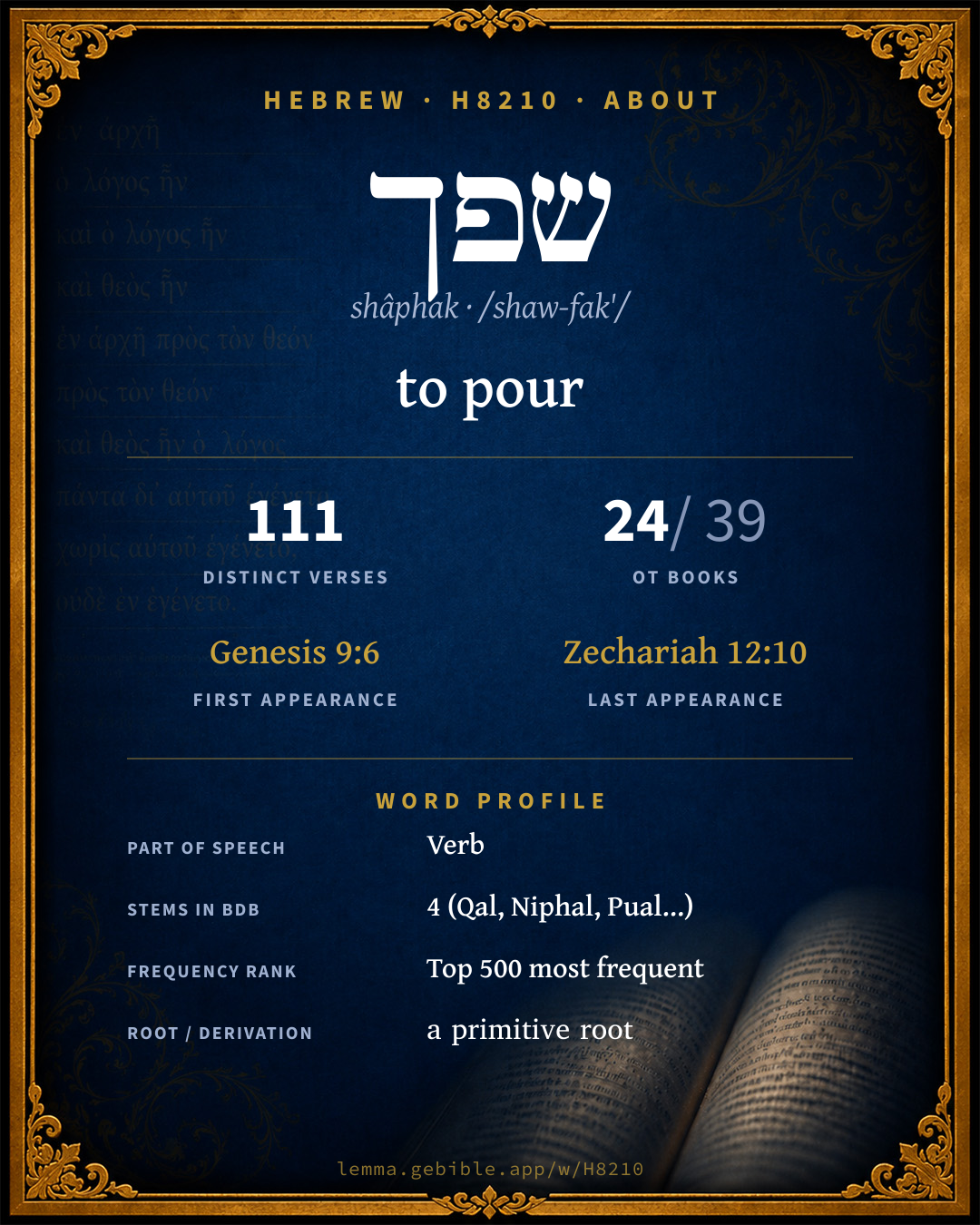
שָׁפַךְ
to pour
also: pour out, spill fuller range ↓
Full lexicon entry — Brown-Driver-Briggs (BDB)
From Brown-Driver-Briggs (BDB)
Where this word appears
See every Qal verb in the Hebrew Bible →
Grammar key — what these labels mean
Part of speech
- Verb
- An action or state-of-being word.
Stem
- Qal
- The basic, simple active stem — the plain form of the verb (“he wrote”). Here: ‘lit.’
- Niphal
- Usually the simple passive or reflexive of the Qal (“he was written”).
- Qal Passive
- An archaic passive of the Qal, preserved in a few forms.
- Hithpael
- The reflexive or reciprocal stem (the subject acts on itself).
- Pual
- The passive counterpart of the Piel.
Form
- Infinitive Construct
- A bound verbal noun, frequently with prepositions (“to write / in writing”).
- Imperfect
- An incomplete, ongoing, or future action (“he will / would write”).
- Perfect
- A completed action or state — Hebrew marks aspect (completeness) more than strict tense (“he wrote”).
- Sequential Perfect
- A perfect with prefixed waw continuing a preceding imperfect or command (waw-consecutive perfect).
- Imperative
- A direct command (“write!”).
- Sequential Imperfect
- An imperfect with prefixed waw — the standard past-narrative form (waw-consecutive imperfect).
- Jussive
- A third- or second-person volitional form expressing wish or command (“let him write”).
- Participle Active
- A verbal adjective expressing ongoing or characteristic action (“writing / one who writes”).
- Participle Passive
- A verbal adjective expressing action received (“written”).
- Cohortative
- A first-person volitional form expressing wish or resolve (“let me / let us write”).
State
- Absolute
- The independent form of a noun, not bound to a following word.
- Construct
- A noun bound to a following noun in a possessive / “of” relationship (the construct chain).
Person
- 3rd Person
- The one spoken about (“he / she / it / they”).
- 1st Person
- The speaker (“I / we”).
- 2nd Person
- The one addressed (“you”).
Gender
- Masculine
- Grammatically masculine.
- Common
- Either gender — not distinguished for this form.
- Feminine
- Grammatically feminine.
Number
- Singular
- One.
- Plural
- More than one (in Hebrew, generally three or more).
31 verses where H8210 appears in the Qal stem in the Book of Ezekiel. Filtered view — show all forms. Click any verse to open its interlinear word-by-word view. Verse text shown in the World English Bible for context — . Each verse’s Hebrew form is shown with its reference; the English is not keyword-highlighted, since the data carries no word-level English alignment. Use “Compare translations” on any verse to read it across multiple English versions. This concordance covers the Hebrew Bible; Septuagint (Greek Old Testament) occurrences are not indexed here.
Ezekiel
- Ezekiel 4:2 וְ/שָׁפַכְתָּ֥ conj + Qal wpf 2ms and lay siege against it, and build forts against it, and cast up a mound against it; set camps also against it, and plant battering rams against it round about.
- Ezekiel 7:8 אֶשְׁפּ֤וֹךְ Qal impf 1cs Now will I shortly pour out my wrath on you, and accomplish my anger against you, and will judge you according to your ways; and I will bring on you all your abominations.
- Ezekiel 9:8 בְּ/שָׁפְכְּ/ךָ֥ prep + Qal inf.cs + sfx pers 2ms It happened, while they were smiting, and I was left, that I fell on my face, and cried, and said, Ah Lord Yahweh! will you destroy all the residue of Israel in your pouring out of your wrath on Jerusalem?
- Ezekiel 14:19 וְ/שָׁפַכְתִּ֨י conj + Qal wpf 1cs Or if I send a pestilence into that land, and pour out my wrath on it in blood, to cut off from it man and animal;
- Ezekiel 16:15 וַ/תִּשְׁפְּכִ֧י conj + Qal wimpf 2fs But you did trust in your beauty, and played the prostitute because of your renown, and poured out your prostitution on everyone who passed by; his it was.
- Ezekiel 16:38 וְ/שֹׁפְכֹ֖ת conj + Qal ptcp.act fp cs I will judge you, as women who break wedlock and shed blood are judged; and I will bring on you the blood of wrath and jealousy.
- Ezekiel 17:17 בִּ/שְׁפֹּ֥ךְ prep + Qal inf.cs Neither shall Pharaoh with his mighty army and great company help him in the war, when they cast up mounds and build forts, to cut off many persons.
- Ezekiel 18:10 שֹׁפֵ֣ךְ Qal ptcp.act ms cs If he fathers a son who is a robber, a shedder of blood, and who does any one of these things,
- Ezekiel 20:8 לִ/שְׁפֹּ֧ךְ prep + Qal inf.cs But they rebelled against me, and would not listen to me; they did not every man cast away the abominations of their eyes, neither did they forsake the idols of Egypt. Then I said I would pour out my wrath on them, to accomplish my anger against them in the midst of the land of Egypt.
- Ezekiel 20:13 לִ/שְׁפֹּ֨ךְ prep + Qal inf.cs But the house of Israel rebelled against me in the wilderness: they didn't walk in my statutes, and they rejected my ordinances, which if a man keep, he shall live in them; and my Sabbaths they greatly profaned. Then I said I would pour out my wrath on them in the wilderness, to consume them.
- Ezekiel 20:21 לִ/שְׁפֹּ֧ךְ prep + Qal inf.cs But the children rebelled against me; they didn't walk in my statutes, neither kept my ordinances to do them, which if a man do, he shall live in them; they profaned my Sabbaths. Then I said I would pour out my wrath on them, to accomplish my anger against them in the wilderness.
- Ezekiel 20:33 שְׁפוּכָ֖ה Qal ptcp.pass fs As I live, says the Lord Yahweh, surely with a mighty hand, and with an outstretched arm, and with wrath poured out, will I be king over you:
- Ezekiel 20:34 שְׁפוּכָֽה Qal ptcp.pass fs and I will bring you out from the peoples, and will gather you out of the countries in which you are scattered, with a mighty hand, and with an outstretched arm, and with wrath poured out;
- Ezekiel 21:22 לִ/שְׁפֹּ֥ךְ prep + Qal inf.cs In his right hand was the divination [for] Jerusalem, to set battering rams, to open the mouth in the slaughter, to lift up the voice with shouting, to set battering rams against the gates, to cast up mounds, to build forts.
- Ezekiel 21:31 וְ/שָׁפַכְתִּ֤י conj + Qal wpf 1cs I will pour out my indignation on you; I will blow on you with the fire of my wrath; and I will deliver you into the hand of brutish men, skillful to destroy.
- Ezekiel 22:3 שֹׁפֶ֥כֶת Qal ptcp.act fs You shall say, Thus says the Lord Yahweh: A city that sheds blood in the midst of her, that her time may come, and that makes idols against herself to defile her!
- Ezekiel 22:4 שָׁפַ֜כְתְּ Qal pf 2fs You have become guilty in your blood that you have shed, and are defiled in your idols which you have made; and you have caused your days to draw near, and are come even to your years: therefore have I made you a reproach to the nations, and a mocking to all the countries.
- Ezekiel 22:6 שְׁפָךְ Qal inf.cs Behold, the princes of Israel, everyone according to his power, have been in you to shed blood.
- Ezekiel 22:9 שְׁפָךְ Qal inf.cs Slanderous men have been in you to shed blood; and in you they have eaten on the mountains: in the midst of you they have committed lewdness.
- Ezekiel 22:12 שְׁפָךְ Qal inf.cs In you have they taken bribes to shed blood; you have taken interest and increase, and you have greedily gained of your neighbors by oppression, and have forgotten me, says the Lord Yahweh.
- Ezekiel 22:22 שָׁפַ֥כְתִּי Qal pf 1cs As silver is melted in the midst of the furnace, so shall you be melted in the midst of it; and you shall know that I, Yahweh, have poured out my wrath on you.
- Ezekiel 22:27 לִ/שְׁפָּךְ prep + Qal inf.cs Her princes in the midst of it are like wolves ravening the prey, to shed blood, [and] to destroy souls, that they may get dishonest gain.
- Ezekiel 22:31 וָ/אֶשְׁפֹּ֤ךְ conj + Qal wimpf 1cs Therefore have I poured out my indignation on them; I have consumed them with the fire of my wrath: their own way have I brought on their heads, says the Lord Yahweh.
- Ezekiel 23:8 וַ/יִּשְׁפְּכ֥וּ conj + Qal wimpf 3mp Neither has she left her prostitution since [the days of] Egypt; for in her youth they lay with her, and they handled the bosom of her virginity; and they poured out their prostitution on her.
- Ezekiel 23:45 שֹׁפְכ֣וֹת Qal ptcp.act fp cs Righteous men, they shall judge them with the judgment of adulteresses, and with the judgment of women who shed blood; because they are adulteresses, and blood is in their hands.
- Ezekiel 24:7 שְׁפָכַ֨תְ/הוּ֙ Qal pf 3fs + sfx pers 3ms For her blood is in the midst of her; she set it on the bare rock; she didn't pour it on the ground, to cover it with dust.
- Ezekiel 26:8 וְ/שָׁפַ֤ךְ conj + Qal wpf 3ms He shall kill with the sword your daughters in the field; and he shall make forts against you, and cast up a mound against you, and raise up the buckler against you.
- Ezekiel 30:15 וְ/שָׁפַכְתִּ֣י conj + Qal wpf 1cs I will pour my wrath on Sin, the stronghold of Egypt; and I will cut off the multitude of No.
- Ezekiel 33:25 תִּשְׁפֹּ֑כוּ Qal impf 2mp Therefore tell them, Thus says the Lord Yahweh: You eat with the blood, and lift up your eyes to your idols, and shed blood: and shall you possess the land?
- Ezekiel 36:18 וָ/אֶשְׁפֹּ֤ךְ שָׁפְכ֣וּ conj + Qal wimpf 1cs Qal pf 3cp Therefore I poured out my wrath on them for the blood which they had poured out on the land, and because they had defiled it with their idols;
- Ezekiel 39:29 שָׁפַ֤כְתִּי Qal pf 1cs neither will I hide my face any more from them; for I have poured out my Spirit on the house of Israel, says the Lord Yahweh.
About this entry
At a glance — auto-summarized from this page’s data, not written by a person. Every figure links to its source below. This summary describes the numbers; it doesn’t interpret them.
The Hebrew verb שפך centers on the idea of “to pour.” The verb spans 4 stems, from Qal to Niphal. Spanning 111 verses in 24 books, it ranks among the common words of the Hebrew Bible. Ezekiel dominates its distribution — 32 of 111 verses. Debuting at Genesis 9:6, it then recurs through the corpus. For the data behind this summary, explore the sense tree and the renderings breakdown below.
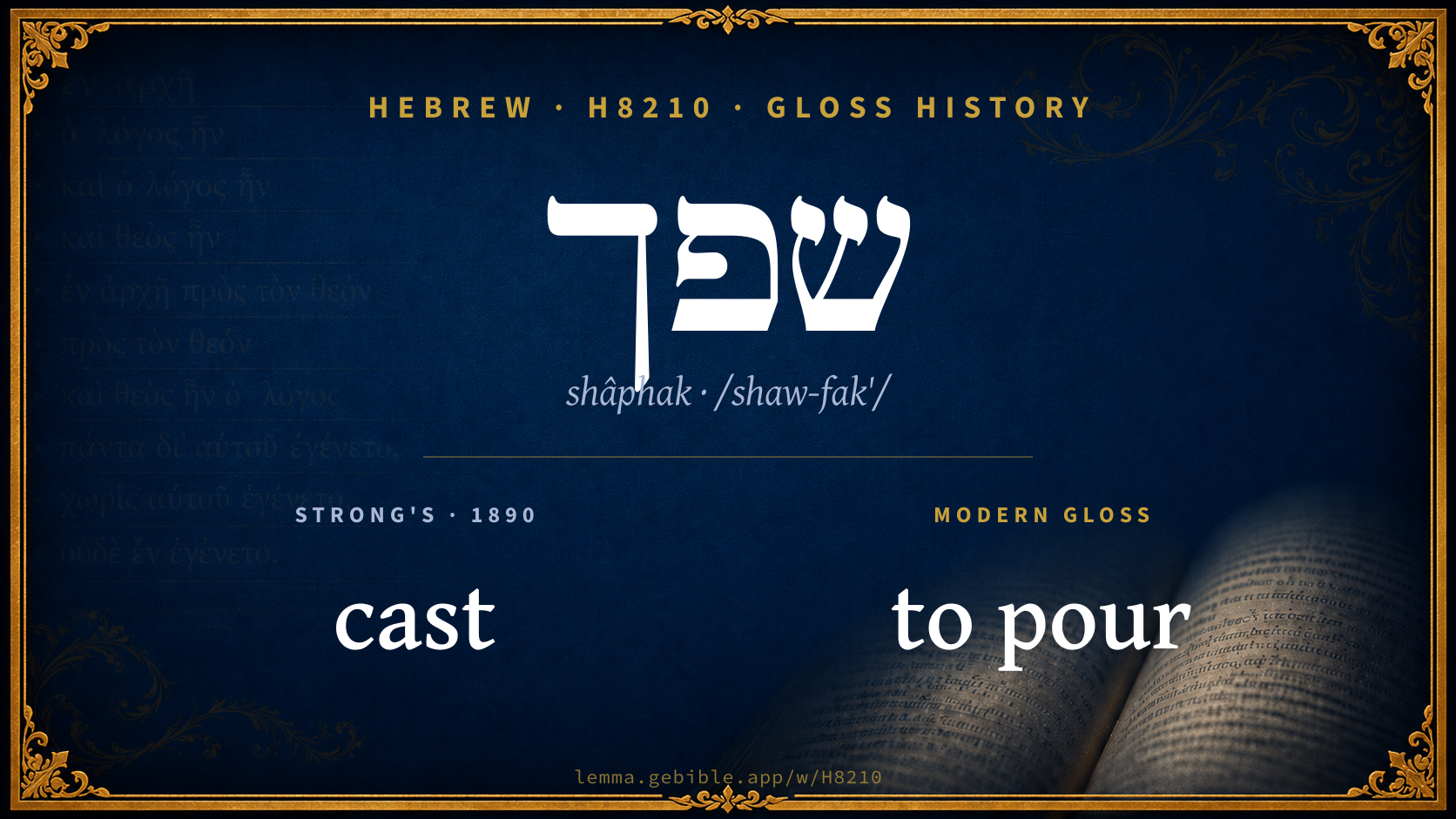
Gloss history
Strong's 1890 vs modern scholarship
About this word
Strong's H8210 catalogs a Hebrew word from the Hebrew Old Testament.
These counts are not copied from any lexicon or concordance. They are computed here, from the morphology-tagged Hebrew Old Testament. What Lemma adds →
- 111
- distinct verses
- The word appears in 111 distinct verses.
- 24 / 39
- OT books
- The word appears in 24 of 39 Old Testament books.
- #372
- by frequency
- Top 500 most frequent Hebrew words (rank 372 of 8,640 Hebrew words by occurrence).
View all 111 occurrences in the concordance →
By section of the Old Testament
By traditional corpus
Conventional, traditional groupings — biblical authorship is debated, so this is a traditional corpus grouping, not an authorship claim. Each share is this word’s portion of its verses in that division of the Hebrew canon. Each figure is a share of the word’s 111 distinct verses.
- Prophets (Nevi'im) 65 verses · 59%
- Writings (Ketuvim) 27 verses · 24%
- Torah (Pentateuch) 19 verses · 17%
How translations render this word
Counts come from each version’s own published word-to-Strong’s tagging or interlinear alignment — an approximate guide to how each version renders this word, not a word-level alignment the data otherwise carries. Because each total is that version’s own tagged count, the per-version totals vary from one another and need not match the appearance or distinct-verse counts above. These counts may also differ from a printed concordance because Lemma counts each distinctly tagged rendering and does not collapse phrase taggings into a single head-word total. This is a fixed set of word-tagged versions (KJV, ASV, BSB, ULT) and does not change with the reading translation you choose elsewhere. Each version’s license is shown beside its name below (and on Sources).
BDB lists this Strong’s number as 2 distinct words (homographs). Each count above pools all of them and is not split by sense — see the Senses section below. A low-frequency rendering may belong to a different one of those words, not the primary meaning.
- King James Version†: Shed 17×, Pour out 8×, Cast 4×
- American Standard Version†: Shed 11×, Pour out 9×, Cast 4×
- Berean Standard Bible†: Pour out 13×, Shed 12×, I will pour out 9×
- unfoldingWord Literal Text†: Pour out 17×, I will pour out 9×, Poured out 8×
King James Version Public Domain
Renders H8210 across 115† tagged occurrences — most commonly:
Plus other, less common renderings. Plus 52 renderings that appear only once — usually multi-word phrases or single function words the recovered tagging swept in, not distinct renderings.
American Standard Version Public Domain
Renders H8210 across 112† tagged occurrences — most commonly:
Plus other, less common renderings. Plus 53 renderings that appear only once — usually multi-word phrases or single function words the recovered tagging swept in, not distinct renderings.
Berean Standard Bible Public Domain
Renders H8210 across 112† tagged occurrences — most commonly:
Plus other, less common renderings. Plus 38 renderings that appear only once — usually multi-word phrases or single function words the recovered tagging swept in, not distinct renderings. Not rendered by a distinct English word in 3 further occurrences.
unfoldingWord Literal Text CC BY-SA 4.0
Renders H8210 across 129† tagged occurrences — most commonly:
Plus other, less common renderings. Plus 51 renderings that appear only once — usually multi-word phrases or single function words the recovered tagging swept in, not distinct renderings.
10 senses and sub-senses in the full BDB
Hebrew verbs can shift meaning by stem (binyan): Qal is the basic action, Niphal is often passive or reflexive, Piel often intensifies or makes it factitive, and Hiphil is typically causative. The senses below are grouped under the stem BDB assigns to each. This entry also uses Pual (the passive of Piel) and Hithpael (reflexive or reciprocal).
What do BDB’s symbols mean?
BDB uses these scholarly abbreviations:
| Symbol | Meaning |
|---|---|
| 𝔊 | the Septuagint (the ancient Greek translation, LXX) |
| 𝔙 | the Vulgate (the Latin translation) |
| 𝔖 | the Syriac version (the Peshitta) |
| 𝔗 | the Targum (the Aramaic translation) |
| ψ | the Psalms |
| √ | root (the underlying root or stem) |
| ‖ | parallel passage (a synonymous or contrasted parallel) |
| † | the dagger: every passage where the word occurs is cited |
The 10 senses and sub-senses the full Brown-Driver-Briggs lexicon distinguishes for this word, in lexicon order (not ranked by frequency), with BDB’s own verbatim wording and sub-sense lettering. Shown in Hebrew script with BDB’s own scholarly abbreviations. The condensed entry is in the Lexicon Entry tab. See also the Forms in the corpus table below.
שפך I [m.] doubtful word
שפך II pour out, pour (NH id.
Qal
- Pf. 3 ms. שׁ׳ 1 K 2:31 +; 3 fs. sf. שְׁפָכַ֫תְהוּ Ez 24:7, etc.; Impf. 3 ms. יִשְׁפֹּךְ 2 K 19:32 +; 2 ms. sf. 3 ms. תִּשְׁפְּכֶנּוּ Dt 12:16 +, etc.; Imv. ms. שְׁפוֹךְ Ju 6:20 +, שְׁפָךְ־ ψ 69:25; fs. שִׁפְכִי La 2:19, etc.; Inf. cstr. שְׁפָךְ־ 1 K 18:28 +, לִשְׁפֹּךְ Is 59:7 +, etc.; Pt. act. שֹׁפֵךְ Gn 9:6 +, f. שֹׁפֶ֫כֶת Ez 22:3, etc.; pass. שָׁפוּךְ ψ 79:10, שְׁפוּכָה Ez 20:33, 34;— e.g. 1 Kings 2:31
- 1. lit.:
- a. pour out, pour water Ex 4:9 (J; acc. loc.), 1 S 7:6 (+ לִפְנֵי י׳, unique, symb. of contrition), עַל־פְּנֵי הָאָרֶץ (subj. י׳) Am 5:8; 9:6; blood like water (to flow away and be absorbed), עַל־הָאָרֶץ Dt 12:16, 24; 15:23, cf. Lv 17:13 (H) Ez 24:7; also + אֶל loc. Ex 29:12; Lv 4:7, 18, 25, 30, 34; + עַל pers. reflex. 1 K 18:28; pour out broth Ju 6:20, libation (נֶסֶךְ, to (ל) false gods) Is 57:6; dust Lv 14:41 (P; אֶל loc.); c. acc. סֹלְלָה mound (in siege), = make by pouring (earth, orig. from baskets, see especially Assyrian šapâku DlWB 679 b JenKosmol. 41), + עַל־ of city 2 K 19:32 = Is 37:33; Je 6:6; Ez 4:2; 26:8, אֶל־ 2 S 20:15; abs. Ez 17:17; 21:27; Dn 11:15; וַיִּשׁ׳ מֵעָיו אַרְצָה 2 S 20:10 (by a sword-thrust in the belly), cf. יִשׁ׳ לָאָרֶץ מְרֵרָתִי Jb 16:13 (metaph., י׳ subj.). e.g. Exodus 4:9
- b. techn., acc.; דָּם shed blood Gn 37:22 (E) 9:6 (P) 1 S 25:31; Ez 22:4 + 9 times Ez, + 15 times (pass. ψ 79:10) + Ez 36:18 (c. עַל־הָאָרֶץ), 1 Ch 22:8 (c. אַ֫רְצָה); acc. דָּמִים †1 K 2:31; 1 Ch 28:3 ψ 79:3 (כַּמַּיִם). e.g. Genesis 37:22
- 2. fig.:
- a. י׳ subj., pour out anger, etc.: עֲלֵיהֶם אֶשׁ׳ כַּמַּיִם עֶבְרָתִי Ho 5:10; שׁ׳ חֲמָתִי עַל Ez 14:19 + 8 times Ez, Je 10:25; Is 42:25 ψ 79:6 (אֶל et עַל); acc. ח׳ om. Je 6:11; c. ב loc. La 2:4; ח׳ שְׁפוּכָה Ez 20:33, 34; acc. חֲרוֹן אַפּוֹ La 4:11; acc. זַעַם (עַל pers.) Ez 21:36 + 3 times; acc. בּוּזּ contempt, עַל pers., Jb 12:21 = ψ 107:40; pour their own wickedness עֲלֵיהֶם Je 14:16 (i.e. requite it); pour out רוּחִי עַל Ez 39:29, cf. Zc 12:10; Jo 3:1, 2. e.g. Hosea 5:10
- b. hum. subj. pour out one’s heart, etc., כַּמַּיִם לִבֵּךְ La 2:19, לְפָנָיו לְבַבְכֶם ψ 62:9 (i.e. bef. י׳), אֶת־נַפְשִׁי לִפְנֵי י׳ 1 S 1:15, עָלַי (reflex.; v. עַל 1 d) ψ 42:5; אֶת־שִׂיחוֹ לִפְנֵי י׳ ψ 102:1 (title), cf. 142:3; in bad sense, וַתִּשְׁפְּכִי אֶת־תַּזְנוּתַיִךְ עַל־ Ez 16:15, cf. 23:8. e.g. Lamentations 2:19
Niphal
- Pf. 3 ms. נִשְׁפַּךְ La 2:11, etc.; Impf. 3 ms. יִשָּׁפֵךְ Gn 9:6 +, etc.; Inf. cstr. הִשָּׁפֵךְ Ez 16:36;—be poured out: of ashes 1 K 13:3, 5, blood (עַל loc.) Dt 12:27; be shed, of blood Gn 9:6 (P) Dt 19:10; in fig. La 2:11 my liver is poured לָאָרֶץ (cf. Qal 1 a ad fin.); ψ 22:15 I am poured out like water (nerveless, helpless); subj. נְּחֻשְׁתֵּךְ Ez 16:36 (v. ii. [נְחשֶׁת]; cf. v 15 Qal 2 b). e.g. Lamentations 2:11
Pual
- Pf. 3 ms. consec. וְשֻׁפַּךְ Zp 1:17 be poured out כֶּעָפָר, of blood; שֻׁפַּךְ Nu 35:33 (P) be shed, of blood; 3 fs. שֻׁפְּכָה ψ 73:2 Kt my steps were caused to slip (Qr שֻׁפְּכוּ). e.g. Zephaniah 1:17
Hithpael
- Impf. 3 fs. עָלַי תִּשְׁתַּפֵּךְ נַפְשִׁי Jb 30:16 my soul pours itself out upon me; 3 fpl. תִּשְׁתַּפֵּ֫כְנָה אַבְנֵי־קֹדֶשׁ (Ges§ 54 k) La 4:1 fig. of slaughter; Inf. cstr. בְּהִשְׁתַּפֵּךְ נַפְשָׁם אֶל־חֵיק אִמֹּתָם 2:12, i.e. they expire. e.g. Job 30:16
Senses from the full Brown-Driver-Briggs lexicon (Brown, Driver, Briggs; Oxford 1906 — public domain), digitized via Sefaria, supplemented by the OpenScriptures HebrewLexicon (CC BY 4.0). Full attribution on Sources.
Word origin
I. n.[m.] doubtful word; hand-clapping, i.e. mockery (?) (cf. vb. Jb 27:23);—שָׂ֑פֶק Jb 36:18 in difficult cl. כִּי־חֵמָה פֶּן־יְסִיתְךָ בְשׂ׳ because there is passion, (beware) lest it incite thee to mockery, BaeKau Da (but הסית בְּ = incite against, hence Bu reads לִשְׂפֹּק); De is not clear; others (as Di): lest it (passion) excite thee at the chastisement (v. √ 2; cf. Thes); Du reads מִשְׂפָּק לְחֵמָה lest chastisement incite thee to wrath.—On Jb 20:22 (edd.) v. שֵׂפֶק.
I. vb. pour out, pour (NH id.; Assyrian šapâku, pour out, especially (DlWB JenKosmol. 41) earth, to form mound; Arabic سَفَكَ pour out, cf. سَبَكَ melt and pour into mould; Ethiopic ሰበከ: Aramaic שְׁפַךְ, ܫܦܰܟ (rare) = BH);—
— Brown-Driver-Briggs (Oxford 1906, public domain), digitized via Sefaria, supplemented by the OpenScriptures HebrewLexicon (CC BY 4.0). See Sources.
Origin: a primitive root
Jastrow Dictionary
A second Hebrew/Aramaic lexicon for comparison, covering Aramaic and post-biblical (Talmudic, Targumic, Midrashic) usage that the biblical-Hebrew BDB does not. Matched by lemma rather than by Strong’s number, so a lemma may carry more than one Jastrow headword (shown separately below), and the entries cover usage well beyond the Bible.
שָׁפַךְ
- Shaf. of הפך) [to invert,] to pour; to empty. Lam. R. to IV, 11 מזמר אני שהפך חופתו … ולא ש׳ חמתו וכ׳ I sing, because he (the king) has upset his son’s bridal chamber, but has not poured out his anger over his son; שש׳ הקב"ה … ולא ש׳ because the Lord has poured his anger over wood and stone, and did not pour it out over Israel. Yeb. 75ᵇ (ref. to Deut. XXIII, 2) מי שע"י כריתה שׁוֹפֵךְ he who pours (semen, instead of shooting forth, מקלח) in consequence of cutting. Succ. II, 9, v. קִיתוֹן. Y. Sabb. XII, end, 13ᵈ וכתב לא השופך ‘and he writes’ (Deut. XXIV, 3), but not ‘he pours’ (a chemical fluid over a sympathetic writing to make it legible); ib. שופך דיו וכ׳ he pours ink in which there is no gall-nut, and this catches (settles on) the written letters; Y. Gitt. II, 44ᵇ top שָׁפֵיךְ (Chald.); a. fr.—ש׳ דמים to shed blood. Gen. R. s. 34. B. Mets. 58ᵇ, v. לָבַן II; a. fr.—[Midr. Till. to Ps. XXII, 16 שופכין, read: שׁוֹפְתִין, v. שָׁפַת.] e.g. Deuteronomy 23:2
- to be poured out, emptied. Ḥull. 47ᵇ ריאה שׁנִשְׁפְּכָה כקיתון a lung which (by tearing the membrane) is emptied like a ladle. Sot. 42ᵇ (play on שופך, v. שׁוֹבַךְ) שכל הרואה אותו נ׳ לפניו וכ׳ whoever saw him, was poured out before him like a ladle (his courage failed him, cmp. מָסַס). Pes. 22ᵇ דם שנ׳ כמים וכ׳ blood that is poured out like water makes susceptible of uncleanness. Ib. 22ᵃ כמים הנִשְׁפָּכִין like water that is poured out (ordinary water), opp. המתנסכין used for libation. Ib. 20ᵇ תִּשָּׁפֵךְ חבל, v. חֲבַל II. Zeb. VIII, 7, sq. יִשָּׁפֵךְ לאמה shall be poured into the sewer; a. fr.
- to make slanting. Part. pass. מְשׁוּפָּךְ. Yoma 68ᵇ (ref. to שפך, Lev. IV, 12) שיהא מקומו מש׳ the place for the ashes must be sloping; Sifra Vayikra, Hob., Par. 3, ch. V; Zeb. 106ᵃ e.g. Leviticus 4:12
שְׁפַךְ
- Targ. Ez. XXIV, 7. Ib. XXII, 6. Targ. Zech. XII, 10; a. fr.—Ab. Zar. 72ᵇ אמר … כי שַׁפְכִיתוּ וכ׳ R. said to the laborers engaged in filling, when you pour wine (from vessel to vessel) let no gentile come near to help you &c. Y. Sabb. XX, end, 17ᵈ שְׁפוֹךְ, v. צְנִינִים; a. fr.
- to be poured out. Targ. I Kings XIII, 3. Targ. Ps. LXXIX, 10; a. fr.—B. Mets. 26ᵃ אִשְׁתַּפּוּבֵי אִישְׁתַּפּוּךְ the things in the wall were washed down; a. e.
A Dictionary of the Targumim, the Talmud Babli and Yerushalmi, and the Midrashic Literature (Marcus Jastrow; London, Luzac, 1903) — Public Domain. Digitized via Sefaria. Digitized via Sefaria. Full attribution on Sources.
Forms in the corpus
The 93 distinct written forms H8210 takes in the Hebrew Bible, most frequent first — each parse links to that stem’s occurrences in the concordance. Hebrew forms include their vowel points and cantillation, so a single lemma takes many written forms.
The 60 most common forms are shown; 33 rarer forms follow in the full concordance.
Same root — word family
Other BDB entries built from the same root as H8210, grouped by Strong’s listed origin. These share a root / origin per the lexicon — not necessarily a shared meaning. Each links to that word’s own entry.
Derived from this word
Proper names from this root
People and places named from this root — a name, not an additional meaning of the word.
Compare all same-root words → 1 of the same-root words is a proper name (a person or place). They share a root, not necessarily a meaning.
Septuagint verse parallels
This word appears in 105 verses that also exist in the Greek Old Testament (Septuagint), out of the 111 Hebrew verses it occurs in. You can read those verses in Greek by switching the Old Testament edition to the Septuagint.
Read these verses in the Septuagint
- Genesis 9:6
- Exodus 4:9
- Leviticus 4:7
- Numbers 35:33
- Deuteronomy 12:16
- Judges 6:20
- 1 Samuel 1:15
- 2 Samuel 20:10
- 1 Kings 2:31
- 2 Kings 19:32
- 1 Chronicles 22:8
- Job 12:21
This is a verse-level parallel only — the same verses exist in both the Hebrew and Greek Old Testaments. No word-level Hebrew↔Greek correspondence is claimed: the data carries no such alignment, so no Greek word is shown as this Hebrew word’s translation. Coverage is not total — the Septuagint omits the deuterocanon and renumbers the Psalms, so some Hebrew verses have no direct Greek parallel.