
Psalms 107:40

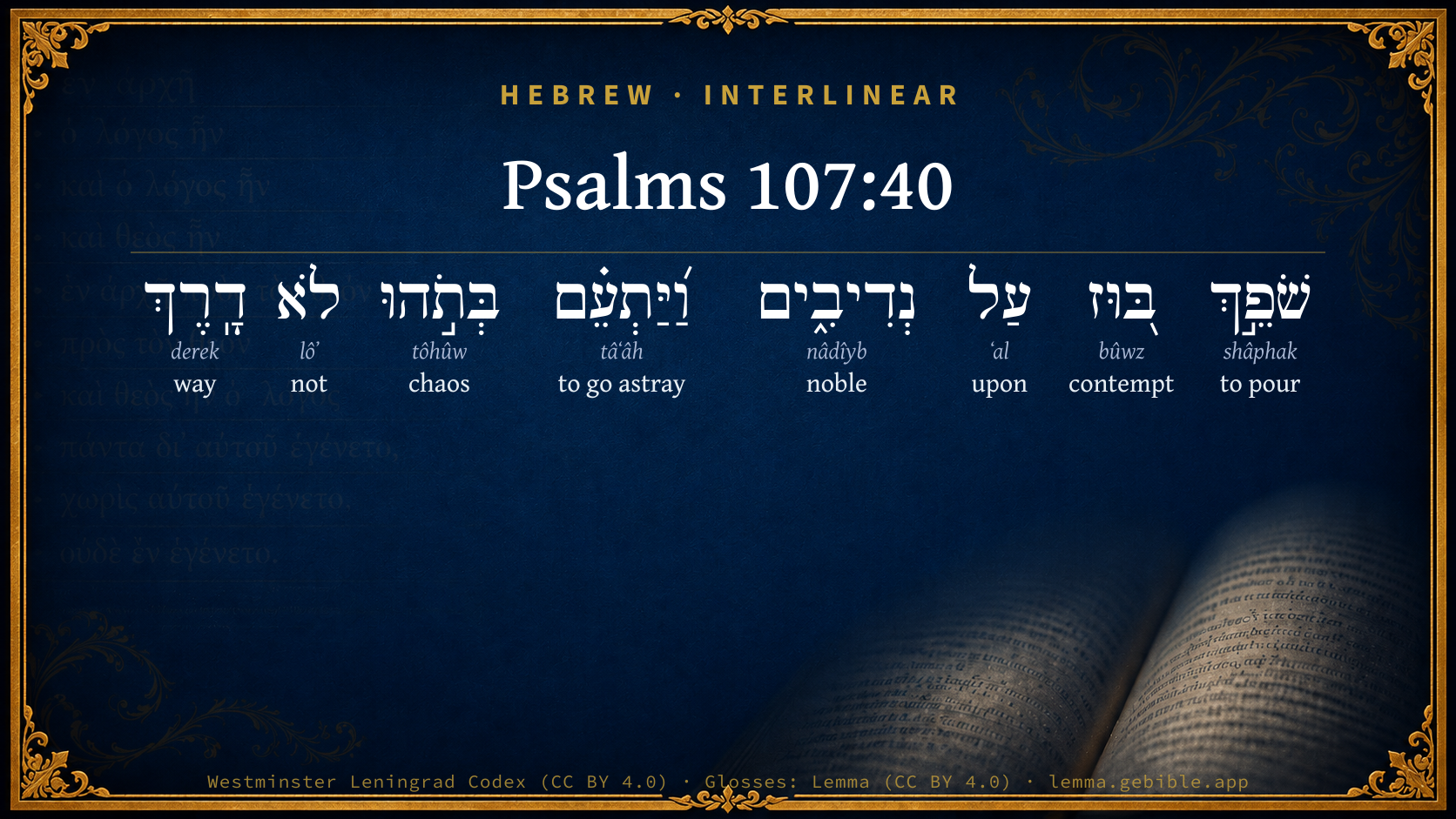
Hebrew (Westminster Leningrad Codex) Psalms 107:40 appears in the Hebrew Old Testament. The text above is from the Westminster Leningrad Codex. Each word links to its Strong’s number, a concise gloss, and parsing drawn from the Open Scriptures Hebrew Bible morphology. Click any word for its full Brown-Driver-Briggs (BDB) entry.
Download image
Cite this verse

Psalms 107:40 (World English Bible). Public Domain. Lemma interlinear Bible study tool, https://lemma.gebible.app/v/psalms/107/40.

Show BibTeX & RIS
BibTeX
RIS
English Translation
He pours contempt on princes, And causes them to wander in a trackless waste.
World English Bible · Public Domain
Download a study sheet

One document with this verse’s original text, its word-by-word gloss line, the meaning frame, cross-references with their text, attributed commentary, and full source and license credits — printable, and it pastes into notes with its structure intact.

This verse Autodidact and up

Study sheet (.html) Plain text (.txt)

A passage Seminary Student

Up to 50 verses in one chapter. A passage sheet keeps up to 6 commentary sources and 12 cross-references per verse, in the order this page ranks them, and says so on the sheet whenever that leaves anything out. Ask for a single verse and you get the Autodidact verse sheet above.

Everything on this page stays free to read, with no account — the sheet is a download of what is already on screen, not access to it.

Want to remove ads? Support Godless Engineer
Compare translations 3

The same verse in 3 English versions, stacked beneath the original-language interlinear above. Click any original word for its lexicon entry.

Each is an independent rendering of the whole verse — the interlinear is not word-aligned to these translations.

Highlighted words mark where these versions differ — a whole-verse word diff, not a word-by-word alignment.

  • World English Bible Public Domain
    He pours contempt on princes, And causes them to wander in a trackless waste.
  • King James Version Public Domain
    He poureth contempt upon princes, and causeth them to wander in the wilderness, where there is no way.
  • unfoldingWord Literal Text CC BY-SA 4.0
    He pours contempt on the leaders and causes them to wander in an empty place of no road.

unfoldingWord Literal Text — © unfoldingWord, licensed CC BY-SA 4.0. Word-aligned USFM3 via Door43 (git.door43.org/unfoldingWord/en_ult).

Versions to compare (up to 4)

3 of 4 selected

Show all 18 translations

Every available English version of this verse, each an independent rendering of the whole verse.

  • World English Bible Public Domain
    He pours contempt on princes, And causes them to wander in a trackless waste.
  • Berean Standard Bible Public Domain
    He pours out contempt on the nobles and makes them wander in a trackless wasteland.
  • Majority Standard Bible Public Domain
    He pours out contempt on the nobles and makes them wander in a trackless wasteland.
  • King James Version Public Domain
    He poureth contempt upon princes, and causeth them to wander in the wilderness, where there is no way.
  • American Standard Version (1901) Public Domain
    He poureth contempt upon princes, And causeth them to wander in the waste, where there is no way.
  • Revised Version (1885) Public Domain
    He poureth contempt upon princes, and causeth them to wander in the waste, where there is no way.
  • Geneva Bible (1599) Public Domain
    He powreth contempt vpon princes, and causeth them to erre in desert places out of the way.
  • Douay-Rheims (1899) Public Domain
    Contempt was poured forth upon their princes: and he caused them to wander where there was no passing, and out of the way.
  • Young's Literal Translation Public Domain
    He is pouring contempt upon nobles, And causeth them to wander in vacancy -- no way.
  • Literal Standard Version CC BY-SA 4.0
    He is pouring contempt on nobles, || And causes them to wander in vacancy—no way.
  • Unlocked Literal Bible CC BY-SA 4.0
    He pours contempt on the leaders and causes them to wander in the wilderness, where there are no roads.
  • unfoldingWord Literal Text CC BY-SA 4.0
    He pours contempt on the leaders and causes them to wander in an empty place of no road.
  • Darby Bible Public Domain
    He poureth contempt upon nobles, and causeth them to wander in a pathless waste;
  • World Messianic Bible Public Domain
    He pours contempt on princes, and causes them to wander in a trackless waste.
  • Webster's Bible Public Domain
    He poureth contempt upon princes, and causeth them to wander in the wilderness, where there is no way.
  • Free Bible Version CC BY-SA 4.0
    He pours out his contempt on their leaders, making them wander, lost in the wilderness.
  • Bible in Basic English Public Domain
    He puts an end to the pride of kings, and sends them wandering in the waste lands where there is no way.
  • JPS Tanakh (1917) Public Domain
    He poureth contempt upon princes, and causeth them to wander in the waste, where there is no way.

Literal Standard Version (2020), Covenant Press — licensed CC BY-SA 4.0. Text via the HelloAO Bible API (eBible.org). Unlocked Literal Bible (unfoldingWord) — licensed CC BY-SA 4.0. Text via the HelloAO Bible API (eBible.org). unfoldingWord Literal Text — © unfoldingWord, licensed CC BY-SA 4.0. Word-aligned USFM3 via Door43 (git.door43.org/unfoldingWord/en_ult). Free Bible Version, Dr. Jonathan Gallagher — licensed CC BY-SA 4.0. Text via the HelloAO Bible API (eBible.org).

Word by word

More ways to search: Search by grammar → Find every occurrence → Compare this word →

Practice this passage: Drill this verse → Learn its vocabulary →

About this verse

These counts appear in no published source. They are computed here, from the morphology-tagged text and Lemma’s own curated glosses. What Lemma adds →

8
words
8
distinct lemmas
Wisdom
section

Notable vocabulary

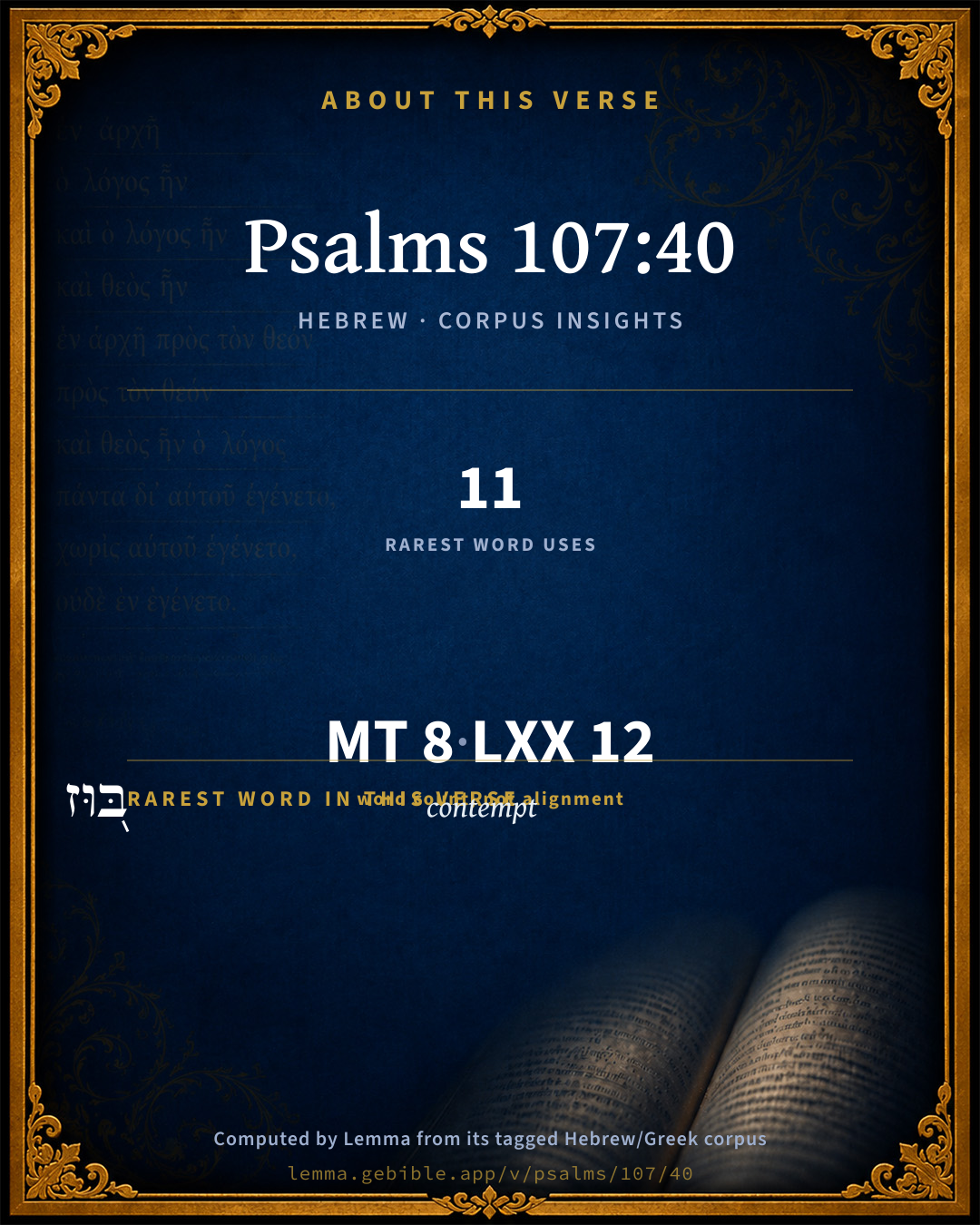
The rarest word here is בּ֭וּז contempt H937 — appearing just 11 times in the whole Hebrew Bible.

Shared distinctive vocabulary

בּ֭וּז contempt H937 occurs in 11 verses of the Hebrew Bible. Also found in:

Grammatical profile

  • 2 verbs
  • 3 nouns
  • 1 adjective
  • 1 preposition
  • 1 particle

Verb forms

  • שֹׁפֵ֣ךְ Qal · Participle Active
  • וַ֝יַּתְעֵ֗ם Hiphil · Sequential Imperfect

Hebrew & Septuagint length

In English translation the verse runs 14 words from the Hebrew and 18 from the Septuagint (LXX English) — closely comparable.

A rough comparison of the two English renderings, which tokenize alike — not a word-level alignment.

Word counts can differ between the Hebrew and the Greek without any difference in meaning — e.g. the Hebrew direct-object marker אֵת has no separate Greek word, and Greek often adds the article ὁ.

In the original languages it is 8 Hebrew tokens and 12 Greek tokens — but the two are counted differently (Hebrew bundles its prefixes and suffixes into one token; the Greek is in lemma form), so that isn’t a like-for-like length.

Cross-references

22

Topical passages linked to Psalms 107:40 in the Treasury of Scripture Knowledge — connected by theme and wording, ordered by reader-vote popularity; previews shown in the World English Bible.

  • Job 12:24 He takes away understanding from the chiefs of the people of the earth, And causes them to wander in a wilderness where there is no way.
  • Job 12:21 He pours contempt on princes, And loosens the belt of the strong.
  • Daniel 4:33 The same hour was the thing fulfilled on Nebuchadnezzar: and he was driven from men, and ate grass as oxen, and his body was wet with the dew of the sky, until his hair was grown like eagles' [feathers], and his nails like birds' [claws].
  • Isaiah 23:8–9 Who has purposed this against Tyre, the giver of crowns, whose merchants are princes, whose traffickers are the honorable of the earth?
  • Exodus 8:3 and the river shall swarm with frogs, which shall go up and come into your house, and into your bedchamber, and on your bed, and into the house of your servants, and on your people, and into your ovens, and into your kneading-troughs:
  • Exodus 8:17 They did so; and Aaron stretched out his hand with his rod, and struck the dust of the earth, and there were lice on man, and on animal; all the dust of the earth became lice throughout all the land of Egypt.
  • Exodus 8:24 Yahweh did so; and there came grievous swarms of flies into the house of Pharaoh, and into his servants' houses: and in all the land of Egypt the land was corrupted by reason of the swarms of flies.
  • Deuteronomy 32:10 He found him in a desert land, In the waste howling wilderness; He compassed him about, he cared for him, He kept him as the apple of his eye.
  • Joshua 10:24–26 It happened, when they brought forth those kings to Joshua, that Joshua called for all the men of Israel, and said to the chiefs of the men of war who went with him, Come near, put your feet on the necks of these kings. They came near, and put their feet on the necks of them.
  • Judges 1:6–7 But Adoni-bezek fled; and they pursued after him, and caught him, and cut off his thumbs and his great toes.
  • Judges 4:21 Then Jael Heber's wife took a tent-pin, and took a hammer in her hand, and went softly to him, and struck the pin into his temples, and it pierced through into the ground; for he was in a deep sleep; so he swooned and died.
  • 1 Samuel 5:9 It was so, that after they had carried it about, the hand of Yahweh was against the city with a very great confusion: and he struck the men of the city, both small and great; and tumors broke out on them.
  • 1 Samuel 6:4 Then they said, "What shall be the trespass-offering which we shall return to him?" They said, "Five golden tumors, and five golden mice, [according to] the number of the lords of the Philistines; for one plague was on you all, and on your lords.
  • 1 Kings 21:19 You shall speak to him, saying, Thus says Yahweh, Have you killed and also taken possession? You shall speak to him, saying, Thus says Yahweh, In the place where dogs licked the blood of Naboth shall dogs lick your blood, even yours.
  • 2 Kings 9:35–37 They went to bury her; but they found no more of her than the skull, and the feet, and the palms of her hands.
  • Psalms 78:66 He struck his adversaries backward. He put them to a perpetual reproach.
  • Psalms 107:4 They wandered in the wilderness in a desert way. They found no city to live in.
  • Jeremiah 13:15–18 Hear you, and give ear; don't be proud; for Yahweh has spoken.
  • Daniel 5:5–6 In the same hour came forth the fingers of a man's hand, and wrote over against the lampstand on the plaster of the wall of the king's palace: and the king saw the part of the hand that wrote.
  • Daniel 5:18–30 You king, the Most High God gave Nebuchadnezzar your father the kingdom, and greatness, and glory, and majesty:
  • Acts 12:23 Immediately an angel of the Lord struck him, because he didn't give God the glory, and he was eaten by worms and died.
  • Revelation 19:18 that you may eat the flesh of kings, the flesh of captains, the flesh of mighty men, and the flesh of horses and of those who sit on them, and the flesh of all men, both free and slave, and small and great."

Cross-references courtesy of OpenBible.info (CC BY 4.0).

Hebrew and Greek witnesses Masoretic Hebrew ↔ Greek Septuagint

The same verse in the two great witnesses to the Old Testament, shown verse-for-verse.

You’re reading Greek Psalm 106 (Hebrew Psalm 107). The Septuagint counts the superscription, so verse numbers can differ from the Hebrew — chapter-level alignment, not verse-by-verse. Numbering follows Rahlfs.

These are two independent witnesses, not word-aligned to each other, and the Septuagint is shown in lemma (dictionary) form.

Hebrew Psalms 107:40 Masoretic · Westminster Leningrad Codex

שֹׁפֵ֣ךְ בּ֭וּז עַל נְדִיבִ֑ים וַ֝יַּתְעֵ֗ם בְּתֹ֣הוּ לֹא דָֽרֶךְ

He pours contempt on princes, And causes them to wander in a trackless waste.

World English Bible · Public Domain

Greek LXX Greek Psalm 106:40 Septuagint · lemma form

ἐκχέω ἐξουδένωσις ἐπί ἄρχων καί πλανάω αὐτός ἐν ἄβατος καί οὐ ὁδός

Contempt is poured upon their princes, and he causes them to wander in a desert and trackless land.

LXX2012 (modern English Septuagint) · Public Domain

Hebrew: Westminster Leningrad Codex (CC BY 4.0). Greek: Septuagint (public domain); English from LXX2012 (modern English Septuagint) (Public Domain). How the Septuagint differs from the Hebrew →

Commentary

Notes on Psalms 107:40 from classic Christian and Jewish commentators (each source and its license shown beneath its notes). The classic Christian expositions comment on the surrounding passage and are grouped to its opening verse, so a note may address several verses; the Jewish commentaries on the Tanakh (Rashi and others) are per-verse, so they appear only where the commentator wrote on this verse.

Lemma curates 59 commentaries, every one of them public domain or Creative Commons licensed, each selected and text-cleaned for this edition rather than reprinted as found. About our sources →

Trapp's Complete Commentary

John Trapp

Psa 107:40 He poureth contempt upon princes, and causeth them to wander in the wilderness, [where there is] no way.

Ver. 40. He poureth contempt, &c.] See Job 12:21; Job 12:24, {See Trapp on "Job 12:21"} {See Trapp on "Job 12:24"} Poena tyrannorum est contemptus, exilium, nex, saith Genebrard. All the policy or king craft cannot save them.

John Trapp, A Commentary or Exposition upon All the Books of the Old and New Testament (1647–1656) — public domain. Text from a community e-Sword module.

Joseph Benson's Commentary

Psa 107:40. He poureth contempt upon princes — Even princes and kings cannot secure to themselves and their posterity the continuance of their dignity, glory, and authority. Though they might be honourable, adored like gods by their people, and terrible to their enemies, when God frowns upon them for their transgressions, their honour and power vanish away; they become despicable in the eyes of their own subjects, and of other nations. He causeth them to wander in the wilderness, &c. — Those that exalt themselves God abases; and in order thereto infatuates; he gives them up to foolish and pernicious counsels, by which they are exposed to contempt, and brought to their wit’s end, not knowing what course to take: or, he baffles those counsels by which they thought to support their pomp and power, so that they issue in their ruin. Or, the sense is, he deprives them of their crowns and kingdoms, banishes them from their courts, and forces them to flee into desolate wildernesses for shelter and subsistence. Yet setteth he the poor on high from affliction — At the same time that he bringeth down great potentates, he advances those that were obscure and contemptible; and maketh him families like a flock — Which increase very much in a little time. “Let not those, then, who have received the largest share of Heaven’s favours, boast and presume. The continuance of those favours depends upon the continuance of their fidelity and obedience. Mighty empires, with their princes, have, for their wickedness, been brought low by the arm of Jehovah, and laid in the dust; while nations, poor and feeble, and never thought of, have been taken from thence, and exalted over them. What revolutions have, in like manner, happened, and probably are still to happen in the church! Jerusalem is fallen through unbelief; and the Gentile Church stands only by faith, from which if she depart, vengeance will be executed on her likewise. Yet, even in the worst of times, there is a promise that the poor in spirit, the faithful and humble disciples of the holy Jesus, shall be preserved from the evil, and set on high from affliction; yea, that they shall be multiplied like a flock, under the care of the good Shepherd, to preserve his name, and to continue a church upon earth until he shall return again.” — Horne.

Joseph Benson's Commentary on the Old and New Testaments (1811–1818) — public domain. Text from a community e-Sword module.

J. A. Alexander on Psalms

Joseph Addison Alexander

40. (Psa 107:40) Pouring contempt on princes—and he has made them wander in a waste (where there is) no way. From the exiles he reverts to their Deliverer, and describes him as spurning the most lordly of their persecutors—nay, as making them take the place of those whom they oppressed, which idea is conveyed by the figure before used of wanderers in a pathless desert. See above, on Psa 107:4, and compare Job 12:21; Job 12:24. The word for waste or void is one of those used in Gen 1:2, to describe the original condition of the earth.

Joseph Addison Alexander, The Psalms Translated and Explained (1850) — public domain. Text from a community e-Sword module.

Tyndale Open Study Notes

Tyndale Open Resources

107:40 In his contempt for human rulers, the Lord rectifies their corruption on earth.

Tyndale Open Study Notes — © Tyndale Open Resources, licensed CC BY-SA 4.0. Text via the HelloAO Bible API.

Geneva Bible (1599)

Geneva Bible translators

For their wickedness and tyranny he causeth the people and subjects to contemn them.

Geneva Bible (1599) marginal notes — public domain. Text via Bolls.life.

Adam Clarke's Commentary

Verse 40. He poureth contempt upon princes] How many have lately been raised from nothing, and set upon thrones! And how many have been cast down from thrones, and reduced to nothing! And where are now those mighty troublers of the earth? On both sides they are in general gone to give an account of themselves to God. And what an account!

Where there is no way.] Who can consider the fate of the late emperor of the French, Napoleon, without seeing the hand of God in his downfall! All the powers of Europe were leagued against him in vain; they were as stubble to his bow. "HE came, HE saw, and HE conquered" almost every where, till God, by a Russian FROST, destroyed his tens of thousands of veteran troops. And afterwards his armies of raw conscripts would have over-matched the world had not a particular providence intervened at Waterloo, when all the skill and valour of his opponents had been nearly reduced to nothing. How terrible art thou, O Lord, in thy judgments! Thou art fearful in praises, doing wonders.

The dreary rock of St. Helena, where there was no way, saw a period to the mighty conqueror, who had strode over all the countries of Europe!

Adam Clarke's Commentary on the Bible (1810–1826) — public domain. Text from a community e-Sword/MySword module.

The Cambridge Bible for Schools and Colleges

gen. ed. J. J. S. Perowne

40. “He poureth contempt upon princes,

And maketh them wander in a wayless waste,”

The Cambridge Bible for Schools and Colleges (gen. ed. J. J. S. Perowne; Cambridge University Press, 1878–1918) — public domain. Text from a community e-Sword module.

John Gill's Exposition

Whoso is wise,.... Or as it may be read interrogatively, "who is wise?" as in Jer 9:12, that is, spiritually wise, wise unto salvation; who is made to know wisdom in the hidden part; for not such as are possessed of natural wisdom, or worldly wise men, much less who are wise to do evil, are here meant.

And will observe these things; the remarkable appearances of divine Providence to persons in distress; the various changes and vicissitudes in the world; the several afflictions of God's people, and their deliverances out of them; the wonderful works of God in nature, providence, and grace; these will be observed, taken notice of, laid up in the mind, and kept by such who are truly wise, who know how to make a right use and proper improvement of them.

Even they shall understand the lovingkindness of the Lord; everyone of the wise men; they will perceive the kindness of God unto all men, in the several dispensations of his providence towards them, and his special love and kindness towards his own people, even in all their afflictions; they will perceive this to be at the bottom of every mercy and blessing; they will understand more of the nature and excellency of it, and know more of the love of God and Christ, which passeth knowledge. Or "the kindnesses of the Lord shall be understood": that is, by wise men; so R. Moses in Aben Ezra renders the words.

Next: Psalms Chapter 108

John Gill's Exposition of the Whole Bible (1746–1763) — public domain (CC PDM 1.0). Text via the HelloAO Bible API.

Albert Barnes' Notes on the Bible

He poureth contempt upon princes - He treats them as if they were common people; he pays no regard in his providence to their station and rank. They are subjected to the same needs as others; they meet with reverses like others; they become captives like others; they sicken and die like others; they are laid in the grave like others; and, with the same offensiveness, they turn back to dust. Between monarchs and their subjects, masters and their slaves, mistresses and their handmaidens, rich men and poor men, beauty and deformity, there is no distinction in the pains of sickness, in the pangs of dying, in the loathsomeness of the grave. The process of corruption goes on in the most splendid coffin, and beneath the most costly monument which art and wealth can rear, as well as in the plainest coffin, and in the grave marked by no stone or memorial. What can more strikingly show “contempt” for the trappings of royalty, for the adornings of wealth, for the stars and garters of nobility, for coronets and crowns, for the diamonds, the pearls, and the gold that decorate beauty, than that which occurs “in a grave!” The very language used here, alike in the Hebrew and in our translation, is found in Job 12:21. The word rendered “princes” properly means “willing, voluntary, prompt;” and is then applied to the generous, to the noble-minded, to those who give liberally. It then denotes one of noble rank, as the idea of rank in the mind of the Orientals was closely connected with the notion of liberality in giving. Thus it comes to demote one of noble birth, and might be applied to any of exalted rank.

And causeth them to wander in the wilderness - Margin, “void place.” The Hebrew word - תהו tôhû - means properly wasteness, desolateness; emptiness, vanity. See Gen 1:2; Job 26:7; Isa 41:29; Isa 44:9; Isa 49:4. Here it means an empty, uninhabited place; a place where there is no path to guide; a land of desolation. The reference seems to be to the world beyond the grave; the land of shadows and night. Compare the notes at Job 10:21-22.

Where there is no way - literally, “no way.” That is, no well-trodden path. All must soon go to that pathless world.

Albert Barnes' Notes on the Bible (1834–1885) — public domain. Text from a community e-Sword/MySword module.

Matthew Poole's English Annotations

He poureth contempt upon princes; those who were honourable and adored like gods by their people, and terrible to all their enemies, he renders them despicable to their own subjects, and to other nations; and this he doth suddenly, abundantly, and unavoidably, as this phrase of pouring it out upon them seems to imply. To wander in the wilderness, where there is no way; either,

1. He giveth them up to foolish and pernicious counsels, by which they are exposed to contempt, and brought to their wit’s end, not knowing what course to take. Or,

2. He banished them from their own courts and kingdoms, and forced them to flee into desolate wildernesses for shelter and subsistence.

Matthew Poole's English Annotations on the Holy Bible (1683–1685) — public domain. Text from a community e-Sword/MySword module.

The Treasury of David

Charles H. Spurgeon

Ver. 40-41. In these two verses we see how the Lord at will turns the wheel of providence. Paying no respect to man's imaginary grandeur, he puts princes down and makes them wander in banishment as they had made their captives wander when they drove them from land to land: at the same time, having ever a tender regard for the poor and needy, the Lord delivers the distressed and sets them in a position of comfort and happiness. This is to be seen upon the roll of history again and again, and in spiritual experience we remark its counterpart: the self sufficient are made to despise themselves and search in vain for help in the wilderness of their nature, while poor convicted souls are added to the Lord's family and dwell in safety as the sheep of his fold.

Ver. 40. He poureth contempt upon princes. Mighty potentates, who have been the terror and dread of the whole world, when once denuded of their dignity and power, have become the sport even of their own dependants. John Calvin.

Ver. 40. Princes. Persons of high rank are the most exempt, in ordinary times, from destitution and want, and misery must reach a great height when it invades them. No part of the world probably has witnessed so many and great reverses of this kind as the regions and countries of the East. William Walford.

Psalms 107:41*

Charles H. Spurgeon's The Treasury of David (1869–1885) — public domain. Psalms only. Text from a community e-Sword/MySword module.

Whedon's Commentary on the Bible

Daniel D. Whedon

40. No way—No prepared road; a quotation from Job_12:21; Job_12:24

Daniel D. Whedon (gen. ed.), Commentary on the Old and New Testaments (1874–1909) — public domain. Text from a community e-Sword module.

The Pulpit Commentary

He poureth contempt upon princes. A direct quotation from Job_12:21, but not therefore to be regarded as spurious, since the sacred writers often quote one another, and the psalmists especially are very much in the habit of citing, or referring to Job (see, in this very psalm, besides the present passage, vers. 10, 18 (bis), 20, 34, 41, and 42). And causeth them to wander in the wilderness; rather, a wilderness. (comp. Job_12:24) Where there is no way. "Wandering in a wilderness without a way denotes helpless embarrassment" (Hengstenberg).

The Pulpit Commentary (1880–1919), ed. H.D.M. Spence-Jones & Joseph S. Exell — public domain. Text from a community e-Sword module.

John Wesley's Explanatory Notes

Contempt - Renders them despicable. Wander - Banishes them from their own courts and kingdoms, and forces them to flee into desolate wildernesses for shelter.

John Wesley, Explanatory Notes Upon the Whole Bible (1754–1765) — public domain. Text via the GEBible commentary corpus.

Lesson kit

Teaching starters — assembled from the data on this page, not authored interpretation. Every prompt links to the verse data it draws on. Edit before teaching.

Psalms, in the Wisdom, opens this verse with 8 words (8 distinct Hebrew lemmas). Its most distinctive word is bûwz (“contempt”). A historical commentator’s framing appears above. Read the whole chapter for the surrounding context.

Discussion questions

  1. The word bûwz carries the sense “contempt.” How does it shape the verse?
  2. Genesis 38:23 shares the word «contempt» with this verse. How do the two illuminate each other?
  3. These translations render this verse differently; the difference is in the English rendering, not the original. What questions does that raise?
  4. The verb «שֹׁפֵ֣ךְ» is Qal Participle Active. How does its form color the action?
  5. Reading how Trapp's Complete Commentary and Joseph Benson's Commentary read this verse, where do the two commentators agree and where do they part?

Things to notice

Reading settings

Reading text

Shown beneath each verse's original-language words.

Old Testament
Old Testament edition

Read the OT as the Masoretic Hebrew (MT) or the Greek Septuagint (LXX).

English shown for the Greek Septuagint (in the Hebrew ↔ Greek comparison).

Comparing translations? Open the Compare panel on any verse page to stack up to four side by side.