
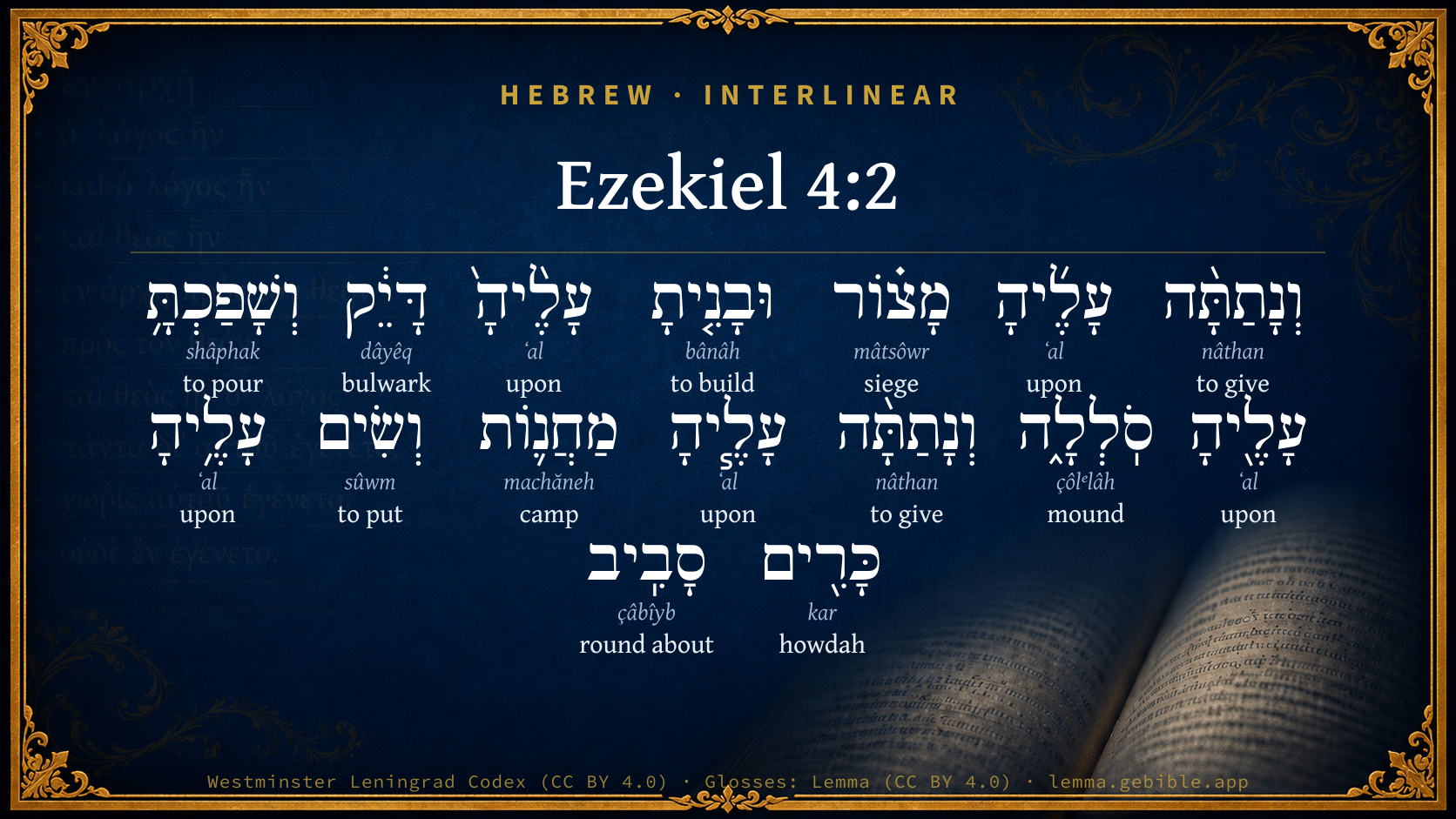
Ezekiel 4:2

Hebrew (Westminster Leningrad Codex) Ezekiel 4:2 appears in the Hebrew Old Testament. The text above is from the Westminster Leningrad Codex. Each word links to its Strong’s number, a concise gloss, and parsing drawn from the Open Scriptures Hebrew Bible morphology. Click any word for its full Brown-Driver-Briggs (BDB) entry.
Download image
Cite this verse

Ezekiel 4:2 (World English Bible). Public Domain. Lemma interlinear Bible study tool, https://lemma.gebible.app/v/ezekiel/4/2.

Show BibTeX & RIS
BibTeX
RIS
English Translation
and lay siege against it, and build forts against it, and cast up a mound against it; set camps also against it, and plant battering rams against it round about.
World English Bible · Public Domain
Download a study sheet

One document with this verse’s original text, its word-by-word gloss line, the meaning frame, cross-references with their text, attributed commentary, and full source and license credits — printable, and it pastes into notes with its structure intact.

This verse Autodidact and up

Study sheet (.html) Plain text (.txt)

A passage Seminary Student

Up to 50 verses in one chapter. A passage sheet keeps up to 6 commentary sources and 12 cross-references per verse, in the order this page ranks them, and says so on the sheet whenever that leaves anything out. Ask for a single verse and you get the Autodidact verse sheet above.

Everything on this page stays free to read, with no account — the sheet is a download of what is already on screen, not access to it.

Want to remove ads? Support Godless Engineer
Compare translations 3

The same verse in 3 English versions, stacked beneath the original-language interlinear above. Click any original word for its lexicon entry.

Each is an independent rendering of the whole verse — the interlinear is not word-aligned to these translations.

Highlighted words mark where these versions differ — a whole-verse word diff, not a word-by-word alignment.

  • World English Bible Public Domain
    and lay siege against it, and build forts against it, and cast up a mound against it; set camps also against it, and plant battering rams against it round about.
  • King James Version Public Domain
    And lay siege against it, and build a fort against it, and cast a mount against it; set the camp also against it, and set battering rams against it round about.
  • unfoldingWord Literal Text CC BY-SA 4.0
    Then lay siege against it, and build forts against it. Raise up an assault ramp against it and set camps around it. Place battering rams all around it.

unfoldingWord Literal Text — © unfoldingWord, licensed CC BY-SA 4.0. Word-aligned USFM3 via Door43 (git.door43.org/unfoldingWord/en_ult).

Versions to compare (up to 4)

3 of 4 selected

Show all 18 translations

Every available English version of this verse, each an independent rendering of the whole verse.

  • World English Bible Public Domain
    and lay siege against it, and build forts against it, and cast up a mound against it; set camps also against it, and plant battering rams against it round about.
  • Berean Standard Bible Public Domain
    Then lay siege against it: Construct a siege wall, build a ramp to it, set up camps against it, and place battering rams around it on all sides.
  • Majority Standard Bible Public Domain
    Then lay siege against it: Construct a siege wall, build a ramp to it, set up camps against it, and place battering rams around it on all sides.
  • King James Version Public Domain
    And lay siege against it, and build a fort against it, and cast a mount against it; set the camp also against it, and set battering rams against it round about.
  • American Standard Version (1901) Public Domain
    and lay siege against it, and build forts against it, and cast up a mound against it; set camps also against it, and plant battering rams against it round about.
  • Revised Version (1885) Public Domain
    and lay siege against it, and build forts against it, and cast up a mount against it; set camps also against it, and plant battering rams against it round about.
  • Geneva Bible (1599) Public Domain
    And lay siege against it, and builde a fort against it, and cast a mount against it: set the campe also against it, and lay engins of warre against it rounde about.
  • Douay-Rheims (1899) Public Domain
    And lay siege against it, and build forts, and cast up a mount, and set a camp against it, and place battering rams round about it.
  • Young's Literal Translation Public Domain
    and hast placed against it a siege, and builded against it a fortification, and poured out against it a mount, and placed against it camps, yea, set thou against it battering-rams round about.
  • Literal Standard Version CC BY-SA 4.0
    and have placed a siege against it, and built a fortification against it, and poured out a mound against it, and placed camps against it, indeed, set battering-rams against it all around.
  • Unlocked Literal Bible CC BY-SA 4.0
    Then lay siege against it, and build forts against it. Raise up an assault ramp against it and set camps around it. Place battering rams all around it.
  • unfoldingWord Literal Text CC BY-SA 4.0
    Then lay siege against it, and build forts against it. Raise up an assault ramp against it and set camps around it. Place battering rams all around it.
  • Darby Bible Public Domain
    and lay siege against it, and build forts against it, and cast a mound against it, and set camps against it, and place battering-rams against it round about.
  • World Messianic Bible Public Domain
    Lay siege against it, build forts against it, and cast up a mound against it. Also set camps against it and plant battering rams against it all around.
  • Webster's Bible Public Domain
    And lay siege against it, and build a fort against it, and cast a mount against it; set the camp also against it, and set battering rams against it on every side.
  • Free Bible Version CC BY-SA 4.0
    Show that it's under siege: establish a siege perimeter all around it, build a siege ramp against it, set up the enemy camps beside it, and put battering rams on all sides around it.
  • Bible in Basic English Public Domain
    And make an attack on it, shutting it in, building strong places against it, and making high an earthwork against it; and put up tents against it, placing engines all round it for smashing down its walls.
  • JPS Tanakh (1917) Public Domain
    and lay siege against it, and build forts against it, and cast up a mound against it; set camps also against it, and set battering rams against it round about.

Literal Standard Version (2020), Covenant Press — licensed CC BY-SA 4.0. Text via the HelloAO Bible API (eBible.org). Unlocked Literal Bible (unfoldingWord) — licensed CC BY-SA 4.0. Text via the HelloAO Bible API (eBible.org). unfoldingWord Literal Text — © unfoldingWord, licensed CC BY-SA 4.0. Word-aligned USFM3 via Door43 (git.door43.org/unfoldingWord/en_ult). Free Bible Version, Dr. Jonathan Gallagher — licensed CC BY-SA 4.0. Text via the HelloAO Bible API (eBible.org).

Word by word

More ways to search: Search by grammar → Find every occurrence → Compare this word →

Practice this passage: Drill this verse → Learn its vocabulary →

דָּיֵ֔ק
dâyêq
H1785
“bulwark”
Noun, Common, Masculine, Singular, Absolute
Part of Speech
Noun
Type
Common
Gender
Masculine
Number
Singular
State
Absolute
Full BDB Definition

Origin: from a root corresponding to H1751

TWOT: 417a

bulwark, siege-wall, sidewall
  1. וְנָתַתָּ֨ה nâthan H5414 “and · to give” Conjunction + Verb, Qal, Sequential Perfect, 2nd Person, Masculine, Singular
  2. עָלֶ֜יהָ ʻal H5921 “upon · her” Preposition + Suffix, Personal, 3rd Person, Feminine, Singular
  3. מָצ֗וֹר mâtsôwr H4692 “siege” Noun, Common, Masculine, Singular, Absolute
  4. וּבָנִ֤יתָ bânâh H1129 “and · to build” Conjunction + Verb, Qal, Sequential Perfect, 2nd Person, Masculine, Singular
  5. עָלֶ֨יהָ֙ ʻal H5921 “upon · her” Preposition + Suffix, Personal, 3rd Person, Feminine, Singular
  6. וְשָׁפַכְתָּ֥ shâphak H8210 “and · to pour” Conjunction + Verb, Qal, Sequential Perfect, 2nd Person, Masculine, Singular
  7. עָלֶ֖יהָ ʻal H5921 “upon · her” Preposition + Suffix, Personal, 3rd Person, Feminine, Singular
  8. סֹֽלְלָ֑ה çôlᵉlâh H5550 “mound” Noun, Common, Feminine, Singular, Absolute
  9. וְנָתַתָּ֨ה nâthan H5414 “and · to give” Conjunction + Verb, Qal, Sequential Perfect, 2nd Person, Masculine, Singular
  10. עָלֶ֧יהָ ʻal H5921 “upon · her” Preposition + Suffix, Personal, 3rd Person, Feminine, Singular
  11. מַחֲנ֛וֹת machăneh H4264 “camps” Noun, Common, Both, Plural, Absolute
  12. וְשִׂים sûwm H7760 “and · put” Conjunction + Verb, Qal, Imperative, 2nd Person, Masculine, Singular
  13. עָלֶ֥יהָ ʻal H5921 “upon · her” Preposition + Suffix, Personal, 3rd Person, Feminine, Singular
  14. כָּרִ֖ים kar H3733 “howdahs” Noun, Common, Masculine, Plural, Absolute
  15. סָבִֽיב çâbîyb H5439 “round about” Noun, Common, Both, Singular, Absolute

About this verse

These counts appear in no published source. They are computed here, from the morphology-tagged text and Lemma’s own curated glosses. What Lemma adds →

16
words
11
distinct lemmas
Prophets
section

Notable vocabulary

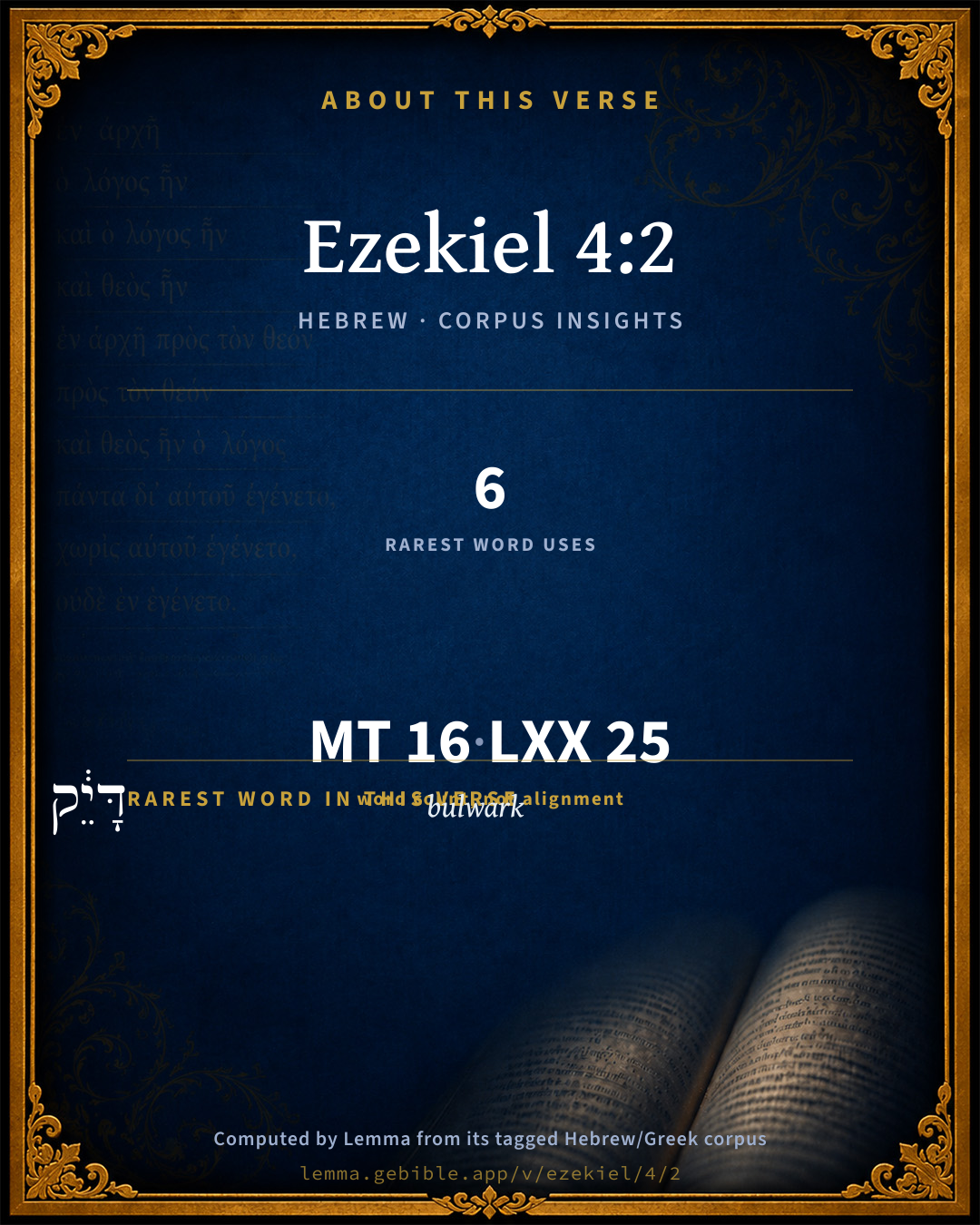
The rarest word here is דָּיֵ֔ק bulwark H1785 — appearing just 6 times in the whole Hebrew Bible.

Shared distinctive vocabulary

דָּיֵ֔ק bulwark H1785 occurs in 6 verses of the Hebrew Bible. Also found in:

Grammatical profile

  • 5 verbs
  • 6 nouns
  • 5 prepositions

Verb forms

  • וְנָתַתָּ֨ה Qal · Sequential Perfect
  • וּבָנִ֤יתָ Qal · Sequential Perfect
  • וְשָׁפַכְתָּ֥ Qal · Sequential Perfect
  • וְנָתַתָּ֨ה Qal · Sequential Perfect
  • וְשִׂים Qal · Imperative

Repetition

Words recur within this verse — often emphatic in Hebrew:

  • עָלֶ֜יהָ upon H5921 ×5
  • וְנָתַתָּ֨ה to give H5414 ×2

Hebrew & Septuagint length

In English translation the verse runs 30 words from the Hebrew and 29 from the Septuagint (LXX English) — closely comparable.

A rough comparison of the two English renderings, which tokenize alike — not a word-level alignment.

Word counts can differ between the Hebrew and the Greek without any difference in meaning — e.g. the Hebrew direct-object marker אֵת has no separate Greek word, and Greek often adds the article ὁ.

In the original languages it is 16 Hebrew tokens and 25 Greek tokens — but the two are counted differently (Hebrew bundles its prefixes and suffixes into one token; the Greek is in lemma form), so that isn’t a like-for-like length.

Cross-references

5

Topical passages linked to Ezekiel 4:2 in the Treasury of Scripture Knowledge — connected by theme and wording, ordered by reader-vote popularity; previews shown in the World English Bible.

  • Ezekiel 21:22 In his right hand was the divination [for] Jerusalem, to set battering rams, to open the mouth in the slaughter, to lift up the voice with shouting, to set battering rams against the gates, to cast up mounds, to build forts.
  • Jeremiah 6:6 For thus has Yahweh of Hosts said, Hew you down trees, and cast up a mound against Jerusalem: this is the city to be visited; she is wholly oppression in the midst of her.
  • Jeremiah 39:1–2 It happened when Jerusalem was taken, (in the ninth year of Zedekiah king of Judah, in the tenth month, came Nebuchadrezzar king of Babylon and all his army against Jerusalem, and besieged it;
  • Jeremiah 52:4 It happened in the ninth year of his reign, in the tenth month, in the tenth day of the month, that Nebuchadrezzar king of Babylon came, he and all his army, against Jerusalem, and encamped against it; and they built forts against it round about.
  • Luke 19:42–44 saying, "If you, even you, had known today the things which belong to your peace! But now, they are hidden from your eyes.

Cross-references courtesy of OpenBible.info (CC BY 4.0).

Hebrew and Greek witnesses Masoretic Hebrew ↔ Greek Septuagint

The same verse in the two great witnesses to the Old Testament, shown verse-for-verse.

These are two independent witnesses, not word-aligned to each other, and the Septuagint is shown in lemma (dictionary) form.

Hebrew Ezekiel 4:2 Masoretic · Westminster Leningrad Codex

וְנָתַתָּ֨ה עָלֶ֜יהָ מָצ֗וֹר וּבָנִ֤יתָ עָלֶ֨יהָ֙ דָּיֵ֔ק וְשָׁפַכְתָּ֥ עָלֶ֖יהָ סֹֽלְלָ֑ה וְנָתַתָּ֨ה עָלֶ֧יהָ מַחֲנ֛וֹת וְשִׂים עָלֶ֥יהָ כָּרִ֖ים סָבִֽיב

and lay siege against it, and build forts against it, and cast up a mound against it; set camps also against it, and plant battering rams against it round about.

World English Bible · Public Domain

Greek LXX Ezekiel 4:2 Septuagint · lemma form

καί δίδωμι ἐπί αὐτός περιοχή καί οἰκοδομέω ἐπί αὐτός προμαχών καί περιβάλλω ἐπί αὐτός χάραξ καί δίδωμι ἐπί αὐτός παρεμβολή καί τάσσω ὁ βελόστασις κύκλος

And you shall besiege it, and build works against it, and throw up a mound round about it, and pitch camps against it, and set up engines round about.

LXX2012 (modern English Septuagint) · Public Domain

On this verse, Jamieson, Fausset & Brown discusses the Septuagint’s reading. Read the note in Commentary ↓

Hebrew: Westminster Leningrad Codex (CC BY 4.0). Greek: Septuagint (public domain); English from LXX2012 (modern English Septuagint) (Public Domain). How the Septuagint differs from the Hebrew →

Targum (Aramaic paraphrase)

1

The Targum is the ancient Jewish Aramaic paraphrase of the Hebrew Scriptures — an interpretive translation, not the Hebrew text itself. Onkelos (literal) and Pseudo-Jonathan (expansive) render the Torah, and Jonathan the Prophets. Coverage is partial: where no permissively-licensed English translation exists for a verse, only the Aramaic is shown. This is verse-level text, not a word-by-word alignment to the Hebrew.

  1. Targum Jonathan Prophets (Joshua–Malachi)
    וְתִתֵּן עֲלָהּ צְיָר וְתִבְנֵי עֲלָהּ מִלְיָתָא וְתִשְׁרֵי עֲלָהּ מַשִׁרְיָן וּמַנֵי עֲלָהּ אֶפְדוֹרְוָן סְחוֹר סְחוֹר:

    (no public-domain English translation for this verse)

    Targum Jonathan — Aramaic: “Mikraot Gedolot” (public domain). English: “Sefaria Community Translation” (CC0 1.0 (public-domain dedication)); “London "Chaldee Paraphrase," 1871” (public domain). Text via Sefaria.

Commentary

Notes on Ezekiel 4:2 from classic Christian and Jewish commentators (each source and its license shown beneath its notes). The classic Christian expositions comment on the surrounding passage and are grouped to its opening verse, so a note may address several verses; the Jewish commentaries on the Tanakh (Rashi and others) are per-verse, so they appear only where the commentator wrote on this verse.

Lemma curates 59 commentaries, every one of them public domain or Creative Commons licensed, each selected and text-cleaned for this edition rather than reprinted as found. About our sources →

Trapp's Complete Commentary

John Trapp

Eze 4:2 And lay siege against it, and build a fort against it, and cast a mount against it; set the camp also against it, and set [battering] rams against it round about.

Ver. 2. And lay siege against it.] This to carnal reason seemeth childish and ridiculous; not unlike the practice of boys that make forts of snow; or of the Papists’ St Francis, who made him a wife and children of snow; fair, but soon fading comforts; or of his disciple Massaeus, who is much magnified, because at his master’s command he did - not Diogenes-like, tumble his tub, but - himself tumble up and down as a little one, in reference to that of our Saviour, {a} "Except ye be converted, and become as little children, ye shall not enter into the kingdom of heaven." {Mat 18:3} But it must be considered, that what the prophet did here, he did by the word and command of the most wise God. This made the sacrifices of old, and doth make the sacraments still, to be reverend and tremendous; because holy and reverend is his name who instituted them. It cannot be said so of Popish ceremonies, men’s inventions; they have not God’s image or inscription, and are therefore frivolous and fruitless, worthily cast out of our churches.

{a} Sedulius., lib. iii. cap. 2.

John Trapp, A Commentary or Exposition upon All the Books of the Old and New Testament (1647–1656) — public domain. Text from a community e-Sword module.

Joseph Benson's Commentary

Eze 4:2-3. And lay siege against it — Make a portraiture of a siege, and of such warlike instruments as are used in sieges, figuring every thing just as when an army lies before a place with an intention of taking it. Moreover, take thou an iron pan — Or rather, an iron plate, probably such as cakes were baked on. “This,” says Bishop Newcome, “may denote the strong trenches of the besiegers, or their firmness and perseverance in the siege; or, according to others, that there was an iron wall between the besieged and God, whom the prophet represented;” namely, the sins of the people, which separated between them and God, and prevented him from showing them mercy.

Joseph Benson's Commentary on the Old and New Testaments (1811–1818) — public domain. Text from a community e-Sword module.

Jamieson, Fausset & Brown

Robert Jamieson, A. R. Fausset & David Brown

forth--rather, "watch tower" (Jer 52:4) wherein the besieges could watch the movements of the besieged [GESENIUS]. A wall of circumvallation [Septuagint and ROSENMULLER]. A kind of battering-ram [MAURER]. The first view is best.

a mount--wherewith the Chaldeans could be defended from missiles.

battering-rams--literally, "through-borers." In Eze 21:22 the same Hebrew is translated "captains."

Jamieson, Fausset & Brown — Commentary Critical and Explanatory on the Whole Bible (1871) — public domain (CC PDM 1.0). Text via the HelloAO Bible API.

Adam Clarke's Commentary

Verse 2. Battering rams] כרים carim. This is the earliest account we have of this military engine. It was a long beam with a head of brass, like the head and horns of a ram, whence its name. It was hung by chains or ropes, between two beams, or three legs, so that it could admit of being drawn backward and forward some yards. Several stout men, by means of ropes, pulled it as far back as it could go, and then, suddenly letting it loose, it struck with great force against the wall which it was intended to batter and bring down. This machine was not known in the time of Homer, as in the siege of Troy there is not the slightest mention of such. And the first notice we have of it is here, where we see that it was employed by Nebuchadnezzar in the siege of Jerusalem, A.M. 3416. It was afterwards used by the Carthaginians at the siege of Gades, as Vitruvius notes, lib. x. c. 19, in which he gives a circumstantial account of the invention, fabrication, use, and improvement of this machine. It was for the want of a machine of this kind, that the ancient sieges lasted so long; they had nothing with which to beat down or undermine the walls.

Adam Clarke's Commentary on the Bible (1810–1826) — public domain. Text from a community e-Sword/MySword module.

Ellicott's Commentary for English Readers

(2) Lay siege against it.—It must have seemed at this time unlikely that Jerusalem would soon become the subject of another siege. The only power by whom such a siege could be undertaken was Babylon, Egypt having been so thoroughly defeated as to be for a long time out of the question; and Nebuchadnezzar had now, within a few years, thrice completely conquered Judaea, had carried two of its kings, one after the other, captive in chains, and had also taken into captivity 10,000 of the chief of the people, setting up as king over the remnant a creature of his own, who was yet of the royal house of Judah. A fresh siege could only be the result of a fresh rebellion, an act, under the circumstances, of simple infatuation. Yet of this infatuation Zedekiah, through the “anger of the LORD” (2Ki_24:20), was guilty, and thus the prophecy was fulfilled. The prophecy itself is undated, but must have been between the call of Ezekiel in the fifth month of the fifth year (Eze_1:2) and the next date given (Eze_8:1), the sixth month of the sixth year. The siege began, according to Jer_52:4, in the tenth month of the ninth year, so that the prophecy preceded its fulfilment by only about four years.

Build a fort against it.—Rather, a tower. The several acts of a siege are graphically described. First the city is invested; then a tower is built, as was customary, of sufficient height to overlook the walls and thus obtain information of the doings of the besieged. Instruments for throwing stones or darts were also sometimes placed in such towers; next is “cast a mound against it,” a common operation of the ancient siege (comp. Isa_37:33; Jer_32:24), in which a sort of artificial hill was built to give the besiegers an advantage; then the camps (not merely camp) are set round the city to prevent ingress and egress; and finally “the battering rams” are brought against the walls. These last were heavy beams, headed with iron, and slung in towers, so that they could be swung against the walls with great force. They are frequently to be noticed in the representations of sieges found in the ruins of Nineveh. The practice of forming the end of the beam like a ram’s head belongs to the Greeks and Romans; but the instrument itself was much older.

A Bible Commentary for English Readers, edited by Charles John Ellicott (1878–1897) — public domain. Text from a community e-Sword module.

The Cambridge Bible for Schools and Colleges

gen. ed. J. J. S. Perowne

2. a fort against it] The word is always used in the sing., though sometimes rightly rendered forts (2Ki_25:1), as the term is the name of a class of offensive siege works. The work was probably a species of tower, of which a number might be erected “round about” the walls (2Ki_25:1), and was used as a station for archers, or to discharge projectiles from (cf. LXX. ch. Eze_17:17). Towers of this kind, manned by archers are seen on the Assyrian bas-reliefs. Layard, Nin. and Bab. p. 149.

cast a mount] The “mount” or mound was an embankment raised till the besiegers standing on it were on a level with the top of the wall and able to command the streets of the city, cf. Lam_4:18. See Isa_37:33; Jer_6:6; Jer_32:24.

set the camp] set camps, detachments of soldiery.

battering rams] These were beams of wood with a head of iron, suspended by chains or ropes from a cross plank, and swung with great force by a number of men against the walls to batter them down. The term “round about” indicates that they were applied to different parts of the wall, perhaps where it might be thought weakest. It is not probable that the siege works were also engraved upon the brick. The latter rather by its elevation above the ground represented the city, and the siege works would be upon the ground, if we are to suppose them anywhere. But as the whole is a creation of the imagination it may be doubtful if the prophet was so precise or consistent as to put to himself the question where the siege works were placed.

The Cambridge Bible for Schools and Colleges (gen. ed. J. J. S. Perowne; Cambridge University Press, 1878–1918) — public domain. Text from a community e-Sword module.

John Gill's Exposition

And lay siege against it,.... In his own person, as in Eze 4:3; or draw the form of a siege, or figure of an army besieging a city; or rather of the instruments and means used in a siege, as follows:

and build a fort against it: Kimchi interprets it a wooden tower, built over against the city, to subdue it; Jarchi takes it to be an instrument by which stones were cast into the city; and so the Arabic version renders it, "machines to cast stones"; the Targum, a fortress; so Nebuchadnezzar in reality did what was here only done in type, Kg2 25:1; where the same word is used as here:

and cast a mount about it; a heap of earth cast up, in order to look into the city, cast in darts, and mount the walls; what the French call "bastion", as Jarchi observes:

set the camp also against it; place the army in their tents about it:

and set battering rams against it round about; a warlike instrument, that had an iron head, and horns like a ram, with which in a siege the walls of a city were battered and beaten down. Jarchi, Kimchi, and Ben Melech, interpret the word of princes and generals of the army, who watched at the several corners of the city, that none might go in and out; so the Targum seems to understand it (b). The Arabic version is, "mounts to cast darts"; See Gill on Eze 21:22.

(b) So R. Sol. Urbin. Ohel Moed, fol. 50. 9.

John Gill's Exposition of the Whole Bible (1746–1763) — public domain (CC PDM 1.0). Text via the HelloAO Bible API.

Albert Barnes' Notes on the Bible

Lay siege against it - The prophet is represented as doing that which he portrays. The leading features of a siege are depicted. See the Jer 6:6 note.

The camp - Encampments. The word denotes various hosts in various positions around the city.

Fort - It was customary in sieges to construct towers of vast height, sometimes of 20 stories, which were wheeled up to the walls to enable the besiegers to reach the battlements with their arrows; in the lower part of such a tower there was commonly a battering-ram. These towers are frequently represented in the Assyrian monuments.

Battering rams - Better than the translation in the margin. Assyrian monuments prove that these engines of war are of great antiquity. These engines seem to have been beams suspended by chains generally in moveable towers, and to have been applied against the walls in the way familiar to us from Greek and Roman history. The name “ram” was probably given to describe their mode of operation; no Assyrian monument yet discovered exhibits the ram’s head of later times.

Albert Barnes' Notes on the Bible (1834–1885) — public domain. Text from a community e-Sword/MySword module.

Haydock's Catholic Bible Commentary

Cast up. The ditch would be about three feet deep, and the earth being thrown up, people might approach the town with less danger. (Worthington) --- The besieged were thus also prevented from going out, 4 Kings xxv. 1. Forts or towers were erected to overlook and clear the walls. --- Rams. This is the first time we find them mentioned. Homer is silent about them; (Calmet) and the ancient sieges lasted so long, because people had not found out the art of demolishing the walls. (Diodorus ii.)

George Leo Haydock (1774–1849), Haydock's Catholic Family Bible and Commentary, 1859 edition — public domain. Excludes Psalms (Douay-Rheims chapter numbering differs from Protestant) and Deuterocanonical books (Catholic canon only).

Matthew Poole's English Annotations

Draw the figure of a siege about the city; raise a tower and bulwarks which may annoy the besieged, and defend the besiegers, from which may be shot either darts against men, or mighty stones against the walls and towers of the city.

Cast a mount; which made large, high, and strong, and near as they can, might thence by help of galleries get over the walls and enter the city. Lay out the ground also for the army of the Chaldeans to pitch their tents in, and to form their camp.

Rams; the Chaldee paraphrast understands the captains and chief leaders among the soldiers, but it is better understood of those engines wherewith besiegers did batter the walls and towers of a besieged city; an engine of great use in days of old among all warlike nations, invented, say some, in the siege of Troy.

Matthew Poole's English Annotations on the Holy Bible (1683–1685) — public domain. Text from a community e-Sword/MySword module.

Whedon's Commentary on the Bible

Daniel D. Whedon

2. Lay siege… build a fort… cast a mount — All of these ordinary acts of a besieging army are so acted out in the picture-sermon of the dumb prophet that his hearers are made to understand the calamity which must soon fall upon their national capital. The “fort” was supposed to be occupied by archers, the “mount” was built in order that the besiegers might overlook the walls of the city and command the streets (Isa_37:33; Jer_6:6; Jer_32:24).

The camp — Literally, camps. The besieging army is represented as divided into encampments which guard the city at all points. How the prophet represented these soldiers, battering-rams, etc., we do not know. They hardly seem to be a part of the picture engraved upon his unbaked brick.

Battering-rams — It has been doubted by a recent writer (Havet) whether battering-rams were invented as early as Ezekiel’s day, but the Assyrian monuments show pictures of them in use centuries earlier. There was usually a battering-ram in the lower part of each fort — or movable tower. The Hebrew word (kar) does not indicate that this “batterer” must have had a ram’s head upon it. The Assyrian “ram” often had a spear-shaped head.

Daniel D. Whedon (gen. ed.), Commentary on the Old and New Testaments (1874–1909) — public domain. Text from a community e-Sword module.

The Pulpit Commentary

Lay siege against it, etc. The wonder would increase as the spectators looked on what followed. Either tracing the scene on the tablet, or, more probably, as ver. 3 seems to indicate, constructing a model of the scene, the prophet brings before their eyes all the familiar details of a siege, such as we see on numerous Assyrian bas-reliefs: such also as the narratives of the Old Testament bring before us. There are

(1) the forts (as in 2Ki_25:1; Jer_52:4; Eze_17:17 Eze_21:22 Eze_26:8) or, perhaps, the wall of circumvallation, which the besiegers erected that they might carry on their operations in safety;

(2) then the mount, or mound (the English of the Authorized Version does not distinguish between the two) of earth from which they plied the bows or catapults; (Jer_6:6 Jer_32:24 Jer_33:4; Ezekiel, ut supra )

(3) the camps (plural in the Hebrew and Revised Version), or encampments, in which they were stationed in various positions found the city;

(4) the battering rams. Here the history both of the word and the thing has a special interest. The primary meaning of the Hebrew word is "lamb" (Deu_32:14; 1Sa_15:9, et al., Revised Version) or, better, "full grown wethers or rams" (Furst). Like the Greek kriov (Xen., "Cyrop.," 7:4:1 RAPC 2Ma 12:15), and the Latin aries (Livy, 21:12; 31:32, et al. ), it was transferred to the engine which was used to "butt," like a ram, against the walls of a besieged city, and which, in Roman warfare, commonly terminated in a ram"s head in bronze or iron. Ezekiel is the only Old Testament writer who, here and in Eze_21:22, uses the word, for which the LXX gives belosta) and the Vulgate arietes. The margin of the Authorized Version in both places gives "chief leaders," taking "rams" in another figurative sense; but, in the face of the LXX and Vulgate, there is no reason for accepting this. Battering rams frequently appear in Assyrian bas-reliefs of a much earlier date than Ezekiel"s time, at Nimroud (Vaux, "Nineveh and Persepolis," p. 456), Konyunyik Layard, "Nineveh and Babylon," p. 14:0, and elsewhere. They were hung by chains near the bottom of the besiegers" towers, and were propelled against the walls.

HOMILIES BY J.R. THOMSON Ver. 2. Siege.

By the remarkable symbolism described in this chapter, Ezekiel was himself assured that the metropolis of his country was about to endure the horrors of a siege, and his action was intended for a sign to the house of Israel. Jerusalem, like many of the ruinous cities of antiquity, and indeed of modern times, underwent the calamity again and again. It was probably the siege by Nebuchadnezzar which was foretold by the symbol of the tile and the iron pan. To be besieged was a not uncommon incident of warfare. But the prophet of God treated this approaching catastrophe, not merely as a fact of history, but as a moral and Divine lesson.

I THE GENERAL LESSONS VIVIDLY PRESENTED BY A CITY ENDURING A STATE OF SIEGE.

1. Community in civic life. Every city always has its own social characteristics. Citizens take a pride in the prosperity and glory of their city, especially if it be the metropolis of the nation. In our own time Paris was besieged by the German army, and its unity was never so realized as when thus encompassed by the enemy.

2. Community in resistance and hostility. Distinctions of rank and of social position almost vanish when a common danger threatens every class alike. Each man takes his share in the defence of the city, in bearing the common burden. All are drawn together by their community in dread or in defiance of the foe.

3. Community in the experience of suffering. Hunger and thirst, privation and want of rest, are shared by all the citizens of a beleaguered city. Men who partake the same calamity are drawn together by their common experience. The annals of a siege will usually be found to contain the record of remarkable cases of heroic unselfishness and public devotion.

II THE SPECIAL LESSONS PRESENTED BY THE SIEGE OF JERUSALEM. There may well have been manifested a community in spiritual discipline and profit.

1. The vanity of human pride and ambition was strikingly exhibited. TheJews were a vain glorious people; they possessed many distinctive marks of superiority raising them above the heathen, and their knew and boasted that it was so. They took credit to themselves for much for which they ought to have offered thanks to God. Their self-confidence and glorying were rebuked in the most emphatic manner when their fair and famed metropolis was besieged and threatened with destruction. This lesson is impressed upon their countrymen with unsparing faithfulness by the ancient Hebrew prophets.

2. Equally pointed was the lesson conveyed as to the utter vanity of merelyhuman help. The Jews did indeed sometimes seek alliances which might befriend and assist them in their distress; but against such alliances they were repeatedly warned by the prophets, whose duty it was to assure their countrymen of the vanity of the help of man. Especially were they rebuked for seeking friendship and aid from Egypt against, the forces of the Eastern foe; and they found such friendship hollow, and such aid ineffectual.

3. The inhabitants of Jerusalem and the people of Judah generally were, bythe siege of the city, directed to seek Divine deliverance. The city might fall; its walls might be levelled with the dust; its defenders might be slain; its inhabitants decimated. But all this might be overruled for the nation"s real and lasting good, should calamity and humiliation lead to repentance, should Divine favour be entreated, and a way of salvation be opened up to the remnant of the people. T.

The Pulpit Commentary (1880–1919), ed. H.D.M. Spence-Jones & Joseph S. Exell — public domain. Text from a community e-Sword module.

John Wesley's Explanatory Notes

Lay siege - Draw the figure of a siege about the city. Build - Raise a tower and bulwarks.

John Wesley, Explanatory Notes Upon the Whole Bible (1754–1765) — public domain. Text via the GEBible commentary corpus.

Rashi

Rabbi Shlomo Yitzchaki (Rashi)

a stone-throwing catapult Heb. דיק, mangonel in Old French, [mangonneau in modern French], with which they cast stones upon the city.

a siege mound Heb. סֹלְלָה, he would pour earth and press upon it (סֹלְלָה) and beat it down with sticks, and make a high mound on which to stand and look into the city and shoot arrows.

סֹלְלָה is bastion in Old French, rampart.

and place villages around it Heb. כָּרִים. Jonathan rendered: אֶפְרוֹרְוָן, which are villages that his armies make, and [the armies] dwell in tents on [all] sides of the city, so that no man could come or go. Another explanation is that כָּרִים are officers appointed over the army; this one guards on this side, and that one on that side.

Rashi on the Tanakh — English translations: “The Judaica Press complete Tanach with Rashi, translated by A. J. Rosenberg” (CC BY 4.0); “Pentateuch with Rashi's commentary by M. Rosenbaum and A.M. Silbermann, 1929-1934” (public domain); “The Metsudah Tanach series, Lakewood, N.J” (CC BY 4.0); and “The Book of Joshua, Metsudah Publications, 1997” (CC BY 4.0). Text via Sefaria.

Lesson kit

Teaching starters — assembled from the data on this page, not authored interpretation. Every prompt links to the verse data it draws on. Edit before teaching.

Ezekiel, in the Prophets, opens this verse with 16 words (11 distinct Hebrew lemmas). Its most distinctive word is dâyêq (“bulwark”). A historical commentator’s framing appears above. Read the whole chapter for the surrounding context.

Discussion questions

  1. The word dâyêq carries the sense “bulwark.” How does it shape the verse?
  2. How does 2 Kings 25:1, which shares the word «bulwark», read alongside this verse?
  3. What does the repetition of “upon” (5× in this one verse) do in this verse?
  4. These translations render this verse differently; the difference is in the English rendering, not the original. What questions does that raise?
  5. «וְנָתַתָּ֨ה» is a Qal Sequential Perfect verb. How does that grammatical form shape the action described?
  6. Compare how Trapp's Complete Commentary and Joseph Benson's Commentary read this verse. Where do they agree or differ?

Things to notice

Reading settings

Reading text

Shown beneath each verse's original-language words.

Old Testament
Old Testament edition

Read the OT as the Masoretic Hebrew (MT) or the Greek Septuagint (LXX).

English shown for the Greek Septuagint (in the Hebrew ↔ Greek comparison).

Comparing translations? Open the Compare panel on any verse page to stack up to four side by side.