
Jeremiah 7:6

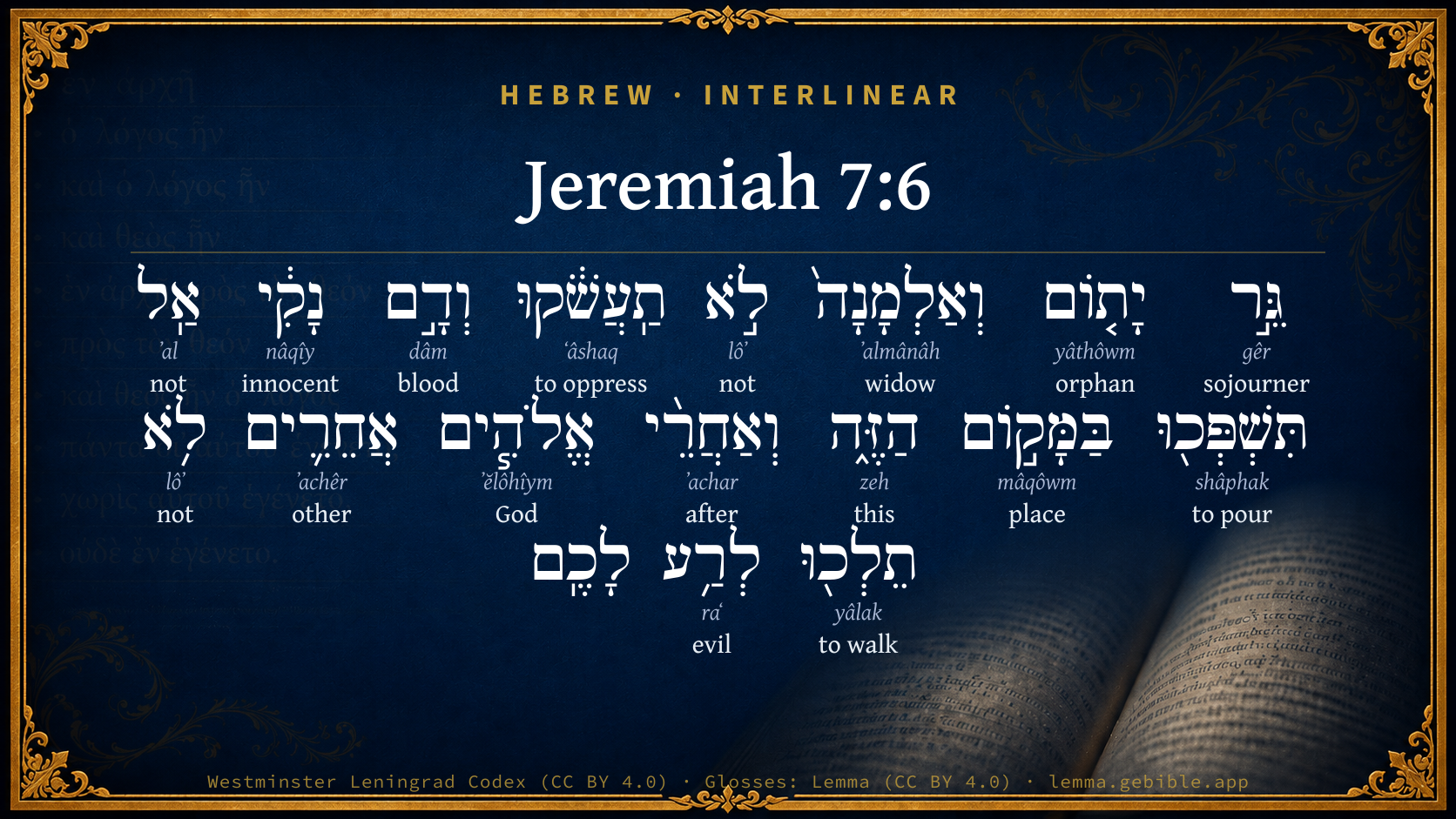
Hebrew (Westminster Leningrad Codex) Jeremiah 7:6 appears in the Hebrew Old Testament. The text above is from the Westminster Leningrad Codex. Each word links to its Strong’s number, a concise gloss, and parsing drawn from the Open Scriptures Hebrew Bible morphology. Click any word for its full Brown-Driver-Briggs (BDB) entry.
Download image
Cite this verse

Jeremiah 7:6 (World English Bible). Public Domain. Lemma interlinear Bible study tool, https://lemma.gebible.app/v/jeremiah/7/6.

Show BibTeX & RIS
BibTeX
RIS
English Translation
if you don't oppress the foreigner, the fatherless, and the widow, and don't shed innocent blood in this place, neither walk after other gods to your own hurt:
World English Bible · Public Domain
Download a study sheet

One document with this verse’s original text, its word-by-word gloss line, the meaning frame, cross-references with their text, attributed commentary, and full source and license credits — printable, and it pastes into notes with its structure intact.

This verse Autodidact and up

Study sheet (.html) Plain text (.txt)

A passage Seminary Student

Up to 50 verses in one chapter. A passage sheet keeps up to 6 commentary sources and 12 cross-references per verse, in the order this page ranks them, and says so on the sheet whenever that leaves anything out. Ask for a single verse and you get the Autodidact verse sheet above.

Everything on this page stays free to read, with no account — the sheet is a download of what is already on screen, not access to it.

Want to remove ads? Support Godless Engineer
Compare translations 3

The same verse in 3 English versions, stacked beneath the original-language interlinear above. Click any original word for its lexicon entry.

Each is an independent rendering of the whole verse — the interlinear is not word-aligned to these translations.

Highlighted words mark where these versions differ — a whole-verse word diff, not a word-by-word alignment.

  • World English Bible Public Domain
    if you don't oppress the foreigner, the fatherless, and the widow, and don't shed innocent blood in this place, neither walk after other gods to your own hurt:
  • King James Version Public Domain
    If ye oppress not the stranger, the fatherless, and the widow, and shed not innocent blood in this place, neither walk after other gods to your hurt:
  • unfoldingWord Literal Text CC BY-SA 4.0
    if you do not oppress the stranger, the fatherless one, or the widow and you do not shed innocent blood in this place, and do not walk after other gods to your harm—

unfoldingWord Literal Text — © unfoldingWord, licensed CC BY-SA 4.0. Word-aligned USFM3 via Door43 (git.door43.org/unfoldingWord/en_ult).

Versions to compare (up to 4)

3 of 4 selected

Show all 18 translations

Every available English version of this verse, each an independent rendering of the whole verse.

  • World English Bible Public Domain
    if you don't oppress the foreigner, the fatherless, and the widow, and don't shed innocent blood in this place, neither walk after other gods to your own hurt:
  • Berean Standard Bible Public Domain
    if you no longer oppress the foreigner and the fatherless and the widow, and if you no longer shed innocent blood in this place or follow other gods to your own harm,
  • Majority Standard Bible Public Domain
    if you no longer oppress the foreigner and the fatherless and the widow, and if you no longer shed innocent blood in this place or follow other gods to your own harm,
  • King James Version Public Domain
    If ye oppress not the stranger, the fatherless, and the widow, and shed not innocent blood in this place, neither walk after other gods to your hurt:
  • American Standard Version (1901) Public Domain
    if ye oppress not the sojourner, the fatherless, and the widow, and shed not innocent blood in this place, neither walk after other gods to your own hurt:
  • Revised Version (1885) Public Domain
    if ye oppress not the stranger, the fatherless, and the widow, and shed not innocent blood in this place, neither walk after other gods to your own hurt:
  • Geneva Bible (1599) Public Domain
    And oppresse not the stranger, the fatherlesse and the widow and shed no innocent blood in this place, neither walke after other gods to your destruction,
  • Douay-Rheims (1899) Public Domain
    If you opress not the stranger, the fatherless, and the widow, and shed not innocent blood in this place, and walk not after strange gods to your own hurt,
  • Young's Literal Translation Public Domain
    Sojourner, fatherless, and widow, ye oppress not, And innocent blood do not shed in this place, And after other gods do not walk, for evil to yourselves,
  • Literal Standard Version CC BY-SA 4.0
    You do not oppress sojourner, fatherless, and widow, || And innocent blood is not shed in this place, || And [you] do not walk after other gods, for evil to yourselves,
  • Unlocked Literal Bible CC BY-SA 4.0
    if you do not exploit the one staying in the land, the orphan, or the widow and do not pour out innocent blood in this place, and do not walk after other gods to your own harm—
  • unfoldingWord Literal Text CC BY-SA 4.0
    if you do not oppress the stranger, the fatherless one, or the widow and you do not shed innocent blood in this place, and do not walk after other gods to your harm—
  • Darby Bible Public Domain
    [if] ye oppress not the stranger, the fatherless, and the widow, and shed no innocent blood in this place, neither walk after other gods to your hurt;
  • World Messianic Bible Public Domain
    if you don’t oppress the foreigner, the fatherless, and the widow, and don’t shed innocent blood in this place, and don’t walk after other gods to your own hurt,
  • Webster's Bible Public Domain
    If ye oppress not the stranger, the fatherless, and the widow, and shed not innocent blood in this place, neither walk after other gods to your hurt:
  • Free Bible Version CC BY-SA 4.0
    if you stop mistreating foreigners and orphans and widows, and if you stop murdering innocent people and stop hurting yourselves by worshiping other gods,
  • Bible in Basic English Public Domain
    If you are not cruel to the man from a strange country, and to the child without a father, and to the widow, and do not put the upright to death in this place, or go after other gods, causing damage to yourselves:
  • JPS Tanakh (1917) Public Domain
    if ye oppress not the stranger, the fatherless, and the widow, and shed not innocent blood in this place, neither walk after other gods to your hurt;

Literal Standard Version (2020), Covenant Press — licensed CC BY-SA 4.0. Text via the HelloAO Bible API (eBible.org). Unlocked Literal Bible (unfoldingWord) — licensed CC BY-SA 4.0. Text via the HelloAO Bible API (eBible.org). unfoldingWord Literal Text — © unfoldingWord, licensed CC BY-SA 4.0. Word-aligned USFM3 via Door43 (git.door43.org/unfoldingWord/en_ult). Free Bible Version, Dr. Jonathan Gallagher — licensed CC BY-SA 4.0. Text via the HelloAO Bible API (eBible.org).

Word by word

More ways to search: Search by grammar → Find every occurrence → Compare this word →

Practice this passage: Drill this verse → Learn its vocabulary →

תַֽעֲשֹׁ֔קוּ
ʻâshaq
H6231
“to oppress”
Verb, Qal, Imperfect, 2nd Person, Masculine, Plural
Part of Speech
Verb
Stem
Qal
Form
Imperfect
Person
2nd Person
Gender
Masculine
Number
Plural
Full BDB Definition

Origin: a primitive root (comp. H6229 )

TWOT: 1713

to press upon, oppress, violate, defraud, do violence, get deceitfully, wrong, extort - (Qal) - to oppress, wrong, extort - to oppress - (Pual) to be exploited, be crushed
  1. גֵּ֣ר gêr H1616 “sojourner” Noun, Common, Masculine, Singular, Absolute
  2. יָת֤וֹם yâthôwm H3490 “orphan” Noun, Common, Masculine, Singular, Absolute
  3. וְאַלְמָנָה֙ ʼalmânâh H490 “and · widow” Conjunction + Noun, Common, Feminine, Singular, Absolute
  4. לֹ֣א lôʼ H3808 “not” Particle, Negative
  5. וְדָ֣ם dâm H1818 “and · blood” Conjunction + Noun, Common, Masculine, Singular, Absolute
  6. נָקִ֔י nâqîy H5355 “innocent” Adjective, Adjective, Masculine, Singular, Absolute
  7. אַֽל ʼal H408 “not” Particle, Negative
  8. תִּשְׁפְּכ֖וּ shâphak H8210 “to pour” Verb, Qal, Jussive, 2nd Person, Masculine, Plural
  9. בַּמָּק֣וֹם mâqôwm H4725 “in/at the · place” Preposition, Determined + Noun, Common, Masculine, Singular, Absolute
  10. הַזֶּ֑ה zeh H2088 “the · this” Particle, Definite Article + Pronoun, Demonstrative, Masculine, Singular
  11. וְאַחֲרֵ֨י ʼachar H310 “and · after” Conjunction + Preposition
  12. אֱלֹהִ֧ים ʼĕlôhîym H430 “God(s)” Noun, Common, Masculine, Plural, Absolute
  13. אֲחֵרִ֛ים ʼachêr H312 “other” Adjective, Adjective, Masculine, Plural, Absolute
  14. לֹ֥א lôʼ H3808 “not” Particle, Negative
  15. תֵלְכ֖וּ yâlak H3212 “to walk” Verb, Qal, Imperfect, 2nd Person, Masculine, Plural
  16. לְרַ֥ע raʻ H7451 “to/for · evil” Preposition + Adjective, Adjective, Masculine, Singular, Absolute

About this verse

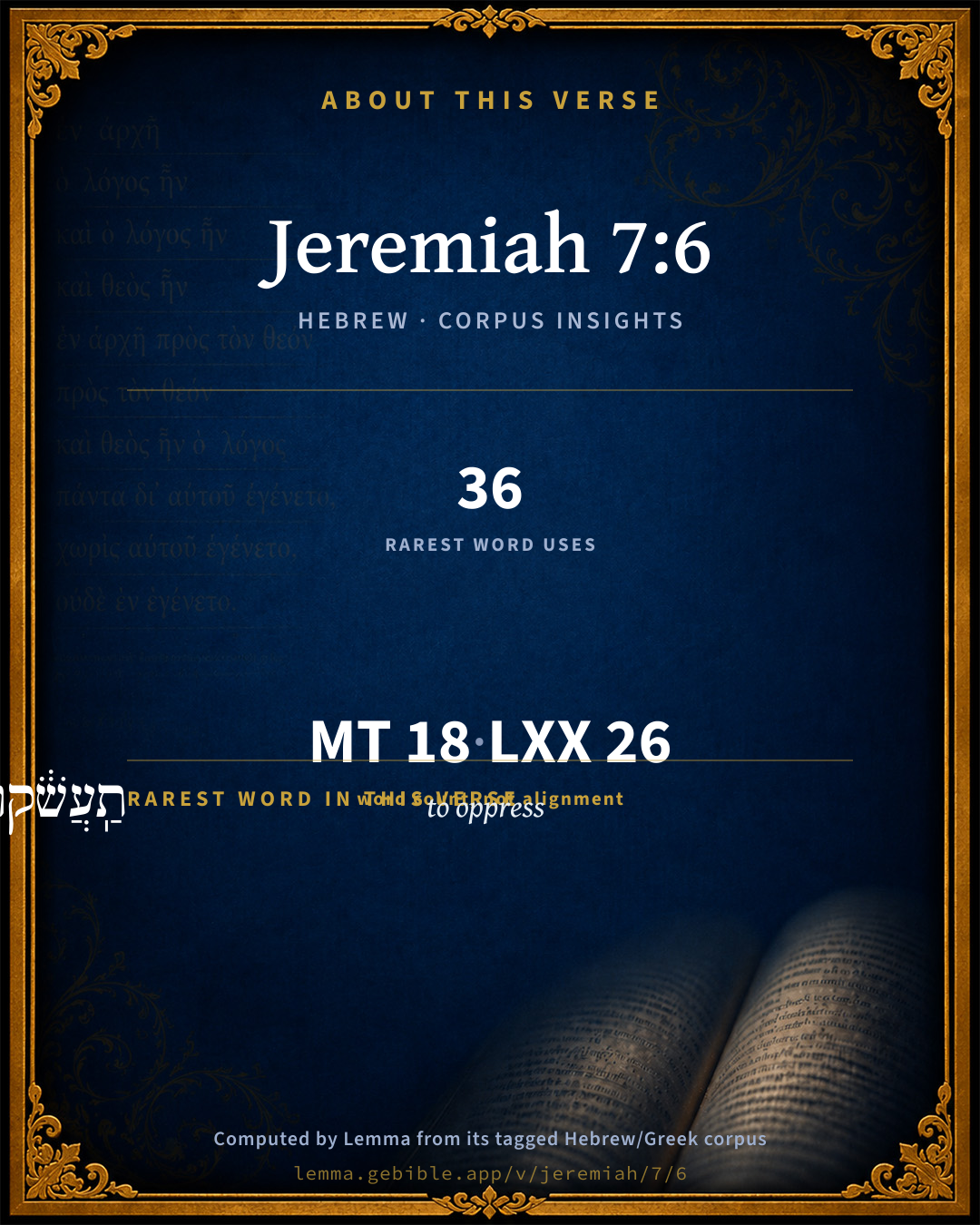
These counts appear in no published source. They are computed here, from the morphology-tagged text and Lemma’s own curated glosses. What Lemma adds →

18
words
16
distinct lemmas
Prophets
section

Shared distinctive vocabulary

תַֽעֲשֹׁ֔קוּ to oppress H6231 occurs in 35 verses of the Hebrew Bible. Also found in:

Grammatical profile

  • 3 verbs
  • 6 nouns
  • 3 adjectives
  • 1 pronoun
  • 2 prepositions
  • 3 particles

Verb forms

  • תַֽעֲשֹׁ֔קוּ Qal · Imperfect
  • תִּשְׁפְּכ֖וּ Qal · Jussive
  • תֵלְכ֖וּ Qal · Imperfect

Repetition

A word recurs within this verse — often emphatic in Hebrew:

Hebrew & Septuagint length

In the original languages it is 18 Hebrew tokens and 26 Greek tokens — but the two are counted differently (Hebrew bundles its prefixes and suffixes into one token; the Greek is in lemma form), so that isn’t a like-for-like length.

Cross-references

30

Topical passages linked to Jeremiah 7:6 in the Treasury of Scripture Knowledge — connected by theme and wording, ordered by reader-vote popularity; previews shown in the World English Bible.

  • Exodus 22:21–24 "You shall not wrong an alien, neither shall you oppress him, for you were aliens in the land of Egypt.
  • Deuteronomy 8:19 It shall be, if you shall forget Yahweh your God, and walk after other gods, and serve them, and worship them, I testify against you this day that you shall surely perish.
  • Jeremiah 13:10 This evil people, who refuse to hear my words, who walk in the stubbornness of their heart, and are gone after other gods to serve them, and to worship them, shall even be as this belt, which is profitable for nothing.
  • Zechariah 7:9–12 "Thus has Yahweh of Hosts spoken, saying, 'Execute true judgment, and show kindness and compassion every man to his brother.
  • Deuteronomy 11:28 and the curse, if you shall not listen to the commandments of Yahweh your God, but turn aside out of the way which I command you this day, to go after other gods, which you have not known.
  • Deuteronomy 6:14–15 You shall not go after other gods, of the gods of the peoples who are round about you;
  • Jeremiah 2:34 Also in your skirts is found the blood of the souls of the innocent poor: you did not find them breaking in; but it is because of all these things.
  • Deuteronomy 24:17 You shall not wrest the justice [due] to the foreigner, [or] to the fatherless, nor take the widow's clothing to pledge;
  • Deuteronomy 27:19 Cursed be he who wrests the justice [due] to the foreigner, fatherless, and widow. All the people shall say, Amen.
  • Psalms 82:3–4 "Defend the weak, the poor, and the fatherless. Maintain the rights of the poor and oppressed.
  • Isaiah 59:7 Their feet run to evil, and they make haste to shed innocent blood: their thoughts are thoughts of iniquity; desolation and destruction are in their paths.
  • Jeremiah 19:4 Because they have forsaken me, and have estranged this place, and have burned incense in it to other gods, that they didn't know, they and their fathers and the kings of Judah; and have filled this place with the blood of innocents,
  • Jeremiah 22:3–4 Thus says Yahweh: Execute you justice and righteousness, and deliver him who is robbed out of the hand of the oppressor: and do no wrong, do no violence, to the foreigner, the fatherless, nor the widow; neither shed innocent blood in this place.
  • Malachi 3:5 I will come near to you to judgment; and I will be a swift witness against the sorcerers, and against the adulterers, and against the perjurers, and against those who oppress the hireling in his wages, the widow, and the fatherless, and who deprive the foreigner of justice, and don't fear me," says Yahweh of Hosts.
  • Matthew 23:35–37 that on you may come all the righteous blood shed on the earth, from the blood of righteous Abel to the blood of Zachariah son of Barachiah, whom you killed between the sanctuary and the altar.
  • James 1:27 Pure religion and undefiled before our God and Father is this: to visit the fatherless and widows in their affliction, and to keep oneself unstained by the world.
  • 2 Kings 21:6 He made his son to pass through the fire, and practiced sorcery, and used enchantments, and dealt with those who had familiar spirits, and with wizards: he worked much evil in the sight of Yahweh, to provoke him to anger.
  • 2 Kings 24:4 and also for the innocent blood that he shed; for he filled Jerusalem with innocent blood: and Yahweh would not pardon.
  • Job 31:13–22 "If I have despised the cause of my man-servant Or of my maid-servant, When they contended with me;
  • Psalms 106:38 They shed innocent blood, Even the blood of their sons and of their daughters, Whom they sacrificed to the idols of Canaan. The land was polluted with blood.
  • Jeremiah 2:30 In vain have I struck your children; they received no correction: your own sword has devoured your prophets, like a destroying lion.
  • Jeremiah 7:5 For if you thoroughly amend your ways and your doings; if you thoroughly execute justice between a man and his neighbor;
  • Jeremiah 22:15–17 Shall you reign, because you strive to excel in cedar? Didn't your father eat and drink, and do justice and righteousness? then it was well with him.
  • Jeremiah 26:15 Only know for certain that, if you put me to death, you will bring innocent blood on yourselves, and on this city, and on the inhabitants of it; for of a truth Yahweh has sent me to you to speak all these words in your ears.
  • Jeremiah 26:23 and they fetched forth Uriah out of Egypt, and brought him to Jehoiakim the king, who killed him with the sword, and cast his dead body into the graves of the common people.
  • Lamentations 4:13 [It is] because of the sins of her prophets, [and] the iniquities of her priests, That have shed the blood of the just in the midst of her.
  • Ezekiel 18:6 and has not eaten on the mountains, neither has lifted up his eyes to the idols of the house of Israel, neither has defiled his neighbor's wife, neither has come near to a woman in her impurity,
  • Ezekiel 22:3–6 You shall say, Thus says the Lord Yahweh: A city that sheds blood in the midst of her, that her time may come, and that makes idols against herself to defile her!
  • Matthew 27:4 saying, "I have sinned in that I betrayed innocent blood." But they said, "What is that to us? You see to it."
  • Matthew 27:25 All the people answered, "May his blood be on us, and on our children!"

Cross-references courtesy of OpenBible.info (CC BY 4.0).

Hebrew and Greek witnesses Masoretic Hebrew ↔ Greek Septuagint

The same verse in the two great witnesses to the Old Testament, shown verse-for-verse.

These are two independent witnesses, not word-aligned to each other, and the Septuagint is shown in lemma (dictionary) form.

Hebrew Jeremiah 7:6 Masoretic · Westminster Leningrad Codex

גֵּ֣ר יָת֤וֹם וְאַלְמָנָה֙ לֹ֣א תַֽעֲשֹׁ֔קוּ וְדָ֣ם נָקִ֔י אַֽל תִּשְׁפְּכ֖וּ בַּמָּק֣וֹם הַזֶּ֑ה וְאַחֲרֵ֨י אֱלֹהִ֧ים אֲחֵרִ֛ים לֹ֥א תֵלְכ֖וּ לְרַ֥ע לָכֶֽם

if you don't oppress the foreigner, the fatherless, and the widow, and don't shed innocent blood in this place, neither walk after other gods to your own hurt:

World English Bible · Public Domain

Greek LXX Structure differs

In the Septuagint, Jeremiah is about an eighth shorter than the Hebrew and arranges its material differently — the Oracles Against the Nations (Hebrew chapters 46–51) appear in the middle of the Greek book, after 25:13. Because the chapter and verse boundaries do not line up, a verse-for-verse comparison with the Hebrew is not shown.

A verse-for-verse comparison isn’t shown here because the chapters and verses don’t line up. Switch to the LXX edition with the MT / LXX toggle above to read the Greek directly.

Hebrew: Westminster Leningrad Codex (CC BY 4.0). Greek: Septuagint (public domain); English from a public-domain English Septuagint. How the Septuagint differs from the Hebrew →

Targum (Aramaic paraphrase)

1

The Targum is the ancient Jewish Aramaic paraphrase of the Hebrew Scriptures — an interpretive translation, not the Hebrew text itself. Onkelos (literal) and Pseudo-Jonathan (expansive) render the Torah, and Jonathan the Prophets. Coverage is partial: where no permissively-licensed English translation exists for a verse, only the Aramaic is shown. This is verse-level text, not a word-by-word alignment to the Hebrew.

  1. Targum Jonathan Prophets (Joshua–Malachi)
    גִיוֹר יָתוֹם וְאַרְמְלָא לָא תוֹנִיסוּן וְדַם זַכַּאי לָא תִשְׁדוּן בְּאַתְרָא הָדֵין וּבָתַר פַּלְחֵי כּוֹכְבַיָא לָא תְּהָכוֹן לְאַבְאָשָׁא לְכוֹן:

    (no public-domain English translation for this verse)

    Targum Jonathan — Aramaic: “Mikraot Gedolot” (public domain). English: “Sefaria Community Translation” (CC0 1.0 (public-domain dedication)); “London "Chaldee Paraphrase," 1871” (public domain). Text via Sefaria.

Commentary

Notes on Jeremiah 7:6 from classic Christian and Jewish commentators (each source and its license shown beneath its notes). The classic Christian expositions comment on the surrounding passage and are grouped to its opening verse, so a note may address several verses; the Jewish commentaries on the Tanakh (Rashi and others) are per-verse, so they appear only where the commentator wrote on this verse.

Lemma curates 59 commentaries, every one of them public domain or Creative Commons licensed, each selected and text-cleaned for this edition rather than reprinted as found. About our sources →

Trapp's Complete Commentary

John Trapp

Jer 7:6 [If] ye oppress not the stranger, the fatherless, and the widow, and shed not innocent blood in this place, neither walk after other gods to your hurt:

Ver. 6. If ye oppress not the stranger, &c.] Turtures amat Deus, non vultures. See on Isa 1:23.

John Trapp, A Commentary or Exposition upon All the Books of the Old and New Testament (1647–1656) — public domain. Text from a community e-Sword module.

Jamieson, Fausset & Brown

Robert Jamieson, A. R. Fausset & David Brown

this place--this city and land (Jer 7:7).

to your hurt--so Jer 7:19; "to the confusion or their own faces" (Jer 13:10; Pro 8:36).

Jamieson, Fausset & Brown — Commentary Critical and Explanatory on the Whole Bible (1871) — public domain (CC PDM 1.0). Text via the HelloAO Bible API.

John Calvin's Commentaries

Then he adds, if ye will not oppress the stranger and the orphan and the widow This also belonged to the judges: but God no doubt shews here generally, that injustice greatly prevailed among the people, as he condemns the cruelty and perfidy of the judges themselves.

As to strangers and orphans and widows, they are often mentioned; for strangers as well as orphans and widows were almost destitute of protection, and were subject to many wrongs, as though they were exposed as a prey. Hence, whenever a right government is referred to, God mentions strangers and orphans and widows; for it might hence be easily understood of what kind was the public administration of justice; for when others obtain their right, it is no matter of wonder, since they have advocates to defend their cause, and they have also the aid of friends. Thus every one who defends his own cause, obtains at least some portion of his right. But when strangers and orphans and widows are not unjustly dealt with, it is an evidence of real integrity; for we may hence conclude, that there is no respect of persons among the judges. But as this subject has been handled elsewhere, I only touch on it lightly here.

And if ye will not shed, he says, innocent blood in this place Here the Prophet accuses the judges of a more heinous crime, and calls them murderers. They had, however, no doubt some plausible pretences for shedding the blood of the innocent. But the Prophet, speaking here in the name of God and by the dictates of his Spirit, overlooks all these as altogether vain, though the judges might have thought them sufficient excuses. By saying, in this place, he shews how foolish was their confidence in boasting of God’s worship, sacrifices, and Temple, while yet they had polluted the Temple with their cruel murders.

He then passes to the first table of the law, If ye will not walk after foreign gods to your evil By stating a part for the whole, he condemns every kind of impiety: for what is it to walk after alien gods but to depart from the pure and legitimate worship of the true God and to corrupt it with superstitions? We see then what the Prophet means: he recalls the Jews to the duty of observing the law, that they might thereby give a veritable evidence of their repentance: “Prove, “he says, “that you have repented from the heart.” He shews how they were to prove this, even by observing the law of God. And, as I have said, he refers to the first Table by stating a part for the whole. As to the second Table, he mentions some particulars which were intended to shew that they violated justice and equity, and also that cruelty and perfidiousness, frauds and rapines, prevailed greatly among them.

John Calvin's Commentaries (1540-1563) — public domain. Text from the Calvin Translation Society English edition (1840s-50s) via the Christian Classics Ethereal Library (ccel.org). Calvin's coverage is partial (roughly two-thirds of the Bible); uncommented books and verses are honest gaps, never fabricated. The 19th-century editor's footnotes and remarks are omitted so the notes are faithfully Calvin's own voice.

Ellicott's Commentary for English Readers

(6) The stranger, the fatherless, and the widow.—Grouped together, as in Deu_14:29; Deu_24:19-21, as the three great representatives of the poor and helpless, standing most in need therefore of man’s justice and of the divine protection.

A Bible Commentary for English Readers, edited by Charles John Ellicott (1878–1897) — public domain. Text from a community e-Sword module.

The Cambridge Bible for Schools and Colleges

gen. ed. J. J. S. Perowne

6. if ye oppress not the stranger, the fatherless, and the widow] The foreigner, temporarily resident, as having no legal status, specially needed commendation to the kindness of those around him. Harshness to such was strongly denounced in the “Book of the Covenant” (Exodus 21-23, e.g. Jer_22:21, Jer_23:9) and Deut. (e.g. Deu_24:17).

The Cambridge Bible for Schools and Colleges (gen. ed. J. J. S. Perowne; Cambridge University Press, 1878–1918) — public domain. Text from a community e-Sword module.

John Gill's Exposition

If ye oppress not the stranger, the fatherless, and the widow,.... Who have none to help them, and who ought to have mercy and compassion shown them, as well as justice done them; and should not be injured by private men in their persons and properties, and much less oppressed in courts of judicature by those who should be the patrons and defenders of them:

and shed not innocent blood in this place: in the temple, where the sanhedrim, or great court of judicature, sat; for this does not so much respect the commission of murder by private persons, as the condemnation of innocent men to death by the judges, which is all one as shedding their blood; and by which actions they defiled that temple they cried up, and put their trust in; to shed innocent blood in any place, Kimchi observes, is an evil; but to shed it in this place, in the temple, was a greater evil, because this was the place of the Shechinah, or where the divine Majesty dwelt:

neither walk after other gods to your hurt; the gods of e people, as the Targum; "for this", as the Arabic version renders it, "is pernicious to you"; idolatry was more hurtful to themselves than to God; and therefore it is dissuaded from by an argument taken from their own interest.

John Gill's Exposition of the Whole Bible (1746–1763) — public domain (CC PDM 1.0). Text via the HelloAO Bible API.

Matthew Poole's English Annotations

Here they are cautioned against three sins that this people were generally addicted to, oppression, blood, and idolatry; and he instanceth in the worst of oppressions, viz. of such as God hath more especially taken into his immediate protection, because these are most void of help, and most obnoxious to injuries; the

stranger, Exo 22:21, the

fatherless, and widow, Jer 7:22-24; see them all three together, Deu 10:18; 27:19; see on Isa 10:1,2; and where God speaks of right administering of justice, he usually makes mention of these three, to prove the integrity and impartiality of justice; and though this may more properly respect the princes and great ones, yet I conceive here the prophet doth not so restrain it.

Shed not innocent blood, either by murder or unrighteous sentence; being one of those sins in special mentioned for which God expresseth his high displeasure, and will send the Chaldeans upon them, 2Ki 24:4.

In this place; either in this city in special, or the whole land in general; see Jer 7:3; and there he would show what a foolish thing it is that they should boast of their security in this place, and yet shed blood, which pollutes every place, Num 35:31, &c.

Neither walk after other gods; abstain from your idolatrous courses and depart not from my pure and uncorrupted worship, unto your superstitious and hypocritical service; and he adds to

your hurt, or your own hurt, to show that they will be the only sufferers by it, not God, Jer 7:19. God is neither benefited nor damaged by any thing that we can do, Job 35:6-8.

Matthew Poole's English Annotations on the Holy Bible (1683–1685) — public domain. Text from a community e-Sword/MySword module.

The Pulpit Commentary

The stranger, the fatherless, and the widow; specially commended to the care of the Israelites. (Exo_22:21, 22 a passage belonging to one of the most evidently primitive portions of the Pentateuch; Deu_24:17, Deu_24:19, 21 27:19; comp. Isa_1:17, 23 10:2 Eze_22:7) In plus; i.e. specially in Jerusalem, but not altogether excluding the rest of the kingdom (see vers. 3, 7).

The Pulpit Commentary (1880–1919), ed. H.D.M. Spence-Jones & Joseph S. Exell — public domain. Text from a community e-Sword module.

John Wesley's Explanatory Notes

Oppress not - Here they are cautioned against three sins, that this people were generally addicted to, oppression, blood, and idolatry; and instances in the worst of oppressions, of such as God hath more especially taken into his immediate protection.

John Wesley, Explanatory Notes Upon the Whole Bible (1754–1765) — public domain. Text via the GEBible commentary corpus.

Lesson kit

Teaching starters — assembled from the data on this page, not authored interpretation. Every prompt links to the verse data it draws on. Edit before teaching.

Jeremiah, in the Prophets, opens this verse with 18 words (16 distinct Hebrew lemmas). Its most distinctive word is ʻâshaq (“to oppress”). A historical commentator’s framing appears above. Read the whole chapter for the surrounding context.

Discussion questions

  1. How does “to oppress” (ʻâshaq) shape what this verse is saying?
  2. Leviticus 6:2 shares the word «to oppress» with this verse. How do the two illuminate each other?
  3. “not” occurs 2× in this one verse. What is the effect of the repetition?
  4. The translations on this page render this verse differently — a whole-verse word diff, not a word-by-word alignment. What might account for the different wordings?
  5. The verb «תַֽעֲשֹׁ֔קוּ» is Qal Imperfect. How does its form color the action?
  6. Reading how Trapp's Complete Commentary and Jamieson, Fausset & Brown read this verse, where do the two commentators agree and where do they part?

Things to notice

Reading settings

Reading text

Shown beneath each verse's original-language words.

Old Testament
Old Testament edition

Read the OT as the Masoretic Hebrew (MT) or the Greek Septuagint (LXX).

English shown for the Greek Septuagint (in the Hebrew ↔ Greek comparison).

Comparing translations? Open the Compare panel on any verse page to stack up to four side by side.