1 Kings 13:5

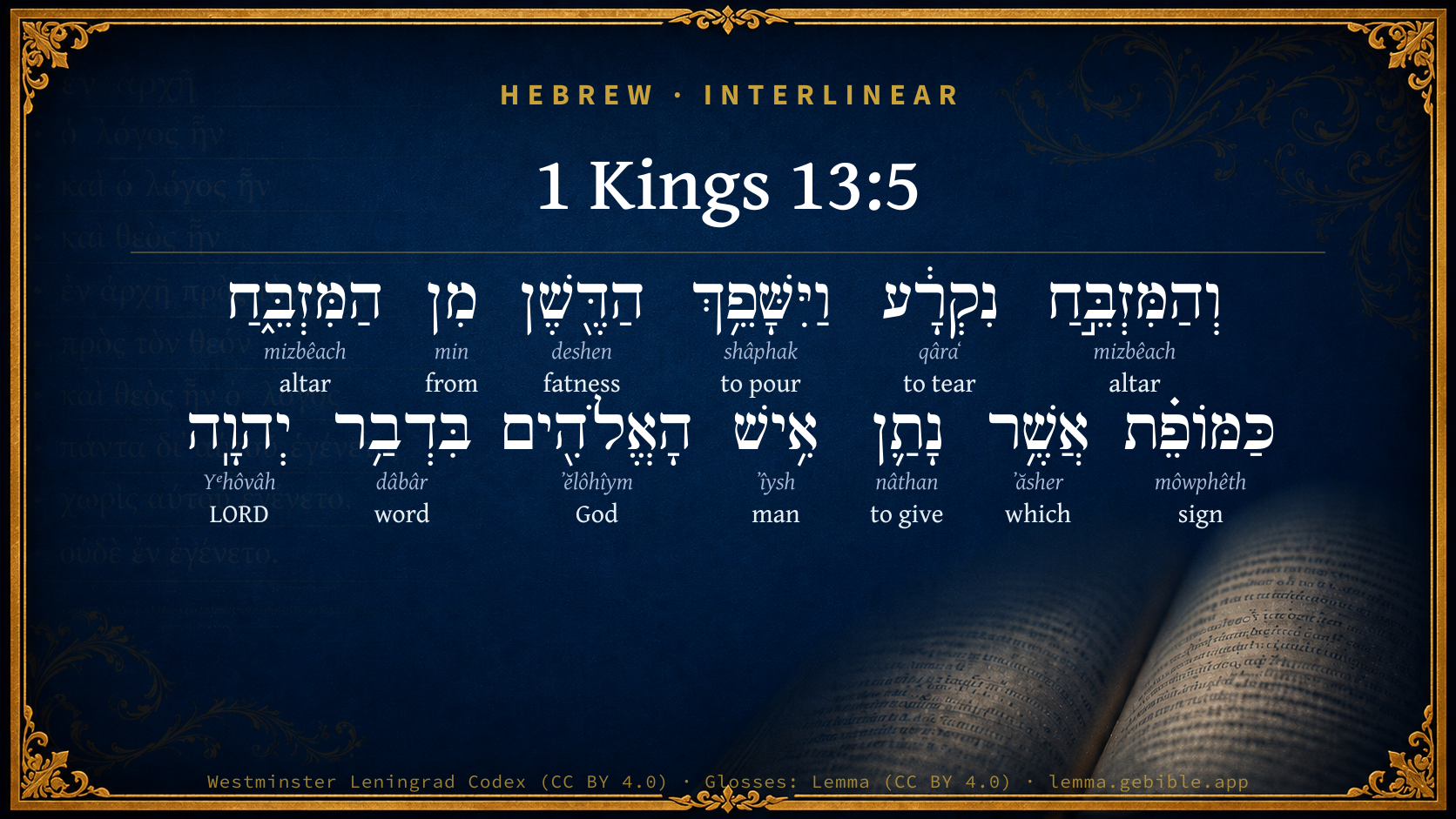
Hebrew (Westminster Leningrad Codex) 1 Kings 13:5 appears in the Hebrew Old Testament. The text above is from the Westminster Leningrad Codex. Each word links to its Strong’s number, a concise gloss, and parsing drawn from the Open Scriptures Hebrew Bible morphology. Click any word for its full Brown-Driver-Briggs (BDB) entry.
Download image
Cite this verse

1 Kings 13:5 (World English Bible). Public Domain. Lemma interlinear Bible study tool, https://lemma.gebible.app/v/1-kings/13/5.

Show BibTeX & RIS
BibTeX
RIS
English Translation
The altar also was torn, and the ashes poured out from the altar, according to the sign which the man of God had given by the word of Yahweh.
World English Bible · Public Domain
Download a study sheet

One document with this verse’s original text, its word-by-word gloss line, the meaning frame, cross-references with their text, attributed commentary, and full source and license credits — printable, and it pastes into notes with its structure intact.

This verse Autodidact and up

Study sheet (.html) Plain text (.txt)

A passage Seminary Student

Up to 50 verses in one chapter. A passage sheet keeps up to 6 commentary sources and 12 cross-references per verse, in the order this page ranks them, and says so on the sheet whenever that leaves anything out. Ask for a single verse and you get the Autodidact verse sheet above.

Everything on this page stays free to read, with no account — the sheet is a download of what is already on screen, not access to it.

Want to remove ads? Support Godless Engineer
Compare translations 3

The same verse in 3 English versions, stacked beneath the original-language interlinear above. Click any original word for its lexicon entry.

Each is an independent rendering of the whole verse — the interlinear is not word-aligned to these translations.

Highlighted words mark where these versions differ — a whole-verse word diff, not a word-by-word alignment.

  • World English Bible Public Domain
    The altar also was torn, and the ashes poured out from the altar, according to the sign which the man of God had given by the word of Yahweh.
  • King James Version Public Domain
    The altar also was rent, and the ashes poured out from the altar, according to the sign which the man of God had given by the word of the LORD.
  • unfoldingWord Literal Text CC BY-SA 4.0
    And the altar was split open, and the ash was poured out from the altar, according to the sign that the man of God had given by the word of Yahweh.

unfoldingWord Literal Text — © unfoldingWord, licensed CC BY-SA 4.0. Word-aligned USFM3 via Door43 (git.door43.org/unfoldingWord/en_ult).

Versions to compare (up to 4)

3 of 4 selected

Show all 18 translations

Every available English version of this verse, each an independent rendering of the whole verse.

  • World English Bible Public Domain
    The altar also was torn, and the ashes poured out from the altar, according to the sign which the man of God had given by the word of Yahweh.
  • Berean Standard Bible Public Domain
    And the altar was split apart, and the ashes poured out, according to the sign that the man of God had given by the word of the LORD.
  • Majority Standard Bible Public Domain
    And the altar was split apart, and the ashes poured out, according to the sign that the man of God had given by the word of the LORD.
  • King James Version Public Domain
    The altar also was rent, and the ashes poured out from the altar, according to the sign which the man of God had given by the word of the LORD.
  • American Standard Version (1901) Public Domain
    The altar also was rent, and the ashes poured out from the altar, according to the sign which the man of God had given by the word of Jehovah.
  • Revised Version (1885) Public Domain
    The altar also was rent, and the ashes poured out from the altar, according to the sign which the man of God had given by the word of the LORD.
  • Geneva Bible (1599) Public Domain
    The altar also claue asunder, and the ashes fell out from the altar, according to the signe, which the man of God had giuen by the commandement of the Lord.
  • Douay-Rheims (1899) Public Domain
    The altar also was rent, and the ashes were poured out from the altar, according to the sign which the man of God had given before in the word of the Lord.
  • Young's Literal Translation Public Domain
    and the altar is rent, and the ashes poured forth from the altar, according to the sign that the man of God had given by the word of Jehovah.
  • Literal Standard Version CC BY-SA 4.0
    and the altar is torn, and the ashes [are] poured forth from the altar, according to the sign that the man of God had given by the word of YHWH.
  • Unlocked Literal Bible CC BY-SA 4.0
    (The altar was also split apart and the ashes poured out from the altar, as described by the sign that the man of God had given by the word of Yahweh.)
  • unfoldingWord Literal Text CC BY-SA 4.0
    And the altar was split open, and the ash was poured out from the altar, according to the sign that the man of God had given by the word of Yahweh.
  • Darby Bible Public Domain
    And the altar was rent, and the ashes poured out from the altar, according to the sign that the man of God had given by the word of Jehovah.
  • World Messianic Bible Public Domain
    The altar was also split apart, and the ashes poured out from the altar, according to the sign which the man of God had given by the LORD’s word.
  • Webster's Bible Public Domain
    The altar also was rent, and the ashes poured out from the altar, according to the sign which the man of God had given by the word of the LORD.
  • Free Bible Version CC BY-SA 4.0
    The altar split apart, and the ashes spilled out from it, fulfilling the sign that the man of God had given from the Lord.
  • Bible in Basic English Public Domain
    And the altar was broken and the burned waste on it overturned; this was the sign which the man of God had given by the word of the Lord.
  • JPS Tanakh (1917) Public Domain
    The altar also was rent, and the ashes poured out from the altar, according to the sign which the man of God had given by the word of the LORD.

Literal Standard Version (2020), Covenant Press — licensed CC BY-SA 4.0. Text via the HelloAO Bible API (eBible.org). Unlocked Literal Bible (unfoldingWord) — licensed CC BY-SA 4.0. Text via the HelloAO Bible API (eBible.org). unfoldingWord Literal Text — © unfoldingWord, licensed CC BY-SA 4.0. Word-aligned USFM3 via Door43 (git.door43.org/unfoldingWord/en_ult). Free Bible Version, Dr. Jonathan Gallagher — licensed CC BY-SA 4.0. Text via the HelloAO Bible API (eBible.org).

Word by word

More ways to search: Search by grammar → Find every occurrence → Compare this word →

Practice this passage: Drill this verse → Learn its vocabulary →

הַדֶּ֖שֶׁן
deshen
H1880
“the · fatness”
Particle, Definite Article + Noun, Common, Masculine, Singular, Absolute
Part of Speech
Particle + Noun
Type
Common
Gender
Masculine
Number
Singular
State
Absolute
Full BDB Definition

Origin: from H1878

TWOT: 457a

fat ashes, fatness - fatness - of fertility - of blessing (figuratively) - fat ashes (ashes of victims, mixed with the fat)
  1. וְהַמִּזְבֵּ֣חַ mizbêach H4196 “and · the · altar” Conjunction + Particle, Definite Article + Noun, Common, Masculine, Singular, Absolute
  2. נִקְרָ֔ע qâraʻ H7167 “to tear” Verb, Niphal, Perfect, 3rd Person, Masculine, Singular
  3. וַיִּשָּׁפֵ֥ךְ shâphak H8210 “and · to pour” Conjunction + Verb, Niphal, Sequential Imperfect, 3rd Person, Masculine, Singular
  4. מִן min H4480 “from” Preposition
  5. הַמִּזְבֵּ֑חַ mizbêach H4196 “the · altar” Particle, Definite Article + Noun, Common, Masculine, Singular, Absolute
  6. כַּמּוֹפֵ֗ת môwphêth H4159 “like/as the · sign” Preposition, Determined + Noun, Common, Masculine, Singular, Absolute
  7. אֲשֶׁ֥ר ʼăsher H834 “which” Particle, Relative
  8. נָתַ֛ן nâthan H5414 “to give” Verb, Qal, Perfect, 3rd Person, Masculine, Singular
  9. אִ֥ישׁ ʼîysh H376 “man of” Noun, Common, Masculine, Singular, Construct
  10. הָאֱלֹהִ֖ים ʼĕlôhîym H430 “the · God(s)” Particle, Definite Article + Noun, Common, Masculine, Plural, Absolute
  11. בִּדְבַ֥ר dâbâr H1697 “in/at · word of” Preposition + Noun, Common, Masculine, Singular, Construct
  12. יְהוָֽה Yᵉhôvâh H3068 “LORD” Noun, Proper

About this verse

These counts appear in no published source. They are computed here, from the morphology-tagged text and Lemma’s own curated glosses. What Lemma adds →

13
words
12
distinct lemmas
Historical
section

Notable vocabulary

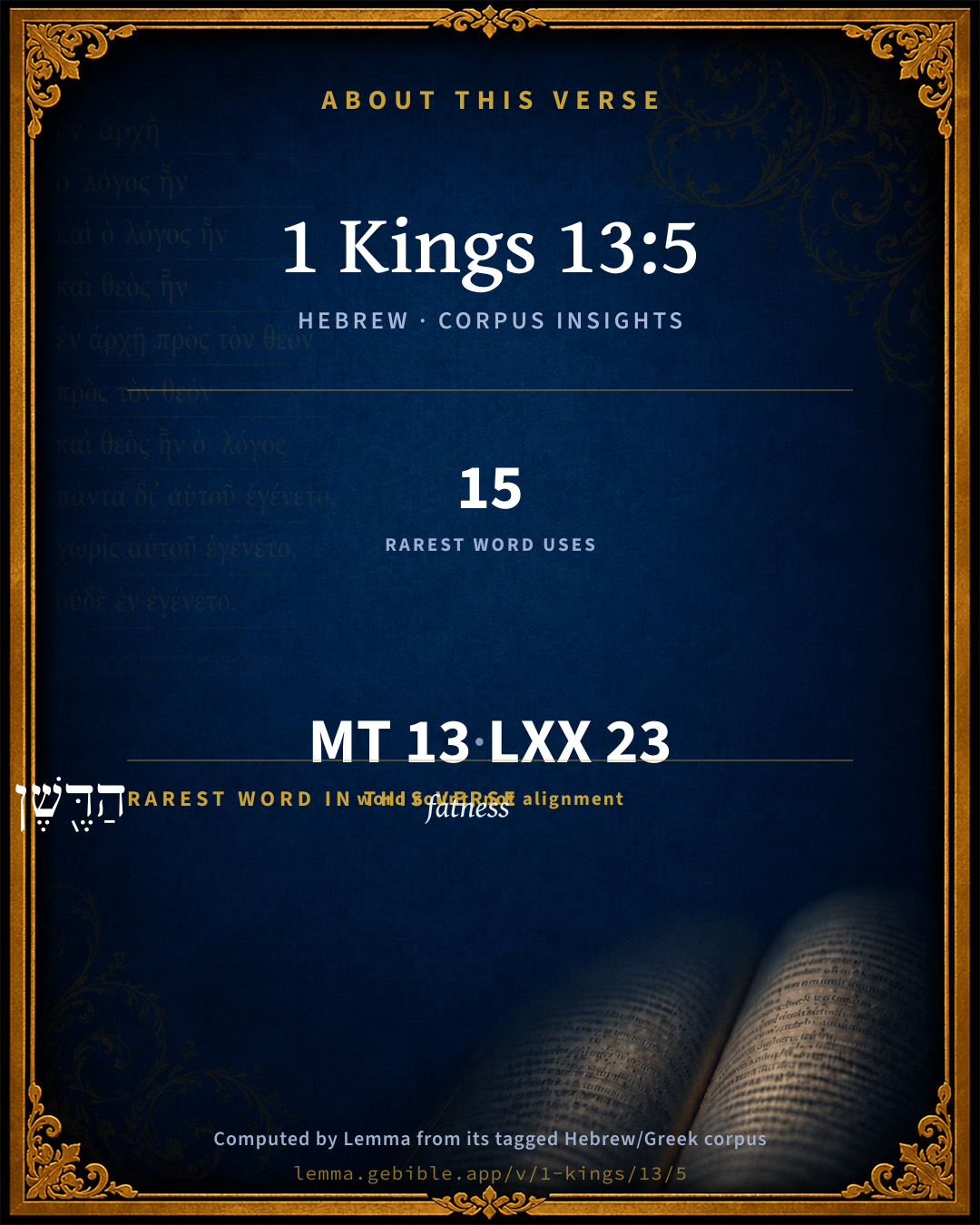
The rarest word here is הַדֶּ֖שֶׁן fatness H1880 — appearing just 15 times in the whole Hebrew Bible.

Shared distinctive vocabulary

הַדֶּ֖שֶׁן fatness H1880 occurs in 14 verses of the Hebrew Bible. Also found in:

Grammatical profile

  • 3 verbs
  • 8 nouns
  • 1 preposition
  • 1 particle

Verb forms

  • נִקְרָ֔ע Niphal · Perfect
  • וַיִּשָּׁפֵ֥ךְ Niphal · Sequential Imperfect
  • נָתַ֛ן Qal · Perfect

Repetition

A word recurs within this verse — often emphatic in Hebrew:

  • וְהַמִּזְבֵּ֣חַ altar H4196 ×2

Hebrew & Septuagint length

In English translation the verse runs 29 words from the Hebrew and 30 from the Septuagint (LXX English) — closely comparable.

A rough comparison of the two English renderings, which tokenize alike — not a word-level alignment.

Word counts can differ between the Hebrew and the Greek without any difference in meaning — e.g. the Hebrew direct-object marker אֵת has no separate Greek word, and Greek often adds the article ὁ.

In the original languages it is 13 Hebrew tokens and 23 Greek tokens — but the two are counted differently (Hebrew bundles its prefixes and suffixes into one token; the Greek is in lemma form), so that isn’t a like-for-like length.

Cross-references

9

Topical passages linked to 1 Kings 13:5 in the Treasury of Scripture Knowledge — connected by theme and wording, ordered by reader-vote popularity; previews shown in the World English Bible.

  • Exodus 9:18–25 Behold, tomorrow about this time I will cause it to rain a very grievous hail, such as has not been in Egypt since the day it was founded even until now.
  • Numbers 16:23–35 Yahweh spoke to Moses, saying,
  • Deuteronomy 18:22 when a prophet speaks in the name of Yahweh, if the thing doesn't follow, nor happen, that is the thing which Yahweh has not spoken: the prophet has spoken it presumptuously, you shall not be afraid of him.
  • 1 Kings 13:3 He gave a sign the same day, saying, This is the sign which Yahweh has spoken: Behold, the altar shall be torn, and the ashes that are on it shall be poured out.
  • 1 Kings 22:28 Micaiah said, If you return at all in peace, Yahweh has not spoken by me. He said, Hear, you peoples, all of you.
  • 1 Kings 22:35 The battle increased that day: and the king was stayed up in his chariot against the Syrians, and died at even; and the blood ran out of the wound into the bottom of the chariot.
  • Jeremiah 28:16–17 Therefore thus says Yahweh, Behold, I will send you away from off the surface of the earth: this year you shall die, because you have spoken rebellion against Yahweh.
  • Mark 16:20 They went out, and preached everywhere, the Lord working with them, and confirming the word by the signs that followed. Amen.
  • Acts 5:1–10 But a certain man named Ananias, with Sapphira, his wife, sold a possession,

Cross-references courtesy of OpenBible.info (CC BY 4.0).

Hebrew and Greek witnesses Masoretic Hebrew ↔ Greek Septuagint

The same verse in the two great witnesses to the Old Testament, shown verse-for-verse.

These are two independent witnesses, not word-aligned to each other, and the Septuagint is shown in lemma (dictionary) form.

Hebrew 1 Kings 13:5 Masoretic · Westminster Leningrad Codex

וְהַמִּזְבֵּ֣חַ נִקְרָ֔ע וַיִּשָּׁפֵ֥ךְ הַדֶּ֖שֶׁן מִן הַמִּזְבֵּ֑חַ כַּמּוֹפֵ֗ת אֲשֶׁ֥ר נָתַ֛ן אִ֥ישׁ הָאֱלֹהִ֖ים בִּדְבַ֥ר יְהוָֽה

The altar also was torn, and the ashes poured out from the altar, according to the sign which the man of God had given by the word of Yahweh.

World English Bible · Public Domain

Greek LXX 1 Kings 13:5 Septuagint · lemma form

καί ὁ θυσιαστήριον ῥήγνυμι καί ἐκχέω ὁ πιότης ἀπό ὁ θυσιαστήριον κατά ὁ τέρας ὅς δίδωμι ὁ ἄνθρωπος ὁ θεός ἐν λόγος κύριος

And the altar was torn, and the fatness was poured out from the altar, according to the sign which the man of God gave by the word of the Lord.

LXX2012 (modern English Septuagint) · Public Domain

Hebrew: Westminster Leningrad Codex (CC BY 4.0). Greek: Septuagint (public domain); English from LXX2012 (modern English Septuagint) (Public Domain). How the Septuagint differs from the Hebrew →

Targum (Aramaic paraphrase)

1

The Targum is the ancient Jewish Aramaic paraphrase of the Hebrew Scriptures — an interpretive translation, not the Hebrew text itself. Onkelos (literal) and Pseudo-Jonathan (expansive) render the Torah, and Jonathan the Prophets. Coverage is partial: where no permissively-licensed English translation exists for a verse, only the Aramaic is shown. This is verse-level text, not a word-by-word alignment to the Hebrew.

  1. Targum Jonathan Prophets (Joshua–Malachi)
    וּמַדְבְּחָא אִתְבְּזַע וְאִשְׁתַּפֵּיךְ קִטְמָא מִן מַדְבְּחָא כְּאָתָא דִיהַב נְבִיָא דַייָ בְּפִתְגָמָא דַיָי:

    (no public-domain English translation for this verse)

    Targum Jonathan — Aramaic: “Mikraot Gedolot” (public domain). English: “Sefaria Community Translation” (CC0 1.0 (public-domain dedication)); “London "Chaldee Paraphrase," 1871” (public domain). Text via Sefaria.

Commentary

Notes on 1 Kings 13:5 from classic Christian and Jewish commentators (each source and its license shown beneath its notes). The classic Christian expositions comment on the surrounding passage and are grouped to its opening verse, so a note may address several verses; the Jewish commentaries on the Tanakh (Rashi and others) are per-verse, so they appear only where the commentator wrote on this verse.

Lemma curates 59 commentaries, every one of them public domain or Creative Commons licensed, each selected and text-cleaned for this edition rather than reprinted as found. About our sources →

Trapp's Complete Commentary

John Trapp

1Ki 13:5 The altar also was rent, and the ashes poured out from the altar, according to the sign which the man of God had given by the word of the LORD.

Ver. 5. The altar was rent.] But not till the violence intended against God’s prophet was revenged: so dear to him are such, and so tender is he of their safety.

According to the sign.] This might have convinced and reclaimed those idolaters, had not their necks been possessed with an iron sinew.

John Trapp, A Commentary or Exposition upon All the Books of the Old and New Testament (1647–1656) — public domain. Text from a community e-Sword module.

Geneva Bible (1599)

Geneva Bible translators

Hebrew, mouth.

Geneva Bible (1599) marginal notes — public domain. Text via Bolls.life.

Adam Clarke's Commentary

Verse 5. The altar was also rent] It split or clave of its own accord; and, as the split parts would decline at the top from the line of their perpendicular, so the ashes and coals would fall off, or be poured out.

Adam Clarke's Commentary on the Bible (1810–1826) — public domain. Text from a community e-Sword/MySword module.

John Gill's Exposition

The altar also was rent,.... Split into two parts perhaps, and one fell one way, and the other another;

and the ashes poured out from the altar; the ashes of the burnt offering, these were spilled on the ground; all which was done without any outward force, or any visible means thereof:

according to the sign which the man of God had given by the word of the Lord; by his direction and order.

John Gill's Exposition of the Whole Bible (1746–1763) — public domain (CC PDM 1.0). Text via the HelloAO Bible API.

Albert Barnes' Notes on the Bible

We need not suppose a complete shattering of the altar, but rather the appearance of a crack or fissure in the fabric, which, extending from top to bottom, caused the embers and the fragments of the victims to fall until they reached the ground.

Albert Barnes' Notes on the Bible (1834–1885) — public domain. Text from a community e-Sword/MySword module.

The Pulpit Commentary

The altar also was rent by the same invisible power, and probably at the same moment, and the ashes poured out from the altar, according to the sign which the man of God had given by the word of the Lord.

The Pulpit Commentary (1880–1919), ed. H.D.M. Spence-Jones & Joseph S. Exell — public domain. Text from a community e-Sword module.

Lesson kit

Teaching starters — assembled from the data on this page, not authored interpretation. Every prompt links to the verse data it draws on. Edit before teaching.

1 Kings, in the Historical, opens this verse with 13 words (12 distinct Hebrew lemmas). Its most distinctive word is deshen (“fatness”). A historical commentator’s framing appears above. Read the whole chapter for the surrounding context.

Discussion questions

  1. What does “fatness” (deshen) contribute to the verse as a whole?
  2. Leviticus 1:16 shares the word «fatness» with this verse. How do the two illuminate each other?
  3. “altar” occurs 2× in this one verse. What is the effect of the repetition?
  4. These translations render this verse differently. What is at stake in choosing one wording over another?
  5. The verb «נִקְרָ֔ע» is Niphal Perfect. How does its form color the action?
  6. Reading how Trapp's Complete Commentary and Geneva Bible (1599) read this verse, where do the two commentators agree and where do they part?

Things to notice

Reading settings

Reading text

Shown beneath each verse's original-language words.

Old Testament
Old Testament edition

Read the OT as the Masoretic Hebrew (MT) or the Greek Septuagint (LXX).

English shown for the Greek Septuagint (in the Hebrew ↔ Greek comparison).

Comparing translations? Open the Compare panel on any verse page to stack up to four side by side.