Jeremiah 22:17

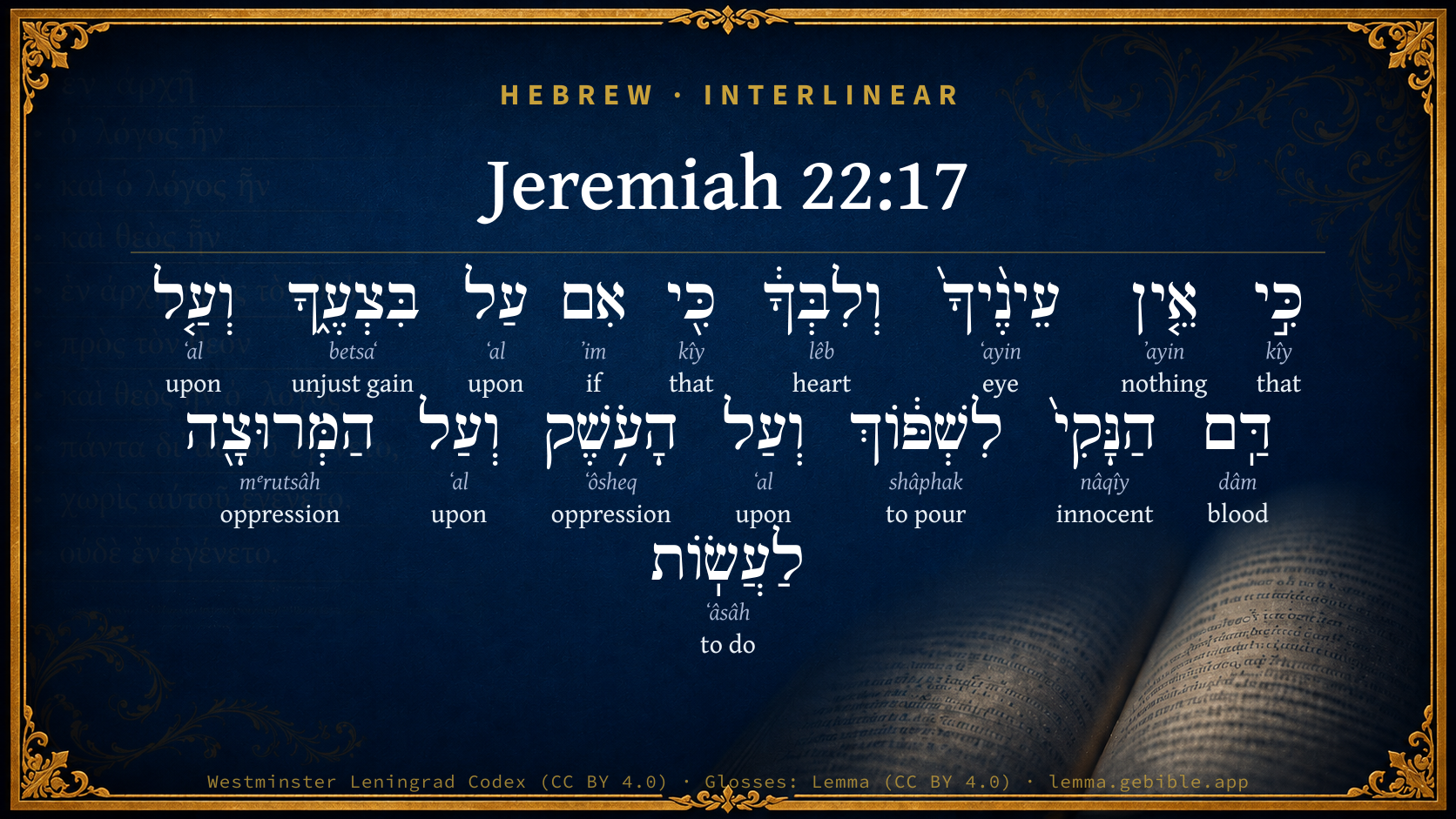
Hebrew (Westminster Leningrad Codex) Jeremiah 22:17 appears in the Hebrew Old Testament. The text above is from the Westminster Leningrad Codex. Each word links to its Strong’s number, a concise gloss, and parsing drawn from the Open Scriptures Hebrew Bible morphology. Click any word for its full Brown-Driver-Briggs (BDB) entry.
Download image
Cite this verse

Jeremiah 22:17 (World English Bible). Public Domain. Lemma interlinear Bible study tool, https://lemma.gebible.app/v/jeremiah/22/17.

Show BibTeX & RIS
BibTeX
RIS
English Translation
But your eyes and your heart are not but for your covetousness, and for shedding innocent blood, and for oppression, and for violence, to do it.
World English Bible · Public Domain
Highlights
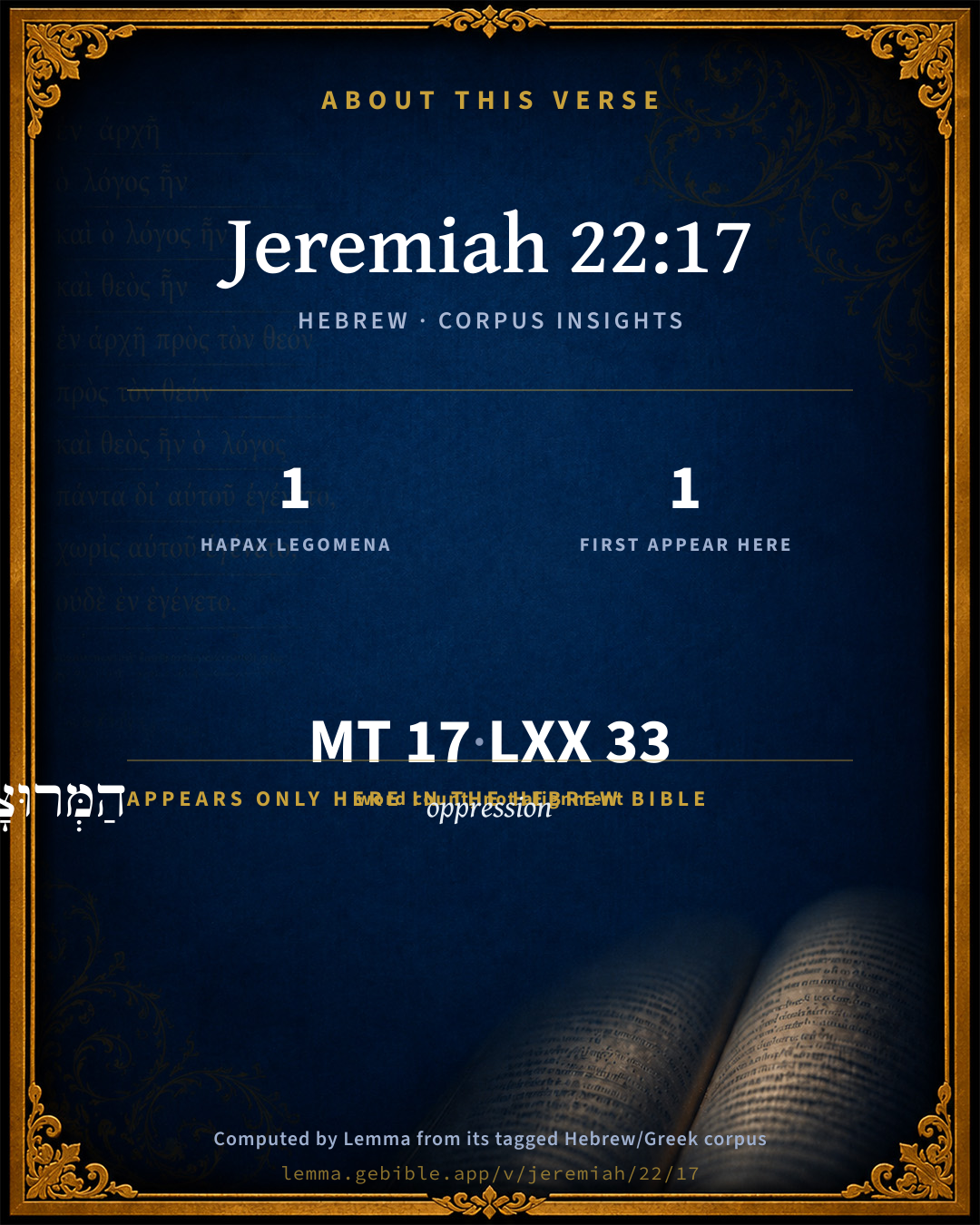
  • 1 hapax legomenon — only here in the Hebrew Bible
  • 1 first appearance in the Hebrew Bible
Full analysis ↓
Download a study sheet

One document with this verse’s original text, its word-by-word gloss line, the meaning frame, cross-references with their text, attributed commentary, and full source and license credits — printable, and it pastes into notes with its structure intact.

This verse Autodidact and up

Study sheet (.html) Plain text (.txt)

A passage Seminary Student

Up to 50 verses in one chapter. A passage sheet keeps up to 6 commentary sources and 12 cross-references per verse, in the order this page ranks them, and says so on the sheet whenever that leaves anything out. Ask for a single verse and you get the Autodidact verse sheet above.

Everything on this page stays free to read, with no account — the sheet is a download of what is already on screen, not access to it.

Want to remove ads? Support Godless Engineer
Compare translations 3

The same verse in 3 English versions, stacked beneath the original-language interlinear above. Click any original word for its lexicon entry.

Each is an independent rendering of the whole verse — the interlinear is not word-aligned to these translations.

Highlighted words mark where these versions differ — a whole-verse word diff, not a word-by-word alignment.

  • World English Bible Public Domain
    But your eyes and your heart are not but for your covetousness, and for shedding innocent blood, and for oppression, and for violence, to do it.
  • King James Version Public Domain
    But thine eyes and thine heart are not but for thy covetousness, and for to shed innocent blood, and for oppression, and for violence, to do it.
  • unfoldingWord Literal Text CC BY-SA 4.0
    “But there is nothing in your eyes and your heart except upon your unjust gain, and upon the blood of the innocent to pour out, and upon oppression and upon extortion to do

unfoldingWord Literal Text — © unfoldingWord, licensed CC BY-SA 4.0. Word-aligned USFM3 via Door43 (git.door43.org/unfoldingWord/en_ult).

Versions to compare (up to 4)

3 of 4 selected

Show all 18 translations

Every available English version of this verse, each an independent rendering of the whole verse.

  • World English Bible Public Domain
    But your eyes and your heart are not but for your covetousness, and for shedding innocent blood, and for oppression, and for violence, to do it.
  • Berean Standard Bible Public Domain
    “But your eyes and heart are set on nothing except your own dishonest gain, on shedding innocent blood, on practicing extortion and oppression.”
  • Majority Standard Bible Public Domain
    “But your eyes and heart are set on nothing except your own dishonest gain, on shedding innocent blood, on practicing extortion and oppression.”
  • King James Version Public Domain
    But thine eyes and thine heart are not but for thy covetousness, and for to shed innocent blood, and for oppression, and for violence, to do it.
  • American Standard Version (1901) Public Domain
    But thine eyes and thy heart are not but for thy covetousness, and for shedding innocent blood, and for oppression, and for violence, to do it.
  • Revised Version (1885) Public Domain
    But thine eyes and thine heart are not but for thy covetousness, and for to shed innocent blood, and for oppression, and for violence, to do it.
  • Geneva Bible (1599) Public Domain
    But thine eyes and thine heart are but only for thy couetousnesse, and for to sheade innocent blood, and for oppression, and for destruction, euen to doe this.
  • Douay-Rheims (1899) Public Domain
    But thy eyes and thy heart are set upon covetousness, and upon shedding innocent blood, and upon oppression, and running after evil works.
  • Young's Literal Translation Public Domain
    But thine eyes and thy heart are not, Except on thy dishonest gain, And on shedding of innocent blood, And on oppression, and on doing of violence.
  • Literal Standard Version CC BY-SA 4.0
    “But your eyes and your heart are not, || Except on your dishonest gain, || And on shedding of innocent blood, || And on oppression, and on doing of violence.”
  • Unlocked Literal Bible CC BY-SA 4.0
    But there is nothing in your eyes and heart except worry for your unjust profit and for pouring out innocent blood, for producing oppression and crushing of others.
  • unfoldingWord Literal Text CC BY-SA 4.0
    “But there is nothing in your eyes and your heart except upon your unjust gain, and upon the blood of the innocent to pour out, and upon oppression and upon extortion to do
  • Darby Bible Public Domain
    But thine eyes and thy heart are only on thine extortion, and on the blood of the innocent, to shed it, and on oppression and on violence, to do it.
  • World Messianic Bible Public Domain
    But your eyes and your heart are only for your covetousness, for shedding innocent blood, for oppression, and for doing violence.”
  • Webster's Bible Public Domain
    But thy eyes and thy heart are only for thy covetousness, and for shedding innocent blood, and for oppression, and for violence, to do it.
  • Free Bible Version CC BY-SA 4.0
    But all you're looking for, all you think about, is getting whatever you want, however dishonestly. You kill the innocent, you violently mistreat and exploit your people.
  • Bible in Basic English Public Domain
    But your eyes and your heart are fixed only on profit for yourself, on causing the death of him who has done no wrong, and on violent and cruel acts.
  • JPS Tanakh (1917) Public Domain
    But thine eyes and thy heart are not but for thy covetousness, and for shedding innocent blood, and for oppression, and for violence, to do it.

Literal Standard Version (2020), Covenant Press — licensed CC BY-SA 4.0. Text via the HelloAO Bible API (eBible.org). Unlocked Literal Bible (unfoldingWord) — licensed CC BY-SA 4.0. Text via the HelloAO Bible API (eBible.org). unfoldingWord Literal Text — © unfoldingWord, licensed CC BY-SA 4.0. Word-aligned USFM3 via Door43 (git.door43.org/unfoldingWord/en_ult). Free Bible Version, Dr. Jonathan Gallagher — licensed CC BY-SA 4.0. Text via the HelloAO Bible API (eBible.org).

Word by word

More ways to search: Search by grammar → Find every occurrence → Compare this word →

Practice this passage: Drill this verse → Learn its vocabulary →

הַמְּרוּצָ֖ה
mᵉrutsâh
H4835
“the · oppression”
Particle, Definite Article + Noun, Common, Feminine, Singular, Absolute
Part of Speech
Particle + Noun
Type
Common
Gender
Feminine
Number
Singular
State
Absolute
Full BDB Definition

Origin: from H7533

TWOT: 2212b

crushing, oppression
  1. כִּ֣י kîy H3588 “that” Conjunction
  2. אֵ֤ין ʼayin H369 “nothing” Particle, Negative
  3. עֵינֶ֨יךָ֙ ʻayin H5869 “eyes · your” Noun, Common, Both, Dual, Construct + Suffix, Personal, 2nd Person, Masculine, Singular
  4. וְלִבְּךָ֔ lêb H3820 “and · heart · your” Conjunction + Noun, Common, Masculine, Singular, Construct + Suffix, Personal, 2nd Person, Masculine, Singular
  5. כִּ֖י kîy H3588 “that” Conjunction
  6. אִם ʼim H518 “if” Conjunction
  7. עַל ʻal H5921 “upon” Preposition
  8. בִּצְעֶ֑ךָ betsaʻ H1215 “unjust gain · your” Noun, Common, Masculine, Singular, Construct + Suffix, Personal, 2nd Person, Masculine, Singular
  9. וְעַ֤ל ʻal H5921 “and · upon” Conjunction + Preposition
  10. דַּֽם dâm H1818 “blood of” Noun, Common, Masculine, Singular, Construct
  11. הַנָּקִי֙ nâqîy H5355 “the · innocent” Particle, Definite Article + Adjective, Adjective, Masculine, Singular, Absolute
  12. לִשְׁפּ֔וֹךְ shâphak H8210 “to pour” Preposition + Verb, Qal, Infinitive Construct
  13. וְעַל ʻal H5921 “and · upon” Conjunction + Preposition
  14. הָעֹ֥שֶׁק ʻôsheq H6233 “the · oppression” Particle, Definite Article + Noun, Common, Masculine, Singular, Absolute
  15. וְעַל ʻal H5921 “and · upon” Conjunction + Preposition
  16. לַעֲשֽׂוֹת ʻâsâh H6213 “to do” Preposition + Verb, Qal, Infinitive Construct

About this verse

These counts appear in no published source. They are computed here, from the morphology-tagged text and Lemma’s own curated glosses. What Lemma adds →

17
words
13
distinct lemmas
Prophets
section

Notable vocabulary

1 hapax legomenon — a word that appears only here in the entire Hebrew Bible:

  • הַמְּרוּצָ֖ה oppression H4835

First appearance in Scripture

This word makes its first canonical appearance in the Hebrew Bible here:

  • הַמְּרוּצָ֖ה oppression H4835

Shared distinctive vocabulary

הָעֹ֥שֶׁק oppression H6233 occurs in 15 verses of the Hebrew Bible. Also found in:

Grammatical profile

  • 2 verbs
  • 6 nouns
  • 1 adjective
  • 4 prepositions
  • 3 conjunctions
  • 1 particle

Verb forms

  • לִשְׁפּ֔וֹךְ Qal · Infinitive Construct
  • לַעֲשֽׂוֹת Qal · Infinitive Construct

Repetition

Words recur within this verse — often emphatic in Hebrew:

Hebrew & Septuagint length

In the original languages it is 17 Hebrew tokens and 33 Greek tokens — but the two are counted differently (Hebrew bundles its prefixes and suffixes into one token; the Greek is in lemma form), so that isn’t a like-for-like length.

Cross-references

25

Topical passages linked to Jeremiah 22:17 in the Treasury of Scripture Knowledge — connected by theme and wording, ordered by reader-vote popularity; previews shown in the World English Bible.

  • 2 Kings 24:4 and also for the innocent blood that he shed; for he filled Jerusalem with innocent blood: and Yahweh would not pardon.
  • Jeremiah 22:3 Thus says Yahweh: Execute you justice and righteousness, and deliver him who is robbed out of the hand of the oppressor: and do no wrong, do no violence, to the foreigner, the fatherless, nor the widow; neither shed innocent blood in this place.
  • Ezekiel 19:6 He went up and down among the lions; he became a young lion, and he learned to catch the prey; he devoured men.
  • 2 Peter 2:14 having eyes full of adultery, and who can't cease from sin; enticing unsettled souls; having a heart trained in greed; children of cursing;
  • Psalms 10:3 For the wicked boasts of his heart's cravings, He blesses the greedy, and condemns Yahweh.
  • Ezekiel 33:31 They come to you as the people comes, and they sit before you as my people, and they hear your words, but don't do them; for with their mouth they show much love, but their heart goes after their gain.
  • Exodus 18:21 Moreover you shall provide out of all the people able men, such as fear God: men of truth, hating unjust gain; and place such over them, to be rulers of thousands, rulers of hundreds, rulers of fifties, and rulers of tens.
  • Joshua 7:21 when I saw among the spoil a goodly Babylonian mantle, and two hundred shekels of silver, and a wedge of gold of fifty shekels weight, then I coveted them, and took them; and, behold, they are hid in the earth in the midst of my tent, and the silver under it.
  • 1 Kings 21:19 You shall speak to him, saying, Thus says Yahweh, Have you killed and also taken possession? You shall speak to him, saying, Thus says Yahweh, In the place where dogs licked the blood of Naboth shall dogs lick your blood, even yours.
  • 2 Chronicles 36:8 Now the rest of the acts of Jehoiakim, and his abominations which he did, and that which was found in him, behold, they are written in the book of the kings of Israel and Judah: and Jehoiachin his son reigned in his place.
  • Job 31:7 If my step has turned out of the way, If my heart walked after my eyes, If any defilement has stuck to my hands,
  • Psalms 119:36–37 Turn my heart toward your statutes, Not toward selfish gain.
  • Jeremiah 26:22–24 and Jehoiakim the king sent men into Egypt, [namely], Elnathan the son of Achbor, and certain men with him, into Egypt;
  • Zephaniah 3:3 Her princes in the midst of her are roaring lions. Her judges are evening wolves. They leave nothing until the next day.
  • Mark 7:21–22 For from within, out of the hearts of men, proceed evil thoughts, adulteries, sexual sins, murders, thefts,
  • Luke 12:15–21 He said to them, "Beware! Keep yourselves from covetousness, for a man's life doesn't consist of the abundance of the things which he possesses."
  • Luke 16:13–14 No servant can serve two masters, for either he will hate the one, and love the other; or else he will hold to one, and despise the other. You aren't able to serve God and mammon."
  • Romans 1:29 being filled with all unrighteousness, sexual immorality, wickedness, covetousness, maliciousness; full of envy, murder, strife, deceit, evil habits, secret slanderers,
  • 1 Corinthians 6:10 nor thieves, nor covetous, nor drunkards, nor slanderers, nor extortioners, will inherit the Kingdom of God.
  • Ephesians 5:3–5 But sexual immorality, and all uncleanness, or covetousness, let it not even be mentioned among you, as becomes saints;
  • Colossians 3:5 Put to death therefore your members which are on the earth: sexual immorality, uncleanness, depraved passion, evil desire, and covetousness, which is idolatry;
  • James 1:14–15 But each one is tempted, when he is drawn away by his own lust, and enticed.
  • 2 Peter 2:3 In covetousness they will exploit you with deceptive words: whose sentence now from of old doesn't linger, and their destruction will not slumber.
  • 1 Timothy 6:9–10 But those who are determined to be rich fall into a temptation and a snare and many foolish and harmful lusts, such as drown men in ruin and destruction.
  • 1 John 2:15–16 Don't love the world, neither the things that are in the world. If anyone loves the world, the Father's love isn't in him.

Cross-references courtesy of OpenBible.info (CC BY 4.0).

Hebrew and Greek witnesses Masoretic Hebrew ↔ Greek Septuagint

The same verse in the two great witnesses to the Old Testament, shown verse-for-verse.

These are two independent witnesses, not word-aligned to each other, and the Septuagint is shown in lemma (dictionary) form.

Hebrew Jeremiah 22:17 Masoretic · Westminster Leningrad Codex

כִּ֣י אֵ֤ין עֵינֶ֨יךָ֙ וְלִבְּךָ֔ כִּ֖י אִם עַל בִּצְעֶ֑ךָ וְעַ֤ל דַּֽם הַנָּקִי֙ לִשְׁפּ֔וֹךְ וְעַל הָעֹ֥שֶׁק וְעַל הַמְּרוּצָ֖ה לַעֲשֽׂוֹת

But your eyes and your heart are not but for your covetousness, and for shedding innocent blood, and for oppression, and for violence, to do it.

World English Bible · Public Domain

Greek LXX Structure differs

In the Septuagint, Jeremiah is about an eighth shorter than the Hebrew and arranges its material differently — the Oracles Against the Nations (Hebrew chapters 46–51) appear in the middle of the Greek book, after 25:13. Because the chapter and verse boundaries do not line up, a verse-for-verse comparison with the Hebrew is not shown.

A verse-for-verse comparison isn’t shown here because the chapters and verses don’t line up. Switch to the LXX edition with the MT / LXX toggle above to read the Greek directly.

Hebrew: Westminster Leningrad Codex (CC BY 4.0). Greek: Septuagint (public domain); English from a public-domain English Septuagint. How the Septuagint differs from the Hebrew →

Targum (Aramaic paraphrase)

1

The Targum is the ancient Jewish Aramaic paraphrase of the Hebrew Scriptures — an interpretive translation, not the Hebrew text itself. Onkelos (literal) and Pseudo-Jonathan (expansive) render the Torah, and Jonathan the Prophets. Coverage is partial: where no permissively-licensed English translation exists for a verse, only the Aramaic is shown. This is verse-level text, not a word-by-word alignment to the Hebrew.

  1. Targum Jonathan Prophets (Joshua–Malachi)
    אֲרֵי לֵית עֵינָךְ וְלִבָּךְ אֱלָהֵין עַל מָמוֹנָא לְמֵינַס וְעַל דַם זַכָּאי לְמִשְׁפַּךְ וְעַל עוּשְׁקָא וְעַל דְבִרְעוּת נַפְשָׁךְ לְמֶעְבַּד:

    (no public-domain English translation for this verse)

    Targum Jonathan — Aramaic: “Mikraot Gedolot” (public domain). English: “Sefaria Community Translation” (CC0 1.0 (public-domain dedication)); “London "Chaldee Paraphrase," 1871” (public domain). Text via Sefaria.

Commentary

Notes on Jeremiah 22:17 from classic Christian and Jewish commentators (each source and its license shown beneath its notes). The classic Christian expositions comment on the surrounding passage and are grouped to its opening verse, so a note may address several verses; the Jewish commentaries on the Tanakh (Rashi and others) are per-verse, so they appear only where the commentator wrote on this verse.

Lemma curates 59 commentaries, every one of them public domain or Creative Commons licensed, each selected and text-cleaned for this edition rather than reprinted as found. About our sources →

Trapp's Complete Commentary

John Trapp

Jer 22:17 But thine eyes and thine heart [are] not but for thy covetousness, and for to shed innocent blood, and for oppression, and for violence, to do [it].

Ver. 17. But thine eyes and thy heart are not but for thy covetousness.] That is all thou mindest and lookest after, oculis atque animo intentus ad rem. "Hearts they have," saith Peter of such, "exercised with covetous practices: cursed children." {2Pe 2:14} William Rufus is in story noted for such another.

John Trapp, A Commentary or Exposition upon All the Books of the Old and New Testament (1647–1656) — public domain. Text from a community e-Sword module.

Joseph Benson's Commentary

Jer 22:17. But thine eyes and thy heart are not but for thy covetousness — They are for that, and for nothing else. For this cause Jehoiakim is compared to a lion, by the Prophet Eze 19:6. Observe, reader, in covetousness the heart walks after the eyes, Job 31:7; it is therefore called the lust of the eye, 1Jn 2:15 : and the eyes and the heart are then for covetousness when the aims and affections are set upon the wealth of this world; and when they are so the temptation is strong to fraud, oppression, and all manner of violence and villany, even, as it is here said, to shed innocent blood.

Joseph Benson's Commentary on the Old and New Testaments (1811–1818) — public domain. Text from a community e-Sword module.

Tyndale Open Study Notes

Tyndale Open Resources

22:17 Unlike his father, Josiah, Jehoiakim practiced greed and dishonesty and ignored the requirements of the covenant.

Tyndale Open Study Notes — © Tyndale Open Resources, licensed CC BY-SA 4.0. Text via the HelloAO Bible API.

Jamieson, Fausset & Brown

Robert Jamieson, A. R. Fausset & David Brown

thine--as opposed to thy father, Josiah.

Jamieson, Fausset & Brown — Commentary Critical and Explanatory on the Whole Bible (1871) — public domain (CC PDM 1.0). Text via the HelloAO Bible API.

John Calvin's Commentaries

Here the Prophet expresses more clearly how much Jehoiakim differed from Josiah his father. He indeed shews that he was wholly unlike him, because Josiah had endeavored to observe what was equitable, while he set all his thoughts on fraud, plunder, and cruelty; for by the eye and the heart he means all the faculties of his soul and body. One of the main senses of the body, as it is well known, is the sight. Hence the Prophet includes here whatever is external and internal in men, when he says, thine eye, that is, all thy bodily senses are set on covetousness, and also thine heart, that is, all thy thoughts, feelings, designs, meditations, and purposes are employed in the same way. He intimates, in short, that Jehoiakim was corrupt both in body and mind, so that having cast aside every fear of God, he abandoned himself to avarice as well as to plunder and all acts of oppression. Thine eye, he says, and thy heart is not, except on covetousness

The verb בצע, betso, means to covet; hence the noun signifies not only avarice, but also any sinful lust. He adds cruelty, for it, cannot be but that all are bloody who give loose reins to their lusts. He mentions in the third place rapacity, or violent seizure; for עשק, oshek, means to take by force what belongs to another; hence the noun signifies rapacity. What follows in the last place is oppression, or disquietude. As רוף, ruts, means to run, Jerome renders it “the course of thy work,” as though ל, lamed, prefixed to עשות, oshut, were not one of the serviles, ם, ל, כ, ב, beth, caph, lamed, mem, but this cannot be admitted. The clear meaning of the Prophet indeed is, that Jehoiakim was not only intent on taking possession on what belonged to others, but that he also oppressed and distressed all he could. It is lastly added, to do; the verb to do is to be applied to what has gone before, that Jehoiakim employed all his thoughts, and was wholly engaged in evil deeds, that he not only contrived acts of cruelty and of avariciousness in his mind, but also carried fully into execution what he had contrived. It follows, —

John Calvin's Commentaries (1540-1563) — public domain. Text from the Calvin Translation Society English edition (1840s-50s) via the Christian Classics Ethereal Library (ccel.org). Calvin's coverage is partial (roughly two-thirds of the Bible); uncommented books and verses are honest gaps, never fabricated. The 19th-century editor's footnotes and remarks are omitted so the notes are faithfully Calvin's own voice.

Ellicott's Commentary for English Readers

(17) Thy covetousness.—More literally, thy gain, the word used implying (as in Jer_6:13; Jer_8:10) the idea of violence and oppression as the means by which it was obtained. The verb from which the noun is derived is so translated—“ violence” (literally, “crushing”)—in Deu_28:33. The marginal reading, “incursion,” has nothing to commend it. In “the blood of the innocent” here, as in Jer_22:3, we have an allusive reference to many, for the most part unrelenting, acts of cruelty. One of these, the murder of Urijah, meets us in Jer_26:23.

A Bible Commentary for English Readers, edited by Charles John Ellicott (1878–1897) — public domain. Text from a community e-Sword module.

The Cambridge Bible for Schools and Colleges

gen. ed. J. J. S. Perowne

17. covetousness] better as mg. dishonest gain. Jehoiakim “remained fixed in the recollections of his countrymen, as the last example of those cruel, selfish, luxurious princes, the natural product of Oriental monarchies, the disgrace of the monarchy of David.” (Stanley, J. Ch. II. 448.)

The Cambridge Bible for Schools and Colleges (gen. ed. J. J. S. Perowne; Cambridge University Press, 1878–1918) — public domain. Text from a community e-Sword module.

John Gill's Exposition

But thine eyes and thine heart are not but for thy covetousness,.... He was wholly intent upon gratifying that lust; his heart was meditating, contriving, and forming schemes for that purpose; and his eyes were looking out here and there for proper objects and opportunities to exercise it:

and for to shed innocent blood; in order to get their money, goods, and possessions into his hands; avarice often leads to murder:

and for oppression, and for violence, to do it; by making incursions, and seizing upon the properties of men, and converting them to his own use; so true it is, that covetousness, or the love of money, is the root of all evil, Ti1 6:10.

John Gill's Exposition of the Whole Bible (1746–1763) — public domain (CC PDM 1.0). Text via the HelloAO Bible API.

Albert Barnes' Notes on the Bible

Covetousness - literally, gain. Besides exacting forced labor Jehoiakim, to procure the necessary means for the vast expenses he incurred, put innocent people to death on various pretexts, and escheated their property.

Albert Barnes' Notes on the Bible (1834–1885) — public domain. Text from a community e-Sword/MySword module.

Matthew Poole's English Annotations

All that thou lookest after, and that thy heart is set upon, is thy own grandeur and riches. And to make thyself great, thou makest no difficulty to destroy thy subjects that are innocent, and have not deserved death, and to oppress others, using all manner of violence against them. It is not to be thought that Jehoiakim did all this in person, but by such corrupt and unjust judges as he set up; so God accounted that Ahab had killed and taken possession, 1Ki 21:19, though the elders and nobles were those that did it, 1Ki 21:11-13. Princes are responsible to God for the sins of their ministers and judges.

Matthew Poole's English Annotations on the Holy Bible (1683–1685) — public domain. Text from a community e-Sword/MySword module.

Whedon's Commentary on the Bible

Daniel D. Whedon

17. But thine eyes, etc. — Thou rulest for thine own selfish emolument or cruel and revengeful gratification; thy father ruled for the good of his people.

Daniel D. Whedon (gen. ed.), Commentary on the Old and New Testaments (1874–1909) — public domain. Text from a community e-Sword module.

The Pulpit Commentary

But thou, O Jehoiakim, art the opposite of thy father. For (not, But) thine eyes and thine heart are not but for thy covetousness. "Covetousness" includes the ideas of injustice and violence; (comp. Jer_6:13 Jer_8:10) hence the second half of the verse emphasizes the cruel tyranny which marked the internal policy of Jehoiakim.

The Pulpit Commentary (1880–1919), ed. H.D.M. Spence-Jones & Joseph S. Exell — public domain. Text from a community e-Sword module.

unfoldingWord translationNotes

Door43 World Missions Community

there is nothing in your eyes and heart except worry ... crushing of others

Here "eyes" is a metonym for seeing and "heart" is a metonym for thinking. AT: "you never look for or think about anything except ... crushing of others" or "you only look for and think about ways to cheat others and pour out innocent blood, and to oppress and crush others" (See: Metonymy)

unjust profit

This is getting money by cheating or by using unfair means.

pouring out innocent blood

Here "pouring out ... blood" is associated with murder, and "blood" refers to the murdered people. AT: "murdering innocent people" (See: Idiom and Synecdoche)

crushing of others

"doing violence to others in order to get money"

They will not lament for him

In verse 18, Yahweh stops speaking directly to Jehoiakim and begins to speak to other people. Here "lament" refers to grieving at Jehoiakim's death. AT: "They will not lament for Jehoiakim when he dies" (See: Ellipsis)

Woe, my brother! ... Woe, my sister! ... Woe, master! ... Woe, majesty!

Yahweh uses the word "Woe" several times for emphasis. He addresses the various people who would normally show great sadness when someone dies. (See: Parallelism)

He will be buried with a donkey's burial, dragged away and thrown out

The burial of Jehoiakim is spoken of as being the same as the manner in which people would bury a donkey. This can be stated in active form. AT: "They will bury his dead body the way they would bury a dead donkey; they will drag it away and throw it out" (See: Metaphor and Active or Passive)

translationWords

heart

profit

innocent

blood

oppress

Jehoiakim

king

Judah

lament

lord

majesty

bury

donkey

gate

Jerusalem

unfoldingWord translationNotes — © Distant Shores Media and the Door43 World Missions Community, licensed CC BY-SA 4.0. Source: git.door43.org/Door43/en_tn.

Rashi

Rabbi Shlomo Yitzchaki (Rashi)

on your gain to steal money.

the crushing the crushing of the poor, and עֹשֶק, oppression proves it, for ‘oppressed’ and ‘crushed’ are always juxtaposed in the language of the Scriptures. Cf. (I Sam. 12: 3) “Whom did I oppress or whom did I crush?”

Rashi on the Tanakh — English translations: “The Judaica Press complete Tanach with Rashi, translated by A. J. Rosenberg” (CC BY 4.0); “Pentateuch with Rashi's commentary by M. Rosenbaum and A.M. Silbermann, 1929-1934” (public domain); “The Metsudah Tanach series, Lakewood, N.J” (CC BY 4.0); and “The Book of Joshua, Metsudah Publications, 1997” (CC BY 4.0). Text via Sefaria.

Lesson kit

Teaching starters — assembled from the data on this page, not authored interpretation. Every prompt links to the verse data it draws on. Edit before teaching.

Jeremiah, in the Prophets, opens this verse with 17 words (13 distinct Hebrew lemmas). Its most distinctive word is mᵉrutsâh (“oppression”). A historical commentator’s framing appears above. Read the whole chapter for the surrounding context.

Discussion questions

  1. What does “oppression” (mᵉrutsâh) contribute to the verse as a whole?
  2. 1 word here appears nowhere else in the Hebrew Bible. Why might the author reach for such rare wording?
  3. This is the first place “oppression” appears in Scripture (first appears here). What does its debut here establish?
  4. How does Leviticus 6:4, which shares the word «oppression», read alongside this verse?
  5. What does the repetition of “upon” (4× in this one verse) do in this verse?
  6. The translations on this page render this verse differently — a whole-verse word diff, not a word-by-word alignment. What might account for the different wordings?
  7. «לִשְׁפּ֔וֹךְ» is a Qal Infinitive Construct verb. How does that grammatical form shape the action described?
  8. Compare how Trapp's Complete Commentary and Joseph Benson's Commentary read this verse. Where do they agree or differ?

Things to notice

  • 1 word in this verse appears nowhere else in the Hebrew Bible.
  • 1 word makes its first canonical appearance in Scripture here.
  • This verse counts 17 Hebrew ↔ 33 Greek words.
  • These translations choose different wording for 13 words in this verse.
  • “upon” occurs 4× in this single verse.

Reading settings

Reading text

Shown beneath each verse's original-language words.

Old Testament
Old Testament edition

Read the OT as the Masoretic Hebrew (MT) or the Greek Septuagint (LXX).

English shown for the Greek Septuagint (in the Hebrew ↔ Greek comparison).

Comparing translations? Open the Compare panel on any verse page to stack up to four side by side.