Psalms 22:14

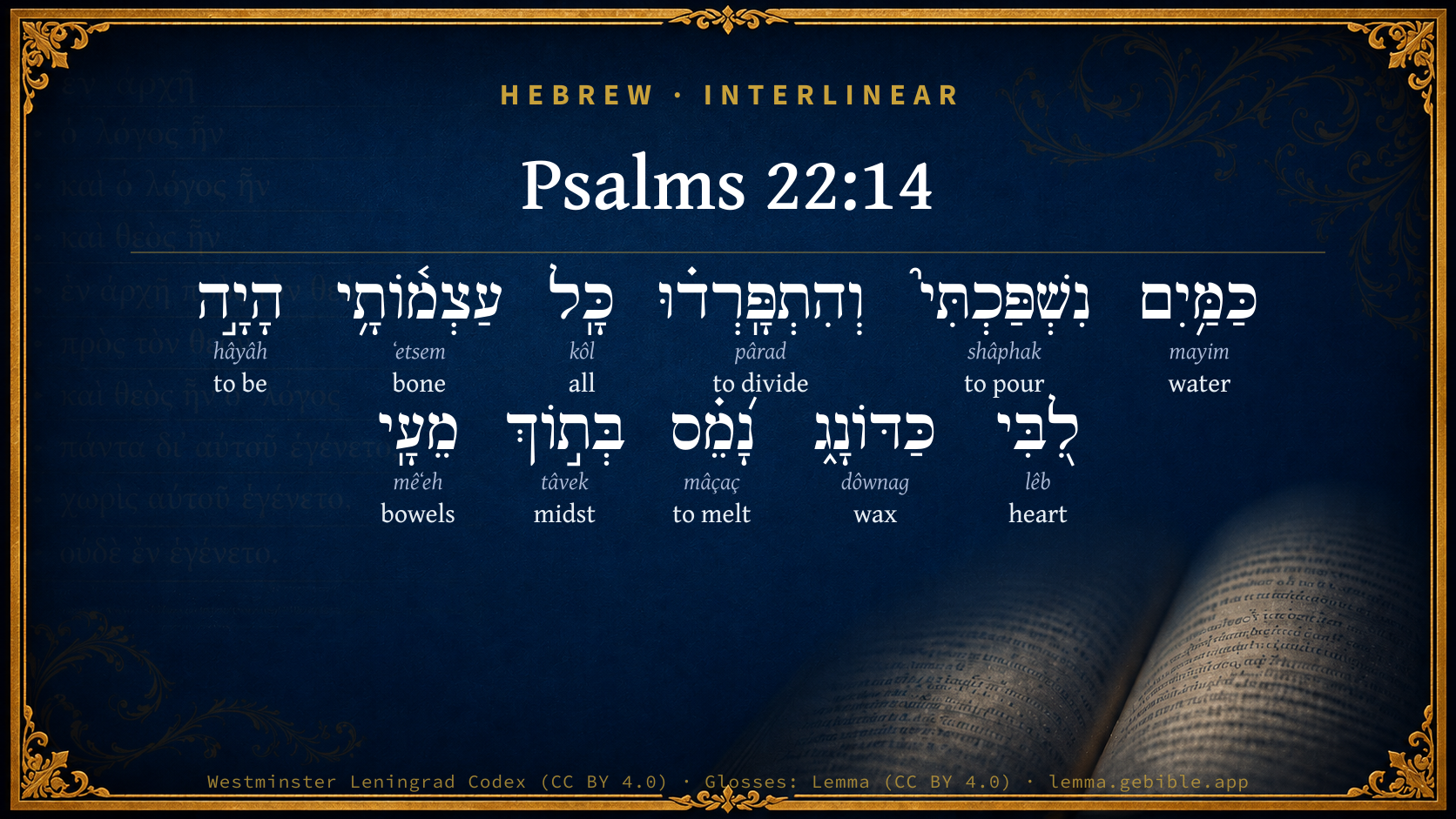
Hebrew (Westminster Leningrad Codex) Psalms 22:14 appears in the Hebrew Old Testament. The text above is from the Westminster Leningrad Codex. Each word links to its Strong’s number, a concise gloss, and parsing drawn from the Open Scriptures Hebrew Bible morphology. Click any word for its full Brown-Driver-Briggs (BDB) entry.
Download image
Cite this verse

Psalms 22:14 (World English Bible). Public Domain. Lemma interlinear Bible study tool, https://lemma.gebible.app/v/psalms/22/14.

Show BibTeX & RIS
BibTeX
RIS
English Translation
I am poured out like water. All my bones are out of joint. My heart is like wax; It is melted within me.
World English Bible · Public Domain
Highlights
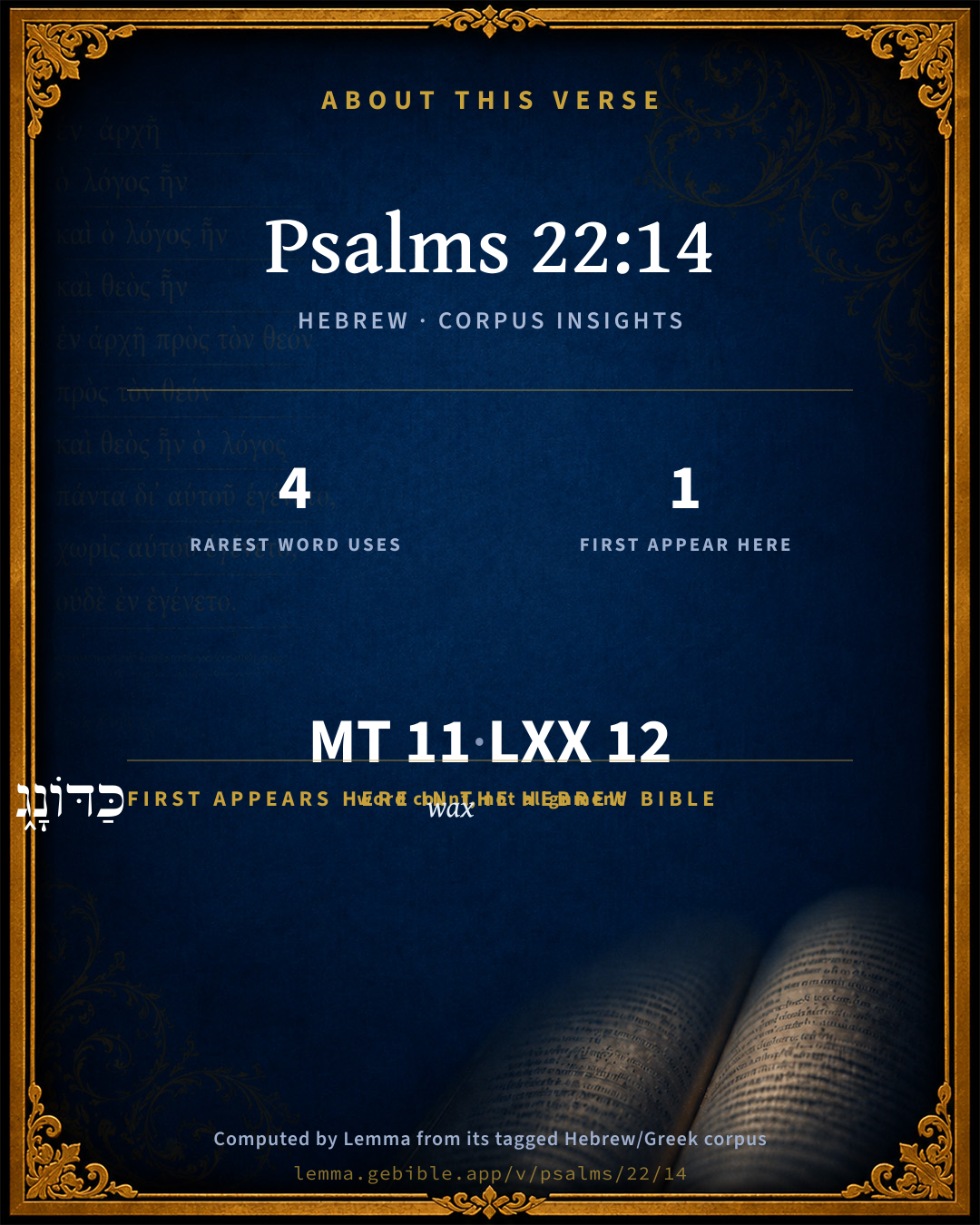
  • 1 first appearance in the Hebrew Bible
Full analysis ↓
Download a study sheet

One document with this verse’s original text, its word-by-word gloss line, the meaning frame, cross-references with their text, attributed commentary, and full source and license credits — printable, and it pastes into notes with its structure intact.

This verse Autodidact and up

Study sheet (.html) Plain text (.txt)

A passage Seminary Student

Up to 50 verses in one chapter. A passage sheet keeps up to 6 commentary sources and 12 cross-references per verse, in the order this page ranks them, and says so on the sheet whenever that leaves anything out. Ask for a single verse and you get the Autodidact verse sheet above.

Everything on this page stays free to read, with no account — the sheet is a download of what is already on screen, not access to it.

Want to remove ads? Support Godless Engineer
Compare translations 3

The same verse in 3 English versions, stacked beneath the original-language interlinear above. Click any original word for its lexicon entry.

Each is an independent rendering of the whole verse — the interlinear is not word-aligned to these translations.

Highlighted words mark where these versions differ — a whole-verse word diff, not a word-by-word alignment.

  • World English Bible Public Domain
    I am poured out like water. All my bones are out of joint. My heart is like wax; It is melted within me.
  • King James Version Public Domain
    I am poured out like water, and all my bones are out of joint: my heart is like wax; it is melted in the midst of my bowels.
  • unfoldingWord Literal Text CC BY-SA 4.0
    I am poured out like water, and all of my bones are dislocated. My heart is like wax; it has melted within my inner parts.

unfoldingWord Literal Text — © unfoldingWord, licensed CC BY-SA 4.0. Word-aligned USFM3 via Door43 (git.door43.org/unfoldingWord/en_ult).

Versions to compare (up to 4)

3 of 4 selected

Show all 18 translations

Every available English version of this verse, each an independent rendering of the whole verse.

  • World English Bible Public Domain
    I am poured out like water. All my bones are out of joint. My heart is like wax; It is melted within me.
  • Berean Standard Bible Public Domain
    I am poured out like water, and all my bones are disjointed. My heart is like wax; it melts away within me.
  • Majority Standard Bible Public Domain
    I am poured out like water, and all my bones are disjointed. My heart is like wax; it melts away within me.
  • King James Version Public Domain
    I am poured out like water, and all my bones are out of joint: my heart is like wax; it is melted in the midst of my bowels.
  • American Standard Version (1901) Public Domain
    I am poured out like water, And all my bones are out of joint: My heart is like wax; It is melted within me.
  • Revised Version (1885) Public Domain
    I am poured out like water, and all my bones are out of joint: my heart is like wax; it is melted in the midst of my bowels.
  • Geneva Bible (1599) Public Domain
    I am like water powred out, and all my bones are out of ioynt: mine heart is like waxe: it is molten in the middes of my bowels.
  • Douay-Rheims (1899) Public Domain
    They have opened their mouths against me, as a lion ravening and roaring.
  • Young's Literal Translation Public Domain
    As waters I have been poured out, And separated themselves have all my bones, My heart hath been like wax, It is melted in the midst of my bowels.
  • Literal Standard Version CC BY-SA 4.0
    I have been poured out as waters, || And all my bones have separated themselves, || My heart has been like wax, || It is melted in the midst of My bowels.
  • Unlocked Literal Bible CC BY-SA 4.0
    I am being poured out like water, and all my bones are dislocated. My heart is like wax; it melts away within my inner parts.
  • unfoldingWord Literal Text CC BY-SA 4.0
    I am poured out like water, and all of my bones are dislocated. My heart is like wax; it has melted within my inner parts.
  • Darby Bible Public Domain
    I am poured out like water, and all my bones are out of joint: my heart is become like wax; it is melted in the midst of my bowels.
  • World Messianic Bible Public Domain
    I am poured out like water. All my bones are out of joint. My heart is like wax. It is melted within me.
  • Webster's Bible Public Domain
    \\22:13\\They gaped upon me with their mouths, as a ravening and a roaring lion.
  • Free Bible Version CC BY-SA 4.0
    I feel like I'm being poured out like water. I'm falling apart as if all my bones have become loose. My mind feels like it's wax melting inside me.
  • Bible in Basic English Public Domain
    I am flowing away like water, and all my bones are out of place: my heart is like wax, it has become soft in my body.
  • JPS Tanakh (1917) Public Domain
    (22-15) I am poured out like water, and all my bones are out of joint; my heart is become like wax; it is melted in mine inmost parts.

Literal Standard Version (2020), Covenant Press — licensed CC BY-SA 4.0. Text via the HelloAO Bible API (eBible.org). Unlocked Literal Bible (unfoldingWord) — licensed CC BY-SA 4.0. Text via the HelloAO Bible API (eBible.org). unfoldingWord Literal Text — © unfoldingWord, licensed CC BY-SA 4.0. Word-aligned USFM3 via Door43 (git.door43.org/unfoldingWord/en_ult). Free Bible Version, Dr. Jonathan Gallagher — licensed CC BY-SA 4.0. Text via the HelloAO Bible API (eBible.org).

Word by word

More ways to search: Search by grammar → Find every occurrence → Compare this word →

Practice this passage: Drill this verse → Learn its vocabulary →

כַּדּוֹנָ֑ג
dôwnag
H1749
“like/as the · wax”
Preposition, Determined + Noun, Common, Masculine, Singular, Absolute
Part of Speech
Preposition + Noun
Type
Common
Gender
Masculine
Number
Singular
State
Absolute
Full BDB Definition

Origin: of uncertain derivation

TWOT: 444a

wax (always figurative 'of melting')
  1. כַּמַּ֥יִם mayim H4325 “like/as the · water(s)” Preposition, Determined + Noun, Common, Masculine, Plural, Absolute
  2. נִשְׁפַּכְתִּי֮ shâphak H8210 “to pour” Verb, Niphal, Perfect, 1st Person, Common, Singular
  3. וְהִתְפָּֽרְד֗וּ pârad H6504 “and · to divide” Conjunction + Verb, Hithpael, Perfect, 3rd Person, Common, Plural
  4. כָּֽל kôl H3605 “all of” Noun, Common, Masculine, Singular, Construct
  5. עַצְמ֫וֹתָ֥י ʻetsem H6106 “bones · my” Noun, Common, Feminine, Plural, Construct + Suffix, Personal, 1st Person, Common, Singular
  6. הָיָ֣ה hâyâh H1961 “to be” Verb, Qal, Perfect, 3rd Person, Masculine, Singular
  7. לִ֭בִּי lêb H3820 “heart · my” Noun, Common, Masculine, Singular, Construct + Suffix, Personal, 1st Person, Common, Singular
  8. נָ֝מֵ֗ס mâçaç H4549 “to melt” Verb, Niphal, Perfect, 3rd Person, Masculine, Singular
  9. בְּת֣וֹךְ tâvek H8432 “in/at · midst of” Preposition + Noun, Common, Masculine, Singular, Construct
  10. מֵעָֽי mêʻeh H4578 “bowels · my” Noun, Common, Masculine, Plural, Construct + Suffix, Personal, 1st Person, Common, Singular

About this verse

These counts appear in no published source. They are computed here, from the morphology-tagged text and Lemma’s own curated glosses. What Lemma adds →

11
words
11
distinct lemmas
Wisdom
section

Notable vocabulary

The rarest word here is כַּדּוֹנָ֑ג wax H1749 — appearing just 4 times in the whole Hebrew Bible.

First appearance in Scripture

This word makes its first canonical appearance in the Hebrew Bible here:

  • כַּדּוֹנָ֑ג wax H1749

Shared distinctive vocabulary

כַּדּוֹנָ֑ג wax H1749 occurs in 4 verses of the Hebrew Bible. Also found in:

Grammatical profile

  • 4 verbs
  • 7 nouns

Verb forms

  • נִשְׁפַּכְתִּי֮ Niphal · Perfect
  • וְהִתְפָּֽרְד֗וּ Hithpael · Perfect
  • הָיָ֣ה Qal · Perfect
  • נָ֝מֵ֗ס Niphal · Perfect

Hebrew & Septuagint length

In English translation the verse runs 23 words from the Hebrew and 25 from the Septuagint (LXX English) — closely comparable.

A rough comparison of the two English renderings, which tokenize alike — not a word-level alignment.

Word counts can differ between the Hebrew and the Greek without any difference in meaning — e.g. the Hebrew direct-object marker אֵת has no separate Greek word, and Greek often adds the article ὁ.

In the original languages it is 11 Hebrew tokens and 12 Greek tokens — but the two are counted differently (Hebrew bundles its prefixes and suffixes into one token; the Greek is in lemma form), so that isn’t a like-for-like length.

Cross-references

12

Topical passages linked to Psalms 22:14 in the Treasury of Scripture Knowledge — connected by theme and wording, ordered by reader-vote popularity; previews shown in the World English Bible.

  • Job 30:16 "Now my soul is poured out within me. Days of affliction have taken hold on me.
  • Psalms 22:17 I can count all of my bones. They look and stare at me.
  • Psalms 31:10 For my life is spent with sorrow, My years with sighing. My strength fails because of my iniquity. My bones are wasted away.
  • Daniel 5:6 Then the king's face was changed in him, and his thoughts troubled him; and the joints of his loins were loosened, and his knees struck one against another.
  • Job 23:16 For God has made my heart faint. The Almighty has terrified me.
  • Joshua 7:5 The men of Ai struck of them about thirty-six men; and they chased them [from] before the gate even to Shebarim, and struck them at the descent; and the hearts of the people melted, and became as water.
  • Mark 14:33–34 He took with him Peter, James, and John, and began to be greatly troubled and distressed.
  • Luke 22:44 Being in agony he prayed more earnestly. His sweat became like great drops of blood falling down on the ground.
  • John 12:27 "Now my soul is troubled. What shall I say? 'Father, save me from this time?' But for this cause I came to this time.
  • Psalms 68:2 As smoke is driven away, So drive them away. As wax melts before the fire, So let the wicked perish at the presence of God.
  • Nahum 2:10 She is empty, void, and waste. The heart melts, the knees knock together, their bodies and faces have grown pale.
  • Matthew 26:38 Then he said to them, "My soul is exceedingly sorrowful, even to death. Stay here, and watch with me."

Cross-references courtesy of OpenBible.info (CC BY 4.0).

Hebrew and Greek witnesses Masoretic Hebrew ↔ Greek Septuagint

The same verse in the two great witnesses to the Old Testament, shown verse-for-verse.

You’re reading Greek Psalm 21 (Hebrew Psalm 22). The Septuagint counts the superscription, so verse numbers can differ from the Hebrew — chapter-level alignment, not verse-by-verse. Numbering follows Rahlfs.

These are two independent witnesses, not word-aligned to each other, and the Septuagint is shown in lemma (dictionary) form.

Hebrew Psalms 22:14 Masoretic · Westminster Leningrad Codex

כַּמַּ֥יִם נִשְׁפַּכְתִּי֮ וְהִתְפָּֽרְד֗וּ כָּֽל עַצְמ֫וֹתָ֥י הָיָ֣ה לִ֭בִּי כַּדּוֹנָ֑ג נָ֝מֵ֗ס בְּת֣וֹךְ מֵעָֽי

I am poured out like water. All my bones are out of joint. My heart is like wax; It is melted within me.

World English Bible · Public Domain

Greek LXX Greek Psalm 21:14 Septuagint · lemma form

ἀναοἴγω ἐπί ἐγώ ὁ στόμα αὐτός ὡς λέων ὁ ἁρπάζω καί ὠρύομαι

I am poured out like water, and all my bones are loosened: my heart in the midst of my belly is become like melting wax.

LXX2012 (modern English Septuagint) · Public Domain

Hebrew: Westminster Leningrad Codex (CC BY 4.0). Greek: Septuagint (public domain); English from LXX2012 (modern English Septuagint) (Public Domain). How the Septuagint differs from the Hebrew →

Commentary

Notes on Psalms 22:14 from classic Christian and Jewish commentators (each source and its license shown beneath its notes). The classic Christian expositions comment on the surrounding passage and are grouped to its opening verse, so a note may address several verses; the Jewish commentaries on the Tanakh (Rashi and others) are per-verse, so they appear only where the commentator wrote on this verse.

Lemma curates 59 commentaries, every one of them public domain or Creative Commons licensed, each selected and text-cleaned for this edition rather than reprinted as found. About our sources →

John Gill's Exposition

I am poured out like water,.... This may refer to Christ's sweat in the garden, when through his agony or conflict with Satan, and his vehemency in prayer, and the pressure on his mind, in a view of his people's sins, and the wrath of God for, them, and the accursed death he was about to undergo on that account, sweat in great abundance came from all parts of his body, and not only stood in large drops, but fell to the ground like great drops of blood; so that his body was all covered with water, or rather seemed to be dissolving into water, or else to the quantity of tears he shed both there and elsewhere; his sorrow was great even unto death, which vented itself in floods of tears; his prayers were offered up with strong crying and tears; his head was, as Jeremiah wished his might be, as waters, and his eyes a fountain of tears, yea, his whole body seemed to be bathed with them: or else to the shedding of his blood, and the pouring out his soul unto death for his people, which was voluntarily done by himself, or by his enemies; which they shed like water, and made no account of it, Psa 79:3. Some have thought this respects the opinion some had of him, even some of his own disciples, when he was dead; all their hopes of his being their Redeemer and Saviour being gone, he was as water spilled on the ground, which cannot be gathered up; see Sa2 14:14; but rather the phrase intends his being quite dispirited, his heart failing, his soul sorrowful unto death, his hands feeble, his knees weak like water, and he just ready to faint and die; see Jos 7:5, Eze 7:17;

and all my bones are out of joint; not through the stretching of his body on the cross, which seems to be designed in Psa 22:17; but as it is with persons in a panic, their joints seem to be loosed, and their bones parting asunder, their legs tremble, no member can perform its office, but as if everyone was dislocated and out of its place; see Psa 6:2;

my heart is like wax, it is melted in the midst of my bowels; as wax melts before the fire, so did the heart of Christ at the wrath and fury of God, which was poured forth like fire upon him; and which he had a sense of, when in the garden and on the cross, bearing the sins of his people, and sustaining the punishment due unto them for it was not because of his enemies, nor merely at the presence of God, and his righteous judgments, which is sometimes the case; see Sa2 17:10; but at the apprehension of divine wrath, and feeling the same, as the surety of his people; and what an idea does this give of the wrath of God! for if the heart of Christ, the Lion of the tribe of Judah, melted at it, what heart can endure, or hands be strong, when God deals with them in his wrath? Eze 22:14.

John Gill's Exposition of the Whole Bible (1746–1763) — public domain (CC PDM 1.0). Text via the HelloAO Bible API.

Trapp's Complete Commentary

John Trapp

Psa 22:14 I am poured out like water, and all my bones are out of joint: my heart is like wax; it is melted in the midst of my bowels.

Ver. 14. I am poured out like water] i.e. I am almost past all recovery, as water spilt upon the ground.

And all my bones are out of joint] Or, disparted, as on a rack, or by a strappado. Who hath not heard how Lithgow, the Scot, was used at Malaga, in Spain, by the bloody inquisitors? after that he had passed through the greatest part of the known world, and travelled through forests, wildernesses, and deserts, where he met with thieves and murderers, lions, bulls, bears, and tigers, and escaped them, how they starved him, wounded him, disjointed him, in ten hours’ time laid seventy various torments upon him, though they had nothing against him but suspicion of religion. And yet, after this, God wonderfully delivered him, so that he was brought on his bed wounded and broken to King James, whose letters of recommendation he had for his safe travel through the world, and to whom he made this relation to the face of Gundamour, the Spanish ambassador. This was much, but yet little or nothing to Christ’s sufferings, whence that passage in the Greek litany, Dι αγνωστων σου παθηματων, &c., By thine unknown sufferings, good Lord, deliver us.

My heart is like wax, &c.] Fear and faintness causeth an extreme sweat (such as was that of our Saviour in his agony, Luk 22:44), it disableth also the members from acting their parts, and softeneth the heart, Job 23:16.

John Trapp, A Commentary or Exposition upon All the Books of the Old and New Testament (1647–1656) — public domain. Text from a community e-Sword module.

The Biblical Illustrator

Joseph S. Exell

Psa_22:14-18

They pierced my hands and my feet.

Our Lords passion

The great mystery of the passion of our Lord is one which in all its fulness the human mind cannot comprehend. In what manner His sufferings purchased our redemption, and what was the precise nature of those sufferings, are points which we shall in vain attempt to ascertain or demonstrate by words, however forcible; but that Christ died for our sins, and that we are redeemed by His precious blood, are amongst the many declarations of Scripture which place beyond all doubt the truth that the sufferings of Christ were an atonement for our sin.

I. The sufferings of Christ as man. Every kind of pain tortured His body. The closing scenes of His life mark Him most conspicuously as the Man of Sorrows.

II. The sufferings which Christ endured as the Son of God. The sins of the whole world oppressed Him. Sin when duly felt is a heavy burden. How heavy, then, must have been the weight of the sins of the whole world! How wondrous is the outpouring of such love on the part of Jesus and of God! Let the memory of it guard us from attempting to extenuate sin, or in any way making light of it. And when we are called upon to suffer, let the example of our Lords meekness and humility be that which we shall follow. (T. R. Redwar, M. A.)

The influence of a great sacrifice

It is strange to think that any man should think lightly of sin viewed in the light of Calvary Cross. It has a wonderful power and influence if you would view it aright. One day a little girl, sitting by her mothers side, gazed very intently at her parents hand. A mere stranger would have said, What a deformity! as the hand was blurred and twisted. The girl asked her mother why the hand was different to the other. The mother told her that years ago when her little child was a baby the cot in which she lay caught fire, and her mother in her terror and anxiety tore off the curtains to stop the flames and wrap the child in. In doing so she so burned her hand that for months after she was unable to use it. You can think how the childs love multiplied beyond all words as she heard the story. Her future delight was to save that injured hand all the work she could possibly.

The Biblical Illustrator, edited by Joseph S. Exell (c. 1880s–1900s) — public domain. Text from a community e-Sword module.

Joseph Benson's Commentary

Psa 22:14-15. I am poured out like water — My spirits are spent and gone like water, which, once spilt, can never be recovered; my very flesh is melted within me, and I am become as weak as water. My bones are out of joint — I am as unable to help myself, and as full of pain, as if all my bones were disjointed. My heart is like wax — Melted through fear and overwhelming grief. My strength is dried — I have, in a manner, no more moisture left in me, than is in a dry potsherd. My tongue cleaveth, &c. — Through excessive thirst and drought. Thou hast brought me to death —

By thy providence delivering me into the power of mine enemies, and by thy terrors in my soul.

Joseph Benson's Commentary on the Old and New Testaments (1811–1818) — public domain. Text from a community e-Sword module.

J. A. Alexander on Psalms

Joseph Addison Alexander

15. (Psa 22:14). Like water I am poured out, and all my bones are parted; my heart has become like wax, melted in the midst of my bowels. Similar terms are used in Jos 7:5, Lam 2:19, to describe dismay and fear; but in the case before us they seem rather descriptive of extreme weakness. See Psa 58:8 (7), 2Sa 14:14, and compare the symbolical action in 1Sa 7:6. The comparison with water is applied to moral weakness also in Gen 49:4. The parting of the bones may either denote dislocation or extreme emaciation, making the bones prominent. In either case the essential idea is still that of desperate exhaustion and debility.

Joseph Addison Alexander, The Psalms Translated and Explained (1850) — public domain. Text from a community e-Sword module.

Tyndale Open Study Notes

Tyndale Open Resources

22:14 The psalmist’s sense of being poured out like water expresses a meaningless, transitory existence that leaves him depleted.

Tyndale Open Study Notes — © Tyndale Open Resources, licensed CC BY-SA 4.0. Text via the HelloAO Bible API.

Geneva Bible (1599)

Geneva Bible translators

Before he spake of the cruelty of his enemies, and now he declareth the inward griefs of the mind, so that Christ was tormented both in soul and body.

Geneva Bible (1599) marginal notes — public domain. Text via Bolls.life.

Jamieson, Fausset & Brown

Robert Jamieson, A. R. Fausset & David Brown

Utter exhaustion and hopeless weakness, in these circumstances of pressing danger, are set forth by the most expressive figures; the solidity of the body is destroyed, and it becomes like water; the bones are parted; the heart, the very seat of vitality, melts like wax; all the juices of the system are dried up; the tongue can no longer perform its office, but lies parched and stiffened (compare Gen 49:4; Sa2 14:14; Psa 58:8). In this, God is regarded as the ultimate source, and men as the instruments.

Jamieson, Fausset & Brown — Commentary Critical and Explanatory on the Whole Bible (1871) — public domain (CC PDM 1.0). Text via the HelloAO Bible API.

Adam Clarke's Commentary

Verse 14. I am poured out like water] That is, as the old Psalter: Thai rought na mare to sla me than to spil water.

The images in this verse are strongly descriptive of a person in the deepest distress; whose strength, courage, hope, and expectation of succour and relief, had entirely failed.

Our Lord's sufferings were extreme; but I cannot think there is any sound theologic sense in which these things can be spoken of Christ, either in his agony in the garden, or his death upon the cross.

Adam Clarke's Commentary on the Bible (1810–1826) — public domain. Text from a community e-Sword/MySword module.

John Calvin's Commentaries

14. I am poured out like water. Hitherto he has informed us that being surrounded by wild beasts, he was not far from death, as if he had been at the point of being devoured every moment. He now bewails, in addition to this, his inward distress; from which we learn that he was not stupid or insensible in dangers. It could have been no ordinary fear which made him almost pine away, by which his bones were disjointed, and his heart poured out like water. We see, then, that David was not buffeted with the waves of affliction like a rock which cannot be moved, but was agitated within by sore troubles and temptations, which, through the infirmity of the flesh, he would never have been able to sustain had he not been aided by the power of the Spirit of God. How these sufferings are applicable to Christ I have informed you a little before. Being a real man, he was truly subject to the infirmities of our flesh, only without the taint of sin. The perfect purity of his nature did not extinguish the human affections; it only regulated them, that they might not become sinful through excess. The greatness of his griefs, therefore, could not so weaken him as to prevent him, even in the midst of his most excruciating sufferings, from submitting himself to the will of God, with a composed and peaceful mind. Now, although this is not the case with respect to us, who have within us turbulent and disorderly affections, and who never can keep them under such restraint as not to be driven hither and thither by their impetuosity, yet, after the example of David, we ought to take courage; and when, through our infirmity, we are, as it were, almost lifeless, we should direct our groanings to God, beseeching him that he would be graciously pleased to restore us to strength and vigor. “Ace qu’il luy plaise nous remettre sus, et nous rendre force et vigueur.” — Fr.

John Calvin's Commentaries (1540-1563) — public domain. Text from the Calvin Translation Society English edition (1840s-50s) via the Christian Classics Ethereal Library (ccel.org). Calvin's coverage is partial (roughly two-thirds of the Bible); uncommented books and verses are honest gaps, never fabricated. The 19th-century editor's footnotes and remarks are omitted so the notes are faithfully Calvin's own voice.

Ellicott's Commentary for English Readers

(14) The state of hopeless prostration into which the victim of these terrible foes is brought could not be more powerfully described. It is a state of entire dissolution. Again Lam_2:2 offers a close parallel.

Out of joint.—Perhaps, better, stand out as in a state of emaciation. (Comp. Psa_22:17.) Literally, separate themselves. In other places, however, “bones” is used in the sense in which we use “fibres,” in such a phrase as “all the fibres of his frame.”

A Bible Commentary for English Readers, edited by Charles John Ellicott (1878–1897) — public domain. Text from a community e-Sword module.

The Cambridge Bible for Schools and Colleges

gen. ed. J. J. S. Perowne

14. Cp. Jos_7:5; Psa_6:2 ff. It is the experience of the dying man. Cp. Newman’s Dream of Gerontius,

“This emptying out of each constituent

And natural force, whereby I come to be.”

14–17. The effects of anxiety and persecution. Vital strength and courage fail; his frame is racked and tortured; he is reduced to a skeleton.

The Cambridge Bible for Schools and Colleges (gen. ed. J. J. S. Perowne; Cambridge University Press, 1878–1918) — public domain. Text from a community e-Sword module.

Albert Barnes' Notes on the Bible

I am poured out like water - The sufferer now turns from his enemies, and describes the effect of all these outward persecutions and trials on himself. The meaning in this expression is, that all his strength was gone. It is remarkable that we have a similar expression, which is not easily accounted for, when we say of ourselves that “we are as weak as water.” An expression similar to this occurs in Jos 7:5 : “The hearts of the people melted, and became as water.” Compare Lam 2:19; Psa 58:7. “My bones are out of joint.” Margin, “sundered.” The Hebrew word - פרד pârad - means “to break off, to break in pieces, to separate by breaking;” and then, to be separated, or divided. It is not necessary to suppose here that his bones were literally dislocated or “put out of joint,” anymore than it is necessary to suppose that he was literally “poured out like water,” or that his heart was literally “melted like wax” within him. The meaning is that he was utterly prostrated and powerless; he was as if his bones had been dislocated, and he was unable to use his limbs.

My heart is like wax - The idea here also is that of debility. His strength seemed all to be gone. His heart was no longer firm; his vigour was exhausted.

It is melted in the midst of my bowels - Or, within me. The word bowels in the Scriptures is not restricted in its signification as it is with us. It embraces the upper parts of the viscera as well as the lower, and consequently would include that part in which the heart is situated. See the notes at Isa 16:11. The meaning here is that his heart was no longer firm and strong. As applied to the Redeemer, this would refer to the prostration of his strength in his last struggle; and no one can prove that these thoughts did not pass through his mind when on the cross.

Albert Barnes' Notes on the Bible (1834–1885) — public domain. Text from a community e-Sword/MySword module.

Matthew Poole's English Annotations

I am poured out like water; my heart faileth, my spirits are spent and gone like water, which once spilt can never be recovered; my very flesh is melted within me, and I am become as weak as water. See the like phrase Jos 7:5, and compare 2Sa 14:14; Job 14:11.

All my bones are out of joint; I am as weak and unable to move or help myself, and withal as full of torment, as if I were upon a rack, and all my bones were disjointed. Or, all my bones are separated, one from another; as they were in some sort in Christ, by the stretching of his body upon the cross.

My heart; the seat of life, and fountain which supplies spirits and vigour to the whole body.

Is like wax; melted, as it follows, through fear and overwhelming grief: compare Psa 68:2; 97:5.

Matthew Poole's English Annotations on the Holy Bible (1683–1685) — public domain. Text from a community e-Sword/MySword module.

The Treasury of David

Charles H. Spurgeon

Ver. 14. Turning from his enemies, our Lord describes his own personal condition in language which should bring the tears into every loving eye.

I am poured out like water. He was utterly spent, like water poured upon the earth; his heart failed him, and had no more firmness in it than running water, and his whole being was made a sacrifice, like a libation poured out before the Lord. He had long been a fountain of tears; in Gethsemane his heart welled over in sweat, and on the cross he gushed forth with blood; he poured out his strength and spirit, so that he was reduced to the most feeble and exhausted state.

All my bones are out of joint, as if distended upon a rack. Is it not most probable that the fastenings of the hands and feet, and the jar occasioned by fixing the cross in the earth, may have dislocated the bones of the Crucified One? If this is not intended, we must refer the expression to that extreme weakness which would occasion relaxation of the muscles and a general sense of parting asunder throughout the whole system.

My heart is like wax; it is melted in the midst of my bowels. Excessive debility and intense pain made his inmost life to feel like wax melted in the heat. The Greek liturgy uses the expression, "thine unknown sufferings", and well it may. The fire of Almighty wrath would have consumed our souls for ever in hell; it was no light work to bear as a substitute the heat of an anger so justly terrible. Dr. Gill wisely observes, "if the heart of Christ, the Lion of the tribe of Judah, melted at it, what heart can endure, or hands be strong, when God deals with them in his wrath?"

Ver. 14. I am poured out like water, and all my bones are out of joint: my heart is like wax; it is melted in the midst of my bowels. He was faint. Such a feeling of languor and faintness supervened that language fails to express it, and the emblem of "water poured out" is employed to represent it. As the water falls from the vessel to the earth, see how its particles separate farther and farther from each other. Its velocity increases as it falls. It has no power to stay itself midway, much less to return to its place. It is the very picture of utter weakness. So did our Lord feel himself to be when hanging on the cross. He was faint with weakness. The sensations experienced when about to faint away are very overpowering. We appear to our own consciousness to be nothing but weakness, as water poured out. All our bones feel relaxed and out of joint; we seem as though we had none. The strength of bone is gone, the knitting of the joints is loosened, and the muscular vigour fled. A sickly giddiness overcomes us. We have no power to bear up. All heart is lost. Our strength disappears like that of wax, of melting wax, which drops upon surrounding objects, and is lost. Daniel thus describes his sensations on beholding the great vision, "There remained no strength in me: for my vigour was turned into corruption, and I retained no strength." Da 10:8. In regard, however, to the faintness which our Lord experienced, we ought to notice this additional and remarkable circumstance, that he did not altogether faint away. The relief of insensibility he refused to take. When consciousness ceases, all perception of pain is necessarily and instantly terminated. But our Lord retained his full consciousness throughout the awful scene; and patiently endured for a considerable period, those, to us, insupportable sensations which precede the actual swoon. John Stevenson.

Ver. 14. I am poured out like water: that is, in the thought of my enemies I am utterly destroyed. "For we must needs die, and are as water spilt on the ground, which cannot be gathered up again." 2Sa 14:14. "What marvel", asks St. Bernard, "that the name of the Bridegroom should be as ointment poured forth, when he himself, for the greatness of his love, was poured forth like water!" J. M. Neale.

Ver. 14. I am poured out like water, i.e., I am almost past all recovery, as water spilt upon the ground. John Trapp.

Ver. 14. All my bones are out of joint. The rack is devised as a most exquisite pain, even for terror. And the cross is a rack, whereon he was stretched till, saith the Psalm, "all his bones were out of joint." But even to stand, as he hung, three long hours together, holding up but the arms at length, I have heard it avowed of some that have felt it, to be a pain scarce credible. But the hands and the feet being so cruelly nailed (part, of all other, most sensible, by reason of the texture of sinews there in them most) it could not but make his pain out of measure painful. It was not for nothing, that dolores acerrimi dicuntur cruciatus (saith the heathen man), that the most sharp and bitter pains of all other have their name from hence, and are called cruciatus pains like those of the cross. It had a meaning, that they gave him, that he had (for his welcome to the cross) a cup mixed with gall or myrrh; and (for his farewell) a sponge of vinegar; to show by the one the bitterness, and by the other the sharpness of the pains of this painful death. Lancelot Andrewes.

Ver. 14. All my bones are out of joint. We know that the greatest and most intolerable pain that the body can endure, is that arising from a bone out of its place, or dislocated joint. Now when the Lord was raised up upon the cross, and his sacred body hung in the air from the nails, all the joints began to give, so that the bones were parted the one from the other so visibly that, in very truth (as David had prophesied) they might tell all his bones, and thus, throughout the whole body, he endured acute torture. Whilst our Lord suffered these torments, his enemies, who had so earnestly desired to see him crucified, far from pitying him, were filled with delight, as though celebrating a victory. Fra Thome de Jesu.

Charles H. Spurgeon's The Treasury of David (1869–1885) — public domain. Psalms only. Text from a community e-Sword/MySword module.

Whedon's Commentary on the Bible

Daniel D. Whedon

14. I am poured out like water—A figure denoting a profuse waste of the vital forces. But in 2Sa_14:14, the figure implies that the loss is irrecoverable, “as water spill which cannot be gathered up again,” which gave to the ceremony of pouring out water “before the Lord” the significance of a confirmation of a covenant whose engagements could not be recalled. 1Sa_7:6. The life of Christ was freely given. “He poured out his soul unto death,” (Isa_53:12,) in his soul agony and bloody sweat. Mat_26:38; Luk_22:44.

Bones… out of joint—As if the ligaments were dissolved and the muscles weakened, so that the limbs were uncontrollable. This would be the natural effect of crucifixion. But of Christ, not a bone was broken. Joh_19:36.

My heart is like wax—The loss of courage and resolution through fear is often signified by the melting of wax. Psa_68:2; Mic_1:4; Jos_2:11. Jesus was “sore amazed” and “very heavy,” (Mar_14:33,) and fear was a leading feature of his sufferings. Heb_5:7. See Psa_22:19-21 of this psalm.

Daniel D. Whedon (gen. ed.), Commentary on the Old and New Testaments (1874–1909) — public domain. Text from a community e-Sword module.

The Pulpit Commentary

I am poured out like water. (comp. Psa_58:7 2Sa_14:14) The exact meaning is uncertain; but extreme" weakness and exhaustion, something like utter prostration, seems to be indicated. And all my bones are out of joint. The strain of the body suspended on the cross would all but dislocate the joints of the arms, and would be felt in every bone of the body. My heart is like wax; it is melted in the midst of my bowels. The proximate cause of death in crucifixion is often failure of the heart"s action, the supply of venous blood not being sufficient to stimulate it. Hence palpitation, faintness, and final syncope.

The Pulpit Commentary (1880–1919), ed. H.D.M. Spence-Jones & Joseph S. Exell — public domain. Text from a community e-Sword module.

John Wesley's Explanatory Notes

Water - My spirits are spent and gone like water which once spilt can never be recovered; my very flesh is melted within me, and I am become as weak as water. Bones - I am as unable to help myself, and as full of torment, as if all my bones were disjointed. Wax - Melted, through fear and overwhelming grief.

John Wesley, Explanatory Notes Upon the Whole Bible (1754–1765) — public domain. Text via the GEBible commentary corpus.

Keil & Delitzsch

C. F. Keil & F. Delitzsch

(Heb.: 22:15-16)Now he described, how, thus encompassed round, he is still just living, but already as it were dead. The being poured out like water reminds us of the ignominious abandonment of the Crucified One to a condition of weakness, in which His life, deprived of its natural support, is in the act of dissolution, and its powers dried up (Sa2 14:14); the bones being stretched out, of the forcible stretching out of His body (חתפּרד, from פּרד to separate, cf. Arab. frd, according to its radical signification, which has been preserved in the common Arabic dialect: so to spread out or apart that the thing has no bends or folds,

(Note: Vid., Bocthor, Dict. fran.-arabe, s. v. Etendre and Dployer.)

Greek ἐξαπλοῦν); the heart being melted, recalls His burning anguish, the inflammation of the wounds, and the pressure of blood on the head and heart, the characteristic cause of death by crucifixion. נמס, in pause נמס, is 3 praet.; wax, דּונג, receives its name from its melting (דנג, root דג, τηκ). In Psa 22:16 the comparison כּחרשׂ has reference to the issue of result (vid., Psa 18:43): my strength is dried up, so that it is become like a potsherd. חכּי (Saadia) instead of כּחי commends itself, unless, כּח perhaps, like the Talmudic כּיח cidumlaT eht eki, also had the signification "spittle" (as a more dignified word for רק). לשׁון, with the exception perhaps of Pro 26:28, is uniformly feminine; here the predicate has the masculine ground-form without respect to the subject. The part. pass. has a tendency generally to be used without reference to gender, under the influence of the construction laid down in Ges. 143, 1, b, according to which לשׁני may be treated as an accusative of the object; מלקוחי, however, is acc. loci (cf. ל Psa 137:6; Job 29:10; אל Lam 4:4; Eze 3:26): my tongue is made to cleave to my jaws, fauces meas. Such is his state in consequence of outward distresses. His enemies, however, would not have power to do all this, if God had not given it to them. Thus it is, so to speak, God Himself who lays him low in death. שׁפת to put anywhere, to lay, with the accompanying idea of firmness and duration, Arab. ṯbât, Isa 26:12; the future is used of that which is just taking place. Just in like manner, in Isa 53:1-12, the death of the Servant of God is spoken of not merely as happening thus, but as decreed; and not merely as permitted by God, but as being in accordance with the divine will. David is persecuted by Saul, the king of His people, almost to the death; Jesus, however, is delivered over by the Sanhedrim, the authority of His people, to the heathen, under whose hands He actually dies the death of the cross: it is a judicial murder put into execution according to the conditions and circumstances of the age; viewed, however, as to its final cause, it is a gracious dispensation of the holy God, in whose hands all the paths of the world's history run parallel, and who in this instance makes sin subservient to its own expiation.

Keil & Delitzsch — Biblical Commentary on the Old Testament (1861–1891) — public domain (CC PDM 1.0). Text via the HelloAO Bible API. (Old Testament only.)

unfoldingWord translationNotes

Door43 World Missions Community

I am being poured out like water

This can be stated in active form. AT: "It is like someone is pouring me out like water" (See: Active or Passive)

I am being poured out like water

The writer speaks about feeling completely exhausted and weak as if he were water being poured out of a jar. (See: Simile)

all my bones are dislocated

"all my bones are out of place." It is possible the writer is in some kind of physical pain. Or he may be speaking of his emotional pain as if it were physical pain. (See: Metaphor)

My heart is like wax ... inner parts

The writer speaks about no longer having courage as if his heart melted like wax. Here "heart" represents "courage." (See: Simile and Metonymy)

wax

a soft substance that melts at a relatively low temperature

within my inner parts

"inside of me"

My strength has dried up like a piece of pottery

The writer speaks about feeling weak as if his strength were like a dry piece of pottery that can easily break. (See: Simile)

piece of pottery

an object made of baked clay that can be used in the house

my tongue sticks to the roof of my mouth

"my tongue sticks to the top of my mouth." The writer may be describing his extreme thirst. Or he may be continuing to speak about being weak as if he were completely dry. (See: Metaphor)

You have laid me in the dust of death

Possible meanings for "dust of death" are 1) it refers to a person turning to dust after they die. AT: "You are about to let me die and become dust" or 2) it is a way of speaking about the grave, which would mean God is causing the writer to die. AT: "You have laid me in my grave" (See: Metaphor)

You have laid me

The "you" is singular and refers to God. (See: Forms of You)

translationWords

heart

strength

tongue

die

unfoldingWord translationNotes — © Distant Shores Media and the Door43 World Missions Community, licensed CC BY-SA 4.0. Source: git.door43.org/Door43/en_tn.

Rashi

Rabbi Shlomo Yitzchaki (Rashi)

a tearing lion Nebuchadnezzar.

Rashi on the Tanakh — English translations: “The Judaica Press complete Tanach with Rashi, translated by A. J. Rosenberg” (CC BY 4.0); “Pentateuch with Rashi's commentary by M. Rosenbaum and A.M. Silbermann, 1929-1934” (public domain); “The Metsudah Tanach series, Lakewood, N.J” (CC BY 4.0); and “The Book of Joshua, Metsudah Publications, 1997” (CC BY 4.0). Text via Sefaria.

Radak

Rabbi David Kimhi (Radak)

They open their mouth against me: – These bulls just mentioned open their mouth against me and tear me. Although it is not the way of bulls to tear, yet these bulls are like

A tearing and roaring lion: – i.e. a lion which is tearing and roaring, אריה (lion) (here) lacks the kaph of comparison. Similarly we have, “Judah is a lion's whelp” (Gen. 49:9); “Issachar is a strong ass” (ibid. 14); “Naphtali is a hind let loose” (ibid. 21), and such like. The roaring of the lion after he has torn is for joy and pride, as (says) the text (Amos. 3:4): “Will a lion roar in the forest when he hath no prey? Will a young lion cry out of his den if he have taken nothing?” So it is with enemies; after killing and plundering us, they rejoice and behave as insolent boasters.

Radak on the Tanakh — English translations: “Sefaria Community Translation” (CC0 1.0 (public-domain dedication)); “Eliyahu Munk, HaChut Hameshulash” (CC BY 4.0); “Rabbi Mike Feuer, Jerusalem Anthology” (CC BY 4.0); and “R. David Kimhi on the first book of Psalms, Translated by R.G. Finch, London, 1919” (public domain). Text via Sefaria.

Lesson kit

Teaching starters — assembled from the data on this page, not authored interpretation. Every prompt links to the verse data it draws on. Edit before teaching.

Psalms, in the Wisdom, opens this verse with 11 words (11 distinct Hebrew lemmas). Its most distinctive word is dôwnag (“wax”). A historical commentator’s framing appears above. Read the whole chapter for the surrounding context.

Discussion questions

  1. The word dôwnag carries the sense “wax.” How does it shape the verse?
  2. This is the first place “wax” appears in Scripture (first appears here). What does its debut here establish?
  3. How does Psalms 68:2, which shares the word «wax», read alongside this verse?
  4. The translations on this page render this verse differently — a whole-verse word diff, not a word-by-word alignment. What might account for the different wordings?
  5. «נִשְׁפַּכְתִּי֮» is a Niphal Perfect verb. How does that grammatical form shape the action described?
  6. Compare how John Gill's Exposition and Trapp's Complete Commentary read this verse. Where do they agree or differ?

Things to notice

Reading settings

Reading text

Shown beneath each verse's original-language words.

Old Testament
Old Testament edition

Read the OT as the Masoretic Hebrew (MT) or the Greek Septuagint (LXX).

English shown for the Greek Septuagint (in the Hebrew ↔ Greek comparison).

Comparing translations? Open the Compare panel on any verse page to stack up to four side by side.