
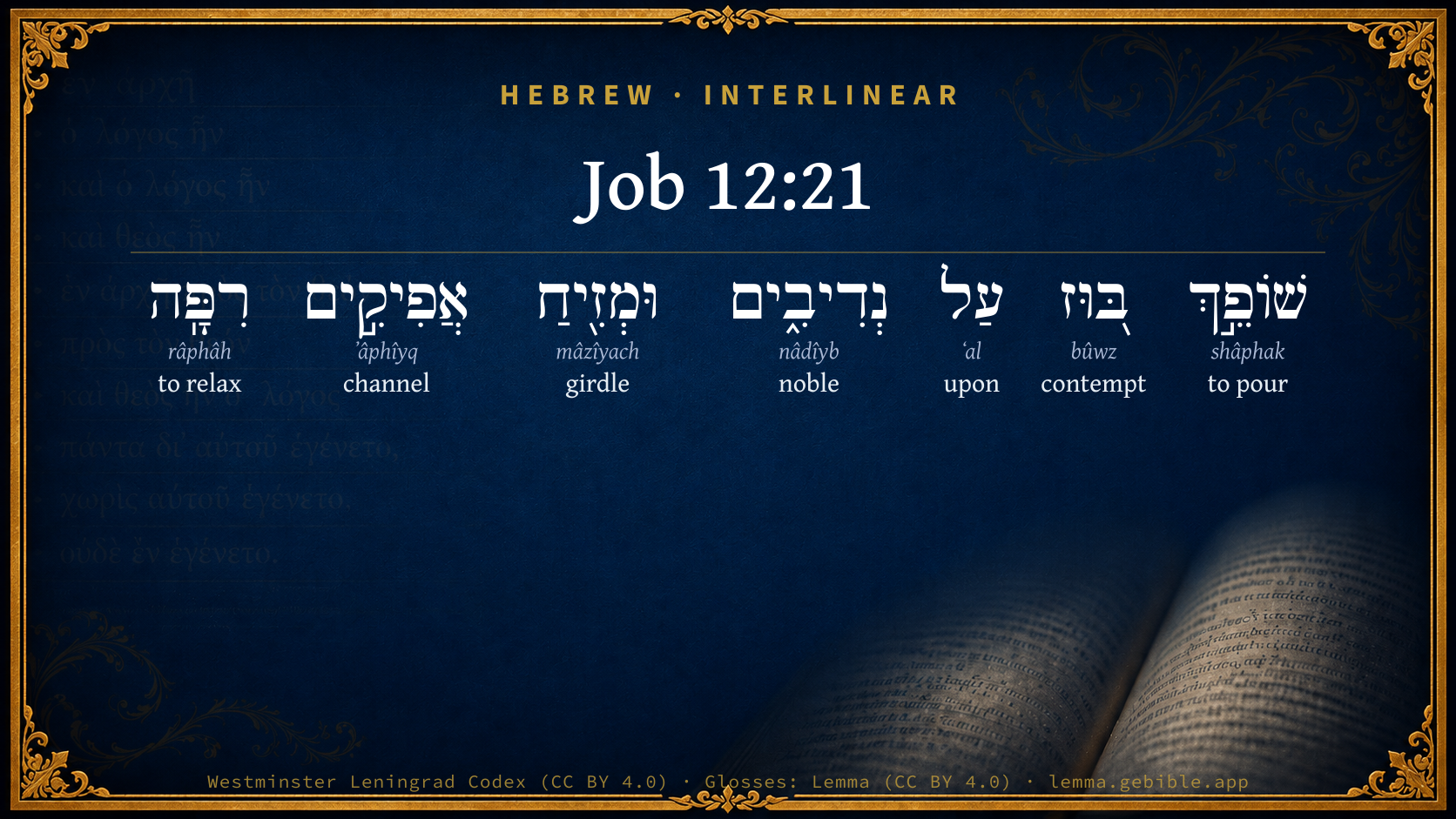
Job 12:21

Hebrew (Westminster Leningrad Codex) Job 12:21 appears in the Hebrew Old Testament. The text above is from the Westminster Leningrad Codex. Each word links to its Strong’s number, a concise gloss, and parsing drawn from the Open Scriptures Hebrew Bible morphology. Click any word for its full Brown-Driver-Briggs (BDB) entry.
Download image
Cite this verse

Job 12:21 (World English Bible). Public Domain. Lemma interlinear Bible study tool, https://lemma.gebible.app/v/job/12/21.

Show BibTeX & RIS
BibTeX
RIS
English Translation
He pours contempt on princes, And loosens the belt of the strong.
World English Bible · Public Domain
Highlights
  • 1 first appearance in the Hebrew Bible
Full analysis ↓
Download a study sheet

One document with this verse’s original text, its word-by-word gloss line, the meaning frame, cross-references with their text, attributed commentary, and full source and license credits — printable, and it pastes into notes with its structure intact.

This verse Autodidact and up

Study sheet (.html) Plain text (.txt)

A passage Seminary Student

Up to 50 verses in one chapter. A passage sheet keeps up to 6 commentary sources and 12 cross-references per verse, in the order this page ranks them, and says so on the sheet whenever that leaves anything out. Ask for a single verse and you get the Autodidact verse sheet above.

Everything on this page stays free to read, with no account — the sheet is a download of what is already on screen, not access to it.

Want to remove ads? Support Godless Engineer
Compare translations 3

The same verse in 3 English versions, stacked beneath the original-language interlinear above. Click any original word for its lexicon entry.

Each is an independent rendering of the whole verse — the interlinear is not word-aligned to these translations.

Highlighted words mark where these versions differ — a whole-verse word diff, not a word-by-word alignment.

  • World English Bible Public Domain
    He pours contempt on princes, And loosens the belt of the strong.
  • King James Version Public Domain
    He poureth contempt upon princes, and weakeneth the strength of the mighty.
  • unfoldingWord Literal Text CC BY-SA 4.0
    the one pouring contempt on nobles, and the belt of the mighty ones he loosens;

unfoldingWord Literal Text — © unfoldingWord, licensed CC BY-SA 4.0. Word-aligned USFM3 via Door43 (git.door43.org/unfoldingWord/en_ult).

Versions to compare (up to 4)

3 of 4 selected

Show all 18 translations

Every available English version of this verse, each an independent rendering of the whole verse.

  • World English Bible Public Domain
    He pours contempt on princes, And loosens the belt of the strong.
  • Berean Standard Bible Public Domain
    He pours out contempt on nobles and disarms the mighty.
  • Majority Standard Bible Public Domain
    He pours out contempt on nobles and disarms the mighty.
  • King James Version Public Domain
    He poureth contempt upon princes, and weakeneth the strength of the mighty.
  • American Standard Version (1901) Public Domain
    He poureth contempt upon princes, And looseth the belt of the strong.
  • Revised Version (1885) Public Domain
    He poureth contempt upon princes, and looseth the belt of the strong.
  • Geneva Bible (1599) Public Domain
    He powreth contempt vpon princes, and maketh the strength of the mightie weake.
  • Douay-Rheims (1899) Public Domain
    He poureth contempt upon princes, and relieveth them that were oppressed.
  • Young's Literal Translation Public Domain
    Pouring contempt upon princes, And the girdle of the mighty He made feeble.
  • Literal Standard Version CC BY-SA 4.0
    Pouring contempt on princes, || And the girdle of the mighty He made feeble.
  • Unlocked Literal Bible CC BY-SA 4.0
    He pours contempt upon princes and unfastens the belt of strong people.
  • unfoldingWord Literal Text CC BY-SA 4.0
    the one pouring contempt on nobles, and the belt of the mighty ones he loosens;
  • Darby Bible Public Domain
    He poureth contempt upon nobles, and slackeneth the girdle of the mighty;
  • World Messianic Bible Public Domain
    He pours contempt on princes, and loosens the belt of the strong.
  • Webster's Bible Public Domain
    He poureth contempt upon princes, and weakeneth the strength of the mighty.
  • Free Bible Version CC BY-SA 4.0
    He pours scorn upon princes and takes away power from the strong.
  • Bible in Basic English Public Domain
    He puts shame on chiefs, and takes away the power of the strong;
  • JPS Tanakh (1917) Public Domain
    He poureth contempt upon princes, and looseth the belt of the strong.

Literal Standard Version (2020), Covenant Press — licensed CC BY-SA 4.0. Text via the HelloAO Bible API (eBible.org). Unlocked Literal Bible (unfoldingWord) — licensed CC BY-SA 4.0. Text via the HelloAO Bible API (eBible.org). unfoldingWord Literal Text — © unfoldingWord, licensed CC BY-SA 4.0. Word-aligned USFM3 via Door43 (git.door43.org/unfoldingWord/en_ult). Free Bible Version, Dr. Jonathan Gallagher — licensed CC BY-SA 4.0. Text via the HelloAO Bible API (eBible.org).

Word by word

More ways to search: Search by grammar → Find every occurrence → Compare this word →

Practice this passage: Drill this verse → Learn its vocabulary →

About this verse

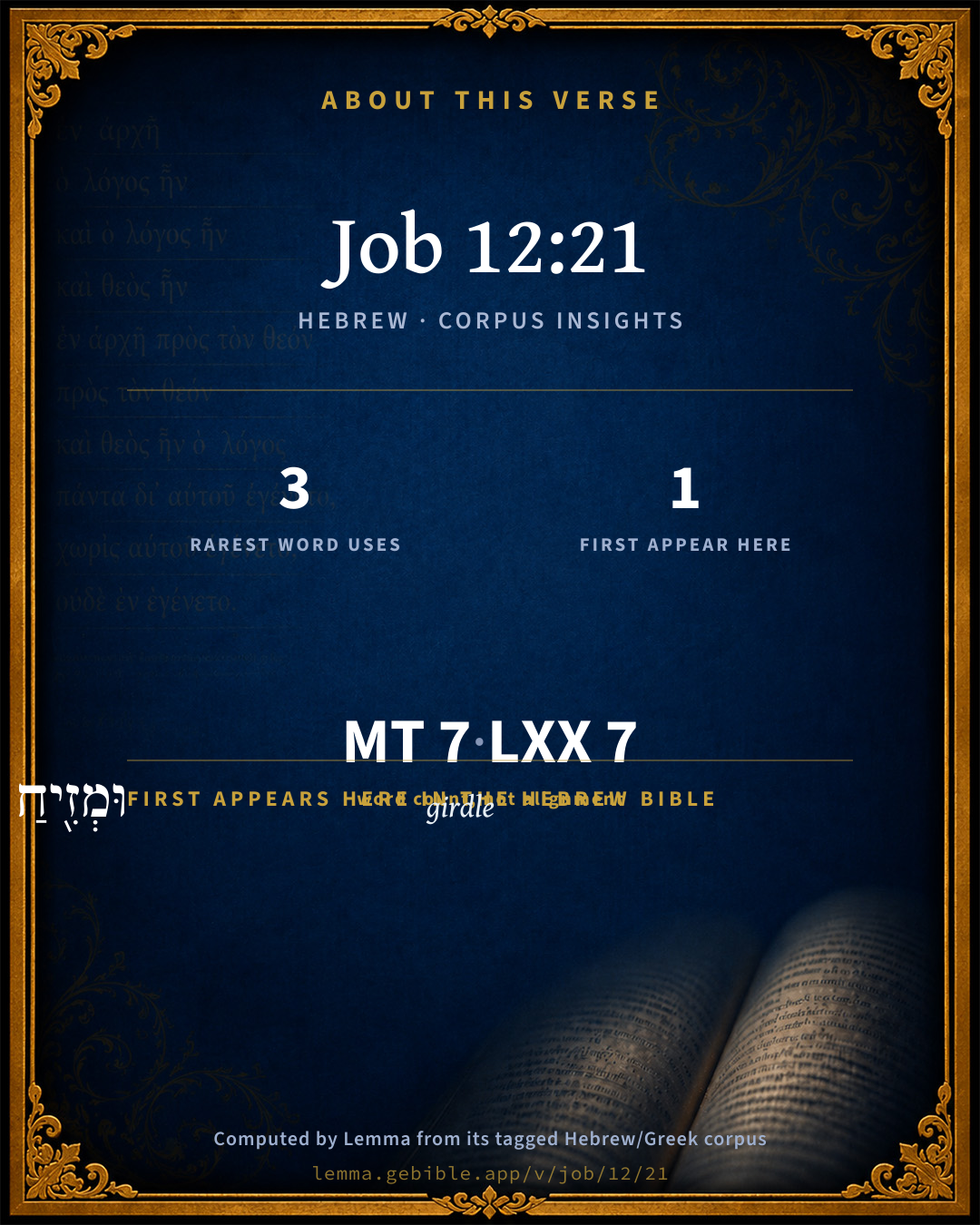
These counts appear in no published source. They are computed here, from the morphology-tagged text and Lemma’s own curated glosses. What Lemma adds →

7
words
7
distinct lemmas
Wisdom
section

Notable vocabulary

The rarest word here is וּמְזִ֖יחַ girdle H4206 — appearing just 3 times in the whole Hebrew Bible.

First appearance in Scripture

This word makes its first canonical appearance in the Hebrew Bible here:

  • וּמְזִ֖יחַ girdle H4206

Shared distinctive vocabulary

וּמְזִ֖יחַ girdle H4206 occurs in 3 verses of the Hebrew Bible. Also found in:

Grammatical profile

  • 2 verbs
  • 3 nouns
  • 1 adjective
  • 1 preposition

Verb forms

  • שׁוֹפֵ֣ךְ Qal · Participle Active
  • רִפָּֽה Piel · Perfect

Hebrew & Septuagint length

In English translation the verse runs 12 words from the Hebrew and 9 from the Septuagint (LXX English) — closely comparable.

A rough comparison of the two English renderings, which tokenize alike — not a word-level alignment.

Word counts can differ between the Hebrew and the Greek without any difference in meaning — e.g. the Hebrew direct-object marker אֵת has no separate Greek word, and Greek often adds the article ὁ.

In the original languages it is 7 Hebrew tokens and 7 Greek tokens — but the two are counted differently (Hebrew bundles its prefixes and suffixes into one token; the Greek is in lemma form), so that isn’t a like-for-like length.

Cross-references

18

Topical passages linked to Job 12:21 in the Treasury of Scripture Knowledge — connected by theme and wording, ordered by reader-vote popularity; previews shown in the World English Bible.

  • Psalms 107:40 He pours contempt on princes, And causes them to wander in a trackless waste.
  • Exodus 8:2 If you refuse to let them go, behold, I will plague all your borders with frogs:
  • Exodus 16:24 They laid it up until the morning, as Moses asked, and it didn't become foul, neither was there any worm in it.
  • 1 Kings 21:23–24 Of Jezebel also spoke Yahweh, saying, The dogs shall eat Jezebel by the rampart of Jezreel.
  • 2 Kings 9:26 Surely I have seen yesterday the blood of Naboth, and the blood of his sons, says Yahweh; and I will requite you in this plat, says Yahweh. Now therefore take and cast him into the plat [of ground], according to the word of Yahweh.
  • 2 Kings 9:34–37 When he was come in, he ate and drink; and he said, See now to this cursed woman, and bury her; for she is a king's daughter.
  • Isaiah 5:27 None shall be weary nor stumble among them; None shall slumber nor sleep; Neither shall the belt of their loins be untied, Nor the latchet of their shoes be broken:
  • Isaiah 11:5 Righteousness shall be the belt of his waist, and faithfulness the belt of his loins.
  • Isaiah 22:21 and I will cloth him with your robe, and strengthen him with your belt, and I will commit your government into his hand; and he shall be a father to the inhabitants of Jerusalem, and to the house of Judah.
  • Isaiah 23:9 Yahweh of hosts has purposed it, to stain the pride of all glory, to bring into contempt all the honorable of the earth.
  • Isaiah 24:21–22 It shall happen in that day, that Yahweh will punish the host of the high ones on high, and the kings of the earth on the earth.
  • Isaiah 37:38 It happened, as he was worshipping in the house of Nisroch his god, that Adrammelech and Sharezer his sons struck him with the sword; and they escaped into the land of Ararat. Esar Haddon his son reigned in his place.
  • Daniel 2:21–22 He changes the times and the seasons; he removes kings, and sets up kings; he gives wisdom to the wise, and knowledge to those who have understanding;
  • Daniel 4:32–33 and you shall be driven from men; and they dwelling shall be with the animals of the field; you shall be made to eat grass as oxen; and seven times shall pass over you; until you know that the Most High rules in the kingdom of men, and gives it to whoever he will.
  • Matthew 2:12–13 Being warned in a dream that they shouldn't return to Herod, they went back to their own country another way.
  • Acts 12:23 Immediately an angel of the Lord struck him, because he didn't give God the glory, and he was eaten by worms and died.
  • Ephesians 6:10 Finally, be strong in the Lord, and in the strength of his might.
  • Ephesians 6:14 Stand therefore, having the utility belt of truth buckled around your waist, and having put on the breastplate of righteousness,

Cross-references courtesy of OpenBible.info (CC BY 4.0).

Hebrew and Greek witnesses Masoretic Hebrew ↔ Greek Septuagint

The same verse in the two great witnesses to the Old Testament, shown verse-for-verse.

These are two independent witnesses, not word-aligned to each other, and the Septuagint is shown in lemma (dictionary) form.

Hebrew Job 12:21 Masoretic · Westminster Leningrad Codex

שׁוֹפֵ֣ךְ בּ֭וּז עַל נְדִיבִ֑ים וּמְזִ֖יחַ אֲפִיקִ֣ים רִפָּֽה

He pours contempt on princes, And loosens the belt of the strong.

World English Bible · Public Domain

Greek LXX Job 12:21 Septuagint · lemma form

ἐκχέω ἀτιμία ἐπί ἄρχων ταπεινός δέ ἰάομαι

He pours dishonor upon princes, and heals the lowly.

LXX2012 (modern English Septuagint) · Public Domain

On this verse, Haydock's Catholic Bible Commentary discusses the Septuagint’s reading. Read the note in Commentary ↓

Hebrew: Westminster Leningrad Codex (CC BY 4.0). Greek: Septuagint (public domain); English from LXX2012 (modern English Septuagint) (Public Domain). How the Septuagint differs from the Hebrew →

Commentary

Notes on Job 12:21 from classic Christian and Jewish commentators (each source and its license shown beneath its notes). The classic Christian expositions comment on the surrounding passage and are grouped to its opening verse, so a note may address several verses; the Jewish commentaries on the Tanakh (Rashi and others) are per-verse, so they appear only where the commentator wrote on this verse.

Lemma curates 59 commentaries, every one of them public domain or Creative Commons licensed, each selected and text-cleaned for this edition rather than reprinted as found. About our sources →

Jamieson, Fausset & Brown

Robert Jamieson, A. R. Fausset & David Brown

job 12:21Psa 107:40 quotes, in its first clause, this verse and, in its second, Job 12:24.

weakeneth the strength--literally, "looseth the girdle"; Orientals wear flowing garments; when active strength is to be put forth, they gird up their garments with a girdle. Hence here--"He destroyeth their power" in the eyes of the people.

Jamieson, Fausset & Brown — Commentary Critical and Explanatory on the Whole Bible (1871) — public domain (CC PDM 1.0). Text via the HelloAO Bible API.

Trapp's Complete Commentary

John Trapp

Job 12:21 He poureth contempt upon princes, and weakeneth the strength of the mighty.

Ver. 21. He poureth contempt upon princes] Or nobles, or gentlemen, which are, or should be, free, bounteous, munificent benefactors (ευεργεται): if they be not Nedibim, but Nebalim, liberal, but churlish (see these opposed, Isa 32:5), it is just in God to pour contempt, to lay abundance of shame and scorn upon them, as sordid penny fathers, ignoble Euelios, poor-spirited men, the base brood, or rather blot, of their better forefathers. Of our Edward II it is chronicled, that never was prince received with greater love and opinion of all than he, or never any that sooner lost it: for his very first action in recalling his minion, Pierce Gaveston, discovered a headstrong wilfulness, that was uncounsellable; hence he was slighted by his subjects, pursued by his wife and son, and at length cruelly murdered (Daniel). Mercer observeth that David hath the selfsame words, Psa 107:40, that are found here and Job 12:24. Neither need we wonder, since they both spoke by the same spirit.

And weakeneth the strength of the mighty] Heb. He slackeneth the girdle of the impetuous, that, like strong streams in narrow straits, bear down all before them. So do soldiers in war. See 2Sa 22:36 Job 6:11. But God can loose their girdles (or belts, which bind their garments, and buckle their armour close to them), he can dispirit them, and make them feeble and faint hearted, as he did Samson, and those Assyrians, Psa 76:5-6. By this whole discourse of Job it appeareth that he had very diligently observed God’s providence, and way of administration in the several ranks of men, and alterations of commonwealths; whereby he had learned secretly to admire and adore God’s judgments, which thing we ought also similarily to do.

John Trapp, A Commentary or Exposition upon All the Books of the Old and New Testament (1647–1656) — public domain. Text from a community e-Sword module.

Joseph Benson's Commentary

Job 12:21-22. He poureth contempt upon princes — That is, he makes them contemptible to their subjects and others; and weakeneth the strength of the mighty — The word מזיח, meziach, here rendered strength, occurs also Psa 109:19, where it is translated girdle. The clause might here have been rendered, He looseth the girdle of the mighty, a phrase which signifies weakness, Isa 5:27; as the girding of the girdle denotes strength and power, Isa 22:21; Isa 45:5. Both these phrases are taken from the quality of their garments, which, being loose and long, disabled a man for walking or working. He discovereth deep things out of darkness — That is, the most secret and crafty counsels of princes: which are contrived and carried on in the dark.

Joseph Benson's Commentary on the Old and New Testaments (1811–1818) — public domain. Text from a community e-Sword module.

Tyndale Open Study Notes

Tyndale Open Resources

12:21 pours disgrace upon princes: Cp. Ps 107:40. • disarms (literally looses the belt of): The strong are no longer girded for battle.

Tyndale Open Study Notes — © Tyndale Open Resources, licensed CC BY-SA 4.0. Text via the HelloAO Bible API.

Adam Clarke's Commentary

Verse 21. He poureth contempt upon princes] נדיבים nedibim, "those of royal extraction;" widely different from the כהנים cohanim mentioned Job 12:19.

Weakeneth the strength of the mighty.] אפיקים aphikim, the compact; the well-strung together; the nervous and sinewy. Perhaps there is a reference here to the crocodile, as the same term is applied, Job 40:13, to the compactness of his bones: and as רפה מזיח rippah meziach, which we translate weakeneth the strength, signifies more properly looseth the girdle, as the margin has properly rendered it, the reference seems still more pointed; for it is known that "the crocodile, from the shoulders to the extremity of the tail, is covered with large square scales, disposed like parallel girdles, fifty-two in number. In the middle of each girdle are four protuberances, which become higher as they approach the end of the tail, and compose four rows." See the quotation in Parkhurst, under the word אפק aphak. What is human strength against this? We may say as the Lord said, Job 40:19: He that made him can make his sword to approach unto him. He alone can loose the girdles of this mighty one.

Adam Clarke's Commentary on the Bible (1810–1826) — public domain. Text from a community e-Sword/MySword module.

The Cambridge Bible for Schools and Colleges

gen. ed. J. J. S. Perowne

21. contempt upon princes] Or, nobles, ch. Job_34:18; cf. Psa_107:40.

weakeneth the strength of the mighty] lit. looseth the girdle of the strong. As the garments were girt up for active labour or battle, to loose the girdle means to incapacitate; Isa_5:27.

The Cambridge Bible for Schools and Colleges (gen. ed. J. J. S. Perowne; Cambridge University Press, 1878–1918) — public domain. Text from a community e-Sword module.

John Gill's Exposition

He discovereth deep things out of darkness,.... The deep things of God, his own deep things which lie in his heart, wrapped up in darkness impenetrable to creatures, and which could never be known unless he had discovered them; such as the thoughts of his heart, which are very deep, Psa 92:5; the deep things of God, which the Spirit of God only knows, searches, and reveals, Co1 2:10; even his thoughts of peace, and good things for his people, which are many and precious, are known to himself, and made known to them, or otherwise must have remained in darkness, and out of their reach, being as high as the heavens are from the earth; the decrees and purposes of God, which he hath purposed in himself, are deep things in his own breast, and lie concealed in darkness there, until discovered by the accomplishment of them; such as his decrees of election in Christ, redemption by him, and the effectual calling by his grace; all which are revealed and made known by the execution of them: the love of God to his people, which lay hid in his heart from everlasting; this is discovered by the gift and mission of his Son; in the regeneration and quickening of his people, and of which he makes still larger discoveries to them in the course of their lives: likewise the mysteries of the Gospel, unknown to natural men, even the wise and prudent, only known to such to whom it is given to know them, to whom they are revealed by the Father of Christ, and by the Spirit of wisdom and revelation in the knowledge of the mystery of God, and of the Father, and of Christ; respecting the persons in the Godhead, the grace of each person, the incarnation of Christ, the union of the two natures in him, redemption and justification by him, regeneration by the Spirit of God, union to Christ, and communion with him, and conformity to him in soul and body, now and hereafter: likewise the secrets of his providence, in which there is a great depth of his wisdom and knowledge, and is in great obscurity; his path is in the great waters, and his footsteps are not known; his judgments are unsearchable, and his ways past finding out, but before long they will be made manifest, and lie open to view. There are also the deep things of others, which he discovers, as the depth of sin in the deceitful heart of man, which none knows as himself; and which lie hid there until they are discovered in the light of the divine Spirit, who convinces of them, enlightens the understanding to behold those swarms of lusts and corruptions it never discerned before; and then a man comes to see and know the plague of his own heart, he was before a stranger to; also the depths of Satan, his deep laid schemes, his wiles and stratagems, to draw into sin, and so to ruin; these are unknown to natural men, but saints are made acquainted with them, so that they are not altogether ignorant of his devices, Rev 2:24; likewise the secret plots, counsels, and combinations of wicked men, which they lay deep, and seek to hide from the Lord, being formed in the dark; but he sees and knows them, discovers and confounds them: to which may be added all the wicked actions of men done in the dark, but cannot be hid from God, with whom the darkness and the light are both alike; and who, sooner or later, brings them to light, even the hidden things of darkness, and makes manifest the counsels of the heart, as he will do more especially at the day of judgment, to which every secret thing will be brought:

and bringeth but to light the shadow of death; not only life and immortality, as by the Gospel, but death, and the shadow of it, even deadly darkness, the grossest of darkness; such who are darkness itself he makes light, and out of the darkness in them commands light to shine, as in the first creation; to them that sit in darkness, and in the shadow of death, he causes a great light to arise, the light of the Gospel, and the light of grace, yea, Christ himself, the light of the world; he calls and brings them out of it into marvellous light, out of the dark dungeon and prison of sin and unbelief, to the enjoyment of spiritual light and life here, and to everlasting light and glory hereafter.

John Gill's Exposition of the Whole Bible (1746–1763) — public domain (CC PDM 1.0). Text via the HelloAO Bible API.

Albert Barnes' Notes on the Bible

He poureth contempt upon princes - He has power to hurl them from their thrones, and to overwhelm them with disgrace.

And weakeneth the strength of the mighty - Margin, as in Hebrew “looseth the girdle of the strong.” The Orientals wore loose flowing robes, which were secured by a girdle around the loins. When they labored, ran, or traveled, their robes were girded up. But this is common everywhere. Wrestlers, leapers, and runners, put a girdle around them, and are able thus to accomplish much more than they otherwise could. To loosen that, is to weaken them. So Job says that God had power to loosen the strength of the mighty. He here seems to labor for expressions, and varies the form of the image in every way to show the absolute control which God has over people, and the fact that his power is seen in the reverses of mankind. Lucretius has a passage strongly resembling this in the general sentiment:

Usque adeo res humanas vis abdita quaedam

Obterit; et pulchros fasces, saevasque secures,

Proculcare, atque ludibrio sibi habere, videtur.

Lib. v. 1232.

So from his awful shades, some Power unseen

O’erthrows all human greatness! Treads to dust

Rods, ensigns, crowns - the proudest pomps of state;

And laughs at all the mockery of mad!

Good.

Albert Barnes' Notes on the Bible (1834–1885) — public domain. Text from a community e-Sword/MySword module.

Haydock's Catholic Bible Commentary

Relieveth. Hebrew, "ungirdeth (disarms) the strong." (Calmet) --- Septuagint, "but the lowly (humble) he has healed."

George Leo Haydock (1774–1849), Haydock's Catholic Family Bible and Commentary, 1859 edition — public domain. Excludes Psalms (Douay-Rheims chapter numbering differs from Protestant) and Deuterocanonical books (Catholic canon only).

Matthew Poole's English Annotations

He poureth contempt upon princes, i.e. he makes them contemptible to their subjects and others.

Weakeneth, Heb. he looseth the girdle; which phrase signifies weakness, as Isa 5:27; as the girding of the girdle notes strength and power, as Isa 22:21; 45:5; both these phrases being taken from the quality of their garments, which being loose and long, did disenable a man for travel or work.

Matthew Poole's English Annotations on the Holy Bible (1683–1685) — public domain. Text from a community e-Sword/MySword module.

Whedon's Commentary on the Bible

Daniel D. Whedon

21. Weakeneth the strength, etc. — Literally, Looseth the girdle of the strong; a proverbial phrase, says Umbreit, “for destroying their power, that is, in the eyes of the people.” The garments of the Orientals were long and flowing, and were consequently in the way when active service was demanded. The girdle served to bind them up; and hence, to unloose the girdle typified inaction or effeminacy. God promised to unloose the loins of kings before Cyrus, (Isa_45:1,) that is. to render them unfit for material resistance.

Daniel D. Whedon (gen. ed.), Commentary on the Old and New Testaments (1874–1909) — public domain. Text from a community e-Sword module.

The Pulpit Commentary

He poureth contempt upon princes; literally, upon the munificent. But the word has often the more generic sense of "princes," "great men". (see 1Sa_2:8 Pro_25:7, etc.) And weakeneth the strength of the mighty; literally, looseth the belt of the strong. But our version sufficiently expresses the meaning.

The Pulpit Commentary (1880–1919), ed. H.D.M. Spence-Jones & Joseph S. Exell — public domain. Text from a community e-Sword module.

Rashi

Rabbi Shlomo Yitzchaki (Rashi)

and loosens the belt of the strong And He loosens the belt of the strong. He opens their belt to weaken them, like (Ps. 109:19), “and for the girdle (ולמזח) wherewith he is girded continually.”

the strong Heb. אפיקים, like (below 40:18), “as strong as (אפיקי) copper; (ibid. 41:7), “He is proud of the strength of (אפיקי) His scales.”

Rashi on the Tanakh — English translations: “The Judaica Press complete Tanach with Rashi, translated by A. J. Rosenberg” (CC BY 4.0); “Pentateuch with Rashi's commentary by M. Rosenbaum and A.M. Silbermann, 1929-1934” (public domain); “The Metsudah Tanach series, Lakewood, N.J” (CC BY 4.0); and “The Book of Joshua, Metsudah Publications, 1997” (CC BY 4.0). Text via Sefaria.

Lesson kit

Teaching starters — assembled from the data on this page, not authored interpretation. Every prompt links to the verse data it draws on. Edit before teaching.

Job, in the Wisdom, opens this verse with 7 words (7 distinct Hebrew lemmas). Its most distinctive word is mâzîyach (“girdle”). A historical commentator’s framing appears above. Read the whole chapter for the surrounding context.

Discussion questions

  1. How does “girdle” (mâzîyach) shape what this verse is saying?
  2. This is the first place “girdle” appears in Scripture (first appears here). What does its debut here establish?
  3. How does Psalms 109:19, which shares the word «girdle», read alongside this verse?
  4. These translations render this verse differently. What is at stake in choosing one wording over another?
  5. «שׁוֹפֵ֣ךְ» is a Qal Participle Active verb. How does that grammatical form shape the action described?
  6. Compare how Jamieson, Fausset & Brown and Trapp's Complete Commentary read this verse. Where do they agree or differ?

Things to notice

Reading settings

Reading text

Shown beneath each verse's original-language words.

Old Testament
Old Testament edition

Read the OT as the Masoretic Hebrew (MT) or the Greek Septuagint (LXX).

English shown for the Greek Septuagint (in the Hebrew ↔ Greek comparison).

Comparing translations? Open the Compare panel on any verse page to stack up to four side by side.