
Joel 2:29

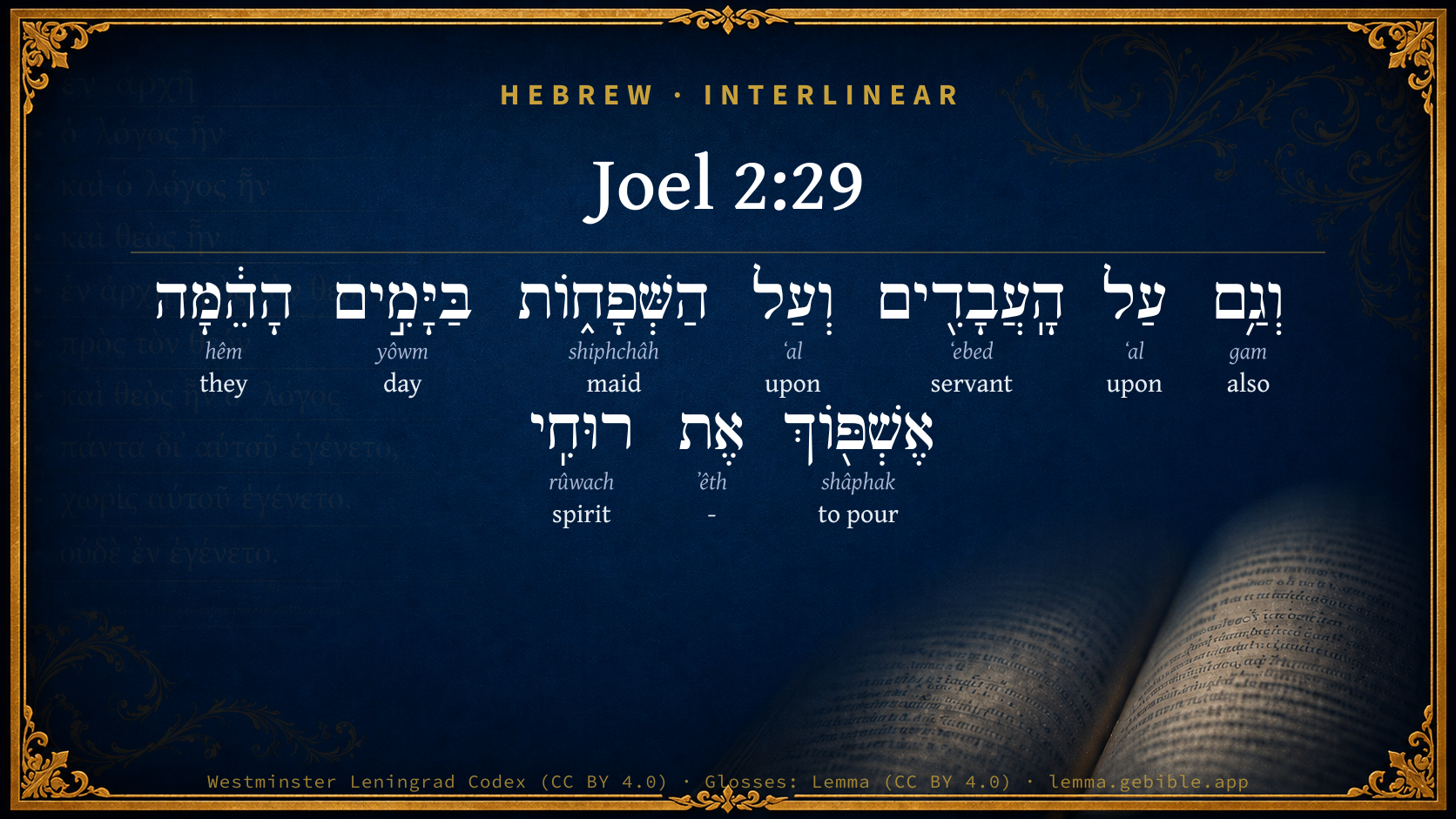
Hebrew (Westminster Leningrad Codex) Joel 2:29 appears in the Hebrew Old Testament. The text above is from the Westminster Leningrad Codex. Each word links to its Strong’s number, a concise gloss, and parsing drawn from the Open Scriptures Hebrew Bible morphology. Click any word for its full Brown-Driver-Briggs (BDB) entry.
Download image
Cite this verse

Joel 2:29 (World English Bible). Public Domain. Lemma interlinear Bible study tool, https://lemma.gebible.app/v/joel/2/29.

Show BibTeX & RIS
BibTeX
RIS
English Translation
And also on the servants and on the handmaids in those days, I will pour out my Spirit.
World English Bible · Public Domain
Download a study sheet

One document with this verse’s original text, its word-by-word gloss line, the meaning frame, cross-references with their text, attributed commentary, and full source and license credits — printable, and it pastes into notes with its structure intact.

This verse Autodidact and up

Study sheet (.html) Plain text (.txt)

A passage Seminary Student

Up to 50 verses in one chapter. A passage sheet keeps up to 6 commentary sources and 12 cross-references per verse, in the order this page ranks them, and says so on the sheet whenever that leaves anything out. Ask for a single verse and you get the Autodidact verse sheet above.

Everything on this page stays free to read, with no account — the sheet is a download of what is already on screen, not access to it.

Want to remove ads? Support Godless Engineer
Compare translations 3

The same verse in 3 English versions, stacked beneath the original-language interlinear above. Click any original word for its lexicon entry.

Each is an independent rendering of the whole verse — the interlinear is not word-aligned to these translations.

Highlighted words mark where these versions differ — a whole-verse word diff, not a word-by-word alignment.

  • World English Bible Public Domain
    And also on the servants and on the handmaids in those days, I will pour out my Spirit.
  • King James Version Public Domain
    And also upon the servants and upon the handmaids in those days will I pour out my spirit.
  • unfoldingWord Literal Text CC BY-SA 4.0
    And even on male servants and on female servants, in those days I will pour out my Spirit.

unfoldingWord Literal Text — © unfoldingWord, licensed CC BY-SA 4.0. Word-aligned USFM3 via Door43 (git.door43.org/unfoldingWord/en_ult).

Versions to compare (up to 4)

3 of 4 selected

Show all 16 translations

Every available English version of this verse, each an independent rendering of the whole verse.

  • World English Bible Public Domain
    And also on the servants and on the handmaids in those days, I will pour out my Spirit.
  • Berean Standard Bible Public Domain
    Even on My menservants and maidservants, I will pour out My Spirit in those days.
  • Majority Standard Bible Public Domain
    Even on My menservants and maidservants, I will pour out My Spirit in those days.
  • King James Version Public Domain
    And also upon the servants and upon the handmaids in those days will I pour out my spirit.
  • American Standard Version (1901) Public Domain
    and also upon the servants and upon the handmaids in those days will I pour out my Spirit.
  • Revised Version (1885) Public Domain
    and also upon the servants and upon the handmaids in those days will I pour out my spirit.
  • Geneva Bible (1599) Public Domain
    And also vpon the seruants, and vpon the maydes in those dayes wil I powre my Spirit.
  • Douay-Rheims (1899) Public Domain
    Moreover upon my servants and handmaids in those days I will pour forth my spirit.
  • Young's Literal Translation Public Domain
    And also on the men-servants, and on the maid-servants, In those days I do pour out My Spirit.
  • Literal Standard Version CC BY-SA 4.0
    And also on the menservants and on the maidservants, || In those days I pour out My Spirit.
  • Unlocked Literal Bible CC BY-SA 4.0
    Also on servants and female servants, in those days I will pour out my Spirit.
  • unfoldingWord Literal Text CC BY-SA 4.0
    And even on male servants and on female servants, in those days I will pour out my Spirit.
  • Darby Bible Public Domain
    Yea, even upon the bondmen and upon the handmaids in those days will I pour out my Spirit.
  • World Messianic Bible Public Domain
    And also on the servants and on the handmaids in those days, I will pour out my Spirit.
  • Free Bible Version CC BY-SA 4.0
    In those days I will also pour out my Spirit on male slaves and female slaves.
  • JPS Tanakh (1917) Public Domain
    (3-2) And also upon the servants and upon the handmaids in those days will I pour out My spirit.

Literal Standard Version (2020), Covenant Press — licensed CC BY-SA 4.0. Text via the HelloAO Bible API (eBible.org). Unlocked Literal Bible (unfoldingWord) — licensed CC BY-SA 4.0. Text via the HelloAO Bible API (eBible.org). unfoldingWord Literal Text — © unfoldingWord, licensed CC BY-SA 4.0. Word-aligned USFM3 via Door43 (git.door43.org/unfoldingWord/en_ult). Free Bible Version, Dr. Jonathan Gallagher — licensed CC BY-SA 4.0. Text via the HelloAO Bible API (eBible.org).

Word by word

More ways to search: Search by grammar → Find every occurrence → Compare this word →

Practice this passage: Drill this verse → Learn its vocabulary →

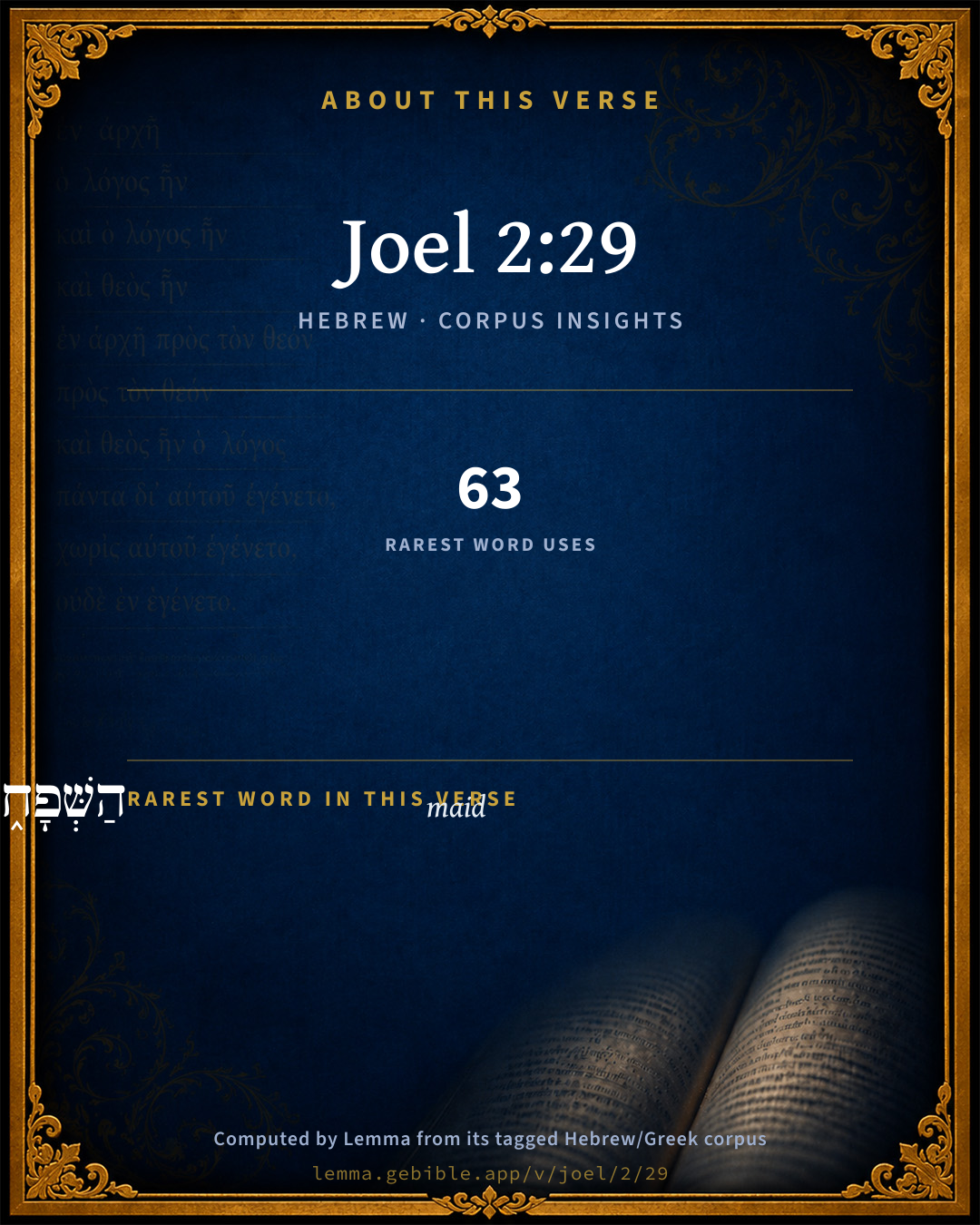
הַשְּׁפָח֑וֹת
shiphchâh
H8198
“the · maids”
Particle, Definite Article + Noun, Common, Feminine, Plural, Absolute
Part of Speech
Particle + Noun
Type
Common
Gender
Feminine
Number
Plural
State
Absolute
Full BDB Definition

Origin: from the same as H8207 ">H8207 )

TWOT: None

maid, maid-servant, slavegirl - maid, maid-servant (as belonging to a mistress) - of address, speaker, humility (figuratively)
  1. וְגַ֥ם gam H1571 “and · also” Conjunction + Particle, Accusative
  2. עַל ʻal H5921 “upon” Preposition
  3. הָֽעֲבָדִ֖ים ʻebed H5650 “the · servants” Particle, Definite Article + Noun, Common, Masculine, Plural, Absolute
  4. וְעַל ʻal H5921 “and · upon” Conjunction + Preposition
  5. בַּיָּמִ֣ים yôwm H3117 “in/at the · days” Preposition, Determined + Noun, Common, Masculine, Plural, Absolute
  6. הָהֵ֔מָּה hêm H1992 “the · they” Particle, Definite Article + Pronoun, Demonstrative, Masculine, Plural
  7. אֶשְׁפּ֖וֹךְ shâphak H8210 “to pour” Verb, Qal, Imperfect, 1st Person, Common, Singular
  8. אֶת ʼêth H853 “-” Particle, Direct Object
  9. רוּחִֽי rûwach H7307 “spirit · my” Noun, Common, Both, Singular, Construct + Suffix, Personal, 1st Person, Common, Singular

About this verse

These counts appear in no published source. They are computed here, from the morphology-tagged text and Lemma’s own curated glosses. What Lemma adds →

10
words
9
distinct lemmas
Prophets
section

Grammatical profile

  • 1 verb
  • 4 nouns
  • 1 pronoun
  • 2 prepositions
  • 2 particles

Verb forms

  • אֶשְׁפּ֖וֹךְ Qal · Imperfect

Repetition

A word recurs within this verse — often emphatic in Hebrew:

Hebrew & Septuagint length

In English translation the verse runs 18 words from the Hebrew and 18 from the Septuagint (LXX English) — the same length.

A rough comparison of the two English renderings, which tokenize alike — not a word-level alignment.

Word counts can differ between the Hebrew and the Greek without any difference in meaning — e.g. the Hebrew direct-object marker אֵת has no separate Greek word, and Greek often adds the article ὁ.

Cross-references

3

Topical passages linked to Joel 2:29 in the Treasury of Scripture Knowledge — connected by theme and wording, ordered by reader-vote popularity; previews shown in the World English Bible.

  • 1 Corinthians 12:13 For in one Spirit we were all baptized into one body, whether Jews or Greeks, whether bond or free; and were all given to drink into one Spirit.
  • Galatians 3:28 There is neither Jew nor Greek, there is neither slave nor free man, there is neither male nor female; for you are all one in Christ Jesus.
  • Colossians 3:11 where there can't be Greek and Jew, circumcision and uncircumcision, barbarian, Scythian, bondservant, freeman; but Christ is all, and in all.

Cross-references courtesy of OpenBible.info (CC BY 4.0).

Hebrew and Greek witnesses Masoretic Hebrew ↔ Greek Septuagint

The same verse in the two great witnesses to the Old Testament, shown verse-for-verse.

These are two independent witnesses, not word-aligned to each other, and the Septuagint is shown in lemma (dictionary) form.

Hebrew Joel 2:29 Masoretic · Westminster Leningrad Codex

וְגַ֥ם עַל הָֽעֲבָדִ֖ים וְעַל הַשְּׁפָח֑וֹת בַּיָּמִ֣ים הָהֵ֔מָּה אֶשְׁפּ֖וֹךְ אֶת רוּחִֽי

And also on the servants and on the handmaids in those days, I will pour out my Spirit.

World English Bible · Public Domain

Greek LXX Joel 2:29 Septuagint · lemma form
And on my servants and on my handmaids in those days will I pour out of my Spirit.

LXX2012 (modern English Septuagint) · Public Domain

On this verse, Haydock's Catholic Bible Commentary discusses the Septuagint’s reading. Read the note in Commentary ↓

Hebrew: Westminster Leningrad Codex (CC BY 4.0). Greek: Septuagint (public domain); English from LXX2012 (modern English Septuagint) (Public Domain). How the Septuagint differs from the Hebrew →

Commentary

Notes on Joel 2:29 from classic Christian and Jewish commentators (each source and its license shown beneath its notes). The classic Christian expositions comment on the surrounding passage and are grouped to its opening verse, so a note may address several verses; the Jewish commentaries on the Tanakh (Rashi and others) are per-verse, so they appear only where the commentator wrote on this verse.

Lemma curates 59 commentaries, every one of them public domain or Creative Commons licensed, each selected and text-cleaned for this edition rather than reprinted as found. About our sources →

Trapp's Complete Commentary

John Trapp

Joe 2:29 And also upon the servants and upon the handmaids in those days will I pour out my spirit.

Ver. 29. And also upon the servants] They shall be the free men and women of Jesus Christ, 1Co 7:22, by as full a measure of God’s free and noble Spirit bestowed upon them as upon their masters and mistresses. The Trent translation hath it, upon my servants and my handmaids but there is no such pronoun in the original though it is true that all that have the Spirit are his; and the contrary, Rom 8:9 Eph 1:13 The scope of the text is, as Mercer well noteth to show that ut gratuitum et commune Christ beneficium, sic et spiritus, as the benefits of Christ are free and common to all his people, so is the Spirit. And surely, next to the love of Christ indwelling in our nature, we may well wonder at the love of the Holy Ghost, that will dwell in our defiled souls, and act in them as he doth. For there are diversity of gifts, but the same Spirit, 1Co 12:4, as the diverse smells of flowers come from the same influence, and the diverse sounds in the organ from the same breath.

John Trapp, A Commentary or Exposition upon All the Books of the Old and New Testament (1647–1656) — public domain. Text from a community e-Sword module.

Jamieson, Fausset & Brown

Robert Jamieson, A. R. Fausset & David Brown

And also--"And even." The very slaves by becoming the Lord's servants are His freemen (Co1 7:22; Gal 3:28; Col 3:11; Plm 1:16). Therefore, in Act 2:18 it is quoted, "My servants" and "My handmaidens"; as it is only by becoming the Lord's servants they are spiritually free, and partake of the same spirit as the other members of the Church.

Jamieson, Fausset & Brown — Commentary Critical and Explanatory on the Whole Bible (1871) — public domain (CC PDM 1.0). Text via the HelloAO Bible API.

Adam Clarke's Commentary

Verse 29. And also upon the servants and upon the handmaids] The gifts of teaching and instructing men shall not be restricted to any one class or order of people. He shall call and qualify the men of his own choice; and shall take such out of all ranks, orders, degrees, and offices in society. And he will pour out his Spirit upon them; and they shall be endowed with all the gifts and graces necessary to convert sinners, and build up the Church of Christ on its most holy faith.

And this God has done, and is still doing. He left the line of Aaron, and took his apostles indiscriminately from any tribe. He passed by the regular order of the priesthood, and the public schools of the most celebrated doctors, and took his evangelists from among fishermen, tent-makers, and even the Roman tax-gatherers. And he, lastly, passed by the Jewish tribes, and took the Gentile converts, and made them preachers of righteousness to the inhabitants of the whole earth. The same practice he continues to the present day; yet he did not then pass by a man brought up at the feet of Gamaliel, no more than he would now a man brought up in a celebrated seminary of learning. He is ever free to use his own gifts, in his own way; and when learning is sanctified, by being devoted to the service of God, and the possessor is humble and pious, and has those natural gifts necessary for a public teacher, perhaps we might safely say, God would in many cases prefer such: but he will have others, as intimated in the prophecy, that we may see the conversion of men is not by human might, nor power, but by the Spirit of the Lord of hosts. The learned man can do nothing without his Spirit; the unlearned must have his gifts and graces, without which both their labours would be unprofitable; and thus the excellency of the power is of God, and no flesh can glory in his presence. See my sermon on this passage.

Adam Clarke's Commentary on the Bible (1810–1826) — public domain. Text from a community e-Sword/MySword module.

John Calvin's Commentaries

As the particle גם gam amplifies in Hebrew, it seems singular that the Prophet now limits to a few a gift common to all; for he had previously said, “Upon all flesh will I pour out my Spirit;” and now, “Upon servants and handmaids;” and he puts down “Also”. If he had simply said “Upon servants and handmaids will I pour out my Spirit,” there would have been no inconsistency, for it would have been the explanation of his former statement; for we know that what the Prophet says of all men must be taken with exception, inasmuch as many who were unbelievers were without this gift, and even those who before excelled in some sort of divine knowledge; we indeed know that the Jews were blinded, and we also know that not all among the common people were partakers of this excellent gift. There is no doubt, therefore, but that this which is said of “all flesh,” must be limited to the Church. It would not, then, have appeared strange, had the Prophet now added, “Upon servants and handmaids;” but the particles וגם ugam, “And also,” create difficulty: it is a way of speaking to enlarge on what has been said, but here it seems not to enlarge; for to pour out the Spirit upon all the people, is more than to pour it out on servants and handmaids. The solution is twofold: the particles וגם ugam are sometimes to be taken confirmatively. ‘I have blessed him,’ said Isaac of his son Jacob, ‘and also blessed shall he be.’ So in this place we may take the words of the Prophet to be, yea surely, being a repetition serving to confirm what had been said: but I prefer another sense; for the Prophet, I doubt not, meant here to add something more incredible than what he had previously said, “Upon servants and maid-servants will I pour out my Spirit,” that is, even upon those who were before Prophets; for they shall be enriched with a new gift, and shall gain increasing knowledge after the restoration of the Church, which is now approaching. We apprehend this to be the meaning of the Prophet. He had promised the grace of the Spirit to the whole body of the faithful, which appears, as I have said, from comparing the ancient state with our own: but now, after having spoken of the mass or the common people, he comes to the Prophets, who were superior to others who before performed the office of teaching, who attained rank and degree in the Church; these also shall gain accessions; that is, “My Spirit shall not only be conspicuous in the ignorant and the common people, but also in the Prophets themselves.”

Surely it is a greater thing when they are taught who were before superior to others, and whom the Lord had set over the Church, and when they appear as new men, after having received a gift which the Lord had not previously conferred on them. When, therefore, new light appears in such men, it is certainly a greater thing than when the Spirit is poured out on the common people. We now then see the Prophet’s meaning as to the servants and the handmaids.

He then repeats, In those days, intimating that so sudden and incredible the change will be, that Prophets will seem to have been before untaught men; for a much more excellent doctrine shall be given them. Then God shall so pour out his Spirits that all the ancient prophecies will appear obscure and of no value, compared with the great and extraordinary light which Christ, the Sun of Righteousness, will bring at his rising. And he mentions “handmaids”, for there were, we know, Prophetesses under the Law. Let us now go on —

John Calvin's Commentaries (1540-1563) — public domain. Text from the Calvin Translation Society English edition (1840s-50s) via the Christian Classics Ethereal Library (ccel.org). Calvin's coverage is partial (roughly two-thirds of the Bible); uncommented books and verses are honest gaps, never fabricated. The 19th-century editor's footnotes and remarks are omitted so the notes are faithfully Calvin's own voice.

Ellicott's Commentary for English Readers

(29) And also (better, even) upon the servants. . . .—The result of which promise, according to St. Peter’s interpretation, is “They shall prophesy.” “The promise is to you and to your children, and to all that are afar off, even as many as the Lord our God shall call” (Act_2:39).

A Bible Commentary for English Readers, edited by Charles John Ellicott (1878–1897) — public domain. Text from a community e-Sword module.

The Cambridge Bible for Schools and Colleges

gen. ed. J. J. S. Perowne

29. Even those holding menial positions will share in the same spiritual illumination (comp. in the N.T. 1Co_12:13; Gal_3:28; Col_3:11).

The Cambridge Bible for Schools and Colleges (gen. ed. J. J. S. Perowne; Cambridge University Press, 1878–1918) — public domain. Text from a community e-Sword module.

John Gill's Exposition

And also upon the servants and upon the handmaids in those days will I pour my Spirit. Men servants and maidservants should partake of the gifts and grace of the Spirit in great, abundance; and many of them were effectually called by grace, through the ministry of the word; and some servants became ministers of it; all which appears from Co1 7:21; for that is not true what the Jews (p) say, the Shechinah or divine Majesty does not rest but upon a wise man, and one mighty and rich; or prophecy, as Maimonides (q) has it.

(p) T. Bab. Sabbat, fol. 92. 1. (q) Moreh Nevochim, par. 2. c. 32.

John Gill's Exposition of the Whole Bible (1746–1763) — public domain (CC PDM 1.0). Text via the HelloAO Bible API.

Albert Barnes' Notes on the Bible

And also upon the servants - God tells beforehand that he would be no respecter of persons. He had said, that He would endow every age and sex. He adds here, and every condition, even that of slaves, both male and female. He does not add here, that they shall prophesy. Under the law, God had provided for slaves, that, even if aliens, they should by circumcision be enrolled in His family and people; that they should have the rest and the devotion of the sabbath; and share the joy of their great festivals, going up with their masters and mistresses to the place which God appointed. They were included in one common ordinance of joy; “Ye shall rejoice before the Lord your God, ye and your sons and your daughters, and (literally) your men slaves and your women slaves, and the Levite which is within your gates” Gen 17:23, Gen 17:27; Exo 20:10; Deu 12:12, Deu 12:18; Deu 16:11, Deu 16:14. In the times before the Gospel, they doubtless fell under the contempt in which the Pharisees held all the less educated class; “These people who knoweth not the law” (i. e., according to the explanation of their schools) “is cursed.”

Whence it was a saying of theirs , “Prophecy doth not reside except on one wise and mighty and rich.” As then elsewhere it was given as a mark of the Gospel, “the poor have the Gospel preached unto them,” so here. It was not what the Jews of his day expected, for he says, “And on the servants too.” But he tells beforehand, what was against the pride both of his own times and of the time of its fulfillment, that “God chose the foolish things of the world to confound the wise, and God hath chosen the weak things of the world to confound the things which are mighty; and base things of the world and things which are despised hath God chosen, and things which are not, to bring to naught things that are, that no flesh should glory in His presence” 1Co 1:27-30. The prophetic word circles round to that wherewith it began, the all-containing promise of the large out-pouring of the Spirit of God; and that, upon those whom the carnal Jews at all times would least expect to receive it. It began with including the pagan; “I will pour out My Spirit on all flesh;” it instances individual gifts; and then it ends by resting on the slaves; “and on these too in those days will I pour out My Spirit.” The order of the words is significant. He begins, “I will pour out My Spirit upon all flesh,” and then, in order to leave the mind resting on these same great words, he inverts the order, and ends, “and upon the servants and upon the handmaidens I will pour out My Spirit.” It leaves the thoughts resting on the great words, “I will pour out My Spirit.”

The Church at Rome, whose “faith was spoken of throughout the whole world” Rom 1:8, was, as far as it consisted of converted Jews, made up of slaves, who had been set free by their masters. For such were most of the Roman Jews , “who occupied that large section of Rome beyond the Tiber.” Most of these, Philo says, “having been made freemen, were Roman citizens. For having been brought as captives to Italy, set free by their purchasers, without being compelled to change any of their country’s rites, they had their synagogues and assembled in them, especially on the sabbath.”

Peter, in declaring that these words began to be fulfilled in the Day of Pentecost, quotes them with two lesser differences. “I will pour out of My Spirit, and upon My servants and My handmaidens.” The words declare something in addition, but do not alter the meaning, and so Peter quotes them as they lay in the Greek, which probably was the language known by most of the mixed multitude, to whom he spake on the day of Pentecost. The words, “I will pour out My Spirit,” express the largeness and the fullness of the gift of Him , “Who is Very God, Unchangeable and Infinite, who is given or poured out, not by change of place but by the largeness of His presence.” The words, “I will pour out of My Spirit,” express in part, that He who is Infinite cannot be contained by us who are finite; in part, they indicate, that there should be a distribution of gifts, although “worked by One and the Same Spirit,” as the prophet also implies in what follows.

Again, the words, “the servants and the handmaidens,” mark the outward condition; the words “My servants and My handmaidens,” declare that there should be no difference between “bond and free.” The servants and handmaidens should have that highest title of honor, that they should be the servants of God. For what more can the creature desire? The Psalmist says to God, “Lo I am Thy servant and the son of Thine handmaid” Psa 116:16; and God gives it as a title of honor to Abraham and Moses and Job and David and Isaiah (Gen 26:24; Num 12:7; Jos 1:2; 2Ki 21:8; Job 1:8; Job 2:3; Job 42:7-8; 2Sa 7:5, etc.; Isa 20:3), and Abraham and David call themselves the servants of God, Gen 19:19; Psa 86:2, Psa 86:4, and Paul, Peter, and Jude, “servants of Jesus Christ” Rom 1:1; Gal 1:10; 2Pe 1:1; Jud 1:1, and James, “the servant of God” (Jam 1:1; also Tit 1:1); and the blessed Virgin, “the handmaid of the Lord Luk 1:38, Luk 1:48; yea, and our Lord Himself, in His Human Nature is spoken of in prophecy as (Isa 42:1; Isa 49:6; Isa 52:13; Zec 12:8; Eze 34:23-24; Eze 37:24-25) “the Servant of the Lord.”

Albert Barnes' Notes on the Bible (1834–1885) — public domain. Text from a community e-Sword/MySword module.

Haydock's Catholic Bible Commentary

Handmaids. Septuagint of St. Jerome and St. Peter read, my handmaids. "My," is omitted in both places in Complutensian and Hebrew and the latter word in the Roman Septuagint.

George Leo Haydock (1774–1849), Haydock's Catholic Family Bible and Commentary, 1859 edition — public domain. Excludes Psalms (Douay-Rheims chapter numbering differs from Protestant) and Deuterocanonical books (Catholic canon only).

Matthew Poole's English Annotations

And also, with equal freeness, upon the servants and upon the handmaids, upon the meanest believers: see Gal 3:28; Col 3:11.

My Spirit, of sanctification and adoption.

Matthew Poole's English Annotations on the Holy Bible (1683–1685) — public domain. Text from a community e-Sword/MySword module.

Whedon's Commentary on the Bible

Daniel D. Whedon

29. And also — Better, and even. Introduces something very extraordinary. The position of slaves was very humble; ordinarily they would not be thought of in connection with these great spiritual gifts; but in the Messianic age, there will be no distinction between “bond and free,” so far as spiritual possessions are concerned; all alike will share in the outpouring of the Spirit. LXX. reads, “my servants and my handmaidens,” that is, of God and not of men; the change may be due to failure to understand the extension of the divine promises so as to include even slaves. Whether there is any thought of the non-Israelitish slaves, who as a result of their connection with families of the chosen race are to become par-takers of the Spirit, is not clear. For the fulfillment see above, p. 149.

In this new relation the people of Jehovah are forever safe; they will be protected when the day of Jehovah, temporarily postponed, comes; its terrors will fall only upon those who are outside of the covenant relation.

This day the prophet appears to expect soon after the outpouring of the Spirit.

Daniel D. Whedon (gen. ed.), Commentary on the Old and New Testaments (1874–1909) — public domain. Text from a community e-Sword module.

John Wesley's Explanatory Notes

My spirit - Of adoption and sanctification.

John Wesley, Explanatory Notes Upon the Whole Bible (1754–1765) — public domain. Text via the GEBible commentary corpus.

Lesson kit

Teaching starters — assembled from the data on this page, not authored interpretation. Every prompt links to the verse data it draws on. Edit before teaching.

Joel, in the Prophets, opens this verse with 10 words (9 distinct Hebrew lemmas). Its most distinctive word is shiphchâh (“maid”). A historical commentator’s framing appears above. Read the whole chapter for the surrounding context.

Discussion questions

  1. The word shiphchâh carries the sense “maid.” How does it shape the verse?
  2. How does 1 Corinthians 12:13, which shares this passage’s theme, read alongside this verse?
  3. What does the repetition of “upon” (2× in this one verse) do in this verse?
  4. The translations on this page render this verse differently — a whole-verse word diff, not a word-by-word alignment. What might account for the different wordings?
  5. «אֶשְׁפּ֖וֹךְ» is a Qal Imperfect verb. How does that grammatical form shape the action described?
  6. Compare how Trapp's Complete Commentary and Jamieson, Fausset & Brown read this verse. Where do they agree or differ?

Things to notice

  • These translations choose different wording for 6 words in this verse.
  • “upon” occurs 2× in this single verse.
  • 9 distinct Hebrew lemmas span 10 words in this verse.

Reading settings

Reading text

Shown beneath each verse's original-language words.

Old Testament
Old Testament edition

Read the OT as the Masoretic Hebrew (MT) or the Greek Septuagint (LXX).

English shown for the Greek Septuagint (in the Hebrew ↔ Greek comparison).

Comparing translations? Open the Compare panel on any verse page to stack up to four side by side.