Ezekiel 36:18

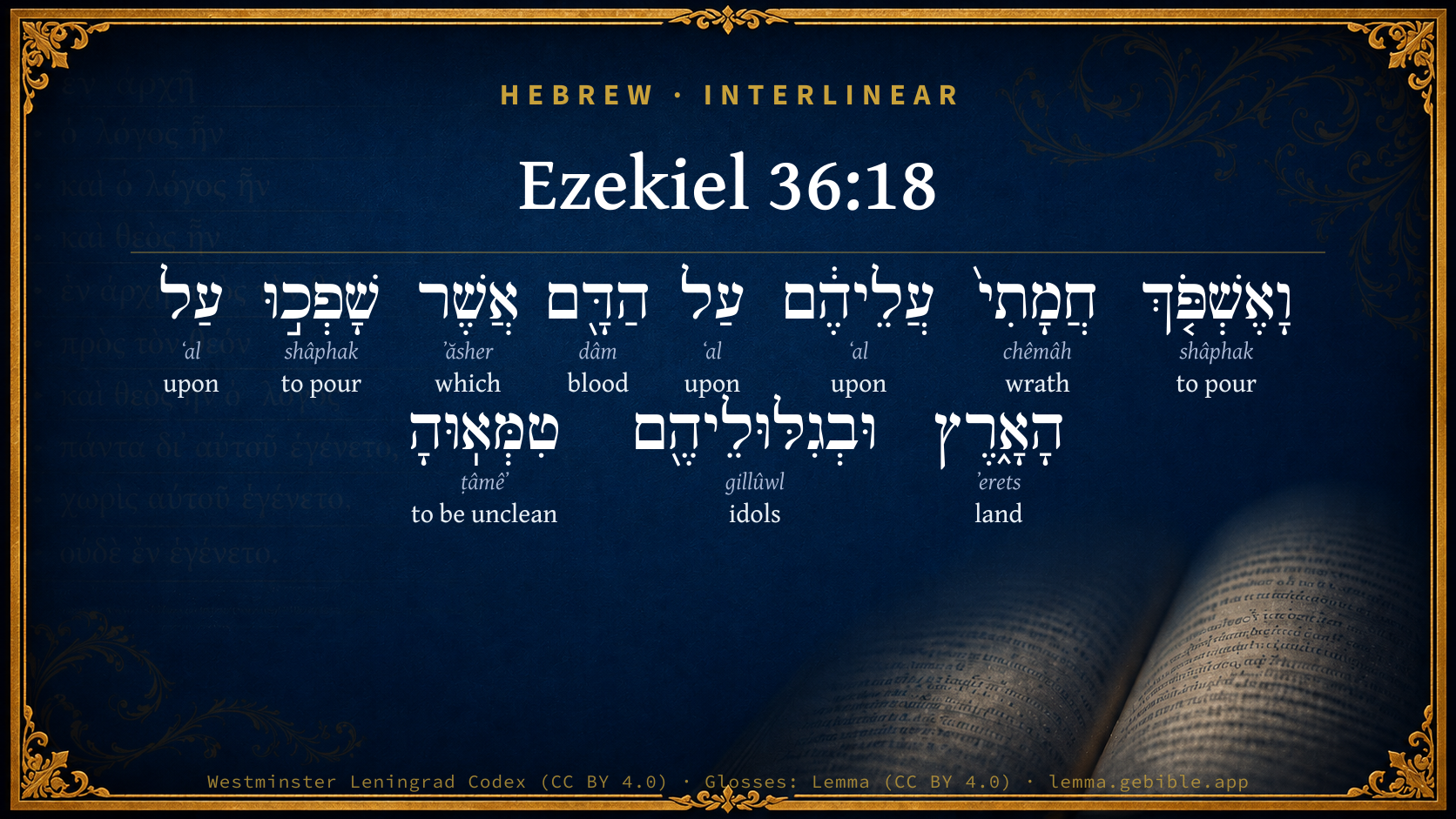
Hebrew (Westminster Leningrad Codex) Ezekiel 36:18 appears in the Hebrew Old Testament. The text above is from the Westminster Leningrad Codex. Each word links to its Strong’s number, a concise gloss, and parsing drawn from the Open Scriptures Hebrew Bible morphology. Click any word for its full Brown-Driver-Briggs (BDB) entry.
Download image
Cite this verse

Ezekiel 36:18 (World English Bible). Public Domain. Lemma interlinear Bible study tool, https://lemma.gebible.app/v/ezekiel/36/18.

Show BibTeX & RIS
BibTeX
RIS
English Translation
Therefore I poured out my wrath on them for the blood which they had poured out on the land, and because they had defiled it with their idols;
World English Bible · Public Domain
Download a study sheet

One document with this verse’s original text, its word-by-word gloss line, the meaning frame, cross-references with their text, attributed commentary, and full source and license credits — printable, and it pastes into notes with its structure intact.

This verse Autodidact and up

Study sheet (.html) Plain text (.txt)

A passage Seminary Student

Up to 50 verses in one chapter. A passage sheet keeps up to 6 commentary sources and 12 cross-references per verse, in the order this page ranks them, and says so on the sheet whenever that leaves anything out. Ask for a single verse and you get the Autodidact verse sheet above.

Everything on this page stays free to read, with no account — the sheet is a download of what is already on screen, not access to it.

Want to remove ads? Support Godless Engineer
Compare translations 3

The same verse in 3 English versions, stacked beneath the original-language interlinear above. Click any original word for its lexicon entry.

Each is an independent rendering of the whole verse — the interlinear is not word-aligned to these translations.

Highlighted words mark where these versions differ — a whole-verse word diff, not a word-by-word alignment.

  • World English Bible Public Domain
    Therefore I poured out my wrath on them for the blood which they had poured out on the land, and because they had defiled it with their idols;
  • King James Version Public Domain
    Wherefore I poured my fury upon them for the blood that they had shed upon the land, and for their idols wherewith they had polluted it:
  • unfoldingWord Literal Text CC BY-SA 4.0
    So I poured out my fury against them for the blood that they poured out on the land and for their pollution of it by their idols.

unfoldingWord Literal Text — © unfoldingWord, licensed CC BY-SA 4.0. Word-aligned USFM3 via Door43 (git.door43.org/unfoldingWord/en_ult).

Versions to compare (up to 4)

3 of 4 selected

Show all 18 translations

Every available English version of this verse, each an independent rendering of the whole verse.

  • World English Bible Public Domain
    Therefore I poured out my wrath on them for the blood which they had poured out on the land, and because they had defiled it with their idols;
  • Berean Standard Bible Public Domain
    So I poured out My wrath upon them because of the blood they had shed on the land, and because they had defiled it with their idols.
  • Majority Standard Bible Public Domain
    So I poured out My wrath upon them because of the blood they had shed on the land, and because they had defiled it with their idols.
  • King James Version Public Domain
    Wherefore I poured my fury upon them for the blood that they had shed upon the land, and for their idols wherewith they had polluted it:
  • American Standard Version (1901) Public Domain
    Wherefore I poured out my wrath upon them for the blood which they had poured out upon the land, and because they had defiled it with their idols;
  • Revised Version (1885) Public Domain
    Wherefore I poured out my fury upon them for the blood which they had poured out upon the land, and because they had defiled it with their idols:
  • Geneva Bible (1599) Public Domain
    Wherfore I powred my wrath vpon them, for the blood that they had shed in the land, and for their idoles, wherewith they had polluted it.
  • Douay-Rheims (1899) Public Domain
    And I poured out my indignation upon them for the blood which they had shed upon the land, and with their idols they defiled it.
  • Young's Literal Translation Public Domain
    And I do pour out My fury upon them For the blood that they shed on the land, And with their idols they have defiled it.
  • Literal Standard Version CC BY-SA 4.0
    And I pour out My fury on them || For the blood that they shed on the land, || And they have defiled it with their idols.
  • Unlocked Literal Bible CC BY-SA 4.0
    So I poured out my fury against them for the blood that they poured out on the land and for their pollution of it by their idols.
  • unfoldingWord Literal Text CC BY-SA 4.0
    So I poured out my fury against them for the blood that they poured out on the land and for their pollution of it by their idols.
  • Darby Bible Public Domain
    And I poured out my fury upon them for the blood that they had shed upon the land, and because they had defiled it with their idols.
  • World Messianic Bible Public Domain
    Therefore I poured out my wrath on them for the blood which they had poured out on the land, and because they had defiled it with their idols.
  • Webster's Bible Public Domain
    Wherefore I poured my fury upon them for the blood that they had shed upon the land, and for their idols with which they had polluted it:
  • Free Bible Version CC BY-SA 4.0
    So I became angry with them because of murders they committed in the country, and because they made it unclean by worshiping idols.
  • Bible in Basic English Public Domain
    So I let loose my wrath on them because of those whom they had violently put to death in the land, and because they had made it unclean with their images:
  • JPS Tanakh (1917) Public Domain
    Wherefore I poured out My fury upon them for the blood which they had shed upon the land, and because they had defiled it with their idols;

Literal Standard Version (2020), Covenant Press — licensed CC BY-SA 4.0. Text via the HelloAO Bible API (eBible.org). Unlocked Literal Bible (unfoldingWord) — licensed CC BY-SA 4.0. Text via the HelloAO Bible API (eBible.org). unfoldingWord Literal Text — © unfoldingWord, licensed CC BY-SA 4.0. Word-aligned USFM3 via Door43 (git.door43.org/unfoldingWord/en_ult). Free Bible Version, Dr. Jonathan Gallagher — licensed CC BY-SA 4.0. Text via the HelloAO Bible API (eBible.org).

Word by word

More ways to search: Search by grammar → Find every occurrence → Compare this word →

Practice this passage: Drill this verse → Learn its vocabulary →

וּבְגִלּוּלֵיהֶ֖ם
gillûwl
H1544
“and · in/at · idols · their”
Conjunction + Preposition + Noun, Common, Masculine, Plural, Construct + Suffix, Personal, 3rd Person, Masculine, Plural
Part of Speech
Conjunction + Preposition + Noun
Type
Common
Gender
Masculine
Number
Plural
State
Construct
Full BDB Definition

Origin: from H1556

TWOT: 353h

idols
  1. וָאֶשְׁפֹּ֤ךְ shâphak H8210 “and · to pour” Conjunction + Verb, Qal, Sequential Imperfect, 1st Person, Common, Singular
  2. חֲמָתִי֙ chêmâh H2534 “wrath · my” Noun, Common, Feminine, Singular, Construct + Suffix, Personal, 1st Person, Common, Singular
  3. עֲלֵיהֶ֔ם ʻal H5921 “upon · them” Preposition + Suffix, Personal, 3rd Person, Masculine, Plural
  4. עַל ʻal H5921 “upon” Preposition
  5. הַדָּ֖ם dâm H1818 “the · blood” Particle, Definite Article + Noun, Common, Masculine, Singular, Absolute
  6. אֲשֶׁר ʼăsher H834 “which” Particle, Relative
  7. שָׁפְכ֣וּ shâphak H8210 “to pour” Verb, Qal, Perfect, 3rd Person, Common, Plural
  8. עַל ʻal H5921 “upon” Preposition
  9. הָאָ֑רֶץ ʼerets H776 “the · land” Particle, Definite Article + Noun, Common, Both, Singular, Absolute
  10. טִמְּאֽוּהָ ṭâmêʼ H2930 “to be unclean · her” Verb, Piel, Perfect, 3rd Person, Common, Plural + Suffix, Personal, 3rd Person, Feminine, Singular

About this verse

These counts appear in no published source. They are computed here, from the morphology-tagged text and Lemma’s own curated glosses. What Lemma adds →

11
words
8
distinct lemmas
Prophets
section

Shared distinctive vocabulary

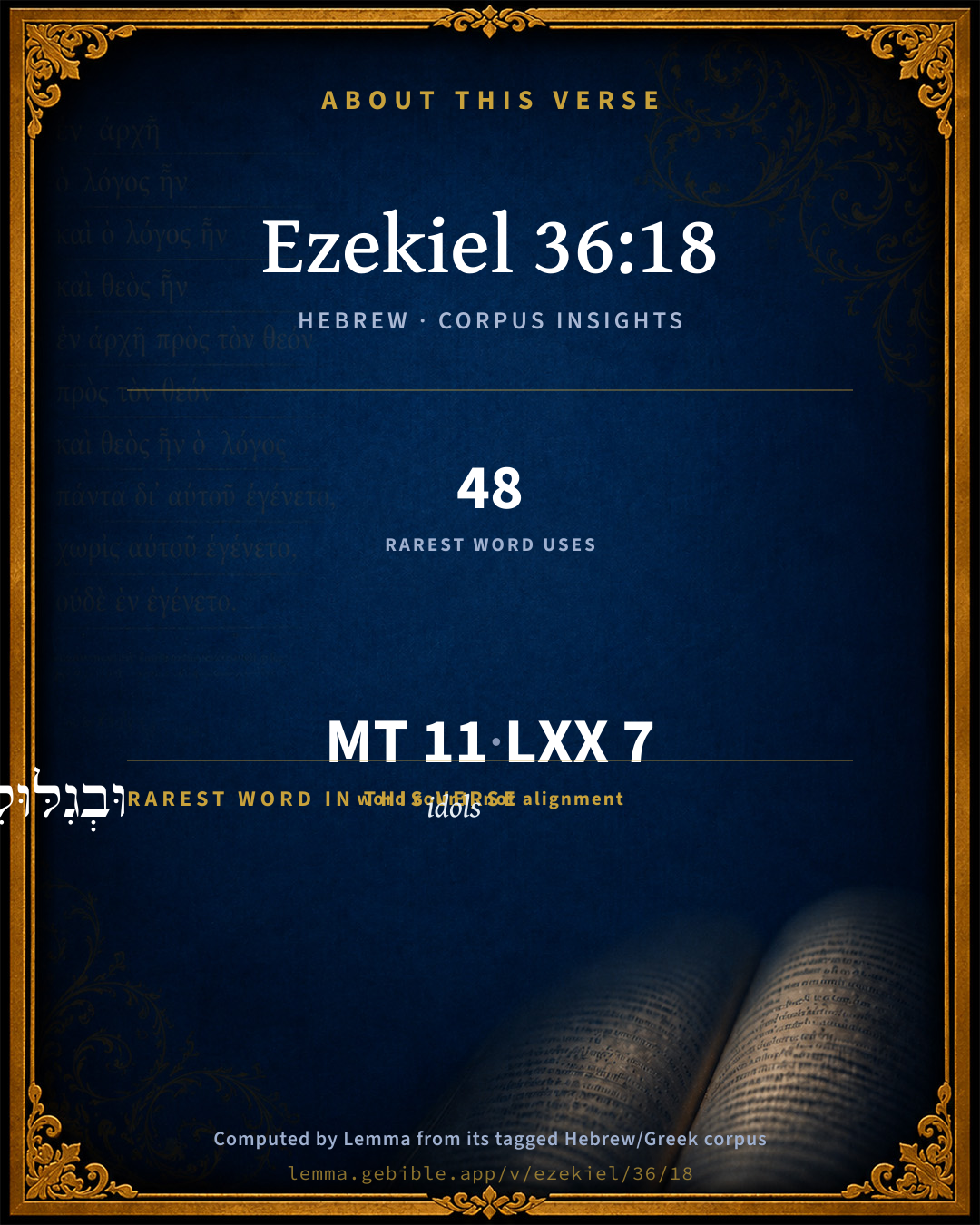
וּבְגִלּוּלֵיהֶ֖ם idols H1544 occurs in 45 verses of the Hebrew Bible. Also found in:

Grammatical profile

  • 3 verbs
  • 4 nouns
  • 3 prepositions
  • 1 particle

Verb forms

  • וָאֶשְׁפֹּ֤ךְ Qal · Sequential Imperfect
  • שָׁפְכ֣וּ Qal · Perfect
  • טִמְּאֽוּהָ Piel · Perfect

Repetition

Words recur within this verse — often emphatic in Hebrew:

  • עֲלֵיהֶ֔ם upon H5921 ×3
  • וָאֶשְׁפֹּ֤ךְ to pour H8210 ×2

Hebrew & Septuagint length

In English translation the verse runs 28 words from the Hebrew and 8 from the Septuagint (LXX English) — the Septuagint runs noticeably shorter here. See the side-by-side →

A rough comparison of the two English renderings, which tokenize alike — not a word-level alignment.

Word counts can differ between the Hebrew and the Greek without any difference in meaning — e.g. the Hebrew direct-object marker אֵת has no separate Greek word, and Greek often adds the article ὁ.

In the original languages it is 11 Hebrew tokens and 7 Greek tokens — but the two are counted differently (Hebrew bundles its prefixes and suffixes into one token; the Greek is in lemma form), so that isn’t a like-for-like length.

Cross-references

15

Topical passages linked to Ezekiel 36:18 in the Treasury of Scripture Knowledge — connected by theme and wording, ordered by reader-vote popularity; previews shown in the World English Bible.

  • 2 Chronicles 34:21 Go you, inquire of Yahweh for me, and for those who are left in Israel and in Judah, concerning the words of the book that is found; for great is the wrath of Yahweh that is poured out on us, because our fathers have not kept the word of Yahweh, to do according to all that is written in this book.
  • Ezekiel 7:8 Now will I shortly pour out my wrath on you, and accomplish my anger against you, and will judge you according to your ways; and I will bring on you all your abominations.
  • Lamentations 2:4 He has bent his bow like an enemy, he has stood with his right hand as an adversary, Has killed all that were pleasant to the eye: In the tent of the daughter of Zion he has poured out his wrath like fire.
  • Lamentations 4:11 Yahweh has accomplished his wrath, he has poured out his fierce anger; He has kindled a fire in Zion, which has devoured the foundations of it.
  • 2 Chronicles 34:26 But to the king of Judah, who sent you to inquire of Yahweh, thus shall you tell him, Thus says Yahweh, the God of Israel: As touching the words which you have heard,
  • Isaiah 42:25 Therefore he poured on him the fierceness of his anger, and the strength of battle; and it set him on fire round about, yet he didn't know; and it burned him, yet he didn't lay it to heart.
  • Jeremiah 7:20 Therefore thus says the Lord Yahweh: Behold, my anger and my wrath shall be poured out on this place, on man, and on animal, and on the trees of the field, and on the fruit of the ground; and it shall burn, and shall not be quenched.
  • Jeremiah 44:6 Therefore my wrath and my anger was poured forth, and was kindled in the cities of Judah and in the streets of Jerusalem; and they are wasted and desolate, as it is this day.
  • Ezekiel 14:19 Or if I send a pestilence into that land, and pour out my wrath on it in blood, to cut off from it man and animal;
  • Ezekiel 16:36–38 Thus says the Lord Yahweh, Because your filthiness was poured out, and your nakedness uncovered through your prostitution with your lovers; and because of all the idols of your abominations, and for the blood of your children, that you gave to them;
  • Ezekiel 21:31 I will pour out my indignation on you; I will blow on you with the fire of my wrath; and I will deliver you into the hand of brutish men, skillful to destroy.
  • Ezekiel 23:37 For they have committed adultery, and blood is in their hands; and with their idols have they committed adultery; and they have also caused their sons, whom they bore to me, to pass through [the fire] to them to be devoured.
  • Nahum 1:6 Who can stand before his indignation? Who can endure the fierceness of his anger? His wrath is poured out like fire, and the rocks are broken apart by him.
  • Revelation 14:10 he also will drink of the wine of the wrath of God, which is prepared unmixed in the cup of his anger. He will be tormented with fire and sulfur in the presence of the holy angels, and in the presence of the Lamb.
  • Revelation 16:1–21 I heard a loud voice out of the temple, saying to the seven angels, "Go and pour out the seven bowls of the wrath of God on the earth!"

Cross-references courtesy of OpenBible.info (CC BY 4.0).

Hebrew and Greek witnesses Masoretic Hebrew ↔ Greek Septuagint

The same verse in the two great witnesses to the Old Testament, shown verse-for-verse.

Here the Septuagint runs noticeably shorter than the Hebrew — LXX2012 (modern English Septuagint) 8 words vs World English Bible 28. A rough length comparison of the two English translations, not a word-level alignment — read both below.

These are two independent witnesses, not word-aligned to each other, and the Septuagint is shown in lemma (dictionary) form.

Hebrew Ezekiel 36:18 Masoretic · Westminster Leningrad Codex

וָאֶשְׁפֹּ֤ךְ חֲמָתִי֙ עֲלֵיהֶ֔ם עַל הַדָּ֖ם אֲשֶׁר שָׁפְכ֣וּ עַל הָאָ֑רֶץ וּבְגִלּוּלֵיהֶ֖ם טִמְּאֽוּהָ

Therefore I poured out my wrath on them for the blood which they had poured out on the land, and because they had defiled it with their idols;

World English Bible · Public Domain

Greek LXX Ezekiel 36:18 Septuagint · lemma form

καί ἐκχέω ὁ θυμός ἐγώ ἐπί αὐτός

So I poured out my wrath upon them:

LXX2012 (modern English Septuagint) · Public Domain

Hebrew: Westminster Leningrad Codex (CC BY 4.0). Greek: Septuagint (public domain); English from LXX2012 (modern English Septuagint) (Public Domain). How the Septuagint differs from the Hebrew →

Targum (Aramaic paraphrase)

1

The Targum is the ancient Jewish Aramaic paraphrase of the Hebrew Scriptures — an interpretive translation, not the Hebrew text itself. Onkelos (literal) and Pseudo-Jonathan (expansive) render the Torah, and Jonathan the Prophets. Coverage is partial: where no permissively-licensed English translation exists for a verse, only the Aramaic is shown. This is verse-level text, not a word-by-word alignment to the Hebrew.

  1. Targum Jonathan Prophets (Joshua–Malachi)
    וּשְׁפִיכַת חֵימְתִי עֲלֵיהוֹן עַל דָם זַכַּאי דַאֲשַׁדוּ עַל אַרְעָא וּבְפוּלְחַן טַעֲוָתְהוֹן סַאֲבוּהָ:

    (no public-domain English translation for this verse)

    Targum Jonathan — Aramaic: “Mikraot Gedolot” (public domain). English: “Sefaria Community Translation” (CC0 1.0 (public-domain dedication)); “London "Chaldee Paraphrase," 1871” (public domain). Text via Sefaria.

Commentary

Notes on Ezekiel 36:18 from classic Christian and Jewish commentators (each source and its license shown beneath its notes). The classic Christian expositions comment on the surrounding passage and are grouped to its opening verse, so a note may address several verses; the Jewish commentaries on the Tanakh (Rashi and others) are per-verse, so they appear only where the commentator wrote on this verse.

Lemma curates 59 commentaries, every one of them public domain or Creative Commons licensed, each selected and text-cleaned for this edition rather than reprinted as found. About our sources →

Trapp's Complete Commentary

John Trapp

Eze 36:18 Wherefore I poured my fury upon them for the blood that they had shed upon the land, and for their idols [wherewith] they had polluted it:

Ver. 18. For the blood which they had shed.] These two gross sins are instanced, viz., murder and idolatry, lest they should plead, as in Jer 2:35, "I have not sinned"; or as in Hos 12:8, "In all my works they shall find none iniquity in me; that were sin."

John Trapp, A Commentary or Exposition upon All the Books of the Old and New Testament (1647–1656) — public domain. Text from a community e-Sword module.

The Biblical Illustrator

Joseph S. Exell

Eze_36:18-19

Wherefore I poured My fury upon them.

Man suffering

I. God is slow to punish. He does punish; He shall punish; with reverent be it spoken, He must punish. Yet no hand of clock goes so slowly as His hand of vengeance. He does pour out His fury; but His indignation is the volcano that groans loud and long before it discharges the elements of destruction, and pours its fiery lavas on the vineyards at its feet. Where, when Gods anger has burned hottest, was it ever known that judgment trod on the heels of sin? A period always intervenes; room is given for remonstrance on His part, and for repentance upon ours. The stroke of judgment is like the lightning flash, irresistible, fatal; it kills,--kills in the twinkling of an eye. But the clouds from which it leaps are slow to gather; they thicken by degrees: and he must be intensely engaged with the pleasures, or engrossed in the business of the world, whom the flash and peal surprise. The mustering clouds, the deepening gloom, the still and sultry air, the awful silence, the big pattering raindrops, these reveal his danger to the traveller; and warn him away from river, road, or hill to the nearest shelter. And, heeded or unheeded, many are the warnings you get from God. As these prove, He has no pleasure in the death of the wicked; He is not willing that any should perish, but that all should come to repentance. Let us do the same justice to our Father in heaven that we would render to an earthly parent. Would it be doing a father justice to look at him only when the rod is raised in his hand, and, though the trembling lip and weeping eyes and choked utterance of his culprit boy, and a fond mothers intercession, all plead with him to spare, he refuses, firmly refuses? In this, how stern he looks! But before you can know that father, or judge his heart aright, you should know how often ere this the offence had been forgiven; you should have heard with what tender affection he had warned that child; above all, you should have stood at his closet door, and listened when he pleaded with God on behalf of an erring son. Justice to him also requires that you should have seen with what slow and lingering steps he went for the rod, the trembling of his trend, and how, with tears streaming from his eyes, he raised them to heaven and sought strength to inflict a punishment which, could it serve the purpose, he would a hundred times rather bear than inflict.

II. How He punished His ancient people. These were the children of Abraham, beloved for the fathers sake, the honoured custodiers of Divine truth; Gods chosen people, through whose line and lineage His Son was to appear. How solemn, then, and how appropriate, the question, If they do these things in a green tree, what shall be done in the dry? Look at Judah sitting amid the ruins of Jerusalem, her temple without a worshipper, her silent streets choked with the dead: look at that bound, weeping, bleeding remnant of a nation toiling on its way to Babylon: look at these peeled and riven boughs; may I not warn you with the Apostle, If God spaced not the natural branches, take heed lest He also spare not thee. If we speak thus, it is for your good. We arm ourselves with these thunders only, in the words of Paul, to persuade you by the terrors of the Lord. We have no faith in terror dissociated from tenderness. And as we trust more to drawing than to driving men to Jesus, we entreat you to observe that He who is the good is also a most tender Shepherd. Among the hills of our native land I have met a shepherd far from the flock and folds, driving home a lost sheep, one which had gone astray, a creature panting for breath, amazed, alarmed, foot-sore; and when the rocks around rang loud to the baying of the dogs, I have seen them--whenever it offered to turn from the path, with open mouth dash fiercely at its sides, and so hound it home. How differently Jesus brings back His lost ones! The lost sheep sought and found, He lifts it up tenderly, lays it on His shoulder, and, retracing His steps, returns homeward with joy, and invites His neighbours to rejoice with Him. Catching grace from His lips, and kindness from His looks, I desire to address you as becomes the servant of such a gentle, lowly, loving Master. Yet, shall I conceal Gods verity, and ruin mens souls to spare their feelings? If any are living without God and Christ and hope and prayer, I implore them to look here: turn to this dreadful pit. With what fire it burns! How it resounds with moaning wail and woeful groans 1 Now, while we stand together on its margin, or rather draw back with horror, ponder, I pray you, the solemn question, Who among us shall dwell with everlasting burnings? It is alleged by travellers that the ostrich, when hard pressed by the hunters, will thrust its head into a bush, and, without further attempt either at flight or resistance, quietly submit to the stroke of death. Men say that, having thus succeeded in shutting the pursuers out of its own sight, the bird is stupid enough to fancy that it has shut itself out of theirs, and that the danger which it has ceased to see has ceased to exist. We doubt that. This poor bird, which has thrust its head into the bush, and stands quietly to receive the shot, has been hunted to death. For hours the cry of staunch pursuers has rung in its startled ear; for hours their feet have been on its weary track; it has exhausted strength, and breath, and craft, and cunning, to escape; and even yet, give it time to breathe, grant it but another chance, and it is away with the wind; with wings outspread and rapid feet it spurns the burning sand. It is because escape is hopeless and death is certain that it has buried its head in that bush, and closed its eyes to a fate which it cannot avert. To man belongs the folly of closing his eyes to a fate which he can avert. He thrusts his head into the bush while escape is possible; and, because he can put death and judgment and eternity out of mind, lives as if time had no bed of death, and eternity no bar of judgment. Be wise. Be men. Look your danger in the face. Flee to Jesus now. Escape from the wrath to come. To come? In a sense wrath has already come. The fire has caught, it has seized your garments; delay, and you are wrapt in flames. Oh! haste away, and throw yourselves into the fountain which has power to quench these fires, and cleanse you from all your sins. (T. Guthrie, D. D.)

Gods punitive justice

Does man ask, Why am I born with a bias to sin? why has anothers hand been permitted to sow germs of evil in me? why should I, who was no party to the first covenant, be buried in its ruins? To these questions this is my reply: I shrink from sitting in judgment upon my judge. Clouds and darkness are round about Jehovah now; but I feel confident that, when the veil of this present economy shall be rent, and expiring Time, echoing the cry of the cross, exclaims, It is finished, it shall be seen that righteousness and judgment are the pillars of Jehovahs throne, that there is no unrighteousness with God. But although the permission of sin is a mystery, the fact of its punishment is no mystery at all; and, while every answer to the question, How did God allow sin? leaves us unsatisfied, to my mind nothing is plainer than this, that, whatever was His reason for permitting it to exist, He could not permit it to exist unpunished.

I. The truth of God requires the punishment of sin. Some have fancied that they honour God most when, sinking all other attributes in mercy--indiscriminating mercy--they represent Him as embracing the whole world in His arms, and receiving to His bosom with equal affection the sinners that hate and the saints that love Him. They cannot claim originality for this idea. Its authorship belongs to the father of lies. Satan said so before them. It is the identical doctrine that damned this world. The serpent said to the woman, Ye shall not surely die. Are your hopes of salvation resting on such a baseless fancy? If so, you cannot have considered in what aspect this theory presents that God for whose honour you profess such tender regard. We almost shrink from explaining it. You save the creature, but save him at a price more costly than was paid for sinners upon the Cross of Calvary. Your scheme exalts man; but far more than man is exalted, God is degraded. By it no man is lost; but there is a greater Joss. The truth of God is lost; and in that loss His crown is spoiled of its topmost jewel, His kingdom totters, and the throne of the universe is shaken to its deepest foundations. It is as manifest as daylight that Gods truth and your scheme cannot stand together. Liar stands against either God or you; and, in the words of the Apostle, you make God a liar. Nor is that all; my faith has lost the very rock on which it stood, as I flattered myself, steadfast and unmovable. For however awful the threatenings in His word may be, if God is not true to them, what security have I that He will prove true to its gracious promises?

II. The love of God requires that sin should be punished. Let me at once prove and illustrate the point by a piece of plain analogy. This city, its neighbourhood, nay, the whole land, is shaken by the news of some most cruel, bloody, monstrous crime. Fear seizes the public mind; pale horror sits on all mens faces; doors are double barred; and justice lets loose the hounds of law on the track of the criminal. At length, to the relief and satisfaction of all honest citizens, he is caught. He is tried, condemned, laid in irons, and waits but the sentence to be signed. To save or slay, to hang or pardon, is now the question with him whose prerogative it is to do either. And the law is left to take its course. Now, by what motive is the sovereign impelled to shut up his bowels of mercy, and sign the warrant for execution? Is it want of pity? No; the fatal pen is taken with reluctance; it trembles in his hand; and tears of compassion for this guilty wretch drop upon the page. It is not so much abhorrence of the guilty, as love of the innocent, and regard for their lives, peace, purity, and honour, that dooms the man to death. If he were pardoned, and his crime allowed to go unpunished, neither mans life nor womans virtue were safe. Unless this felon dies, the peace of a thousand happy families lies open to foul attack. Love for those who have the highest claim on a sovereigns protection requires that justice be satisfied, and the guilty die. There are scenes of domestic suffering which present another, no less convincing, and more touching analogy. It has happened that, from love and regard to the interests of his other children, to save them from a brothers contamination, a kind parent has felt constrained to pronounce sentence on his son, and banish him from his house. How sad to think that he may be lost! The dread of that goes like a knife to the heart; yet, bitter truth! painful conclusion! it is better that one child be lost than a whole family be lost. These lambs claim protection from the wolf; he must be driven forth from the fold. Love herself, while she weeps, demands this sacrifice; and, just because it is most lacerating, most excruciating, to a parents heart, it is in such a case the highest and holiest exercise of parental love to bar the door against a child. There have been parents so weak and foolish as to peril the morals, the fortunes, the souls of all their other children, rather than punish one; and in consequence of this I have seen sin, like a plague, infect every member of the family, and vice ferment and spread till it had leavened the whole lump. Divine love, however, is no blind Divinity: and God, being as wise as He is tender, sinners may rest assured, that out of mere pity to them He will neither sacrifice the interest nor peril the happiness of His people. Bleeding, dying, redeeming Love shall bolt the gates of heaven with her own hand, and from its happy, holy precincts exclude all that could hurt or defile.

III. Unless sin is to be awfully punished, the language of scripture appears extravagant. The sufferings and misery which await the impenitent and unbelieving have been painted by God in most appalling colours. They are such that, for our salvation, His Son descended from the heavens and expired upon a Cross. They are such that, when Paul thought of the lost, he wept like a woman. They are such that, though a dauntless man, who shook his chain in the face of kings, whose spirit no sufferings could subdue, and whose heart no dangers could appall, who stood as unmoved amid a thousand perils as ever sea rock amid the roaring billows, he could not contemplate the fate of the wicked without the deepest emotion. What horror did David feel at the sight and fate of sinners! With his face turned up to heaven, you see a blind man approach the edge of an awful precipice; every step brings him nearer, nearer still, to the brink, Now he reaches it; he stands on the grassy edge. Oh, for an arm to reach him, a voice to warn him, a blow to send him staggering back upon the ground. He has lifted his foot; it is projected beyond the brink; another moment, a breath of wind, the least change of balance, and he is whirling twenty fathoms down. You stop your ears; shut your eyes; turn away your head; horror takes hold of you. Such were Davids feelings when he contemplated the fate of the wicked. The wrath of God is the key to the Psalmists sorrow, to an Apostles tears, to the bloody mysteries of the Cross. That was the necessity which drew the Saviour down. God certainly is not willing that you should perish; and by these terrors He would persuade you to accept salvation. Meditate on these words: pray over them--Woe unto him that striveth with his Maker! The wicked shall be turned into hell, and all the nations that forget God. Still, it is not terror which is the power, the mighty power of God. The Gospel, like most medicines for the body, is of a compound nature; but whatever else enters into its composition, its curative property is love. God, indeed, tells us of hell, but it is to persuade us to fly to heaven; and, as a skilful painter fills the background of his picture with his darker colours, God introduces the smoke of torment and the black thunder clouds of Sinai to give brighter prominence to the Cross, to Jesus, and His love to the chief of sinners. His voice of terror is like the scream of the mother bird when the hawk is in the sky. She alarms her brood that they may run and hide beneath her feathers; and as I believe that God had left that mother dumb unless He had given her wings to cover them, I am sure that He, who is very pitiful, and has no pleasure in the meanest creatures pain, had never turned our eyes on the horrible gulf unless for the voice that cries, Deliver him from going down to the pit, for I have found a ransom. (T. Guthrie, D. D.)

The Biblical Illustrator, edited by Joseph S. Exell (c. 1880s–1900s) — public domain. Text from a community e-Sword module.

Tyndale Open Study Notes

Tyndale Open Resources

36:18 Israel had made the land unfit for God’s presence through murder and the worship of idols. As a result of their covenant breaking, they were expelled from the land and scattered among the nations (see Deut 29:22-28).

Tyndale Open Study Notes — © Tyndale Open Resources, licensed CC BY-SA 4.0. Text via the HelloAO Bible API.

Jamieson, Fausset & Brown

Robert Jamieson, A. R. Fausset & David Brown

The reason for their removal was their sin, which God's holiness could not let pass unpunished; just as a woman's legal uncleanness was the reason for her being separated from the congregation.

Jamieson, Fausset & Brown — Commentary Critical and Explanatory on the Whole Bible (1871) — public domain (CC PDM 1.0). Text via the HelloAO Bible API.

The Cambridge Bible for Schools and Colleges

gen. ed. J. J. S. Perowne

18. The effect of these sins was to awaken the fury of Jehovah. The “blood” may be murder from violence or judicial murder, so often reprobated in the earlier prophets, or it may be the sacrifice of children, Eze_16:36, Eze_23:37.

The Cambridge Bible for Schools and Colleges (gen. ed. J. J. S. Perowne; Cambridge University Press, 1878–1918) — public domain. Text from a community e-Sword module.

John Gill's Exposition

Wherefore I poured my fury on them,.... Like a mighty flood that carries all before it, in just retaliation

for the blood they had shed upon the land; the innocent blood, as the Targum; the blood of righteous men, that opposed and reproved them for their sinful ways; the blood of the prophets, that were sent to warn them of them; and especially the blood of the Son of God; for this prophecy reaches further than to the times of the Babylonish captivity:

and for their idols wherewith they had polluted it; or, "for their dung" (m); their dunghill gods; not only for their idols, and their idolatry, before the Babylonish captivity, which they after that were free from; but for the traditions of their elders, they set up against and above the word of God; and their own legal righteousness, their idols, the works of their hands, which wore as dung; and through their attachment to which they rejected Christ and his righteousness; and which brought wrath upon them, and them into their present captivity.

(m) "stercoreis diis suis", Junius & Tremellius, Polanus; "stercoribus suis", Cocceius, Starckius.

John Gill's Exposition of the Whole Bible (1746–1763) — public domain (CC PDM 1.0). Text via the HelloAO Bible API.

Haydock's Catholic Bible Commentary

Blood of their own children, and of the innocent, chap. xvi. 36., and xxii. 2., and xxxiii. 25.

George Leo Haydock (1774–1849), Haydock's Catholic Family Bible and Commentary, 1859 edition — public domain. Excludes Psalms (Douay-Rheims chapter numbering differs from Protestant) and Deuterocanonical books (Catholic canon only).

Matthew Poole's English Annotations

Wherefore; these and other sins were the true cause that the land was emptied of men, there was no ground for the heathen’s calumny.

I poured my fury; I was angry with them, and the effects of my anger were such as made the land and cities desolate.

For the blood that they had shed; for murders committed in the land, and frequently charged on them, Eze 22:3,6,9,12,27; 23:45.

For their idols: idolatry was another of their sins, which brought desolation on them.

Matthew Poole's English Annotations on the Holy Bible (1683–1685) — public domain. Text from a community e-Sword/MySword module.

Lesson kit

Teaching starters — assembled from the data on this page, not authored interpretation. Every prompt links to the verse data it draws on. Edit before teaching.

Ezekiel, in the Prophets, opens this verse with 11 words (8 distinct Hebrew lemmas). Its most distinctive word is gillûwl (“idols”). The Greek Septuagint runs shorter here. A historical commentator’s framing appears above. Read the whole chapter for the surrounding context.

Discussion questions

  1. How does “idols” (gillûwl) shape what this verse is saying?
  2. How does Leviticus 26:30, which shares the word «idols», read alongside this verse?
  3. What does the repetition of “upon” (3× in this one verse) do in this verse?
  4. The Septuagint runs shorter here than the Hebrew. What might account for the difference?
  5. These translations render this verse differently. What is at stake in choosing one wording over another?
  6. «וָאֶשְׁפֹּ֤ךְ» is a Qal Sequential Imperfect verb. How does that grammatical form shape the action described?
  7. Compare how Trapp's Complete Commentary and The Biblical Illustrator read this verse. Where do they agree or differ?

Things to notice

Reading settings

Reading text

Shown beneath each verse's original-language words.

Old Testament
Old Testament edition

Read the OT as the Masoretic Hebrew (MT) or the Greek Septuagint (LXX).

English shown for the Greek Septuagint (in the Hebrew ↔ Greek comparison).

Comparing translations? Open the Compare panel on any verse page to stack up to four side by side.