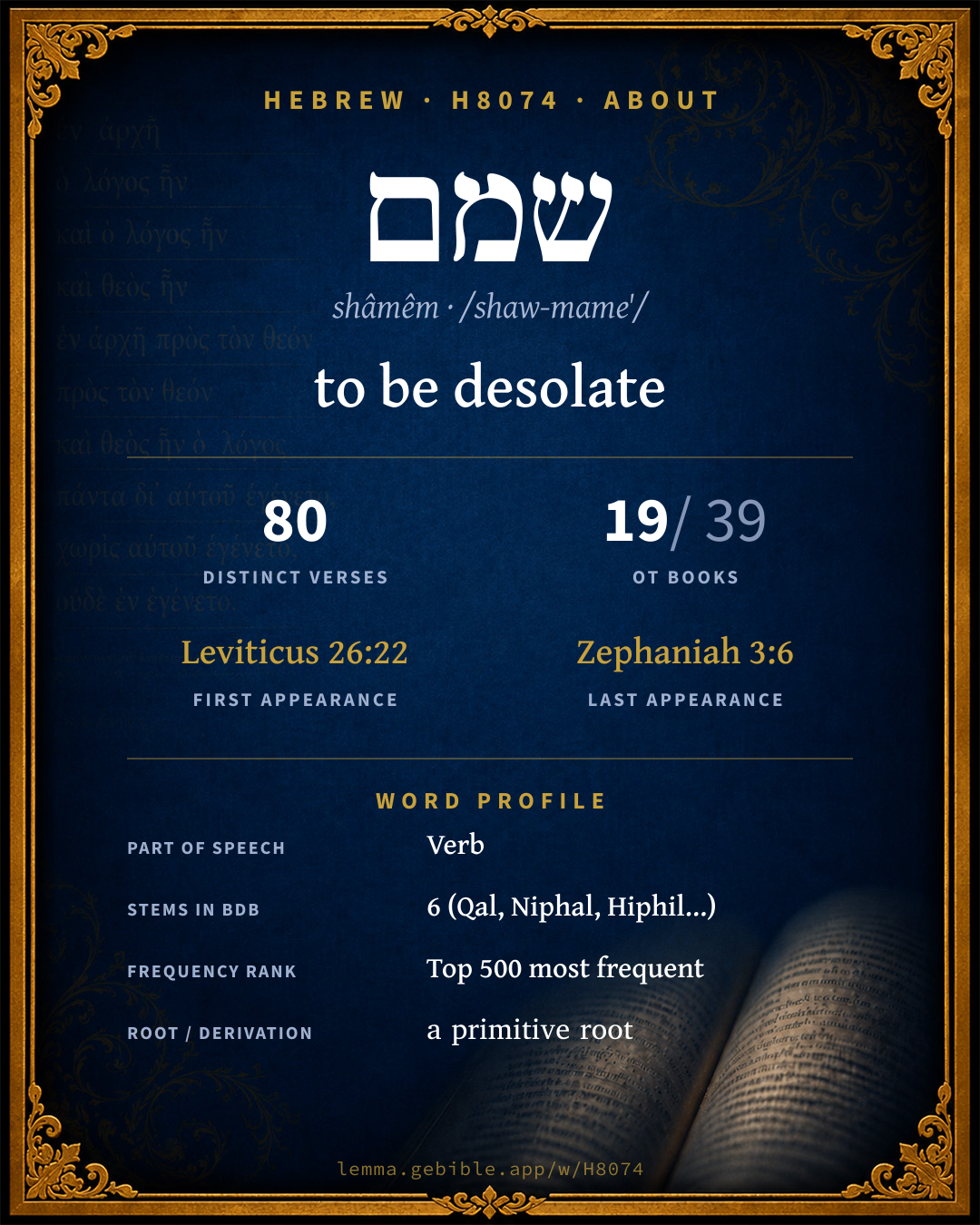
שָׁמֵם
to be desolate
also: be appalled, stun, stupefy fuller range ↓
Full lexicon entry — Brown-Driver-Briggs (BDB)
From Brown-Driver-Briggs (BDB)
Where this word appears
See every Niphal verb in the Hebrew Bible →
Grammar key — what these labels mean
Part of speech
- Verb
- An action or state-of-being word.
Stem
- Niphal
- Usually the simple passive or reflexive of the Qal (“he was written”). Here: ‘be desolated’
- Hiphil
- The causative active stem (“he caused / brought about”). Here: ‘devastate’
- Qal
- The basic, simple active stem — the plain form of the verb (“he wrote”). Here: ‘be desolated’
- Hophal
- The passive counterpart of the Hiphil (“he was caused to…”).
- Hithpolel
- The reflexive counterpart of the Polel.
Form
- Sequential Perfect
- A perfect with prefixed waw continuing a preceding imperfect or command (waw-consecutive perfect).
- Imperfect
- An incomplete, ongoing, or future action (“he will / would write”).
- Perfect
- A completed action or state — Hebrew marks aspect (completeness) more than strict tense (“he wrote”).
- Participle Active
- A verbal adjective expressing ongoing or characteristic action (“writing / one who writes”).
- Participle Passive
- A verbal adjective expressing action received (“written”).
- Infinitive Construct
- A bound verbal noun, frequently with prepositions (“to write / in writing”).
- Imperative
- A direct command (“write!”).
- Sequential Imperfect
- An imperfect with prefixed waw — the standard past-narrative form (waw-consecutive imperfect).
- Infinitive Absolute
- An unbound verbal noun, often intensifying or standing in for a finite verb.
State
- Absolute
- The independent form of a noun, not bound to a following word.
- Construct
- A noun bound to a following noun in a possessive / “of” relationship (the construct chain).
Person
- 3rd Person
- The one spoken about (“he / she / it / they”).
- 1st Person
- The speaker (“I / we”).
- 2nd Person
- The one addressed (“you”).
Gender
- Common
- Either gender — not distinguished for this form.
- Masculine
- Grammatically masculine.
- Feminine
- Grammatically feminine.
Number
- Plural
- More than one (in Hebrew, generally three or more).
- Singular
- One.
Every verse where H8074 appears in the Book of Ezekiel — 22 distinct verses. Click any verse to open its interlinear word-by-word view. Verse text shown in the World English Bible for context — . Each verse’s Hebrew form is shown with its reference; the English is not keyword-highlighted, since the data carries no word-level English alignment. Use “Compare translations” on any verse to read it across multiple English versions. This concordance covers the Hebrew Bible; Septuagint (Greek Old Testament) occurrences are not indexed here.
Ezekiel
- Ezekiel 3:15 מַשְׁמִ֥ים Hiphil ptcp.act ms Then I came to them of the captivity at Tel Aviv, that lived by the river Chebar, and to where they lived; and I sat there overwhelmed among them seven days.
- Ezekiel 4:17 וְ/נָשַׁ֨מּוּ֙ conj + Niphal wpf 3cp that they may want bread and water, and be dismayed one with another, and pine away in their iniquity.
- Ezekiel 6:4 וְ/נָשַׁ֨מּוּ֙ conj + Niphal wpf 3cp Your altars shall become desolate, and your sun-images shall be broken; and I will cast down your slain men before your idols.
- Ezekiel 14:8 וַ/הֲשִֽׂמֹתִ֨י/הוּ֙ conj + Hiphil wpf 1cs + sfx pers 3ms and I will set my face against that man, and will make him an astonishment, for a sign and a proverb, and I will cut him off from the midst of my people; and you shall know that I am Yahweh.
- Ezekiel 20:26 אֲשִׁמֵּ֔/ם Hiphil impf 1cs + sfx pers 3mp and I polluted them in their own gifts, in that they caused to pass through [the fire] all that opens the womb, that I might make them desolate, to the end that they might know that I am Yahweh.
- Ezekiel 25:3 נָשַׁ֔מָּה Niphal pf 3fs and tell the children of Ammon, Hear the word of the Lord Yahweh: Thus says the Lord Yahweh, Because you said, Aha, against my sanctuary, when it was profaned; and against the land of Israel, when it was made desolate; and against the house of Judah, when they went into captivity:
- Ezekiel 26:16 וְ/שָׁמְמ֖וּ conj + Qal wpf 3cp Then all the princes of the sea shall come down from their thrones, and lay aside their robes, and strip off their embroidered garments: they shall clothe themselves with trembling; they shall sit on the ground, and shall tremble every moment, and be astonished at you.
- Ezekiel 27:35 שָׁמְמ֖וּ Qal pf 3cp All the inhabitants of the isles are astonished at you, and their kings are horribly afraid; they are troubled in their face.
- Ezekiel 28:19 שָׁמְמ֖וּ Qal pf 3cp All those who know you among the peoples shall be astonished at you: you are become a terror, and you shall nevermore have any being.
- Ezekiel 29:12 נְשַׁמּ֗וֹת Niphal ptcp.act fp I will make the land of Egypt a desolation in the midst of the countries that are desolate; and her cities among the cities that are laid waste shall be a desolation forty years; and I will scatter the Egyptians among the nations, and will disperse them through the countries.
- Ezekiel 30:7 וְ/נָשַׁ֕מּוּ נְשַׁמּ֑וֹת conj + Niphal wpf 3cp Niphal ptcp.act fp They shall be desolate in the midst of the countries that are desolate; and her cities shall be in the midst of the cities that are wasted.
- Ezekiel 30:12 וַ/הֲשִׁמֹּתִ֞י conj + Hiphil wpf 1cs I will make the rivers dry, and will sell the land into the hand of evil men; and I will make the land desolate, and all that is therein, by the hand of strangers: I, Yahweh, have spoken it.
- Ezekiel 30:14 וַ/הֲשִׁמֹּתִי֙ conj + Hiphil wpf 1cs I will make Pathros desolate, and will set a fire in Zoan, and will execute judgments on No.
- Ezekiel 32:10 וַ/הֲשִׁמּוֹתִ֨י conj + Hiphil wpf 1cs Yes, I will make many peoples amazed at you, and their kings shall be horribly afraid for you, when I shall brandish my sword before them; and they shall tremble at every moment, every man for his own life, in the day of your fall.
- Ezekiel 32:15 וּ/נְשַׁמָּ֗ה conj + Niphal ptcp.pass fs When I shall make the land of Egypt desolate and waste, a land destitute of that of which it was full, when I shall strike all those who dwell therein, then shall they know that I am Yahweh.
- Ezekiel 33:28 וְ/שָֽׁמְמ֛וּ conj + Qal wpf 3cp I will make the land a desolation and an astonishment; and the pride of her power shall cease; and the mountains of Israel shall be desolate, so that none shall pass through.
- Ezekiel 35:12 שממה שָׁמֵ֑מוּ Qal pf 3fs Qal pf 3cp You shall know that I, Yahweh, have heard all your insults which you have spoken against the mountains of Israel, saying, They are laid desolate, they are given us to devour.
- Ezekiel 35:15 שָׁמֵ֖מָה Qal pf 3fs As you did rejoice over the inheritance of the house of Israel, because it was desolate, so will I do to you: you shall be desolate, Mount Seir, and all Edom, even all of it; and they shall know that I am Yahweh.
- Ezekiel 36:3 שַׁמּוֹת֩ Qal inf.cs therefore prophesy, and say, Thus says the Lord Yahweh: Because, even because they have made you desolate, and swallowed you up on every side, that you might be a possession to the residue of the nations, and you are taken up in the lips of talkers, and the evil report of the people;
- Ezekiel 36:34 הַ/נְּשַׁמָּ֖ה ptcl def.art + Niphal ptcp.pass fs The land that was desolate shall be tilled, whereas it was a desolation in the sight of all who passed by.
- Ezekiel 36:35 הַ/נְּשַׁמָּ֔ה וְ/הַֽ/נְשַׁמּ֥וֹת ptcl def.art + Niphal ptcp.pass fs conj + ptcl def.art + Niphal ptcp.pass fp They shall say, This land that was desolate is become like the garden of Eden; and the waste and desolate and ruined cities are fortified and inhabited.
- Ezekiel 36:36 הַ/נְּשַׁמָּ֑ה ptcl def.art + Niphal ptcp.pass fs Then the nations that are left round about you shall know that I, Yahweh, have built the ruined places, and planted that which was desolate: I, Yahweh, have spoken it, and I will do it.
About this entry
At a glance — auto-summarized from this page’s data, not written by a person. Every figure links to its source below. This summary describes the numbers; it doesn’t interpret them.
At its core, שמם (shâmêm) means “to be desolate.” Different stems carry different senses — BDB groups them under 6 stems, among them Qal and Niphal. It appears 80 verses across 19 books of the Hebrew Bible, among its moderately common vocabulary. The word gravitates to Ezekiel (28%), then Jeremiah and Isaiah. First canonically at Leviticus 26:22, it enters the text early. Dig into 80-verse concordance and the renderings breakdown below.
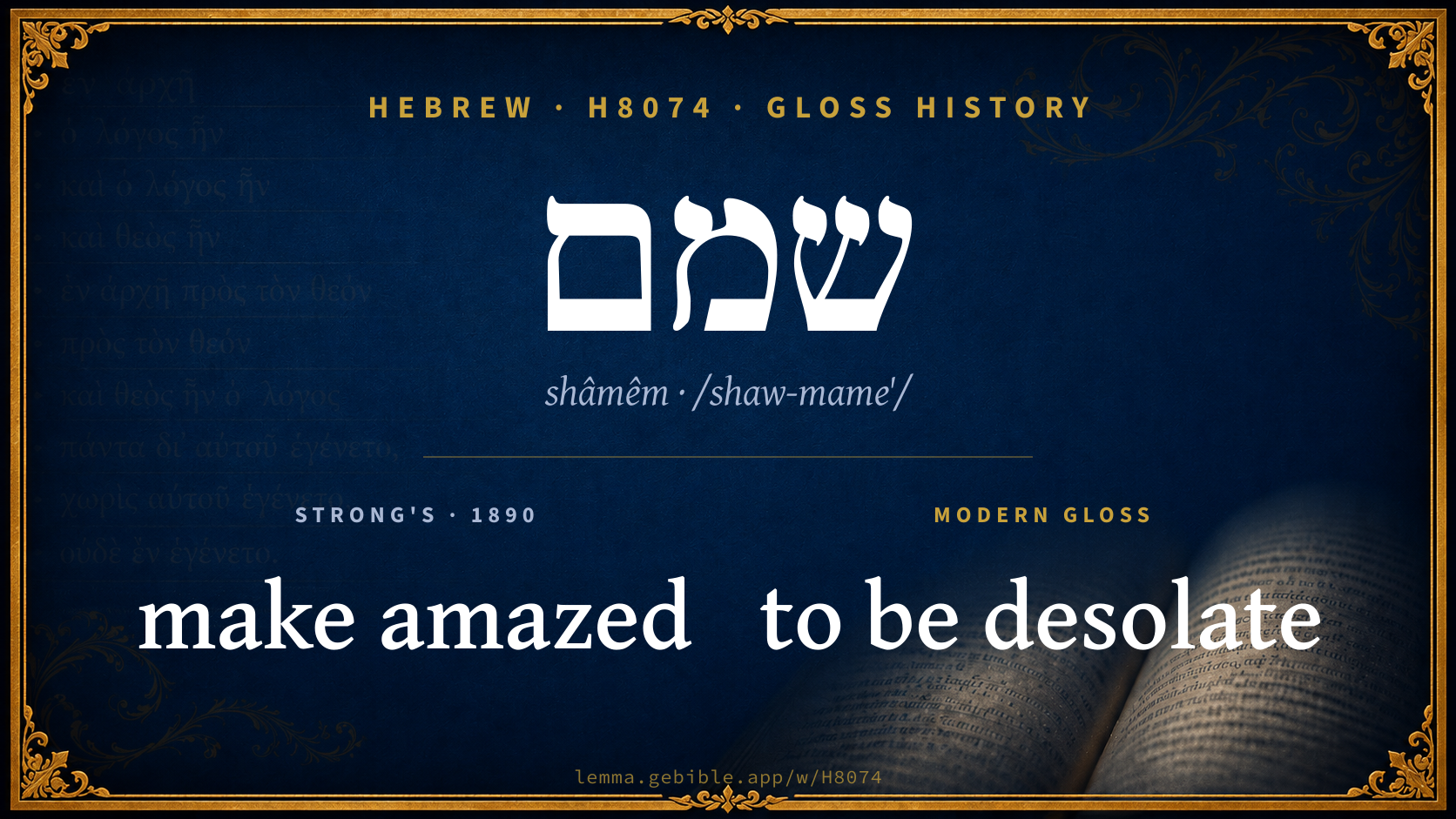
Gloss history
Strong's 1890 vs modern scholarship
About this word
Strong's H8074 catalogs a Hebrew word from the Hebrew Old Testament.
These counts are not copied from any lexicon or concordance. They are computed here, from the morphology-tagged Hebrew Old Testament. What Lemma adds →
- 80
- distinct verses
- The word appears in 80 distinct verses.
- 19 / 39
- OT books
- The word appears in 19 of 39 Old Testament books.
- #475
- by frequency
- Top 500 most frequent Hebrew words (rank 475 of 8,640 Hebrew words by occurrence).
View all 80 occurrences in the concordance →
By section of the Old Testament
By traditional corpus
Conventional, traditional groupings — biblical authorship is debated, so this is a traditional corpus grouping, not an authorship claim. Each share is this word’s portion of its verses in that division of the Hebrew canon. Each figure is a share of the word’s 80 distinct verses.
- Prophets (Nevi'im) 50 verses · 63%
- Writings (Ketuvim) 23 verses · 29%
- Torah (Pentateuch) 7 verses · 9%
How translations render this word
Counts come from each version’s own published word-to-Strong’s tagging or interlinear alignment — an approximate guide to how each version renders this word, not a word-level alignment the data otherwise carries. Because each total is that version’s own tagged count, the per-version totals vary from one another and need not match the appearance or distinct-verse counts above. These counts may also differ from a printed concordance because Lemma counts each distinctly tagged rendering and does not collapse phrase taggings into a single head-word total. This is a fixed set of word-tagged versions (KJV, ASV, BSB, ULT) and does not change with the reading translation you choose elsewhere. Each version’s license is shown beside its name below (and on Sources).
BDB lists this Strong’s number as 2 distinct words (homographs). Each count above pools all of them and is not split by sense — see the Senses section below. A low-frequency rendering may belong to a different one of those words, not the primary meaning.
- King James Version†: Desolate 13×, Are desolate 7×, Shall be astonished 6×
- American Standard Version†: Desolate 9×, Are desolate 6×, Shall be astonished 6×
- Berean Standard Bible†: Desolate 6×, Will be appalled 6×, Are appalled 4×
- unfoldingWord Literal Text†: Desolate 5×, Desolation 5×, And 4×
King James Version Public Domain
Renders H8074 across 93† tagged occurrences — most commonly:
Plus other, less common renderings. Plus 36 renderings that appear only once — usually multi-word phrases or single function words the recovered tagging swept in, not distinct renderings. Not rendered by a distinct English word in 1 further occurrence.
American Standard Version Public Domain
Renders H8074 across 93† tagged occurrences — most commonly:
Plus other, less common renderings. Plus 41 renderings that appear only once — usually multi-word phrases or single function words the recovered tagging swept in, not distinct renderings.
Berean Standard Bible Public Domain
Renders H8074 across 85† tagged occurrences — most commonly:
Plus other, less common renderings. Plus 44 renderings that appear only once — usually multi-word phrases or single function words the recovered tagging swept in, not distinct renderings. Not rendered by a distinct English word in 1 further occurrence.
unfoldingWord Literal Text CC BY-SA 4.0
Renders H8074 across 86† tagged occurrences — most commonly:
Plus other, less common renderings. Plus 41 renderings that appear only once — usually multi-word phrases or single function words the recovered tagging swept in, not distinct renderings.
17 senses and sub-senses in the full BDB
Hebrew verbs can shift meaning by stem (binyan): Qal is the basic action, Niphal is often passive or reflexive, Piel often intensifies or makes it factitive, and Hiphil is typically causative. The senses below are grouped under the stem BDB assigns to each. This entry also uses Hophal (the passive of Hiphil) and one or more reduplicated stems (the Pōlēl/Pilpēl type), which for hollow or geminate roots behave much like Piel — often intensive or iterative.
What do BDB’s symbols mean?
BDB uses these scholarly abbreviations:
| Symbol | Meaning |
|---|---|
| 𝔊 | the Septuagint (the ancient Greek translation, LXX) |
| 𝔙 | the Vulgate (the Latin translation) |
| 𝔖 | the Syriac version (the Peshitta) |
| 𝔗 | the Targum (the Aramaic translation) |
| ψ | the Psalms |
| √ | root (the underlying root or stem) |
| ‖ | parallel passage (a synonymous or contrasted parallel) |
| † | the dagger: every passage where the word occurs is cited |
The 17 senses and sub-senses the full Brown-Driver-Briggs lexicon distinguishes for this word, in lexicon order (not ranked by frequency), with BDB’s own verbatim wording and sub-sense lettering. Shown in Hebrew script with BDB’s own scholarly abbreviations. The condensed entry is in the Lexicon Entry tab. See also the Forms in the corpus table below.
שמם I be desolated, appalled (connex. of meanings not clear) (NH id.
Qal
- Pf. 3 fs. שָׁמֵ֑מָה Ez 35:15, etc.; Impf. 3 ms. יִשֹּׁם 1 K 9:8 +, 3 mpl. יָשֹׁ֫מּוּ Jb 17:8 ψ 40:16, etc.; Imv. mpl. שֹׁ֫מּוּ Je 2:12; Inf. cstr. (?) metapl. שַׁמּוֹת Ez 36:3 (Ges§ 67r, but v. infra);—תֵּשַׁם, etc. (v. [יָשַׁם]) are placed here by most; Ez 6:6 reads תִּישָׁ֑מְנָה, v. Ges§ 67 p dd;—Pt. שׁוֹמֵם La 3:11 (v. also Pōʿ.); f. שֹׁמֵמָ֔ה (Ges§ 84 a s) 2 S 13:20 +; pl. שׁוֹמֵמִין La 1:4, etc.;— e.g. Ezekiel 35:15
- 1. be desolated, of Tamar 2 S 13:20 (i.e. deflowered, or deserted; others appalled), of pers. elsewhere late La 1:16; נְתָנַנִי שֹׁמֵמָה v 13, שָׂמַנִ֫י שׁ׳ 3:11; pt. as n.f. בְּנֵי שׁוֹמֵמָה Is 54:1 (opp. בְּעוּלָה) [Dn 8:13 + v. Pōʿ.]; usually of land, etc. (sometimes = deserted), Is 49:8; Ez 33:28 (מֵאֵין עוֹבֵר), 35:12 (read שָֽׁמְמוּ Qr Co Toy Krae; > Kt שׁממה), v 15; הֶחֳרָבוֹת הַשֹּׁמְמוֹת 36:4 (‖ הֶעָרִים הַנֶּעֱזָבוֹת); שַׁמּוֹת v 3 is prob. corrupt, Co שְׁאָט as v 5, Hi-Sm from שׁמה = נשׁם, Toy נָשֹׁם, Krae נְשֹׁם, La 1:4; 5:18; pt. fpl. as n. = desolate places Is 49:19; 61:4 (both ‖ חֳרָבוֹת), v 4 (cf. שְׁמָמָה 62:4); = desolations Dn 9:18, 26. e.g. 2 Samuel 13:20
- 2. be appalled, awestruck, usually at (עַל) judgments on others, Lv 26:32 (H), Je 2:12 (v. II. [חָרֵב]), Ez 26:16; 27:35; 28:19; Is 52:14; Jb 17:8, cf. 1 K 9:8 = 2 Ch 7:21, Je 18:16; 19:8; 49:17; 50:13; on oneself ψ 40:16 (עַל־עֵקֶב).—Is 42:14 v. [נשׁם]. e.g. Leviticus 26:32
Niphal
- Pf. 3 fs. נָשַׁ֫מָּה Je 12:11 +, 3 pl. נָשַׁ֫מּוּ Zp 3:6 +; Pt. f. נְשַׁמָּה Ez 36:34 +, etc.;—= Qal: e.g. Jeremiah 12:11
- 1. be desolated, of roads Lv 26:22 (H), Is 33:8, bamoth Am 7:9 (‖ יֶחֱרָ֑בוּ), altars Ez 6:4; cf. 25:3; 32:15 Zp 3:6; Zc 7:14; Jo 1:17 ψ 69:26; lands Je 12:11; Ez 29:12; 30:7; 36:34, 35, cities Is 54:3 (opp. יוֹשִׁיבוּ), cf. Ez 36:35; Am 9:14; Je 33:10; הַנְּשַׁמָּה Ez 36:36 the desolated (sc. land, in fig.). e.g. Leviticus 26:22
- 2. be appalled Je 4:9; La 4:5; Ez 4:17; 30:7, c. עַל rei Jb 18:20. e.g. Jeremiah 4:9
Pōʿ
- Pt.
- 1. וָאֵֽשְׁבָה מְשׁוֹמֵם Ezr 9:3 I sat appalled, cf. v 4. e.g. Ezra 9:3
- 2. transit. appalling, causing horror (Dr Dn 150 f.): (הַ)שִּׁקּוּץ מְשֹׁמֵם Dn 11:31, + perhaps 9:27a (v. שִׁקּוּץ); so also שִׁקּ׳ שֹׁמֵם 12:11 (on שׁ׳ v. Ges§ 52s), הַפֶּשַׁע שֹׁמֵם 8:13 the crime causing horror, and שׁ׳ as n. Horror-causer, appaller, 9:27b. e.g. Daniel 11:31
Hiphil
- Pf. 2 ms. הֲשִׁמּ֫וֹתָ Jb 16:7, etc.; Impf. 3 ms. יַשִּׁים (Ges§ 67y) Je 49:20; 50:45, 3 mpl. sf. וַיְשִׁמֵּם 1 S 5:6, 1 pl. נַשִּׁים Nu 21:30, etc.; Imv. mpl. הָשַׁמּוּ (Ges§ 67v) Jb 21:5; Inf. abs. הַשְׁמֵם Mi 6:13; Pt. מַשְׁמִים Ez 3:15;— e.g. Job 16:7
- 1. devastate, ravage, acc. pers. 1 S 5:6; Ez 20:26; Ho 2:14 (fig. of vine), Jb 16:7; acc. loc. Lv 26:31, 32 (H), Je 10:25; Ez 30:12, 14 ψ 79:7, so (acc. om.) Nu 21:30 (poem in JE), Mi 6:13;—Ez 14:8 v. שִׂים Hiph. e.g. 1 Samuel 5:6
- 2.
- a. appall, acc. pers., c. עַל at, Je 49:20; 50:45; Ez 32:10. e.g. Jeremiah 49:20
- b. inwardly trans., וָאֵשֵׁב מַשׁ׳ 3:15 shewing horror, Jb 21:5 (Bu Niph. הִשַּׁמּוּ). e.g. Ezekiel 3:15
Hophal
- Inf. abs. כָּל־יְמֵי הָשַּׁמָּה (sc. הָאָרֶץ) Lv 26:34 (H) all the days of (its) being desolate, so v 35 2 Ch 36:21; Aramaizing, בָּהְשַׁמָּה (Ges§ 67y) Lv 26:43. e.g. Leviticus 26:34
Hithpōʿ
- Impf. 3 ms. יִשְׁתּוֹמֵם ψ 143:4, etc.;— e.g. Psalms 143:4
- 1. be appalled, astounded, כִּי that, because, Is 59:16; 63:5; עַל rei Dn 8:27; בְּתוֹכִי יִשְׁתּ׳ לְבִּי ψ 143:4 (cf. 1 pl. נשתומם Ecclus 43:24). e.g. Isaiah 59:16
- 2. cause oneself desolation, ruin, Ec 7:16 (תִּשּׁוֹמֵם, var. תִּשְׁתּוֹמֵם). e.g. Ecclesiastes 7:16
שמם II devastated
Senses from the full Brown-Driver-Briggs lexicon (Brown, Driver, Briggs; Oxford 1906 — public domain), digitized via Sefaria, supplemented by the OpenScriptures HebrewLexicon (CC BY 4.0). Full attribution on Sources.
Word origin
I. vb. be desolated, appalled (connex. of meanings not clear) (NH id.; J.Aram שְׁמַם Ithp. be dazed);—
II. adj. devastated;—שׁ׳ of sanctuary Dn 9:17; f. שְׁמֵמָה of land Je 12:11.
— Brown-Driver-Briggs (Oxford 1906, public domain), digitized via Sefaria, supplemented by the OpenScriptures HebrewLexicon (CC BY 4.0). See Sources.
Origin: a primitive root
Jastrow Dictionary
A second Hebrew/Aramaic lexicon for comparison, covering Aramaic and post-biblical (Talmudic, Targumic, Midrashic) usage that the biblical-Hebrew BDB does not. Matched by lemma rather than by Strong’s number, so a lemma may carry more than one Jastrow headword (shown separately below), and the entries cover usage well beyond the Bible.
שָׁמֵם
- (b. h.) [to stand still,] to be astonished; to be waste. Tosef. Sot. XV, 10 ונמצא ישראל ש׳ וזרע וכ׳ and as a consequence Israel will be laid waste, and the seed of Abraham cease. Y. Bets. II, 61ᶜ top פעם … ומצא אותה שׁוֹמֶמֶת once he entered the Temple court and found it deserted; יָשֹׁמּוּ בתיהם … שׁהֵשֵׁימּוּ וכ׳ (or יִשַּׁמּוּ) deserted be the homes of those who caused the house of our God to be laid waste; Y. Ḥag. II, 78ᵃ bot. שׁהֵישַׁמּוּ. Cant. R. to V, 5 ראה המדינה שוממת he (Cyrus) saw that the country was ruined. Y. Ber. IV, 8ᵃ ההרוסה והשׁוֹמֵמָה destroyed and deserted. Meg. III, 3 (ref. to Lev. XXVI, 31) קדושתן … שׁוֹמֵמִין (Y. ed. שׁוֹמֵימִין) they remain holy, even when they lie in ruins. Lam. R. introd. (R. Joḥ. 1) שָׁמְמָה עלי נפשי my soul within me is waste (mourns); a. fr. e.g. Leviticus 26:31
- to lay waste, ruin; to confound. Yalk. Prov. 959 אם זכה משמחו ואם לאו מְשַׁמְּמוֹ if a man is good, it (dreaming of wine) means joy to him, if not, it means confounding.—Part. pass. מְשׁוּמָּם; f. מְשׁוּמֶּמֶת. Tosef. Keth. VII, 10 מש׳ היא (ed. Zuck. שעמומית) she (my daughter) is confused in her mind; v. שִׁעֲמֵם, שַׁעֲמוּמִית.
- same. Gen. R. s. 26 (play on אנשי השם, Gen. IV, 4) שׁהֵשִׁימּוּ את העולם ושהוּשַׁמּוּ … שׁיִשּׁוֹם they confounded the world, and they were ruined (driven) out of the world, and caused the world to be laid waste. Y. Bets. l. c.; Y. Ḥag. l. c., v. supra. e.g. Genesis 4:4
- , Hof. הוּשַׁם to be laid waste, ruined. Gen. R. l. c., v. supra. Sot. IX, 15; Cant. R. to II, 13 והגבלן יִשּׁוֹם, v. גַּבְלָן. Y. Bets. l. c.; Y. Ḥag. l. c., v. supra.
- 1. to be astounded. Gen. R. s. 4, end (expl. ש̇מ̇י̇ם̇) שהבריות מִשְׁתּוֹמְמִים … של אש̇ הן של מ̇י̇ם̇ הן men wonder at them, (asking) are they of fire? are they of water?
- 2. to be waste, ruined. Kidd. 66ᵃ והיה העולם מִשְׁתּוֹמֵם וכ׳ and the (Jewish) world was ruined (demoralized), until Simon b. Sh. came and restored the Law &c. Sabb. 33ᵃ והדרכים מִשְׁתּוֹמְמִין and the roads are desolate; a. e.
שַׁמָּם
- (preced.) confounded, demented.—Pl. שַׁמָּמִין. Cant. R. to IV, 7.
A Dictionary of the Targumim, the Talmud Babli and Yerushalmi, and the Midrashic Literature (Marcus Jastrow; London, Luzac, 1903) — Public Domain. Digitized via Sefaria. Digitized via Sefaria. Full attribution on Sources.
Forms in the corpus
The 74 distinct written forms H8074 takes in the Hebrew Bible, most frequent first — each parse links to that stem’s occurrences in the concordance. Hebrew forms include their vowel points and cantillation, so a single lemma takes many written forms.
The 60 most common forms are shown; 14 rarer forms follow in the full concordance.
Same root — word family
Other BDB entries built from the same root as H8074, grouped by Strong’s listed origin. These share a root / origin per the lexicon — not necessarily a shared meaning. Each links to that word’s own entry.
Derived from this word
- משמה mᵉshammâh H4923 devastation
- שמה shammâh H8047 desolation
- שמועה shᵉmûwʻâh H8052 report
- שמם shᵉmam H8075 to be appalled
- שמם shâmêm H8076 desolate
- שממון shimmâmôwn H8078 horror
- שממית sᵉmâmîyth H8079 lizard
Proper names from this root
People and places named from this root — a name, not an additional meaning of the word.
Compare all same-root words → Showing 4 of 10 — not the complete family. 2 of the same-root words are proper names (people or places). They share a root, not necessarily a meaning.
Septuagint verse parallels
This word appears in 77 verses that also exist in the Greek Old Testament (Septuagint), out of the 80 Hebrew verses it occurs in. You can read those verses in Greek by switching the Old Testament edition to the Septuagint.
Read these verses in the Septuagint
- Leviticus 26:22
- Numbers 21:30
- 1 Samuel 5:6
- 1 Kings 9:8
- 2 Chronicles 7:21
- Ezra 9:3
- Job 16:7
- Psalms 79:7
- Ecclesiastes 7:16
- Isaiah 33:8
- Jeremiah 2:12
- Lamentations 1:4
This is a verse-level parallel only — the same verses exist in both the Hebrew and Greek Old Testaments. No word-level Hebrew↔Greek correspondence is claimed: the data carries no such alignment, so no Greek word is shown as this Hebrew word’s translation. Coverage is not total — the Septuagint omits the deuterocanon and renumbers the Psalms, so some Hebrew verses have no direct Greek parallel.