
Ezekiel 20:26

Hebrew (Westminster Leningrad Codex) Ezekiel 20:26 appears in the Hebrew Old Testament. The text above is from the Westminster Leningrad Codex. Each word links to its Strong’s number, a concise gloss, and parsing drawn from the Open Scriptures Hebrew Bible morphology. Click any word for its full Brown-Driver-Briggs (BDB) entry.
Download image
Cite this verse

Ezekiel 20:26 (World English Bible). Public Domain. Lemma interlinear Bible study tool, https://lemma.gebible.app/v/ezekiel/20/26.

Show BibTeX & RIS
BibTeX
RIS
English Translation
and I polluted them in their own gifts, in that they caused to pass through [the fire] all that opens the womb, that I might make them desolate, to the end that they might know that I am Yahweh.
World English Bible · Public Domain
Download a study sheet

One document with this verse’s original text, its word-by-word gloss line, the meaning frame, cross-references with their text, attributed commentary, and full source and license credits — printable, and it pastes into notes with its structure intact.

This verse Autodidact and up

Study sheet (.html) Plain text (.txt)

A passage Seminary Student

Up to 50 verses in one chapter. A passage sheet keeps up to 6 commentary sources and 12 cross-references per verse, in the order this page ranks them, and says so on the sheet whenever that leaves anything out. Ask for a single verse and you get the Autodidact verse sheet above.

Everything on this page stays free to read, with no account — the sheet is a download of what is already on screen, not access to it.

Want to remove ads? Support Godless Engineer
Compare translations 3

The same verse in 3 English versions, stacked beneath the original-language interlinear above. Click any original word for its lexicon entry.

Each is an independent rendering of the whole verse — the interlinear is not word-aligned to these translations.

Highlighted words mark where these versions differ — a whole-verse word diff, not a word-by-word alignment.

  • World English Bible Public Domain
    and I polluted them in their own gifts, in that they caused to pass through [the fire] all that opens the womb, that I might make them desolate, to the end that they might know that I am Yahweh.
  • King James Version Public Domain
    And I polluted them in their own gifts, in that they caused to pass through the fire all that openeth the womb, that I might make them desolate, to the end that they might know that I am the LORD.
  • unfoldingWord Literal Text CC BY-SA 4.0
    I declared them to be unclean through their gifts—they made a sacrifice of every firstborn of the womb and caused them to pass through the fire—that I might fill them with horror so they will know that I am Yahweh!’

unfoldingWord Literal Text — © unfoldingWord, licensed CC BY-SA 4.0. Word-aligned USFM3 via Door43 (git.door43.org/unfoldingWord/en_ult).

Versions to compare (up to 4)

3 of 4 selected

Show all 18 translations

Every available English version of this verse, each an independent rendering of the whole verse.

  • World English Bible Public Domain
    and I polluted them in their own gifts, in that they caused to pass through [the fire] all that opens the womb, that I might make them desolate, to the end that they might know that I am Yahweh.
  • Berean Standard Bible Public Domain
    And I pronounced them unclean through their gifts—the sacrifice of every firstborn in the fire—so that I might devastate them, in order that they would know that I am the LORD.
  • Majority Standard Bible Public Domain
    And I pronounced them unclean through their gifts—the sacrifice of every firstborn in the fire—so that I might devastate them, in order that they would know that I am the LORD.
  • King James Version Public Domain
    And I polluted them in their own gifts, in that they caused to pass through the fire all that openeth the womb, that I might make them desolate, to the end that they might know that I am the LORD.
  • American Standard Version (1901) Public Domain
    and I polluted them in their own gifts, in that they caused to pass through `the fire' all that openeth the womb, that I might make them desolate, to the end that they might know that I am Jehovah.
  • Revised Version (1885) Public Domain
    and I polluted them in their own gifts, in that they caused to pass through the fire all that openeth the womb, that I might make them desolate, to the end that they might know that I am the LORD.
  • Geneva Bible (1599) Public Domain
    And I polluted them in their owne giftes in that they caused to passe by the fire all that first openeth ye wombe, that I might destroy them, to the ende, that they might know that I am ye Lord.
  • Douay-Rheims (1899) Public Domain
    And I polluted them in their own gifts, when they offered all that opened the womb, for their offences: and they shall know that I am the Lord.
  • Young's Literal Translation Public Domain
    And I defile them by their own gifts, By causing to pass away every opener of a womb, So that I make them desolate, So that they know that I `am' Jehovah.
  • Literal Standard Version CC BY-SA 4.0
    And I defile them by their own gifts, || By causing every opener of a womb to pass away, || So that I make them desolate, || So that they know that I [am] YHWH.
  • Unlocked Literal Bible CC BY-SA 4.0
    I declared them to be unclean through their gifts—they made a sacrifice of every firstborn of the womb and caused them to pass through the fire—that I might fill them with horror so they will know that I am Yahweh!'
  • unfoldingWord Literal Text CC BY-SA 4.0
    I declared them to be unclean through their gifts—they made a sacrifice of every firstborn of the womb and caused them to pass through the fire—that I might fill them with horror so they will know that I am Yahweh!’
  • Darby Bible Public Domain
    and I defiled them by their own gifts, in that they devoted all that opened the womb, that I might make them desolate, to the end that they might know that I [am] Jehovah.
  • World Messianic Bible Public Domain
    I polluted them in their own gifts, in that they caused all that opens the womb to pass through the fire, that I might make them desolate, to the end that they might know that I am the LORD.”’
  • Webster's Bible Public Domain
    And I polluted them in their own gifts, in that they caused to pass through the fire all the first-born, that I might make them desolate, to the end that they might know that I am the LORD.
  • Free Bible Version CC BY-SA 4.0
    I let them make themselves unclean by their offerings to idols, including their firstborn sons. I allowed this to happen so that they would be so appalled that they would acknowledge that I am the Lord.
  • Bible in Basic English Public Domain
    I made them unclean in the offerings they gave, causing them to make every first child go through the fire, so that I might put an end to them.
  • JPS Tanakh (1917) Public Domain
    and I polluted them in their own gifts, in that they set apart all that openeth the womb, that I might destroy them, to the end that they might know that I am the LORD.

Literal Standard Version (2020), Covenant Press — licensed CC BY-SA 4.0. Text via the HelloAO Bible API (eBible.org). Unlocked Literal Bible (unfoldingWord) — licensed CC BY-SA 4.0. Text via the HelloAO Bible API (eBible.org). unfoldingWord Literal Text — © unfoldingWord, licensed CC BY-SA 4.0. Word-aligned USFM3 via Door43 (git.door43.org/unfoldingWord/en_ult). Free Bible Version, Dr. Jonathan Gallagher — licensed CC BY-SA 4.0. Text via the HelloAO Bible API (eBible.org).

Word by word

More ways to search: Search by grammar → Find every occurrence → Compare this word →

Practice this passage: Drill this verse → Learn its vocabulary →

פֶּ֣טֶר
peṭer
H6363
“firstborn of”
Noun, Common, Masculine, Singular, Construct
Part of Speech
Noun
Type
Common
Gender
Masculine
Number
Singular
State
Construct
Full BDB Definition

Origin: from H6362

TWOT: 1764a , 1764b

firstborn, firstling, that which separates or first opens
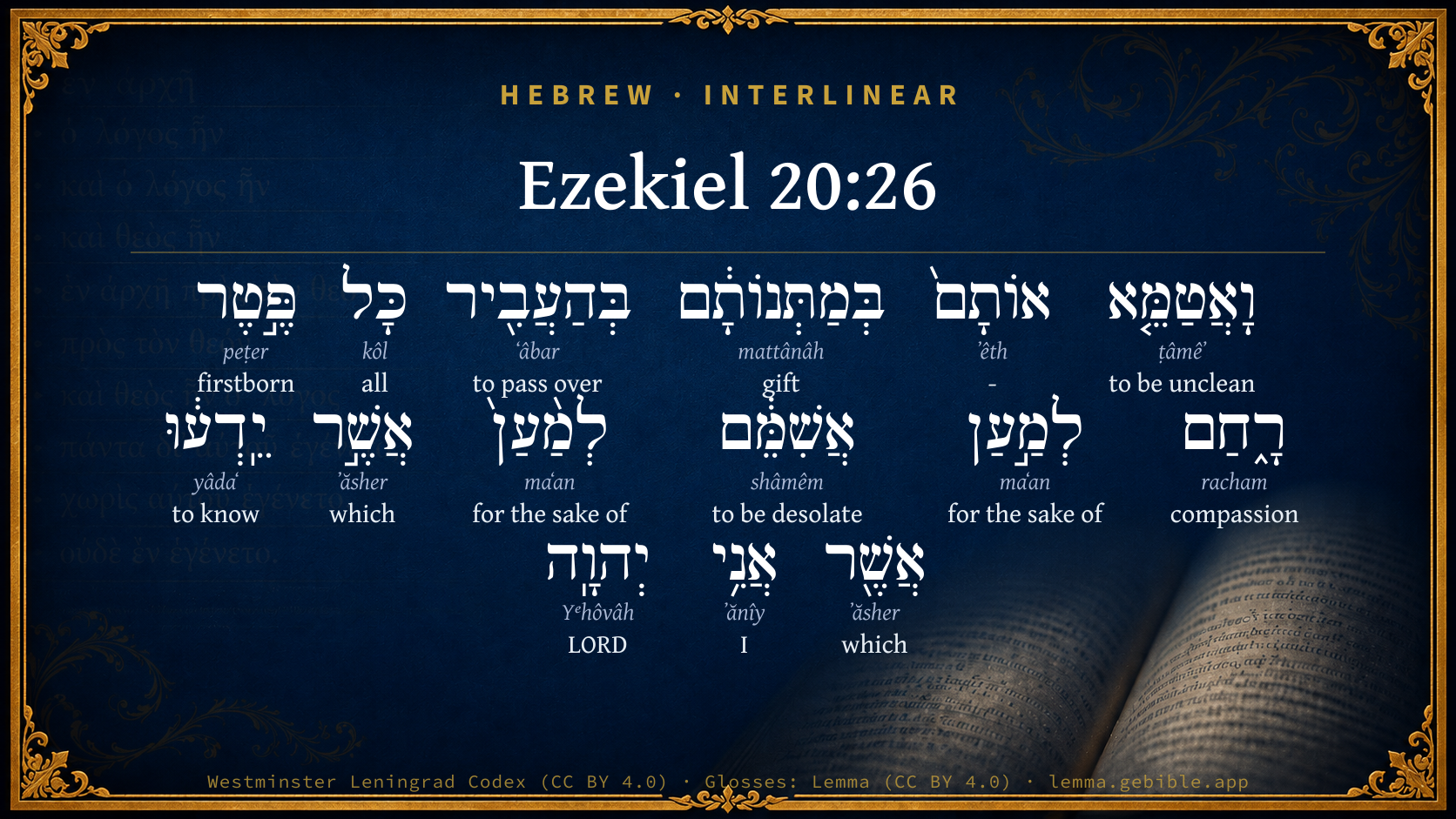
  1. וָאֲטַמֵּ֤א ṭâmêʼ H2930 “and · to be unclean” Conjunction + Verb, Piel, Sequential Imperfect, 1st Person, Common, Singular
  2. אוֹתָם֙ ʼêth H853 “- · them” Particle, Direct Object + Suffix, Personal, 3rd Person, Masculine, Plural
  3. בְּמַתְּנוֹתָ֔ם mattânâh H4979 “in/at · gifts · their” Preposition + Noun, Common, Feminine, Plural, Construct + Suffix, Personal, 3rd Person, Masculine, Plural
  4. בְּהַעֲבִ֖יר ʻâbar H5674 “in/at · to pass over” Preposition + Verb, Hiphil, Infinitive Construct
  5. כָּל kôl H3605 “all of” Noun, Common, Masculine, Singular, Construct
  6. רָ֑חַם racham H7356 “compassion” Noun, Common, Both, Singular, Absolute
  7. לְמַ֣עַן maʻan H4616 “for the sake of” Preposition
  8. אֲשִׁמֵּ֔ם shâmêm H8074 “to be desolate · them” Verb, Hiphil, Imperfect, 1st Person, Common, Singular + Suffix, Personal, 3rd Person, Masculine, Plural
  9. לְמַ֨עַן֙ maʻan H4616 “for the sake of” Preposition
  10. אֲשֶׁ֣ר ʼăsher H834 “which” Particle, Relative
  11. יֵֽדְע֔וּ yâdaʻ H3045 “to know” Verb, Qal, Imperfect, 3rd Person, Masculine, Plural
  12. אֲשֶׁ֖ר ʼăsher H834 “which” Particle, Relative
  13. אֲנִ֥י ʼănîy H589 “I” Pronoun, Personal, 1st Person, Common, Singular
  14. יְהוָֽה Yᵉhôvâh H3068 “LORD” Noun, Proper

About this verse

These counts appear in no published source. They are computed here, from the morphology-tagged text and Lemma’s own curated glosses. What Lemma adds →

15
words
13
distinct lemmas
Prophets
section

Notable vocabulary

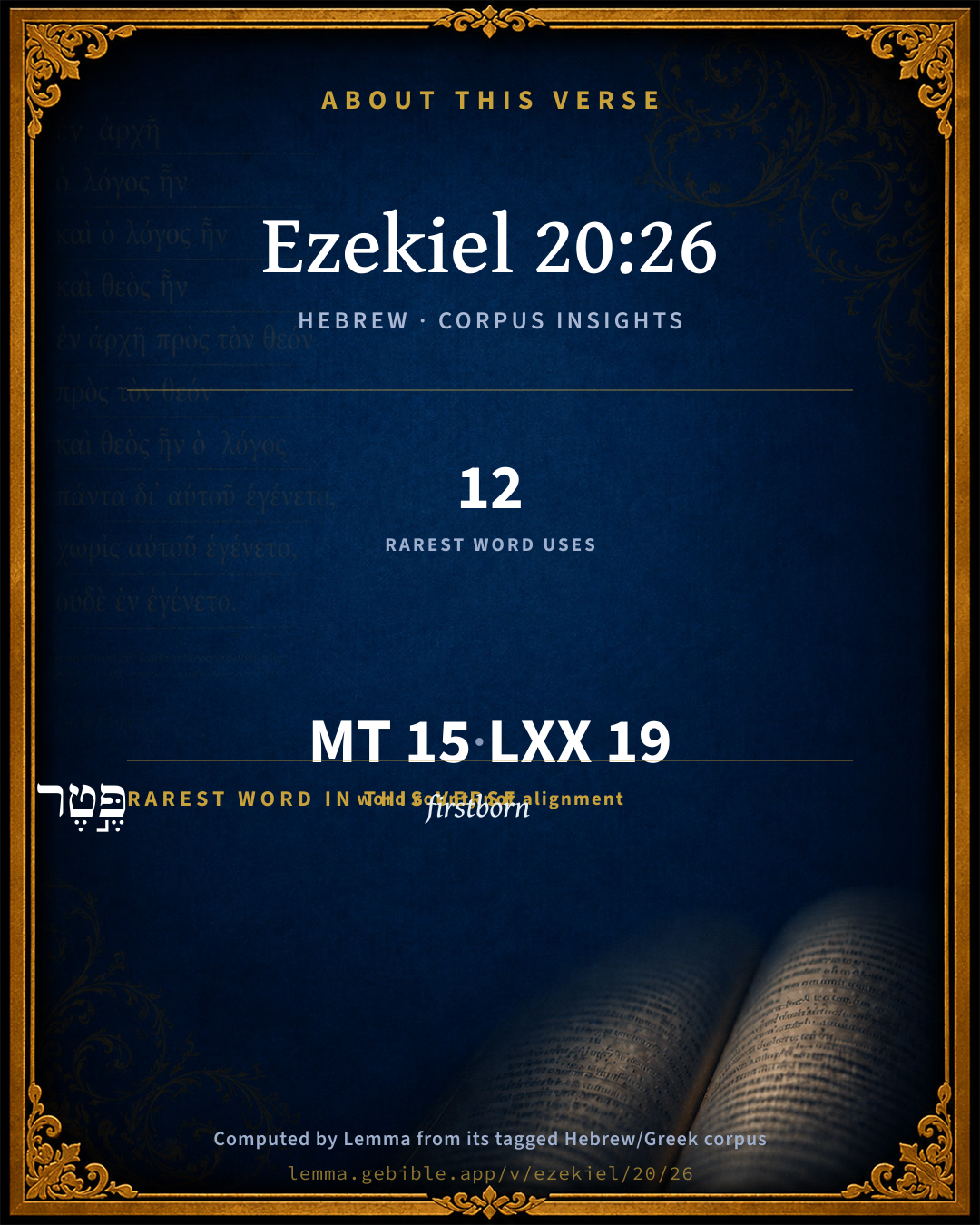
The rarest word here is פֶּ֣טֶר firstborn H6363 — appearing just 12 times in the whole Hebrew Bible.

Shared distinctive vocabulary

פֶּ֣טֶר firstborn H6363 occurs in 10 verses of the Hebrew Bible. Also found in:

Grammatical profile

  • 4 verbs
  • 5 nouns
  • 1 pronoun
  • 2 prepositions
  • 3 particles

Verb forms

  • וָאֲטַמֵּ֤א Piel · Sequential Imperfect
  • בְּהַעֲבִ֖יר Hiphil · Infinitive Construct
  • אֲשִׁמֵּ֔ם Hiphil · Imperfect
  • יֵֽדְע֔וּ Qal · Imperfect

Repetition

Words recur within this verse — often emphatic in Hebrew:

  • לְמַ֣עַן for the sake of H4616 ×2
  • אֲשֶׁ֣ר which H834 ×2

Hebrew & Septuagint length

In English translation the verse runs 39 words from the Hebrew and 25 from the Septuagint (LXX English) — the Septuagint runs noticeably shorter here. See the side-by-side →

A rough comparison of the two English renderings, which tokenize alike — not a word-level alignment.

Word counts can differ between the Hebrew and the Greek without any difference in meaning — e.g. the Hebrew direct-object marker אֵת has no separate Greek word, and Greek often adds the article ὁ.

In the original languages it is 15 Hebrew tokens and 19 Greek tokens — but the two are counted differently (Hebrew bundles its prefixes and suffixes into one token; the Greek is in lemma form), so that isn’t a like-for-like length.

Cross-references

14

Topical passages linked to Ezekiel 20:26 in the Treasury of Scripture Knowledge — connected by theme and wording, ordered by reader-vote popularity; previews shown in the World English Bible.

  • Leviticus 18:21 "'You shall not give any of your children to sacrifice to Molech; neither shall you profane the name of your God: I am Yahweh.
  • Isaiah 63:17 O Yahweh, why do you make us to err from your ways, and harden our heart from your fear? Return for your servants' sake, the tribes of your inheritance.
  • Ezekiel 6:7 The slain shall fall in the midst of you, and you shall know that I am Yahweh.
  • 2 Kings 17:17 They caused their sons and their daughters to pass through the fire, and used divination and enchantments, and sold themselves to do that which was evil in the sight of Yahweh, to provoke him to anger.
  • Ezekiel 16:20–21 Moreover you have taken your sons and your daughters, whom you have borne to me, and these have you sacrificed to them to be devoured. Were your prostitution a small matter,
  • Ezekiel 20:31 and when you offer your gifts, when you make your sons to pass through the fire, do you pollute yourselves with all your idols to this day? and shall I be inquired of by you, house of Israel? As I live, says the Lord Yahweh, I will not be inquired of by you;
  • Exodus 13:12 that you shall set apart to Yahweh all that opens the womb, and every firstborn which you have that comes from an animal. The males shall be Yahweh's.
  • 2 Kings 21:6 He made his son to pass through the fire, and practiced sorcery, and used enchantments, and dealt with those who had familiar spirits, and with wizards: he worked much evil in the sight of Yahweh, to provoke him to anger.
  • 2 Chronicles 28:3 Moreover he burnt incense in the valley of the son of Hinnom, and burnt his children in the fire, according to the abominations of the nations whom Yahweh cast out before the children of Israel.
  • 2 Chronicles 33:6 He also made his children to pass through the fire in the valley of the son of Hinnom; and he practiced sorcery, and used enchantments, and practiced sorcery, and dealt with those who had familiar spirits, and with wizards: he worked much evil in the sight of Yahweh, to provoke him to anger.
  • Jeremiah 19:9 I will cause them to eat the flesh of their sons and the flesh of their daughters; and they shall eat everyone the flesh of his friend, in the siege and in the distress, with which their enemies, and those who seek their life, shall distress them.
  • Jeremiah 32:35 They built the high places of Baal, which are in the valley of the son of Hinnom, to cause their sons and their daughters to pass through [the fire] to Molech; which I didn't command them, neither did it come into my mind, that they should do this abomination, to cause Judah to sin.
  • Luke 2:23 (as it is written in the law of the Lord, "Every male who opens the womb shall be called holy to the Lord"),
  • Romans 11:7–10 What then? That which Israel seeks for, that he didn't obtain, but the chosen ones obtained it, and the rest were hardened.

Cross-references courtesy of OpenBible.info (CC BY 4.0).

Hebrew and Greek witnesses Masoretic Hebrew ↔ Greek Septuagint

The same verse in the two great witnesses to the Old Testament, shown verse-for-verse.

Here the Septuagint runs noticeably shorter than the Hebrew — LXX2012 (modern English Septuagint) 25 words vs World English Bible 39. A rough length comparison of the two English translations, not a word-level alignment — read both below.

These are two independent witnesses, not word-aligned to each other, and the Septuagint is shown in lemma (dictionary) form.

Hebrew Ezekiel 20:26 Masoretic · Westminster Leningrad Codex

וָאֲטַמֵּ֤א אוֹתָם֙ בְּמַתְּנוֹתָ֔ם בְּהַעֲבִ֖יר כָּל פֶּ֣טֶר רָ֑חַם לְמַ֣עַן אֲשִׁמֵּ֔ם לְמַ֨עַן֙ אֲשֶׁ֣ר יֵֽדְע֔וּ אֲשֶׁ֖ר אֲנִ֥י יְהוָֽה

and I polluted them in their own gifts, in that they caused to pass through [the fire] all that opens the womb, that I might make them desolate, to the end that they might know that I am Yahweh.

World English Bible · Public Domain

Greek LXX Ezekiel 20:26 Septuagint · lemma form

καί μιαίνω αὐτός ἐν ὁ δόμα αὐτός ἐν ὁ διαπορεύομαι ἐγώ πᾶς δια ἀναοἴγω μήτρα ὅπως ἀπο ἀναἵζω αὐτός

And I will defile them by their own decrees, when I pass through upon every one that opens the womb, that I may destroy them.

LXX2012 (modern English Septuagint) · Public Domain

On this verse, The Cambridge Bible for Schools and Colleges discusses the Septuagint’s reading. Read the note in Commentary ↓

Hebrew: Westminster Leningrad Codex (CC BY 4.0). Greek: Septuagint (public domain); English from LXX2012 (modern English Septuagint) (Public Domain). How the Septuagint differs from the Hebrew →

Targum (Aramaic paraphrase)

1

The Targum is the ancient Jewish Aramaic paraphrase of the Hebrew Scriptures — an interpretive translation, not the Hebrew text itself. Onkelos (literal) and Pseudo-Jonathan (expansive) render the Torah, and Jonathan the Prophets. Coverage is partial: where no permissively-licensed English translation exists for a verse, only the Aramaic is shown. This is verse-level text, not a word-by-word alignment to the Hebrew.

  1. Targum Jonathan Prophets (Joshua–Malachi)
    וְסָאִיבֵית יַתְהוֹן בְּמַתְּנָתְהוֹן בְּאַעֲבְּרָא כָּל פְּתַח וַלְדָא בְדִיל דְאַצְדִינוּן בְּדִיל דְיֵדְעוּן דִי אֲנָא יְיָ:

    (no public-domain English translation for this verse)

    Targum Jonathan — Aramaic: “Mikraot Gedolot” (public domain). English: “Sefaria Community Translation” (CC0 1.0 (public-domain dedication)); “London "Chaldee Paraphrase," 1871” (public domain). Text via Sefaria.

Commentary

Notes on Ezekiel 20:26 from classic Christian and Jewish commentators (each source and its license shown beneath its notes). The classic Christian expositions comment on the surrounding passage and are grouped to its opening verse, so a note may address several verses; the Jewish commentaries on the Tanakh (Rashi and others) are per-verse, so they appear only where the commentator wrote on this verse.

Lemma curates 59 commentaries, every one of them public domain or Creative Commons licensed, each selected and text-cleaned for this edition rather than reprinted as found. About our sources →

Jamieson, Fausset & Brown

Robert Jamieson, A. R. Fausset & David Brown

I polluted them--not directly; "but I judicially gave them up to pollute themselves." A just retribution for their "polluting My sabbaths" (Eze 20:24). This Eze 20:26 is explanatory of Eze 20:25. Their own sin I made their punishment.

caused to pass through the fire--FAIRBAIRN translates, "In their presenting (literally, 'the causing to pass over') all their first-born," namely, to the Lord; referring to the command (Exo 13:12, Margin, where the very same expression is used). The lustration of children by passing through the fire was a later abomination (Eze 20:31). The evil here spoken of was the admixture of heathenish practices with Jehovah's worship, which made Him regard all as "polluted." Here, "to the Lord" is omitted purposely, to imply, "They kept up the outward service indeed, but I did not own it as done unto Me, since it was mingled with such pollutions." But English Version is supported by the similar phraseology in Eze 20:31, see on Eze 20:31. They made all their children pass through the fire; but he names the first-born, in aggravation of their guilt; that is, "I had willed that the first-born should be redeemed as being Mine, but they imposed on themselves the cruel rites of offering them to Molech" (Deu 18:10).

might know . . . the Lord--that they may be compelled to know Me as a powerful Judge, since they were unwilling to know Me as a gracious Father.

Jamieson, Fausset & Brown — Commentary Critical and Explanatory on the Whole Bible (1871) — public domain (CC PDM 1.0). Text via the HelloAO Bible API.

Trapp's Complete Commentary

John Trapp

Eze 20:26 And I polluted them in their own gifts, in that they caused to pass through [the fire] all that openeth the womb, that I might make them desolate, to the end that they might know that I [am] the LORD.

Ver. 26. And I polluted them in their own gifts,] i.e., I rejected both their persons and presents as unclean. So God would do our best performances (wherein there would not else be so much as truth and sincerity found), were they not wrought in us by the Holy Spirit, and perfumed with Christ’s sweet odours poured into them.

John Trapp, A Commentary or Exposition upon All the Books of the Old and New Testament (1647–1656) — public domain. Text from a community e-Sword module.

Tyndale Open Study Notes

Tyndale Open Resources

20:26 The Israelites even gave their firstborn children as offerings to the god Molech. This exactly reversed the Exodus, which freed the Israelites, the Lord’s “firstborn son” (Exod 4:22), to offer pure worship in the Promised Land.

Tyndale Open Study Notes — © Tyndale Open Resources, licensed CC BY-SA 4.0. Text via the HelloAO Bible API.

Geneva Bible (1599)

Geneva Bible translators

I condemned those things, and counted them as abominable, which they thought had been excellent, and to have declared most zeal, Luke 16:15, for that which God required, as most excellent, that they gave to their idols.

Geneva Bible (1599) marginal notes — public domain. Text via Bolls.life.

Adam Clarke's Commentary

Verse 26. I polluted them in their own gifts] I permitted them to pollute themselves by the offerings which they made to their idols. Causing their children to pass through the fire was one of those pollutions; but, did God ever give them a statute or judgment of this kind? No. He ever inveighs against such things, and they incur his heaviest displeasure and curse. See on Eze 20:31.

Adam Clarke's Commentary on the Bible (1810–1826) — public domain. Text from a community e-Sword/MySword module.

John Calvin's Commentaries

There is no doubt that God here continues the same doctrine’ hence we gather that injurious laws were given to the people when they adopted various errors and worshipped idols of their own fabrication instead of God: hence it is added, I polluted them in their gifts. This, then, was added by the Prophet, lest the Jews should object that they had not altogether rejected the worship of God; for they mingled the ceremonies of the laws with the fictions of the Gentiles, as we saw before, and the Prophet will shortly repeat: in this way they thought they discharged their duty to God, though they added mixtures of their own. Here the Prophet meets them, and cuts off all occasion for turning aside, since they were polluted in their gifts, and nothing was pure or sincere when they thus corrupted God’s precepts by their comments. However, they daily offered their gifts, and professed to present them to the true God; yet they obtained no advantage, because God abominated mixtures of this kind, as we have previously said; for he cannot bear to be worshipped by the will of men, but wishes his children to be simply content with his commands. Now, we perceive the meaning of the Prophet — God pollutes them in their gifts; that is, renders their gifts polluting whenever they think that they discharge their duty; — but how? why, he says, when they cause whatever opens the womb to pass through. Here the Prophet touches on only one kind of superstition, but, by a figure of speech, he means all kinds, by which the Jews vitiated God’s pure worship; for this superstition was very detestable, to pass their sons through the fire, and to consecrate them to idols. But in this passage God speaks only of the first-born, so as greatly to exaggerate the crime: that ceremony was indeed general; but since God claimed the first-born as his own, and wished them to be redeemed at a fixed price, (Exodus 13:2, Exodus 22:29, and Exodus 34:19, 20,) and by this act wished the remembrance of their redemption to be kept up, since all the first-born of Israel, as well as of animals, had escaped, while those of the Egyptians perished, (Numbers 3:13, and Numbers 8:16,) was it not monstrous to pass through the fire, and to offer to idols those who were specially devoted and sacred to God? We see, then, that the Prophet does not speak in vain of the first-born.

That I should destroy thou, says he, and they should know that I am Jehovah. God here shows that he had proceeded gradually to the final vengeance; and for this reason the people were the more convicted of stupidity, since they never perceived God’s judgments manifest. If God had suddenly and impetuously issued his vengeance from heaven, men’s astonishment would not have been wonderful; but when he grants them space of time and a truce that they may weigh the matter at leisure, and admonishes them to repentance, not once only, but often; and then if they remain always the same and are not effected, they show themselves utterly desperate by this slothfulness, as the Prophet now asserts. But when he adds, that they may know that I am Jehovah, he means that as he was not acknowledged as a father by the Jews, he would be their judge, and compel them whether they would or not to feel the formidable nature of that power which they despised. Since we have treated this subject fully before, we now pass it by more lightly. Yet we must notice this, that God is recognized by the reprobate, since, when his fatherly goodness has been for a long time despised by them, he at length appears as a judge, and draws them against their will to his tribunal, and executes his vengeance, so that they cannot escape. It follows —

John Calvin's Commentaries (1540-1563) — public domain. Text from the Calvin Translation Society English edition (1840s-50s) via the Christian Classics Ethereal Library (ccel.org). Calvin's coverage is partial (roughly two-thirds of the Bible); uncommented books and verses are honest gaps, never fabricated. The 19th-century editor's footnotes and remarks are omitted so the notes are faithfully Calvin's own voice.

Ellicott's Commentary for English Readers

(26) To pass through the fire.—The word “fire” here, as in Eze_16:21; Eze_23:37, is not in the original, but is rightly supplied from Eze_20:31. The custom referred to was probably that of consecrating their seed to Moloch, expressly forbidden in Lev_20:1-5. (Comp. also Act_7:43.) The causing children to pass through the fire continued a common sin even to the later days of the monarchy (2Ki_17:17; 2Ki_21:6).

A Bible Commentary for English Readers, edited by Charles John Ellicott (1878–1897) — public domain. Text from a community e-Sword module.

The Cambridge Bible for Schools and Colleges

gen. ed. J. J. S. Perowne

26. might make them desolate] Or, destroy them; less probably: horrify them (ch. Eze_32:10). The train of thought is the same as that expressed in ch. Eze_14:9. The penalty of sin is further delusion and worse sin, the end of which is death. The last clause “to the end … Lord” is wanting in LXX.

The Cambridge Bible for Schools and Colleges (gen. ed. J. J. S. Perowne; Cambridge University Press, 1878–1918) — public domain. Text from a community e-Sword module.

John Gill's Exposition

And one polluted them in their own gifts,.... Suffered them to defile themselves; or declared them to be, and treated them as polluted persons, in the gifts and sacrifices which they offered to idols, particularly their firstborn: as the next clause explains it:

in that they caused to pass though the fire all that openeth the womb; this very likely they did, when they sacrificed to Baalpeor, the same with Molech, Num 25:3;

that I might make them desolate; their families, by stripping them of their children, their firstborn, and strength:

to the end that they might know that I am the Lord; a righteous God, in punishing men for sin, in a way it deserves. Some interpret this, not of causing the firstborn to pass through fire to an idol; but of causing them to pass, or of setting them apart, to the Lord, according to the law in Exo 13:12; where the same word is used as here; and the sense is that God declared them to be impure in or with all their gifts, by commanding them to cause their firstborn to pass to him, which they were obliged to redeem; which sense is approved of by Gussetius (l); and so Abendana, taking the words to refer to both, gives this sense of them,

"I pronounced them impure, and removed them far from me, instead of sanctifying them; because they caused everyone that opens the womb to pass from me, whom I commanded to give to me for holiness, but they have given them to idolatry;''

rather, according to Braunius (m), the words may be understood of God's rejecting and causing the firstborn to pass from him, and not suffering them to offer gifts and sacrifices unto him; which may be meant by pronouncing them impure, or polluting them in their gifts; this was after the worship of the golden calf; when he took Aaron and his sons in their room.

(l) Ebr. Comment. p. 576, 939. (m) Selecta Sacra, l. 4. c. 11. p. 522.

John Gill's Exposition of the Whole Bible (1746–1763) — public domain (CC PDM 1.0). Text via the HelloAO Bible API.

Haydock's Catholic Bible Commentary

I polluted them, &c. That is, I gave them up to such blindness, in punishment of their offences, as to pollute themselves with the blood of all their first-born, whom they offered up to their idols in compliance with their wicked devices. (Challoner) (Menochius) (Leviticus xviii. 21., and 4 Kings iii. ultra[last verse], and xxi. 6. (Calmet) --- Offered. Protestants, "caused to pass through the fire all," &c., chap. xvi. 21. --- For their. Protestants, "that I might make them desolate to the end, that," &c.

George Leo Haydock (1774–1849), Haydock's Catholic Family Bible and Commentary, 1859 edition — public domain. Excludes Psalms (Douay-Rheims chapter numbering differs from Protestant) and Deuterocanonical books (Catholic canon only).

Matthew Poole's English Annotations

Polluted them; either I permitted them to pollute themselves, or discovered that they had polluted themselves, or treated them with loathing and abhorrence, as polluted persons.

In their own gifts; either in their gifts which they pretended to bring to me, or rather in their sacrifices they offered to whom, or at least in what manner, they, not I, had chosen; or, which is most likely, gifts are here their first-born, which are more than other children accounted gifts.

Through the fire: see Eze 16:20,21. Most insufferable affront to God, to see those children inhumanly offered to the devil, which, in remembrance of his redeeming the fathers, were consecrated to God! Exo 13:2; and possibly this was first done when they offered to Baalpeor, Num 25:3.

To the end, & c.; to provoke God so to afflict, weaken, and waste by his judgment, till it should undeniably appear that God had by signal displeasure against them for their sins brought them to desolation.

Might know; be convinced, and forced to own, that the Lord is a mighty King in punishing those that might, but would not, have him a gracious King in governing and guiding them.

Matthew Poole's English Annotations on the Holy Bible (1683–1685) — public domain. Text from a community e-Sword/MySword module.

Whedon's Commentary on the Bible

Daniel D. Whedon

26. I polluted them in their own gifts — From these words certain expositors (Kuenen, Wellhausen, Smend, Toy, etc.) have drawn the conclusion that one of the statutes which were “not good,” and which Jehovah gave in the early days to Israel, was that of child sacrifice. Renan plainly says that Jehovah commanded this evil thing, “in order to avenge himself and punish the nation by prescribing detestable rites” (History, iii, p. 260). This suggestion is a horrible one, and is opposed not only to God’s righteousness and to all that we know of the Mosaic legislation, but is in direct contradiction to the explicit declaration of Jehovah himself (Jer_7:31; Jer_19:5; see also arguments of A. von Hoonacker and Kamphausen). Bertholet, with his customary confidence that Smend and Duhm are far greater authorities than Jeremiah or Ezekiel as to the moral conditions of their times and as to Hebrew history in general, bluntly affirms that these were human sacrifices to Jehovah; adding “and the fact that Jeremiah is of a different opinion is of no importance to the decision!” But the fact is that Jehovah never asked this heathenish gift of human blood (Num_18:15). The so-called sacrifice of Isaac was to teach the great truth that, unlike some heathen deities, Jehovah wanted only the devotion of the heart and preferred their living rather than their dead children. It is, indeed, somewhat doubtful whether this verse refers at all to human sacrifice. Dr. Konig believes that it has sole reference to the sin of the people in failing to obey the Levitical distinctions between clean and unclean animals in sacrifice (Religious History, 1885, p. 137, etc.). But granting that human sacrifice is referred to, which seems on the whole probable, there is no proof whatever that this was an original commandment of the God who said, “Thou shalt not kill,” and who was by nature “merciful and gracious.” Rather, in harmony with our interpretation of Eze_20:25, we conceive the meaning to be that, having given up the service of Jehovah for the service of idols, the people found (in accordance with God’s eternal decree) that with such service came self-degradation and doubled hardship. The man who chose lustful idol worship instead of the pure worship of a holy God became brutal as the gods he worshiped — and the idols required at his hands more awful sacrifices than Jehovah had ever asked. It was God’s ordainment that sin should be the punishment of sin, and that he who refused obedience to the good statutes of a good God should be controlled by the statutes of his own deities, which were “not good.” He who gave up faith in Jehovah and put Molech in his stead was soon called upon to offer his son as a burnt offering. This gift was never asked of him by Jehovah; rather, because of this gift did Jehovah count him “polluted,” literally, profane. (See Lev_18:21; Deu_12:31; Deu_18:10; compare also Orelli, in loco.)

Openeth — Or, first openeth.

That I might make them desolate — Or, amazed, or horrified (Eze_32:10). Jehovah’s purpose in permitting the people to go into these depths of bestiality was that they might be shocked into an appreciation of their own folly and sin and thus be led to repentance.

Daniel D. Whedon (gen. ed.), Commentary on the Old and New Testaments (1874–1909) — public domain. Text from a community e-Sword module.

The Pulpit Commentary

I polluted them through their own gifts. The noun includes all forms of blessing bestowed on Israel its corn and wine and oil, (see Eze_16:19, Eze_16:20) even its sons and daughters, the fruit of the womb, as well as the increase of the earth. (For the prevalence of Moloch worship, and for the phrase, "pass through," see notes on Eze_16:21) The sins were to bring desolation as their punishment, and then men would learn to know Jehovah as indeed he is.

The Pulpit Commentary (1880–1919), ed. H.D.M. Spence-Jones & Joseph S. Exell — public domain. Text from a community e-Sword module.

John Wesley's Explanatory Notes

Polluted - I permitted them to pollute themselves. Might know - Be forced to own, that the Lord is a mighty king in punishing those that would not have him a gracious king in governing them.

John Wesley, Explanatory Notes Upon the Whole Bible (1754–1765) — public domain. Text via the GEBible commentary corpus.

Rashi

Rabbi Shlomo Yitzchaki (Rashi)

And I defiled them with their gifts Those gifts that I legislated for themto hallow for Me every firstborn—I delivered them into the hands of their temptation: to pass those firstborn to the Molech. Hence the statutes that are not good.

in order that I lay them desolate Heb. אֲשְּׁמֵם. I shall lay them desolate and destroy them. אֲשְּׁמֵם, is an expression of שְּׁמָמָה, desolation. Whoever explains it as an expression of אַשְּׁמָה, guilt, errs, because the ‘aleph’ is not part of the radical.

that they know when I will bring upon them the evil.

Rashi on the Tanakh — English translations: “The Judaica Press complete Tanach with Rashi, translated by A. J. Rosenberg” (CC BY 4.0); “Pentateuch with Rashi's commentary by M. Rosenbaum and A.M. Silbermann, 1929-1934” (public domain); “The Metsudah Tanach series, Lakewood, N.J” (CC BY 4.0); and “The Book of Joshua, Metsudah Publications, 1997” (CC BY 4.0). Text via Sefaria.

Lesson kit

Teaching starters — assembled from the data on this page, not authored interpretation. Every prompt links to the verse data it draws on. Edit before teaching.

Ezekiel, in the Prophets, opens this verse with 15 words (13 distinct Hebrew lemmas). Its most distinctive word is peṭer (“firstborn”). The Greek Septuagint runs shorter here. A historical commentator’s framing appears above. Read the whole chapter for the surrounding context.

Discussion questions

  1. How does “firstborn” (peṭer) shape what this verse is saying?
  2. How does Exodus 13:2, which shares the word «firstborn», read alongside this verse?
  3. What does the repetition of “for the sake of” (2× in this one verse) do in this verse?
  4. The Septuagint runs shorter here than the Hebrew. What might account for the difference?
  5. The translations on this page render this verse differently — a whole-verse word diff, not a word-by-word alignment. What might account for the different wordings?
  6. «וָאֲטַמֵּ֤א» is a Piel Sequential Imperfect verb. How does that grammatical form shape the action described?
  7. Compare how Jamieson, Fausset & Brown and Trapp's Complete Commentary read this verse. Where do they agree or differ?

Things to notice

Reading settings

Reading text

Shown beneath each verse's original-language words.

Old Testament
Old Testament edition

Read the OT as the Masoretic Hebrew (MT) or the Greek Septuagint (LXX).

English shown for the Greek Septuagint (in the Hebrew ↔ Greek comparison).

Comparing translations? Open the Compare panel on any verse page to stack up to four side by side.