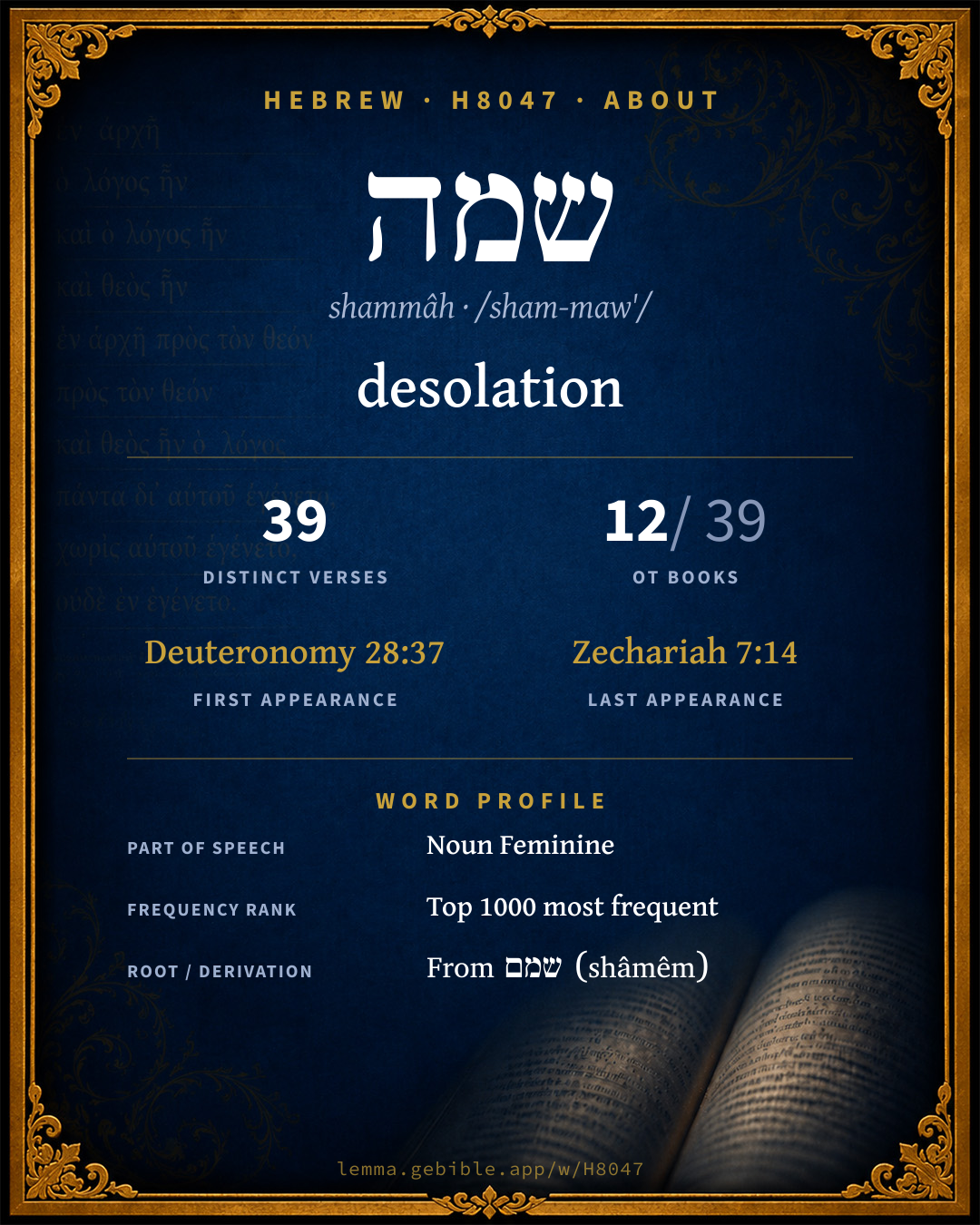
שַׁמָּה
desolation
‘desolation’ is one of 3 main senses fuller range ↓
Full lexicon entry — Brown-Driver-Briggs (BDB)
From Brown-Driver-Briggs (BDB)
Where this word appears
Grammar key — what these labels mean
Part of speech
- Noun
- A naming word — a person, place, thing, or idea.
- Verb
- An action or state-of-being word.
Noun type
- Common
- A common noun — a general class of person, place, or thing (“king,” “city,” “water”), not a specific name.
Stem
- Niphal
- Usually the simple passive or reflexive of the Qal (“he was written”).
Form
- Perfect
- A completed action or state — Hebrew marks aspect (completeness) more than strict tense (“he wrote”).
State
- Absolute
- The independent form of a noun, not bound to a following word.
Person
- 3rd Person
- The one spoken about (“he / she / it / they”).
Gender
- Feminine
- Grammatically feminine.
Number
- Singular
- One.
- Plural
- More than one (in Hebrew, generally three or more).
Grammatical forms
- Noun, Common, Feminine, Singular, Absolute 38 times (95%)
- Noun, Common, Feminine, Plural, Absolute 1 time (3%)
- Verb, Niphal, Perfect, 3rd Person, Feminine, Singular 1 time (3%)
Parsed forms decoded from the imported morphology (morphhb / Westminster Leningrad Codex — WLC text public domain, morphhb tagging CC BY 4.0), counted across 40 parsed occurrences — not distinct verses.
Every verse where H8047 appears — 39 distinct verses across 12 books. Click any verse to open its interlinear word-by-word view. Verse text shown in the World English Bible for context — . Each verse’s Hebrew form is shown with its reference; the English is not keyword-highlighted, since the data carries no word-level English alignment. Use “Compare translations” on any verse to read it across multiple English versions. This concordance covers the Hebrew Bible; Septuagint (Greek Old Testament) occurrences are not indexed here.
Deuteronomy 1 verse
2 Kings 1 verse
2 Chronicles 2 verses
- 2 Chronicles 29:8 לְ/שַׁמָּ֣ה prep + n c fs Therefore the wrath of Yahweh was on Judah and Jerusalem, and he has delivered them to be tossed back and forth, to be an astonishment, and a hissing, as you see with your eyes.
- 2 Chronicles 30:7 לְ/שַׁמָּ֔ה prep + n c fs Don't be you like your fathers, and like your brothers, who trespassed against Yahweh, the God of their fathers, so that he gave them up to desolation, as you see.
Psalms 2 verses
Isaiah 3 verses
- Isaiah 5:9 לְ/שַׁמָּ֣ה prep + n c fs In my ears, Yahweh of Hosts says: "Surely many houses will be desolate, Even great and beautiful, unoccupied.
- Isaiah 13:9 לְ/שַׁמָּ֔ה prep + n c fs Behold, the day of Yahweh comes, cruel, with wrath and fierce anger; to make the land a desolation, and to destroy the sinners of it out of it.
- Isaiah 24:12 שַׁמָּ֑ה n c fs In the city is left desolation, and the gate is struck with destruction.
Jeremiah 24 verses
- Jeremiah 2:15 לְ/שַׁמָּ֔ה prep + n c fs The young lions have roared on him, and yelled; and they have made his land waste: his cities are burned up, without inhabitant.
- Jeremiah 4:7 לְ/שַׁמָּ֔ה prep + n c fs A lion is gone up from his thicket, and a destroyer of nations; he is on his way, he is gone forth from his place, to make your land desolate, that your cities be laid waste, without inhabitant.
- Jeremiah 5:30 שַׁמָּה֙ n c fs A wonderful and horrible thing is happen in the land:
- Jeremiah 8:21 שַׁמָּ֖ה n c fs For the hurt of the daughter of my people am I hurt: I mourn; dismay has taken hold on me.
- Jeremiah 18:16 לְ/שַׁמָּ֖ה prep + n c fs to make their land an astonishment, and a perpetual hissing; everyone who passes thereby shall be astonished, and shake his head.
- Jeremiah 19:8 לְ/שַׁמָּ֖ה prep + n c fs I will make this city an astonishment, and a hissing; everyone who passes thereby shall be astonished and hiss because of all the plagues of it.
- Jeremiah 25:9 לְ/שַׁמָּ֣ה prep + n c fs behold, I will send and take all the families of the north, says Yahweh, and [I will send] to Nebuchadrezzar the king of Babylon, my servant, and will bring them against this land, and against the inhabitants of it, and against all these nations round about; and I will utterly destroy them, and make them an astonishment, and a hissing, and perpetual desolations.
- Jeremiah 25:11 לְ/שַׁמָּ֑ה prep + n c fs This whole land shall be a desolation, and an astonishment; and these nations shall serve the king of Babylon seventy years.
- Jeremiah 25:18 לְ/שַׁמָּ֛ה prep + n c fs [to wit], Jerusalem, and the cities of Judah, and the kings of it, and the princes of it, to make them a desolation, an astonishment, a hissing, and a curse, as it is this day;
- Jeremiah 25:38 לְ/שַׁמָּ֔ה prep + n c fs He has left his covert, as the lion; for their land is become an astonishment because of the fierceness of the oppressing [sword], and because of his fierce anger.
- Jeremiah 29:18 וּ/לְ/שַׁמָּה֙ conj + prep + n c fs I will pursue after them with the sword, with the famine, and with the pestilence, and will deliver them to be tossed back and forth among all the kingdoms of the earth, to be an object of horror, and an astonishment, and a hissing, and a reproach, among all the nations where I have driven them;
- Jeremiah 42:18 וּ/לְ/שַׁמָּה֙ conj + prep + n c fs For thus says Yahweh of Hosts, the God of Israel: As my anger and my wrath has been poured forth on the inhabitants of Jerusalem, so shall my wrath be poured forth on you, when you shall enter into Egypt; and you shall be an object of horror, and an astonishment, and a curse, and a reproach; and you shall see this place no more.
- Jeremiah 44:12 לְ/שַׁמָּ֔ה prep + n c fs I will take the remnant of Judah, that have set their faces to go into the land of Egypt to sojourn there, and they shall all be consumed; in the land of Egypt shall they fall; they shall be consumed by the sword and by the famine; they shall die, from the least even to the greatest, by the sword and by the famine; and they shall be an object of horror, [and] an astonishment, and a curse, and a reproach.
- Jeremiah 44:22 וּ/לְ/שַׁמָּ֧ה conj + prep + n c fs so that Yahweh could no longer bear, because of the evil of your doings, and because of the abominations which you have committed; therefore is your land become a desolation, and an astonishment, and a curse, without inhabitant, as it is this day.
- Jeremiah 46:19 לְ/שַׁמָּ֣ה prep + n c fs You daughter who dwell in Egypt, furnish yourself to go into captivity; for Memphis shall become a desolation, and shall be burnt up, without inhabitant.
- Jeremiah 48:9 לְ/שַׁמָּ֣ה prep + n c fs Give wings to Moab, that she may fly and get her away: and her cities shall become a desolation, without any to dwell therein.
- Jeremiah 49:13 לְ/שַׁמָּ֧ה prep + n c fs For I have sworn by myself, says Yahweh, that Bozrah shall become an astonishment, a reproach, a waste, and a curse; and all the cities of it shall be perpetual wastes.
- Jeremiah 49:17 לְ/שַׁמָּ֑ה prep + n c fs Edom shall become an astonishment: everyone who passes by it shall be astonished, and shall hiss at all the plagues of it.
- Jeremiah 50:3 לְ/שַׁמָּ֔ה prep + n c fs For out of the north there comes up a nation against her, which shall make her land desolate, and none shall dwell therein: they are fled, they are gone, both man and animal.
- Jeremiah 50:23 לְ/שַׁמָּ֛ה prep + n c fs How is the hammer of the whole earth cut apart and broken! how is Babylon become a desolation among the nations!
- Jeremiah 51:29 לְ/שַׁמָּ֖ה prep + n c fs The land trembles and is in pain; for the purposes of Yahweh against Babylon do stand, to make the land of Babylon a desolation, without inhabitant.
- Jeremiah 51:37 שַׁמָּ֥ה n c fs Babylon shall become heaps, a dwelling-place for jackals, an astonishment, and a hissing, without inhabitant.
- Jeremiah 51:41 לְ/שַׁמָּ֛ה prep + n c fs How is Sheshach taken! and the praise of the whole earth seized! how is Babylon become a desolation among the nations!
- Jeremiah 51:43 לְ/שַׁמָּ֔ה prep + n c fs Her cities are become a desolation, a dry land, and a desert, a land in which no man dwells, neither does any son of man pass thereby.
Ezekiel 1 verse
Hosea 1 verse
Joel 1 verse
Micah 1 verse
Zephaniah 1 verse
Zechariah 1 verse
About this entry
At a glance — auto-summarized from this page’s data, not written by a person. Every figure links to its source below. This summary describes the numbers; it doesn’t interpret them.
שמה (shammâh) is a Hebrew noun most often rendered “desolation.” Jeremiah dominates its distribution — 24 of 39 verses. Spanning 39 verses in 12 books, it ranks among the moderately common words of the Hebrew Bible. Not a single-sense word: explore its full sense range. The King James Version usually renders it “astonishment,” while modern versions prefer “desolation” (Berean Standard Bible) — see the renderings breakdown. The sections below give every sense, occurrence, and version rendering.
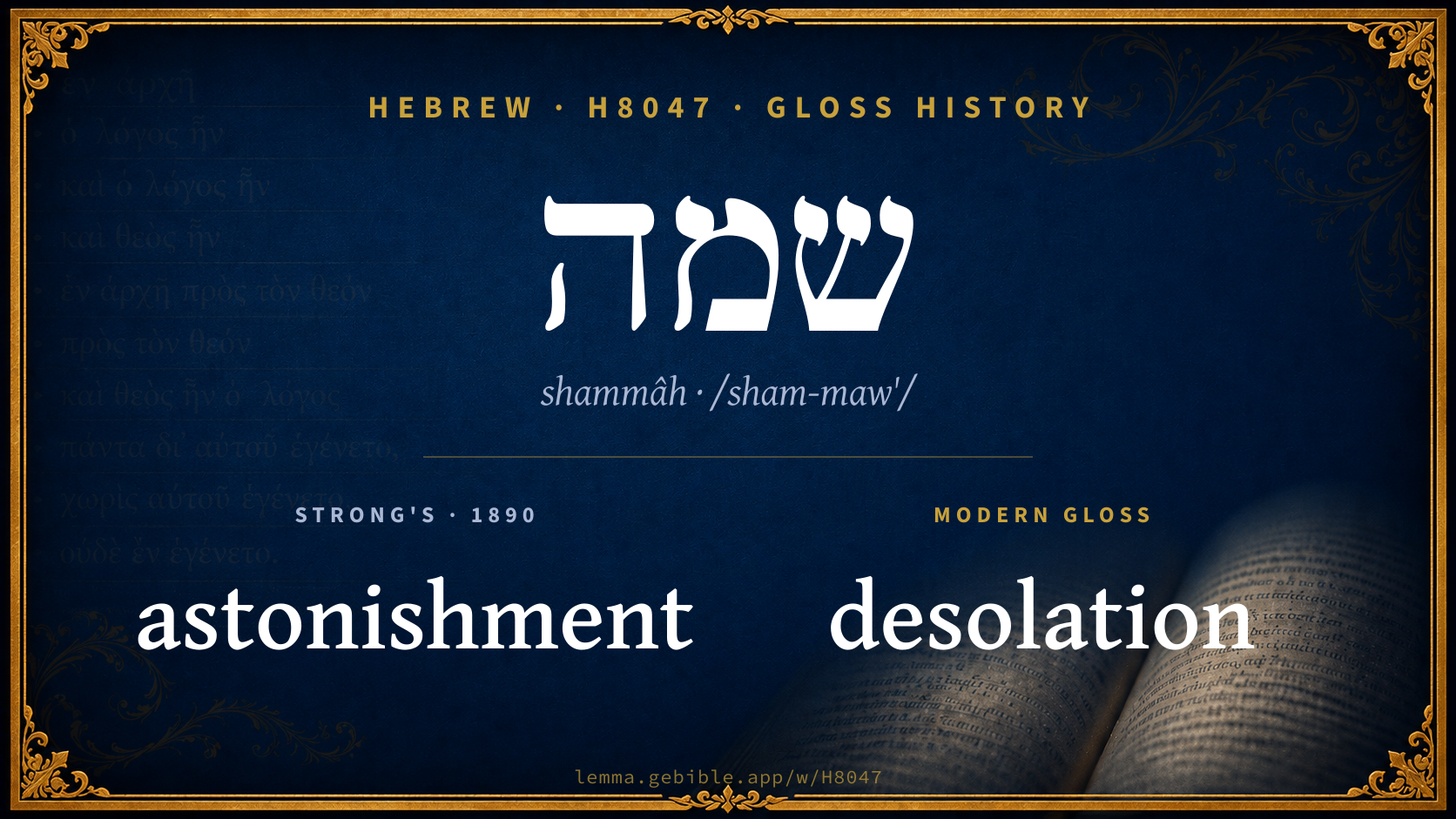
Gloss history
Strong's 1890 vs modern scholarship
About this word
Strong's H8047 catalogs a Hebrew word from the Hebrew Old Testament.
These counts are not copied from any lexicon or concordance. They are computed here, from the morphology-tagged Hebrew Old Testament. What Lemma adds →
- 39
- distinct verses
- The word appears in 39 distinct verses.
- 12 / 39
- OT books
- The word appears in 12 of 39 Old Testament books.
- #909
- by frequency
- Top 1000 most frequent Hebrew words (rank 909 of 8,640 Hebrew words by occurrence).
View all 39 occurrences in the concordance →
Most concentrated in
- Jeremiah 24 verses 62%
- Isaiah 3 verses 8%
- 2 Chronicles 2 verses 5%
By section of the Old Testament
By traditional corpus
Conventional, traditional groupings — biblical authorship is debated, so this is a traditional corpus grouping, not an authorship claim. Each share is this word’s portion of its verses in that division of the Hebrew canon. Each figure is a share of the word’s 39 distinct verses.
- Prophets (Nevi'im) 34 verses · 87%
- Writings (Ketuvim) 4 verses · 10%
- Torah (Pentateuch) 1 verse · 3%
How translations render this word
Counts come from each version’s own published word-to-Strong’s tagging or interlinear alignment — an approximate guide to how each version renders this word, not a word-level alignment the data otherwise carries. Because each total is that version’s own tagged count, the per-version totals vary from one another and need not match the appearance or distinct-verse counts above. These counts may also differ from a printed concordance because Lemma counts each distinctly tagged rendering and does not collapse phrase taggings into a single head-word total. This is a fixed set of word-tagged versions (KJV, ASV, BSB, ULT) and does not change with the reading translation you choose elsewhere. Each version’s license is shown beside its name below (and on Sources).
BDB lists this Strong’s number as 2 distinct words (homographs). Each count above pools all of them and is not split by sense — see the Senses section below. A low-frequency rendering may belong to a different one of those words, not the primary meaning.
- King James Version†: Astonishment 11×, Desolate 6×, Desolation 3×
- American Standard Version†: Astonishment 10×, Desolation 4×, Desolate 3×
- Berean Standard Bible†: Desolation 12×, Horror 7×, Object of horror 6×
- unfoldingWord Literal Text†: Desolation 15×, Horror 5×, Be a horror 2×
King James Version Public Domain
Renders H8047 across 39† tagged occurrences — most commonly:
Plus 15 renderings that appear only once — usually multi-word phrases or single function words the recovered tagging swept in, not distinct renderings.
American Standard Version Public Domain
Renders H8047 across 39† tagged occurrences — most commonly:
Plus 13 renderings that appear only once — usually multi-word phrases or single function words the recovered tagging swept in, not distinct renderings.
Berean Standard Bible Public Domain
Renders H8047 across 39† tagged occurrences — most commonly:
Plus 4 renderings that appear only once — usually multi-word phrases or single function words the recovered tagging swept in, not distinct renderings.
unfoldingWord Literal Text CC BY-SA 4.0
Renders H8047 across 26† tagged occurrences — most commonly:
Plus 4 renderings that appear only once — usually multi-word phrases or single function words the recovered tagging swept in, not distinct renderings.
7 senses and sub-senses in the full BDB
What do BDB’s symbols mean?
BDB uses these scholarly abbreviations:
| Symbol | Meaning |
|---|---|
| 𝔊 | the Septuagint (the ancient Greek translation, LXX) |
| 𝔙 | the Vulgate (the Latin translation) |
| 𝔖 | the Syriac version (the Peshitta) |
| 𝔗 | the Targum (the Aramaic translation) |
| ψ | the Psalms |
| √ | root (the underlying root or stem) |
| ‖ | parallel passage (a synonymous or contrasted parallel) |
| † | the dagger: every passage where the word occurs is cited |
The 7 senses and sub-senses the full Brown-Driver-Briggs lexicon distinguishes for this word, in lexicon order (not ranked by frequency), with BDB’s own verbatim wording and sub-sense lettering. Shown in Hebrew script with BDB’s own scholarly abbreviations. The condensed entry is in the Lexicon Entry tab. See also the Forms in the corpus table below.
שמה I waste, appalment (24 times Je)
- 1. a waste, of land, etc., ψ 46:9 Ho 5:9; Is 5:9; 13:9; 24:12; Zc 7:14; Je 2:15; 4:7; 18:16; 19:8; 46:19; 48:9; 50:3; 51:29, 43, vine Jo 1:7; pers. ψ 73:19; כּוֹס שׁ׳ וּשְׁמָמָה Ez 23:33. e.g. Psalms 46:9
- 2. appalment, horror, i.e. occasion of it; of people, land, etc., Dt 28:37; 2 K 22:19; Mi 6:16; Zp 2:15; Je 5:30; 25:9, 11, 18, 38; 29:18; 42:18; 44:12, 22; 49:13, 17; 50:23; 51:37, 41; 2 Ch 29:8; 30:7; שׁ׳ הֶחֱזִקָ֑תְנִי Je 8:21. e.g. Deuteronomy 28:37
שמה II
- 1. in Edom Gn 36:13, 17; 1 Ch 1:37, usually Σομε. e.g. Genesis 36:13
- 2. third son of Jesse 1 S 16:9; 17:13, Σαμ(μ)α, 𝔊L Σαμαα; v. שִׁמְעָא, שִׁמְעָה, שִׁמִעִי. e.g. 1 Samuel 16:9
- 3. Σαμαια(ς), etc., heroes of David:
- a. 2 S 23:11 (om. accid. ‖ 1 Ch 11:13 Dr), v 33. e.g. 2 Samuel 23:11
- b. v 25 = שַׁמּוֹת 1 Ch 11:27, Σαμαωθ, Σαμ(μ)ωθ; prob. also שַׁמְהוּת 1 Ch 27:8. e.g. 1 Chronicles 11:25
Senses from the full Brown-Driver-Briggs lexicon (Brown, Driver, Briggs; Oxford 1906 — public domain), digitized via Sefaria, supplemented by the OpenScriptures HebrewLexicon (CC BY 4.0). Full attribution on Sources.
Word origin
n.f. waste, appalment (24 times Je);—abs. שׁ׳ Je 5:30 +; pl. abs. שַׁמּוֹת ψ 46:9;—
— Brown-Driver-Briggs (Oxford 1906, public domain), digitized via Sefaria, supplemented by the OpenScriptures HebrewLexicon (CC BY 4.0). See Sources.
Derived from שמם (shâmêm) (H8074) — to be desolate.
Jastrow Dictionary
A second Hebrew/Aramaic lexicon for comparison, covering Aramaic and post-biblical (Talmudic, Targumic, Midrashic) usage that the biblical-Hebrew BDB does not. Matched by lemma rather than by Strong’s number, so a lemma may carry more than one Jastrow headword (shown separately below), and the entries cover usage well beyond the Bible.
שָׁמָּה
- , v. שָׁם
שַׁמָּה
- desolation. M. Kat. 17ᵃ Ms. M., v. שַׁמְתָּא.
A Dictionary of the Targumim, the Talmud Babli and Yerushalmi, and the Midrashic Literature (Marcus Jastrow; London, Luzac, 1903) — Public Domain. Digitized via Sefaria. Digitized via Sefaria. Full attribution on Sources.
Forms in the corpus
The 18 distinct written forms H8047 takes in the Hebrew Bible, most frequent first — each parse links to that state’s occurrences in the concordance. Hebrew forms include their vowel points and cantillation, so a single lemma takes many written forms.
| Form | Parsing | Example | Uses |
|---|---|---|---|
| לְ/שַׁמָּ֔ה | Noun, Common, Feminine, Singular, Absolute | Deuteronomy 28:37 | 10 |
| לְ/שַׁמָּ֣ה | Noun, Common, Feminine, Singular, Absolute | Hosea 5:9 | 7 |
| לְ/שַׁמָּ֖ה | Noun, Common, Feminine, Singular, Absolute | Jeremiah 18:16 | 3 |
| לְ/שַׁמָּ֛ה | Noun, Common, Feminine, Singular, Absolute | Jeremiah 25:18 | 3 |
| וּ/לְ/שַׁמָּה֙ | Noun, Common, Feminine, Singular, Absolute | Jeremiah 29:18 | 2 |
| לְ/שַׁמָּ֑ה | Noun, Common, Feminine, Singular, Absolute | Jeremiah 25:11 | 2 |
| לְ/שַׁמָּ֗ה | Noun, Common, Feminine, Singular, Absolute | Micah 6:16 | 2 |
| וּ/לְ/שַׁמָּ֧ה | Noun, Common, Feminine, Singular, Absolute | Jeremiah 44:22 | 1 |
| לְ/שַׁמָּ֧ה | Noun, Common, Feminine, Singular, Absolute | Jeremiah 49:13 | 1 |
| לְ/שַׁמָּֽה | Noun, Common, Feminine, Singular, Absolute | Zechariah 7:14 | 1 |
| לְ/שַׁמָּה֙ | Noun, Common, Feminine, Singular, Absolute | 2 Kings 22:19 | 1 |
| נָשַׁ֣מָּה | Verb, Niphal, Perfect, 3rd Person, Feminine, Singular | Zechariah 7:14 | 1 |
| שַׁמּ֣וֹת | Noun, Common, Feminine, Plural, Absolute | Psalms 46:8 | 1 |
| שַׁמָּ֑ה | Noun, Common, Feminine, Singular, Absolute | Isaiah 24:12 | 1 |
| שַׁמָּ֖ה | Noun, Common, Feminine, Singular, Absolute | Jeremiah 8:21 | 1 |
| שַׁמָּ֣ה | Noun, Common, Feminine, Singular, Absolute | Ezekiel 23:33 | 1 |
| שַׁמָּ֥ה | Noun, Common, Feminine, Singular, Absolute | Jeremiah 51:37 | 1 |
| שַׁמָּה֙ | Noun, Common, Feminine, Singular, Absolute | Jeremiah 5:30 | 1 |
Same root — word family
Other BDB entries built from the same root as H8047, grouped by Strong’s listed origin. These share a root / origin per the lexicon — not necessarily a shared meaning. Each links to that word’s own entry.
Derives from
Shares the same root
- משמה mᵉshammâh H4923 devastation
- שמועה shᵉmûwʻâh H8052 report
- שמם shᵉmam H8075 to be appalled
- שמם shâmêm H8076 desolate
- שממון shimmâmôwn H8078 horror
- שממית sᵉmâmîyth H8079 lizard
Proper names from this root
People and places named from this root — a name, not an additional meaning of the word.
- שמא Shammâʼ H8037 Shamma
- שמוע Shammûwaʻ H8051 Shammua
- שמה Shammâh H8048 Shammah
- שמות Shammôwth H8054 Shammoth
Compare all same-root words → Showing 4 of 12 — not the complete family. 4 of the same-root words are proper names (people or places). They share a root, not necessarily a meaning.
Septuagint verse parallels
This word appears in 31 verses that also exist in the Greek Old Testament (Septuagint), out of the 39 Hebrew verses it occurs in. You can read those verses in Greek by switching the Old Testament edition to the Septuagint.
Read these verses in the Septuagint
- Deuteronomy 28:37
- 2 Kings 22:19
- 2 Chronicles 29:8
- Psalms 46:8
- Isaiah 5:9
- Jeremiah 2:15
- Ezekiel 23:33
- Hosea 5:9
- Joel 1:7
- Micah 6:16
- Zephaniah 2:15
- Zechariah 7:14
This is a verse-level parallel only — the same verses exist in both the Hebrew and Greek Old Testaments. No word-level Hebrew↔Greek correspondence is claimed: the data carries no such alignment, so no Greek word is shown as this Hebrew word’s translation. Coverage is not total — the Septuagint omits the deuterocanon and renumbers the Psalms, so some Hebrew verses have no direct Greek parallel.