
Isaiah 49:19

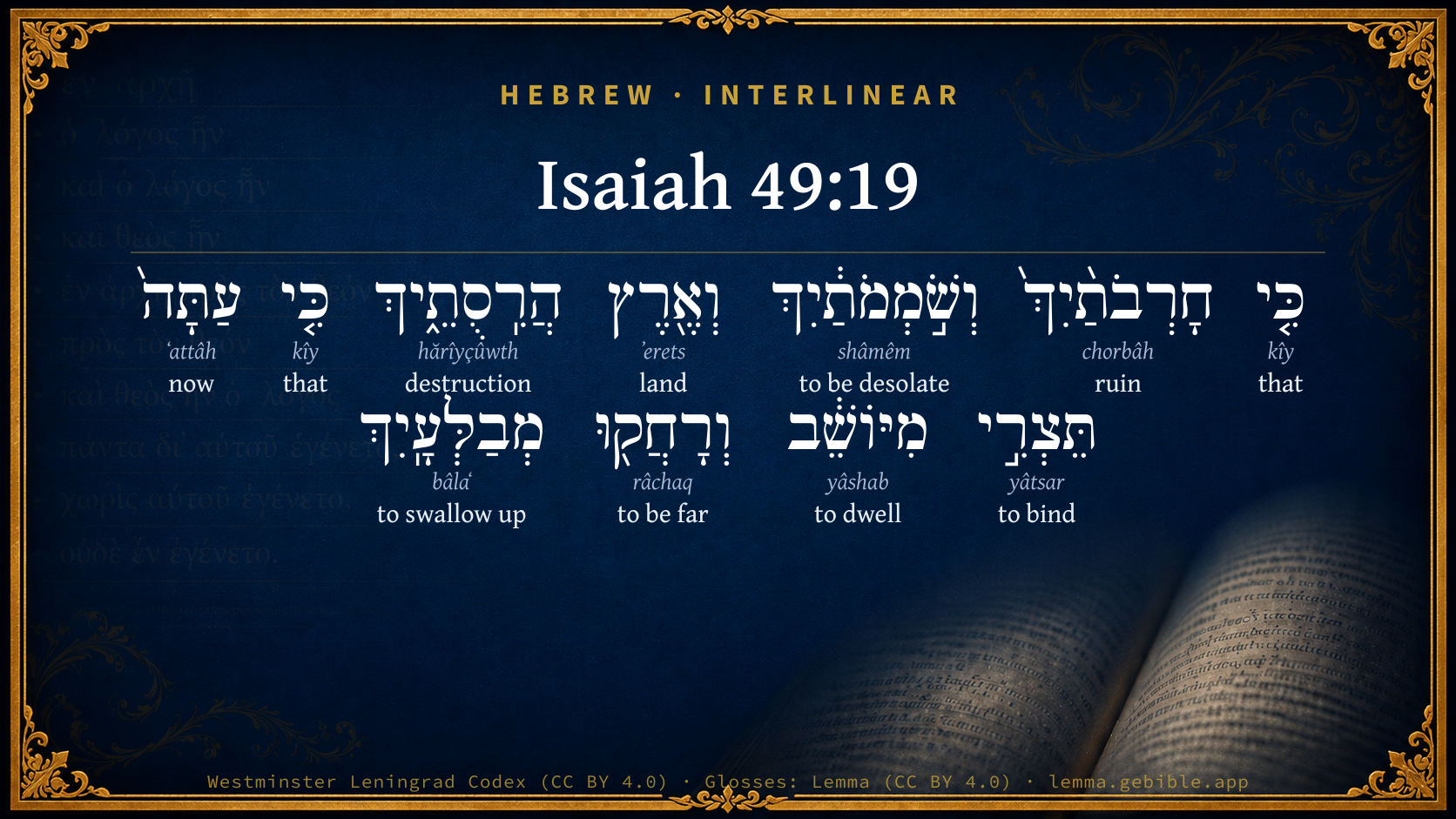
Hebrew (Westminster Leningrad Codex) Isaiah 49:19 appears in the Hebrew Old Testament. The text above is from the Westminster Leningrad Codex. Each word links to its Strong’s number, a concise gloss, and parsing drawn from the Open Scriptures Hebrew Bible morphology. Click any word for its full Brown-Driver-Briggs (BDB) entry.
Download image
Cite this verse

Isaiah 49:19 (World English Bible). Public Domain. Lemma interlinear Bible study tool, https://lemma.gebible.app/v/isaiah/49/19.

Show BibTeX & RIS
BibTeX
RIS
English Translation
For, as for your waste and your desolate places, and your land that has been destroyed, surely now shall you be too small for the inhabitants, and those who swallowed you up shall be far away.
World English Bible · Public Domain
Highlights
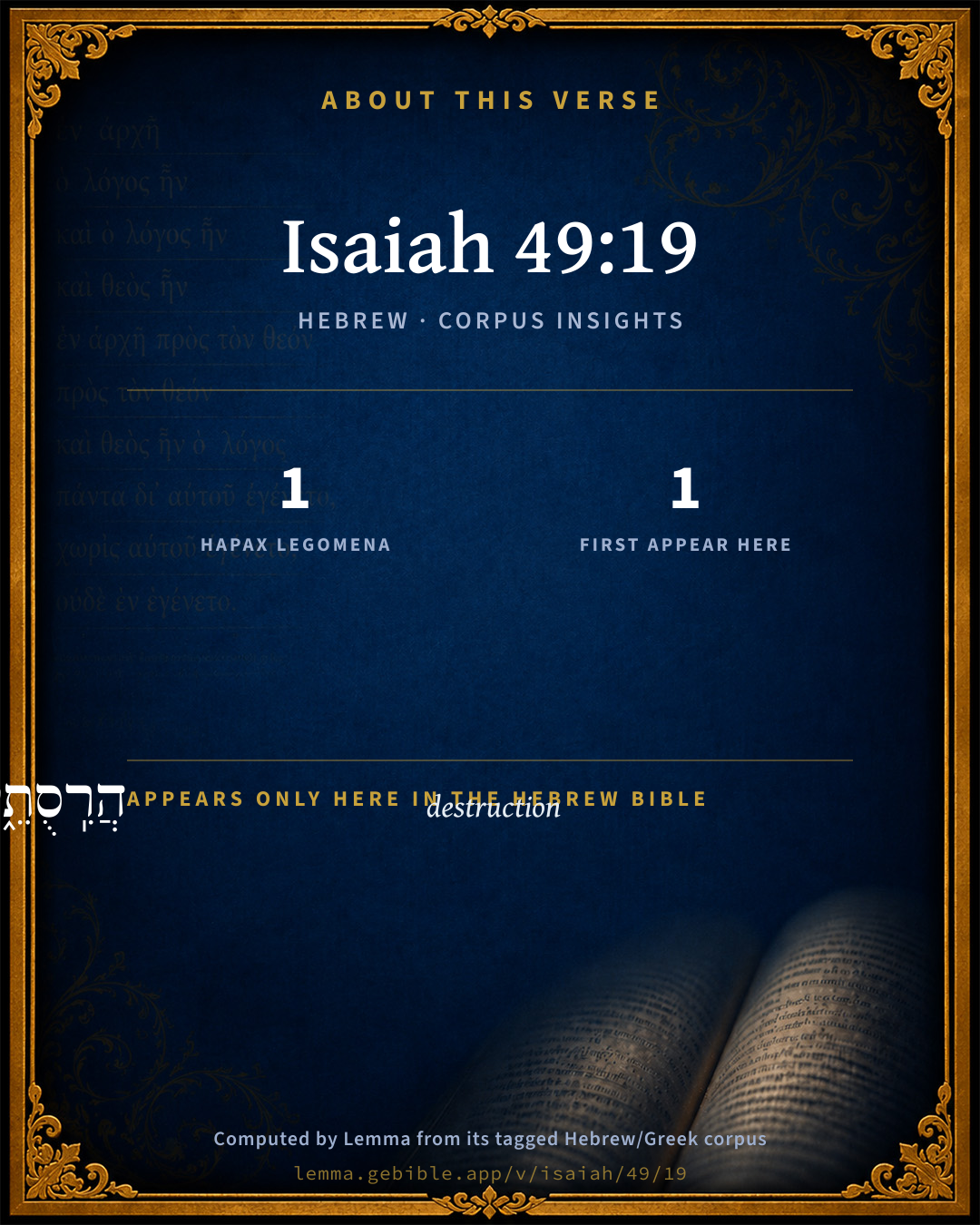
  • 1 hapax legomenon — only here in the Hebrew Bible
  • 1 first appearance in the Hebrew Bible
Full analysis ↓
Download a study sheet

One document with this verse’s original text, its word-by-word gloss line, the meaning frame, cross-references with their text, attributed commentary, and full source and license credits — printable, and it pastes into notes with its structure intact.

This verse Autodidact and up

Study sheet (.html) Plain text (.txt)

A passage Seminary Student

Up to 50 verses in one chapter. A passage sheet keeps up to 6 commentary sources and 12 cross-references per verse, in the order this page ranks them, and says so on the sheet whenever that leaves anything out. Ask for a single verse and you get the Autodidact verse sheet above.

Everything on this page stays free to read, with no account — the sheet is a download of what is already on screen, not access to it.

Want to remove ads? Support Godless Engineer
Compare translations 3

The same verse in 3 English versions, stacked beneath the original-language interlinear above. Click any original word for its lexicon entry.

Each is an independent rendering of the whole verse — the interlinear is not word-aligned to these translations.

Highlighted words mark where these versions differ — a whole-verse word diff, not a word-by-word alignment.

  • World English Bible Public Domain
    For, as for your waste and your desolate places, and your land that has been destroyed, surely now shall you be too small for the inhabitants, and those who swallowed you up shall be far away.
  • King James Version Public Domain
    For thy waste and thy desolate places, and the land of thy destruction, shall even now be too narrow by reason of the inhabitants, and they that swallowed thee up shall be far away.
  • unfoldingWord Literal Text CC BY-SA 4.0
    For your devastations and your desolations and the land of your destruction— surely now you will be too narrow for the dweller, and the ones having swallowed you will be far away.

unfoldingWord Literal Text — © unfoldingWord, licensed CC BY-SA 4.0. Word-aligned USFM3 via Door43 (git.door43.org/unfoldingWord/en_ult).

Versions to compare (up to 4)

3 of 4 selected

Show all 18 translations

Every available English version of this verse, each an independent rendering of the whole verse.

  • World English Bible Public Domain
    For, as for your waste and your desolate places, and your land that has been destroyed, surely now shall you be too small for the inhabitants, and those who swallowed you up shall be far away.
  • Berean Standard Bible Public Domain
    For your ruined and desolate places and your ravaged land will now indeed be too small for your people, and those who devoured you will be far away.
  • Majority Standard Bible Public Domain
    For your ruined and desolate places and your ravaged land will now indeed be too small for your people, and those who devoured you will be far away.
  • King James Version Public Domain
    For thy waste and thy desolate places, and the land of thy destruction, shall even now be too narrow by reason of the inhabitants, and they that swallowed thee up shall be far away.
  • American Standard Version (1901) Public Domain
    For, as for thy waste and thy desolate places, and thy land that hath been destroyed, surely now shalt thou be too strait for the inhabitants, and they that swallowed thee up shall be far away.
  • Revised Version (1885) Public Domain
    For, as for thy waste and thy desolate places and thy land that hath been destroyed, surely now shalt thou be too strait for the inhabitants, and they that swallowed thee up shall be far away.
  • Geneva Bible (1599) Public Domain
    For thy desolations, and thy waste places, and thy land destroied, shall surely be now narow for them that shall dwell in it, and they that did deuoure thee, shalbe farre away.
  • Douay-Rheims (1899) Public Domain
    For thy deserts, and thy desolate places, and the land of thy destruction shall now be too narrow by reason of the inhabitants, end they that swallowed thee up shall be chased far away.
  • Young's Literal Translation Public Domain
    Because thy wastes, and thy desolate places, And the land of thy ruins, Surely now are straitened because of inhabitants, And far off have been those consuming thee.
  • Literal Standard Version CC BY-SA 4.0
    Because your ruins, and your desolate places, || And the land of your ruins, || Are now surely restricted because of inhabitants, || And those consuming you have been far off.
  • Unlocked Literal Bible CC BY-SA 4.0
    Though you were a waste and desolate, a land that was in ruins, now you will be too small for the inhabitants, and those who devoured you will be far away.
  • unfoldingWord Literal Text CC BY-SA 4.0
    For your devastations and your desolations and the land of your destruction— surely now you will be too narrow for the dweller, and the ones having swallowed you will be far away.
  • Darby Bible Public Domain
    For [in] thy waste and thy desolate places, and thy destroyed land, thou shalt even now be too straitened by reason of the inhabitants, and they that swallowed thee up shall be far away.
  • World Messianic Bible Public Domain
    “For, as for your waste and your desolate places, and your land that has been destroyed, surely now that land will be too small for the inhabitants, and those who swallowed you up will be far away.
  • Webster's Bible Public Domain
    For thy waste and thy desolate places, and the land of thy destruction, shall even now be too narrow by reason of the inhabitants, and they that swallowed thee up shall be far away.
  • Free Bible Version CC BY-SA 4.0
    Your ruined towns and abandoned places and devastated lands will be crowded with people, while those who took over your country will be long gone.
  • Bible in Basic English Public Domain
    For though the waste places of your land have been given to destruction, now you will not be wide enough for your people, and those who made you waste will be far away.
  • JPS Tanakh (1917) Public Domain
    For thy waste and thy desolate places and thy land that hath been destroyed — surely now shalt thou be too strait for the inhabitants, and they that swallowed thee up shall be far away.

Literal Standard Version (2020), Covenant Press — licensed CC BY-SA 4.0. Text via the HelloAO Bible API (eBible.org). Unlocked Literal Bible (unfoldingWord) — licensed CC BY-SA 4.0. Text via the HelloAO Bible API (eBible.org). unfoldingWord Literal Text — © unfoldingWord, licensed CC BY-SA 4.0. Word-aligned USFM3 via Door43 (git.door43.org/unfoldingWord/en_ult). Free Bible Version, Dr. Jonathan Gallagher — licensed CC BY-SA 4.0. Text via the HelloAO Bible API (eBible.org).

Word by word

More ways to search: Search by grammar → Find every occurrence → Compare this word →

Practice this passage: Drill this verse → Learn its vocabulary →

הֲרִֽסֻתֵ֑יךְ
hărîyçûwth
H2035
“destruction · your”
Noun, Common, Feminine, Singular, Construct + Suffix, Personal, 2nd Person, Feminine, Singular
Part of Speech
Noun
Type
Common
Gender
Feminine
Number
Singular
State
Construct
Full BDB Definition

Origin: from H2040

TWOT: 516c

destruction, ruin, overthrow
  1. כִּ֤י kîy H3588 “that” Conjunction
  2. חָרְבֹתַ֨יִךְ֙ chorbâh H2723 “ruins · your” Noun, Common, Feminine, Plural, Construct + Suffix, Personal, 2nd Person, Feminine, Singular
  3. וְשֹׁ֣מְמֹתַ֔יִךְ shâmêm H8074 “and · being desolate · you” Conjunction + Verb, Qal, Participle Active, Feminine, Plural, Construct + Suffix, Personal, 2nd Person, Feminine, Singular
  4. וְאֶ֖רֶץ ʼerets H776 “and · land of” Conjunction + Noun, Common, Both, Singular, Construct
  5. כִּ֤י kîy H3588 “that” Conjunction
  6. עַתָּה֙ ʻattâh H6258 “now” Adverb
  7. תֵּצְרִ֣י yâtsar H3334 “to bind” Verb, Qal, Imperfect, 2nd Person, Feminine, Singular
  8. מִיּוֹשֵׁ֔ב yâshab H3427 “from · dwelling” Preposition + Verb, Qal, Participle Active, Masculine, Singular, Absolute
  9. וְרָחֲק֖וּ râchaq H7368 “and · to be far” Conjunction + Verb, Qal, Sequential Perfect, 3rd Person, Common, Plural
  10. מְבַלְּעָֽיִךְ bâlaʻ H1104 “swallowing up · you” Verb, Piel, Participle Active, Masculine, Plural, Construct + Suffix, Personal, 2nd Person, Feminine, Singular

About this verse

These counts appear in no published source. They are computed here, from the morphology-tagged text and Lemma’s own curated glosses. What Lemma adds →

11
words
10
distinct lemmas
Prophets
section

Notable vocabulary

1 hapax legomenon — a word that appears only here in the entire Hebrew Bible:

  • הֲרִֽסֻתֵ֑יךְ destruction H2035

First appearance in Scripture

This word makes its first canonical appearance in the Hebrew Bible here:

  • הֲרִֽסֻתֵ֑יךְ destruction H2035

Shared distinctive vocabulary

תֵּצְרִ֣י to bind H3334 occurs in 10 verses of the Hebrew Bible. Also found in:

Grammatical profile

  • 5 verbs
  • 3 nouns
  • 2 conjunctions
  • 1 adverb

Verb forms

  • וְשֹׁ֣מְמֹתַ֔יִךְ Qal · Participle Active
  • תֵּצְרִ֣י Qal · Imperfect
  • מִיּוֹשֵׁ֔ב Qal · Participle Active
  • וְרָחֲק֖וּ Qal · Sequential Perfect
  • מְבַלְּעָֽיִךְ Piel · Participle Active

Repetition

A word recurs within this verse — often emphatic in Hebrew:

  • כִּ֤י that H3588 ×2

Hebrew & Septuagint length

In English translation the verse runs 36 words from the Hebrew and 29 from the Septuagint (LXX English) — closely comparable.

A rough comparison of the two English renderings, which tokenize alike — not a word-level alignment.

Word counts can differ between the Hebrew and the Greek without any difference in meaning — e.g. the Hebrew direct-object marker אֵת has no separate Greek word, and Greek often adds the article ὁ.

Cross-references

20

Topical passages linked to Isaiah 49:19 in the Treasury of Scripture Knowledge — connected by theme and wording, ordered by reader-vote popularity; previews shown in the World English Bible.

  • Zechariah 10:10 I will bring them again also out of the land of Egypt, And gather them out of Assyria; And I will bring them into the land of Gilead and Lebanon; And there won't be room enough for them.
  • Isaiah 54:1–2 Sing, barren, you who didn't bear; break forth into singing, and cry aloud, you who did not travail with child: for more are the children of the desolate than the children of the married wife, says Yahweh.
  • Jeremiah 30:18–19 Thus says Yahweh: Behold, I will turn again the captivity of Jacob's tents, and have compassion on his dwelling-places; and the city shall be built on its own hill, and the palace shall be inhabited after its own manner.
  • Psalms 56:1–2 Be merciful to me, God, for man wants to swallow me up. All day long, he attacks and oppresses me.
  • Isaiah 49:25–26 But thus says Yahweh, Even the captives of the mighty shall be taken away, and the prey of the terrible shall be delivered; for I will contend with him who contends with you, and I will save your children.
  • Isaiah 51:3 For Yahweh has comforted Zion; he has comforted all her waste places, and has made her wilderness like Eden, and her desert like the garden of Yahweh; joy and gladness shall be found therein, thanksgiving, and the voice of melody.
  • Hosea 1:10–11 Yet the number of the children of Israel will be as the sand of the sea, which can't be measured nor numbered; and it will come to pass that, in the place where it was said to them, 'You are not my people,' they will be called 'sons of the living God.'
  • Psalms 124:3 Then they would have swallowed us up alive, When their wrath was kindled against us;
  • Proverbs 1:12 Let's swallow them up alive like Sheol, And whole, like those who go down into the pit.
  • Isaiah 5:6 I will lay it a wasteland. It won't be pruned nor hoed, But it will grow briers and thorns. I will also command the clouds that they rain no rain on it."
  • Isaiah 49:8 Thus says Yahweh, In an acceptable time have I answered you, and in a day of salvation have I helped you; and I will preserve you, and give you for a covenant of the people, to raise up the land, to make them inherit the desolate heritage:
  • Isaiah 49:17 Your children make haste; your destroyers and those who made you waste shall go forth from you.
  • Jeremiah 30:16 Therefore all those who devour you shall be devoured; and all your adversaries, everyone of them, shall go into captivity; and those who despoil you shall be a spoil, and all who prey on you will I give for a prey.
  • Jeremiah 33:10–11 Thus says Yahweh: Yet again there shall be heard in this place, about which you say, It is waste, without man and without animal, even in the cities of Judah, and in the streets of Jerusalem, that are desolate, without man and without inhabitant and without animal,
  • Jeremiah 51:33 For thus says Yahweh of hosts, the God of Israel: The daughter of Babylon is like a threshing floor at the time when it is trodden; yet a little while, and the time of harvest shall come for her.
  • Jeremiah 51:44 I will execute judgment on Bel in Babylon, and I will bring forth out of his mouth that which he has swallowed up; and the nations shall not flow any more to him: yes, the wall of Babylon shall fall.
  • Ezekiel 36:3 therefore prophesy, and say, Thus says the Lord Yahweh: Because, even because they have made you desolate, and swallowed you up on every side, that you might be a possession to the residue of the nations, and you are taken up in the lips of talkers, and the evil report of the people;
  • Ezekiel 36:9–15 For, behold, I am for you, and I will turn into you, and you shall be tilled and sown;
  • Zechariah 2:4 and said to him, "Run, speak to this young man, saying, 'Jerusalem will be inhabited as villages without walls, because of the multitude of men and cattle in it.
  • Zechariah 2:11 Many nations shall join themselves to Yahweh in that day, and shall be my people; and I will dwell in the midst of you, and you shall know that Yahweh of Hosts has sent me to you.

Cross-references courtesy of OpenBible.info (CC BY 4.0).

Hebrew and Greek witnesses Masoretic Hebrew ↔ Greek Septuagint

The same verse in the two great witnesses to the Old Testament, shown verse-for-verse.

These are two independent witnesses, not word-aligned to each other, and the Septuagint is shown in lemma (dictionary) form.

Hebrew Isaiah 49:19 Masoretic · Westminster Leningrad Codex

כִּ֤י חָרְבֹתַ֨יִךְ֙ וְשֹׁ֣מְמֹתַ֔יִךְ וְאֶ֖רֶץ הֲרִֽסֻתֵ֑יךְ כִּ֤י עַתָּה֙ תֵּצְרִ֣י מִיּוֹשֵׁ֔ב וְרָחֲק֖וּ מְבַלְּעָֽיִךְ

For, as for your waste and your desolate places, and your land that has been destroyed, surely now shall you be too small for the inhabitants, and those who swallowed you up shall be far away.

World English Bible · Public Domain

Greek LXX Isaiah 49:19 Septuagint · lemma form

ὅτι ὁ ἔρημός σύ καί ὁ διαφθείρω καί ὁ πίπτω νῦν στενοχωρέω ἀπό ὁ καταοἰκέω καί μακρύνω ἀπό σύ ὁ καταπίνω σύ

For your desert and marred and ruined places shall now be too narrow by reason of the inhabitants, and they that devoured you shall be removed far from you.

LXX2012 (modern English Septuagint) · Public Domain

Hebrew: Westminster Leningrad Codex (CC BY 4.0). Greek: Septuagint (public domain); English from LXX2012 (modern English Septuagint) (Public Domain). How the Septuagint differs from the Hebrew →

Targum (Aramaic paraphrase)

1

The Targum is the ancient Jewish Aramaic paraphrase of the Hebrew Scriptures — an interpretive translation, not the Hebrew text itself. Onkelos (literal) and Pseudo-Jonathan (expansive) render the Torah, and Jonathan the Prophets. Coverage is partial: where no permissively-licensed English translation exists for a verse, only the Aramaic is shown. This is verse-level text, not a word-by-word alignment to the Hebrew.

  1. Targum Jonathan Prophets (Joshua–Malachi)
    אֲרֵי חָרְבָתַיִךְ וְצַדְיוּתִיךְ וַאֲרַע מְפַגְרוּתִיךְ אֲרֵי כְעַן תִּדַחֲקוּן מִיָתִיב וְיִתְרַחֲקוּן מְסַלְעֲמָךְ:

    For thy waste and desolate places, and the land of thy destruction, surely now shall be too strait by reason of the inhabitants, and they that swallowed thee up shall be far away.

    Targum Jonathan — Aramaic: “Mikraot Gedolot” (public domain). English: “Sefaria Community Translation” (CC0 1.0 (public-domain dedication)); “London "Chaldee Paraphrase," 1871” (public domain). Text via Sefaria.

Commentary

Notes on Isaiah 49:19 from classic Christian and Jewish commentators (each source and its license shown beneath its notes). The classic Christian expositions comment on the surrounding passage and are grouped to its opening verse, so a note may address several verses; the Jewish commentaries on the Tanakh (Rashi and others) are per-verse, so they appear only where the commentator wrote on this verse.

Lemma curates 59 commentaries, every one of them public domain or Creative Commons licensed, each selected and text-cleaned for this edition rather than reprinted as found. About our sources →

Trapp's Complete Commentary

John Trapp

Isa 49:19 For thy waste and thy desolate places, and the land of thy destruction, shall even now be too narrow by reason of the inhabitants, and they that swallowed thee up shall be far away.

Ver. 19. For thy waste and thy desolate places.] Heb., Thy wastenesses and thy desolations. The true Church then may lie waste and desolate and not be so gloriously visible, as the Papists falsely say it always is.

Shall even now be too narrow.] A metaphor from cities that being overcrowded send out colonies into other countries.

And they that swallowed thee up.] See Isa 49:17.

John Trapp, A Commentary or Exposition upon All the Books of the Old and New Testament (1647–1656) — public domain. Text from a community e-Sword module.

Joseph Benson's Commentary

Isa 49:19-21. For thy waste and desolate places, &c. — He alludes to the land of Judea lying waste during the Babylonish captivity. Thus the church of God was in a waste, desolate, and barren state, till the coming of the Messiah, the introduction of the gospel, and the conversion of the Gentiles; and the land of thy destruction — Or, thy land of destruction. He still alludes to Judea, thus characterized, because it was devoted, and should be exposed to destruction, first by the Chaldeans, and again by the Romans, a lively emblem of the ruined state of their church; shall even now be too narrow — To contain the multitude of converts that shall be made. The middle wall of partition that separated the Jews from the Gentiles shall be broken down, and the pale of the church shall be enlarged. The children which thou shalt have, &c. — Hebrew, בני שׁכלין, The children of thy orbity, or, barren and childless state. Those children which thou shalt have when thou art past the ordinary age and state of childbearing, as Sarah in her old age was made the mother of a most numerous posterity; to which he seems to allude: those children which shall be begotten to thee by the gospel when thou shalt be deprived of thine own natural children, or when thou shalt become barren as to the conversion of natural Jews; when the generality of the Jews shall cut themselves off from God and his true church, by their apostacy from him, and by their unbelief and rejection of their Messiah; shall say again — Or rather, shall yet say, though for the present it be far otherwise, The place is too strait for me, &c. — This is figuratively spoken, merely to signify the great enlargement of the church by the accession of the Gentiles. See Isa 54:1. Then shalt thou say in thy heart — Not without admiration, Who hath begotten me these — Whence, or by whom, have I this numerous issue? Seeing I have lost my children — Seeing it is not long since that I was in a manner childless? And am desolate — Without a husband, being forsaken of God, who formerly owned himself for my husband, Isa 54:5; Jer 31:32; a captive, and removing to and fro — In an unsettled condition, and not likely to bear and bring up children for God or myself. Who hath brought up these? — The same thing is repeated in these words to express the miraculousness of this work, and the great surprise of the Jews at it: which shows that he speaks of the conversion of the Gentiles.

Joseph Benson's Commentary on the Old and New Testaments (1811–1818) — public domain. Text from a community e-Sword module.

Tyndale Open Study Notes

Tyndale Open Resources

49:19-21 The population explosion would reach beyond Israel to include the members of foreign nations who turn to the Lord (see 56:6-8; Rev 7:9). • more room: The expanded population would require space far beyond the traditional boundaries of the land of Israel (see also Zech 2:4).

Tyndale Open Study Notes — © Tyndale Open Resources, licensed CC BY-SA 4.0. Text via the HelloAO Bible API.

Jamieson, Fausset & Brown

Robert Jamieson, A. R. Fausset & David Brown

land of thy destruction--thy land once the scene of destruction.

too narrow-- (Isa 54:1-2; Zac 10:10).

Jamieson, Fausset & Brown — Commentary Critical and Explanatory on the Whole Bible (1871) — public domain (CC PDM 1.0). Text via the HelloAO Bible API.

Ellicott's Commentary for English Readers

(19) Shall even now be too narrow.—Literally, with a vivid abruptness, thou shalt be . . . The over population of the future is contrasted with the depopulation of the past (Isa_3:6; Isa_4:1).

A Bible Commentary for English Readers, edited by Charles John Ellicott (1878–1897) — public domain. Text from a community e-Sword module.

The Cambridge Bible for Schools and Colleges

gen. ed. J. J. S. Perowne

19. For as for thy waste and thy desolate places and thy land that hath been destroyed, surely now shalt thou be too strait for the inhabitants, &c.] So R.V. But there appears to be some textual disorder, the subjects in the first half of the verse having no predicate. The R.V. gets over the difficulty by taking “thy waste places” &c. as a sort of casus pendens, resumed in the “thou” of the last clause; but this is a forced construction. The most probable solution is that the original conclusion of the first clause has been lost in copying (Duhm); the second would then commence with the words For now.

the land of thy destruction] lit. “thy land of destruction,” i.e., as R.V., thy land that hath been destroyed.

19, 20. In place of her present solitude, the ideal Zion shall yet look down on a densely peopled city, whose inhabitants are embarrassed for want of room.

The Cambridge Bible for Schools and Colleges (gen. ed. J. J. S. Perowne; Cambridge University Press, 1878–1918) — public domain. Text from a community e-Sword module.

John Gill's Exposition

For thy waste and thy desolate places, and the land of thy destruction,.... Or "thy land of destruction, or thy destroyed land" (n); laid waste and desolate by the enemy, without inhabitants; such countries in which there were few professors of the true religion:

shall even now be too narrow, by reason of the inhabitants; because of the multitude of them; a hyperbolical expression, setting forth the great numbers of Christian converts everywhere: this straitness will not be on account of strangers or enemies having taken possession; but on account of those who are true and proper possessors: for it follows,

and they that swallowed thee up shall be far away; from the church; the Heathen, the Gentiles, or Papists,

shall now perish out of his, Jehovah's, "land"; "sinners shall be consumed out of the earth, and the wicked be no more", Psa 10:16. Antichrist and his abettors, which "swallowed" up the people, their riches, and substance, like beasts of prey, to which he is compared, shall go into perdition, and never disturb the church any more, Rev 13:1.

(n) "terra tua destructa", Junius & Tremellius, Piscator, De Dieu; "et terram destructionis tuam", Cocceius; "et terram tuam quae destructa est", Vitringa.

John Gill's Exposition of the Whole Bible (1746–1763) — public domain (CC PDM 1.0). Text via the HelloAO Bible API.

Albert Barnes' Notes on the Bible

For thy waste and thy desolate places - Thy land over which ruin has been spread, and ever which the exile nation mourns.

And the land of thy destruction - That is, thy land laid in ruins. The construction is not uncommon where a noun is used to express the sense of an adjective. Thus in Psa 2:6, the Hebrew phrase (margin) is correctly rendered ‘my holy hill.’ Here the sense is, that their entire country had been so laid waste as to be a land of desolation.

Shall even now be too narrow - Shall be too limited to contain all who shall become converted to the true God. The contracted territory of Palestine shall be incapable of sustaining all who will acknowledge the true God, and who shall be regarded as his friends.

And they that swallowed thee up - The enemies that laid waste thy land, and that “absorbed,” as it were, thy inhabitants, and removed them to a distant land. They shall be all gone, and the land shall smile again in prosperity and in loveliness.

Albert Barnes' Notes on the Bible (1834–1885) — public domain. Text from a community e-Sword/MySword module.

Haydock's Catholic Bible Commentary

Inhabitants. The country was better peopled, (Calmet) and Jerusalem enlarged under the Machabees. (Josephus, Jewish Wars v. 6.)

George Leo Haydock (1774–1849), Haydock's Catholic Family Bible and Commentary, 1859 edition — public domain. Excludes Psalms (Douay-Rheims chapter numbering differs from Protestant) and Deuterocanonical books (Catholic canon only).

Matthew Poole's English Annotations

Thy waste and thy desolate places; thy own land, which is now waste and desolate, and whereof divers parts lay formerly waste and desolate for want of people to possess and manage them.

The land of thy destruction; or rather, thy land of destruction; so called because it is devoted and shall be exposed to destruction. Shall be far away, to wit, from thee.

Matthew Poole's English Annotations on the Holy Bible (1683–1685) — public domain. Text from a community e-Sword/MySword module.

Whedon's Commentary on the Bible

Daniel D. Whedon

19. In the import of Isa_49:16-18 our Version and the Hebrew quite accurately coincide, though the Hebrew is occasionally broken; as for example:

Thy waste and thy desolate places — More literally, Thy wastes and thy desolations, and the land of thy wasteness.

Shall even now be too narrow — So great should be the number of her converts, here termed inhabitants, that not only the more attractive parts of the land, but even the “waste places” should overflow with people. Not the newly built-up city alone, but all the land around, so long lying waste, shall be renewed in beauty, both of holy citizens and their substance and productiveness, just as in her former palmiest days when God was sole theocratic king: only no more hovering enemies shall, as of old, be around. They shall be far away.

Daniel D. Whedon (gen. ed.), Commentary on the Old and New Testaments (1874–1909) — public domain. Text from a community e-Sword module.

The Pulpit Commentary

The land of thy destruction; or, of thy overthrow i.e, where thou wert overthrown by Nebuchadnezzarshall even now be too narrow, etc. This must not be understood literally. Palestine, after the return from the Captivity, was at no time over-populated; and when the conversion of the Gentiles took place it caused no influx of fresh settlers into the Holy Land. The object of the prophet is simply to mark the vast growth of the Church, which would necessarily spread itself far beyond the limits of Palestine, and would ultimately require the whole earth for its habitation.

The Pulpit Commentary (1880–1919), ed. H.D.M. Spence-Jones & Joseph S. Exell — public domain. Text from a community e-Sword module.

John Wesley's Explanatory Notes

Thy waste places - Thy own land, whereof divers parts lie waste for want of people to possess them. Land of destruction - Which before was desolate and destroyed.

John Wesley, Explanatory Notes Upon the Whole Bible (1754–1765) — public domain. Text via the GEBible commentary corpus.

Keil & Delitzsch

C. F. Keil & F. Delitzsch

Thus will Zion shine forth once more with the multitude of her children as with a festal adorning. "For thy ruins and thy waste places and thy land full of ruin - yea, now thou wilt be too narrow for the inhabitants, and thy devourers are far away. Thy children, that were formerly taken from thee, shall say in thine ears, The space is too narrow for me; give way for me, that I may have room." The word "for" (kı̄) introduces the explanatory reason for the figures just employed of jewellery and a bridal girdle. Instead of the three subjects, "thy ruins," etc., the comprehensive "thou" is employed permutatively, and the sentence commenced afresh. כּי is repeated emphatically in עתּה כּי (for now, or yea now); this has essentially the same meaning as in the apodosis of hypothetical protasis (e.g., Gen 31:42; Gen 43:10), except that the sense is more decidedly affirmative than in the present instance, where one sees it spring out of the confirmative. Zion, that has been hitherto desolate, now becomes too small to hold her inhabitants; and her devourers are far away, i.e., those who took forcible possession of the land and cities, and made them untenable. עוד is to be understood in accordance with Psa 42:6, and בעזניך in accordance with Psa 54:2 (see at Isa 5:9). It will even come to this, that the children of which Zion was formerly robbed will call to one another, so that she becomes a witness with her ears to that which they have so clearly seen: the space is too narrow, give way (geshâh, from nâgash, to advance, then to move generally, also to move in an opposite direction, i.e., to fall back, as in Gen 19:9) for me, that I may be able to settle down.

Keil & Delitzsch — Biblical Commentary on the Old Testament (1861–1891) — public domain (CC PDM 1.0). Text via the HelloAO Bible API. (Old Testament only.)

J. A. Alexander on Isaiah

Joseph Addison Alexander

“For thy ruins, and thy wastes, and thy land of desolation (i.e., thy desolated land), for now thou shalt be too narrow for the inhabitant, and far off shall be thy devourers (those who swallow thee up).” The general meaning of this verse is evident, although the construction is obscure. Perhaps the best solution is the one which supposes the construction to be interrupted and resumed: ‘For thy wants, and thy ruins, and thy land of desolation—(then beginning anew, without completing the first sentence)—for thou shalt be too narrow etc.’ This mode of composition, not unlike what appears in the first draft of any piece of writing till obliterated by correction, is comparatively frequent in the ancient writers, not excepting some of the highest classical models, though proscribed as inelegant and incorrect by the fastidious rules of modern rhetoric. ‘For the inhabitant’ is literally ‘from the inhabitant’, the Hebrew preposition being here used as in 1Ki 19:7. For the application of the verb ‘swallow up’ to enemies, see Lam 2:2; Lam 2:5. The ‘devourers’ of this verse are of course the destroyers of v. 17.

Joseph Addison Alexander, The Prophecies of Isaiah (1846–1847; New York: Scribner, 1870–1878) — public domain. Text from a community e-Sword module.

unfoldingWord translationNotes

Door43 World Missions Community

General Information:

Yahweh continues speaking to Zion as if it were a woman. (See: Personification)

Though you were a waste and desolate

The words "a waste" and "desolate" mean basically the same thing and emphasize that the enemy has destroyed Zion and left it empty. AT: "Though you were completely desolate" (See: Doublet)

those who devoured you

The enemy destroying Zion is spoken of as if they had devoured it. AT: "those who destroyed you" (See: Metaphor)

The children born during the time of your bereavement

Yahweh speaks of the time when the people of Jerusalem were in exile as if the city was bereaved of her children. Those who were born while the people were in exile are spoken of as the city's children. AT: "Those who will inhabit you, who were born while the people were in exile" (See: Metaphor)

The place is too cramped for us

This means that there will be so many people that the city will be too small for them all to live in it.

translationWords

waste

desolate

ruin

devour

unfoldingWord translationNotes — © Distant Shores Media and the Door43 World Missions Community, licensed CC BY-SA 4.0. Source: git.door43.org/Door43/en_tn.

Rashi

Rabbi Shlomo Yitzchaki (Rashi)

you shall be crowded by the inhabitants You shall be crowded by the multitude of inhabitants that shall come into your midst. The place shall be too narrow for them to build houses for themselves.

Rashi on the Tanakh — English translations: “The Judaica Press complete Tanach with Rashi, translated by A. J. Rosenberg” (CC BY 4.0); “Pentateuch with Rashi's commentary by M. Rosenbaum and A.M. Silbermann, 1929-1934” (public domain); “The Metsudah Tanach series, Lakewood, N.J” (CC BY 4.0); and “The Book of Joshua, Metsudah Publications, 1997” (CC BY 4.0). Text via Sefaria.

Ibn Ezra

Rabbi Abraham ibn Ezra

תחת חרבותיך ═ חרבותיך Instead of Thy waste places. Comp. פשעי for my transgressions (Mic. 6:7); פרים instead of calves (Hos. 14:31.) The verse can also be explained thus: They were thy waste places before, but now,

Thou shalt be too narrow by reason of the inhabitants, by reason of the multitude of inhabitants, all of whom are thy children; because they that swallowed them up, will be far away.

Ibn Ezra on the Tanakh — English translations: “Sefaria Community Translation” (CC0 1.0 (public-domain dedication)); “Yalkut, Sifsei Chachomim Chumash, Metsudah Publications, 2009” (CC BY 4.0); and “Commentary of Ibn Ezra on Isaiah - trans. by M. Friedlander, 1873” (public domain). Text via Sefaria.

Lesson kit

Teaching starters — assembled from the data on this page, not authored interpretation. Every prompt links to the verse data it draws on. Edit before teaching.

Isaiah, in the Prophets, opens this verse with 11 words (10 distinct Hebrew lemmas). Its most distinctive word is hărîyçûwth (“destruction”). A historical commentator’s framing appears above. Read the whole chapter for the surrounding context.

Discussion questions

  1. The word hărîyçûwth carries the sense “destruction.” How does it shape the verse?
  2. This verse holds 1 word here found nowhere else in the Hebrew Bible. What might the rare word draw attention to?
  3. The word “destruction” first appears here in Scripture. What is being introduced at this debut?
  4. Genesis 32:7 shares the word «to bind» with this verse. How do the two illuminate each other?
  5. “that” occurs 2× in this one verse. What is the effect of the repetition?
  6. The translations on this page render this verse differently — a whole-verse word diff, not a word-by-word alignment. What might account for the different wordings?
  7. The verb «וְשֹׁ֣מְמֹתַ֔יִךְ» is Qal Participle Active. How does its form color the action?
  8. Reading how Trapp's Complete Commentary and Joseph Benson's Commentary read this verse, where do the two commentators agree and where do they part?

Things to notice

  • 1 word in this verse appears nowhere else in the Hebrew Bible.
  • 1 word makes its first canonical appearance in Scripture here.
  • These translations choose different wording for 23 words in this verse.
  • “that” occurs 2× in this single verse.
  • 10 distinct Hebrew lemmas span 11 words in this verse.

Reading settings

Reading text

Shown beneath each verse's original-language words.

Old Testament
Old Testament edition

Read the OT as the Masoretic Hebrew (MT) or the Greek Septuagint (LXX).

English shown for the Greek Septuagint (in the Hebrew ↔ Greek comparison).

Comparing translations? Open the Compare panel on any verse page to stack up to four side by side.