Isaiah 33:8

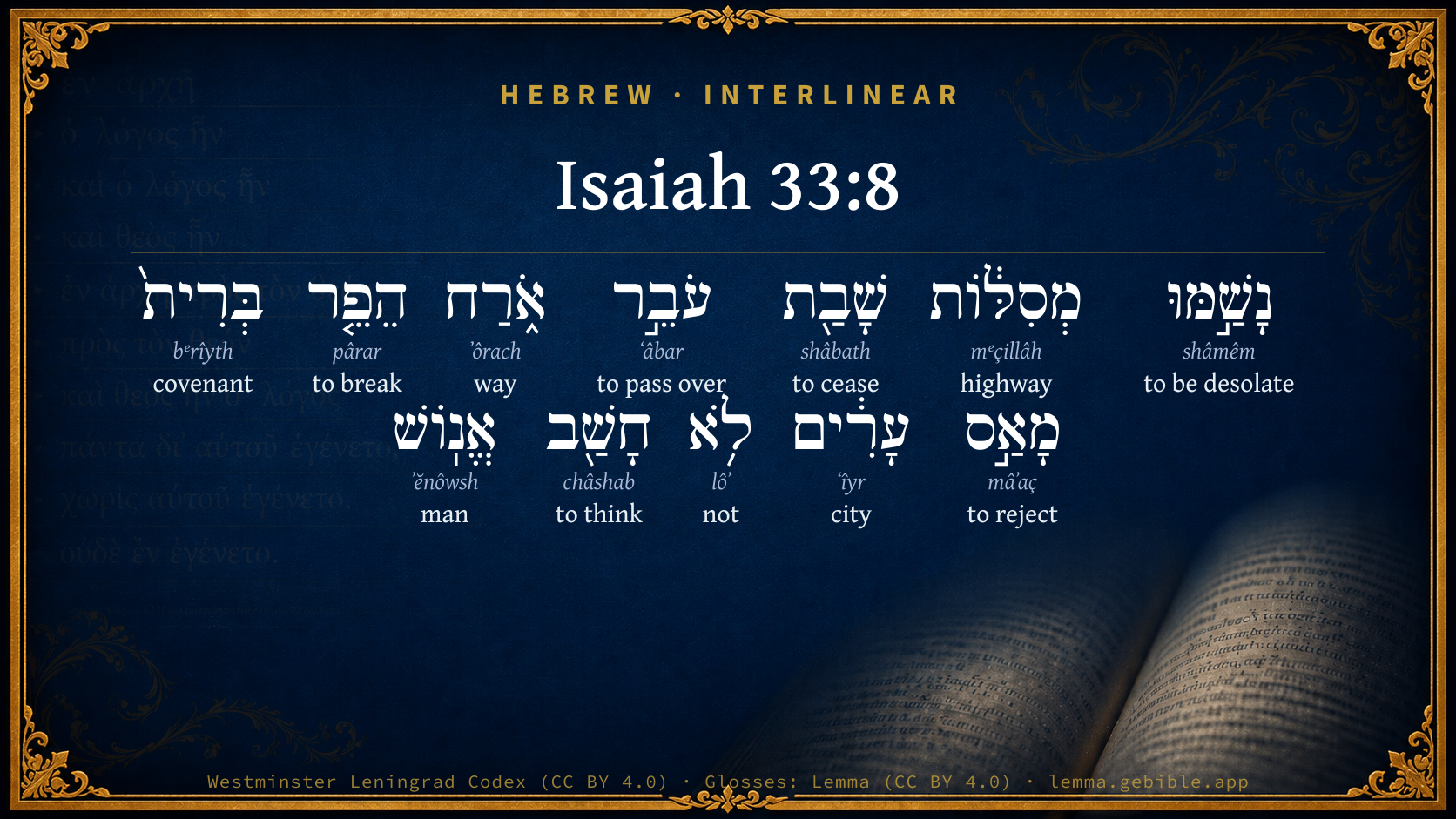
Hebrew (Westminster Leningrad Codex) Isaiah 33:8 appears in the Hebrew Old Testament. The text above is from the Westminster Leningrad Codex. Each word links to its Strong’s number, a concise gloss, and parsing drawn from the Open Scriptures Hebrew Bible morphology. Click any word for its full Brown-Driver-Briggs (BDB) entry.
Download image
Cite this verse

Isaiah 33:8 (World English Bible). Public Domain. Lemma interlinear Bible study tool, https://lemma.gebible.app/v/isaiah/33/8.

Show BibTeX & RIS
BibTeX
RIS
English Translation
The highways lie waste, the wayfaring man ceases: [the enemy] has broken the covenant, he has despised the cities, he doesn't regard man.
World English Bible · Public Domain
Download a study sheet

One document with this verse’s original text, its word-by-word gloss line, the meaning frame, cross-references with their text, attributed commentary, and full source and license credits — printable, and it pastes into notes with its structure intact.

This verse Autodidact and up

Study sheet (.html) Plain text (.txt)

A passage Seminary Student

Up to 50 verses in one chapter. A passage sheet keeps up to 6 commentary sources and 12 cross-references per verse, in the order this page ranks them, and says so on the sheet whenever that leaves anything out. Ask for a single verse and you get the Autodidact verse sheet above.

Everything on this page stays free to read, with no account — the sheet is a download of what is already on screen, not access to it.

Want to remove ads? Support Godless Engineer
Compare translations 3

The same verse in 3 English versions, stacked beneath the original-language interlinear above. Click any original word for its lexicon entry.

Each is an independent rendering of the whole verse — the interlinear is not word-aligned to these translations.

Highlighted words mark where these versions differ — a whole-verse word diff, not a word-by-word alignment.

  • World English Bible Public Domain
    The highways lie waste, the wayfaring man ceases: [the enemy] has broken the covenant, he has despised the cities, he doesn't regard man.
  • King James Version Public Domain
    The highways lie waste, the wayfaring man ceaseth: he hath broken the covenant, he hath despised the cities, he regardeth no man.
  • unfoldingWord Literal Text CC BY-SA 4.0
    The highways are deserted; the traveler of the road has ceased. He has broken a covenant; he has despised cities; he does not regard man.

unfoldingWord Literal Text — © unfoldingWord, licensed CC BY-SA 4.0. Word-aligned USFM3 via Door43 (git.door43.org/unfoldingWord/en_ult).

Versions to compare (up to 4)

3 of 4 selected

Show all 18 translations

Every available English version of this verse, each an independent rendering of the whole verse.

  • World English Bible Public Domain
    The highways lie waste, the wayfaring man ceases: [the enemy] has broken the covenant, he has despised the cities, he doesn't regard man.
  • Berean Standard Bible Public Domain
    The highways are deserted; travel has ceased. The treaty has been broken, the witnesses are despised, and human life is disregarded.
  • Majority Standard Bible Public Domain
    The highways are deserted; travel has ceased. The treaty has been broken, the witnesses are despised, and human life is disregarded.
  • King James Version Public Domain
    The highways lie waste, the wayfaring man ceaseth: he hath broken the covenant, he hath despised the cities, he regardeth no man.
  • American Standard Version (1901) Public Domain
    The highways lie waste, the wayfaring man ceaseth: `the enemy' hath broken the covenant, he hath despised the cities, he regardeth not man.
  • Revised Version (1885) Public Domain
    The highways lie waste, the wayfaring man ceaseth: he hath broken the covenant, he hath despised the cities, he regardeth not man.
  • Geneva Bible (1599) Public Domain
    The pathes are waste: the wayfaring man ceaseth: hee hath broken the couenant: hee hath contemned the cities: he regarded no man.
  • Douay-Rheims (1899) Public Domain
    The ways are made desolate, no one passeth by the road, the covenant is made void, he hath rejected the cities, he hath not regarded the men.
  • Young's Literal Translation Public Domain
    Desolated have been highways, Ceased hath he who passeth along the path, He hath broken covenant, He hath despised enemies, He hath not esteemed a man.
  • Literal Standard Version CC BY-SA 4.0
    Highways have been desolated, || He who passes along the path has ceased, || He has broken covenant, || He has despised enemies, || He has not esteemed a man.
  • Unlocked Literal Bible CC BY-SA 4.0
    The highways are deserted; there are no more travelers. Covenants are broken, witnesses are despised, and mankind is not respected.
  • unfoldingWord Literal Text CC BY-SA 4.0
    The highways are deserted; the traveler of the road has ceased. He has broken a covenant; he has despised cities; he does not regard man.
  • Darby Bible Public Domain
    The highways are desolate, the wayfaring man ceaseth. He hath broken the covenant, he hath despised the cities, he regardeth no man.
  • World Messianic Bible Public Domain
    The highways are desolate. The traveling man ceases. The covenant is broken. He has despised the cities. He doesn’t respect man.
  • Webster's Bible Public Domain
    The highways lie waste, the way-faring man ceaseth: he hath broken the covenant, he hath despised the cities, he regardeth no man.
  • Free Bible Version CC BY-SA 4.0
    Your highways are deserted; nobody's traveling on your roads anymore. He breaks the treaty; he despises the witnesses; he doesn't care about anybody.
  • Bible in Basic English Public Domain
    The highways are waste, no man is journeying there: the agreement is broken, he has made sport of the towns, he has no thought for man.
  • JPS Tanakh (1917) Public Domain
    The highways lie waste, the wayfaring man ceaseth; he hath broken the covenant, he hath despised the cities, he regardeth not man.

Literal Standard Version (2020), Covenant Press — licensed CC BY-SA 4.0. Text via the HelloAO Bible API (eBible.org). Unlocked Literal Bible (unfoldingWord) — licensed CC BY-SA 4.0. Text via the HelloAO Bible API (eBible.org). unfoldingWord Literal Text — © unfoldingWord, licensed CC BY-SA 4.0. Word-aligned USFM3 via Door43 (git.door43.org/unfoldingWord/en_ult). Free Bible Version, Dr. Jonathan Gallagher — licensed CC BY-SA 4.0. Text via the HelloAO Bible API (eBible.org).

Word by word

More ways to search: Search by grammar → Find every occurrence → Compare this word →

Practice this passage: Drill this verse → Learn its vocabulary →

מְסִלּ֔וֹת
mᵉçillâh
H4546
“highways”
Noun, Common, Feminine, Plural, Absolute
Part of Speech
Noun
Type
Common
Gender
Feminine
Number
Plural
State
Absolute
Full BDB Definition

Origin: from H5549

TWOT: 1506d

highway, raised way, public road
  1. נָשַׁ֣מּוּ shâmêm H8074 “to be desolate” Verb, Niphal, Perfect, 3rd Person, Common, Plural
  2. שָׁבַ֖ת shâbath H7673 “to cease” Verb, Qal, Perfect, 3rd Person, Masculine, Singular
  3. עֹבֵ֣ר ʻâbar H5674 “passing over” Verb, Qal, Participle Active, Masculine, Singular, Construct
  4. אֹ֑רַח ʼôrach H734 “way” Noun, Common, Both, Singular, Absolute
  5. הֵפֵ֤ר pârar H6565 “to break” Verb, Hiphil, Perfect, 3rd Person, Masculine, Singular
  6. בְּרִית֙ bᵉrîyth H1285 “covenant” Noun, Common, Feminine, Singular, Absolute
  7. מָאַ֣ס mâʼaç H3988 “to reject” Verb, Qal, Perfect, 3rd Person, Masculine, Singular
  8. עָרִ֔ים ʻîyr H5892 “cities” Noun, Common, Feminine, Plural, Absolute
  9. לֹ֥א lôʼ H3808 “not” Particle, Negative
  10. חָשַׁ֖ב châshab H2803 “to think” Verb, Qal, Perfect, 3rd Person, Masculine, Singular
  11. אֱנֽוֹשׁ ʼĕnôwsh H582 “man” Noun, Common, Masculine, Singular, Absolute

About this verse

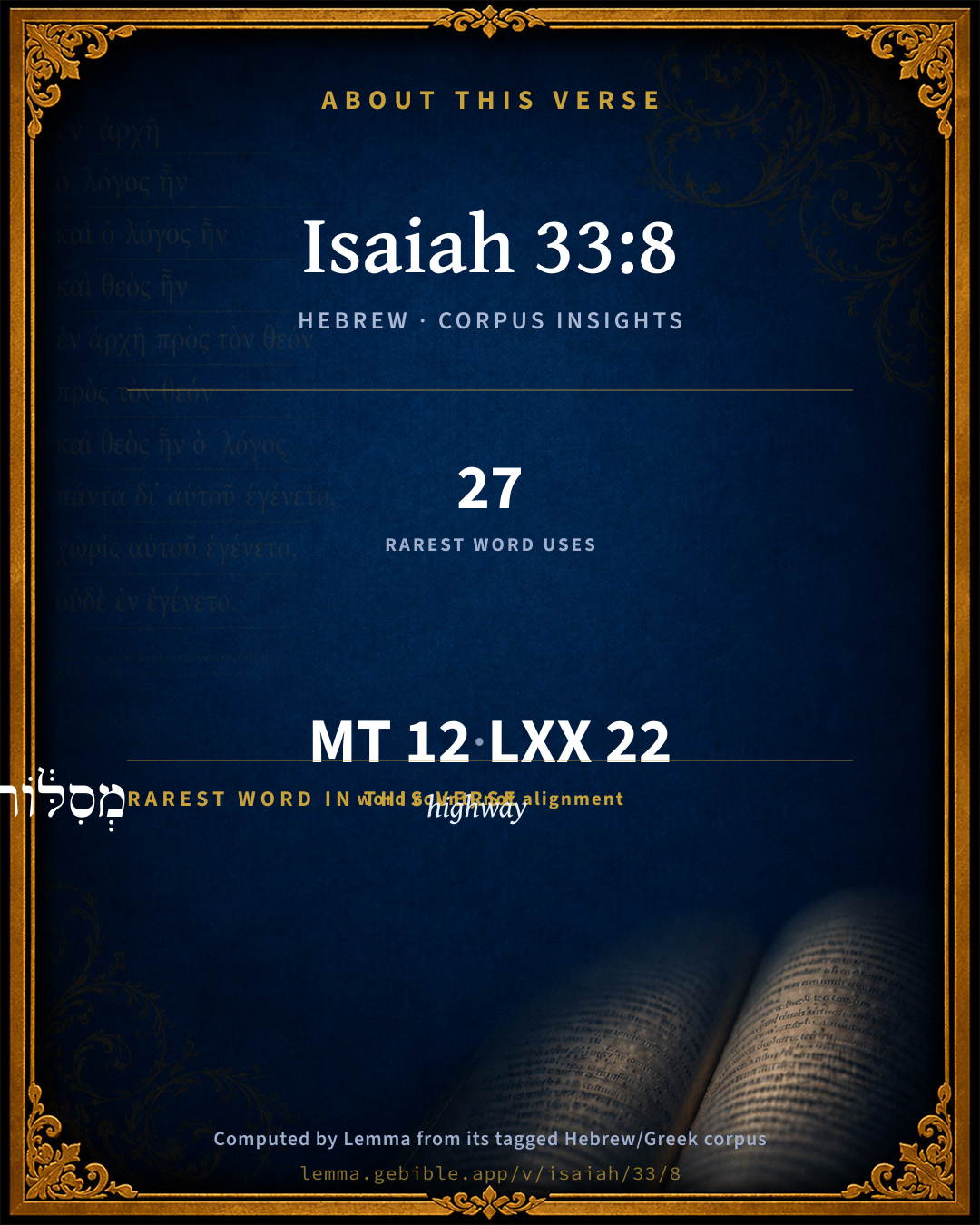
These counts appear in no published source. They are computed here, from the morphology-tagged text and Lemma’s own curated glosses. What Lemma adds →

12
words
12
distinct lemmas
Prophets
section

Shared distinctive vocabulary

מְסִלּ֔וֹת highway H4546 occurs in 26 verses of the Hebrew Bible. Also found in:

Grammatical profile

  • 6 verbs
  • 5 nouns
  • 1 particle

Verb forms

  • נָשַׁ֣מּוּ Niphal · Perfect
  • שָׁבַ֖ת Qal · Perfect
  • עֹבֵ֣ר Qal · Participle Active
  • הֵפֵ֤ר Hiphil · Perfect
  • מָאַ֣ס Qal · Perfect
  • חָשַׁ֖ב Qal · Perfect

Hebrew & Septuagint length

In English translation the verse runs 23 words from the Hebrew and 36 from the Septuagint (LXX English) — the Septuagint runs noticeably longer here. See the side-by-side →

A rough comparison of the two English renderings, which tokenize alike — not a word-level alignment.

Word counts can differ between the Hebrew and the Greek without any difference in meaning — e.g. the Hebrew direct-object marker אֵת has no separate Greek word, and Greek often adds the article ὁ.

In the original languages it is 12 Hebrew tokens and 22 Greek tokens — but the two are counted differently (Hebrew bundles its prefixes and suffixes into one token; the Greek is in lemma form), so that isn’t a like-for-like length.

Cross-references

13

Topical passages linked to Isaiah 33:8 in the Treasury of Scripture Knowledge — connected by theme and wording, ordered by reader-vote popularity; previews shown in the World English Bible.

  • Judges 5:6 In the days of Shamgar the son of Anath, In the days of Jael, the highways were unoccupied, The travelers walked through byways.
  • Isaiah 35:8 A highway shall be there, and a way, and it shall be called The way of holiness. The unclean shall not pass over it, but is shall be for for him who walks in the Way. Wicked fools will not go there.
  • 1 Samuel 17:10 The Philistine said, I defy the armies of Israel this day; give me a man, that we may fight together.
  • 1 Samuel 17:26 David spoke to the men who stood by him, saying, What shall be done to the man who kills this Philistine, and takes away the reproach from Israel? for who is this uncircumcised Philistine, that he should defy the armies of the living God?
  • 2 Kings 18:13–17 Now in the fourteenth year of king Hezekiah did Sennacherib king of Assyria come up against all the fortified cities of Judah, and took them.
  • 2 Kings 18:20–21 You say (but they are but vain words), [There is] counsel and strength for the war. Now on whom do you trust, that you have rebelled against me?
  • Psalms 10:5 His ways are prosperous at all times; He is haughty, and your laws are far from his sight: As for all his adversaries, he sneers at them.
  • Isaiah 10:9–11 Isn't Calno as Carchemish? Isn't Hamath as Arpad? Isn't Samaria as Damascus?
  • Isaiah 10:13–14 For he has said, By the strength of my hand I have done it, and by my wisdom; for I have understanding: and I have removed the bounds of the peoples, and have robbed their treasures, and like a valiant man I have brought down those who sit [on thrones]:
  • Isaiah 10:29–31 they are gone over the pass; they have taken up their lodging at Geba; Ramah trembles; Gibeah of Saul is fled.
  • Isaiah 36:1 Now it happened in the fourteenth year of king Hezekiah, that Sennacherib king of Assyria came up against all the fortified cities of Judah, and took them.
  • Lamentations 1:4 The ways of Zion do mourn, because none come to the solemn assembly; All her gates are desolate, her priests do sigh: Her virgins are afflicted, and she herself is in bitterness.
  • Luke 18:2–4 saying, "There was a judge in a certain city who didn't fear God, and didn't respect man.

Cross-references courtesy of OpenBible.info (CC BY 4.0).

Hebrew and Greek witnesses Masoretic Hebrew ↔ Greek Septuagint

The same verse in the two great witnesses to the Old Testament, shown verse-for-verse.

Here the Septuagint runs noticeably longer than the Hebrew — LXX2012 (modern English Septuagint) 36 words vs World English Bible 23. A rough length comparison of the two English translations, not a word-level alignment — read both below.

These are two independent witnesses, not word-aligned to each other, and the Septuagint is shown in lemma (dictionary) form.

Hebrew Isaiah 33:8 Masoretic · Westminster Leningrad Codex

נָשַׁ֣מּוּ מְסִלּ֔וֹת שָׁבַ֖ת עֹבֵ֣ר אֹ֑רַח הֵפֵ֤ר בְּרִית֙ מָאַ֣ס עָרִ֔ים לֹ֥א חָשַׁ֖ב אֱנֽוֹשׁ

The highways lie waste, the wayfaring man ceases: [the enemy] has broken the covenant, he has despised the cities, he doesn't regard man.

World English Bible · Public Domain

Greek LXX Isaiah 33:8 Septuagint · lemma form

ἐρημόω γάρ ὁ οὗτος ὁδός παύω ὁ φόβος ὁ ἔθνος καί ὁ πρός οὗτος διαθήκη αἴρω καί οὐ μή λογίζομαι αὐτός ἄνθρωπος

For the ways of these shall be made desolate: the terror of the nations has been made to cease, and the covenant with these is taken away, and you⌃ shall by no means deem them men.

LXX2012 (modern English Septuagint) · Public Domain

Hebrew: Westminster Leningrad Codex (CC BY 4.0). Greek: Septuagint (public domain); English from LXX2012 (modern English Septuagint) (Public Domain). How the Septuagint differs from the Hebrew →

Targum (Aramaic paraphrase)

1

The Targum is the ancient Jewish Aramaic paraphrase of the Hebrew Scriptures — an interpretive translation, not the Hebrew text itself. Onkelos (literal) and Pseudo-Jonathan (expansive) render the Torah, and Jonathan the Prophets. Coverage is partial: where no permissively-licensed English translation exists for a verse, only the Aramaic is shown. This is verse-level text, not a word-by-word alignment to the Hebrew.

  1. Targum Jonathan Prophets (Joshua–Malachi)
    צְדִיאוּ כִבְשַׁיָא פְּסָקוּ עָדֵי אוֹרְחָא עַל דְאַשְׁנִיאוּ קְיָמָא אִיתְרְחִיקוּ מִקִרְוֵיהוֹן לָא חֲשִׁיבוּ בְנֵי אֱנָשָׁא דְבִישְׁתָּא אַתְיָא עֲלֵיהוֹן:

    The highways lie desolate, the wayfaring man ceaseth: because they have forgotten the covenant: they shall be removed far from their cities; they have not considered the sons of men, evil shall come upon them.

    Targum Jonathan — Aramaic: “Mikraot Gedolot” (public domain). English: “Sefaria Community Translation” (CC0 1.0 (public-domain dedication)); “London "Chaldee Paraphrase," 1871” (public domain). Text via Sefaria.

Commentary

Notes on Isaiah 33:8 from classic Christian and Jewish commentators (each source and its license shown beneath its notes). The classic Christian expositions comment on the surrounding passage and are grouped to its opening verse, so a note may address several verses; the Jewish commentaries on the Tanakh (Rashi and others) are per-verse, so they appear only where the commentator wrote on this verse.

Lemma curates 59 commentaries, every one of them public domain or Creative Commons licensed, each selected and text-cleaned for this edition rather than reprinted as found. About our sources →

Trapp's Complete Commentary

John Trapp

Isa 33:8 The highways lie waste, the wayfaring man ceaseth: he hath broken the covenant, he hath despised the cities, he regardeth no man.

Ver. 8. The highways lie waste.] And byways are more frequented, through fear of the enemy.

He hath broken the covenant.] Irritum factum est pactum. He took the money sent him, but comes on nevertheless, though he had sworn the contrary. {2Ki 18:14; 2Ki 18:17} It is said of the Turks at this day, that they keep their leagues - which serve, indeed, but as snares to entangle other princes in - no longer than standeth with their own profit. {a} Their maxim is, There is no faith to be kept with dogs, whereby they mean Christians, as the Papists also say, There is no faith to be kept with heretics, whereby they mean Protestants. But why kept not Uladislaus, King of Hungary, his faith better with Amurath, the great Turk? or our Henry III with his barons, by Papal dispensation? Vah scelus! vae periuris.

He hath despised the cities.] And will not take them for his subjects. He scorneth the motion.

He regardeth no man.] He vilipends and slights all jewels generally.

{a} Turkish History, 755.

John Trapp, A Commentary or Exposition upon All the Books of the Old and New Testament (1647–1656) — public domain. Text from a community e-Sword module.

Geneva Bible (1599)

Geneva Bible translators

These are the words of the ambassadors, when they returned from Sennacherib.

Geneva Bible (1599) marginal notes — public domain. Text via Bolls.life.

Jamieson, Fausset & Brown

Robert Jamieson, A. R. Fausset & David Brown

broken . . . covenant--When Sennacherib invaded Judea, Hezekiah paid him a large sum to leave the land; Sennacherib received the money and yet sent his army against Jerusalem (Kg2 18:14, Kg2 18:17).

despised--make slight of as unable to resist him (Isa 10:9; Isa 36:19); easily captures them.

Jamieson, Fausset & Brown — Commentary Critical and Explanatory on the Whole Bible (1871) — public domain (CC PDM 1.0). Text via the HelloAO Bible API.

Ellicott's Commentary for English Readers

(8) The highways lie waste . . .—Another feature in the picture of terror. No traveller dared to show himself in the main road. (Comp. Jdg_5:6.)

He hath broken.—Sennacherib is denounced as having broken the treaty of 2Ki_18:14. Hezekiah had complied with his conditions, and yet there was no suspension of hostilities.

A Bible Commentary for English Readers, edited by Charles John Ellicott (1878–1897) — public domain. Text from a community e-Sword module.

The Cambridge Bible for Schools and Colleges

gen. ed. J. J. S. Perowne

8. The highways lie waste … ceaseth] cf. Jdg_5:6.

he hath broken the covenant] See on Isa_33:7.

he hath despised the cities] For ‘ârîm (cities) Duhm proposes to read ‘çdîm (witnesses), i.e. the witnesses to the broken treaty. There might no doubt be an allusion to the capture of the fenced cities of Judah, 2Ki_18:13.

The Cambridge Bible for Schools and Colleges (gen. ed. J. J. S. Perowne; Cambridge University Press, 1878–1918) — public domain. Text from a community e-Sword module.

John Gill's Exposition

The highways lie waste,.... No man walking in them, for fear of the enemy; "the ways of Zion", which are said to "mourn, because none come to the solemn feasts", Lam 1:4 none daring to attend the ministry of the word and ordinances; see Isa 35:8,

the wayfaring man ceaseth; or, "the traveller rests" (z); or stops; he does not proceed on his journey; a stop is put to a religious course and conversation; there is an entire cessation of religious worship; a sabbath is kept, but not a religious one; he that would walk in Zion's ways is forbid, and is obliged to sit still:

he hath broken the covenant; some, as Kimchi's father, interpret this of the Jews' complaining that God had broken his covenant with them, as in Psa 89:39 but most of Sennacherib's breaking his covenant with Hezekiah, Kg2 18:14 rather this is to be understood of antichrist, whose doctrine is, that faith is not to be kept with heretics, and which will abundantly appear at this distressing time:

he hath despised the cities; as Sennacherib did the fenced cities of Judah; he despised their fortifications, and easily took them, and treated the inhabitants with disdain and contempt; and so will the reformed Protestant cities and countries be invaded, seized upon, and insulted, by the Romish antichrist:

he regardeth no man; so as to keep covenant with them, have compassion on them, and spare them, he fearing neither God nor man.

(z) "cessaverat viator", Junius & Tremellius; "desiit viator", Cocceius.

John Gill's Exposition of the Whole Bible (1746–1763) — public domain (CC PDM 1.0). Text via the HelloAO Bible API.

Albert Barnes' Notes on the Bible

The highways lie waste - This verse contains a description of the desolations that had been caused by the invasion of Sennacherib. Some have understood it as containing the account which the ambassadors sent by Hezekiah gave of the effects of the invasion. Thus Grotius interprets it. But it is probably a description made by the prophet himself, and is designed to state one cause why the messengers that had been sent out wept bitterly. They had not only failed of inducing Sennacherib to abandon his purpose of attacking Jerusalem, but they had witnessed the effects of his invasion already. The public ways were desolate. In the consternation and alarm that was produced by his approach, the roads that had been usually thronged were now solitary and still. A mournful desolation already prevailed, and they apprehended still greater calamities, and hence, they wept.

The wayfaring man ceaseth - Hebrew, ‘He that passes along the road ceases.’ That is, there is a cessation of travel. No one is seen passing along the streets that used to be thronged.

He hath broken the covenant - This may either mean that the Assyrian king had violated the compact which had been made with him by Ahaz, by which he was to come and aid Jerusalem against the allied armies of Syria and Samaria (see the notes at Isa. 7), or it may mean that he had violated an implied compact with Hezekiah. When Judea was threatened with an invasion by Sennacherib, Hezekiah had sent to him when he was at Lachish, and had sought for peace 2Ki 18:14. In that embassy Hezekiah said, ‘I have offended, return from me; that which thou puttest on me I will bear. And the king of Assyria appointed unto Hezekiah king of Judah three hundred talents of silver and thirty talents of gold.’ To pay this, Hezekiah exhausted his treasury, and even stripped the temple of its golden ornaments 2Ki 18:15-16. A compact was thus made by which it was understood that Sennacherib was to withdraw his army, and depart from the land. But notwithstanding this, he still persisted in his purpose, and immediately despatched a part of his army to lay siege to Jerusalem. All the treaties, therefore, had been violated. He had disregarded that which was made with Ahaz, and that which he had now himself made with Hezekiah, and was advancing in violation of all to lay siege to the city.

He hath despised the cities - That is, he disregards their defenses, and their strength; he invades and takes all that comes in his way. He speaks of them with contempt and scorn as being unable to stand before him, or to resist his march. See his vain and confident boasting in Isa 10:9; Isa 36:19.

He regardeth no man - He spares no one, and he observes no compact with any man.

Albert Barnes' Notes on the Bible (1834–1885) — public domain. Text from a community e-Sword/MySword module.

Haydock's Catholic Bible Commentary

Void, though Sennacherib had received what he demanded, 4 Kings xviii. 14.

George Leo Haydock (1774–1849), Haydock's Catholic Family Bible and Commentary, 1859 edition — public domain. Excludes Psalms (Douay-Rheims chapter numbering differs from Protestant) and Deuterocanonical books (Catholic canon only).

Matthew Poole's English Annotations

The highways lie waste, the wayfaring man ceaseth, because the Assyrian soldiers possessed and filled the land.

He hath broken the covenant; Sennacherib broke his faith, given to Hezekiah, of departing for a sum of money, 2Ki 18:14,17.

He hath despised the cities; the defenced cities of Judah, which he contemned and easily took, 2Ki 18:13.

He regardeth no man; either to spare them, or to fear them, or to keep faith with them. He neither feareth God, nor reverenceth man.

Matthew Poole's English Annotations on the Holy Bible (1683–1685) — public domain. Text from a community e-Sword/MySword module.

Whedon's Commentary on the Bible

Daniel D. Whedon

8, 9. The highways lie waste — In disregard of his covenant the enemy still would ravage the country, render impassable the usual highways, cut off travel, break up villages and cities, and show mercy to none. Such treachery called for the world’s detestation and Heaven’s speediest retribution; this is a sense in which the earth, or the land, mourneth; in which Lebanon, noble in its cedars and towering heights, blushes in very shame; in which Sharon, the Shephala, or flowery plain on the sea, wilts to desolation; in which the east Jordanic Bashan, with its rich pastures and oaks, and

Carmel — the synonyme for greatest fertility — forget their rightful glory and hide away through mortification at such stupendous treachery.

Daniel D. Whedon (gen. ed.), Commentary on the Old and New Testaments (1874–1909) — public domain. Text from a community e-Sword module.

The Pulpit Commentary

The highways lie waste. (comp. Jud_1:5:6) The meaning is that" they were unoccupied. Fear of the Assyrians restrained men from travelling. He hath broken the covenant. Sennacherib, when he accepted the sum of money sent him by Hezekiah, (2Ki_18:15; "Eponym Canon," p. 135) must have consented to leave him unmolested for the future. But in a very short time we find him, apparently without any reasonable pretext, sending a fresh expedition against Jerusalem, requiring it to be admitted within the walls, and even threatening the city with destruction. (2Ki_18:17-35 2Ki_19:10-13) Isaiah, therefore, taxes him with having broken his covenant. Despised cities. "Sennacherib," says Delitzsch, "continued to storm the fortified places of Judah, in violation of his agreement." Regardeth no man; i.e. "pays no attention to the protests that are made against his infraction of the treaty does not care what is said or thought of him."

The Pulpit Commentary (1880–1919), ed. H.D.M. Spence-Jones & Joseph S. Exell — public domain. Text from a community e-Sword module.

John Wesley's Explanatory Notes

The covenant - Sennacherib broke his faith, given to Hezekiah, of departing for a sum of money, 2 Kings xviii, 14, 17. Cities - The defensed cities of Judah, which he contemned, and easily took.

John Wesley, Explanatory Notes Upon the Whole Bible (1754–1765) — public domain. Text via the GEBible commentary corpus.

J. A. Alexander on Isaiah

Joseph Addison Alexander

“The highways are wasted, the wayfarer ceaseth; he breaks the covenant, despises cities, values no man.” These are the words of the Prophet himself. The scene presented is that of the actual condition of Judea during the Assyrian invasion. (Compare Jdg 5:6). The verbs of the last clause agree with Sennacherib or the Assyrian. The meaning is that he despised the defenses of the conquered country, as unable to resist him. The last words may either mean that he has no regard to any man’s interest or wishes, or that he does not value human life.

Joseph Addison Alexander, The Prophecies of Isaiah (1846–1847; New York: Scribner, 1870–1878) — public domain. Text from a community e-Sword module.

Rashi

Rabbi Shlomo Yitzchaki (Rashi)

he has abrogated the treaty The enemy has abrogated the treaty he made with Israel.

despised cities He despised in his eyes; no enemy considers any man.

Rashi on the Tanakh — English translations: “The Judaica Press complete Tanach with Rashi, translated by A. J. Rosenberg” (CC BY 4.0); “Pentateuch with Rashi's commentary by M. Rosenbaum and A.M. Silbermann, 1929-1934” (public domain); “The Metsudah Tanach series, Lakewood, N.J” (CC BY 4.0); and “The Book of Joshua, Metsudah Publications, 1997” (CC BY 4.0). Text via Sefaria.

Ibn Ezra

Rabbi Abraham ibn Ezra

The highways lie waste. For the king of Assyria will not be faithful to his treaties with other nations.

He regardeth no man. He does not esteem any person to be worth anything in comparison with himself.

Ibn Ezra on the Tanakh — English translations: “Sefaria Community Translation” (CC0 1.0 (public-domain dedication)); “Yalkut, Sifsei Chachomim Chumash, Metsudah Publications, 2009” (CC BY 4.0); and “Commentary of Ibn Ezra on Isaiah - trans. by M. Friedlander, 1873” (public domain). Text via Sefaria.

Lesson kit

Teaching starters — assembled from the data on this page, not authored interpretation. Every prompt links to the verse data it draws on. Edit before teaching.

Isaiah, in the Prophets, opens this verse with 12 words (12 distinct Hebrew lemmas). Its most distinctive word is mᵉçillâh (“highway”). The Greek Septuagint runs longer here. A historical commentator’s framing appears above. Read the whole chapter for the surrounding context.

Discussion questions

  1. The word mᵉçillâh carries the sense “highway.” How does it shape the verse?
  2. How does Numbers 20:19, which shares the word «highway», read alongside this verse?
  3. The Septuagint runs longer here than the Hebrew. What might account for the difference?
  4. The translations on this page render this verse differently — a whole-verse word diff, not a word-by-word alignment. What might account for the different wordings?
  5. «נָשַׁ֣מּוּ» is a Niphal Perfect verb. How does that grammatical form shape the action described?
  6. Compare how Trapp's Complete Commentary and Geneva Bible (1599) read this verse. Where do they agree or differ?

Things to notice

Reading settings

Reading text

Shown beneath each verse's original-language words.

Old Testament
Old Testament edition

Read the OT as the Masoretic Hebrew (MT) or the Greek Septuagint (LXX).

English shown for the Greek Septuagint (in the Hebrew ↔ Greek comparison).

Comparing translations? Open the Compare panel on any verse page to stack up to four side by side.