
Psalms 40:15

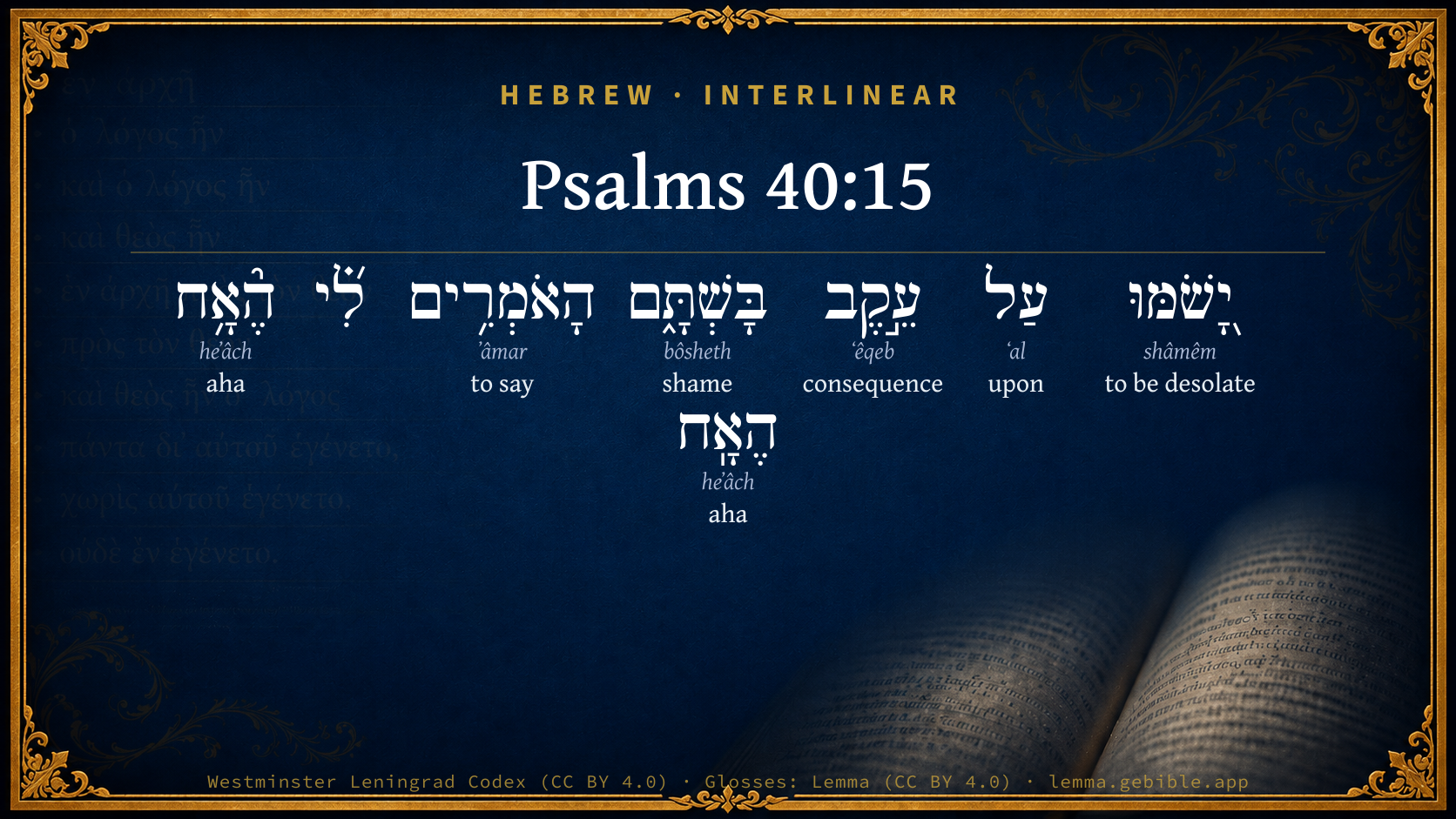
Hebrew (Westminster Leningrad Codex) Psalms 40:15 appears in the Hebrew Old Testament. The text above is from the Westminster Leningrad Codex. Each word links to its Strong’s number, a concise gloss, and parsing drawn from the Open Scriptures Hebrew Bible morphology. Click any word for its full Brown-Driver-Briggs (BDB) entry.
Download image
Cite this verse

Psalms 40:15 (World English Bible). Public Domain. Lemma interlinear Bible study tool, https://lemma.gebible.app/v/psalms/40/15.

Show BibTeX & RIS
BibTeX
RIS
English Translation
Let them be desolate by reason of their shame that tell me, "Aha! Aha!"
World English Bible · Public Domain
Download a study sheet

One document with this verse’s original text, its word-by-word gloss line, the meaning frame, cross-references with their text, attributed commentary, and full source and license credits — printable, and it pastes into notes with its structure intact.

This verse Autodidact and up

Study sheet (.html) Plain text (.txt)

A passage Seminary Student

Up to 50 verses in one chapter. A passage sheet keeps up to 6 commentary sources and 12 cross-references per verse, in the order this page ranks them, and says so on the sheet whenever that leaves anything out. Ask for a single verse and you get the Autodidact verse sheet above.

Everything on this page stays free to read, with no account — the sheet is a download of what is already on screen, not access to it.

Want to remove ads? Support Godless Engineer
Compare translations 3

The same verse in 3 English versions, stacked beneath the original-language interlinear above. Click any original word for its lexicon entry.

Each is an independent rendering of the whole verse — the interlinear is not word-aligned to these translations.

Highlighted words mark where these versions differ — a whole-verse word diff, not a word-by-word alignment.

  • World English Bible Public Domain
    Let them be desolate by reason of their shame that tell me, "Aha! Aha!"
  • King James Version Public Domain
    Let them be desolate for a reward of their shame that say unto me, Aha, aha.
  • unfoldingWord Literal Text CC BY-SA 4.0
    Let them be appalled on account of their shame, the ones saying to me, “Aha! Aha!”

unfoldingWord Literal Text — © unfoldingWord, licensed CC BY-SA 4.0. Word-aligned USFM3 via Door43 (git.door43.org/unfoldingWord/en_ult).

Versions to compare (up to 4)

3 of 4 selected

Show all 18 translations

Every available English version of this verse, each an independent rendering of the whole verse.

  • World English Bible Public Domain
    Let them be desolate by reason of their shame that tell me, "Aha! Aha!"
  • Berean Standard Bible Public Domain
    May those who say to me, “Aha, aha!” be appalled at their own shame.
  • Majority Standard Bible Public Domain
    May those who say to me, “Aha, aha!” be appalled at their own shame.
  • King James Version Public Domain
    Let them be desolate for a reward of their shame that say unto me, Aha, aha.
  • American Standard Version (1901) Public Domain
    Let them be desolate by reason of their shame That say unto me, Aha, aha.
  • Revised Version (1885) Public Domain
    Let them be desolate by reason of their shame that say unto me, Aha, Aha.
  • Geneva Bible (1599) Public Domain
    Let them be destroyed for a rewarde of their shame, which say vnto me, Aha, aha.
  • Douay-Rheims (1899) Public Domain
    Let them be confounded and ashamed together, that seek after my soul to take it away. Let them be turned backward and be ashamed that desire evils to me.
  • Young's Literal Translation Public Domain
    They are desolate because of their shame, Who are saying to me, `Aha, aha.'
  • Literal Standard Version CC BY-SA 4.0
    They are desolate because of their shame, || Who are saying to me, “Aha, aha.”
  • Unlocked Literal Bible CC BY-SA 4.0
    Let them be shocked because of their shame, those who say to me, “Aha, aha!”
  • unfoldingWord Literal Text CC BY-SA 4.0
    Let them be appalled on account of their shame, the ones saying to me, “Aha! Aha!”
  • Darby Bible Public Domain
    Let them be desolate, because of their shame, that say unto me, Aha! Aha!
  • World Messianic Bible Public Domain
    Let them be desolate by reason of their shame that tell me, “Aha! Aha!”
  • Webster's Bible Public Domain
    \\40:14\\Let them be ashamed and confounded together that seek after my soul to destroy it; let them be driven backward and put to shame that wish me evil.
  • Free Bible Version CC BY-SA 4.0
    May they be shocked at their defeat, those who taunted me.
  • Bible in Basic English Public Domain
    Let those who say to me, Aha, aha! be surprised because of their shame.
  • JPS Tanakh (1917) Public Domain
    (40-16) Let them be appalled by reason of their shame that say unto me: 'Aha, aha.'

Literal Standard Version (2020), Covenant Press — licensed CC BY-SA 4.0. Text via the HelloAO Bible API (eBible.org). Unlocked Literal Bible (unfoldingWord) — licensed CC BY-SA 4.0. Text via the HelloAO Bible API (eBible.org). unfoldingWord Literal Text — © unfoldingWord, licensed CC BY-SA 4.0. Word-aligned USFM3 via Door43 (git.door43.org/unfoldingWord/en_ult). Free Bible Version, Dr. Jonathan Gallagher — licensed CC BY-SA 4.0. Text via the HelloAO Bible API (eBible.org).

Word by word

More ways to search: Search by grammar → Find every occurrence → Compare this word →

Practice this passage: Drill this verse → Learn its vocabulary →

About this verse

These counts appear in no published source. They are computed here, from the morphology-tagged text and Lemma’s own curated glosses. What Lemma adds →

8
words
6
distinct lemmas
Wisdom
section

Notable vocabulary

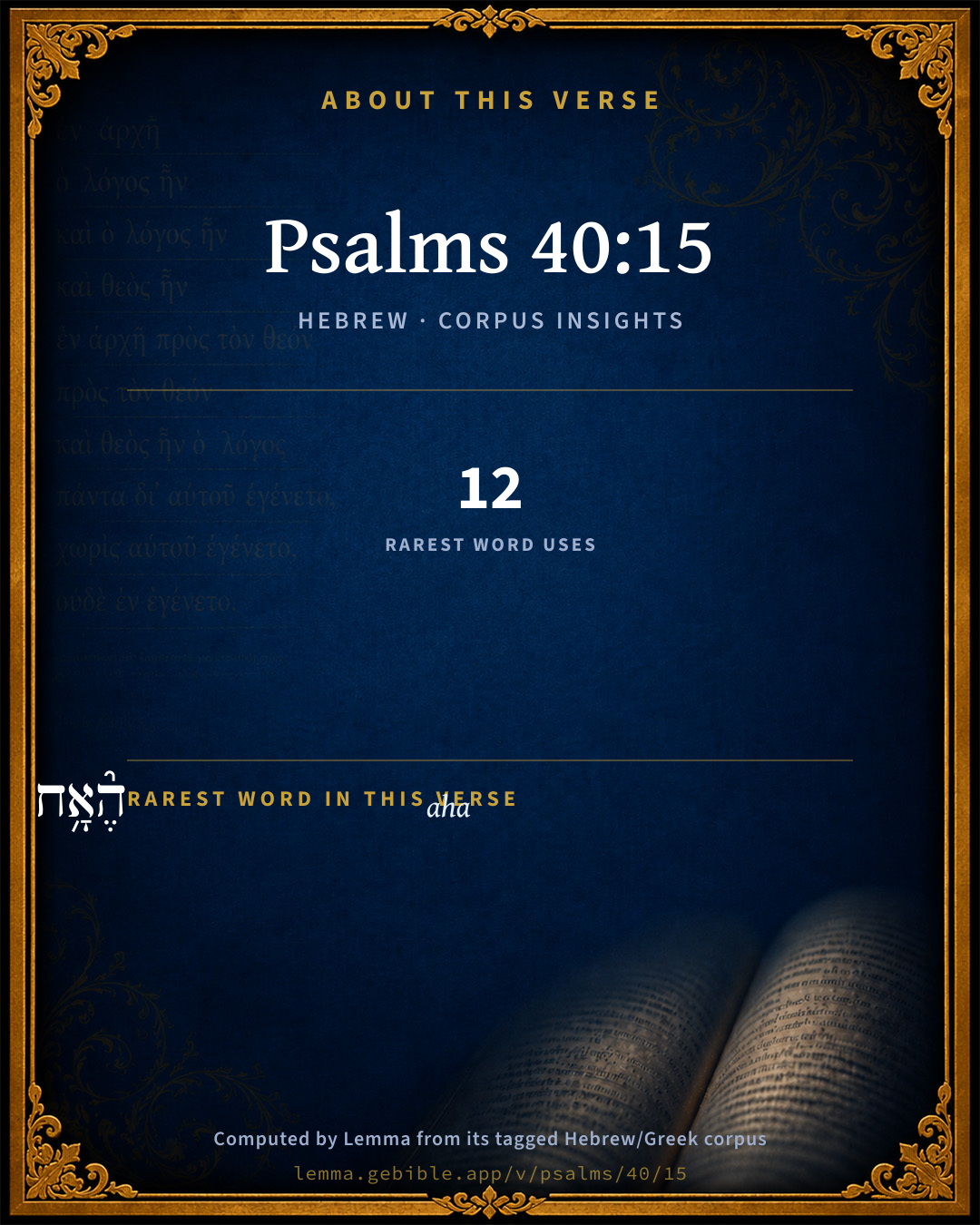
The rarest word here is הֶ֘אָ֥ח aha H1889 — appearing just 12 times in the whole Hebrew Bible.

Shared distinctive vocabulary

הֶ֘אָ֥ח aha H1889 occurs in 9 verses of the Hebrew Bible. Also found in:

Grammatical profile

  • 2 verbs
  • 2 nouns
  • 2 prepositions
  • 2 particles

Verb forms

  • יָ֭שֹׁמּוּ Qal · Imperfect
  • הָאֹמְרִ֥ים Qal · Participle Active

Repetition

A word recurs within this verse — often emphatic in Hebrew:

  • הֶ֘אָ֥ח aha H1889 ×2

Hebrew & Septuagint length

In English translation the verse runs 14 words from the Hebrew and 14 from the Septuagint (LXX English) — the same length.

A rough comparison of the two English renderings, which tokenize alike — not a word-level alignment.

Word counts can differ between the Hebrew and the Greek without any difference in meaning — e.g. the Hebrew direct-object marker אֵת has no separate Greek word, and Greek often adds the article ὁ.

Cross-references

8

Topical passages linked to Psalms 40:15 in the Treasury of Scripture Knowledge — connected by theme and wording, ordered by reader-vote popularity; previews shown in the World English Bible.

  • Psalms 35:21 Yes, they opened their mouth wide against me. They said, "Aha! Aha! Our eye has seen it!"
  • Psalms 35:25 Don't let them say in their heart, "Aha! That's the way we want it!" Don't let them say, "We have swallowed him up!"
  • Psalms 69:24–25 Pour out your indignation on them. Let the fierceness of your anger overtake them.
  • Luke 19:43–44 For the days will come on you, when your enemies will throw up a barricade against you, surround you, hem you in on every side,
  • Psalms 70:3–4 Let them be turned because of their shame Who say, "Aha! Aha!"
  • Psalms 73:19 How they are suddenly destroyed! They are completely swept away with terrors.
  • Psalms 109:6–20 Set a wicked man over him. Let an adversary stand at his right hand.
  • Luke 21:23–24 Woe to those who are pregnant and to those who nurse infants in those days! For there will be great distress in the land, and wrath to this people.

Cross-references courtesy of OpenBible.info (CC BY 4.0).

Hebrew and Greek witnesses Masoretic Hebrew ↔ Greek Septuagint

The same verse in the two great witnesses to the Old Testament, shown verse-for-verse.

You’re reading Greek Psalm 39 (Hebrew Psalm 40). The Septuagint counts the superscription, so verse numbers can differ from the Hebrew — chapter-level alignment, not verse-by-verse. Numbering follows Rahlfs.

These are two independent witnesses, not word-aligned to each other, and the Septuagint is shown in lemma (dictionary) form.

Hebrew Psalms 40:15 Masoretic · Westminster Leningrad Codex

יָ֭שֹׁמּוּ עַל עֵ֣קֶב בָּשְׁתָּ֑ם הָאֹמְרִ֥ים לִ֝֗י הֶ֘אָ֥ח הֶאָֽח

Let them be desolate by reason of their shame that tell me, "Aha! Aha!"

World English Bible · Public Domain

Greek LXX Greek Psalm 39:15 Septuagint · lemma form

κατααἰσχύνω καί ἐντρέπω ἅμα ὁ ζητέω ὁ ψυχή ἐγώ ὁ ἐκαἴρω αὐτός ἀποστρέφω εἰς ὁ ὀπίσω καί ἐντρέπω ὁ θέλω ἐγώ κακός

Let those that say to me, Aha, aha, quickly receive shame for their reward.

LXX2012 (modern English Septuagint) · Public Domain

Hebrew: Westminster Leningrad Codex (CC BY 4.0). Greek: Septuagint (public domain); English from LXX2012 (modern English Septuagint) (Public Domain). How the Septuagint differs from the Hebrew →

Commentary

Notes on Psalms 40:15 from classic Christian and Jewish commentators (each source and its license shown beneath its notes). The classic Christian expositions comment on the surrounding passage and are grouped to its opening verse, so a note may address several verses; the Jewish commentaries on the Tanakh (Rashi and others) are per-verse, so they appear only where the commentator wrote on this verse.

Lemma curates 59 commentaries, every one of them public domain or Creative Commons licensed, each selected and text-cleaned for this edition rather than reprinted as found. About our sources →

Trapp's Complete Commentary

John Trapp

Psa 40:15 Let them be desolate for a reward of their shame that say unto me, Aha, aha.

Ver. 15. Let them be desolate for a reward] A poor reward; but such as sin payeth to her servants: "the wages of sin is death." Sin payeth all her servants in black money. See Psa 35:21. The word here rendered reward signifieth a heel. It is as if the prophet should say, Let one desolation tread upon the heels of another, till they be utterly undone.

John Trapp, A Commentary or Exposition upon All the Books of the Old and New Testament (1647–1656) — public domain. Text from a community e-Sword module.

J. A. Alexander on Psalms

Joseph Addison Alexander

16. (Psa 40:15). They shall be desolate on account of their shame—those saying to me, Aha, aha! The common version, for a reward of their shame, seems to make their shame the crime for which they were to be punished. The Hebrew here sometimes means wages or reward, as the consequence of labour. See Psa 19:12 (11), Pro 22:4. But the general meaning of the phrase, in consequence, is admissible, and quite sufficient here. For the meaning of the last clause, see above, on Psa 35:21; Psa 35:25.

Joseph Addison Alexander, The Psalms Translated and Explained (1850) — public domain. Text from a community e-Sword module.

Geneva Bible (1599)

Geneva Bible translators

Let the same shame and confusion light upon them, which they intended to have brought upon me.

Geneva Bible (1599) marginal notes — public domain. Text via Bolls.life.

Jamieson, Fausset & Brown

Robert Jamieson, A. R. Fausset & David Brown

for a reward--literally, "in consequence of."

Aha--(Compare Psa 35:21, Psa 35:25).

Jamieson, Fausset & Brown — Commentary Critical and Explanatory on the Whole Bible (1871) — public domain (CC PDM 1.0). Text via the HelloAO Bible API.

Adam Clarke's Commentary

Verse 15. That say unto me, Aha, aha.] האח האח heach, heach. See on Ps 35:21.

Adam Clarke's Commentary on the Bible (1810–1826) — public domain. Text from a community e-Sword/MySword module.

John Calvin's Commentaries

When the Psalmist prays (verse 15) that his enemies may be destroyed for a reward of their shame, the meaning is this: As their sole desire has been to overwhelm me with shame, in order that, while thus dismayed and confounded, they might make me the object of their derision; so let a similar confusion fall upon their own heads. In the second clause of the verse he describes the nature of this confusion by relating the terms of their wicked triumphing, by which they poured contempt upon him while he was so oppressed with misery and affliction. We are here taught that, when our enemies shall have persecuted us to the uttermost, a recompense is also prepared for them; and that God will turn back, and cause to fall upon their own heads, all the evil which they had devised against us; and this doctrine ought to act as a restraint upon us, that we may behave ourselves compassionately and kindly towards our neighbors.

John Calvin's Commentaries (1540-1563) — public domain. Text from the Calvin Translation Society English edition (1840s-50s) via the Christian Classics Ethereal Library (ccel.org). Calvin's coverage is partial (roughly two-thirds of the Bible); uncommented books and verses are honest gaps, never fabricated. The 19th-century editor's footnotes and remarks are omitted so the notes are faithfully Calvin's own voice.

The Cambridge Bible for Schools and Colleges

gen. ed. J. J. S. Perowne

15. R.V., Let them be desolate (Lam_1:16) by reason of their shame, the defeat of their malicious plans: or, less probably, let them be astonished (Lev_26:32) for a reward of their shame, at the shame which is their recompense. Psa_70:4 reads let them turn back, as in Psa_6:10. The difference of reading probably arose out of the confusion of sound or form between M and B (ישמו—ישבו).

Aha, aha] The exclamation of malicious pleasure at another’s misfortune. Cp. Psa_35:21; Psa_35:25.

The Cambridge Bible for Schools and Colleges (gen. ed. J. J. S. Perowne; Cambridge University Press, 1878–1918) — public domain. Text from a community e-Sword module.

John Gill's Exposition

Let them be desolate for a reward of their shame,.... Of their shameful wishes, words, and actions, as they were: their habitations in Jerusalem were desolate, and so was their house or temple there, and their whole land, and they themselves were stripped of everything, when Jerusalem was taken and destroyed; see Mat 23:38, Act 1:20;

that say unto me, Aha, aha; words expressive of joy, Psa 35:21, exulting at his miseries and sufferings on the cross, Mat 27:39; so the Targum,

"we have rejoiced at his destruction, with joy at his affliction.''

John Gill's Exposition of the Whole Bible (1746–1763) — public domain (CC PDM 1.0). Text via the HelloAO Bible API.

Albert Barnes' Notes on the Bible

Let them be desolate - The word here employed means to be astonished or amazed; then, to be laid waste, or made desolate. As used here, it refers to their purposes, and the wish or prayer is that they might be wholly unsuccessful, or that in respect to success they might be like a waste and desolate field where nothing grows.

For a reward - The word used here - עקב ‛êqeb - means the end, the last of anything; then, the recompence, reward, wages, as being the end, the result, or issue of a certain course of conduct. That is, in this case, the desolation prayed for would be a proper recompence for their purpose, or for what they said. “Of their shame.” Of their shameful act or purpose; their act as deserving of ignominy.

That say unto me, Aha, aha - That use language of reproach and contempt. This is a term of exultation over another; a word of rejoicing at the calamities that come on another; an act of joy over a fallen enemy: Eze 25:3; see Psa 35:21, note; Psa 35:25, note. As understood of the Messiah, this would refer to the taunts and reproaches of his enemies; the exultation which they manifested when they had him in their power - when they felt secure that their vexations in regard to him were at an end, or that they would be troubled with him no more. By putting him to death they supposed that they might feel safe from further molestation on his account. For this act, this note of exultation and joy, on the part of the Jewish rulers, and of the people as stimulated by those rulers, the desolation which came upon them (the utter ruin of their temple, their city, and their nation) was an appropriate reward. That desolation did not go beyond their desert, for their treatment of the Messiah - as the ruin of the sinner in the future world will not go beyond his desert for having rejected the same Messiah as his Saviour.

Albert Barnes' Notes on the Bible (1834–1885) — public domain. Text from a community e-Sword/MySword module.

Matthew Poole's English Annotations

Desolate, or amazed, or dismayed, or overthrown: of such imprecations I have spoken before.

Their shame, i.e. their sinful and shameful actions, as shame is put for a shameful idol, Hos 9:10, and as fear is oft put for the evil feared.

Matthew Poole's English Annotations on the Holy Bible (1683–1685) — public domain. Text from a community e-Sword/MySword module.

The Treasury of David

Charles H. Spurgeon

Ver. 15. Let them be desolate, or amazed; even as Jesus was desolate in his agony, so let his enemies be in their despair when he defeats them. The desolation caused in the hearts of evil spirits and evil men by envy, malice, chagrin, disappointment, and despair, shall be a fit recompense for their cruelty to the Lord when he was in their hands. For a reward of their shame that say unto me, Aha, aha. Did the foul fiend insult over our Lord? Behold how shame is now his reward! Do wicked men today pour shame upon the name of the Redeemer? Their desolation shall avenge him of his adversaries! Jesus is the gentle Lamb to all who seek mercy through his blood; but let despisers beware, for he is the Lion of the tribe of Judah, and "who shall rouse him up?" The Jewish rulers exulted and scornfully said, "Aha, aha; "but when the streets of Jerusalem ran like rivers deep with gore, "and the temple was utterly consumed, "then their house was left unto them desolate, and the blood of the last of the prophets, according to their own desire, came upon themselves and upon their children. O ungodly reader, if such a person glance over this page, beware of persecuting Christ and his people, for God will surely avenge his own elect. Your "ahas" will cost you dear. It is hard for you to kick against the pricks.

Ver. 15. Aha, aha. An exclamation which occurs three times in the Psalms; and in each case there seems to be reference to the mockery at the Passion. See Ps 35:21 70:3, which appear to belong to the same time as the present Psalm. Christopher Wordsworth.

None.

Psalms 40:16*

Charles H. Spurgeon's The Treasury of David (1869–1885) — public domain. Psalms only. Text from a community e-Sword/MySword module.

Whedon's Commentary on the Bible

Daniel D. Whedon

15. Desolate—The word may be taken in the sense of astonished, struck dumb with fear, Jer_18:16, or of laid waste, as Eze_35:12. The verb is in Kal future, and may be rendered, they shall be astonished. The words “desolate,” “ashamed,” “confounded,” “driven backward,” in this and the previous verses, must be applied to temporal visitations, in defeat of their wicked plots.

Aha—An exclamation at once of mockery and triumph. Psa_35:21; Eze_25:3; Eze_26:2

Daniel D. Whedon (gen. ed.), Commentary on the Old and New Testaments (1874–1909) — public domain. Text from a community e-Sword module.

The Pulpit Commentary

Let them be desolate for a reward of their shame; rather, by reason of their shame (Kay, Alexander, Revised Version). Let the shame and disgrace that attach to them (ver. 14) cause them to be desolate, or deserted of all. That say unto me, Aha, aha! (comp. Psa_35:21, Psa_35:25)

The Pulpit Commentary (1880–1919), ed. H.D.M. Spence-Jones & Joseph S. Exell — public domain. Text from a community e-Sword module.

John Wesley's Explanatory Notes

Shame - Their sinful and shameful actions.

John Wesley, Explanatory Notes Upon the Whole Bible (1754–1765) — public domain. Text via the GEBible commentary corpus.

Rashi

Rabbi Shlomo Yitzchaki (Rashi)

to destroy it Heb. לספותה, to destroy it, as we translate (in Deut. 2:14): “until the entire generation...had vanished, עד דסף כל-דרא.

Rashi on the Tanakh — English translations: “The Judaica Press complete Tanach with Rashi, translated by A. J. Rosenberg” (CC BY 4.0); “Pentateuch with Rashi's commentary by M. Rosenbaum and A.M. Silbermann, 1929-1934” (public domain); “The Metsudah Tanach series, Lakewood, N.J” (CC BY 4.0); and “The Book of Joshua, Metsudah Publications, 1997” (CC BY 4.0). Text via Sefaria.

Lesson kit

Teaching starters — assembled from the data on this page, not authored interpretation. Every prompt links to the verse data it draws on. Edit before teaching.

Psalms, in the Wisdom, opens this verse with 8 words (6 distinct Hebrew lemmas). Its most distinctive word is heʼâch (“aha”). A historical commentator’s framing appears above. Read the whole chapter for the surrounding context.

Discussion questions

  1. How does “aha” (heʼâch) shape what this verse is saying?
  2. Job 39:25 shares the word «aha» with this verse. How do the two illuminate each other?
  3. “aha” occurs 2× in this one verse. What is the effect of the repetition?
  4. These translations render this verse differently; the difference is in the English rendering, not the original. What questions does that raise?
  5. The verb «יָ֭שֹׁמּוּ» is Qal Imperfect. How does its form color the action?
  6. Reading how Trapp's Complete Commentary and J. A. Alexander on Psalms read this verse, where do the two commentators agree and where do they part?

Things to notice

Reading settings

Reading text

Shown beneath each verse's original-language words.

Old Testament
Old Testament edition

Read the OT as the Masoretic Hebrew (MT) or the Greek Septuagint (LXX).

English shown for the Greek Septuagint (in the Hebrew ↔ Greek comparison).

Comparing translations? Open the Compare panel on any verse page to stack up to four side by side.