
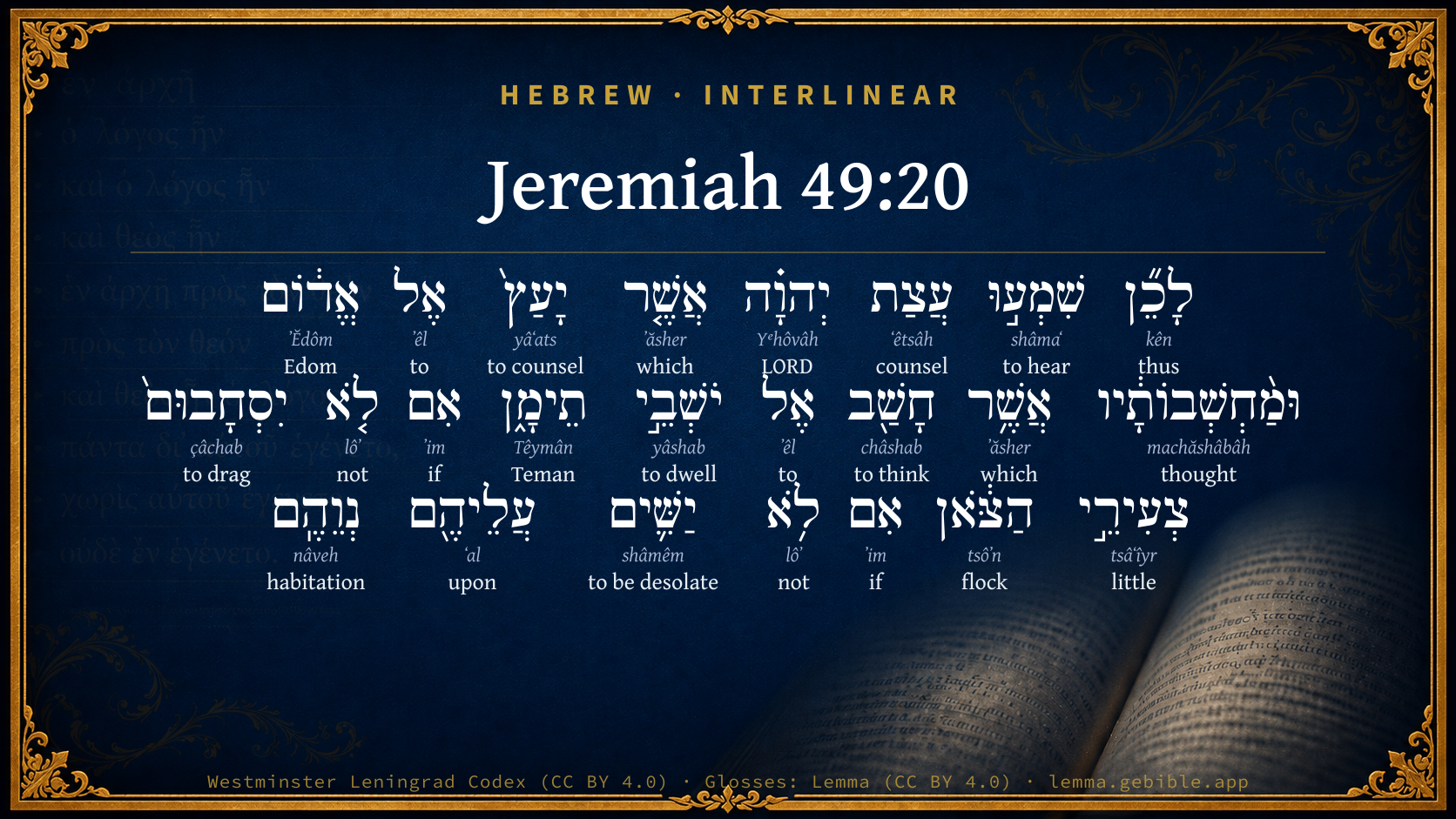
Jeremiah 49:20

Hebrew (Westminster Leningrad Codex) Jeremiah 49:20 appears in the Hebrew Old Testament. The text above is from the Westminster Leningrad Codex. Each word links to its Strong’s number, a concise gloss, and parsing drawn from the Open Scriptures Hebrew Bible morphology. Click any word for its full Brown-Driver-Briggs (BDB) entry.
Download image
Cite this verse

Jeremiah 49:20 (World English Bible). Public Domain. Lemma interlinear Bible study tool, https://lemma.gebible.app/v/jeremiah/49/20.

Show BibTeX & RIS
BibTeX
RIS
English Translation
Therefore hear the counsel of Yahweh, that he has taken against Edom; and his purposes, that he has purposed against the inhabitants of Teman: Surely they shall drag them away, [even] the little ones of the flock; surely he shall make their habitation desolate over them.
World English Bible · Public Domain
Download a study sheet

One document with this verse’s original text, its word-by-word gloss line, the meaning frame, cross-references with their text, attributed commentary, and full source and license credits — printable, and it pastes into notes with its structure intact.

This verse Autodidact and up

Study sheet (.html) Plain text (.txt)

A passage Seminary Student

Up to 50 verses in one chapter. A passage sheet keeps up to 6 commentary sources and 12 cross-references per verse, in the order this page ranks them, and says so on the sheet whenever that leaves anything out. Ask for a single verse and you get the Autodidact verse sheet above.

Everything on this page stays free to read, with no account — the sheet is a download of what is already on screen, not access to it.

Want to remove ads? Support Godless Engineer
Compare translations 3

The same verse in 3 English versions, stacked beneath the original-language interlinear above. Click any original word for its lexicon entry.

Each is an independent rendering of the whole verse — the interlinear is not word-aligned to these translations.

Highlighted words mark where these versions differ — a whole-verse word diff, not a word-by-word alignment.

  • World English Bible Public Domain
    Therefore hear the counsel of Yahweh, that he has taken against Edom; and his purposes, that he has purposed against the inhabitants of Teman: Surely they shall drag them away, [even] the little ones of the flock; surely he shall make their habitation desolate over them.
  • King James Version Public Domain
    Therefore hear the counsel of the LORD, that he hath taken against Edom; and his purposes, that he hath purposed against the inhabitants of Teman: Surely the least of the flock shall draw them out: surely he shall make their habitations desolate with them.
  • unfoldingWord Literal Text CC BY-SA 4.0
    “So listen to the plans that Yahweh has decided against Edom, the plans that he has formed against the inhabitants of Teman. They will certainly be dragged away, even the smallest flock. Their pasturelands will be turned into ruined places.

unfoldingWord Literal Text — © unfoldingWord, licensed CC BY-SA 4.0. Word-aligned USFM3 via Door43 (git.door43.org/unfoldingWord/en_ult).

Versions to compare (up to 4)

3 of 4 selected

Show all 18 translations

Every available English version of this verse, each an independent rendering of the whole verse.

  • World English Bible Public Domain
    Therefore hear the counsel of Yahweh, that he has taken against Edom; and his purposes, that he has purposed against the inhabitants of Teman: Surely they shall drag them away, [even] the little ones of the flock; surely he shall make their habitation desolate over them.
  • Berean Standard Bible Public Domain
    Therefore hear the plans that the LORD has drawn up against Edom and the strategies He has devised against the people of Teman: Surely the little ones of the flock will be dragged away; certainly their pasture will be made desolate because of them.
  • Majority Standard Bible Public Domain
    Therefore hear the plans that the LORD has drawn up against Edom and the strategies He has devised against the people of Teman: Surely the little ones of the flock will be dragged away; certainly their pasture will be made desolate because of them.
  • King James Version Public Domain
    Therefore hear the counsel of the LORD, that he hath taken against Edom; and his purposes, that he hath purposed against the inhabitants of Teman: Surely the least of the flock shall draw them out: surely he shall make their habitations desolate with them.
  • American Standard Version (1901) Public Domain
    Therefore hear ye the counsel of Jehovah, that he hath taken against Edom; and his purposes, that he hath purposed against the inhabitants of Teman: Surely they shall drag them away, `even' the little ones of the flock; surely he shall make their habitation desolate over them.
  • Revised Version (1885) Public Domain
    Therefore hear ye the counsel of the LORD, that he hath taken against Edom; and his purposes, that he hath purposed against the inhabitants of Teman: Surely they shall drag them away, even the little ones of the flock; surely he shall make their habitation desolate with them.
  • Geneva Bible (1599) Public Domain
    Therefore heare the counsell of the Lord that hee hath deuised against Edom, and his purpose that hee hath conceiued against the inhabitants of Teman: surely the least of the flocke shall drawe them out: surely he shall make their habitations desolate with them.
  • Douay-Rheims (1899) Public Domain
    Therefore hear ye the counsel of the Lord, which he hath taken concerning Edom: and his thoughts which he hath thought concerning the inhabitants of Theman: surely the little ones of the flock shall cast them down, of a truth they shall destroy them with their habitation.
  • Young's Literal Translation Public Domain
    Therefore, hear ye the counsel of Jehovah, That He hath counselled concerning Edom, And His devices that He hath devised Concerning the inhabitants of Teman: Drag them out do not little ones of the flock, Make desolate over them doth he not their habitation?
  • Literal Standard Version CC BY-SA 4.0
    Therefore, hear the counsel of YHWH, || That He has counseled concerning Edom, || And His plans that He has devised || Concerning the inhabitants of Teman: Do little ones of the flock not drag them out, || Does He not make their habitation desolate?
  • Unlocked Literal Bible CC BY-SA 4.0
    “So listen to the plans that Yahweh has decided against Edom, the plans that he has formed against the inhabitants of Teman. They will certainly be dragged away, even the smallest flock. Their pasturelands will be turned into ruined places.
  • unfoldingWord Literal Text CC BY-SA 4.0
    “So listen to the plans that Yahweh has decided against Edom, the plans that he has formed against the inhabitants of Teman. They will certainly be dragged away, even the smallest flock. Their pasturelands will be turned into ruined places.
  • Darby Bible Public Domain
    Therefore hear the counsel of Jehovah, which he hath taken against Edom, and his purposes which he hath purposed against the inhabitants of Teman: The little ones of the flock shall certainly draw them away; he shall certainly make their habitation desolate for them.
  • World Messianic Bible Public Domain
    Therefore hear the counsel of the LORD, that he has taken against Edom, and his purposes that he has purposed against the inhabitants of Teman: Surely they will drag them away, the little ones of the flock. Surely he will make their habitation desolate over them.
  • Webster's Bible Public Domain
    Therefore hear the counsel of the LORD, that he hath taken against Edom; and his purposes, that he hath purposed against the inhabitants of Teman: surely the least of the flock shall draw them out: surely he shall make their habitations desolate with them.
  • Free Bible Version CC BY-SA 4.0
    So listen to what the Lord has planned to do to Edom and the people of Teman: Their children will be dragged away like lambs from the flock, and because of them their pasture will become a wasteland.
  • Bible in Basic English Public Domain
    For this cause give ear to the decision of the Lord which he has made against Edom, and to his purposes designed against the people of Teman: Truly, they will be pulled away by the smallest of the flock; truly, he will make waste their fields with them.
  • JPS Tanakh (1917) Public Domain
    Therefore hear ye the counsel of the LORD, that He hath taken against Edom; and His purposes, that He hath purposed against the inhabitants of Teman: Surely the least of the flock shall drag them away, surely their habitation shall be appalled at them.

Literal Standard Version (2020), Covenant Press — licensed CC BY-SA 4.0. Text via the HelloAO Bible API (eBible.org). Unlocked Literal Bible (unfoldingWord) — licensed CC BY-SA 4.0. Text via the HelloAO Bible API (eBible.org). unfoldingWord Literal Text — © unfoldingWord, licensed CC BY-SA 4.0. Word-aligned USFM3 via Door43 (git.door43.org/unfoldingWord/en_ult). Free Bible Version, Dr. Jonathan Gallagher — licensed CC BY-SA 4.0. Text via the HelloAO Bible API (eBible.org).

Word by word

More ways to search: Search by grammar → Find every occurrence → Compare this word →

Practice this passage: Drill this verse → Learn its vocabulary →

יִסְחָבוּם֙
çâchab
H5498
“to drag · them”
Verb, Qal, Imperfect, 3rd Person, Masculine, Plural + Suffix, Personal, 3rd Person, Masculine, Plural
Part of Speech
Verb
Stem
Qal
Form
Imperfect
Person
3rd Person
Gender
Masculine
Number
Plural
Full BDB Definition

Origin: a primitive root

TWOT: 1482

(Qal) to drag
  1. לָכֵ֞ן kên H3651 “to/for · thus” Preposition + Adverb
  2. שִׁמְע֣וּ shâmaʻ H8085 “hear” Verb, Qal, Imperative, 2nd Person, Masculine, Plural
  3. עֲצַת ʻêtsâh H6098 “counsel of” Noun, Common, Feminine, Singular, Construct
  4. יְהוָ֗ה Yᵉhôvâh H3068 “LORD” Noun, Proper
  5. אֲשֶׁ֤ר ʼăsher H834 “which” Particle, Relative
  6. יָעַץ֙ yâʻats H3289 “to counsel” Verb, Qal, Perfect, 3rd Person, Masculine, Singular
  7. אֶל ʼêl H413 “to” Preposition
  8. אֱד֔וֹם ʼĔdôm H123 “Edom” Noun, Proper
  9. וּמַ֨חְשְׁבוֹתָ֔יו machăshâbâh H4284 “and · thoughts · his” Conjunction + Noun, Common, Feminine, Plural, Construct + Suffix, Personal, 3rd Person, Masculine, Singular
  10. אֲשֶׁ֥ר ʼăsher H834 “which” Particle, Relative
  11. חָשַׁ֖ב châshab H2803 “to think” Verb, Qal, Perfect, 3rd Person, Masculine, Singular
  12. אֶל ʼêl H413 “to” Preposition
  13. יֹשְׁבֵ֣י yâshab H3427 “dwelling” Verb, Qal, Participle Active, Masculine, Plural, Construct
  14. תֵימָ֑ן Têymân H8487 “Teman” Noun, Proper
  15. אִם ʼim H518 “if” Conjunction
  16. לֹ֤א lôʼ H3808 “not” Particle, Negative
  17. צְעִירֵ֣י tsâʻîyr H6810 “little of” Adjective, Adjective, Masculine, Plural, Construct
  18. הַצֹּ֔אן tsôʼn H6629 “the · flock” Particle, Definite Article + Noun, Common, Both, Singular, Absolute
  19. אִם ʼim H518 “if” Conjunction
  20. לֹ֥א lôʼ H3808 “not” Particle, Negative
  21. יַשִּׁ֛ים shâmêm H8074 “to be desolate” Verb, Hiphil, Imperfect, 3rd Person, Masculine, Singular
  22. עֲלֵיהֶ֖ם ʻal H5921 “upon · them” Preposition + Suffix, Personal, 3rd Person, Masculine, Plural
  23. נְוֵהֶֽם nâveh H5116 “habitation · their” Noun, Common, Both, Singular, Construct + Suffix, Personal, 3rd Person, Masculine, Plural

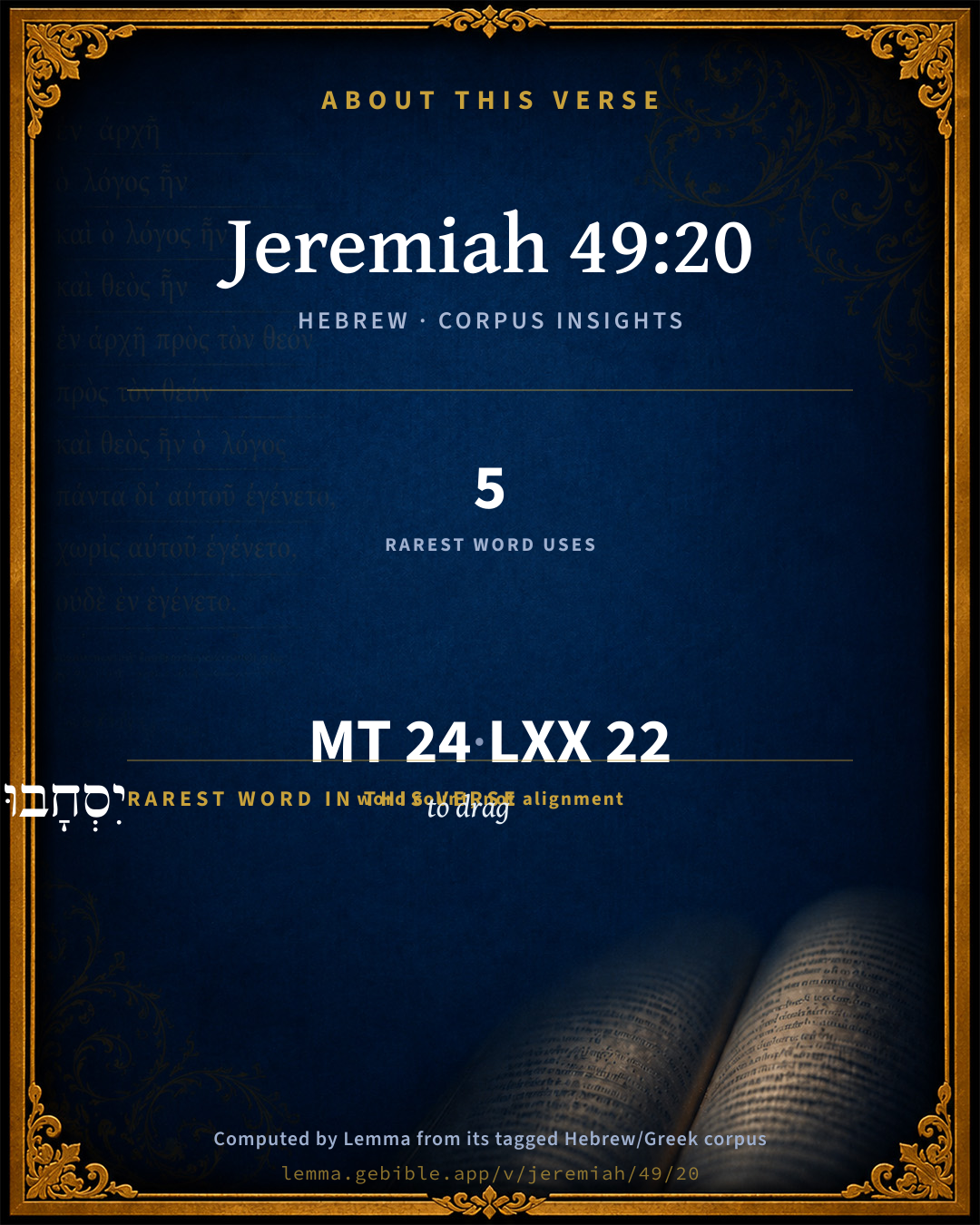
About this verse

These counts appear in no published source. They are computed here, from the morphology-tagged text and Lemma’s own curated glosses. What Lemma adds →

24
words
20
distinct lemmas
Prophets
section

Notable vocabulary

The rarest word here is יִסְחָבוּם֙ to drag H5498 — appearing just 5 times in the whole Hebrew Bible.

Shared distinctive vocabulary

יִסְחָבוּם֙ to drag H5498 occurs in 5 verses of the Hebrew Bible. Also found in:

Grammatical profile

  • 6 verbs
  • 7 nouns
  • 1 adjective
  • 3 prepositions
  • 2 conjunctions
  • 1 adverb
  • 4 particles

Verb forms

  • שִׁמְע֣וּ Qal · Imperative
  • יָעַץ֙ Qal · Perfect
  • חָשַׁ֖ב Qal · Perfect
  • יֹשְׁבֵ֣י Qal · Participle Active
  • יִסְחָבוּם֙ Qal · Imperfect
  • יַשִּׁ֛ים Hiphil · Imperfect

Repetition

Words recur within this verse — often emphatic in Hebrew:

  • אֲשֶׁ֤ר which H834 ×2
  • אֶל to H413 ×2
  • אִם if H518 ×2
  • לֹ֤א not H3808 ×2

Hebrew & Septuagint length

In the original languages it is 24 Hebrew tokens and 22 Greek tokens — but the two are counted differently (Hebrew bundles its prefixes and suffixes into one token; the Greek is in lemma form), so that isn’t a like-for-like length.

Cross-references

15

Topical passages linked to Jeremiah 49:20 in the Treasury of Scripture Knowledge — connected by theme and wording, ordered by reader-vote popularity; previews shown in the World English Bible.

  • Jeremiah 50:45 Therefore hear the counsel of Yahweh, that he has taken against Babylon; and his purposes, that he has purposed against the land of the Chaldeans: Surely they shall drag them away, [even] the little ones of the flock; surely he shall make their habitation desolate over them.
  • Malachi 1:3–4 but Esau I hated, and made his mountains a desolation, and gave his heritage to the jackals of the wilderness."
  • Jeremiah 49:7 Of Edom. Thus says Yahweh of Hosts: Is wisdom no more in Teman? is counsel perished from the prudent? is their wisdom vanished?
  • Job 6:19–20 The caravans of Tema looked, The companies of Sheba waited for them.
  • Psalms 33:11 The counsel of Yahweh stands fast forever, The thoughts of his heart to all generations.
  • Proverbs 19:21 There are many plans in a man's heart, But Yahweh's counsel will prevail.
  • Isaiah 14:24–27 Yahweh of Hosts has sworn, saying, Surely, as I have thought, so shall it happen; and as I have purposed, so shall it stand:
  • Isaiah 46:10–11 declaring the end from the beginning, and from ancient times things that are not [yet] done; saying, My counsel shall stand, and I will do all my pleasure;
  • Jeremiah 37:10 For though you had struck the whole army of the Chaldeans who fight against you, and there remained but wounded men among them, yes would they rise up every man in his tent, and burn this city with fire.
  • Jeremiah 49:13 For I have sworn by myself, says Yahweh, that Bozrah shall become an astonishment, a reproach, a waste, and a curse; and all the cities of it shall be perpetual wastes.
  • Jeremiah 49:17–18 Edom shall become an astonishment: everyone who passes by it shall be astonished, and shall hiss at all the plagues of it.
  • Zechariah 4:6 Then he answered and spoke to me, saying, "This is the word of Yahweh to Zerubbabel, saying, 'Not by might, nor by power, but by my Spirit,' says Yahweh of Hosts.
  • Acts 4:28 to do whatever your hand and your council foreordained to happen.
  • 1 Corinthians 1:27–29 but God chose the foolish things of the world that he might put to shame those who are wise. God chose the weak things of the world, that he might put to shame the things that are strong;
  • Ephesians 1:11 in whom also we were assigned an inheritance, having been foreordained according to the purpose of him who works all things after the counsel of his will;

Cross-references courtesy of OpenBible.info (CC BY 4.0).

Hebrew and Greek witnesses Masoretic Hebrew ↔ Greek Septuagint

The same verse in the two great witnesses to the Old Testament, shown verse-for-verse.

These are two independent witnesses, not word-aligned to each other, and the Septuagint is shown in lemma (dictionary) form.

Hebrew Jeremiah 49:20 Masoretic · Westminster Leningrad Codex

לָכֵ֞ן שִׁמְע֣וּ עֲצַת יְהוָ֗ה אֲשֶׁ֤ר יָעַץ֙ אֶל אֱד֔וֹם וּמַ֨חְשְׁבוֹתָ֔יו אֲשֶׁ֥ר חָשַׁ֖ב אֶל יֹשְׁבֵ֣י תֵימָ֑ן אִם לֹ֤א יִסְחָבוּם֙ צְעִירֵ֣י הַצֹּ֔אן אִם לֹ֥א יַשִּׁ֛ים עֲלֵיהֶ֖ם נְוֵהֶֽם

Therefore hear the counsel of Yahweh, that he has taken against Edom; and his purposes, that he has purposed against the inhabitants of Teman: Surely they shall drag them away, [even] the little ones of the flock; surely he shall make their habitation desolate over them.

World English Bible · Public Domain

Greek LXX Structure differs

In the Septuagint, Jeremiah is about an eighth shorter than the Hebrew and arranges its material differently — the Oracles Against the Nations (Hebrew chapters 46–51) appear in the middle of the Greek book, after 25:13. Because the chapter and verse boundaries do not line up, a verse-for-verse comparison with the Hebrew is not shown.

A verse-for-verse comparison isn’t shown here because the chapters and verses don’t line up. Switch to the LXX edition with the MT / LXX toggle above to read the Greek directly.

Hebrew: Westminster Leningrad Codex (CC BY 4.0). Greek: Septuagint (public domain); English from a public-domain English Septuagint. How the Septuagint differs from the Hebrew →

Targum (Aramaic paraphrase)

1

The Targum is the ancient Jewish Aramaic paraphrase of the Hebrew Scriptures — an interpretive translation, not the Hebrew text itself. Onkelos (literal) and Pseudo-Jonathan (expansive) render the Torah, and Jonathan the Prophets. Coverage is partial: where no permissively-licensed English translation exists for a verse, only the Aramaic is shown. This is verse-level text, not a word-by-word alignment to the Hebrew.

  1. Targum Jonathan Prophets (Joshua–Malachi)
    בְּכֵן שְׁמָעוּ מַלְכָא דַייָ דִמְלַךְ עַל אֱדוֹם וּמַחְשַׁבְתֵּיהּ דַחֲשֵׁיב עַל יַתְבֵי אַרְעָא דָרוֹמָא אִם לָא יְגַרְרוּן וִיקַטְלוּן תַּקִיפֵי עַמָא אִם לָא יִצְדוּן עֲלֵיהוֹן מְדוֹרֵהוֹן:

    (no public-domain English translation for this verse)

    Targum Jonathan — Aramaic: “Mikraot Gedolot” (public domain). English: “Sefaria Community Translation” (CC0 1.0 (public-domain dedication)); “London "Chaldee Paraphrase," 1871” (public domain). Text via Sefaria.

Commentary

Notes on Jeremiah 49:20 from classic Christian and Jewish commentators (each source and its license shown beneath its notes). The classic Christian expositions comment on the surrounding passage and are grouped to its opening verse, so a note may address several verses; the Jewish commentaries on the Tanakh (Rashi and others) are per-verse, so they appear only where the commentator wrote on this verse.

Lemma curates 59 commentaries, every one of them public domain or Creative Commons licensed, each selected and text-cleaned for this edition rather than reprinted as found. About our sources →

Trapp's Complete Commentary

John Trapp

Jer 49:20 Therefore hear the counsel of the LORD, that he hath taken against Edom; and his purposes, that he hath purposed against the inhabitants of Teman: Surely the least of the flock shall draw them out: surely he shall make their habitations desolate with them.

Ver. 20. Therefore hear the counsel.] Now by counsel things are established.

And his purposes.] Or, Contrivements that he hath contrived. {a}

Surely the least of the flock.] The meanest of Nebuchadnezzar’s men shall drag them out of their shelters, as dogs do a dead carcase.

{a} Aνθρωποπαθεια.

John Trapp, A Commentary or Exposition upon All the Books of the Old and New Testament (1647–1656) — public domain. Text from a community e-Sword module.

Joseph Benson's Commentary

Jer 49:20-22. Therefore hear the counsel of the Lord — Let them, the Edomites, hear and consider what God hath purposed against them. Surely the least of the flock shall draw them out — By the least of the flock, may be here understood the common soldiers in the Chaldean army, any one of whom, he says, shall have courage and strength enough to conquer the Idumeans, and draw them to slaughter or captivity. The earth is moved at the noise of their fall — The neighbouring countries are astonished at it. The prophet compares the destruction of Idumea to the fall of a great building, which affrights those that are near it. The noise thereof was heard in the Red sea — The borders of Idumea reached to the Red sea. Behold he shall fly as the eagle — The suddenness and rapidity with which Nebuchadnezzar, or his general, Nebuzar-adan, marched and fell upon Edom, are described in this verse: see note on Jer 48:40-41.

Joseph Benson's Commentary on the Old and New Testaments (1811–1818) — public domain. Text from a community e-Sword module.

Geneva Bible (1599)

Geneva Bible translators

They shall not be able to resist his petty captains.

To visit, the enemy.

Geneva Bible (1599) marginal notes — public domain. Text via Bolls.life.

Jamieson, Fausset & Brown

Robert Jamieson, A. R. Fausset & David Brown

least of the flock--the weakest and humblest of the Chaldean host. Compare Jer 6:3, where the hostile leaders and their hosts are called "shepherds and their flocks."

draw . . . out--"shall drag them away captive" [GROTIUS]; shall drag them to and fro, as a lion (Jer 49:19) does feeble sheep [MAURER].

with them--that is, the habitation which they possess.

Jamieson, Fausset & Brown — Commentary Critical and Explanatory on the Whole Bible (1871) — public domain (CC PDM 1.0). Text via the HelloAO Bible API.

Adam Clarke's Commentary

Verse 20. The inhabitants of Teman] Taken here for the whole of Idumea. These are a kind of synonyms which prevent monotony, and give variety to the poet's versification.

Surely the least of the flock shall draw them out] They shall be like timid sheep; the weakest foe shall overcome them.

Adam Clarke's Commentary on the Bible (1810–1826) — public domain. Text from a community e-Sword/MySword module.

John Calvin's Commentaries

The Prophet proceeds with his subject respecting the Idumeans and their destruction; but he makes a preface in order to gain credit to his words. He then says that this was God’s counsel and his thoughts. He speaks after the manner of men; for he transfers to God what does not properly belong to his nature; for God does not deliberate or consult, but has once for all decreed before the creation of the world what he will do; nor does he toss about his thoughts in all directions, as men do, who do not immediately see what is right or what ought to be done. Nothing of this kind belongs to God. But this way of speaking is sufficiently common, when what strictly applies to man is transferred to God. It ought at the same time to be observed, that this is not done without reason, for when God speaks by his servants, we ever raise doubts, “Is that said in earnest — can it be changed — is it revocable?” In short, we receive what is light and frivolous, and immediately give credit to it; but when God declares anything, we subject it to comments, and raise up a hundred disputes on every subject, “Oh, but this or that may happen; and it may be that God does not speak in earnest.” As, then, men never acquiesce in God’s word, as they ought to do, the Prophets borrow from common use these forms of speech, that God had thus thought, that he had thus decreed.

The meaning is, that whatever Jeremiah had hitherto predicted of the Idumeans, could not be retracted, for it was a settled decree, so fixed as though God had thought of it for a hundred or thousand years.

He now adds, the inhabitants of Teman; by whom he means the Idumeans. But the repetition deserves notice: he first mentions Edom, and then the inhabitants of Teman. And Teman and Seir are sometimes the same. If not, cast them down, etc.; the verb properly means to draw, and to draw in reproach and contempt, as when a carcase is drawn through the mire. Then the Prophet means here a throwing down, accompanied with reproach. And he says, If not, draw them forth shall the least of the flock He speaks here otherwise than before; for he called the Chaldeans chosen, and extolled their strength, that he might strip the Idumeans of their vain confidence; but he now proceeds further and says, that there was no need of great valor to put that nation to flight, because even the least could lay them prostrate on the ground, and also draw them in disgrace through the land. Now, though the manner of speaking is different, yet the meaning remains the same, even that God would arm the Chaldeans with courage, so that they would easily destroy the land of Edom; and then, that though the Chaldeans should not, according to the estimation of men, excel in valor, they would yet be superior to the Idumeans, because victory was in God’s hand, and he could work by means of flies as well as by men, and by children as well as by giants.

The formula of swearing is adopted, when he says, If not, draw them, etc. It is an elliptical phrase, as it has often been observed; such an obtestation as this is understood, “Believe me not hereafter,” or, “Regard me not as God.” In short, it is a form of an oath, which is a stronger affirmation than if he had simply said, “Draw them forth shall the least of the flock.”

Some render the last clause, “If not, set shall they,” etc.; as though the verb came from שום, shum, to put, to set; but it is from שמם, shemem, or ימם, imem, as some think, though rather שמם, shemem The Prophet, I have no doubt, means, that they would destroy, or lay waste over them their dwellings. It follows —

John Calvin's Commentaries (1540-1563) — public domain. Text from the Calvin Translation Society English edition (1840s-50s) via the Christian Classics Ethereal Library (ccel.org). Calvin's coverage is partial (roughly two-thirds of the Bible); uncommented books and verses are honest gaps, never fabricated. The 19th-century editor's footnotes and remarks are omitted so the notes are faithfully Calvin's own voice.

Ellicott's Commentary for English Readers

(20) Surely.—Literally, If not . . .”—the strongest Hebrew idiom of asseveration.

The least of the flock shall draw them out . . .—The English is obscure, probably because the object of the verb has been taken as its subject. Better, Surely they (i.e., the Chaldæan invaders) will vex them, the feeble ones of the flock; surely he will make their pasturage terror-stricken at them. The thought expressed is that the very fields of Edom would, as it were, shudder at the cruelty of their conquerors. It is noticeable that the whole passage is repeated in Jer_50:44-45, and is there applied to Babylon.

A Bible Commentary for English Readers, edited by Charles John Ellicott (1878–1897) — public domain. Text from a community e-Sword module.

The Cambridge Bible for Schools and Colleges

gen. ed. J. J. S. Perowne

20. they shall drag … of the flock] mg. is scarcely intelligible. The figure is that of dogs or other fierce beasts seizing the most helpless of the sheep. Cp. Jer_15:3. But Du. followed by Co. understands the meaning to be that shepherd lads (instead of “little ones of the flock”) shall be dragged away.

habitation] homestead. See on Jer_49:19.

The Cambridge Bible for Schools and Colleges (gen. ed. J. J. S. Perowne; Cambridge University Press, 1878–1918) — public domain. Text from a community e-Sword module.

John Gill's Exposition

Therefore hear the counsel of the Lord that he hath taken against Edom,.... The decree of the Lord; the purpose and resolution he had taken up in his heart against the Idumeans, which was wisely formed, and upon just and good grounds:

and his purposes that he hath purposed against the inhabitants of Teman; a principal place in Edom, the inhabitants of which were famous for their wisdom, Jer 49:7; and therefore are here particularly mentioned; there being no wisdom, nor understanding, nor counsel against the Lord, so as to frustrate his purposes and designs, which have always their effect, Pro 19:21;

surely the least of the flock shall draw them out; not the Persians, the least of the sons of Japheth, as some Rabbins in Jarchi (c); nor the Israelites, as Kimchi, particularly Rachel's sons, or the posterity of Joseph and Benjamin; but the common soldiers, the weakest and most feeble in the Chaldean army: as princes are compared to shepherds, their people are like flocks; and now the least of these in the king of Babylon's army should be a match for the strongest of the Edomites; and should draw them out of their habitations, as dogs or wolves drag sheep out of the folds, and draw about dead carcasses, and devour them. The words are in the form of an oath, "if the least of the flock do not draw them out"; that is, as I live they shall; or I swear by myself they shall certainly do it; so the Targum,

"if they do not draw and kill the mighty of the people:''

surely he shall make their habitations desolate with them; or, "their folds"; the sheep shall be destroyed, and their folds shall be demolished; that is, the inhabitants of Edom shall be slain with the sword, and their cities, towns, and villages, shall be laid waste.

(c) Vid. T. Bab. Yoma, fol. 10. 1.

John Gill's Exposition of the Whole Bible (1746–1763) — public domain (CC PDM 1.0). Text via the HelloAO Bible API.

Haydock's Catholic Bible Commentary

Little. Chaldean, "chiefs of the people." Tsair (Haydock) is supposed to have this sense, Micheas v. 2. (Calmet) --- But the weakest of the Chaldeans will be an overmatch for Edom. (Haydock)

George Leo Haydock (1774–1849), Haydock's Catholic Family Bible and Commentary, 1859 edition — public domain. Excludes Psalms (Douay-Rheims chapter numbering differs from Protestant) and Deuterocanonical books (Catholic canon only).

Matthew Poole's English Annotations

Edom and Teman in this verse signify both the same thing; God calls to men to hear the resolutions he had taken up against the Edomites, resolutions as wise and steady as if they had been taken upon the wisest counsels and deliberation.

Surely the least of the flock shall draw them out; God is resolved to drive out the Edomites, and the least of Nebuchadnezzar’s forces shall drag them out of their lurking-places; and God will make the place where they dwell a desolation.

Matthew Poole's English Annotations on the Holy Bible (1683–1685) — public domain. Text from a community e-Sword/MySword module.

Whedon's Commentary on the Bible

Daniel D. Whedon

20. The least of the flock shall draw them out — The latter part of this verse is not intelligibly rendered in the Authorized Version. It should be, They shall worry them, the feeble ones of the flock; surely he shall lay waste their habitation over them.

Daniel D. Whedon (gen. ed.), Commentary on the Old and New Testaments (1874–1909) — public domain. Text from a community e-Sword module.

The Pulpit Commentary

The counsel of the Lord. At first sight this appears to detract from the perfection of Jehovah. But another prophet declares that the Divine "counsels" are "framed" from eternity. (Jer_25:34)

The Pulpit Commentary (1880–1919), ed. H.D.M. Spence-Jones & Joseph S. Exell — public domain. Text from a community e-Sword module.

John Wesley's Explanatory Notes

Teman - Edom and Teman signify the same thing. The least - The least of Nebuchadrezzar's forces shall drag them out of their lurking places.

John Wesley, Explanatory Notes Upon the Whole Bible (1754–1765) — public domain. Text via the GEBible commentary corpus.

unfoldingWord translationNotes

Door43 World Missions Community

the inhabitants of Teman

"the people who live in Teman"

Teman

Translate the name of this city as you did in Jeremiah 49:7.

They will certainly be dragged away, even the smallest flock

This continues speaking of Yahweh punishing the people of Edom as if he would come like a lion and attack the sheep. This can be stated in active form. AT: "He will drag them away, even the smallest flock" (See: Metaphor and Active or Passive)

even the smallest flock

Here the youngest and weakest people of Edom are spoken of as if they are the smallest flock of sheep. AT: "even the weakest and the smallest people" (See: Metaphor)

Their pasturelands will be turned into ruined places

Here the land of Edom is spoken of as if it were pasturelands for flocks. This can be stated in active form. AT: "He will turn their pasturelands into ruined places" or "He will completely get rid of the people who live there" (See: Metaphor and Active or Passive)

translationWords

Yahweh

Edom

flocks

ruin

unfoldingWord translationNotes — © Distant Shores Media and the Door43 World Missions Community, licensed CC BY-SA 4.0. Source: git.door43.org/Door43/en_tn.

Rashi

Rabbi Shlomo Yitzchaki (Rashi)

if...not An expression of ‘indeed.’

drag them Heb. יסחבום.

the young of the flock. The despised of the nations, and our Rabbis [Yoma 10] expounded that it refers to Persia, who was the youngest of Japheth’s sons.

make desolate Heb. ישים, an expression of desolation (שממה).

Rashi on the Tanakh — English translations: “The Judaica Press complete Tanach with Rashi, translated by A. J. Rosenberg” (CC BY 4.0); “Pentateuch with Rashi's commentary by M. Rosenbaum and A.M. Silbermann, 1929-1934” (public domain); “The Metsudah Tanach series, Lakewood, N.J” (CC BY 4.0); and “The Book of Joshua, Metsudah Publications, 1997” (CC BY 4.0). Text via Sefaria.

Lesson kit

Teaching starters — assembled from the data on this page, not authored interpretation. Every prompt links to the verse data it draws on. Edit before teaching.

Jeremiah, in the Prophets, opens this verse with 24 words (20 distinct Hebrew lemmas). Its most distinctive word is çâchab (“to drag”). A historical commentator’s framing appears above. Read the whole chapter for the surrounding context.

Discussion questions

  1. What does “to drag” (çâchab) contribute to the verse as a whole?
  2. 2 Samuel 17:13 shares the word «to drag» with this verse. How do the two illuminate each other?
  3. “which” occurs 2× in this one verse. What is the effect of the repetition?
  4. These translations render this verse differently. What is at stake in choosing one wording over another?
  5. The verb «שִׁמְע֣וּ» is Qal Imperative. How does its form color the action?
  6. Reading how Trapp's Complete Commentary and Joseph Benson's Commentary read this verse, where do the two commentators agree and where do they part?

Things to notice

Reading settings

Reading text

Shown beneath each verse's original-language words.

Old Testament
Old Testament edition

Read the OT as the Masoretic Hebrew (MT) or the Greek Septuagint (LXX).

English shown for the Greek Septuagint (in the Hebrew ↔ Greek comparison).

Comparing translations? Open the Compare panel on any verse page to stack up to four side by side.