
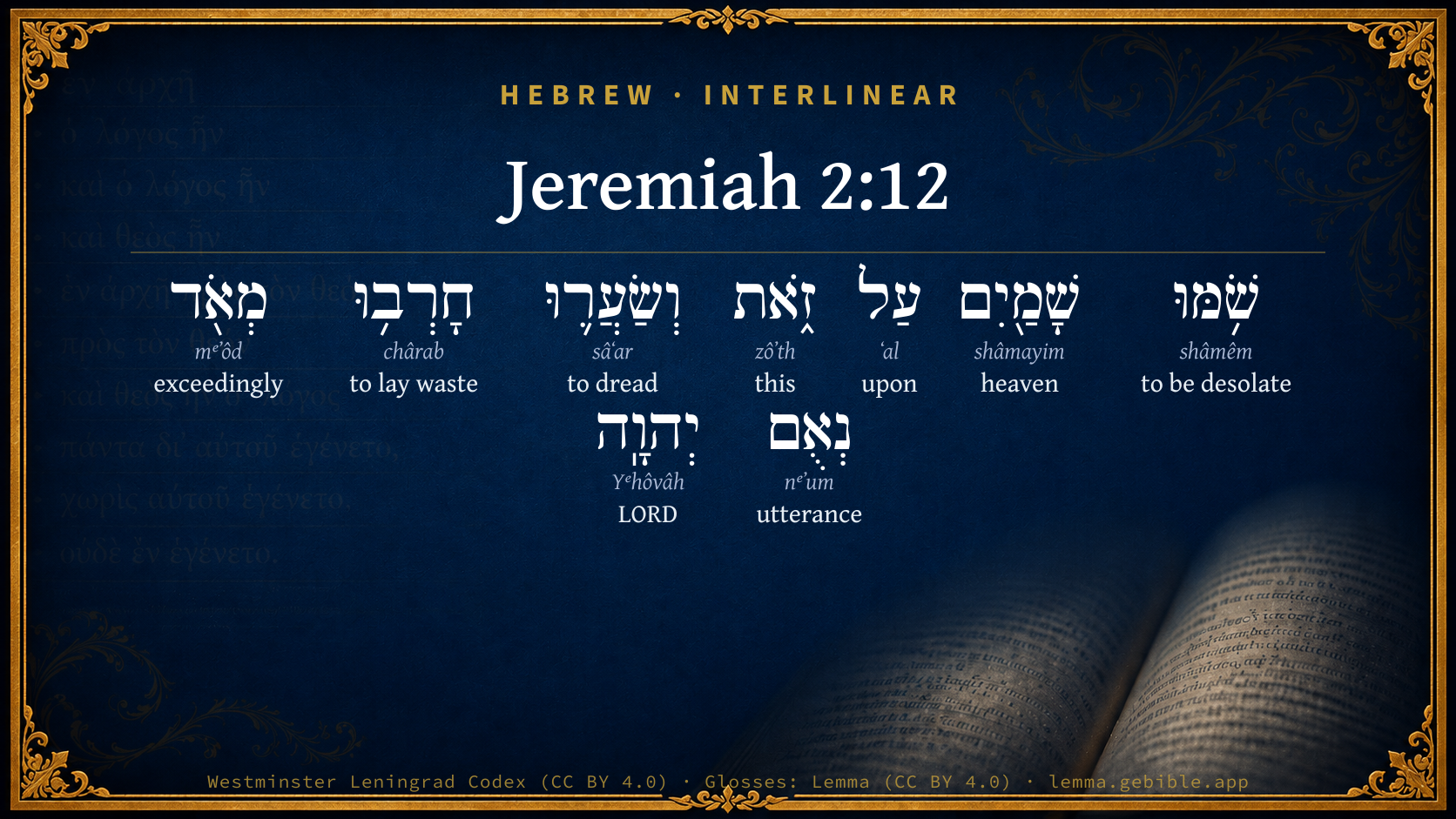
Jeremiah 2:12

Hebrew (Westminster Leningrad Codex) Jeremiah 2:12 appears in the Hebrew Old Testament. The text above is from the Westminster Leningrad Codex. Each word links to its Strong’s number, a concise gloss, and parsing drawn from the Open Scriptures Hebrew Bible morphology. Click any word for its full Brown-Driver-Briggs (BDB) entry.
Download image
Cite this verse

Jeremiah 2:12 (World English Bible). Public Domain. Lemma interlinear Bible study tool, https://lemma.gebible.app/v/jeremiah/2/12.

Show BibTeX & RIS
BibTeX
RIS
English Translation
Be astonished, you heavens, at this, and be horribly afraid, be you very desolate, says Yahweh.
World English Bible · Public Domain
Download a study sheet

One document with this verse’s original text, its word-by-word gloss line, the meaning frame, cross-references with their text, attributed commentary, and full source and license credits — printable, and it pastes into notes with its structure intact.

This verse Autodidact and up

Study sheet (.html) Plain text (.txt)

A passage Seminary Student

Up to 50 verses in one chapter. A passage sheet keeps up to 6 commentary sources and 12 cross-references per verse, in the order this page ranks them, and says so on the sheet whenever that leaves anything out. Ask for a single verse and you get the Autodidact verse sheet above.

Everything on this page stays free to read, with no account — the sheet is a download of what is already on screen, not access to it.

Want to remove ads? Support Godless Engineer
Compare translations 3

The same verse in 3 English versions, stacked beneath the original-language interlinear above. Click any original word for its lexicon entry.

Each is an independent rendering of the whole verse — the interlinear is not word-aligned to these translations.

Highlighted words mark where these versions differ — a whole-verse word diff, not a word-by-word alignment.

  • World English Bible Public Domain
    Be astonished, you heavens, at this, and be horribly afraid, be you very desolate, says Yahweh.
  • King James Version Public Domain
    Be astonished, O ye heavens, at this, and be horribly afraid, be ye very desolate, saith the LORD.
  • unfoldingWord Literal Text CC BY-SA 4.0
    Be appalled, heavens, at this, and shudder, be very desolate! —The declaration of Yahweh.

unfoldingWord Literal Text — © unfoldingWord, licensed CC BY-SA 4.0. Word-aligned USFM3 via Door43 (git.door43.org/unfoldingWord/en_ult).

Versions to compare (up to 4)

3 of 4 selected

Show all 18 translations

Every available English version of this verse, each an independent rendering of the whole verse.

  • World English Bible Public Domain
    Be astonished, you heavens, at this, and be horribly afraid, be you very desolate, says Yahweh.
  • Berean Standard Bible Public Domain
    Be stunned by this, O heavens; be shocked and utterly appalled,” declares the LORD.
  • Majority Standard Bible Public Domain
    Be stunned by this, O heavens; be shocked and utterly appalled,” declares the LORD.
  • King James Version Public Domain
    Be astonished, O ye heavens, at this, and be horribly afraid, be ye very desolate, saith the LORD.
  • American Standard Version (1901) Public Domain
    Be astonished, O ye heavens, at this, and be horribly afraid, be ye very desolate, saith Jehovah.
  • Revised Version (1885) Public Domain
    Be astonished, O ye heavens, at this, and be horribly afraid, be ye very desolate, saith the LORD.
  • Geneva Bible (1599) Public Domain
    O yee heauens, be astonied at this: bee afraid and vtterly confounded, sayeth the Lord.
  • Douay-Rheims (1899) Public Domain
    Be astonished, O ye heavens, at this, and ye gates thereof, be very desolate, saith the Lord.
  • Young's Literal Translation Public Domain
    Be astonished, ye heavens, at this, Yea, be frightened, be greatly wasted, An affirmation of Jehovah.
  • Literal Standard Version CC BY-SA 4.0
    Be astonished, you heavens, at this, || Indeed, be frightened, be greatly desolated,” || A declaration of YHWH.
  • Unlocked Literal Bible CC BY-SA 4.0
    Shudder, heavens, because of this! Be shocked and horrified—this is Yahweh's declaration.
  • unfoldingWord Literal Text CC BY-SA 4.0
    Be appalled, heavens, at this, and shudder, be very desolate! —The declaration of Yahweh.
  • Darby Bible Public Domain
    Be astonished, ye heavens, at this, and shudder; be amazed very much, saith Jehovah.
  • World Messianic Bible Public Domain
    “Be astonished, you heavens, at this and be horribly afraid. Be very desolate,” says the LORD.
  • Webster's Bible Public Domain
    Be astonished, O ye heavens, at this, and be horribly afraid, be ye very desolate, saith the LORD.
  • Free Bible Version CC BY-SA 4.0
    You heavens, you should be appalled, shocked and horrified! declares the Lord.
  • Bible in Basic English Public Domain
    Be full of wonder, O heavens, at this; be overcome with fear, be completely waste, says the Lord.
  • JPS Tanakh (1917) Public Domain
    Be astonished, O ye heavens, at this, and be horribly afraid, be ye exceeding amazed, saith the LORD.

Literal Standard Version (2020), Covenant Press — licensed CC BY-SA 4.0. Text via the HelloAO Bible API (eBible.org). Unlocked Literal Bible (unfoldingWord) — licensed CC BY-SA 4.0. Text via the HelloAO Bible API (eBible.org). unfoldingWord Literal Text — © unfoldingWord, licensed CC BY-SA 4.0. Word-aligned USFM3 via Door43 (git.door43.org/unfoldingWord/en_ult). Free Bible Version, Dr. Jonathan Gallagher — licensed CC BY-SA 4.0. Text via the HelloAO Bible API (eBible.org).

Word by word

More ways to search: Search by grammar → Find every occurrence → Compare this word →

Practice this passage: Drill this verse → Learn its vocabulary →

וְשַׂעֲר֛וּ
sâʻar
H8175
“and · dread”
Conjunction + Verb, Qal, Imperative, 2nd Person, Masculine, Plural
Part of Speech
Conjunction + Verb
Stem
Qal
Form
Imperative
Person
2nd Person
Gender
Masculine
Number
Plural
Full BDB Definition

Origin: a primitive root

TWOT: 2274d , 2275 , 2276

to storm, shiver, dread, bristle (with horror), be very afraid - (Qal) - to bristle (with horror) - to dread - to storm away, sweep away, whirl away - (Qal) - to sweep away - to storm away (of God's action against the wicked) (figuratively) - (Niphal) to be stormy, be tempestuous (exceedingly) - (Piel) to whirl away, be stormed away - (Hithpael) to storm against, come as a storm
  1. שֹׁ֥מּוּ shâmêm H8074 “be desolate” Verb, Qal, Imperative, 2nd Person, Masculine, Plural
  2. שָׁמַ֖יִם shâmayim H8064 “heaven(s)” Noun, Common, Masculine, Plural, Absolute
  3. עַל ʻal H5921 “upon” Preposition
  4. זֹ֑את zôʼth H2063 “this” Pronoun, Demonstrative, Feminine, Singular
  5. חָרְב֥וּ chârab H2717 “lay waste” Verb, Qal, Imperative, 2nd Person, Masculine, Plural
  6. מְאֹ֖ד mᵉʼôd H3966 “exceedingly” Adverb
  7. נְאֻם nᵉʼum H5002 “utterance of” Noun, Common, Masculine, Singular, Construct
  8. יְהוָֽה Yᵉhôvâh H3068 “LORD” Noun, Proper

About this verse

These counts appear in no published source. They are computed here, from the morphology-tagged text and Lemma’s own curated glosses. What Lemma adds →

9
words
9
distinct lemmas
Prophets
section

Notable vocabulary

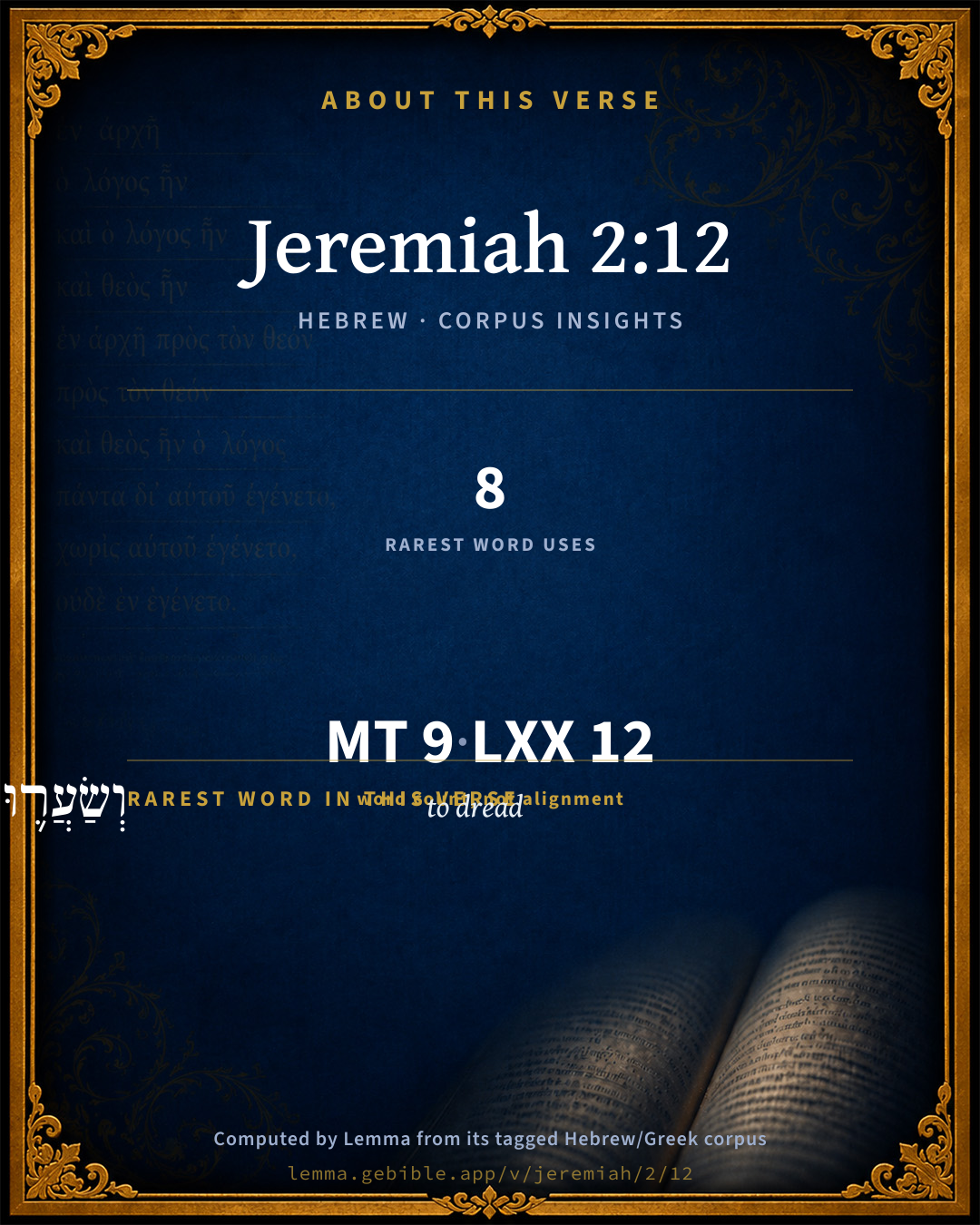
The rarest word here is וְשַׂעֲר֛וּ to dread H8175 — appearing just 8 times in the whole Hebrew Bible.

Shared distinctive vocabulary

וְשַׂעֲר֛וּ to dread H8175 occurs in 8 verses of the Hebrew Bible. Also found in:

Grammatical profile

  • 3 verbs
  • 3 nouns
  • 1 pronoun
  • 1 preposition
  • 1 adverb

Verb forms

  • שֹׁ֥מּוּ Qal · Imperative
  • וְשַׂעֲר֛וּ Qal · Imperative
  • חָרְב֥וּ Qal · Imperative

Hebrew & Septuagint length

In the original languages it is 9 Hebrew tokens and 12 Greek tokens — but the two are counted differently (Hebrew bundles its prefixes and suffixes into one token; the Greek is in lemma form), so that isn’t a like-for-like length.

Cross-references

7

Topical passages linked to Jeremiah 2:12 in the Treasury of Scripture Knowledge — connected by theme and wording, ordered by reader-vote popularity; previews shown in the World English Bible.

  • Isaiah 1:2 Hear, heavens, And listen, earth; for Yahweh has spoken: I have nourished and brought up children, And they have rebelled against me.
  • Deuteronomy 32:1 Give ear, you heavens, and I will speak; Let the earth hear the words of my mouth.
  • Jeremiah 6:19 Hear, earth: behold, I will bring evil on this people, even the fruit of their thoughts, because they have not listened to my words; and as for my law, they have rejected it.
  • Jeremiah 22:29 O earth, earth, earth, hear the word of Yahweh.
  • Micah 6:2 Hear, you mountains, Yahweh's controversy, And you enduring foundations of the earth; For Yahweh has a controversy with his people, And he will contend with Israel.
  • Matthew 27:45 Now from the sixth hour there was darkness over all the land until the ninth hour.
  • Matthew 27:50–53 Jesus cried again with a loud voice, and yielded up his spirit.

Cross-references courtesy of OpenBible.info (CC BY 4.0).

Hebrew and Greek witnesses Masoretic Hebrew ↔ Greek Septuagint

The same verse in the two great witnesses to the Old Testament, shown verse-for-verse.

These are two independent witnesses, not word-aligned to each other, and the Septuagint is shown in lemma (dictionary) form.

Hebrew Jeremiah 2:12 Masoretic · Westminster Leningrad Codex

שֹׁ֥מּוּ שָׁמַ֖יִם עַל זֹ֑את וְשַׂעֲר֛וּ חָרְב֥וּ מְאֹ֖ד נְאֻם יְהוָֽה

Be astonished, you heavens, at this, and be horribly afraid, be you very desolate, says Yahweh.

World English Bible · Public Domain

Greek LXX Structure differs

In the Septuagint, Jeremiah is about an eighth shorter than the Hebrew and arranges its material differently — the Oracles Against the Nations (Hebrew chapters 46–51) appear in the middle of the Greek book, after 25:13. Because the chapter and verse boundaries do not line up, a verse-for-verse comparison with the Hebrew is not shown.

A verse-for-verse comparison isn’t shown here because the chapters and verses don’t line up. Switch to the LXX edition with the MT / LXX toggle above to read the Greek directly.

On this verse, The Cambridge Bible for Schools and Colleges discusses the Septuagint’s reading. Read the note in Commentary ↓

Hebrew: Westminster Leningrad Codex (CC BY 4.0). Greek: Septuagint (public domain); English from a public-domain English Septuagint. How the Septuagint differs from the Hebrew →

Targum (Aramaic paraphrase)

1

The Targum is the ancient Jewish Aramaic paraphrase of the Hebrew Scriptures — an interpretive translation, not the Hebrew text itself. Onkelos (literal) and Pseudo-Jonathan (expansive) render the Torah, and Jonathan the Prophets. Coverage is partial: where no permissively-licensed English translation exists for a verse, only the Aramaic is shown. This is verse-level text, not a word-by-word alignment to the Hebrew.

  1. Targum Jonathan Prophets (Joshua–Malachi)
    אִתְאַבָּלוּ שְׁמַיָא עַל כְּדֵין עַל אַרְעָא דְיִשְׂרָאֵל דַעֲתִידָא לְמֶחֱרַב וְעַל בֵּית מַקְדְשָׁא דְעָתִיד לְאִצְטַדָאָה וְעַל דְעוֹבָדִין בִּישׁוּן עֲבַדוּ עַמִי לַחֲדָא אֲמַר יְיָ:

    (no public-domain English translation for this verse)

    Targum Jonathan — Aramaic: “Mikraot Gedolot” (public domain). English: “Sefaria Community Translation” (CC0 1.0 (public-domain dedication)); “London "Chaldee Paraphrase," 1871” (public domain). Text via Sefaria.

Commentary

Notes on Jeremiah 2:12 from classic Christian and Jewish commentators (each source and its license shown beneath its notes). The classic Christian expositions comment on the surrounding passage and are grouped to its opening verse, so a note may address several verses; the Jewish commentaries on the Tanakh (Rashi and others) are per-verse, so they appear only where the commentator wrote on this verse.

Lemma curates 59 commentaries, every one of them public domain or Creative Commons licensed, each selected and text-cleaned for this edition rather than reprinted as found. About our sources →

Trapp's Complete Commentary

John Trapp

Jer 2:12 Be astonished, O ye heavens, at this, and be horribly afraid, be ye very desolate, saith the LORD.

Ver. 12. Be astonished, O heavens!] A poetic and pathetic expression. Compare Deu 32:1 Isa 1:2.

Be horribly afraid.] Horripilamini portento malitiae, quod iam dicturus sum; be aghast at such a prodigious wickedness.

Be very desolate.] As the sun seemed to be, when at the death of Christ he hid his head in a mantle of black, which made, they say, {a} the heathen astrologer break out into these words, Either the God of nature suffereth, or else the world is at an end.

{a} Dionys.

John Trapp, A Commentary or Exposition upon All the Books of the Old and New Testament (1647–1656) — public domain. Text from a community e-Sword module.

Joseph Benson's Commentary

Jer 2:12-13. Be astonished, O ye heavens, at this — A pathetical expression, in the poetic style, signifying that the wickedness of these apostates from God was so great, that the very inanimate creatures, could they be sensible of it, might well stand amazed at it: that the heavens might be affrighted to behold it, and the celestial bodies withdraw their light and influences from that part of the world where such enormities were practised. “Such rhetorical apostrophes import the unusualness, and likewise the indignity, of the things spoken of; implying them to be such that, if men take no notice of them, the elements themselves will testify against such practices.” — Lowth. See note on Isa 1:2. For my people have committed two evils — Two remarkable evils, ingratitude and folly: they have acted contrary both to their duty and to their interest; they have forsaken me, the fountain of living waters — In whom they had an abundant and constant supply of all that comfort and relief they stood in need of, and had it freely; and hewed them out cisterns — Have had recourse to creatures, and to schemes of their own devising; to gods of their own making, for relief in their necessities, for deliverance out of, or support and comfort in, their troubles. Broken cisterns — False at the bottom, and leaky, so that they can hold no water — They have acted as foolishly as persons would do who should reject the waters of a clear, perpetual spring, to drink rain-water, received in cisterns, which could neither be so sweet nor so wholesome as that of pure springs; and not only so, but should betake themselves to such cisterns as, being broken, could hold no water, or none for any length of time, and therefore could give them no assurance of finding any upon having recourse to them. God may, indeed, be justly compared to a perpetual spring, as he is the fountain or origin of all good things; the author and giver of all blessings, both spiritual and temporal, from whom all good gifts are derived, as from an inexhaustible source; see Psa 36:9. “And wherever else men place their happiness, whether in false religions, or in the uncertain comforts of worldly blessings, they will find themselves as wretchedly disappointed as those who expect to find water in broken cisterns or conduits. Hereby is strongly set forth the folly of the Jews in renouncing the worship of the true God, and their dependance upon him, and betaking themselves to the worship of idols, and the alliance and protection of idolaters.” — Lowth.

Joseph Benson's Commentary on the Old and New Testaments (1811–1818) — public domain. Text from a community e-Sword module.

Tyndale Open Study Notes

Tyndale Open Resources

2:12 The heavens and the earth are often portrayed as witnesses to events among humans (see 51:48; Deut 32:1, 43; 1 Chr 16:31; Ps 96:11; Isa 1:2; 44:23; 49:13).

Tyndale Open Study Notes — © Tyndale Open Resources, licensed CC BY-SA 4.0. Text via the HelloAO Bible API.

Geneva Bible (1599)

Geneva Bible translators

He showeth that the insensible creatures abhor this vile ingratitude, and as it were tremble for fear of God’s great judgments against the same.

Geneva Bible (1599) marginal notes — public domain. Text via Bolls.life.

Jamieson, Fausset & Brown

Robert Jamieson, A. R. Fausset & David Brown

Impassioned personification (Isa 1:2).

horribly afraid--rather, be horrified."

be . . . very desolate--rather, "be exceedingly aghast" at the monstrous spectacle. Literally, "to be dried up," or "devastated," (places devastated have such an unsightly look) [MAURER].

Jamieson, Fausset & Brown — Commentary Critical and Explanatory on the Whole Bible (1871) — public domain (CC PDM 1.0). Text via the HelloAO Bible API.

Adam Clarke's Commentary

Verse 12. Be astonished, O ye heavens] Or, the heavens are astonished. The original will admit either sense. The conduct of this people was so altogether bad, that among all the iniquities of mankind, neither heaven nor earth had witnessed any thing so excessively sinful and profligate.

Adam Clarke's Commentary on the Bible (1810–1826) — public domain. Text from a community e-Sword/MySword module.

John Calvin's Commentaries

When the Prophet saw that he had to do with besotted men, almost void of all reason, he turned to address the heavens: and it is a way of speaking, common in the Prophets, — that they address the heaven and the earth, which have no understanding, and leave men endued with reason and knowledge. This they were wont to do in hopeless cases, when they found no disposition to learn.

Hence now the Prophet bids the heavens to be astonished and to be terrified and to be reduced as it were unto desolation; as though he had said, “This is a wonder, which almost confounds the whole order of nature; it is the same as though we were to see heaven and earth mixed together.” We now then perceive the meaning of the Prophet: for by this representation he intended to shew, how detestable was the impiety of the people, since the heavens, though destitute of reason, ought justly to dread such a monstrous thing.

As to the words, some render them, “Be desolate, ye heavens,” and then repeat the same: but as שמם shemem, means to be astonished, the rendering I have given suits the present passage better, “Be astonished, ye heavens, for this,” and then, “be ye terrified and dried up;” for: חרב chareb, signifies to become dry, and sometimes, to be reduced to a solitude or a waste. It afterwards follows: —

John Calvin's Commentaries (1540-1563) — public domain. Text from the Calvin Translation Society English edition (1840s-50s) via the Christian Classics Ethereal Library (ccel.org). Calvin's coverage is partial (roughly two-thirds of the Bible); uncommented books and verses are honest gaps, never fabricated. The 19th-century editor's footnotes and remarks are omitted so the notes are faithfully Calvin's own voice.

Ellicott's Commentary for English Readers

(12) Be astonished, O ye heavens.—The adjuration had been made familiar by a like utterance in Isa_1:2; Deut. 32 1 “Astonished”—in the old sense, “thunder-stricken,” stupefied. The whole universe is thought of as shocked and startled at the offence against its Creator.

A Bible Commentary for English Readers, edited by Charles John Ellicott (1878–1897) — public domain. Text from a community e-Sword module.

The Cambridge Bible for Schools and Colleges

gen. ed. J. J. S. Perowne

12. be ye very desolate] lit. be ye dry. The heavens are bid to shrivel up in horror at the behaviour of the people. By a figure common in all poetry nature is called upon to adapt herself, as though a living being, to the complexion of human affairs. By a slight alteration of MT., however, we get (instead of “be ye very desolate”) the rendering of LXX, viz. exceedingly, as an epithet of the preceding verb. Render therefore, Shudder exceedingly. Cp. Psa_50:4; Psa_50:6; Isa_44:23; Isa_49:13.

The Cambridge Bible for Schools and Colleges (gen. ed. J. J. S. Perowne; Cambridge University Press, 1878–1918) — public domain. Text from a community e-Sword module.

John Gill's Exposition

For my people have committed two evils,.... Not but that they had committed more, but there were two principal ones they were guilty of, hereafter mentioned; and it was an aggravation of these crimes, that they were the professing people of God who had committed them: and it may be observed, that such sin; they are not without it, nor the commission of it; and may be left to fall into great sins, and yet remain his people; covenant interest cannot be dissolved; this should be considered not as an encouragement to sin, but as a relief under a sense of sin:

they have forsaken me, the fountain of living waters; this is said of Christ, Sol 4:15, grace in him is compared to "water", it being cooling and refreshing, cleansing and fructifying; and to living water, because it quickens dead sinners, revives drooping saints, supports and maintains spiritual life, and issues in eternal life; and because it is perpetual and ever flowing; and to a "fountain", denoting that the original of it is in Christ, and the great abundance of it which is in him; it is as water in a fountain, in us as in streams: now to forsake this fountain is the first of these evils; which is done when the people of God are remiss in the exercise of faith on Christ; grow cold in their affections to him, and neglect his word and ordinances.

And hewed them out cisterns, broken cisterns, that can hold no water; this is the other evil; and such are the world, and the things in it, when cleaved unto, and rest and satisfaction are taken in them; the inventions and ordinances of men, when followed and attended to; moral duties, and evangelical services, when depended on; and even spiritual frames, when these are lived upon, and put in the room of Christ; yea, acts of faith, when they are rested in, and the object not so much regarded as should be: moreover, what may principally be intended are, in the first place, forsaking the worship of God, as the Targum interprets it, the assembling of themselves together to attend his service and ordinances, which is to forsake their own mercies; and, in the next place, following after idols, as the same paraphrase explains it, which have no divinity in them, and can yield no help and relief, or give any comfort, or afford any supply in time of distress and need. It is egregious folly to leave a fountain for a cistern, and especially a broken one: in a fountain the water is living, and always running, and ever springing up; not so in a cistern, and in a broken cistern there is none at all.

John Gill's Exposition of the Whole Bible (1746–1763) — public domain (CC PDM 1.0). Text via the HelloAO Bible API.

Albert Barnes' Notes on the Bible

Be astonished - The King James Version uses this word as equivalent “to be stupefied.”

Desolate - Or, “be dry.” In horror at Israel’s conduct the heavens shrivel and dry up.

Albert Barnes' Notes on the Bible (1834–1885) — public domain. Text from a community e-Sword/MySword module.

Haydock's Catholic Bible Commentary

Gates; angels, or the temple.

George Leo Haydock (1774–1849), Haydock's Catholic Family Bible and Commentary, 1859 edition — public domain. Excludes Psalms (Douay-Rheims chapter numbering differs from Protestant) and Deuterocanonical books (Catholic canon only).

Matthew Poole's English Annotations

Be astonished, O ye heavens; angels, say some, but rather the visible heavenly bodies; a pathetical expression in a poetical prosopopoeia, as Deu 4:26; 32:1, intimating that it is such a tiring that the very inanimate creatures, could they be sensible of it, would be astonished.

Be horribly afraid; the Hebrew imports as much as,

let your hair be lifted up; such a fright, as we usually say, makes our hair stand on end; such a trembling as some dreadful tempest doth sometimes cause in a man. Be ye very desolate; lose your brightness, lustre, and shining, as the sun, that heavenly body, seemed to do when Christ suffered, Mat 27:45; or melting, the heinousness of such a thing, as it were, dissolving them.

Matthew Poole's English Annotations on the Holy Bible (1683–1685) — public domain. Text from a community e-Sword/MySword module.

Whedon's Commentary on the Bible

Daniel D. Whedon

12. Be astonished, O ye heavens — Still further to suggest that which is essentially unspeakable, the prophet employs an apostrophe. He calls upon the “heavens” to “be astonished” at the fearfulness of this crime. Not (as Keil) because here the glory of God is most reflected, nor (as Nagelsbach) because “they can behold and compare all that takes place;” but because they are most beyond the reach of earthly changes, and hence, if they express astonishment, it is the most emphatic expression possible. The terms employed show the struggle of the writer for emphasis. Be astonished,… be horribly afraid, be ye very desolate.

Daniel D. Whedon (gen. ed.), Commentary on the Old and New Testaments (1874–1909) — public domain. Text from a community e-Sword module.

The Pulpit Commentary

Be astonished. "Be appalled" would more nearly express the force of the Hebrew. (so Jer_18:16 Jer_19:8) Be ye very desolate; literally, become dry; i.e. not so much "shrivel and roll up", (on the analogy Isa_34:4) as "become stiff with horror."

The Pulpit Commentary (1880–1919), ed. H.D.M. Spence-Jones & Joseph S. Exell — public domain. Text from a community e-Sword module.

John Wesley's Explanatory Notes

O ye heavens - A pathetical expression, intimating that it is such a thing, that the very inanimate creatures, could they be sensible of it, would be astonished. Be desolate - Lose your brightness, as the sun seemed to do when Christ suffered.

John Wesley, Explanatory Notes Upon the Whole Bible (1754–1765) — public domain. Text via the GEBible commentary corpus.

unfoldingWord translationNotes

Door43 World Missions Community

Shudder, heavens, because of this! Be shocked and horrified

Yahweh turns and talks to the heavens as if they were there listening to him. God says this to express that what Israel has done is terrible. (See: Apostrophe)

Shudder, heavens, because of this! Be shocked and horrified

Possible meanings are 1) God speaks to the creatures in the heavens or 2) God speaks to the heavens themselves as if they were people. (See: Personification)

this is Yahweh's declaration

Yahweh speaks of himself by name to express the certainty of what he is declaring. See how you translated this in Jeremiah 1:8. AT: "this is what Yahweh has declared" or "this is what I, Yahweh, have declared" (See: First, Second, or Third Person)

have abandoned the springs of living waters

God speaks of himself as if he were springs of living waters. AT: "have abandoned me, their springs of living waters" or "have abandoned me, who is like springs of living water" (See: Metaphor)

have dug out cisterns for themselves

God speaks of false gods as if they were cisterns that people dig in order to get water. AT: "have gone to false gods, which are like cisterns they have dug for themselves" (See: Metaphor)

cisterns

deep holes for storing water

translationWords

heaven

horror

commit

evil

fountain

cistern

water

unfoldingWord translationNotes — © Distant Shores Media and the Door43 World Missions Community, licensed CC BY-SA 4.0. Source: git.door43.org/Door43/en_tn.

Rashi

Rabbi Shlomo Yitzchaki (Rashi)

O heavens, be astonished Heb. שמו, an expression of astonishment, like השתוממוּ. It is the imperative form, with the same vowel points as (I Sam. 14:9): “If they say thus to us, “Wait (דּמּוּ).”

and storm Heb. ושערו, an expression of סער, a storm.

become very desolate As though you are becoming desolate because of the Temple that is destined to be destroyed.

Rashi on the Tanakh — English translations: “The Judaica Press complete Tanach with Rashi, translated by A. J. Rosenberg” (CC BY 4.0); “Pentateuch with Rashi's commentary by M. Rosenbaum and A.M. Silbermann, 1929-1934” (public domain); “The Metsudah Tanach series, Lakewood, N.J” (CC BY 4.0); and “The Book of Joshua, Metsudah Publications, 1997” (CC BY 4.0). Text via Sefaria.

Lesson kit

Teaching starters — assembled from the data on this page, not authored interpretation. Every prompt links to the verse data it draws on. Edit before teaching.

Jeremiah, in the Prophets, opens this verse with 9 words (9 distinct Hebrew lemmas). Its most distinctive word is sâʻar (“to dread”). A historical commentator’s framing appears above. Read the whole chapter for the surrounding context.

Discussion questions

  1. What does “to dread” (sâʻar) contribute to the verse as a whole?
  2. Deuteronomy 32:17 shares the word «to dread» with this verse. How do the two illuminate each other?
  3. These translations render this verse differently; the difference is in the English rendering, not the original. What questions does that raise?
  4. The verb «שֹׁ֥מּוּ» is Qal Imperative. How does its form color the action?
  5. Reading how Trapp's Complete Commentary and Joseph Benson's Commentary read this verse, where do the two commentators agree and where do they part?

Things to notice

Reading settings

Reading text

Shown beneath each verse's original-language words.

Old Testament
Old Testament edition

Read the OT as the Masoretic Hebrew (MT) or the Greek Septuagint (LXX).

English shown for the Greek Septuagint (in the Hebrew ↔ Greek comparison).

Comparing translations? Open the Compare panel on any verse page to stack up to four side by side.