
Micah 6:13

Hebrew (Westminster Leningrad Codex) Micah 6:13 appears in the Hebrew Old Testament. The text above is from the Westminster Leningrad Codex. Each word links to its Strong’s number, a concise gloss, and parsing drawn from the Open Scriptures Hebrew Bible morphology. Click any word for its full Brown-Driver-Briggs (BDB) entry.
Download image
Cite this verse

Micah 6:13 (World English Bible). Public Domain. Lemma interlinear Bible study tool, https://lemma.gebible.app/v/micah/6/13.

Show BibTeX & RIS
BibTeX
RIS
English Translation
Therefore I also have struck you with a grievous wound. I have made you desolate because of your sins.
World English Bible · Public Domain
Download a study sheet

One document with this verse’s original text, its word-by-word gloss line, the meaning frame, cross-references with their text, attributed commentary, and full source and license credits — printable, and it pastes into notes with its structure intact.

This verse Autodidact and up

Study sheet (.html) Plain text (.txt)

A passage Seminary Student

Up to 50 verses in one chapter. A passage sheet keeps up to 6 commentary sources and 12 cross-references per verse, in the order this page ranks them, and says so on the sheet whenever that leaves anything out. Ask for a single verse and you get the Autodidact verse sheet above.

Everything on this page stays free to read, with no account — the sheet is a download of what is already on screen, not access to it.

Want to remove ads? Support Godless Engineer
Compare translations 3

The same verse in 3 English versions, stacked beneath the original-language interlinear above. Click any original word for its lexicon entry.

Each is an independent rendering of the whole verse — the interlinear is not word-aligned to these translations.

Highlighted words mark where these versions differ — a whole-verse word diff, not a word-by-word alignment.

  • World English Bible Public Domain
    Therefore I also have struck you with a grievous wound. I have made you desolate because of your sins.
  • King James Version Public Domain
    Therefore also will I make thee sick in smiting thee, in making thee desolate because of thy sins.
  • unfoldingWord Literal Text CC BY-SA 4.0
    And also I, I have made you sick, striking you, devastating because of your sins.

unfoldingWord Literal Text — © unfoldingWord, licensed CC BY-SA 4.0. Word-aligned USFM3 via Door43 (git.door43.org/unfoldingWord/en_ult).

Versions to compare (up to 4)

3 of 4 selected

Show all 18 translations

Every available English version of this verse, each an independent rendering of the whole verse.

  • World English Bible Public Domain
    Therefore I also have struck you with a grievous wound. I have made you desolate because of your sins.
  • Berean Standard Bible Public Domain
    Therefore I am striking you severely, to ruin you because of your sins.
  • Majority Standard Bible Public Domain
    Therefore I am striking you severely, to ruin you because of your sins.
  • King James Version Public Domain
    Therefore also will I make thee sick in smiting thee, in making thee desolate because of thy sins.
  • American Standard Version (1901) Public Domain
    Therefore I also have smitten thee with a grievous wound; I have made thee desolate because of thy sins.
  • Revised Version (1885) Public Domain
    Therefore I also have smitten thee with a grievous wound; I have made thee desolate because of thy sins.
  • Geneva Bible (1599) Public Domain
    Therefore also will I make thee sicke in smiting thee, and in making thee desolate, because of thy sinnes.
  • Douay-Rheims (1899) Public Domain
    Shall I justify wicked balances, and the deceitful weights of the bag?
  • Young's Literal Translation Public Domain
    And I also, I have begun to smite thee, To make desolate, because of thy sins.
  • Literal Standard Version CC BY-SA 4.0
    And I also, I have begun to strike you, || To make desolate, because of your sins.
  • Unlocked Literal Bible CC BY-SA 4.0
    Therefore I will strike you with a terrible blow, and I will make you desolate because of your sins.
  • unfoldingWord Literal Text CC BY-SA 4.0
    And also I, I have made you sick, striking you, devastating because of your sins.
  • Darby Bible Public Domain
    Therefore also will I make [thee] sick in smiting thee; I will make [thee] desolate because of thy sins.
  • World Messianic Bible Public Domain
    Therefore I also have struck you with a grievous wound. I have made you desolate because of your sins.
  • Webster's Bible Public Domain
    Therefore also will I make thee sick in smiting thee, in making thee desolate because of thy sins.
  • Free Bible Version CC BY-SA 4.0
    So I will strike you to make you ill; I will ruin you because of your sins.
  • Bible in Basic English Public Domain
    So I have made a start with your punishment; I have made you waste because of your sins.
  • JPS Tanakh (1917) Public Domain
    Therefore I also do smite thee with a grievous wound; I do make thee desolate because of thy sins.

Literal Standard Version (2020), Covenant Press — licensed CC BY-SA 4.0. Text via the HelloAO Bible API (eBible.org). Unlocked Literal Bible (unfoldingWord) — licensed CC BY-SA 4.0. Text via the HelloAO Bible API (eBible.org). unfoldingWord Literal Text — © unfoldingWord, licensed CC BY-SA 4.0. Word-aligned USFM3 via Door43 (git.door43.org/unfoldingWord/en_ult). Free Bible Version, Dr. Jonathan Gallagher — licensed CC BY-SA 4.0. Text via the HelloAO Bible API (eBible.org).

Word by word

More ways to search: Search by grammar → Find every occurrence → Compare this word →

Practice this passage: Drill this verse → Learn its vocabulary →

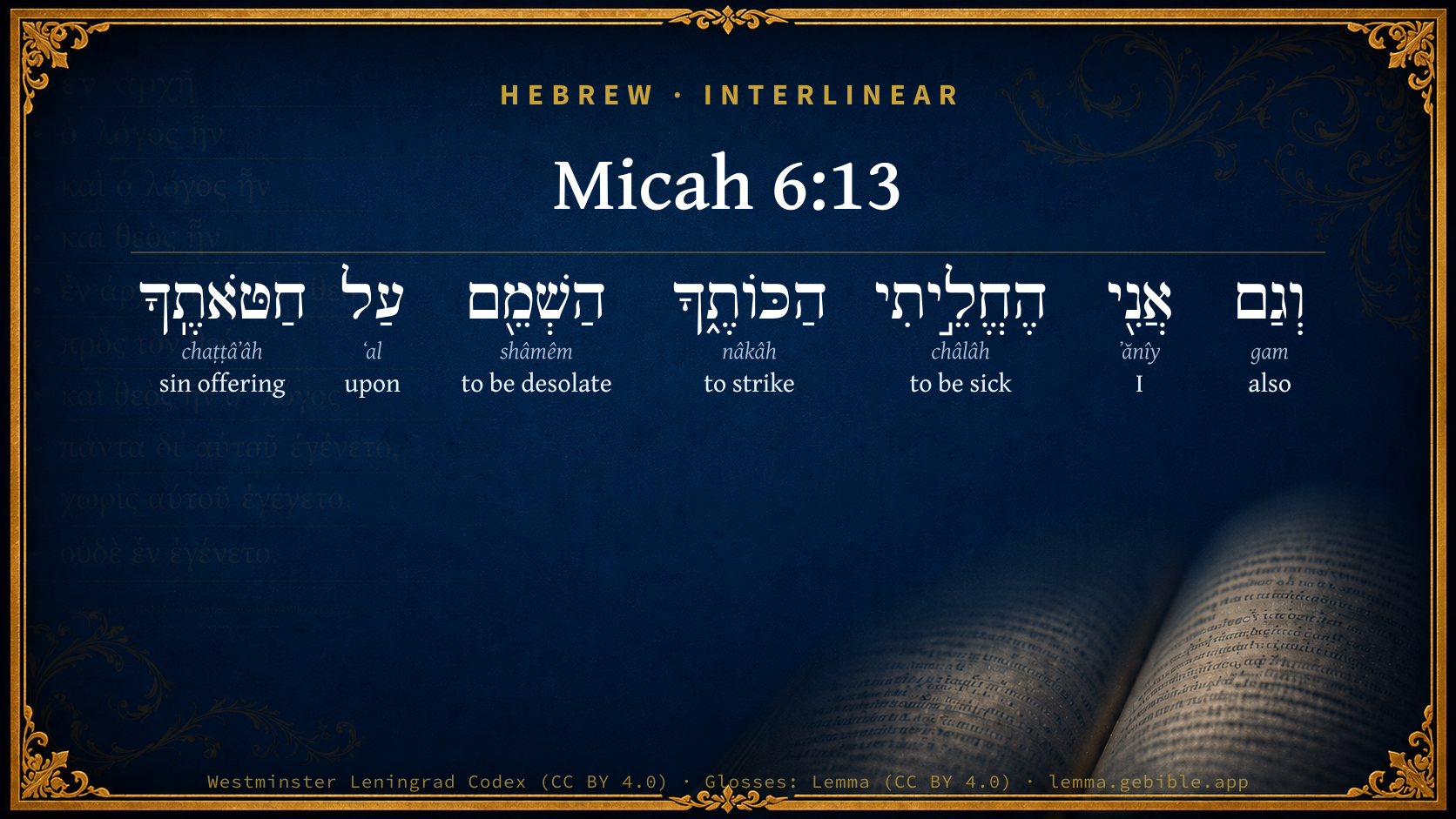
הֶחֱלֵ֣יתִי
châlâh
H2470
“to be sick”
Verb, Hiphil, Perfect, 1st Person, Common, Singular
Part of Speech
Verb
Stem
Hiphil
Form
Perfect
Person
1st Person
Gender
Common
Number
Singular
Full BDB Definition

Origin: a primitive root [compare H2342 , H2470 , H2490 ]

TWOT: 655

to be or become weak, be or become sick, be or become diseased, be or become grieved, be or become sorry - (Qal) to be weak, be sick - (Piel) - to be or become weak, feel weak - to become sick, become ill - (CLBL) to entreat, pray, beg - (Niphal) - to make oneself sick - to be made sick - to be tired - (Pual) to be made weak, become weak - (Hithpael) to make oneself sick - (Hiphil) - to make sore - to make sick - to show signs of sickness, become sick - to grieve - (Hophal) - to be made sick - to be wounded
  1. וְגַם gam H1571 “and · also” Conjunction + Particle, Accusative
  2. אֲנִ֖י ʼănîy H589 “I” Pronoun, Personal, 1st Person, Common, Singular
  3. הַכּוֹתֶ֑ךָ nâkâh H5221 “to strike · you” Verb, Hiphil, Infinitive Construct + Suffix, Personal, 2nd Person, Masculine, Singular
  4. הַשְׁמֵ֖ם shâmêm H8074 “to be desolate” Verb, Hiphil, Infinitive Absolute
  5. עַל ʻal H5921 “upon” Preposition
  6. חַטֹּאתֶֽךָ chaṭṭâʼâh H2403 “sin offerings · your” Noun, Common, Feminine, Plural, Construct + Suffix, Personal, 2nd Person, Masculine, Singular

About this verse

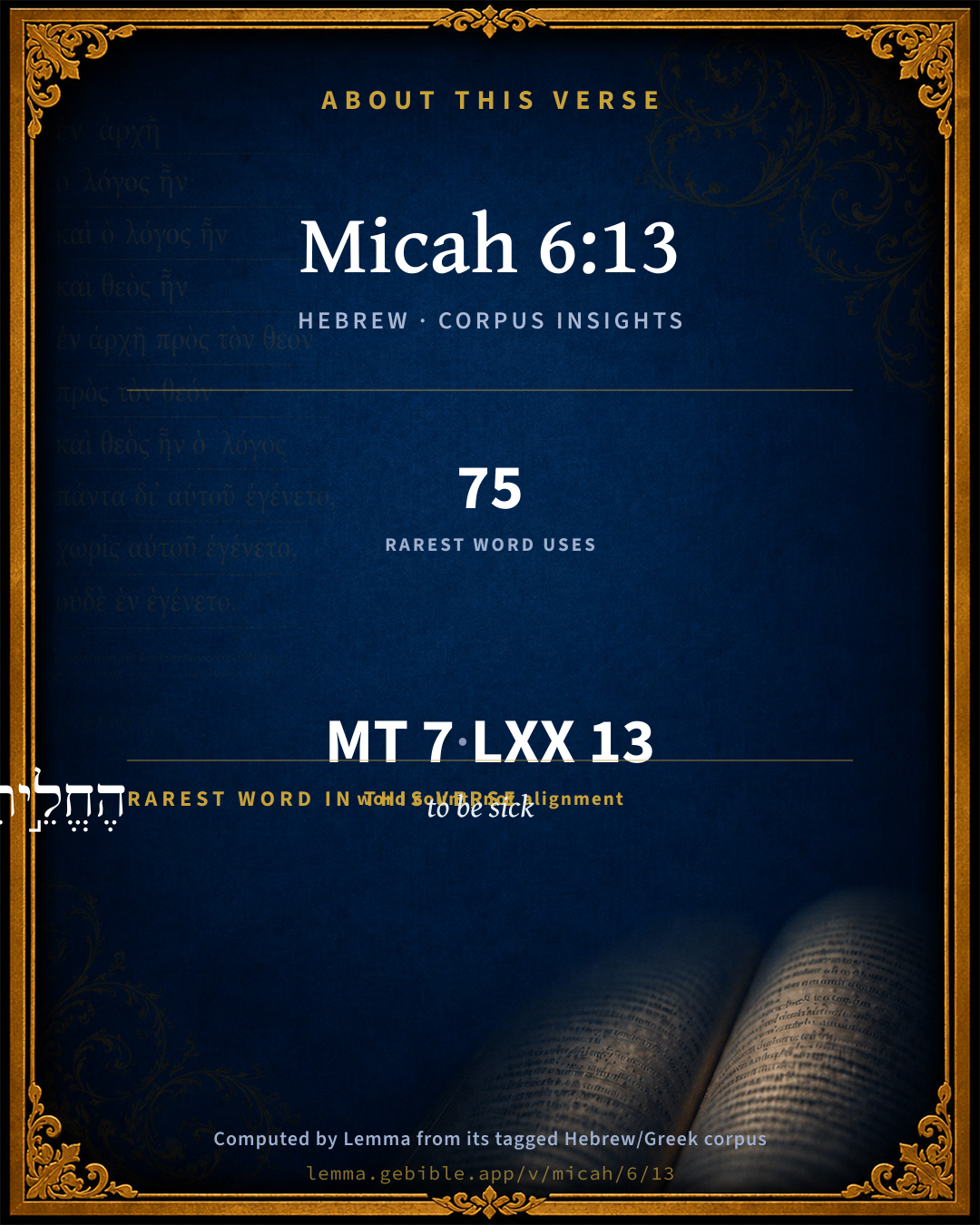
These counts appear in no published source. They are computed here, from the morphology-tagged text and Lemma’s own curated glosses. What Lemma adds →

7
words
7
distinct lemmas
Prophets
section

Grammatical profile

  • 3 verbs
  • 1 noun
  • 1 pronoun
  • 1 preposition
  • 1 particle

Verb forms

  • הֶחֱלֵ֣יתִי Hiphil · Perfect
  • הַכּוֹתֶ֑ךָ Hiphil · Infinitive Construct
  • הַשְׁמֵ֖ם Hiphil · Infinitive Absolute

Hebrew & Septuagint length

In English translation the verse runs 19 words from the Hebrew and 14 from the Septuagint (LXX English) — closely comparable.

A rough comparison of the two English renderings, which tokenize alike — not a word-level alignment.

Word counts can differ between the Hebrew and the Greek without any difference in meaning — e.g. the Hebrew direct-object marker אֵת has no separate Greek word, and Greek often adds the article ὁ.

In the original languages it is 7 Hebrew tokens and 13 Greek tokens — but the two are counted differently (Hebrew bundles its prefixes and suffixes into one token; the Greek is in lemma form), so that isn’t a like-for-like length.

Cross-references

12

Topical passages linked to Micah 6:13 in the Treasury of Scripture Knowledge — connected by theme and wording, ordered by reader-vote popularity; previews shown in the World English Bible.

  • Psalms 107:17–18 Fools are afflicted because of their disobedience, And because of their iniquities.
  • Leviticus 26:16 I also will do this to you: I will appoint terror over you, even consumption and fever, that shall consume the eyes, and make the soul to pine away; and you will sow your seed in vain, for your enemies will eat it.
  • Deuteronomy 28:21–22 Yahweh will make the pestilence cleave to you, until he have consumed you from off the land, where you go in to possess it.
  • Hosea 13:16 Samaria will bear her guilt; For she has rebelled against her God. They will fall by the sword. Their infants will be dashed in pieces, And their pregnant women will be ripped open."
  • Acts 12:23 Immediately an angel of the Lord struck him, because he didn't give God the glory, and he was eaten by worms and died.
  • Job 33:19–22 He is chastened also with pain on his bed, With continual strife in his bones;
  • Isaiah 1:5–7 Why should you be beaten more, That you revolt more and more? The whole head is sick, And the whole heart faint.
  • Isaiah 6:11 Then I said, "Lord, how long?" He answered, "Until cities are waste without inhabitant, And houses without man, And the land becomes utterly waste,
  • Jeremiah 14:18 If I go forth into the field, then, behold, the slain with the sword! and if I enter into the city, then, behold, those who are sick with famine! for both the prophet and the priest go about in the land, and have no knowledge.
  • Lamentations 1:13 From on high has he sent fire into my bones, and it prevails against them; He has spread a net for my feet, he has turned me back: He has made me desolate and faint all the day.
  • Lamentations 3:11 He has turned aside my ways, and pulled me in pieces; he has made me desolate.
  • Hosea 5:9 Ephraim will become a desolation in the day of rebuke. Among the tribes of Israel, I have made known that which will surely be.

Cross-references courtesy of OpenBible.info (CC BY 4.0).

Hebrew and Greek witnesses Masoretic Hebrew ↔ Greek Septuagint

The same verse in the two great witnesses to the Old Testament, shown verse-for-verse.

These are two independent witnesses, not word-aligned to each other, and the Septuagint is shown in lemma (dictionary) form.

Hebrew Micah 6:13 Masoretic · Westminster Leningrad Codex

וְגַם אֲנִ֖י הֶחֱלֵ֣יתִי הַכּוֹתֶ֑ךָ הַשְׁמֵ֖ם עַל חַטֹּאתֶֽךָ

Therefore I also have struck you with a grievous wound. I have made you desolate because of your sins.

World English Bible · Public Domain

Greek LXX Micah 6:13 Septuagint · lemma form

καί ἐγώ ἄρχω ὁ πατάσσω σύ ἀπο ἀναἵζω σύ ἐπί ὁ ἁμαρτία σύ

Therefore will I begin to strike you; I will destroy you in your sins.

LXX2012 (modern English Septuagint) · Public Domain

On this verse, John Gill's Exposition discusses the Septuagint’s reading. Read the note in Commentary ↓

Hebrew: Westminster Leningrad Codex (CC BY 4.0). Greek: Septuagint (public domain); English from LXX2012 (modern English Septuagint) (Public Domain). How the Septuagint differs from the Hebrew →

Targum (Aramaic paraphrase)

1

The Targum is the ancient Jewish Aramaic paraphrase of the Hebrew Scriptures — an interpretive translation, not the Hebrew text itself. Onkelos (literal) and Pseudo-Jonathan (expansive) render the Torah, and Jonathan the Prophets. Coverage is partial: where no permissively-licensed English translation exists for a verse, only the Aramaic is shown. This is verse-level text, not a word-by-word alignment to the Hebrew.

  1. Targum Jonathan Prophets (Joshua–Malachi)
    וְאַף אֲנָא אַיְתֵיתִי עֲלָךְ מְרַע וּמְחָא אַצְדִינָךְ עַל דַחֲטָתָא:

    (no public-domain English translation for this verse)

    Targum Jonathan — Aramaic: “Mikraot Gedolot” (public domain). English: “Sefaria Community Translation” (CC0 1.0 (public-domain dedication)); “London "Chaldee Paraphrase," 1871” (public domain). Text via Sefaria.

Commentary

Notes on Micah 6:13 from classic Christian and Jewish commentators (each source and its license shown beneath its notes). The classic Christian expositions comment on the surrounding passage and are grouped to its opening verse, so a note may address several verses; the Jewish commentaries on the Tanakh (Rashi and others) are per-verse, so they appear only where the commentator wrote on this verse.

Lemma curates 59 commentaries, every one of them public domain or Creative Commons licensed, each selected and text-cleaned for this edition rather than reprinted as found. About our sources →

Trapp's Complete Commentary

John Trapp

Mic 6:13 Therefore also will I make [thee] sick in smiting thee, in making [thee] desolate because of thy sins.

Ver. 13. Therefore also will I make thee sick in smiting thee] This is one twig of that rod, Mic 6:9, that now they shall hear and feel too, that would not hearken to God’s word. Bernard telleth us concerning a brother of his; that when he gave him many good instructions and he, being a soldier, minded them not, he put his finger to his sides and said, One day a spear shall make way to this heart of thine, for instructions and admonitions to enter. God can (and, where he intendeth mercy will) make way for his word by his rod; and seal up instructions by chastening men with pain upon their beds, "and the multitude of their bones with strong pain," Job 33:16; Job 33:19. He can fasten them to their beds, as he did Abimelech, David, Hezekiah, and thereby tame them, and take them a link lower, Job 33:17. He can smite them with sickness, and make them desolate, as it is here; with such sickness as shall make their best friends afraid of them, and that none dare look at them, but as through a grate; and all this with a sting too in the tail of it, because of thy sins. "Fools because of their transgression, and because of their iniquities, are afflicted. Their soul abhorreth all manner of meat" (so sick they are and stomachless, that nothing will down with them); "and they draw near to the gates of death," Psa 107:17-18. This was the case of that rich and wretched cardinal, Henry Beaufort, Bishop of Winchester and Chancellor of England, in the reign of Henry VI, who, tossing upon his sick bed and perceiving he must die, murmured at sickness and death, that his riches could neither relieve him under the one, nor reprieve him from the other (Fox, Martyrs, tel. 925). This was also the case of that great Emperor Charles V, of whom Duplessy reporteth, that when he was old and crazy he cursed his honours, his victories, trophies, riches, saying, Abite hinc, abite longe, Away, begone, miserable comforters are ye all. Mention is made before of a great man that wrote this a little before his death, Spes et fortuna valete. Farewell hope and prosperity. And surely there are not a few rich cormorants, who may well say to their wealth when they are sick, as Cornelius Agrippa did to his familiar spirit, Abi perdita bestia, quae me perdidisti, Begone, thou wicked beast, thou hast been mine undoing, &c. A promise contrary to this threatening in the text is that Isa 33:24, "And the inhabitant shall not say, I am sick: the people that dwell therein shall be forgiven their iniquity."

John Trapp, A Commentary or Exposition upon All the Books of the Old and New Testament (1647–1656) — public domain. Text from a community e-Sword module.

Joseph Benson's Commentary

Mic 6:13-15. Therefore will I make thee sick in smiting thee —

Therefore, upon account of these thy sins, I will, ere long, so smite thee, O Israel, that the strokes shall reach thy heart, and make thee sick unto death of thy wounds. Or, the punishment wherewith I will afflict thee shall waste thy strength like a consuming sickness which preys upon the vitals. Thou shalt eat, but not be satisfied — See note on Hos 4:10. And thy casting down shall be in the midst of thee — Thou shalt be depressed within thee, or have no courage, or spirits, left to support thee. Thou shalt take hold, but not deliver, &c. — Thou shalt lay hold on things to secure them to thee, but thou shalt not be able to save them from the enemy. All the advantages that thou hast made by any means shall become a prey to them. Archbishop Newcome translates it, Thou shalt take hold, but shalt not carry away; contrary to what is said of thy enemies, Isa 5:29; They shall lay hold of the prey, and carry it away safe, and none shall deliver it, or retake it. Thou shalt sow, but shalt not reap — Thou shalt not enjoy the fruit of thy labour: a curse often threatened for disobedience.

Joseph Benson's Commentary on the Old and New Testaments (1811–1818) — public domain. Text from a community e-Sword module.

The Preacher's Complete Homiletical Commentary

Joseph S. Exell (gen. ed.)

CRITICAL NOTES.]

Mic_6:13. Sick] i.e. I smite thee mortally (cf. for expression, Nah_3:19; for matter, Mic_1:9).

Mic_6:14. Satis.] Fulfilment of Lev_26:26. Food would not be enough, nor sustain. Midst] Cast down in borders and in the metropolis, people will flee into the fortress, but only to die, not to be delivered. What goods and families are carried away will be given to the sword (cf. Jer_50:37; Jer_42:16).

Mic_6:15. Reap] The enemy will reap the harvests and plunder the stores (Lev_26:16; Deu_28:38-40).

Mic_6:16.] This punishment brought upon themselves. Omri] The conspirator and regicide (1Ki_16:16-28). Statutes] By which this abandoned dynasty had disgraced the throne of Israel; human ordinances, not God’s commands (Lev_20:23). Bear] “The present generation is ripe for the curse, which the Lord had cast forth in the law for the future of his people (Isa_65:7) [Lange].

HOMILETICS

MORAL CONSUMPTION.—Mic_6:13-14

God threatens to smite Israel with mortal sickness; not so much bodily sickness, as desolation of land. By oppression they had made others weak, so Divine judgments will crush them by famine and invasion. Their calamity is a wasting sickness. The origin, seat, and consequences of this moral consumption are plainly described.

I. Sickness in the centre. “In the midst of thee.” The sinking down, the wasting away, was in the very centre of the country. The capital, the seat of their wickedness and treasures, was smitten, and the plague spread among the people. Inward decay always begins at the heart. And when the vital parts are affected what can arrest its progress?

II. Sickness with sufficiency. “Thou shalt eat, but not be satisfied.” They had abundance of wealth, an insatiable appetite, but their food did not nourish them. Their desires were a disease, not a moral strength. Like the deadly wasting that assails the human frame, there may be a spiritual atrophy to derange and emaciat the soul. The victim cries out with Job, “Thou hast filled me with wrinkles, which is a witness against me, and my leanness, rising up in me, beareth witness to my face.”

III. Sickness aided by outward circumstances. God’s judgments only hastened on the end. The moral atmosphere was fœtid, and all their surroundings unfavourable to health. In God’s favour is life; but he withdrew the fruit of the fields, and the blessings of the skies. When God departs from a people nothing will be left but inherent emptiness and pining consumption. “Their flesh shall consume away while they stand upon their feet, and their eyes shall consume away in their holes, and their tongue shall consume away in their mouth.”

IV. Sickness morally incurable. “I will make thee sick in smiting thee.” The sickness was the result of the smiting. “Thy wound is grievous,” lit. makes sick. It was an incurable wound: “There is no healing of thy bruise” (Nah_3:4). Robbed of their families, smitten in their vineyards, and helpless in their condition, what hope of recovery was left! Spiritual leanness is the greatest calamity that can befall the Church. If God withdraws his help everything will decay. Life, light, and power, hope, joy, and peace, will die away. Creeds and ceremonies will only hasten the ruin. Nothing can survive the death, the moral consumption, of true religion. “My leanness! my leanness! Woe unto me!”

LABOUR WITHOUT PROFIT.—Mic_6:14-15

The judgments are further enumerated by which God would make them sick and desolate. They would sow and plant for others to reap. They would not be able to rescue what they had lost, nor preserve what they possessed from the foe. One stroke would follow another until the land was desolated, and its inhabitants put to shame.

I. Fields would be sown, but no harvest reaped. “Thou shalt sow, but thou shalt not reap.” The crops would be blasted and withered, or the enemy would reap them for himself. They reaped where they sowed not; so they must sow for others to reap. Sin provokes God to frustrate man’s efforts to subsist. He takes from the covetous and unjust the fruit of their efforts just when it is within their grasp. If we wish to enjoy the results of our physical and intellectual labours, we must fear God and love justice.

1. The necessities, and

2. The luxuries of life, the fruit of the field, the oil, and the wine, depend upon the providence of God, and may be taken away in his anger. “Thou shalt plant vineyards, and dress them, but shalt neither drink of the wine nor gather the grapes.”

II. Goods would be rescued, but delivered up to the enemy. “That which thou deliverest will I give up to the sword.” Children on whose account they got their wealth, goods and substance for which they had toiled, would be suddenly taken from them. If anything at all was rescued, it was only for a time, and could not be held. No effort can deliver from the power of God’s executioners. What we hold to be most precious is often most unsafe, and what we are determined not to lose that we lose suddenly.

III. Men would take flight, but could not escape. “Thou shalt take hold,” to rescue or remove to a safe place, but in vain, “but shalt not deliver.” How can men flee from God’s vengeance? No human band can rescue from God’s power. No harbour can hide from his presence. Heaven is the seat of his glory, earth the scene of his power, and hell the place of his wrath.

“What can ’scape the eye of God all seeing,

Or deceive his heart omniscient!” [Milton.]

SINS AND PUNISHMENT: AN UNBROKEN LINK.—Mic_6:16

This judgment the people brought upon themselves by their ungodly conduct. Their calamities were the results of their sins.

I. What were the sins of which they were guilty. First. They had broken the covenant of God and observed the statutes of men. “For the statutes of Omri are kept.” By every motive of hope and fear they were commanded to obey God. This was the purpose of their existence, and the ground on which they held their privileges and country. But the Baal-worship of Omri was patronized and raised into the popular religion (1Ki_16:31-32). Secondly. They observed the doings of Ahab. Ahab’s idolatry and persecuting spirit were commended. The luxury, wickedness, and oppression of the court were sanctioned. Yea, men more wicked than others, men who sold themselves “to work wickedness in the sight of the Lord,” were their examples (1Ki_21:25).

1. These customs were diligently observed. The margin gives, He doth keep diligently. One and all were kept as religious acts, in earnestness and diligence.

2. These customs were universally observed. Judah was at variance with Israel in many things, but they were one in apostasy.

3. These customs were continually observed. They had been introduced ages before Micah’s time, yet he found them prevalent and all-power-ful. Custom is the deposit of the past in the life of the present; the link which binds the present to the future. Thus evils are preserved and perpetuated from one generation to another.

II. What was the punishment which followed these sins? The actual results were very different from the expected fruits. Their conduct was so framed as if they had purposely desired the punishment. “That I should make thee a desolation.”

1. A privileged nation was made desolate. They were deprived of their privileges and honour. Sin will desolate the richest nation and the most flourishing Church; make people an astonishment to some, and a hissing to others.

2. An exalted nation was made a reproach. “You shall bear the reproach of my people.” They would have been God’s people if they had kept his covenant, but their sins brought shame and reproach. The God whom they had forsaken and offended left them in the hands of the heathen. The conduct which they deemed wise and expedient proved fatal to its originators and imitators. True honour is only found in God’s service. Sin and disgrace are bound together by an unbroken link. “We are become a reproach to our neighbours, a scorn and derision to them that are round about us.”

HOMILETIC HINTS AND SUGGESTIONS

Mic_6:14-15.

1. The law of God is the standard of right in all ages. The threatenings of the law of Moses were in force in the days of Micah (Lev_26:16; Deu_28:30).

2. The execution of the law in the history of a nation is not always a warning to a people.

3. The punishment of the law to such as continually violate it is most bitter. Disappointment in labour, deprivation of the necessities of life, troubles in the family and the nation. “When our services of God are soured with sin,” says a quaint author, “his providences will justly be embittered to us.”

Mic_6:16. Statutes of Omri. Idolatrous customs.

1. Originated by great men.

2. Sanctioned by a wicked court.

3. Observed by a religious people. Antiquity and priestly or princely authority are of no force against the command of God. Fashion rules with an iron sceptre, and those who ought to stand up for God, often bow to the law of man.

“Custom’s the world’s great idol we adore,

And knowing this, we seek to know no more.” [Pomfret.]

Reproach. Sin in God’s people is especially great. And as they have peculiar privileges, so their reproach or punishment is proportionable to their profaning of their privileges (Eze_36:20; Eze_36:23) [Hutcheson]. “If professors of religion ruin themselves, their ruin will be the most reproachful of any; and they in a special manner will rise at the last day to everlasting shame and contempt.”

ILLUSTRATIONS TO CHAPTER 6

Mic_6:12-15. Crafty counsels are joyful in the expectation, difficult in the management, and sad in the event [Tacitus]. “There is no law more just than that the contrivers of destruction should perish by their own acts.” “The deceiver is often ruined by deceit.”

Mic_6:16. “The essence of wickedness is forsaking God.” “Those are marked for ruin that are deaf to reproof and good counsel.” Those that prefer the rules of carnal policy before Divine precepts, and the allurements of the world and the flesh before God’s promises and comforts, despise His word, giving the preference to those things which stand in competition with it [Matt. Henry].

The Preacher's Complete Homiletical Commentary (gen. ed. Joseph S. Exell; Funk & Wagnalls, c. 1892) — public domain (pre-1929). A full-Bible homiletical/sermon-outline anthology covering 65 of 66 books (2 John is absent from the source module). Text from a community e-Sword module.

Keil & Delitzsch

C. F. Keil & F. Delitzsch

The threat of punishment follows in Mic 6:13-16. Mic 6:13. "So also now do I smite thee incurably, laying waste because of thy sins. Mic 6:14. Thou wilt eat, and not be satisfied; and thine emptiness remains in thee; and thou wilt remove, and not save; and what thou savest I will give to the sword. Mic 6:15. Thou wilt sow, and not reap; thou wilt tread olives, and not anoint thyself with oil; new wine, and not drink wine." With וגם־אני the threatened punishment is represented as the consequence of, or retribution for, the sins of the people. החליתי הך: literally, I have made the smiting thee sick, i.e., smitten thee with incurable sickness (for hechelaah, see at Nah 3:19 and Jer 30:12; and for the fact itself, Isa 1:5-6). The perfect expresses the certainty of the future. The suffix refers to the people, not of the capital only, but, as we may see from Mic 6:16, of the whole of the kingdom of Judah. Hashmēm (an uncontracted form; see Ges. 67, Anm. 10), devastando, is attached to the preceding verb in an adverbial sense, as a practical exemplification, like the שׁבע in Lev 26:18, Lev 26:24, Lev 26:28, which Micah had in his eye at the time. For the individualizing of the punishment, which follows, rests upon Lev 26:25-26, and Deu 28:39-40. The land is threatened with devastation by the foe, from which the people flee into fortresses, the besieging of which occasions starvation. For the fulfilment of this, see Jer 52:6 (cf. Kg2 6:25). ישׁח, ἁπ.λεγ., hollowness, or emptiness of stomach. ותסּג, thou mayest remove, i.e., carry off thy goods and family, yet wilt thou not save; but even if thou shouldst save anything, it will fall into the hands of the enemy, and be destroyed by his sword (vid., Jer 50:37). The enemy will also partly consume and partly destroy the corn and field-fruit, as well as the stores of oil and wine (vid., Amo 5:11). ולא תסוּך שׁמן is taken verbatim from Deu 28:40.

Keil & Delitzsch — Biblical Commentary on the Old Testament (1861–1891) — public domain (CC PDM 1.0). Text via the HelloAO Bible API. (Old Testament only.)

Tyndale Open Study Notes

Tyndale Open Resources

6:13-16 I will wound you! This phrase introduces all of the curses that God had promised to bring upon the disobedient and rebellious people of Israel (see Deut 28:15-68).

Tyndale Open Study Notes — © Tyndale Open Resources, licensed CC BY-SA 4.0. Text via the HelloAO Bible API.

Jamieson, Fausset & Brown

Robert Jamieson, A. R. Fausset & David Brown

make thee sick in smiting-- (Lev 26:16, to which perhaps the allusion here is, as in Mic 6:14; Psa 107:17-18; Jer 13:13).

Jamieson, Fausset & Brown — Commentary Critical and Explanatory on the Whole Bible (1871) — public domain (CC PDM 1.0). Text via the HelloAO Bible API.

Adam Clarke's Commentary

Verse 13. Will I make thee sick in smiting thee] Perhaps better, "I also am weary with smiting thee, in making thee desolate for thy sins." They were corrected, but to no purpose; they had stroke upon stroke, but were not amended.

Adam Clarke's Commentary on the Bible (1810–1826) — public domain. Text from a community e-Sword/MySword module.

John Calvin's Commentaries

God, after having declared that he would be the Judge of the people, speaks now more clearly of their punishment. He says therefore that he was armed with vengeance: for it often happens, when a judge, even one who hates wickedness, is not able to punish, for he dreads the fierceness of those whom he thinks himself unequal to restrain. Hence God intimates here, that there will not be wanting to him a power to punish the people, I will afflict thee, he says, by striking or wounding thee; for so some render the words. The sum of what is said is, — that nothing would be an obstacle to prevent God from inflicting punishment on the people, for there would be no want of power in his case. There is therefore no reason for men to promise themselves any escape when God ascends his tribunal; for were they fortified by all possible means they could not ward off the hand of God.

John Calvin's Commentaries (1540-1563) — public domain. Text from the Calvin Translation Society English edition (1840s-50s) via the Christian Classics Ethereal Library (ccel.org). Calvin's coverage is partial (roughly two-thirds of the Bible); uncommented books and verses are honest gaps, never fabricated. The 19th-century editor's footnotes and remarks are omitted so the notes are faithfully Calvin's own voice.

The Cambridge Bible for Schools and Colleges

gen. ed. J. J. S. Perowne

13. will I make thee sick] Deadly sick is the meaning; comp. Nah_3:19, where the term is explained in the parallel clause to mean ‘incurable.’

The Cambridge Bible for Schools and Colleges (gen. ed. J. J. S. Perowne; Cambridge University Press, 1878–1918) — public domain. Text from a community e-Sword module.

John Gill's Exposition

Therefore also will I make thee sick in smiting thee,.... With the rod to be heard, Mic 6:9; by sending among them some of his sore judgments, as famine, pestilence, the sword of the enemy, internal wars, and the like; which should cause their kingdom, and state, and families, to decline and waste away, as a sickly and diseased body. So the Targum,

"and I brought upon thee illness and a stroke.''

The Septuagint, Vulgate Latin, Syriac, and Arabic versions, render it, "and I began to smite thee"; as by Hazael, king of Syria, and Tiglathpileser, king of Assyria, who had carried part of them captive;

in making thee desolate because of thy sins; went on, not only to make them sick, and bring them into a declining state, but into utter desolation; as by Shalmaneser, king of Assyria, who carried Israel captive; and by Nebuchadnezzar, king of Babylon, who led Judah captive, because of their sins of idolatry, injustice, and oppression, with others that abounded among them.

John Gill's Exposition of the Whole Bible (1746–1763) — public domain (CC PDM 1.0). Text via the HelloAO Bible API.

Albert Barnes' Notes on the Bible

Therefore also will I - (Literally, And I too,) that is, this dost thou, and thus will I too do. Pococke: “As thou madest sick the heart of the poor oppressed, so will I, by My grievous and severe punishments, make thee sick,” or make thy wound incurable, as in Nahum, “thy wound is grievous,” (Nah 3:19 literally, made sick. In making thee desolate because of thy sins. The heaping up riches shall itself be the cause of thy being waste, deserted, desolate.

Albert Barnes' Notes on the Bible (1834–1885) — public domain. Text from a community e-Sword/MySword module.

Matthew Poole's English Annotations

Therefore, for these many sins of violence, frauds, and lies,

also will I make thee sick in smiting thee; some read, I have begun to smite thee, so it suits well with the history of the wars, rapine, captivity, or desolation by the Syrians, Assyrians, Arabians, &c. brought upon Israel and Judah, which were the beginnings of their sorrows, and God’s just punishments; but as we read it

sick in smiting; it will as well suit with the grammatical construction of the words, with the history too, and thus it will give the greater emphasis to the words; God will ere long so smite, that the strokes of his rod should reach the very heart, and make Israel heart-sick of his wounds, inflicted on him by the Lord.

In making thee desolate: this was fully accomplished, when the kingdom of the ten tribes was overthrown by Shalmaneser, and the kingdom of the two tribes captivated by Nebuchadnezzar.

Because of thy sins; multiplied, aggravated, obstinately retained, and not repented of.

Matthew Poole's English Annotations on the Holy Bible (1683–1685) — public domain. Text from a community e-Sword/MySword module.

The Pulpit Commentary

Vers. 13-16. For all this God threatens punishment.

Will I make thee sick in smiting thee; literally, have made the smiting thee sick; i.e. incurable, as Nah_3:19, or, "have made the blows mortal that are given thee." The perfect is used to express the certainty of the future. The Septuagint and Vulgate read, "I have begun or, will begin to smite thee."

The Pulpit Commentary (1880–1919), ed. H.D.M. Spence-Jones & Joseph S. Exell — public domain. Text from a community e-Sword module.

John Wesley's Explanatory Notes

Sick - God will e're long so smite, that the strokes shall reach the heart, and make Israel heartsick of his wounds.

John Wesley, Explanatory Notes Upon the Whole Bible (1754–1765) — public domain. Text via the GEBible commentary corpus.

unfoldingWord translationNotes

Door43 World Missions Community

I will strike you with a terrible blow

Yahweh striking his people with blows is a metaphor for him punishing them. AT: "I have punished you severely" (See: Metaphor)

your emptiness will remain inside you

A person or thing being hungry is spoken of as if it were something that could be put in a container, and the people are spoken of as if they were containers. AT: "You will be hungry, and you will not be able to eat enough to satisfy yourself" (See: Metaphor)

translationWords

ruin

sin

sword

plant

reap

olive

anoint

oil

grape

wine

unfoldingWord translationNotes — © Distant Shores Media and the Door43 World Missions Community, licensed CC BY-SA 4.0. Source: git.door43.org/Door43/en_tn.

Rashi

Rabbi Shlomo Yitzchaki (Rashi)

I will smite you with sore wounds—I have made your wounds sore - strong and ill and incurable.

and make [you] desolate Heb. הַשְׁמֵם, to make you desolate because of your sins.

Rashi on the Tanakh — English translations: “The Judaica Press complete Tanach with Rashi, translated by A. J. Rosenberg” (CC BY 4.0); “Pentateuch with Rashi's commentary by M. Rosenbaum and A.M. Silbermann, 1929-1934” (public domain); “The Metsudah Tanach series, Lakewood, N.J” (CC BY 4.0); and “The Book of Joshua, Metsudah Publications, 1997” (CC BY 4.0). Text via Sefaria.

Lesson kit

Teaching starters — assembled from the data on this page, not authored interpretation. Every prompt links to the verse data it draws on. Edit before teaching.

Micah, in the Prophets, opens this verse with 7 words (7 distinct Hebrew lemmas). Its most distinctive word is châlâh (“to be sick”). A historical commentator’s framing appears above. Read the whole chapter for the surrounding context.

Discussion questions

  1. What does “to be sick” (châlâh) contribute to the verse as a whole?
  2. Psalms 107:17–18 shares this passage’s theme. How do the two illuminate each other?
  3. These translations render this verse differently; the difference is in the English rendering, not the original. What questions does that raise?
  4. The verb «הֶחֱלֵ֣יתִי» is Hiphil Perfect. How does its form color the action?
  5. Reading how Trapp's Complete Commentary and Joseph Benson's Commentary read this verse, where do the two commentators agree and where do they part?

Things to notice

Reading settings

Reading text

Shown beneath each verse's original-language words.

Old Testament
Old Testament edition

Read the OT as the Masoretic Hebrew (MT) or the Greek Septuagint (LXX).

English shown for the Greek Septuagint (in the Hebrew ↔ Greek comparison).

Comparing translations? Open the Compare panel on any verse page to stack up to four side by side.