
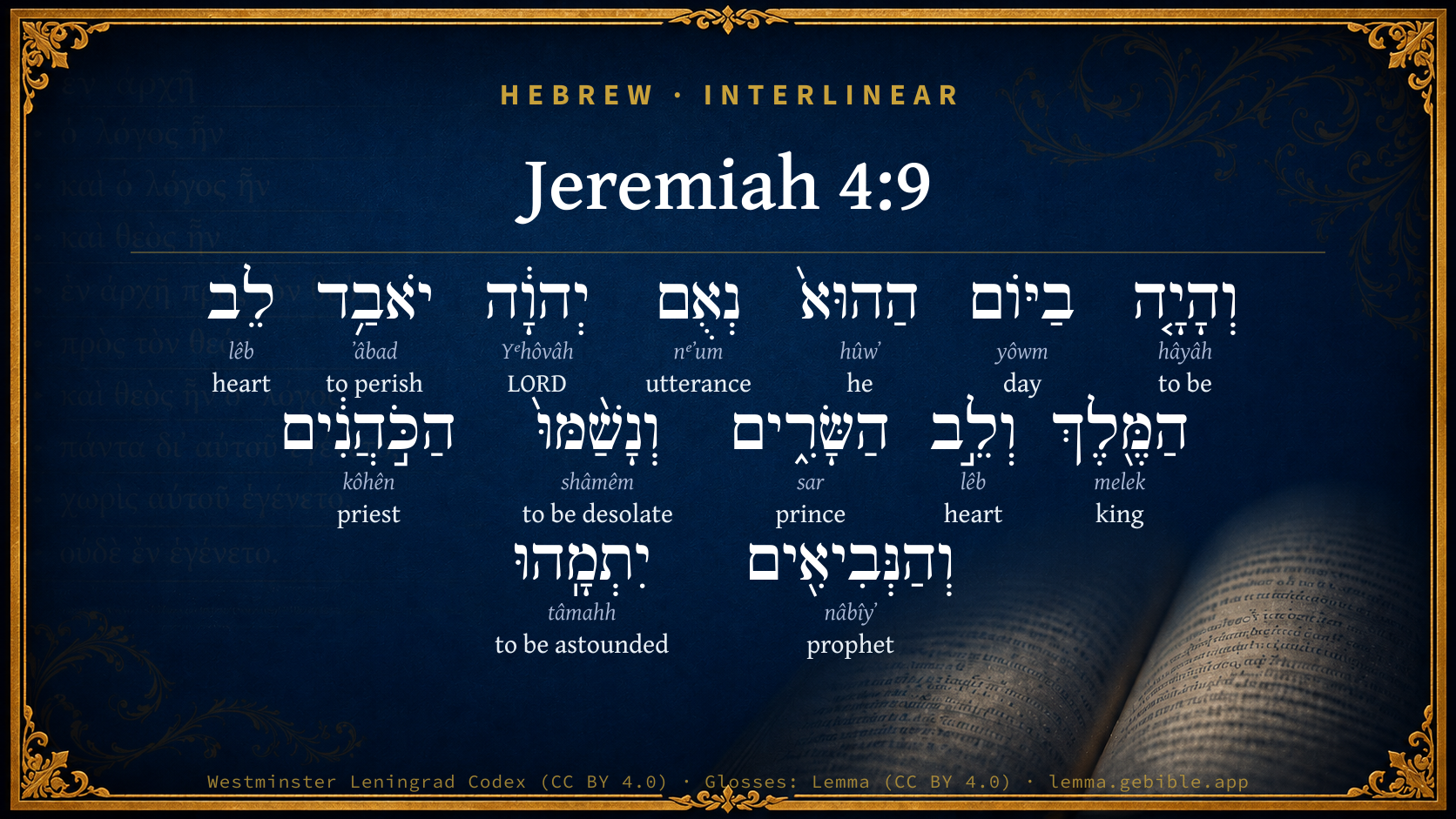
Jeremiah 4:9

Hebrew (Westminster Leningrad Codex) Jeremiah 4:9 appears in the Hebrew Old Testament. The text above is from the Westminster Leningrad Codex. Each word links to its Strong’s number, a concise gloss, and parsing drawn from the Open Scriptures Hebrew Bible morphology. Click any word for its full Brown-Driver-Briggs (BDB) entry.
Download image
Cite this verse

Jeremiah 4:9 (World English Bible). Public Domain. Lemma interlinear Bible study tool, https://lemma.gebible.app/v/jeremiah/4/9.

Show BibTeX & RIS
BibTeX
RIS
English Translation
It shall happen at that day, says Yahweh, that the heart of the king shall perish, and the heart of the princes; and the priests shall be astonished, and the prophets shall wonder.
World English Bible · Public Domain
Download a study sheet

One document with this verse’s original text, its word-by-word gloss line, the meaning frame, cross-references with their text, attributed commentary, and full source and license credits — printable, and it pastes into notes with its structure intact.

This verse Autodidact and up

Study sheet (.html) Plain text (.txt)

A passage Seminary Student

Up to 50 verses in one chapter. A passage sheet keeps up to 6 commentary sources and 12 cross-references per verse, in the order this page ranks them, and says so on the sheet whenever that leaves anything out. Ask for a single verse and you get the Autodidact verse sheet above.

Everything on this page stays free to read, with no account — the sheet is a download of what is already on screen, not access to it.

Want to remove ads? Support Godless Engineer
Compare translations 3

The same verse in 3 English versions, stacked beneath the original-language interlinear above. Click any original word for its lexicon entry.

Each is an independent rendering of the whole verse — the interlinear is not word-aligned to these translations.

Highlighted words mark where these versions differ — a whole-verse word diff, not a word-by-word alignment.

  • World English Bible Public Domain
    It shall happen at that day, says Yahweh, that the heart of the king shall perish, and the heart of the princes; and the priests shall be astonished, and the prophets shall wonder.
  • King James Version Public Domain
    And it shall come to pass at that day, saith the LORD, that the heart of the king shall perish, and the heart of the princes; and the priests shall be astonished, and the prophets shall wonder.
  • unfoldingWord Literal Text CC BY-SA 4.0
    And it will happen in that day—the declaration of Yahweh— the heart of the king and the heart of the officials will perish, And the priests will be appalled, and the prophets will be horrified.’”

unfoldingWord Literal Text — © unfoldingWord, licensed CC BY-SA 4.0. Word-aligned USFM3 via Door43 (git.door43.org/unfoldingWord/en_ult).

Versions to compare (up to 4)

3 of 4 selected

Show all 18 translations

Every available English version of this verse, each an independent rendering of the whole verse.

  • World English Bible Public Domain
    It shall happen at that day, says Yahweh, that the heart of the king shall perish, and the heart of the princes; and the priests shall be astonished, and the prophets shall wonder.
  • Berean Standard Bible Public Domain
    “In that day,” declares the LORD, “the king and officials will lose their courage. The priests will tremble in fear, and the prophets will be astounded.”
  • Majority Standard Bible Public Domain
    “In that day,” declares the LORD, “the king and officials will lose their courage. The priests will tremble in fear, and the prophets will be astounded.”
  • King James Version Public Domain
    And it shall come to pass at that day, saith the LORD, that the heart of the king shall perish, and the heart of the princes; and the priests shall be astonished, and the prophets shall wonder.
  • American Standard Version (1901) Public Domain
    And it shall come to pass at that day, saith Jehovah, that the heart of the king shall perish, and the heart of the princes; and the priests shall be astonished, and the prophets shall wonder.
  • Revised Version (1885) Public Domain
    And it shall come to pass at that day, saith the LORD, that the heart of the king shall perish, and the heart of the princes; and the priests shall be astonished, and the prophets shall wonder.
  • Geneva Bible (1599) Public Domain
    And in that day, saith the Lord, the heart of the King shall perish, and the heart of the princes and the Priestes shall be astonished, and the Prophets shall wonder.
  • Douay-Rheims (1899) Public Domain
    And it shall come to pass in that day, saith the Lord: That the heart of the king shall perish, and the heart of the princes: and the priests shall be astonished, and the prophets shall be amazed
  • Young's Literal Translation Public Domain
    And it hath come to pass, in that day, An affirmation of Jehovah: `Perish doth the heart of the king, And the heart of the princes, And astonished have been the priests, And the prophets do wonder.'
  • Literal Standard Version CC BY-SA 4.0
    “And it has come to pass in that day,” || A declaration of YHWH, || “The heart of the king perishes, || And the heart of the princes, || And the priests have been astonished, || And the prophets wonder.”
  • Unlocked Literal Bible CC BY-SA 4.0
    Then it will happen in that day—this is Yahweh's declaration—that the hearts of the king and his officials will die. The priests will be appalled, and the prophets will be horrified.'”
  • unfoldingWord Literal Text CC BY-SA 4.0
    And it will happen in that day—the declaration of Yahweh— the heart of the king and the heart of the officials will perish, And the priests will be appalled, and the prophets will be horrified.’”
  • Darby Bible Public Domain
    And it shall come to pass in that day, saith Jehovah, that the heart of the king shall perish, and the heart of the princes; and the priests shall be astonished, and the prophets shall be amazed.
  • World Messianic Bible Public Domain
    “It will happen at that day,” says the LORD, “that the heart of the king will perish, along with the heart of the princes. The priests will be astonished, and the prophets will wonder.”
  • Webster's Bible Public Domain
    And it shall come to pass at that day, saith the LORD, that the heart of the king shall perish, and the heart of the princes; and the priests shall be astonished, and the prophets shall wonder.
  • Free Bible Version CC BY-SA 4.0
    When that happens declares the Lord, the king and officials will lose heart, the priests will be devastated, and the prophets will be shocked.
  • Bible in Basic English Public Domain
    And it will come about in that day, says the Lord, that the heart of the king will be dead in him, and the hearts of the rulers; and the priests will be overcome with fear, and the prophets with wonder.
  • JPS Tanakh (1917) Public Domain
    And it shall come to pass at that day, saith the LORD, that the heart of the king shall fail, and the heart of the princes; and the priests shall be astonished, and the prophets shall wonder.

Literal Standard Version (2020), Covenant Press — licensed CC BY-SA 4.0. Text via the HelloAO Bible API (eBible.org). Unlocked Literal Bible (unfoldingWord) — licensed CC BY-SA 4.0. Text via the HelloAO Bible API (eBible.org). unfoldingWord Literal Text — © unfoldingWord, licensed CC BY-SA 4.0. Word-aligned USFM3 via Door43 (git.door43.org/unfoldingWord/en_ult). Free Bible Version, Dr. Jonathan Gallagher — licensed CC BY-SA 4.0. Text via the HelloAO Bible API (eBible.org).

Word by word

More ways to search: Search by grammar → Find every occurrence → Compare this word →

Practice this passage: Drill this verse → Learn its vocabulary →

יִתְמָֽהוּ
tâmahh
H8539
“to be astounded”
Verb, Qal, Imperfect, 3rd Person, Masculine, Plural
Part of Speech
Verb
Stem
Qal
Form
Imperfect
Person
3rd Person
Gender
Masculine
Number
Plural
Full BDB Definition

Origin: a primitive root

TWOT: 2518

to be astounded, be stunned, be amazed, be dumbfounded - (Qal) to be astounded - (Hithpael) to astonish yourself, be astounded, be astonished at one another
  1. וְהָיָ֤ה hâyâh H1961 “and · to be” Conjunction + Verb, Qal, Sequential Perfect, 3rd Person, Masculine, Singular
  2. בַיּוֹם yôwm H3117 “in/at the · day” Preposition, Determined + Noun, Common, Masculine, Singular, Absolute
  3. הַהוּא֙ hûwʼ H1931 “the · he” Particle, Definite Article + Pronoun, Personal, 3rd Person, Masculine, Singular
  4. נְאֻם nᵉʼum H5002 “utterance of” Noun, Common, Masculine, Singular, Construct
  5. יְהוָ֔ה Yᵉhôvâh H3068 “LORD” Noun, Proper
  6. יֹאבַ֥ד ʼâbad H6 “to perish” Verb, Qal, Imperfect, 3rd Person, Masculine, Singular
  7. לֵב lêb H3820 “heart of” Noun, Common, Masculine, Singular, Construct
  8. הַמֶּ֖לֶךְ melek H4428 “the · king” Particle, Definite Article + Noun, Common, Masculine, Singular, Absolute
  9. וְלֵ֣ב lêb H3820 “and · heart of” Conjunction + Noun, Common, Masculine, Singular, Construct
  10. הַשָּׂרִ֑ים sar H8269 “the · princes” Particle, Definite Article + Noun, Common, Masculine, Plural, Absolute
  11. וְנָשַׁ֨מּוּ֙ shâmêm H8074 “and · to be desolate” Conjunction + Verb, Niphal, Sequential Perfect, 3rd Person, Common, Plural
  12. הַכֹּ֣הֲנִ֔ים kôhên H3548 “the · priests” Particle, Definite Article + Noun, Common, Masculine, Plural, Absolute
  13. וְהַנְּבִיאִ֖ים nâbîyʼ H5030 “and · the · prophets” Conjunction + Particle, Definite Article + Noun, Common, Masculine, Plural, Absolute

About this verse

These counts appear in no published source. They are computed here, from the morphology-tagged text and Lemma’s own curated glosses. What Lemma adds →

14
words
13
distinct lemmas
Prophets
section

Notable vocabulary

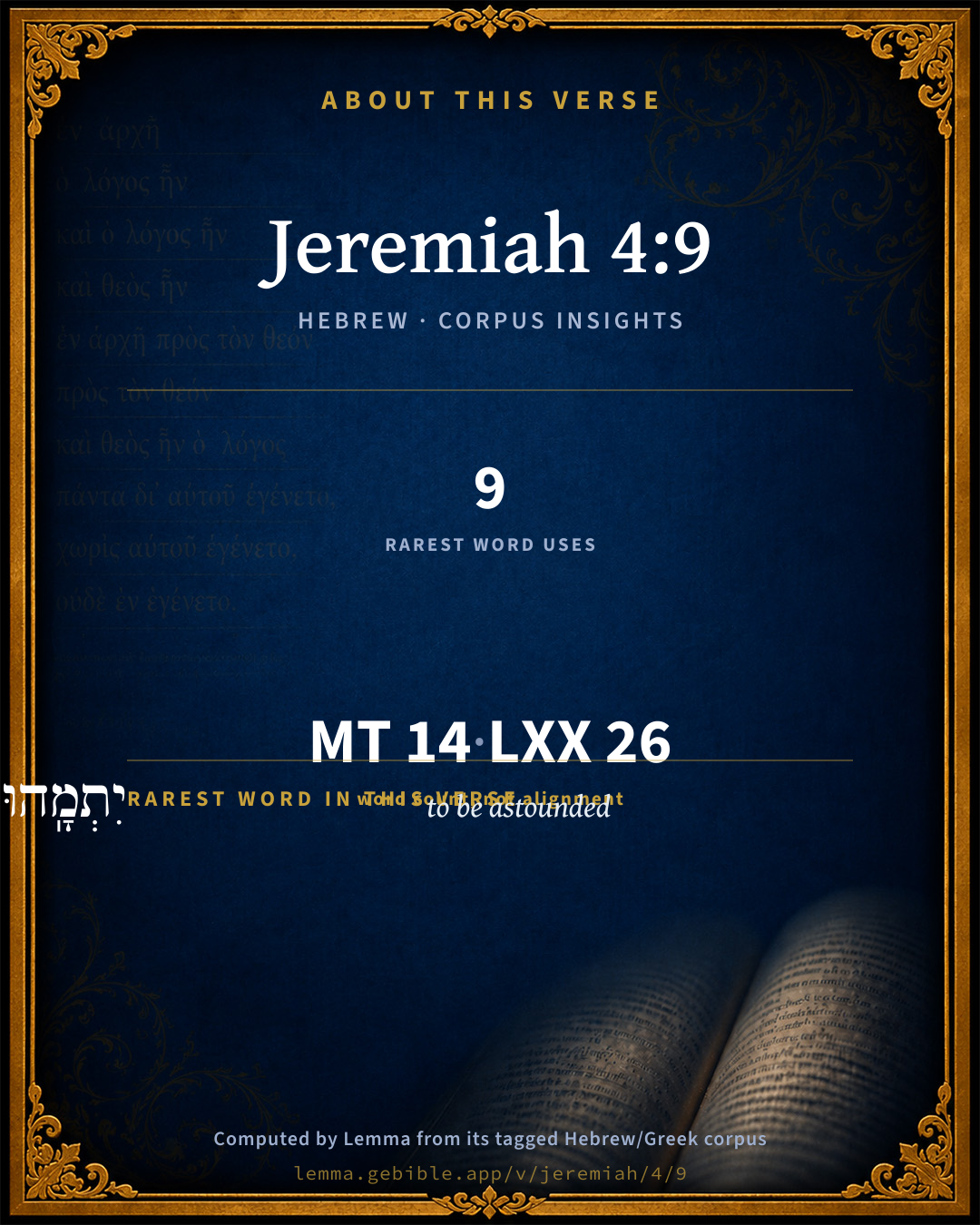
The rarest word here is יִתְמָֽהוּ to be astounded H8539 — appearing just 9 times in the whole Hebrew Bible.

Shared distinctive vocabulary

יִתְמָֽהוּ to be astounded H8539 occurs in 8 verses of the Hebrew Bible. Also found in:

Grammatical profile

  • 4 verbs
  • 9 nouns
  • 1 pronoun

Verb forms

  • וְהָיָ֤ה Qal · Sequential Perfect
  • יֹאבַ֥ד Qal · Imperfect
  • וְנָשַׁ֨מּוּ֙ Niphal · Sequential Perfect
  • יִתְמָֽהוּ Qal · Imperfect

Repetition

A word recurs within this verse — often emphatic in Hebrew:

Hebrew & Septuagint length

In the original languages it is 14 Hebrew tokens and 26 Greek tokens — but the two are counted differently (Hebrew bundles its prefixes and suffixes into one token; the Greek is in lemma form), so that isn’t a like-for-like length.

Cross-references

16

Topical passages linked to Jeremiah 4:9 in the Treasury of Scripture Knowledge — connected by theme and wording, ordered by reader-vote popularity; previews shown in the World English Bible.

  • Isaiah 22:3–5 All your rulers fled away together, they were bound by the archers; all who were found of you were bound together; they fled afar off.
  • Isaiah 29:9–10 Stay you and wonder; take your pleasure and be blind: they are drunken, but not with wine; they stagger, but not with strong drink.
  • Ezekiel 13:9–16 My hand shall be against the prophets who see false visions, and who divine lies: they shall not be in the council of my people, neither shall they be written in the writing of the house of Israel, neither shall they enter into the land of Israel; and you shall know that I am the Lord Yahweh.
  • 1 Samuel 25:37–38 It happened in the morning, when the wine was gone out of Nabal, that his wife told him these things, and his heart died within him, and he became as a stone.
  • 2 Kings 25:4 Then a breach was made in the city, and all the men of war [fled] by night by the way of the gate between the two walls, which was by the king's garden (now the Chaldeans were against the city round about); and [the king] went by the way of the Arabah.
  • Psalms 102:4 My heart is blighted like grass, and withered, For I forget to eat my bread.
  • Isaiah 19:3 The spirit of Egypt shall fail in the midst of it; and I will destroy the counsel of it: and they shall seek to the idols, and to the charmers, and to those who have familiar spirits, and to the wizards.
  • Isaiah 19:11–12 The princes of Zoan are utterly foolish; the counsel of the wisest counselors of Pharaoh is become brutish: how do you say to Pharaoh, I am the son of the wise, the son of ancient kings?
  • Isaiah 19:16 In that day shall the Egyptians be like women; and they shall tremble and fear because of the shaking of the hand of Yahweh of Hosts, which he shakes over them.
  • Isaiah 21:3–4 Therefore are my loins filled with anguish; pangs have taken hold on me, as the pangs of a woman in travail: I am pained so that I can't hear; I am dismayed so that I can't see.
  • Jeremiah 5:31 the prophets prophesy falsely, and the priests bear rule by their means; and my people love to have it so: and what will you do in the end of it?
  • Jeremiah 6:13–14 For from the least of them even to the greatest of them everyone is given to covetousness; and from the prophet even to the priest everyone deals falsely.
  • Jeremiah 37:19 Where now are your prophets who prophesied to you, saying, The king of Babylon shall not come against you, nor against this land?
  • Jeremiah 39:4–5 It happened that, when Zedekiah the king of Judah and all the men of war saw them, then they fled, and went forth out of the city by night, by the way of the king's garden, through the gate between the two walls; and he went out toward the Arabah.
  • Jeremiah 52:7 Then a breach was made in the city, and all the men of war fled, and went forth out of the city by night by the way of the gate between the two walls, which was by the king's garden; (now the Chaldeans were against the city round about;) and they went toward the Arabah.
  • Acts 13:41 'Behold, you scoffers, and wonder, and perish; For I work a work in your days, A work which you will in no way believe, if one declares it to you.'"

Cross-references courtesy of OpenBible.info (CC BY 4.0).

Hebrew and Greek witnesses Masoretic Hebrew ↔ Greek Septuagint

The same verse in the two great witnesses to the Old Testament, shown verse-for-verse.

These are two independent witnesses, not word-aligned to each other, and the Septuagint is shown in lemma (dictionary) form.

Hebrew Jeremiah 4:9 Masoretic · Westminster Leningrad Codex

וְהָיָ֤ה בַיּוֹם הַהוּא֙ נְאֻם יְהוָ֔ה יֹאבַ֥ד לֵב הַמֶּ֖לֶךְ וְלֵ֣ב הַשָּׂרִ֑ים וְנָשַׁ֨מּוּ֙ הַכֹּ֣הֲנִ֔ים וְהַנְּבִיאִ֖ים יִתְמָֽהוּ

It shall happen at that day, says Yahweh, that the heart of the king shall perish, and the heart of the princes; and the priests shall be astonished, and the prophets shall wonder.

World English Bible · Public Domain

Greek LXX Structure differs

In the Septuagint, Jeremiah is about an eighth shorter than the Hebrew and arranges its material differently — the Oracles Against the Nations (Hebrew chapters 46–51) appear in the middle of the Greek book, after 25:13. Because the chapter and verse boundaries do not line up, a verse-for-verse comparison with the Hebrew is not shown.

A verse-for-verse comparison isn’t shown here because the chapters and verses don’t line up. Switch to the LXX edition with the MT / LXX toggle above to read the Greek directly.

Hebrew: Westminster Leningrad Codex (CC BY 4.0). Greek: Septuagint (public domain); English from a public-domain English Septuagint. How the Septuagint differs from the Hebrew →

Targum (Aramaic paraphrase)

1

The Targum is the ancient Jewish Aramaic paraphrase of the Hebrew Scriptures — an interpretive translation, not the Hebrew text itself. Onkelos (literal) and Pseudo-Jonathan (expansive) render the Torah, and Jonathan the Prophets. Coverage is partial: where no permissively-licensed English translation exists for a verse, only the Aramaic is shown. This is verse-level text, not a word-by-word alignment to the Hebrew.

  1. Targum Jonathan Prophets (Joshua–Malachi)
    וִיהֵי בְעִידָנָא הַהִיא אֲמַר יְיָ יִתְּבַר לִבָּא דְמַלְכָּא וְלִבָּא דְרַבְרְבַיָא וְיִצְדוּן כַּהֲנַיָא וּנְבִיֵי שִׁקְרָא יִשְׁתַּעַמְמוּן:

    (no public-domain English translation for this verse)

    Targum Jonathan — Aramaic: “Mikraot Gedolot” (public domain). English: “Sefaria Community Translation” (CC0 1.0 (public-domain dedication)); “London "Chaldee Paraphrase," 1871” (public domain). Text via Sefaria.

Commentary

Notes on Jeremiah 4:9 from classic Christian and Jewish commentators (each source and its license shown beneath its notes). The classic Christian expositions comment on the surrounding passage and are grouped to its opening verse, so a note may address several verses; the Jewish commentaries on the Tanakh (Rashi and others) are per-verse, so they appear only where the commentator wrote on this verse.

Lemma curates 59 commentaries, every one of them public domain or Creative Commons licensed, each selected and text-cleaned for this edition rather than reprinted as found. About our sources →

Trapp's Complete Commentary

John Trapp

Jer 4:9 And it shall come to pass at that day, saith the LORD, [that] the heart of the king shall perish, and the heart of the princes; and the priests shall be astonished, and the prophets shall wonder.

Ver. 9. The heart of the king shall perish.] His courage shall be quailed, and he shall be strangely crestfallen. This was fulfilled in Zedekiah, who sought to save himself by flight, but could not.

John Trapp, A Commentary or Exposition upon All the Books of the Old and New Testament (1647–1656) — public domain. Text from a community e-Sword module.

Joseph Benson's Commentary

Jer 4:9. At that day the heart of the king shall perish — Both his wisdom and his courage: despairing of success, he shall have no spirit to do any thing, and if he had, he would be at a loss what to do; and the heart of the princes — His privy counsellors, who ought to animate and advise him, shall be as much at a loss, and as much in despair as he. And the priests shall be astonished — Shall be in such a consternation that they shall have no heart to execute their office, and therefore not likely to put spirit into the people. The prophets shall wonder — The false prophets, that had nothing but visions of peace for them, shall be thrown into the greatest amazement imaginable, seeing their own guilty blood ready to be shed by that sword, of which they had frequently told the people there was no danger.

Joseph Benson's Commentary on the Old and New Testaments (1811–1818) — public domain. Text from a community e-Sword module.

Tyndale Open Study Notes

Tyndale Open Resources

4:9 The impact of the foreign invasion would show Judah’s leaders that they were not as invincible as they believed (48:41; Isa 22:3-5).

Tyndale Open Study Notes — © Tyndale Open Resources, licensed CC BY-SA 4.0. Text via the HelloAO Bible API.

Geneva Bible (1599)

Geneva Bible translators

That is, the false prophets, which still prophesied peace and security.

Geneva Bible (1599) marginal notes — public domain. Text via Bolls.life.

Jamieson, Fausset & Brown

Robert Jamieson, A. R. Fausset & David Brown

heart--The wisdom of the most leading men will be utterly at a loss to devise means of relief.

Jamieson, Fausset & Brown — Commentary Critical and Explanatory on the Whole Bible (1871) — public domain (CC PDM 1.0). Text via the HelloAO Bible API.

Adam Clarke's Commentary

Verse 9. The heart of the king shall perish] Shall lose all courage.

Adam Clarke's Commentary on the Bible (1810–1826) — public domain. Text from a community e-Sword/MySword module.

John Calvin's Commentaries

As the royal dignity still continued with the Jews, though their power was greatly diminished, they, relying on that distinction, hoped that they had a sufficient protection: hence it was, that they were not moved by any denunciation; for the royal power, which remained not altogether secure, and yet so in some degree, was to them like a shield. We also know what pride filled the courtiers; for they extolled their kings, and thus made a show of their prudence and magnanimity. Since, then, this foolish notion of the chief men respecting their king, and their delusive boasting, deceived the Jews, the Prophet says, In that day perish shall the heart of the king, and the heart of the princes

By heart he no doubt means the understanding or the mind, as the word is to be taken in many other places. Moses says,

“God has not yet given you a heart to understand.” (Deuteronomy 29:4.)

The Latins also call men “hearted” (cordatos) who excel in intelligence and wisdom. So, then, the Prophet shews, that it was a vain and deceptive fancy for the people to expect that the king would be an invincible defense to them; for “the king, “he says, “shall then be deprived of understanding and reason; and the counselors, who lay claim to understanding, shall be found then to be wholly foolish: there is, then, no ground for that vain confidence which deceives you.” The Prophet briefly intended to shake off that false confidence, by which the Jews were inebriated, when they thought that there was a sure safety in the intelligence of the king and princes.

He says the same thing respecting the priests as well as the prophets, as much glory belonged to the priestly order; for the tribe of Levi had not taken that honor to itself, but God himself had set priests over the people. Hence an opinion prevailed, that the priests could not be without understanding and wisdom. With regard to the prophets, Jeremiah no doubt conceded the name to impostors, who falsely professed the name of God; and this way of speaking is common in the writings of the prophets. He does not, then, mean those true and faithful ministers of God, who duly executed their office, but those who boasted of the name and title: and he says of these, that they would be astonished

He, in short, deprives the people of that false confidence, through which they hardened themselves, so as not to fear God’s judgment.

But this passage is entitled to special notice, because it shews that God’s grace is not to be tied either to ranks of men or to titles. The prophetic office had always been in high repute; nor was the priestly without honor, for it was founded on God’s command; but Jeremiah nevertheless declares, that there would be no understanding in the priests and in the prophets, because they would become stupefied and astonished. And with regard to the king, we know that he was the representative of Christ; and yet he pronounces the same thing of the king, and also of his counselors, — that they would be made blind by the just vengeance of God, so as not to see anything. he afterwards adds —

John Calvin's Commentaries (1540-1563) — public domain. Text from the Calvin Translation Society English edition (1840s-50s) via the Christian Classics Ethereal Library (ccel.org). Calvin's coverage is partial (roughly two-thirds of the Bible); uncommented books and verses are honest gaps, never fabricated. The 19th-century editor's footnotes and remarks are omitted so the notes are faithfully Calvin's own voice.

Ellicott's Commentary for English Readers

(9) The heart of the king shall perish.—The heart, as representing the mind generally. Judgment and wisdom were to give way to panic and fear.

A Bible Commentary for English Readers, edited by Charles John Ellicott (1878–1897) — public domain. Text from a community e-Sword module.

The Cambridge Bible for Schools and Colleges

gen. ed. J. J. S. Perowne

9. the priests shall be astonished] because of the punishment which has followed upon their idolatries.

the prophets shall wonder] because of the non-fulfilment of their prophecies.

The Cambridge Bible for Schools and Colleges (gen. ed. J. J. S. Perowne; Cambridge University Press, 1878–1918) — public domain. Text from a community e-Sword module.

John Gill's Exposition

And it shall come to pass at that day, saith the Lord,.... When Nebuchadnezzar should be come up from Babylon into the land of Judea, and lay waste the cities thereof, and besiege Jerusalem:

that the heart of the king shall perish; meaning Zedekiah king of Judah, who should be in the utmost fright and consternation, not knowing what to do, being devoid both of wisdom and courage; see Jer 39:4,

and the heart of the princes; who being seized with the same panic, and at their wits' end, would not be able to give any advice and counsel to the king; so that the people would have no help from the king and his nobles, in whom they put their confidence:

and the priests shall be astonished; which Kimchi interprets of the priests of the high places, the idolatrous priests, whose service would now cease, and whose idols would not save them:

and the prophets shall wonder; which he also interprets of the false prophets; as does the Targum; who prophesied peace, and now they shall see it was a lie they prophesied, since sudden destruction now comes upon them.

John Gill's Exposition of the Whole Bible (1746–1763) — public domain (CC PDM 1.0). Text via the HelloAO Bible API.

Haydock's Catholic Bible Commentary

Heart; counsel and vigour. --- Prophets of falsehood.

George Leo Haydock (1774–1849), Haydock's Catholic Family Bible and Commentary, 1859 edition — public domain. Excludes Psalms (Douay-Rheims chapter numbering differs from Protestant) and Deuterocanonical books (Catholic canon only).

Matthew Poole's English Annotations

The heart of the king shall perish; the king, viz. of Judah, and the great men, that should have encouraged the people in such a calamitous day, and been their great support, shall not only be afraid, but their own hearts shall melt within them, they shall be even at their wits’ end; see Jos 5:1; they shall have no heart at all to do any thing; they shall not be able to help their people, either by their counsel or arms; their courage will utterly fail, and their counsel perish. See Psa 73:26. This was fulfilled in Zedekiah, Jer 39; Jer 42, whose flight would not advantage him.

Shall be astonished; shall be in such a consternation, that they shall not know what course to take.

The prophets, viz. false prophets, that had nothing but visions of peace for them, Eze 13:16; Zec 13:3,4; Jer 8:11. See Jer 4:10.

Shall wonder, not so much at the disappointment of their prophecies, for they knew well enough they were false, Jer 23:26,27, as that they should be possessed with the same horror and frights with the rest, not knowing where to show, or rather to hide, their heads for the shame that would fall upon them; when their lies should be discovered, they would be put to shame, and perish with the rest, and whither shall they cause their shame to go.

Matthew Poole's English Annotations on the Holy Bible (1683–1685) — public domain. Text from a community e-Sword/MySword module.

The Pulpit Commentary

The heart... shall perish; i.e. they shall lose their reason. The same verb in Ethiopic means "to be mad." The "heart" in Old Testament language is the center of the intellectual as well as of the moral life. (comp. Hos_4:11Jo Hos 12:24 Pro_15:28) So St. Ephrem the Syrian says ("Works," in Syriac, 2:316, quoted by Delitzsch), "The reason expatiates in the heart as in a palace.

Despair among the leaders in Israel.

Let us consider how Jehovah leads the prophet up to the emphatic, and what we may call consummating, announcement of this verse. One severe sentence comes on another, until at last the prophet himself, crushed and overwhelmed, gives utterance to the sense he feels of contradiction to former gracious words. This cheerless outlook to Israel, he says, is as a sword piercing to the soul. Looking back, then, through the previous eight verses, we find a spirit of thoroughness running through the whole. Jehovah has asked for thoroughness, and seems to intimate that the-demand will be practically neglected. Thoroughness in turning to him; thoroughness in the putting away of all abominations; thoroughness in observing the sanctity and obligation of the oath; thoroughness in the culture of spiritual life; thoroughness in circumcision of heart; thoroughness everywhere, is the order of the day. Then on the other hand because, in spite of all remonstrances, there is a clinging to the superficial modes in which all merely human reformations are managed we are confronted with the thoroughness of God"s work. If men will not be thorough, at all events God will be so. His fury will come forth like the unquenchable flame; his agents, in the shape of invincible armies, will bear down resistlessly on his unfaithful people; and, as a sort of climax, the very heads and guides will acknowledge themselves utterly overcome. Such is the scene presented in ver. 9. Consider

I HOW THE CONSTERNATION AND HUMILIATION OF THESE MEN NOW IS IN CONTRAST TO THEIR PREVIOUS CONDUCT. We do not stay here to make discriminations among the four classes of prominent men here indicated. The general truth underlying the conduct of all of them is that the leading persons in the State would assuredly lose their self-confidence. Brazen and complacent as that self-confidence is, Jehovah is undermining it in secret, and it wilt come down with a crash. These men were associated in deception; each one deceived, first of all, himself; and then by a continuous mutual action and reaction, the power both of deceiving and of being deceived became very great indeed. The king, upon giving the slightest encouragement, would become a center for all sorts of flatteries and arrogant assurances; and indeed, as long as it was a matter of keeping their own people in subjection, these leaders might have comparatively little difficulty. They knew what they were dealing with, and could keep it in bounds by virtue of long practice and cleverly transmitted tricks of management. There was a certain ground of experience which they went upon in all their contemptuous refusals to listen to God"s prophet. But now there comes up, all at once, a danger outside their experience, and not only defying their resources, but coming down on those resources like a deluge, and utterly sweeping them away. When the downtrodden and aggrieved in their own borders begin to mutter sedition and meditate conspiracy, they may, perhaps, stop this peril in its beginning; but when the majestic destroyer of the Gentiles is on his way, how shall he be met? The lion out of the thicket is manageable enough if the man against whom he advances happens to have a loaded rifle in his hand, and the power of using it with unerring aim; but what if he has nothing more than a cudgel? Kings and princes, priests and prophets, might successfully join in counsel to mislead and keep down their own people; but a strong and proud army, that has come forth like a mighty wild beast intent on prey, is not to be turned back by mere counsels. In the last resort strength must be opposed to strength. The sole virtue of skill lies in this, that it can make the most of strength. But where the strength is lacking, skill can do nothing. No amount of skill can wake a walking-stick do the work of a rifle, and the great peril of most human lives lies just in this, that they go on in the contented use of ordinary resources for ordinary needs. Practically speaking, extraordinary needs are not thought of till they come. There are voices to us, even as to these kings, princes, priests, and prophets of old; but we do not heed them, and meanwhile the lion out of the thicket, all unsuspected, is coming nearer and nearer to us.

II NOTE THE FORCIBLE EXPRESSION WITH REGARD TO THE KINGS AND PRINCES. Their hearts are to perish, not but what priests and prophets may have the same experience. Hebrew parallelism is to be borne in mind. The description of king and princes applies also to priest and prophet, and vice versa. They were overwhelmed in a common catastrophe. It is the heart-perishing itself we would call attention to, whoever the subject of it might he. One is reminded of the similar expression, tolerably frequent in the Old Testament, of the heart melting. With regard to the king, there would be an utter collapse of all kingly dignity and pretension. It is not the mere conquest of territory and the desolation of it that can turn the supreme master into a complete slave. Complete subjection is only achieved when body and mind are alike in bondage. Many a captive has shown himself nobler than his captor; his heart being swelled out with even an increase of vitality, courage, and resource in the very hour-when the ungodly seem to have triumphed.

Discrowned kings have sometimes been more regal than on the coronation-day itself. The thing to be marked here is that these leaders being cast down outwardly were equally cast down inwardly. The whole nature crashes down in ruins. The dispossessed leader becomes as dejected in soul as he is in station. What a warning for us, then, is this melancholy prediction! It is very certain that to us the outward casting down, at all events, must come. Natural resources, limited and temporary at the best, are always showing weak points, always needing patching up, and the most that can be done is to postpone the evil day. And then what is the end to be? Are our hearts also to perish? Is there to come on us utter despair and brokenness of spirit? It need not be so. Look on the courage of genuine Christians in captivity, in martyrdom, in poverty, amid the attacks of slander, in the midst of spiritual non-success. If the heart perish, it will be for want of believing resort to the succors which come down from the heavenly places. God can so unite, inspire, instruct, and gladden the heart of every believer, as effectually to deliver At from perishing. And remember, we are every one called to be, if not kings, at all events viceroys in our own life. There must be no yielding to presumptuous and audacious dictation of men. He who leans upon the mere assertions of others, because he is himself indisposed to make the necessary effort for finding out truth, must be prepared at last to get into that state which is described as one in which the heart perishes. Y.

The Pulpit Commentary (1880–1919), ed. H.D.M. Spence-Jones & Joseph S. Exell — public domain. Text from a community e-Sword module.

John Wesley's Explanatory Notes

The heart - They shall have no heart to do any thing, they shall not be able to help their people, either by their counsel or arms. Prophets - False prophets that had nothing but visions of peace for them.

John Wesley, Explanatory Notes Upon the Whole Bible (1754–1765) — public domain. Text via the GEBible commentary corpus.

Keil & Delitzsch

C. F. Keil & F. Delitzsch

When this wrath bursts over them, the rulers and leaders of the people will be perplexed and helpless. The heart, i.e., the mind, is lot. For this use of לב, cf. Job 12:3; Job 34:10; Pro 7:7, etc. נשׁמּוּ, be paralyzed by terror, like the Kal in Jer 2:12. The prophets are mentioned last, because Jer 4:10 cites a word of prophecy whereby they seduced the people into a false security.

Keil & Delitzsch — Biblical Commentary on the Old Testament (1861–1891) — public domain (CC PDM 1.0). Text via the HelloAO Bible API. (Old Testament only.)

unfoldingWord translationNotes

Door43 World Missions Community

this is Yahweh's declaration

Yahweh speaks of himself by name to express the certainty of what he is declaring. See how you translated this in Jeremiah 1:8. AT: "this is what Yahweh has declared" or "this is what I, Yahweh, have declared" (See: First, Second, or Third Person)

the hearts of the king and his officials will die

Here "hearts" represent courage. Also "the hearts ... will die" represents losing courage and being afraid. AT: "the king and his officials will stop being courageous" or "the king and his officials will be terrified" (See: Metonymy and Metaphor)

the sword is striking against their life

Here enemies being ready to kill people is spoken of as if the sword was a person striking at people. AT: "our enemies are ready to slaughter us with their swords" (See: Personification)

translationWords

king

die

priest

prophet

Lord Yahweh

deceive

people group

peace

sword

unfoldingWord translationNotes — © Distant Shores Media and the Door43 World Missions Community, licensed CC BY-SA 4.0. Source: git.door43.org/Door43/en_tn.

Rashi

Rabbi Shlomo Yitzchaki (Rashi)

And it shall be on that day On the day of Josiah they will wonder why so much befell him, for they do not know that his generation did not repent properly. When he came to abolish idolatry, what did the scorners of the generation do? They would engrave an image of a pagan deity on their doors, half of it on this door and half of it on this door. When he would open it, it was not discernible, and when he went away from there, he would close it, and it would join together.

Rashi on the Tanakh — English translations: “The Judaica Press complete Tanach with Rashi, translated by A. J. Rosenberg” (CC BY 4.0); “Pentateuch with Rashi's commentary by M. Rosenbaum and A.M. Silbermann, 1929-1934” (public domain); “The Metsudah Tanach series, Lakewood, N.J” (CC BY 4.0); and “The Book of Joshua, Metsudah Publications, 1997” (CC BY 4.0). Text via Sefaria.

Lesson kit

Teaching starters — assembled from the data on this page, not authored interpretation. Every prompt links to the verse data it draws on. Edit before teaching.

Jeremiah, in the Prophets, opens this verse with 14 words (13 distinct Hebrew lemmas). Its most distinctive word is tâmahh (“to be astounded”). A historical commentator’s framing appears above. Read the whole chapter for the surrounding context.

Discussion questions

  1. The word tâmahh carries the sense “to be astounded.” How does it shape the verse?
  2. Genesis 43:33 shares the word «to be astounded» with this verse. How do the two illuminate each other?
  3. “heart” occurs 2× in this one verse. What is the effect of the repetition?
  4. These translations render this verse differently; the difference is in the English rendering, not the original. What questions does that raise?
  5. The verb «וְהָיָ֤ה» is Qal Sequential Perfect. How does its form color the action?
  6. Reading how Trapp's Complete Commentary and Joseph Benson's Commentary read this verse, where do the two commentators agree and where do they part?

Things to notice

Reading settings

Reading text

Shown beneath each verse's original-language words.

Old Testament
Old Testament edition

Read the OT as the Masoretic Hebrew (MT) or the Greek Septuagint (LXX).

English shown for the Greek Septuagint (in the Hebrew ↔ Greek comparison).

Comparing translations? Open the Compare panel on any verse page to stack up to four side by side.